Old range balls can hurt your range before they crack, especially when staff keep borderline balls in daily buckets without a clear replacement rule.
Driving ranges should replace old range balls when they fail visual, functional, washer, batch, or data-based retirement triggers. Key signals include cracks, deep scuffs, paint or logo loss, washer residue, compression spread, abnormal flight, customer complaints, and launch-monitor data drift.
| Replacement trigger | What it catches | How to check | Staff action |
|---|---|---|---|
| Cracks or cuts | Safety / flight failure | Visual sorting | Reject bin |
| Severe scuffs | Guest-facing decline | Surface grade | Cull or downgrade |
| Paint or logo loss | Sorting and ID failure | Post-wash check | Remove or re-mark |
| Compression drift | Zombie Ball risk | Sample test | Move to test bin |
| Data complaints | Tech bay trust issue | A/B check | Test vs control lot |
| Washer residue | Coating weakness | Washer log | Hold the batch |
Modern practice facilities now serve a wider off-course golf audience, so bucket quality is part of the customer experience, not just backroom inventory. Off-course golf participation data supports that larger context, but your replacement timing should still come from facility-level triggers: reject counts, washer logs, batch age, complaints, and ball-condition checks.
Use this guide to decide which balls stay in play, which move to test or downgrade bins, and which replacement evidence belongs in your next range ball RFQ.
How Often Should Ranges Replace Balls?
Your range may want a simple replacement cycle, but one universal schedule can waste budget or leave bad balls in circulation too long.
Your range should replace old balls when facility-defined triggers fail, not just when a calendar date arrives. Track visual rejects, washer wear, batch age, customer complaints, ball-speed consistency, and active inventory so your replacement cycle reflects real operating conditions.
Calendar, Data, or Staff Sorting?
Calendar age is useful for purchasing forecasts, seasonal budgets, and bulk range ball replacement planning. It should not be the only rule that decides when a ball leaves daily circulation. A high-volume tech bay, a public grass range, a short-game area, and a golf academy lesson bay can wear balls differently.
The stronger policy combines calendar review with facility triggers. Track monthly reject count, active inventory, customer complaints, washer log, batch age, and any data checks you run in launch-monitor areas. That gives your team a replacement cycle based on your range, not someone else’s guess.
| Trigger type | What it catches | How to track | Facility action |
|---|---|---|---|
| Visual grade | Scuffs, cracks, paint loss | Daily sorting sheet | Cull or downgrade |
| Functional concern | Dead feel or abnormal flight | Test bin | Compare with control lot |
| Washer wear | Coating or logo loss | Washer log | Hold affected batch |
| Data complaint | Launch-monitor distrust | Bay report | Run A/B check |
| Batch age | Unknown lifecycle | Batch ID | Review replacement plan |
| Inventory level | Low active stock | Monthly count | Reorder |
Create a range ball replacement checklist with visual, washer, batch, inventory, and data triggers. Review monthly reject count, active stock, customer complaints, and washer logs before reordering. A ball or batch should leave daily circulation when it fails your facility-defined trigger.
✔ True — Replacement should use facility triggers
Your range traffic, cleaning process, customer mix, ball circulation, and service standard decide replacement timing better than a generic calendar rule.
✘ False — “Every driving range can follow the same replacement cycle”
A fixed schedule can replace usable balls too early or keep poor balls too long. Use the calendar for planning, then use triggers for action.
What Is the Zombie Ball Risk?
Your staff may return visually clean balls to the bucket even when players complain that shots feel dead, fly short, or produce inconsistent feedback.
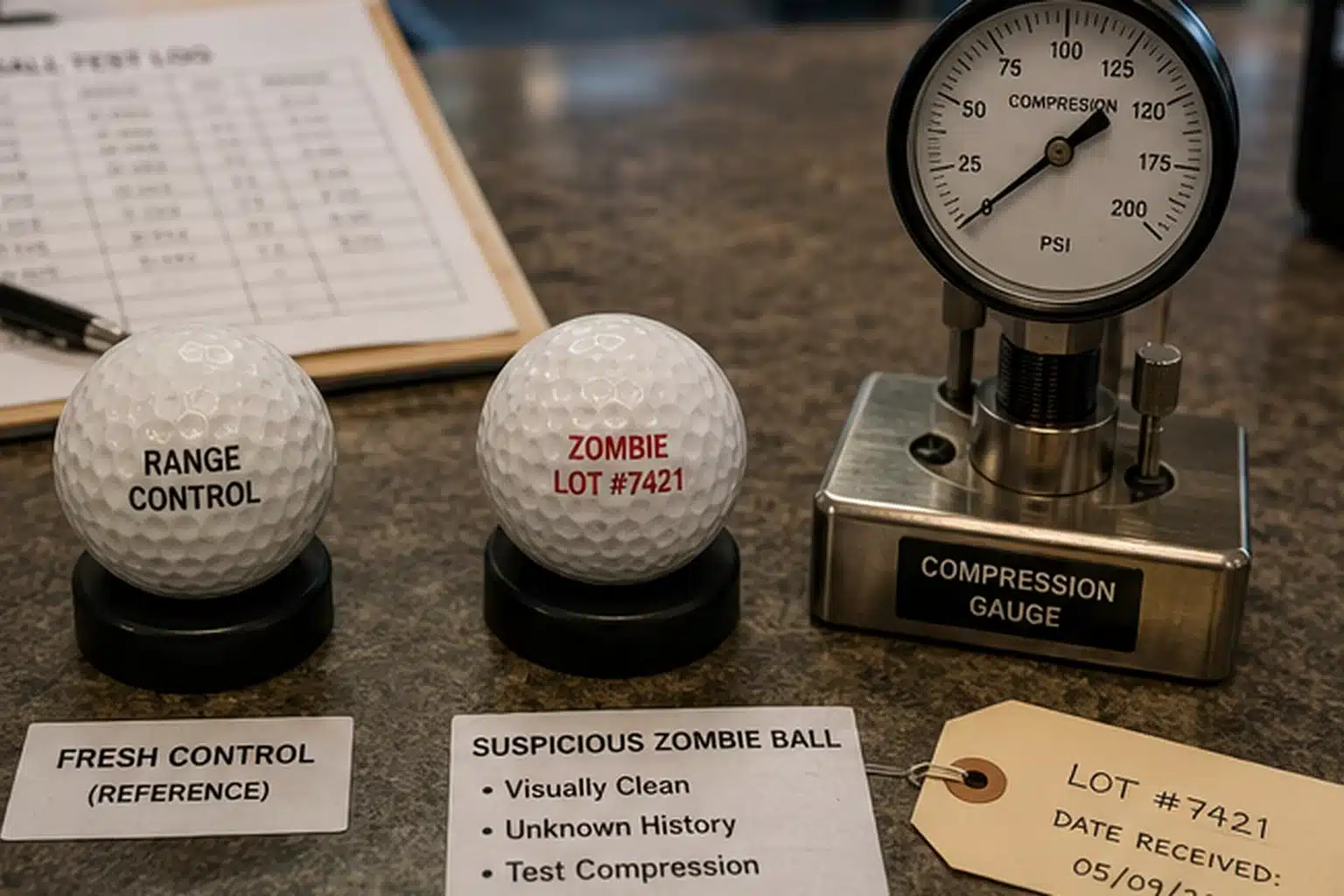
A Zombie Ball is a range ball that looks acceptable but no longer behaves like a reliable practice ball. Your staff should not send suspicious balls straight back to circulation; move them to a test bin for compression checks, flight comparison, or control-lot review.
Clean Outside, Dead Inside?
A “Zombie Ball” is not an official certification term. It is a useful staff concept for a ball that passes a quick glance but fails your functional standard. It may have subtle cover wear, dirt-loaded dimples, faded marks, compression drift, or a history of mixed-batch use.
Do not assume every clean old ball is dead. Do not assume every ugly ball is unusable either. The decision should depend on your facility standard. If a ball looks clean but repeatedly causes dead feel, abnormal flight, customer complaints, or launch-monitor concerns, send it to test instead of daily circulation.
For tech-enabled bays, range-ball condition guidance notes that construction, surface wear, dirt buildup, age, and condition can affect measured distance, spin data, carry, and shot-to-shot variation. That makes suspicious clean balls worth testing before they return to premium areas.
Build a test-bin process for visually acceptable but suspicious balls. Compare them against a fresh control lot using compression checks, same-bay data comparison, or staff flight review. The goal is not to prove every old range ball fails. The goal is to stop questionable balls from quietly rejoining the bucket.
Which Balls Belong in the Reject Bin?
Your team may know cracked balls are bad, but daily sorting gets messy when damage is less obvious.
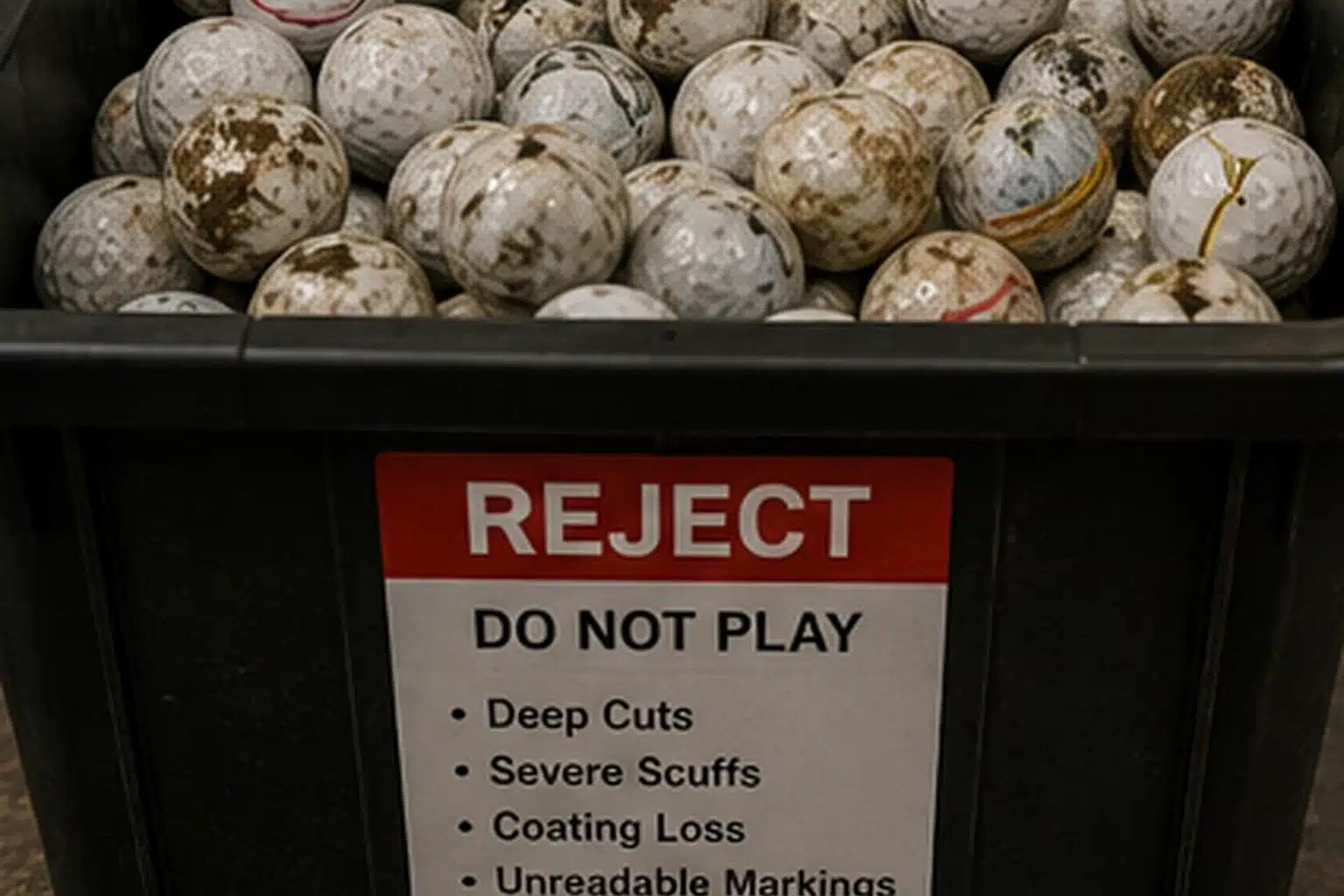
Your reject bin should catch more than cracked balls. Staff should remove balls with deep cuts, severe scuffs, coating loss, unreadable markings, dirt that will not clean, abnormal flight, dead feel, or repeated data complaints, then route borderline balls to test or downgrade bins.
Visual Failure or Functional Failure?
A cracked ball should leave circulation. That part is easy. The harder calls are dull coating, paint loss, unreadable stripe, shallow cuts, washer staining, scuffed dimples, or balls that feel wrong even when they still look playable.
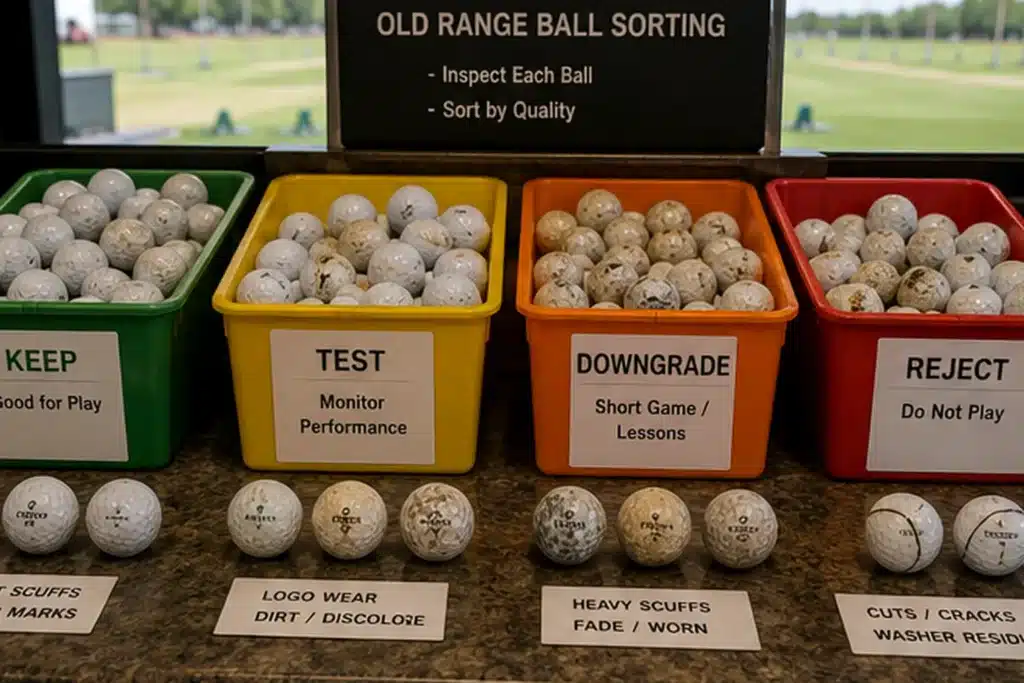
Use a four-bin workflow: keep, test, downgrade, reject. “Keep” goes back to daily circulation. “Test” means the ball looks acceptable but has suspicious behavior or history. “Downgrade” means the ball is safe but no longer meets your guest-facing or data-sensitive standard. “Reject” means it should leave active inventory.
| Sorting category | Ball condition | Risk | Staff action |
|---|---|---|---|
| Keep | Clean and consistent | Low | Return to circulation |
| Test | Looks clean but suspect | Hidden decay | Compare with control lot |
| Downgrade | Cosmetic wear only | Guest-facing decline | Use in lower-priority area |
| Reject | Cracked, cut, severe scuff | Flight or safety issue | Remove from inventory |
| Hold batch | Washer residue or bulk complaint | Systemic defect | Quarantine and review |
Staff returning borderline balls without a test bin is an early warning that your SOP is too vague. Your process should state that borderline balls move to test instead of returning directly to daily-use buckets.
Create a photo-based reject-bin guide with defect examples and routing rules. Audit reject-bin decisions weekly until staff sorting becomes consistent. The best checklist is simple enough for a busy range shift, not a lab manual nobody reads.
✔ True — Staff need a four-bin workflow
Keep, test, downgrade, and reject bins make old-ball decisions faster and more consistent. Borderline balls should not depend on staff mood or guesswork.
✘ False — “Cracked balls are the only balls worth rejecting”
Severe scuffs, unreadable marks, coating loss, abnormal flight, dead feel, and repeat complaints can all justify removal, testing, or downgrade.
Do Washers and Pickers Accelerate Wear?
Your balls may look worse after cleaning, not better, if washer friction, brushes, chemicals, or pickup systems expose coating weakness.
Washers and pickers can reveal or accelerate old-ball failure. Your range should log post-wash coating dullness, logo loss, dirt that will not clean, filter residue, cracks, and reject count so cleaning equipment becomes part of the replacement evidence.
What Should the Washer Log Show?
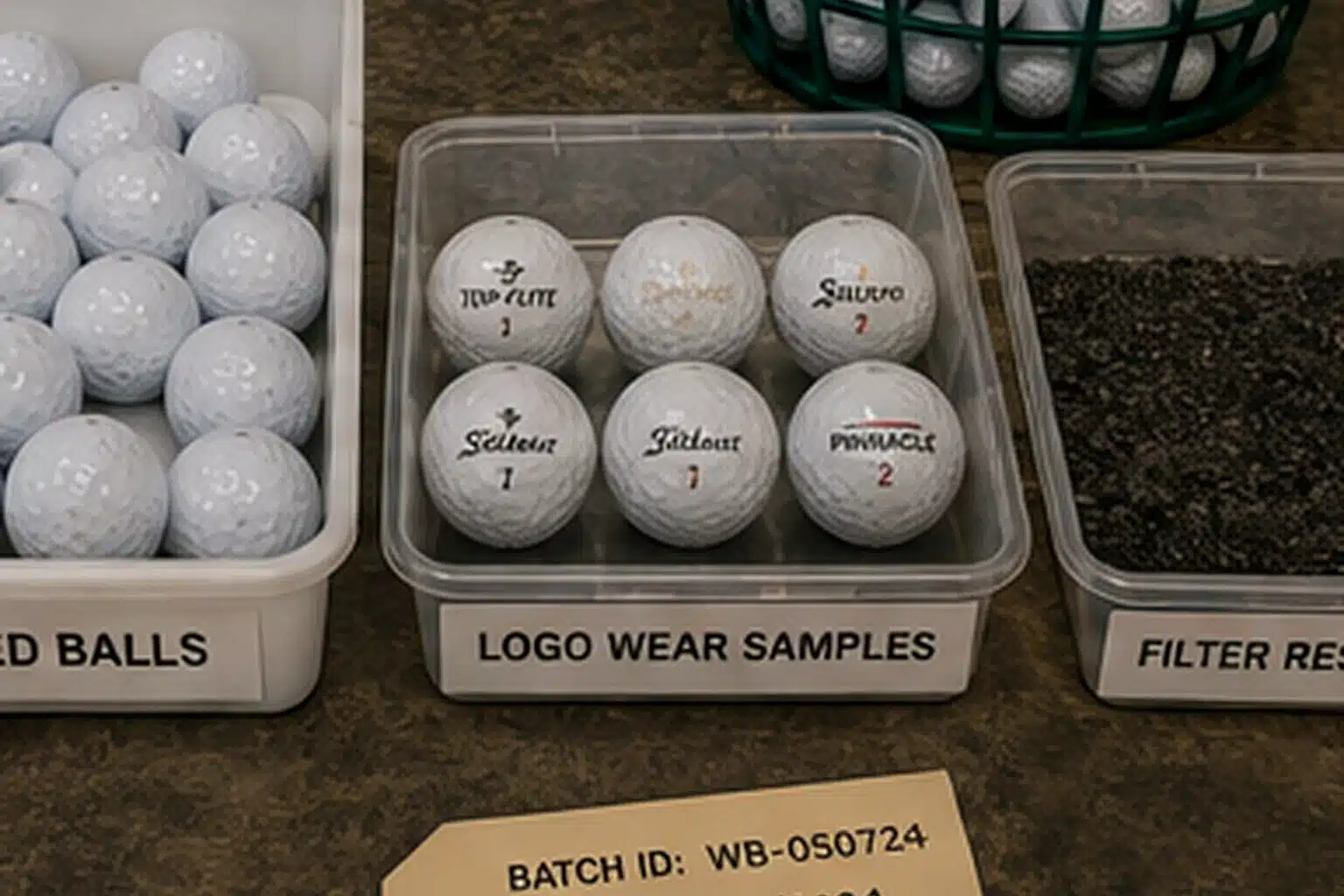
A washer is not only a cleaning machine. It is also a repeated stress point. Brushes, water quality, chemicals, filter residue, grit, and high-volume cycling can reveal coating weakness, logo loss, dull finish, seam issues, and dirt that no longer releases from the surface.
Pickers and collection systems add another layer. Repeated impact, bucket dumping, mat contact, cart handling, and storage abrasion can all push borderline balls toward failure. That does not mean washer damage is always the supplier’s fault. It means your range should record what happens after cleaning.
When washers create dull coating or logo loss and nobody logs the defect pattern, your range loses the evidence needed to fix the root cause. Your maintenance log should require post-wash inspection for coating dullness, logo visibility, filter residue, crack count, severe scuff count, and post-wash rejects. A batch should be held for review when post-wash defects rise above your facility-defined trigger.
The deliverable is a washer-cycle log with coating, logo, filter, crack, scuff, and reject-count fields. Treat washer logs as replacement evidence, not only maintenance records. If one batch suddenly sheds coating dust or loses its ID mark faster than the rest, your future supplier conversation becomes much more specific.
Your facility may be treating all range areas the same, even though not every bay needs the same ball standard.
Not every range area should share the same old balls. Your tech bays, lesson bays, fitting areas, general range, short-range zones, and downgraded-use areas can use different standards, but each ball group needs clear labels, staff rules, and circulation control.
Tech Bays, Lesson Bays, or General Range?
Launch-monitor bays, premium lesson areas, and fitting studios need the tightest ball standard because guests are paying for feedback. A public outdoor range may tolerate more cosmetic wear if flight, safety, and appearance remain acceptable. A short-range or limited-flight area may use downgraded balls that should never drift back into premium buckets.
| Range area | Ball standard | Old-ball risk | Action |
|---|---|---|---|
| Launch-monitor bays | Highest consistency | Data complaints | Use control or fresh lots |
| Lesson / fitting bays | Stable feedback | Bad coaching data | Separate better balls |
| General range | Safe and acceptable | Guest appearance issue | Use normal daily fleet |
| Short-range area | Lower flight demand | Overuse of good stock | Downgrade suitable balls |
| Reject inventory | No circulation | Bad balls return | Remove or dispose |
Ball speed matters to customer perception, especially in driver practice. Ball-speed guidance notes that, in a driver context, 1 mph of ball speed can increase driver distance by up to about 2 yards. Do not apply that as a universal formula to every club, but use it as a reminder that small input changes can become noticeable in data-sensitive areas.
Create a ball circulation map by range area with keep, downgrade, and reject rules. Physically mark, bin, or label downgraded balls so they do not drift back into tech bays. Check premium and downgraded inventory regularly; a downgrade area only works if the boundaries are real.
✔ True — Range areas can use different standards
Tech bays and fitting areas usually need cleaner, more consistent balls than lower-priority practice zones. Segregation helps protect budget and guest trust.
✘ False — “Downgraded balls can drift freely back into every bucket”
A downgraded ball program only works if staff, bins, labels, and circulation rules keep those balls out of premium areas.
What Should Your Replacement RFQ Require?
Your next replacement order can improve the system or restart the same problem. A low-price RFQ may ignore the evidence your future retirement policy needs.
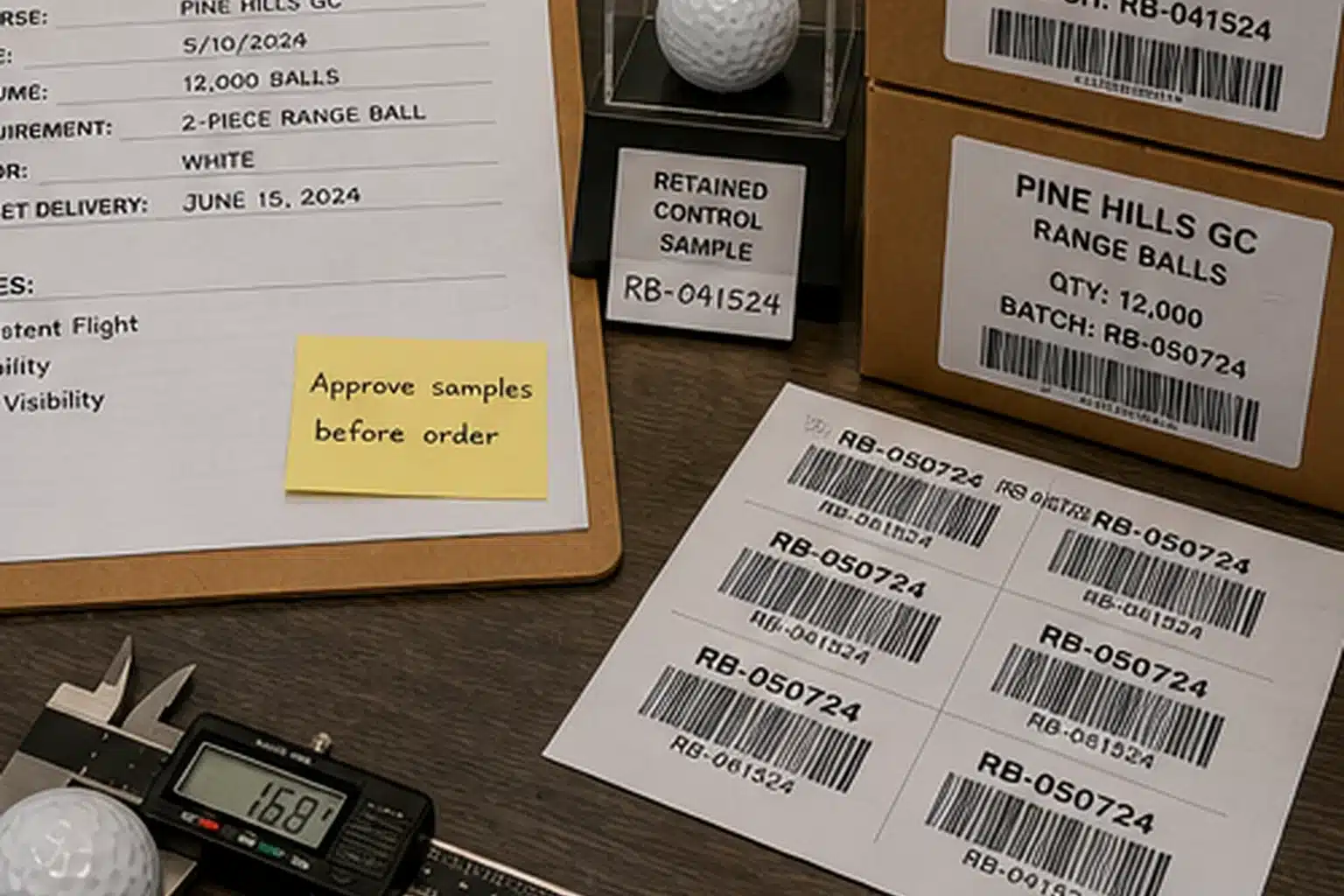
Your replacement RFQ should ask for evidence that supports future retirement decisions. Request compression target, batch spread, 12-ball QC data, washer-cycle proof, batch ID, retained sample, carton labels, readable batch marks, and replacement guidance—not only the lowest unit price.
Compression Target or Batch Spread?
A compression target is helpful, but batch spread tells you whether the shipment is consistent. If the new batch arrives with wide variation, your replacement program starts noisy. Ask for raw data, not only a polished average.
| RFQ item | Why it matters | What to request | Acceptance evidence |
|---|---|---|---|
| Compression target | Functional baseline | Target range | Supplier spec |
| Batch spread | Consistency control | Mean, SD, range | 12-ball QC report |
| Weight / diameter | Lot uniformity | Raw values | QC sheet |
| Washer-cycle proof | Cleaning durability | Wash test note | Before/after evidence |
| Batch ID | Retirement tracking | Carton and ball mark | Batch record |
| Retained sample | Dispute control | Reference sample | Sample match |
| Replacement guidance | Policy support | Suggested review logic | Facility checklist input |
Use this RFQ wording:
“Please quote commercial range balls for a driving range replacement program. Include compression target, acceptable batch compression spread, 12-ball raw QC data for compression, weight, and diameter, washer-cycle durability evidence, readable batch mark or stripe options, batch ID tracking, retained samples, carton labels, and replacement-cycle guidance. Do not quote only by lowest unit price.”
A supplier that quotes replacement balls without batch spread is not giving your team enough control. Supplier shall link compression target, 12-ball QC raw values, washer-cycle durability evidence, batch ID, carton label, retained sample, readable batch mark, and shipment lot under one proof version before dispatch.
Buyer acceptance requires batch ID match, retained sample match, QC report match, readable batch mark, no severe cover, dimple, dimensional, or visual defects in inspected samples, and documentation suitable for future replacement tracking.
Range-ball durability guidance frames performance and durability as important considerations for practice-range purchasing because useful life affects season-level operating cost. That does not mean you keep balls forever. It means your RFQ should support a better retirement policy from the first replacement shipment.
FAQ
How Often Do Driving Ranges Replace Golf Balls?
Driving ranges should not follow one universal replacement interval; they should replace balls when facility-defined visual, functional, washer, batch, inventory, or data triggers fail. Calendar age can support budgeting, but it should not be the only rule.
Your replacement cycle depends on traffic, washer cycles, surface wear, weather, range area, customer expectations, active inventory, and reject-bin results. Review monthly reject count, staff sorting results, washer logs, customer complaints, batch age, and any tech-bay data checks. A public outdoor range and a premium launch-monitor bay may need different replacement triggers.
How Long Do Range Balls Last?
Range ball life depends on hit volume, surface wear, washing, picking, storage, weather exposure, and the standard your facility promises to customers. A fixed lifespan can mislead your staff and distort your replacement budget.
Track monthly rejected balls, active inventory, washer-related wear, visible defects, batch age, and complaint frequency. Keep daily-use stock separate from test, downgrade, and reject stock. Your own replacement log will usually be more useful than a generic claim about how long range balls should last.
Do Old Range Balls Lose Distance?
Old range balls can lose distance or become less consistent, but the amount is not universal. Your facility should compare suspicious balls with a fresh control lot before making any distance-loss claim.
Distance and consistency can change because of compression drift, surface wear, dirt buildup, dimple damage, mixed batches, or intentional range-ball construction. Watch ball-speed spread, carry dispersion, and repeated player complaints. Use facility-defined thresholds instead of promising that old balls always lose a fixed number of yards.
What Do Driving Ranges Do With Old Balls?
Driving ranges can reject, downgrade, test, sell through approved channels, recycle, discard, or move old balls to lower-priority use depending on condition. The wrong move is sending every old ball back into normal circulation.
Use keep, test, downgrade, and reject bins. Clean and consistent balls can return to daily buckets. Borderline balls should go to test. Cosmetic-only wear may fit a downgrade area. Cracked, cut, severely scuffed, or functionally unreliable balls should leave active inventory.
Can Ball Washers Damage Range Balls?
Ball washers can reveal or accelerate coating, logo, surface, seam, and dirt-related problems, especially when balls already sit near the edge of your facility standard. Washer logs should be part of replacement decisions.
Check coating dullness, logo visibility, filter residue, dirt that does not clean, crack count, severe scuffs, and post-wash rejects. If one batch shows sudden dullness, coating dust, or unreadable marks after washing, hold the batch for review before returning it to circulation.
Should Staff Sort Range Balls by Condition?
Yes. Staff should sort range balls by condition using simple visual standards and clear bin rules, so borderline balls do not return to circulation by habit or inconsistent judgment across shifts.
Use photo examples for cracks, cuts, severe scuffs, coating loss, faded marks, stubborn dirt, and test-bin candidates. Train keep, test, downgrade, and reject decisions. Audit sorting until staff decisions become consistent. A simple four-bin workflow usually beats vague instructions like “throw away the bad ones.”
Should Tech Bays Use the Same Balls as Public Bays?
Not always. Launch-monitor bays, coaching areas, and fitting bays usually need tighter ball consistency than general public range areas because customers rely more heavily on distance, spin, and feedback quality.
Keep control lots or better-condition balls separate for premium areas. Use downgraded balls only in approved lower-priority zones. Prevent older or downgraded stock from drifting back into premium bays through labels, bins, staff rules, or a clear circulation map.
What Is a Range Ball Retirement Policy?
A range ball retirement policy is a written SOP for deciding when a ball stays in circulation, moves to test, gets downgraded, or leaves inventory entirely based on facility-defined standards.
It should include visual grades, washer logs, batch age, compression checks when needed, complaint triggers, reject-bin rules, circulation rules by range area, and replacement RFQ requirements. The policy turns old-ball decisions from staff guesswork into a repeatable operating system.
Conclusion
Old range ball replacement is an operating SOP, not a calendar guess. Your range should not wait for every ball to crack before removing weak balls from circulation.
The best ranges use visual grades, test bins, washer logs, area-specific circulation rules, batch IDs, retained samples, and supplier proof to keep old balls from hurting guest experience, staff workflow, and replacement planning.
Range balls should leave circulation when they fail the facility standard—not only when they physically break.
You might also like — Cheap Commercial Range Balls: What Is the Real Cost Per Usable Hit?