Driving range ball cost is best compared as normalized cost per usable hit: same-scope attributed cost divided by same-scope usable hits recorded or estimated under the same rejection rule. Supplier cost-per-hit claims are not comparable unless the SKU, failure endpoint, observation method, period, and cost scope are normalized.
A low quote can therefore look cheaper simply because the supplier counts more hits in the denominator. If its hit-life claim ends at physical cracking but your facility removes balls earlier, that claimed cost per hit does not represent your real operating cost.
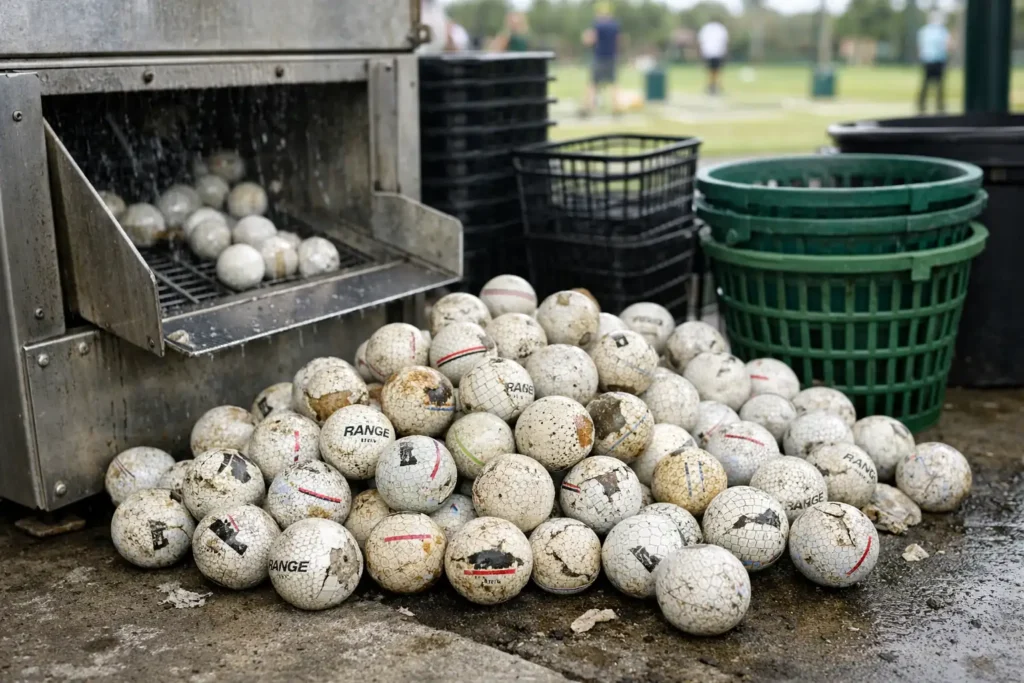
Commercial range balls repeatedly move through a facility loop: hit → pick → wash → sort → dispense → hit again → reject, lose, or replenish. Purchase price is only one part of that operating cycle.
This guide uses one buying framework: Define → Measure → Normalize. Define what your facility calls usable, measure candidate and control lots under the same operating logic, then compare verified cost per usable hit before ranking suppliers.
What Does Driving Range Ball Cost Really Include?
Your cheaper quote may genuinely lower your budget. It may also create more sorting, cleaning, reject handling, and emergency replenishment after the balls enter circulation.
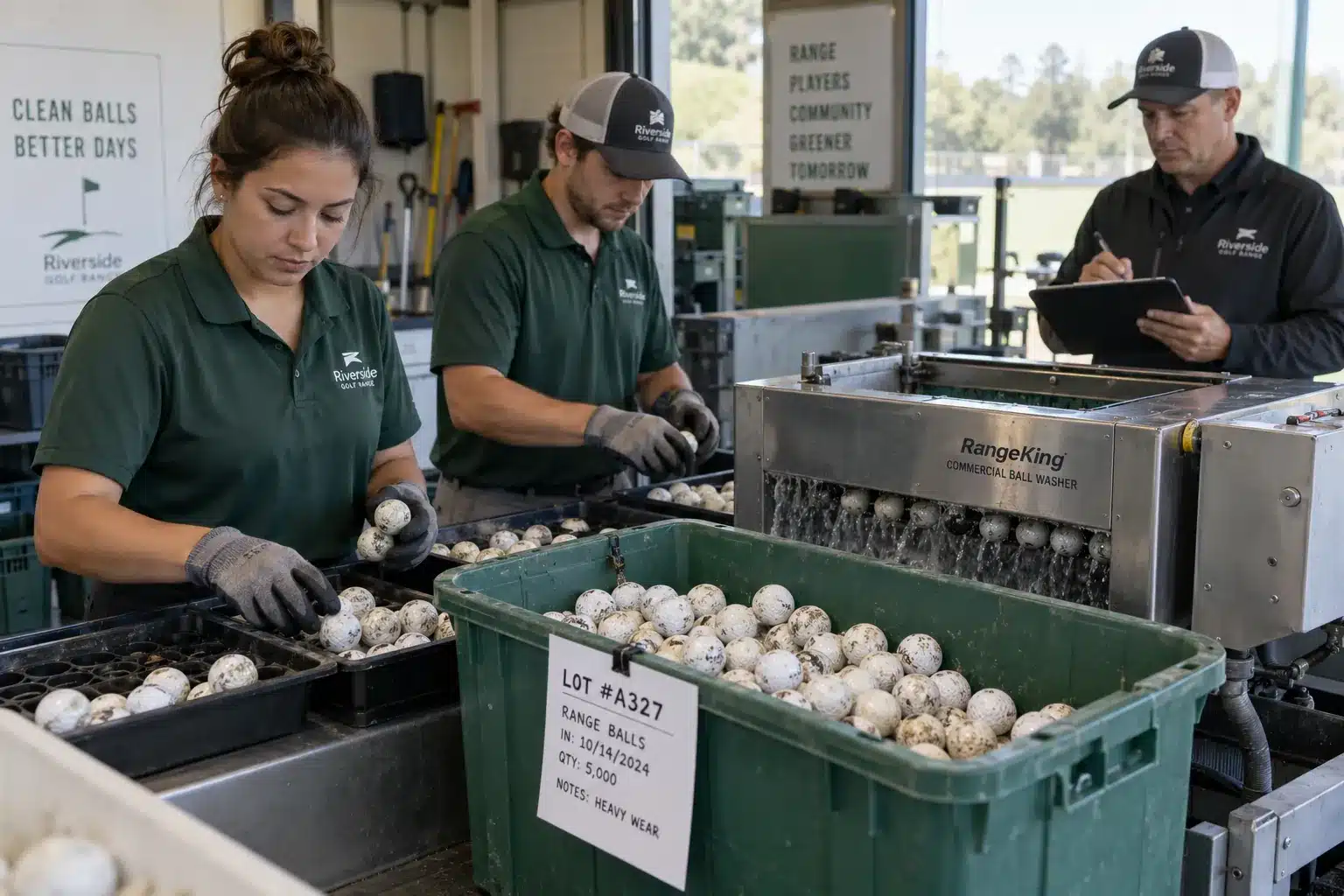
Driving range ball cost is more than purchase price, but every operating problem should not be added as a separate dollar cost. Build the numerator from costs attributable to the same lot or period, then track rejects, losses, washer incidents, and complaints as drivers unless your facility has a defined way to monetize them.
A professional TCO model starts with a simple discipline: do not count the same economic loss twice.
For example, suppose worn balls are removed from circulation and your next replenishment purchase replaces them. If that replacement spend is already inside the observation period, adding the replacement invoice and then adding every rejected ball again at unit value may duplicate part of the same cost.
The same problem appears with lost inventory. Unrecovered balls can drive replenishment spend, but that does not automatically mean you should add both the replacement invoice and a second full “lost ball cost” without checking whether the values overlap.
General procurement guidance on total cost of ownership supports the broader principle: purchase price is only one component of total economic exposure. Procurement, acquisition, usage, scrap, rework, and end-of-life costs can all matter.
For range-ball economics, we apply that principle through a facility-specific KPI:
Verified Cost Per Usable Hit = Total Cost Attributed to the Same Lot or Period ÷ Total Usable Hits Recorded or Estimated for That Same Lot or Period
The important words are same lot or period.
You should not divide facility-wide annual operating cost by one supplier’s laboratory hit-life claim. The numerator and denominator need the same scope.
What Belongs in the Numerator?
Separate Money Cost from Driver KPI first.
| Pain / decision | Record | TCO treatment | Double-count risk | Buyer action |
|---|---|---|---|---|
| Delivered purchase / replenishment | PO / invoice | Include once | Low | Tie to lot / period |
| Sorting minutes | Staff log | Convert with local labor rate | Medium | Record actual minutes |
| Washer downtime | Maintenance log | Monetize only if locally defined | Medium | Log time and cause |
| Wear-out rejects | Reject log | Driver unless separately costed | High | Use reason code |
| Lost / unrecovered | Loss log | Driver / replenishment input | High | Separate from wear |
| Complaints | Service record | KPI unless monetized | High | Do not invent cost |
A hard-cost numerator may include delivered purchase or replenishment spend, sorting labor, measurable washer cleaning or downtime, emergency replenishment premiums, and other locally defined operating expenses attributable to that population.
Driver KPIs explain why those costs moved. Useful examples include:
-
wear-out reject rate;
-
unrecovered loss;
-
sorting minutes;
-
washer incidents;
-
facility-mark or logo failures;
-
complaint count;
-
unexplained inventory shrinkage;
-
replacement cadence.
These records are operationally valuable even when they remain outside the dollar numerator.
A complaint is a good example. If your facility has a documented service-recovery cost, you can include that defined expense. If you do not, keep complaint count visible as a KPI rather than inventing a “brand image cost” to make the spreadsheet appear more complete.
You should not add the same loss twice.
Construction can influence this model without replacing it. A 2-piece ionomer or Surlyn range ball is often a strong starting point for high-volume, cost-sensitive range operations because durability and replacement pressure matter. But the construction label cannot prove the lowest normalized TCO at your facility. Keep the deeper material decision in the Surlyn vs urethane golf balls guide.
Before supplier ranking begins, create a Range Ball Cost-Scope Sheet.
Write down:
-
the SKU / lot or observation population;
-
the observation period;
-
which costs enter the numerator;
-
which records remain driver KPIs;
-
how labor is monetized;
-
how downtime is monetized;
-
whether replenishment spend already captures attrition.
A range-ball TCO model becomes useful only when finance can follow where each cost came from.
✔ True — Operating costs can belong in range-ball TCO when they are attributed consistently
Sorting labor, washer interruptions, emergency replenishment and other measurable operating costs can change which lot is economically better.
✘ False — “Every reject, lost ball, complaint and replacement event should automatically become another dollar line”
Some records are causes of spend rather than new independent costs. Keep cost and driver KPIs separate so your model does not charge the same problem twice.
When Is Cost Per Usable Hit Comparable?
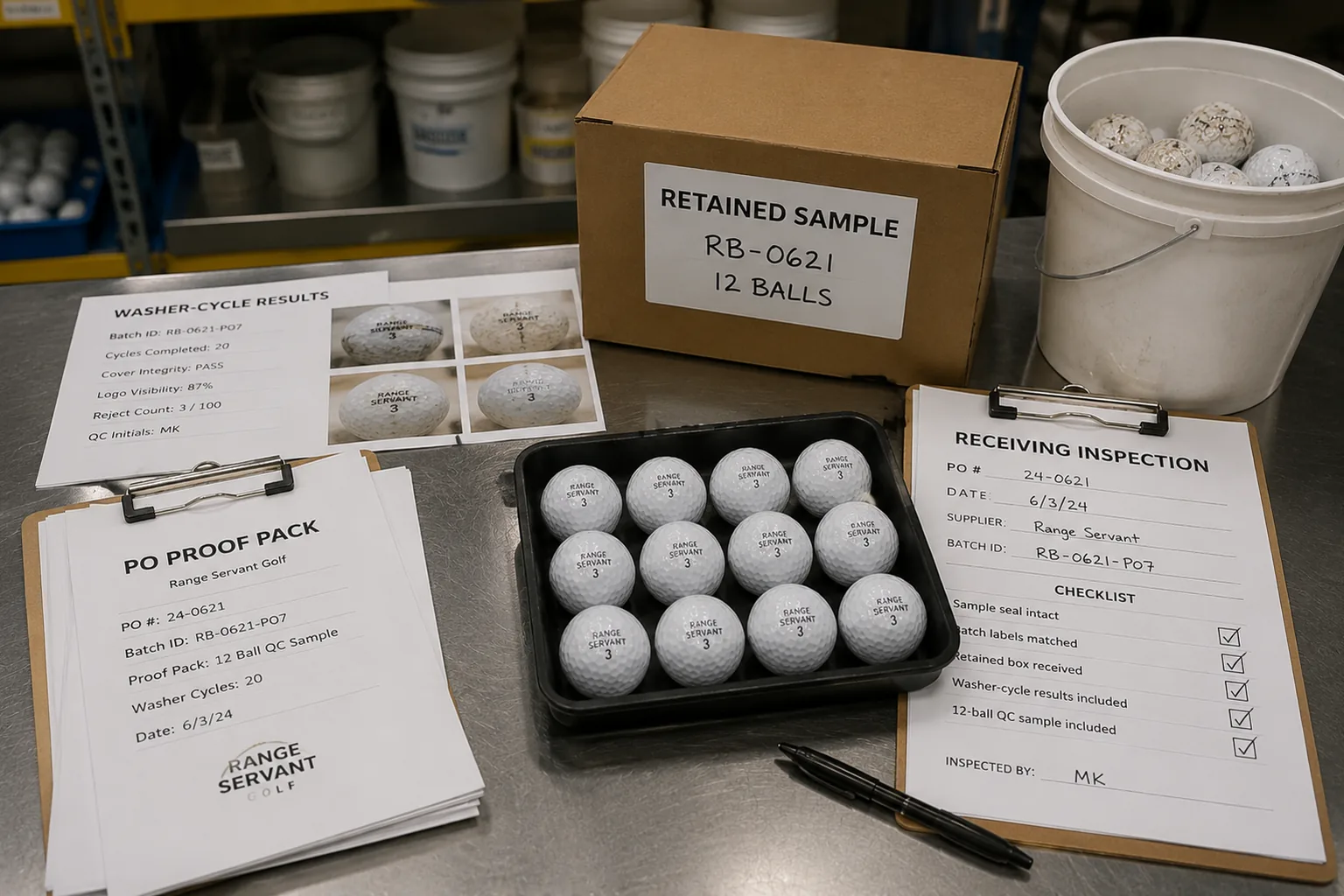
Supplier A quotes $X per hit. Supplier B quotes $Y per hit. The lower number looks decisive—until you discover that each supplier used a different definition of life.
Cost per usable hit is comparable only when both suppliers use the same denominator logic. Normalize the SKU, usable definition, failure endpoint, observation period, test or operating method, loss treatment, and cost scope before deciding that the lower cost-per-hit claim is actually cheaper.
This is the Same-Denominator Rule.
A cost-per-hit claim contains two numbers:
cost ÷ hits
Most sourcing discussions challenge the cost and accept the hits.
That is backwards.
The hit count may be the less comparable number.
Supplier A might count impacts until the cover physically cracks. Supplier B might stop when a facility-style rejection rule is reached. Supplier A might report a laboratory repeated-impact average. Supplier B might use a field observation. One may exclude lost balls because laboratory samples never disappear. Another may include attrition in an operating model.
Both suppliers can produce mathematically correct cost-per-hit figures while measuring different economic realities.
Imagine:
Supplier A = $X / hit
Supplier B = $Y / hit
If Supplier A’s denominator means “impacts until crack” and Supplier B’s denominator means “hits before removal under a facility rejection standard,” the lower number cannot be ranked until those endpoints are normalized.
The same is true for observation period. A shorter facility pilot and a longer facility pilot experience different exposure. A laboratory impact test and a live range fleet experience fundamentally different stress systems.
What Must Be Normalized?
| Normalization item | Supplier A | Supplier B | Why it changes TCO | Buyer action |
|---|---|---|---|---|
| Exact SKU | Defined / undefined | Defined / undefined | Product may differ | Lock SKU |
| Usable definition | Endpoint A | Endpoint B | Changes hit denominator | Normalize |
| Observation period | Period A | Period B | Changes exposure | Align scope |
| Test / operating method | Method A | Method B | Changes stress | Record method |
| Loss treatment | Included / excluded | Included / excluded | Changes economics | Align treatment |
| Cost scope | Purchase / operating | Purchase / operating | Changes numerator | Normalize |
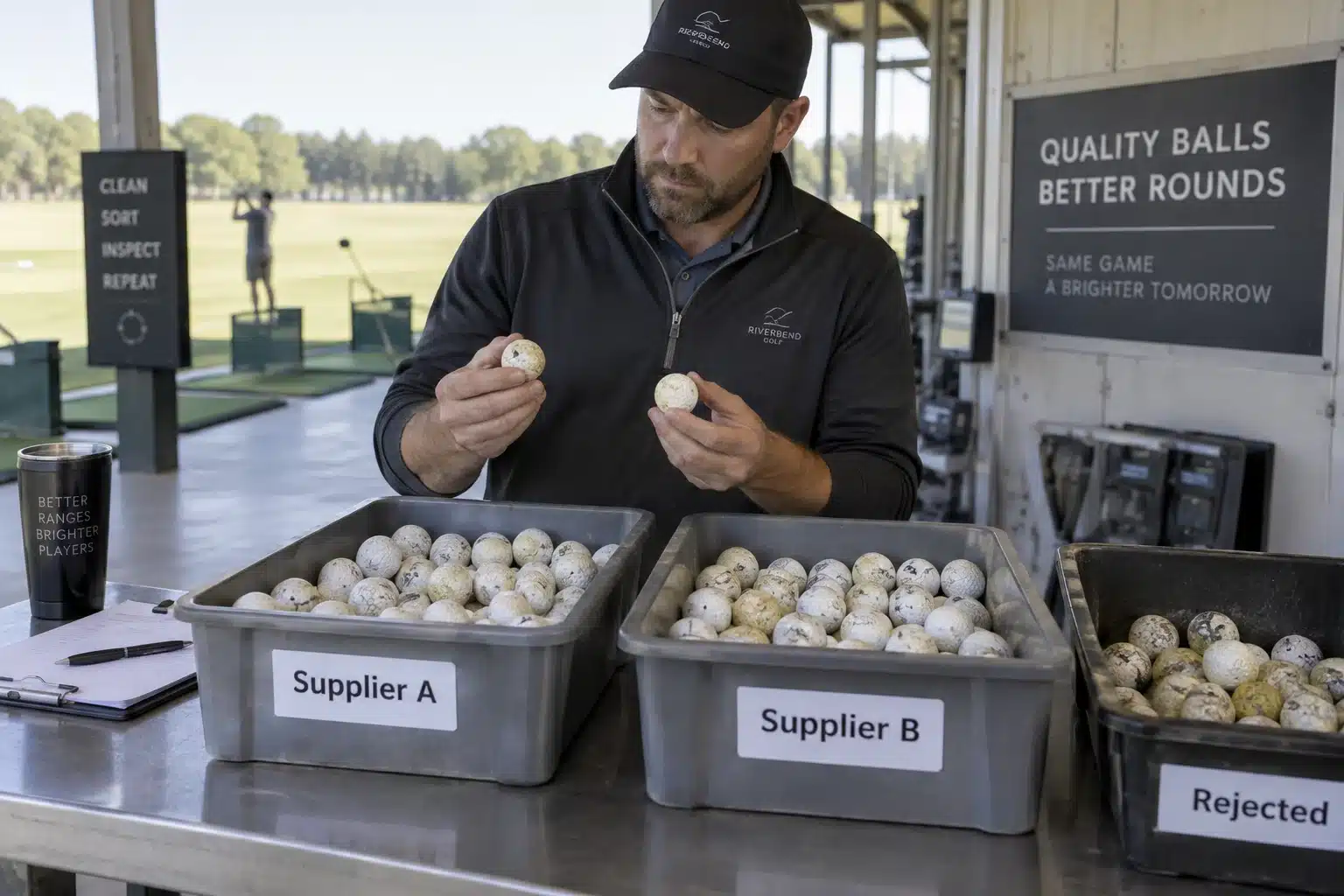
Professional durability testing itself shows why this discipline matters. Two technically valid repeated-impact tests can use different sample sizes, conditions, failure endpoints, and reporting statistics.
That means even a familiar test-machine name does not automatically create the same denominator.
A quoted hit-life figure can be reported as:
-
average impacts until crack;
-
minimum life;
-
median life;
-
relative durability index;
-
pass/fail at a defined checkpoint;
-
percentage of samples surviving a target condition.
Those are not interchangeable.
The same applies to the cost side. Supplier A may divide purchase price by laboratory impacts. Supplier B may include a delivered price and an operating estimate. Again, both can call the result “cost per hit.”
Your RFQ or quote-comparison sheet should therefore contain a field called:
Denominator Definition
At minimum, it should capture:
-
usable / failure endpoint;
-
test or operating method;
-
observation period;
-
cost scope.
For a facility-side calculation, add loss treatment and rejection rule.
If those fields are empty, do not use the supplier’s cost-per-hit figure to rank the quote.
Cost per hit with an undefined denominator is a failure signal.
This is where the current market conversation often goes wrong. A very long claimed lifespan naturally makes a cost-per-hit calculation look excellent. But a longer denominator is not automatically better evidence. It may simply represent a later failure endpoint.
Your procurement preference should be:
Prefer the most auditable denominator, not the longest claimed life.
The number you can reproduce under the same method is more valuable than the number that looks best in a sales table.
How Do You Define “Usable” for TCO?
The most important word in “cost per usable hit” is not cost. It is usable.
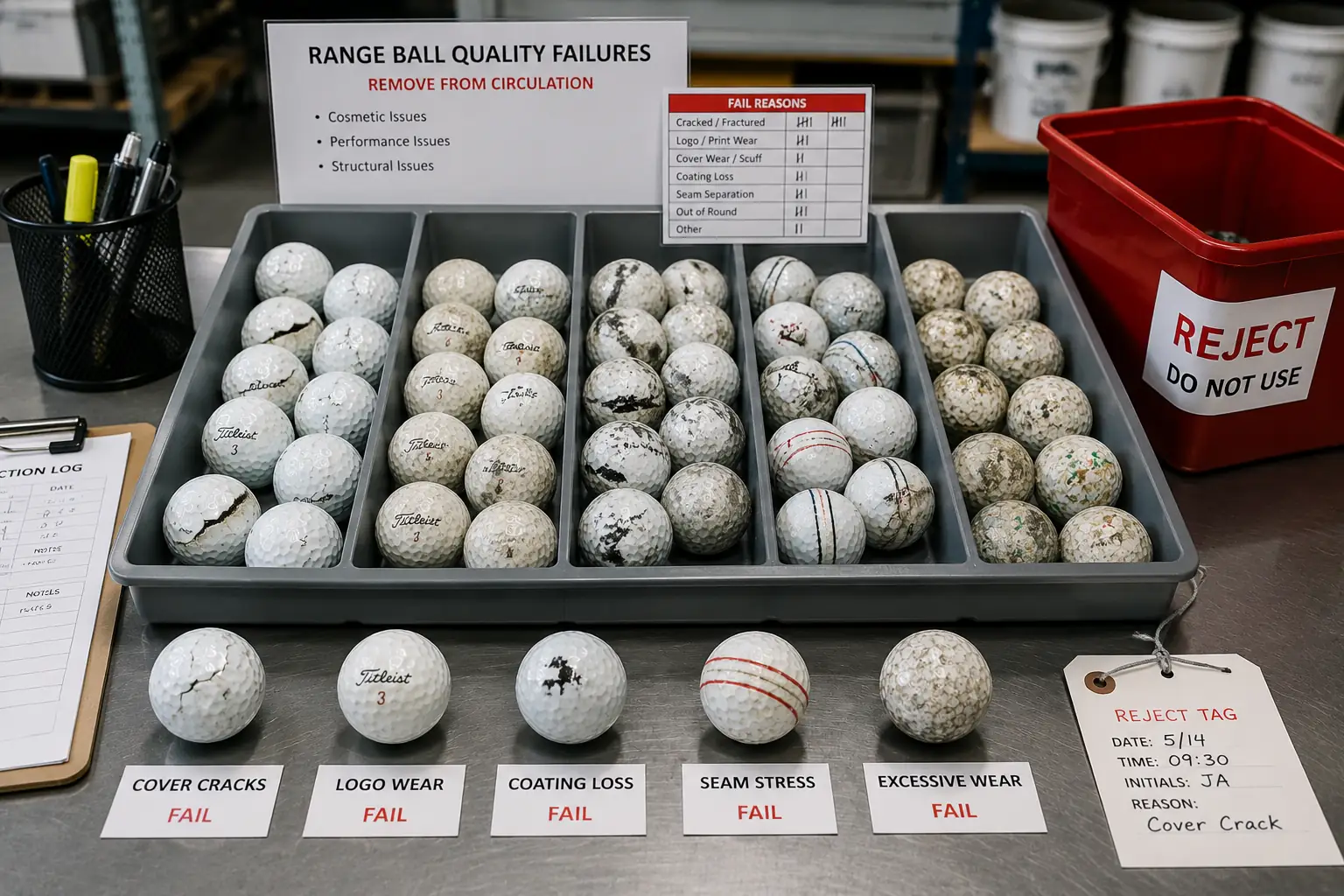
“Usable” is a facility-defined acceptance state, not simply “the ball can still be hit.” Your TCO denominator needs a written rejection endpoint before hit life can become a procurement metric; otherwise a supplier can appear cheaper simply by counting balls longer than your operation would keep them.
Your facility defines usable.
A range ball may remain physically intact and still fail your operating standard.
A structural endpoint might remove a ball after a crack, split, cut, or other physical failure.
A visual or presentation endpoint might remove a ball when the surface condition is no longer suitable for a member-facing or premium range.
An identification endpoint may apply when a range stripe, facility mark, or logo becomes too difficult to recognize through normal hit-wash-sort circulation.
A functional or program-specific endpoint may matter when a population is no longer acceptable for a particular training environment.
The point is not to create one universal rejection threshold for every driving range.
It is to stop the supplier from silently defining the denominator for you.
Suppose a laboratory life claim ends only at physical cracking. Your operation, however, removes a ball earlier because the facility mark becomes unreadable or because the ball no longer meets the standard used in your teaching bays.
Those extra laboratory impacts are not usable hits for your facility economics.
Real range-operation evidence supports this distinction. A published range-ball durability study followed balls under actual facility use and evaluated performance and durability over time. The facility described in that study cared about maintaining player-facing performance and quality, not merely whether a ball could still survive another physical strike.
That example should not become your replacement calendar.
It demonstrates something more important:
Physical survival and facility usability can end at different times.
A hit-life claim therefore needs two levels of evidence:
Supplier endpoint: What ended the test?
Facility endpoint: What removes the ball from usable circulation?
A hit that occurs after your approved facility endpoint should not inflate your TCO denominator.
For the detailed Keep / Test / Downgrade / Reject process, use the dedicated range ball retirement policy rather than turning this economics page into a retirement SOP.
Here, your action is narrower.
Before the pilot begins, write one sentence:
What event removes a ball from usable inventory for this TCO comparison?
That event might be structural, visual, identification-related, or program-specific. Your standard may also vary by range area, provided the candidate and control are compared under the same rule.
A hit-life number without a rejection rule is not a comparable TCO metric.
✔ True — Facility usable life can end before physical crack life
A ball may remain physically hittable while failing your condition, identification, presentation or functional standard for normal circulation.
✘ False — “If a ball can still be struck, every later hit belongs in the TCO denominator”
That lets the test endpoint define your economics. Set the facility rejection rule before comparing supplier life claims.
Can You Trust a Supplier Hit-Life Claim?
A quote gives you one hit-life number. Another supplier gives you a higher one. The useful question is not which number is largest.
A supplier hit-life number is procurement evidence only when the method behind it is visible. Ask for the exact SKU, sample size, batch identity, conditioning, impact method, checkpoints, failure endpoint, raw results, and report version—and keep laboratory durability separate from real driving-range service life.
When a supplier gives you a hit-life number, ask:
What produced the denominator?
Professional durability evidence should let you reconstruct the claim.
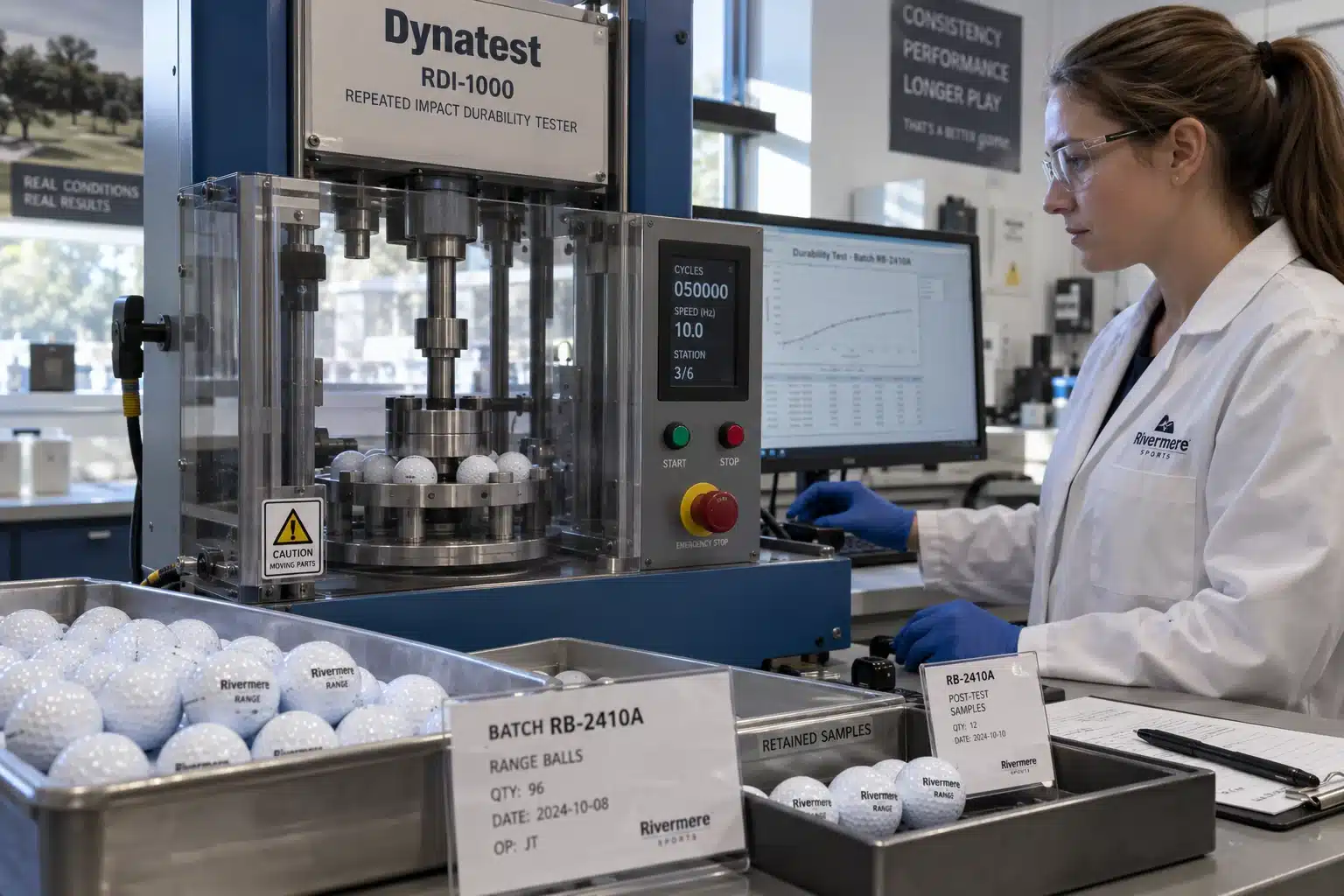
A public repeated-impact golf-ball methodology provides a useful example of disclosure discipline. The method identifies the tester, sets an impact velocity of 43 m/s, uses ten balls, defines cracking as the endpoint, and reports an average-based durability result.
Those numbers are not a range-ball industry standard.
They demonstrate what a methodology-backed claim looks like.
By contrast, “our ball lasts X hits” is not decision-grade evidence unless the sample, condition, endpoint, and reporting method are also disclosed.
| Claim field | What you request | Weak evidence | Auditable evidence | Buyer action |
|---|---|---|---|---|
| SKU | Exact model | “2-piece range ball” | SKU / spec ID | Lock model |
| Sample | Count + IDs | No sample count | Sample list | Check coverage |
| Batch | Lot identity | Loose samples | Production-linked lot | Trace |
| Method | Equipment / condition | “Impact tested” | Defined procedure | Verify |
| Endpoint | Failure definition | “Passed” | Defined failure rule | Normalize |
| Results | Individual + summary | Marketing average | Raw + statistic | Compare |
Lab Test or Real Facility Life?
A laboratory impact test answers:
How did this defined sample behave under this defined test condition?
A facility pilot answers:
How long did this identifiable lot remain usable under our operating system?
These are both valuable questions.
They are not the same question.
At Golfara, we use defined-condition testing as manufacturing and QC evidence. We do not turn a generic impact result from a 2-piece ball into a commercial range-life claim unless the tested SKU, route, batch, and method are confirmed as the same product evidence being quoted.
That boundary is intentional.
Laboratory Impact Test ≠ Real Driving-Range Lifetime.
A laboratory impact rig does not reproduce your full operating environment, including mats or ground contact, collection equipment, washing and detergent, weather exposure, sorting, loss, and facility-specific rejection standards.
A laboratory PASS can establish defined-condition resistance. Your real facility pilot establishes operational usability.
These two evidence layers answer complementary questions when durability is central to the buying decision.
ASTM D2240 measures durometer indentation hardness and can support material or cover-consistency checks when applied appropriately. It does not convert a Shore D reading into whole-ball compression or real-world range-ball life.
Shore D ≠ whole-ball compression, and Shore D ≠ hit life.
Golf-ball rule-conformance testing belongs in a different evidence category. Official R&A Equipment Rules address conformance requirements including weight, size, spherical symmetry, initial velocity, and overall distance.
Those requirements answer rule-conformance questions. They do not define how long a commercial range ball remains usable in your facility.
Rule conformity and facility durability answer different questions.
The same caution applies whenever a quote cites an ASTM, ISO, laboratory, or “industry-standard” test. A standard number is not meaningful evidence until you verify:
-
the standard title;
-
its scope;
-
whether it applies to the claimed property;
-
the tested sample;
-
the batch link;
-
the actual test conditions.
A professional-looking acronym should not make your procurement questions disappear.
A hit-life claim with no failure endpoint is a failure signal.
Request this once in your RFQ:
Provide the durability-claim method and the corresponding evidence file showing the exact SKU, sample size, batch identity, conditioning, test equipment or method, impact condition, checkpoints, failure endpoint, individual results, summary statistic, and report version.
The objective is not to make the supplier promise more hits.
It is to make the number auditable.
How Should You Run a Pilot Against a Control Lot?
You receive a new candidate lot, dump it into the existing fleet, and call that a “real-world test.” Later, the data may be real—but the attribution is gone.
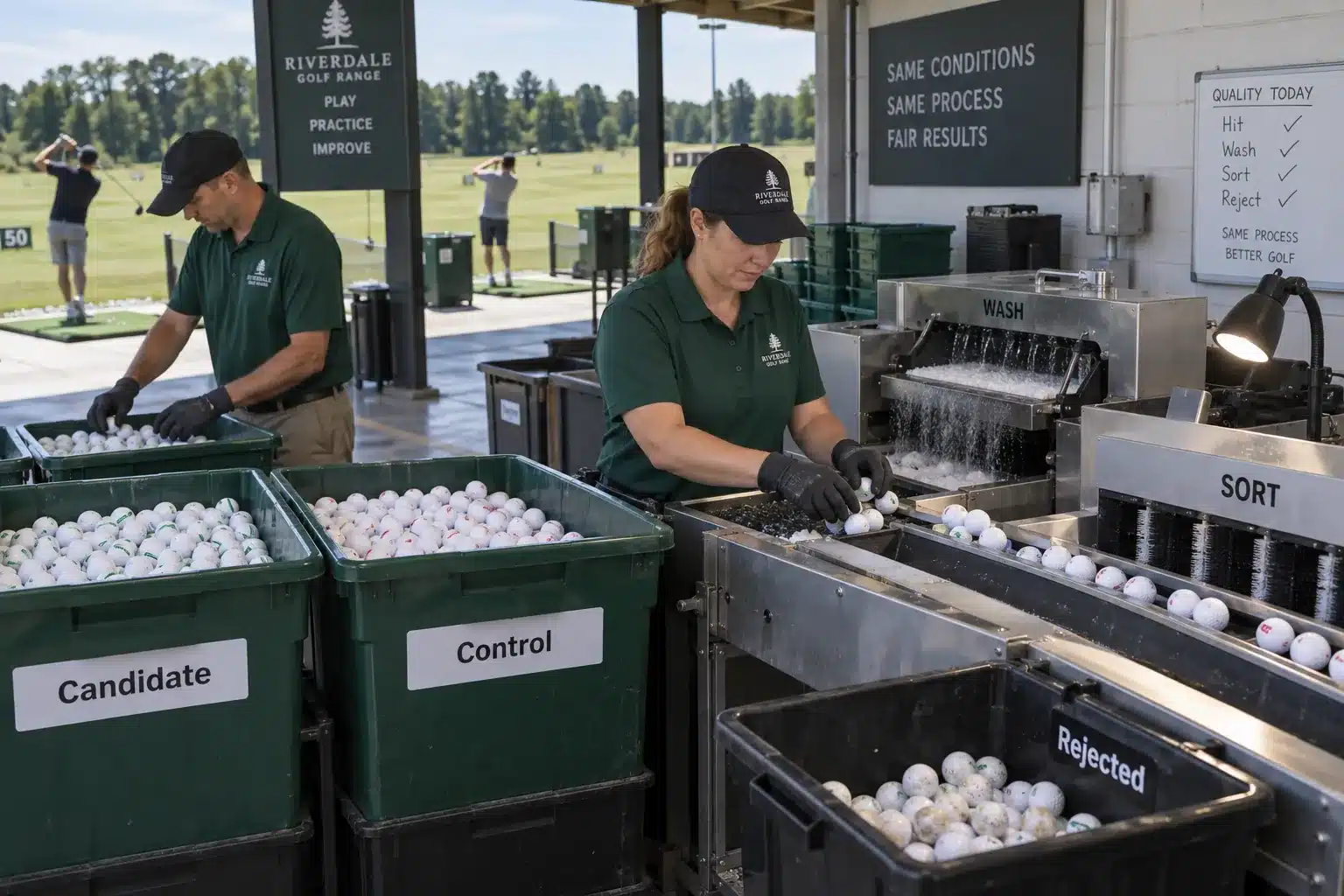
Your pilot should compare an identifiable candidate lot with an identifiable control lot under the same operating rules. Once candidate balls are mixed into the legacy fleet, reject, loss, washer, logo, and labor costs become difficult to attribute, so the pilot loses much of its TCO value.
A costly pilot mistake can happen before meaningful measurement even begins:
Mixed Fleet = Bad Measurement.
If a candidate lot immediately disappears into a much larger legacy fleet, how will you later identify:
-
which population produced the wear rejects;
-
which balls created abnormal washer residue;
-
which marks became unreadable;
-
which population required more sorting;
-
which balls were lost;
-
which lot triggered a complaint?
You may still know that “the range had more rejects this month,” but that is not supplier-level TCO evidence.
The pilot does not need laboratory isolation.
It needs operational attribution.
Use the same observation period for candidate and control where practical. Keep the same facility rejection rule. Use the same hit-count or operating-proxy logic. Keep washer conditions comparable where they affect the result. Record the same removal-reason codes.
Useful fields include:
- recorded or estimated hits;
- wear-out rejects;
- lost / unrecovered balls;
- operational damage;
- washer incidents;
- sorting minutes;
- mark / logo failures;
- failure-reason code.
Why Keep Candidate Lots Identifiable?
If you cannot identify the candidate lot, you cannot reliably attribute its operating cost.
The identification method can fit your operation: lot-specific marking, a stripe or facility code, separate storage, or a defined bay or observation window can all work.
The method can vary; the lot identity cannot disappear.
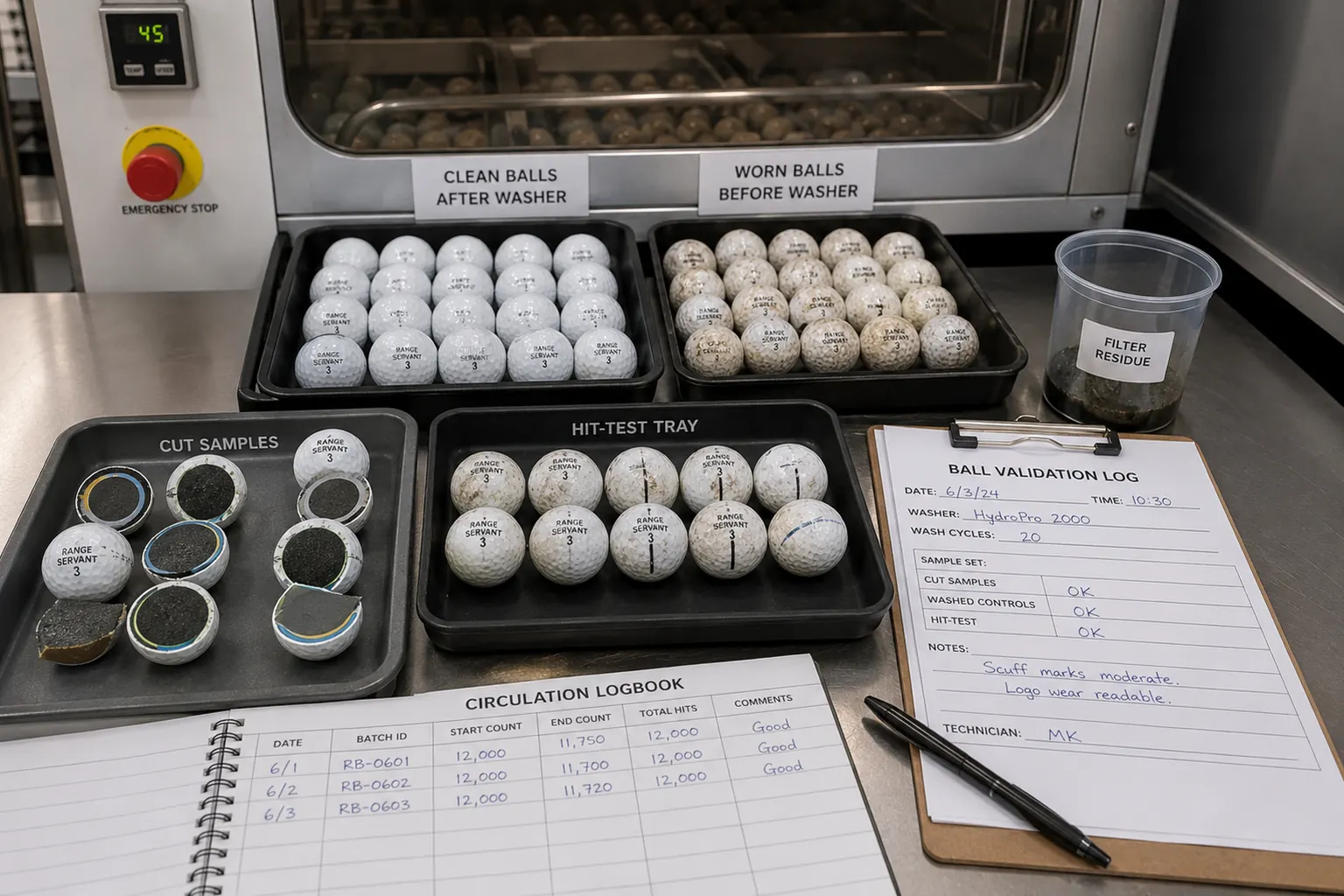
The older Cut / Wash / Hit framework still works as pre-bulk failure screening: cutting can expose obvious structural anomalies, washing can reveal abnormal residue or mark-readability issues, and defined hitting can reveal impact-related failure. These checks can reject a weak candidate early, but they cannot predict an exact real-world hit life.
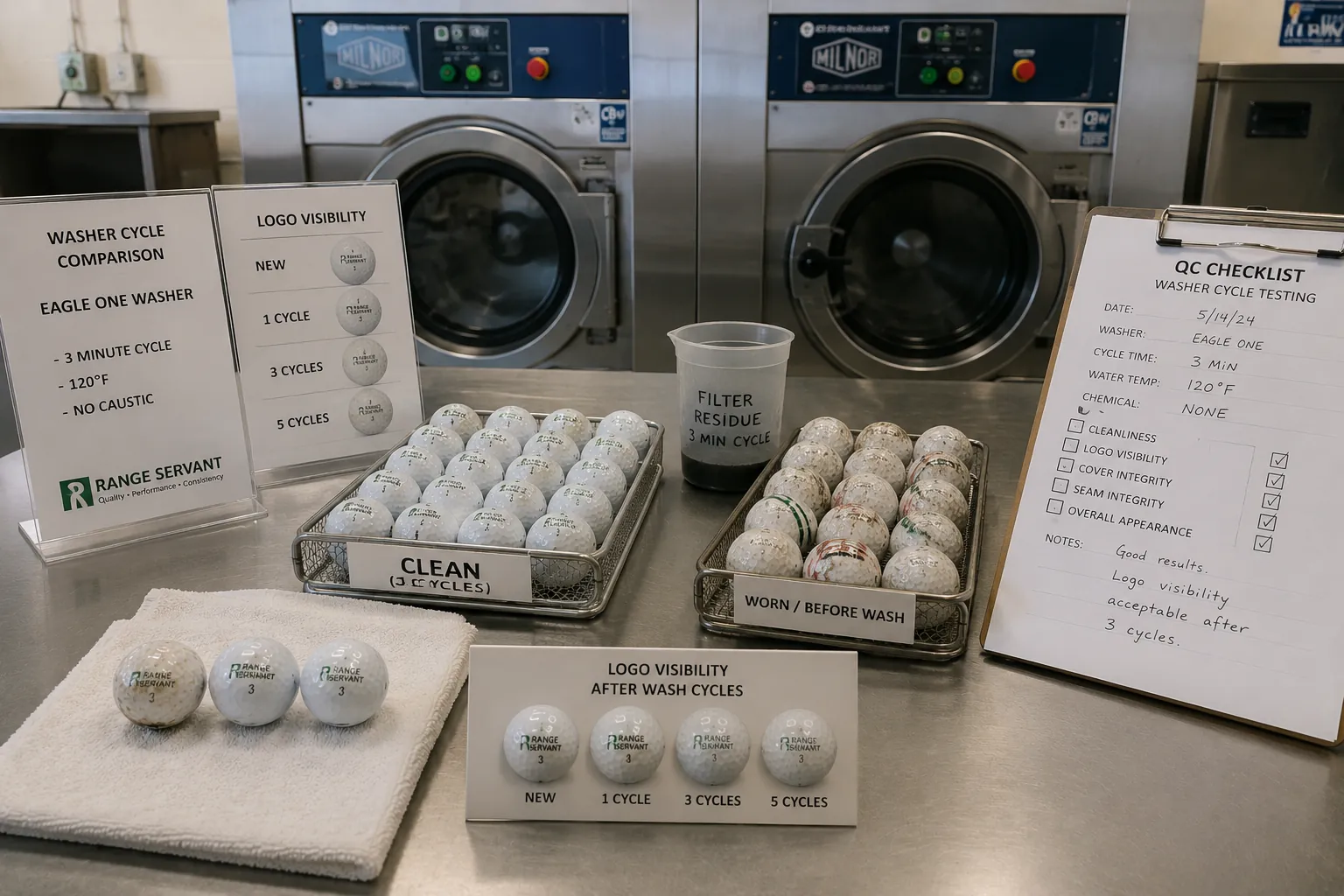
Logo or facility-mark durability belongs in the operating-cost model only when it affects identification, sorting, or rework. Ask whether the mark remains readable through the real hit-wash-sort workflow; do not assume pad or UV printing is automatically superior without comparable evidence.
Washer evidence works the same way. This article does not need washer throughput specifications. It needs a record of whether one lot creates more abnormal residue, cleaning burden, mark failure, or rejects than the control.
Automation incidents can also become a cost driver. If your pilot shows ball-related handling problems, move the mechanical diagnosis into the range ball picker jams guide.
If the issue is training or radar-data usefulness, separate the economics from the deeper performance analysis in the range ball data consistency guide.
A candidate lot mixed into the legacy fleet before measurement is a failure signal.
Pilot-lot acceptance shall use the buyer-approved usable/rejection rule and the same observation method applied to the control lot. Any change in test conditions, lot identity, failure criteria, or cost scope shall be recorded before the TCO comparison is accepted.
Prefer the lowest normalized operating cost, not the lowest opening quote.
You can measure that reliably only while both populations remain identifiable.
✔ True — A real-world pilot can stay operationally realistic while preserving lot identity
Candidate and control balls can circulate under normal conditions as long as your team can still attribute rejects, losses, washer events and labor to the correct population.
✘ False — “Mixing the candidate into the old fleet immediately creates the most accurate TCO test”
It may create realistic operating conditions, but it destroys attribution. Once lot identity disappears, supplier-level conclusions become much weaker.
What Should a Range Ball TCO Worksheet Record?
You now have a purchase price, a usable definition, a supplier durability claim, and a pilot. The final step is converting all four into one procurement decision without mixing evidence scopes.
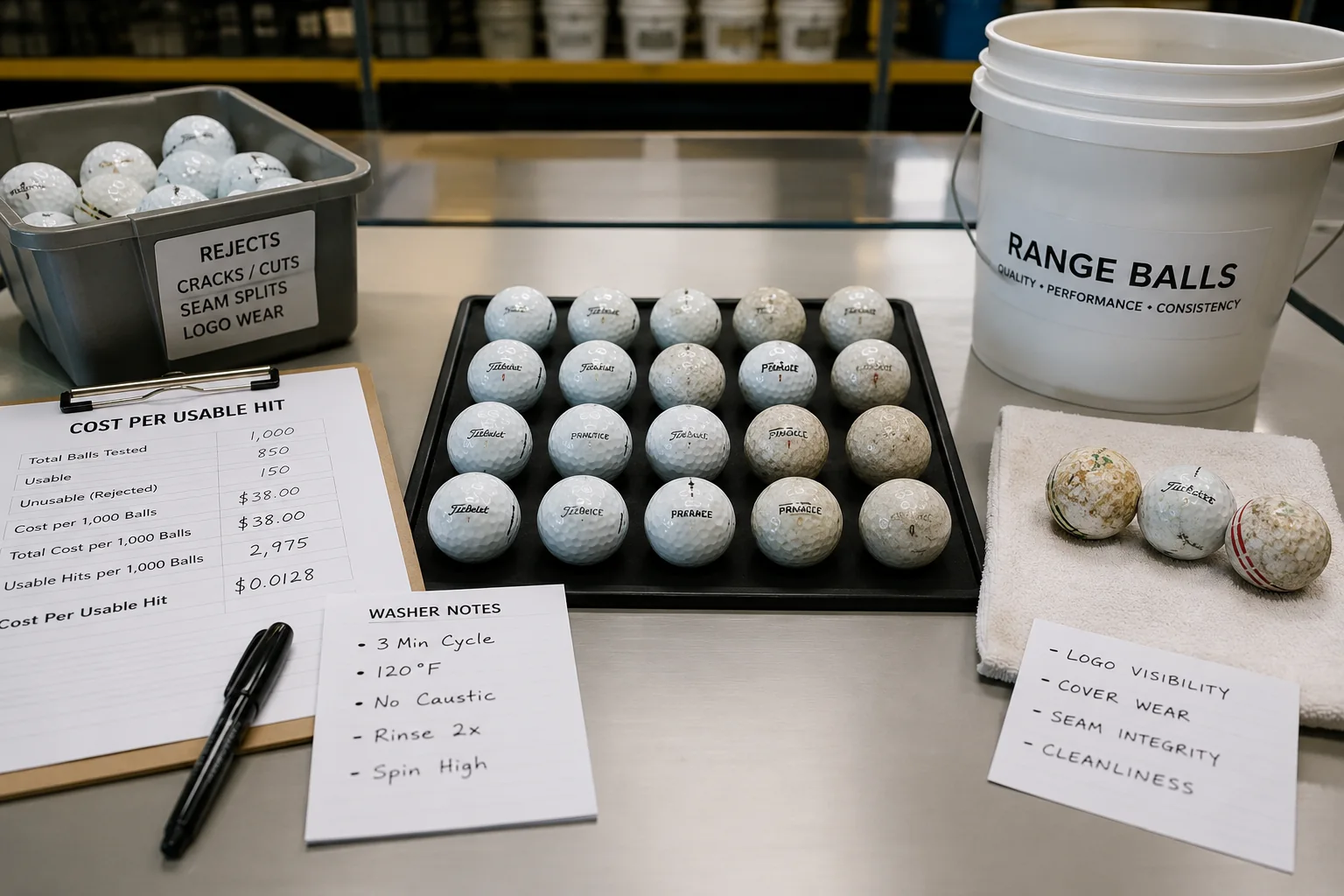
A useful range-ball TCO worksheet separates supplier evidence from facility operating evidence, then converts only locally measurable costs into money. Use the same observation logic for every lot, record the rejection rule and denominator method, and calculate verified cost per usable hit only after the evidence is traceable.
Build the worksheet in two layers.
Layer A — Supplier / Product Evidence records the supplier, exact SKU, lot or batch ID, delivered cost, durability method, sample size, laboratory endpoint, QC evidence, and retained-sample reference.
Layer B — Facility Operating Evidence records the observation period, active inventory, recorded or estimated hits, rejection rule, reason-coded rejects and losses, sorting burden, washer events, mark failures, emergency replenishment, and ending usable inventory.
Then calculate:
Verified Cost Per Usable Hit = Same-Scope Attributed Cost ÷ Same-Scope Recorded or Estimated Usable Hits
| Worksheet field | Supplier evidence | Facility evidence | Cost or driver | Buyer action |
|---|---|---|---|---|
| Delivered cost | Quote / invoice | Receiving record | Cost | Lock scope |
| Hit method | Lab / claim method | Transaction proxy | Denominator | Define |
| Usable rule | Supplier endpoint | Facility endpoint | Denominator | Normalize |
| Reject / loss | Claim if available | Reason-coded log | Driver | Separate causes |
| Sorting | — | Staff minutes | Monetizable cost | Apply local rate |
| Washer | Test evidence | Incident / downtime | Driver / cost | Record |
| Emergency replenishment | — | Actual event | Cost | Calculate premium |
| Final CPUH | Supplier claim | Normalized worksheet | Decision metric | Rank lots |
Recorded Hits or Operating Proxy?
Many driving ranges cannot count how many times each individual ball has been hit.
That is normal.
Do not solve imperfect facility data by returning to a supplier marketing number.
Use recorded data when you genuinely have it. Otherwise, build a consistent facility operating estimate.
For facilities with dispenser or bucket data:
Estimated Hits During Period = Transactions × Defined Balls Dispensed Per Transaction
If you use several bucket sizes, calculate each category separately and sum the totals.
You can then estimate fleet exposure:
Estimated Hits per Active Ball = Estimated Total Hits ÷ Average Active Fleet During the Same Period
This is not an industry standard.
It is an operating proxy.
Its value comes from using the same logic for every candidate.
Apply the same observation period, transaction source, active-fleet method, rejection rule, loss classification, and cost scope to every candidate.
You do not need fake precision.
You need repeatable comparison.
The same rule applies when converting operating burden into money.
Use your own loaded labor rate:
Sorting Cost = Sorting Minutes ÷ 60 × Loaded Labor Rate
Use your own downtime method:
Washer Downtime Cost = Downtime Hours × Facility-Defined Downtime Cost
If a problem triggers an emergency replenishment purchase:
Emergency Replenishment Premium = Actual Emergency Cost − Normal Equivalent Cost
Use your facility’s own labor, downtime, and replenishment-cost assumptions rather than generic industry values.
Loss coding deserves particular care because a lower ending inventory does not tell you why balls disappeared from the active fleet.
Keep at least four removal codes separate: wear-out rejection for product-condition loss, unrecovered/lost for recovery loss, theft/shrinkage for asset-control loss, and operational damage for handling or facility-system loss.
If all four go into one “ball loss” field, supplier durability can be blamed for a collection problem, or facility shrinkage can make a good candidate look economically weak.
The detailed prevention strategy belongs in the range ball shrinkage guide.
Replenishment spend belongs in this TCO model, but safety stock, reorder points, stock windows, and replenishment cadence are separate inventory decisions. Keep those controls in your range ball replenishment strategy rather than turning this TCO worksheet into an inventory-management article.
At Golfara, we recommend keeping the supplier evidence pack and the facility operating log connected to the same SKU, batch, retained sample, and observation scope. That link becomes especially valuable when a later reorder performs differently and your team needs to determine whether the economics changed because the product changed or because the operation changed.
Your final worksheet should not ask:
“Which supplier claims the longest life?”
It should ask:
Which identifiable lot delivered the lowest normalized operating cost under the same usable definition, denominator method, and observation scope?
That is a number your operations team, procurement team, and finance team can defend.
FAQ
Should lost and worn-out balls use the same cost code?
No. Wear-out rejection and unrecovered loss represent different economic causes, so combining them can make a supplier durability problem look like a facility-recovery problem—or the reverse.
Keep separate codes for:
-
wear-out rejection;
-
lost / unrecovered;
-
theft or shrinkage where known;
-
operational damage.
The same purchase invoice may eventually replace all four, but your driver analysis still needs the causes separated. Otherwise, facility shrinkage can be mistaken for poor product durability and distort the supplier TCO comparison.
Can colored range balls lower operating loss?
Possibly. Better visibility or identification may improve retrieval in some range environments, but there is no defensible universal percentage showing that one color reduces loss by the same amount across every facility.
Run an A/B observation using:
-
the same time period;
-
comparable range areas;
-
the same recovery workflow;
-
recovered and unrecovered counts.
If your data shows a real retrieval benefit, include the measured effect in your facility TCO. Do not import somebody else’s loss-reduction percentage.
Does a third-party report prove usable life?
No. Independent execution can make a durability test more credible, but a laboratory name does not make the hit-life result comparable if the sample identity, method, conditions, and failure endpoint remain unclear.
Request:
-
the full report;
-
method reference;
-
sample / SKU identity;
-
batch link where available;
-
failure endpoint.
A third-party report can independently document a method. It cannot fix an undefined denominator.
Should refurbished balls use the same TCO model?
Yes. Use the same rejection rule, observation scope, cost treatment, and operating proxy, but keep the refurbished population identifiable enough for attribution.
The deeper condition and source discussion belongs in the refurbished range balls guide.
Can a 2-piece Surlyn ball still lose on TCO?
Yes. A 2-piece ionomer or Surlyn ball may suit high-volume range use, but construction alone does not prove the lowest normalized cost per usable hit.
Compare it with your control lot under the same rejection rule, observation method, and cost scope before making the economic decision.
Should complaints become a dollar TCO cost?
Only when your facility has a defined monetization method. Otherwise, complaint count should remain a driver KPI rather than becoming an invented “brand image cost” inside the hard TCO numerator.
Track:
-
complaint count;
-
complaint reason;
-
service-recovery events;
-
directly measurable expense where applicable.
If a complaint triggers a documented refund, comp, or labor event, you can include that defined cost once. If it does not, keep the soft indicator visible without pretending it has a precise dollar value.
Conclusion
The cheapest range ball is not the one with the lowest unit price or the longest claimed hit life. It is the lot that delivers the lowest normalized cost per usable hit under the same usable definition, observation method, rejection rule, and cost scope.
Before ranking suppliers, define what your facility considers usable, verify how each hit-life claim was produced, and keep candidate and control lots identifiable long enough to attribute the result.
A supplier’s cost-per-hit claim becomes procurement evidence only when you can understand—and reproduce—the denominator behind it.
Define → Measure → Normalize. Then compare the economics, not the marketing number.
You might also like — When Should Driving Ranges Replace Old Range Balls?