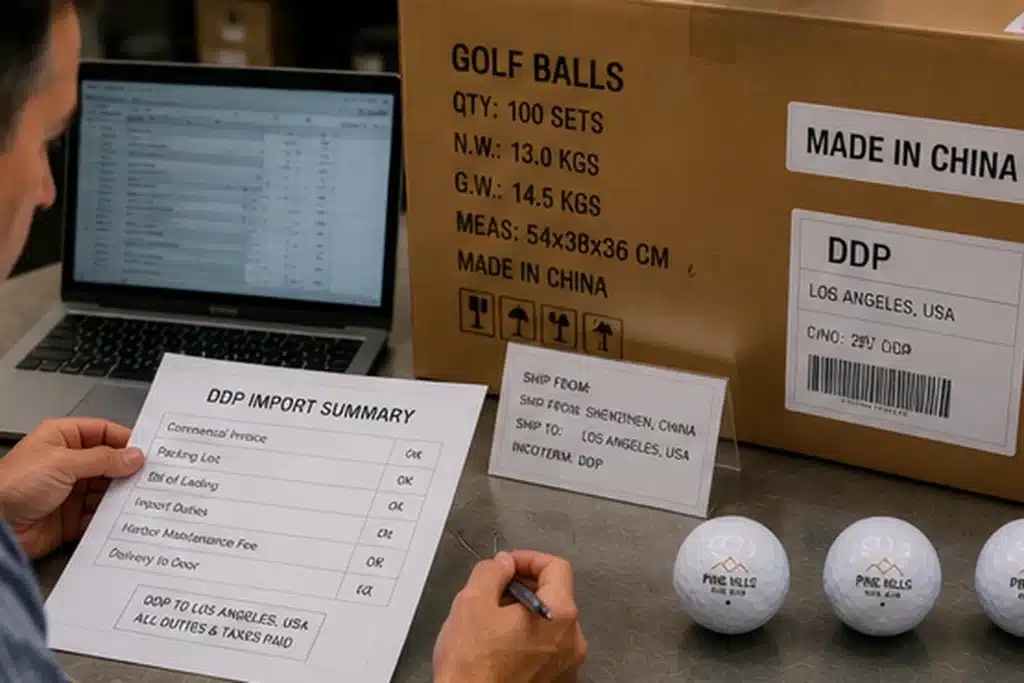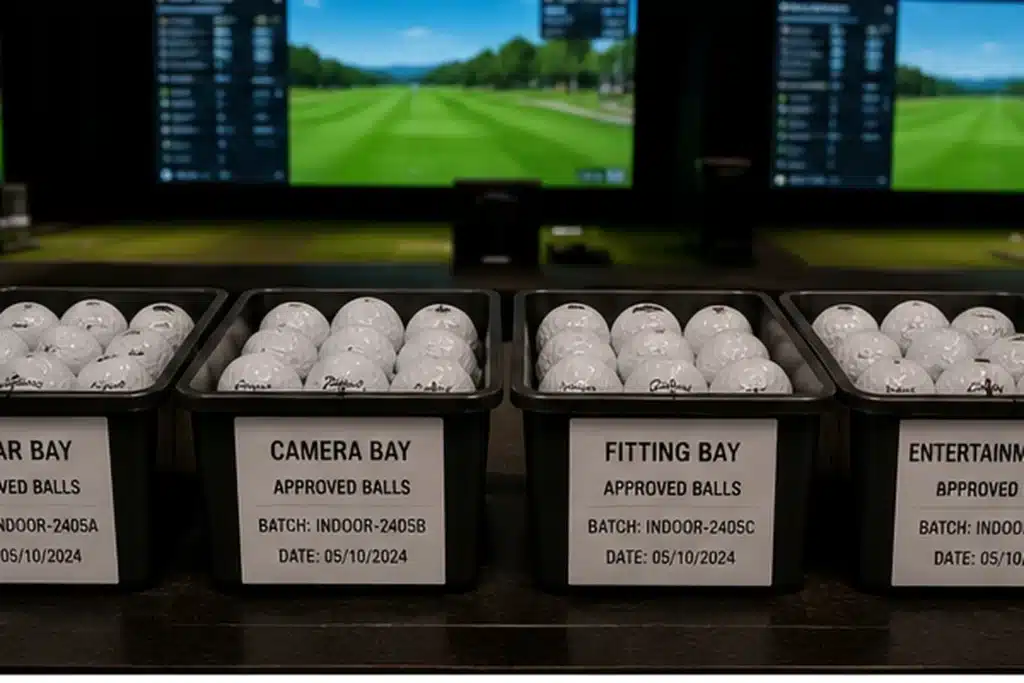
Indoor golf balls look simple until one wrong surface, mark, or batch starts hurting tracking, screens, and guest confidence.
Indoor golf facilities should choose balls by tracking system, bay purpose, and clean-surface policy. Radar bays may need RCT or marker-ready balls; camera bays need clean, low-glare surfaces; premium fitting bays need batch-controlled inventory; all bays need indoor-only surface rules.
| Facility area | Main risk | Ball priority | Evidence to request |
|---|---|---|---|
| Radar bay | Missed spin capture | RCT or marker-ready option | Read-stability test |
| Camera bay | Glare or visual noise | Clean low-glare surface | Optical check |
| Premium fitting bay | Data baseline drift | Same model and batch | 12-ball QC report |
| Entertainment bay | High turnover | Durable indoor-use ball | Surface wear proof |
| Shared inventory | Screen marks or dirt | Indoor-only rule | Clean-surface check |
Use this guide to match balls to your bay technology, protect clean screen surfaces, split premium and standard inventory, and write an RFQ that supports your indoor-only ball policy.
What Balls Work Best Indoors?
Your facility may be tempted to choose one popular “simulator ball” for every room, but indoor golf is not one use case.
The best indoor golf ball is the one that matches your tracking system, bay purpose, and clean-surface rule. Your facility should compare radar compatibility, camera visibility, screen-marking risk, batch consistency, and staff policy before choosing one ball for every indoor bay.
Indoor ball selection is a facility policy decision, not a personal golf ball preference. A premium fitting room, a party bay, a lesson bay, a camera-based simulator, and a radar-based launch monitor may expose different risks. If you treat all bays the same, you may solve one problem while creating another: better feel but more screen marks, strong durability but weaker fitting baseline, or clean appearance but unstable indoor spin capture.
| Facility need | Wrong shortcut | Better rule | Evidence to request |
|---|---|---|---|
| Radar tracking | Any clean white ball | RCT or marker-ready option | Read test |
| Camera capture | Glossy random ball | Clean low-glare surface | Bay test |
| Screen cleanliness | Guest outdoor balls | Indoor-only inventory | Rub proof |
| Fitting accuracy | Mixed models | Same model and batch | 12-ball QC |
| High-turnover bays | Premium-only stock | Durable indoor-use ball | Wear proof |
Create an approved-ball matrix by bay type: radar, camera, premium fitting, lesson, entertainment, and event use. Test each approved ball in the actual bay before bulk rollout. No ball should enter full circulation until it passes tracking checks, clean-surface inspection, and staff-handling rules.
✔ True — Indoor facilities need a ball policy
A commercial facility needs repeatable rules for bay technology, surface cleanliness, inventory separation, guest balls, and reorders. The “best” ball is the one that fits your operating system.
✘ False — “One retail ball choice automatically fits every bay”
A ball that works well in one simulator room may create glare, missed reads, marking risk, or baseline drift in another bay type.
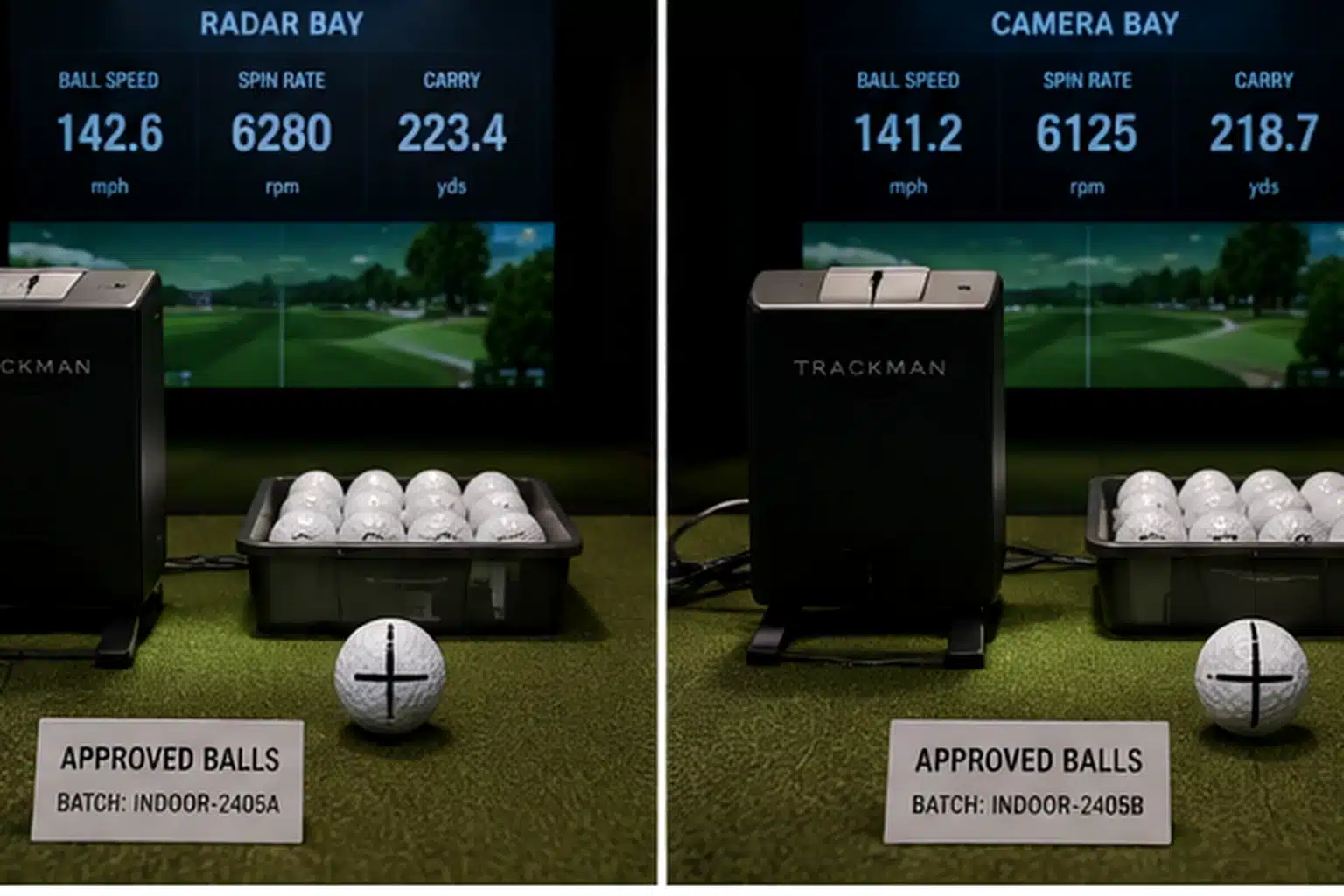
Do Radar and Camera Bays Need Different Balls?
Your radar bay may miss spin if the ball is not suitable for short indoor flight, while your camera bay may struggle with glare, dirty surfaces, or poor contrast.
Radar and camera bays can require different ball approval tests. Your radar bay may need a ball that supports indoor spin capture, while your camera bay may need a clean, low-glare, high-contrast surface that the optical system can read consistently under your lighting.
RCT, marked, or clean matte?
Radar-based indoor systems may need RCT or approved marker-ready balls when spin capture is difficult indoors. Titleist describes RCT balls as using embedded radar-reflective technology for indoor radar-based launch monitors, which supports the radar-bay logic without proving every radar room needs the same ball. RCT technical reference
Camera and photometric systems follow a different decision path. Camera-based launch monitors rely on high-speed imagery, lighting, ball visibility, and surface consistency near impact. Uneekor’s product information, for example, describes high-speed camera capture and dimple-based ball tracking, which supports the need to test visibility, glare, and contrast in your actual camera bays. camera-based tracking reference
| Bay type | Tracking risk | Ball decision | Buyer action |
|---|---|---|---|
| Radar bay | Weak indoor spin capture | RCT or marker-ready option | Run read-stability test |
| Camera bay | Glare or visual noise | Clean low-glare surface | Test under bay lighting |
| Mixed hardware | One ball may not fit all | Approved list by system | Separate inventory |
| Fitting bay | Data baseline drift | Same model and batch | Keep control lot |
| Event bay | High turnover | Durable indoor-use ball | Inspect surfaces |
Supplier cannot say whether the ball is for radar or camera bays is a failure signal. Run sample balls in every hardware type before bulk ordering. Your deliverable should be a tracking compatibility note stating which balls are approved for radar bays, camera bays, premium fitting bays, and mixed-hardware locations.
Buyer acceptance should require actual-bay read checks before full rollout. A supplier data sheet is useful, but your room geometry, lighting, hitting distance, screen condition, and hardware setup decide whether the ball works in your facility.
How Clean Should Indoor Balls Stay?
Your indoor rooms can look older fast when dirty balls, outdoor grit, marker residue, chipped paint, or low-quality prints leave marks on the screen or confuse tracking.
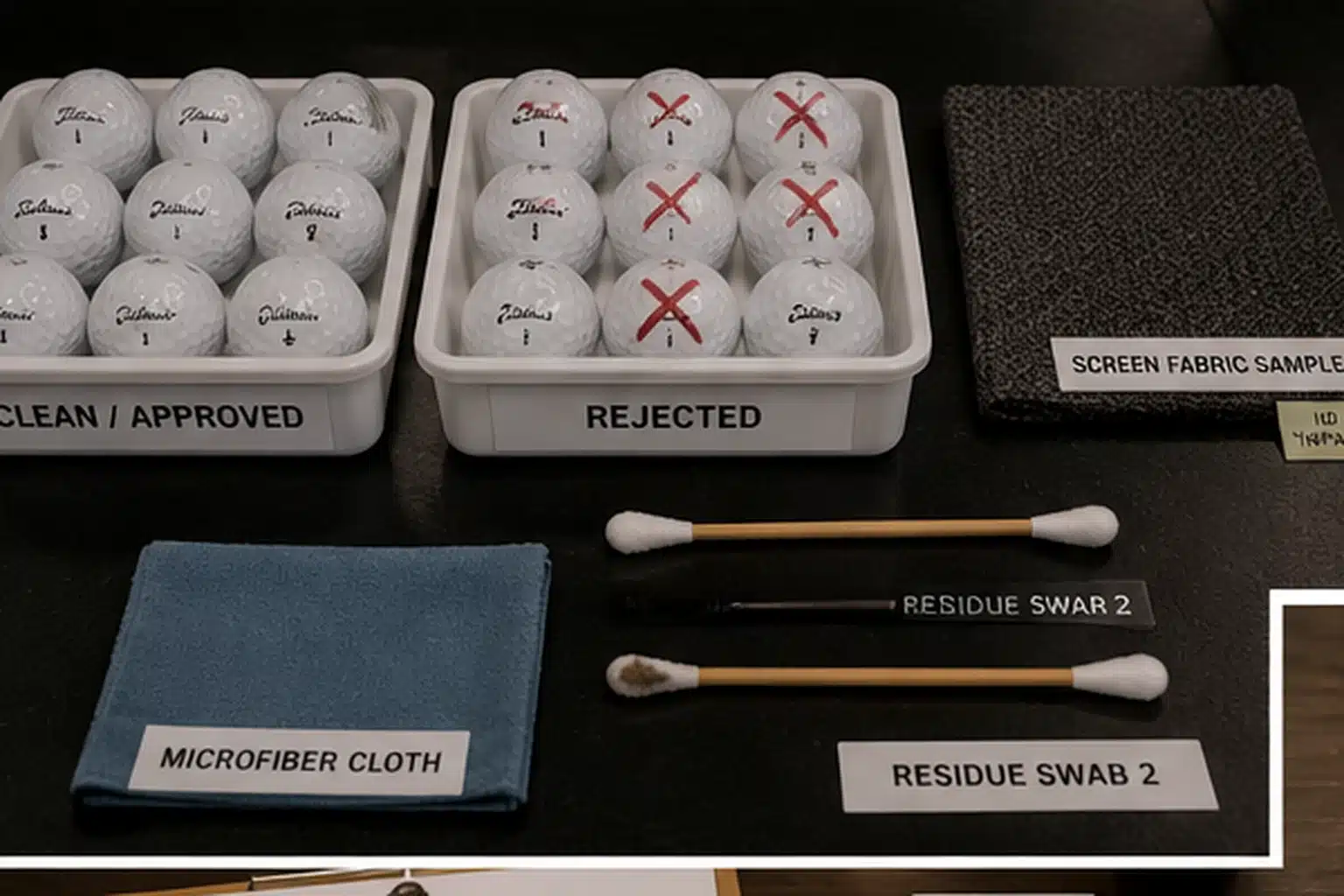
Indoor balls should stay clean enough to protect the screen surface and tracking environment. Your facility should inspect dirt, grit, marker residue, dye transfer, chipped paint, scuffs, and glossy glare before approved balls return to premium or camera-sensitive bays.
Factory mark or hand-drawn line?
Clean-surface policy is not housekeeping drama. It is a screen-room operating standard. TrackMan’s impact-screen maintenance guidance recommends using clean golf balls that are not scuffed, which supports a practical indoor-only ball policy without turning this article into a screen-damage scare piece. impact screen maintenance guidance
Your staff should inspect outdoor dirt, sand, grass stains, marker residue, chipped paint, glossy glare, and scuffed covers. Hand-drawn alignment lines may help one tracking setup but create residue or inconsistent appearance in another. Factory marks, logos, and alignment lines should pass dry/wet rub checks and dye-transfer checks before they enter premium bays.
| Surface issue | Facility risk | Check method | Staff action |
|---|---|---|---|
| Outdoor dirt | Screen marks | Check-in inspection | Reject or clean |
| Marker residue | Dye transfer | Dry/wet rub check | Use approved marks |
| Chipped paint | Visual noise | Surface inspection | Move to test bin |
| Gloss glare | Camera read issue | Bay lighting test | Approve by system |
| Scuffed cover | Screen and data risk | Post-hit check | Cull or downgrade |
Factory mark has no rub or dye-transfer proof is a failure signal. Build a clean-surface SOP covering dirt, scuffs, residue, printed marks, dye transfer, and return-to-bay rules. Approved balls should show no unacceptable dye transfer, residue, or surface defect under your facility-defined inspection.
Supplier shall link approved indoor-use sample, tracking compatibility note, clean-surface proof, dry/wet rub evidence, batch ID, carton label, retained sample, and shipment lot under one proof version before dispatch.
✔ True — Clean surface is an indoor operating standard
A ball touches the screen, passes through the tracking environment, and sits in front of paying guests. Dirt, residue, scuffs, and glare deserve staff rules.
✘ False — “Any hand-drawn line is safe because it helps tracking”
Marks should be approved for the specific bay. Uncontrolled ink, stickers, or residue can create screen, cleanliness, or tracking problems.
Your entertainment bays may need durable, clean, affordable inventory, while your premium fitting or lesson bays need a more stable ball baseline.
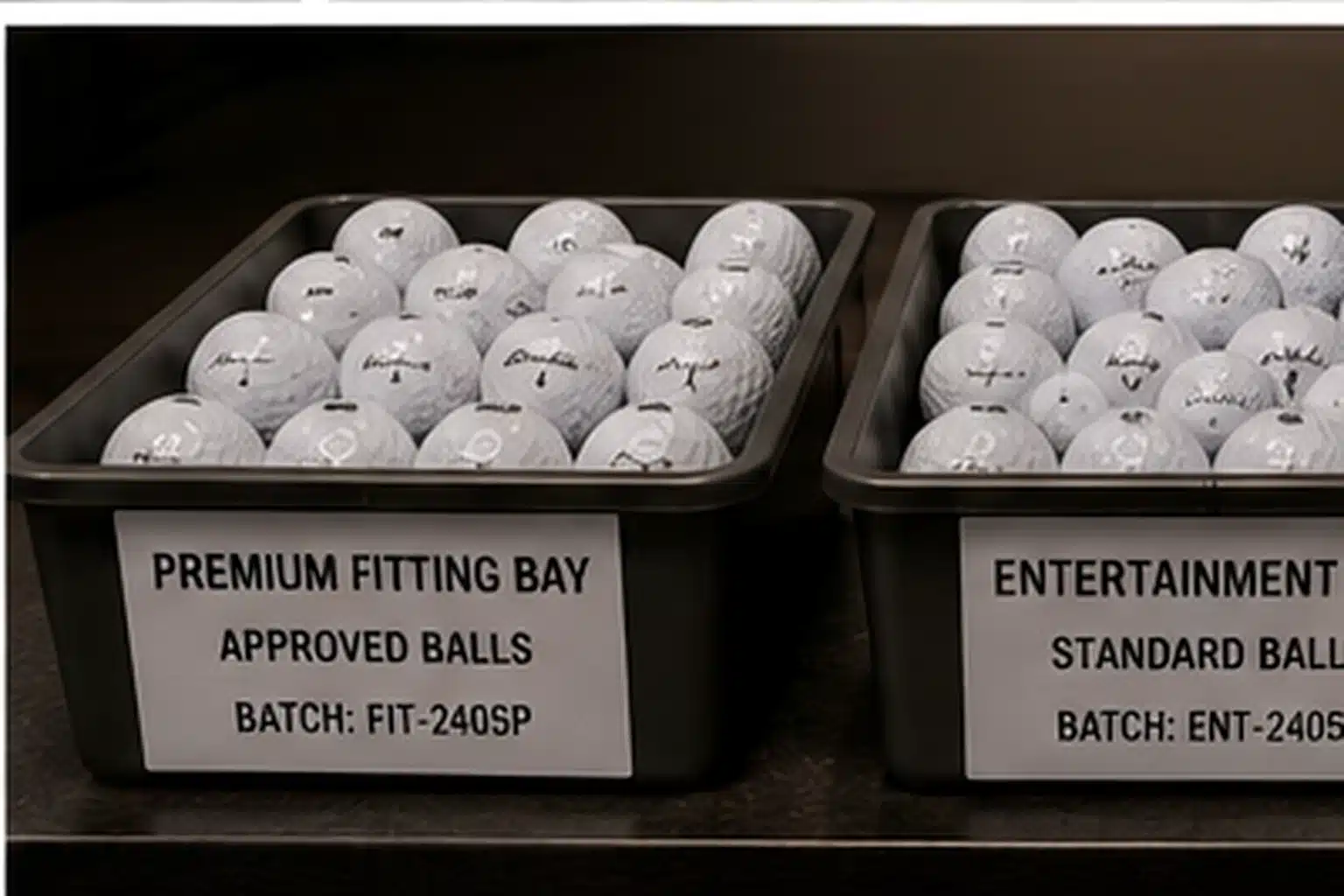
Premium fitting bays should usually use tighter inventory control than standard entertainment bays. Your facility can separate durable indoor-use balls for high-turnover play from batch-controlled balls for fitting, lessons, and data-sensitive sessions where mixed models create unnecessary noise.
Standard bay or fitting bay?
Do not assume premium bays universally require urethane or tour-level balls. The safer rule is to match the ball model to the data promise of that bay. If the room is sold for club fitting, gapping, lessons, or premium practice, mixed models and mixed batches weaken confidence.
| Bay type | Main promise | Ball standard | Control action |
|---|---|---|---|
| Premium fitting bay | Reliable baseline | Same model and batch | Keep control lot |
| Lesson bay | Consistent feedback | Approved stable inventory | Avoid mixed models |
| Entertainment bay | Durable play | Clean indoor-use ball | Inspect often |
| Event bay | High turnover | Cost-controlled approved ball | Use separate stock |
| Test inventory | Approval check | Sample batches | Do not mix into daily use |
Premium bay inventory mixes models and batches is a failure signal. Create a bay-level inventory split with approved ball models, batch IDs, retained samples, and usage rules. Physically separate fitting-bay balls from standard-bay inventory so staff do not solve a busy Saturday by dumping every white ball into every room.
Premium-bay inventory should match the approved model, batch, and retained sample before use. Standard entertainment bays can use durable indoor-use balls if they pass clean-surface and tracking checks. Premium balls in every bay may feel safer, but it can overbuy precision where durability and staff control matter more.
Your purchasing file should include a 12-ball QC report for data-sensitive inventory: raw compression, weight, and diameter values, plus mean, standard deviation, range, method, instrument ID, calibration date, batch ID, and retained sample. That does not replace actual bay testing, but it helps prevent a reorder from quietly changing your fitting baseline.
Should Guests Bring Outdoor Balls Indoors?
Your guests may want to use their own balls, but outdoor-used balls can bring grit, sand, grass, mud, marker residue, and cart-path scuffs into indoor bays.
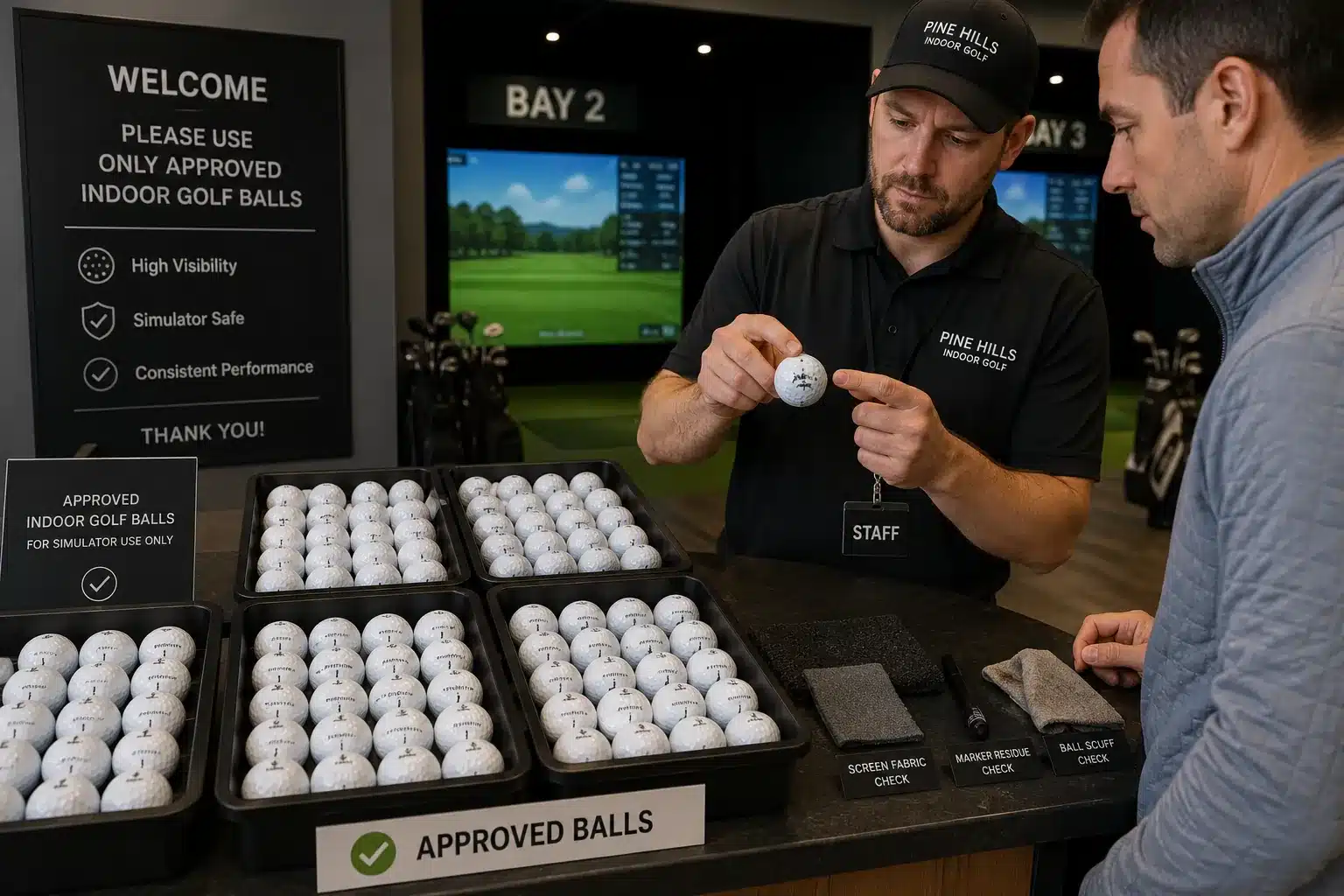
Indoor-only ball policies protect your screen surface, tracking environment, and bay consistency. Your facility can still allow guest balls for special fitting cases, but dirty, scuffed, marker-heavy, or outdoor-used balls should not enter premium indoor bays without inspection.
Indoor-only rule or guest freedom?
A strict indoor-only policy can feel annoying to golfers unless your staff explains it well. The point is not control for control’s sake. The point is protecting the screen room, tracking environment, and bay baseline. A customer’s favorite ball may be fine after inspection; a dirty outdoor ball with sand, scuffs, and marker residue should not be treated the same.
Policy should appear at booking, check-in, bay entry, and staff training. Provide approved indoor balls by default. For special fitting sessions, allow guest balls only after surface inspection. Track outdoor-ball violations, screen marks, marker-residue incidents, and cleaning events by bay.
Write a guest-ball policy covering approved balls, inspection rules, premium-bay exceptions, and staff authority. Guest balls must pass clean-surface inspection before entering premium or data-sensitive bays. The policy becomes easier to enforce when staff can point to a clean tray, an approved-ball bin, and a simple inspection script.
✔ True — Indoor-only rules protect the facility standard
Your facility is responsible for screens, tracking quality, room appearance, and guest trust. Approved indoor balls make that standard easier to protect.
✘ False — “Guest-owned balls should always be allowed because they feel more authentic”
Guest preference matters, but dirty, scuffed, marker-heavy, or unknown balls should not override premium-bay cleanliness and tracking rules.
What Should Your Indoor Ball RFQ Include?
A quote for simulator golf balls may sound fine but still fail your facility if it does not prove tracking fit, clean surface, batch control, and receiving acceptance.
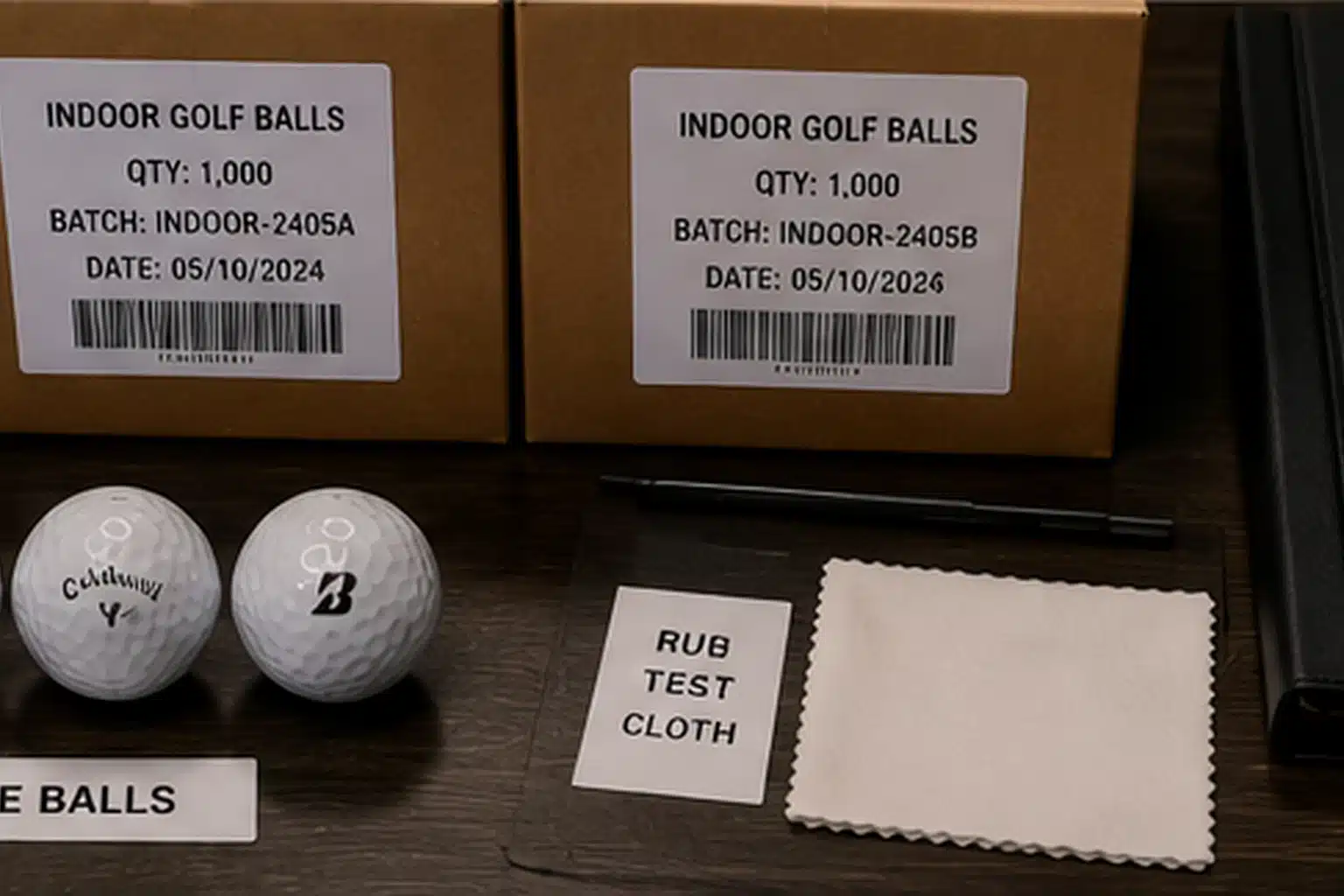
Your indoor ball RFQ should request proof, not only a simulator-ball price. Ask for tracking compatibility, clean-surface testing, screen-marking checks, dry/wet rub evidence, 12-ball QC data, batch ID, retained sample, carton labels, and receiving criteria for your facility policy.
Tracking note or clean-surface proof?
Your RFQ should connect the ball to the room where it will be used. Ask whether the ball is intended for radar bays, camera bays, or both. Ask for surface finish details, clean-surface evidence, screen-marking checks, dry/wet rub results for any logo or mark, and batch traceability.
| RFQ item | Why it matters | What to request | Acceptance evidence |
|---|---|---|---|
| Tracking fit | Bay compatibility | Radar/camera note | Actual-bay test result |
| Surface finish | Camera and screen standard | Gloss / matte note | Approved sample |
| Clean-surface proof | Screen marking risk | Dry/wet rub check | No transfer evidence |
| QC baseline | Premium bay consistency | 12-ball raw data | Mean, SD, range report |
| Batch ID | Traceability | Carton and sample link | Batch record |
| Retained sample | Dispute control | Reference sample | Receiving match |
| Facility policy support | Staff execution | Label / approved list | SOP-ready documentation |
You can place this language into the RFQ:
“Please quote golf balls for commercial indoor simulator use. State whether the ball is approved for radar bays, camera bays, or both. Include surface finish details, clean-surface standard, screen-marking and dye-transfer check, dry/wet rub evidence for any logo or mark, 12-ball QC data for compression, weight, and diameter, batch ID tracking, retained samples, carton labels, and receiving criteria.”
Buyer acceptance requires approved tracking result, no unacceptable dye transfer or screen-marking evidence, QC report match, batch ID match, retained sample match, readable carton labels, and no severe cover, marking, dimensional, or visual defects in inspected samples.
Your receiving inspection should check every shipment against the approved sample before the balls enter daily circulation. If the reorder looks similar but creates new missed reads, screen marks, or fitting variance, batch ID and retained sample records give your team a path to isolate the problem instead of arguing from memory.
FAQ
What is the best golf ball for an indoor simulator?
There is no single best golf ball for every commercial indoor simulator. The best choice depends on tracking system, bay purpose, clean-surface requirements, screen-marking risk, and how tightly the facility needs to control data consistency.
A radar bay may need RCT or marker-ready compatibility. A camera bay may need a clean, low-glare, high-contrast surface. A fitting bay may need same-model, same-batch inventory with retained samples. A high-turnover entertainment bay may prioritize durability and clean-surface proof. Test balls in the actual bay before buying bulk inventory.
Do golf balls matter on a simulator?
Yes. Golf balls matter on a simulator because surface finish, markings, cleanliness, compression consistency, and batch control can affect tracking, screen appearance, and guest trust.
A simulator ball is both a tracking input and a screen-contact surface. Watch missed reads, inspect screen marks, and track ball batch by bay. When problems repeat in one room, the ball should be part of the investigation along with lighting, mat condition, calibration, and guest handling.
Do you need special golf balls for TrackMan indoors?
Some radar-based indoor setups may benefit from RCT or marker-ready balls, depending on system requirements and indoor spin-capture conditions. Do not assume every indoor bay needs the same ball without testing.
Check hardware guidance, test approved samples, and document read stability inside your own room. RCT-style technology can help radar systems capture indoor spin, but camera-based systems and mixed-hardware facilities may follow different approval logic.
Can regular golf balls be used indoors?
Regular golf balls can be used indoors only if they meet your facility’s tracking, clean-surface, and screen-marking rules. Outdoor-used balls should be inspected before entering indoor bays.
Check dirt, scuffs, marker residue, chipped paint, and glossy glare. For premium fitting or data-sensitive rooms, use approved indoor-only inventory unless the guest ball passes inspection and the session requires that specific model. A regular golf ball is not automatically a facility-approved indoor ball.
Does ball color affect launch monitors?
Ball color can matter, especially for camera or optical systems under certain lighting, glare, contrast, or surface conditions. Verify color and finish with your actual bay setup.
Do not assume every white, yellow, matte, glossy, or patterned ball behaves the same in every room. Test under facility lighting, compare missed reads by ball type, and document which colors or finishes are approved for each bay. Radar and camera systems may care about different ball features.
Should facilities mark golf balls for simulator use?
Facilities should mark golf balls only when the tracking system needs it and the marking is approved. Hand-drawn lines, stickers, or low-quality ink can create residue, dye transfer, or inconsistent tracking.
Use approved factory marks where possible. Request rub and dye-transfer proof. Keep marked balls in the correct bay type and do not let staff create their own marking system without inspection rules. A mark that helps one room may create problems in another.
Can dirty golf balls mark simulator screens?
Yes, dirty, scuffed, marker-heavy, or outdoor-used golf balls can mark screens or worsen room appearance. Indoor facilities should use clean, non-scuffed balls and inspect questionable balls before they enter premium bays.
The issue is not only screen damage. Marks and residue can make a premium room look neglected, increase cleaning work, and create guest complaints. Use check-in inspection, clean-surface SOPs, dry/wet rub evidence, and approved indoor-only inventory to reduce preventable marks.
How long do golf balls last indoors?
There is no universal indoor golf ball lifespan. Use surface condition, screen marks, tracking complaints, compression checks, bay usage, and staff inspection results to decide replacement.
Inspect balls after sessions. Track complaints by bay. Separate keep, test, and reject inventory. A high-turnover entertainment bay may retire balls differently from a premium fitting bay with tighter data expectations. Your own facility data is more useful than a generic lifespan claim.
Should fitting bays use different balls?
Often yes. Fitting and coaching bays should use a more controlled ball baseline than standard entertainment bays because customers rely more on data consistency.
Use the same model and batch where possible. Keep retained samples. Avoid mixed models in premium bays. If a fitting room promises precise feedback, its ball inventory should be controlled like part of the measurement system.
Can guests bring their own golf balls to indoor golf?
Guests can bring their own balls only if your facility policy allows it and the balls pass surface inspection. Premium, camera-sensitive, or screen-sensitive bays should not accept dirty, scuffed, marker-heavy, or outdoor-damaged balls.
Guest-owned balls may be appropriate for brand-specific fitting, gapping, or player preference sessions. They should still be inspected at check-in or bay entry. Your staff should have authority to reject balls that threaten clean-surface rules or tracking consistency.
Conclusion
Indoor golf facilities need a controlled ball policy, not random simulator balls. Your facility should match balls to bay technology, keep surfaces clean, separate premium and standard inventory, control guest balls, and require supplier proof before every approved batch enters circulation.
The safest program is simple to explain and strict enough to run: approved-ball matrix, actual-bay testing, clean-surface SOP, indoor-only inventory, batch-controlled premium bays, 12-ball QC report, batch ID, retained sample, and receiving criteria.
A golf ball may look like the smallest item in the room, but in an indoor facility it touches the screen, feeds the tracking system, shapes the data, and influences whether guests trust the bay.
You might also like — Are Cheap Golf Balls Damaging Your Impact Screen?