Reordered golf balls feel different when the second batch is not locked to the first batch’s real production evidence.
Common causes include compression drift, coating or clear-coat changes, cover hardness variation, material-lot changes, facility routing changes, missing retained samples, and reorder POs that only say “same as last time.”
| Reorder drift | What buyers feel | What changed | What to request |
|---|---|---|---|
| Core compression | Clicky or dead feel | Core cure or batch spread | 12-ball compression comparison |
| Cover hardness | Firmer or softer strike | Cover or mantle hardness | Shore D record |
| Clear coat | Slick or tacky surface | Coating route or cure | Coating version lock |
| Color / gloss | Batch looks different | Paint or finish system | Retained sample check |
| Supplier route | Feels like another SKU | Facility or material change | BOM declaration |
| No batch ID | Subjective dispute | No old-batch reference | Previous batch ID |
Use this guide to control batch-to-batch drift with previous batch ID, retained samples, raw compression data, coating version lock, BOM declaration, and reorder PO acceptance criteria.
Why Do Reordered Balls Feel Different?
Your customer liked the first order, so your team expects the reorder to feel identical. Then the second batch feels clickier, softer, slicker, tackier, firmer, or less lively.
Reordered balls feel different when the second batch is not compared against the first batch’s real evidence. Your team should check previous batch ID, retained sample, compression data, coating version, cover hardness where relevant, material declaration, and receiving inspection before accepting a repeat shipment.
Same SKU does not guarantee same batch feel. Feel drift can come from core compression, cover hardness, coating cure, clear-coat route, material lots, production facility routing, storage, or missing retained samples. It can also come from weak buyer wording when the PO says only “same as last time.”
| Buyer symptom | Possible drift | Proof to request | Next action |
|---|---|---|---|
| Feels clicky | Compression or cover drift | Raw compression data | Compare batches |
| Feels dead | Core response drift | 12-ball QC report | Check spread |
| Feels slick | Coating change | Coating declaration | Lock version |
| Looks different | Finish or color drift | Retained sample photos | Compare sample |
| Supplier says same | No batch reference | Previous batch ID | Rewrite PO |
DTC brands, distributors, indoor facilities, and range operators judge repeat suppliers by batch-to-batch consistency. A first order wins trust; a second order that feels different creates a harder question: did the product change, or did your reorder evidence fail?
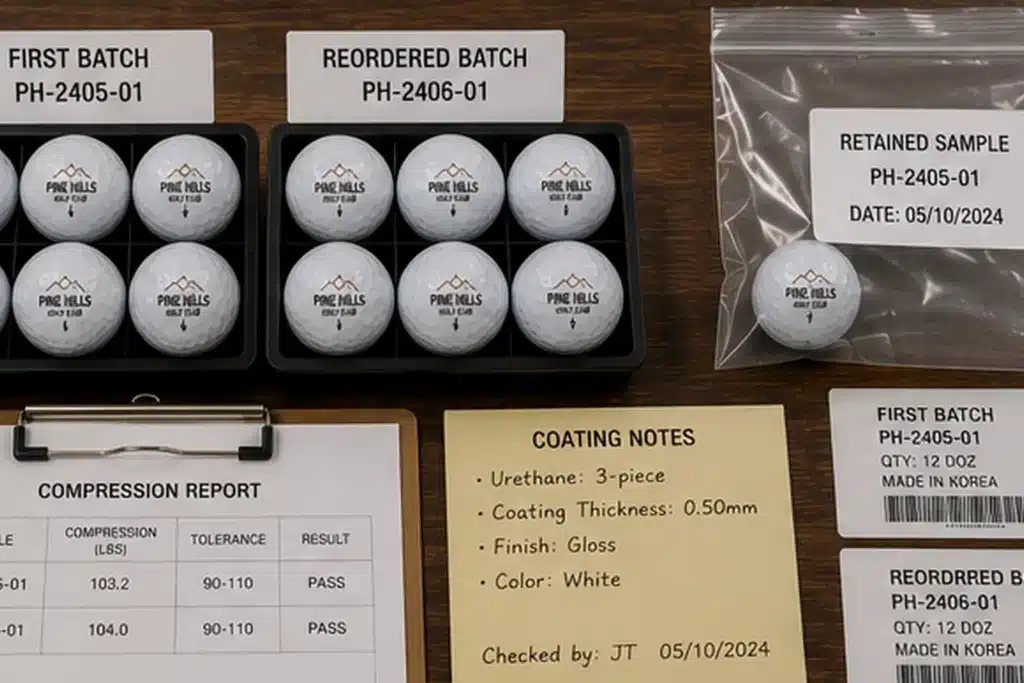
Create a reorder comparison file with previous batch ID, current batch ID, retained sample photos, compression data, coating note, supplier declaration, and acceptance decision. Compare the new batch against the first-batch retained sample and historical QC report. The reorder should meet buyer-agreed batch-to-batch criteria before shipment acceptance.
✔ True — A reorder needs batch-linked control
The first batch becomes useful only when it is linked to batch ID, retained samples, QC data, coating notes, and acceptance criteria.
✘ False — “Same SKU means the second batch will automatically feel the same”
A SKU name can stay unchanged while compression spread, coating route, material lot, or supplier routing changes the buyer experience.
Is Same as Last Time Enough?
Your supplier may know what you ordered before, but “same as last time” does not define the previous product experience.
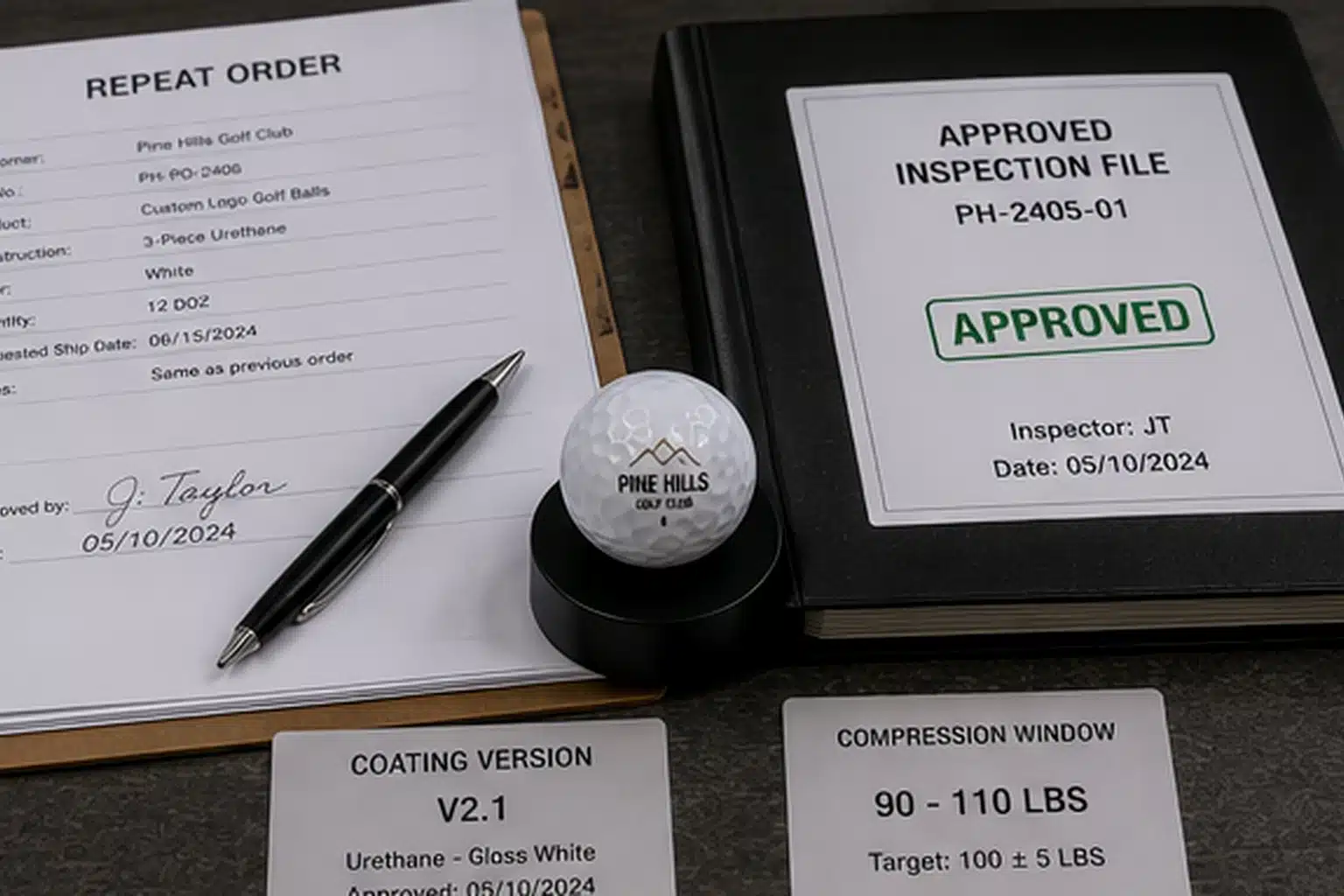
Same as last time is not a quality specification. Your reorder should cite the previous batch ID, retained sample ID, compression window, coating version, material declaration, and approved inspection file so your supplier knows exactly which product experience must be repeated.
Batch ID or memory?
A repeat order is not protected by memory, old emails, or a friendly account manager. Your previous order may have had a known compression profile, coating version, material route, packaging spec, and inspection result. Unless those details appear in the reorder PO, the supplier may treat the SKU name as enough.
| Weak reorder wording | What it misses | Better requirement | Buyer action |
|---|---|---|---|
| Same as last time | No batch link | Previous batch ID | Add to PO |
| Same feel | No data | Compression comparison | Request raw values |
| Same surface | No coating lock | Coating version | Ask declaration |
| Same material | No BOM proof | No-change clause | Get signature |
| Same package | No version control | Packaging sample ID | Lock packaging |
Supplier accepts a reorder from “same as last time” only is a failure signal. Your PO should include a repeat-order reference block: previous batch ID, retained sample ID, prior QC report, coating version, and accepted tolerance notes. Check that the supplier confirmation repeats the exact batch and sample references before production starts.
Production should not start from same-as-last-time language alone. That phrase may be useful in conversation, but it should never be the only enforceable instruction in a repeat order. Write the PO as if the person handling production has never seen the first batch, because often, they have not.
Which Specs Drift Between Batches?
Your second batch can feel different even when the logo, sleeve, and carton look similar. The cause may sit inside the ball or on its surface.
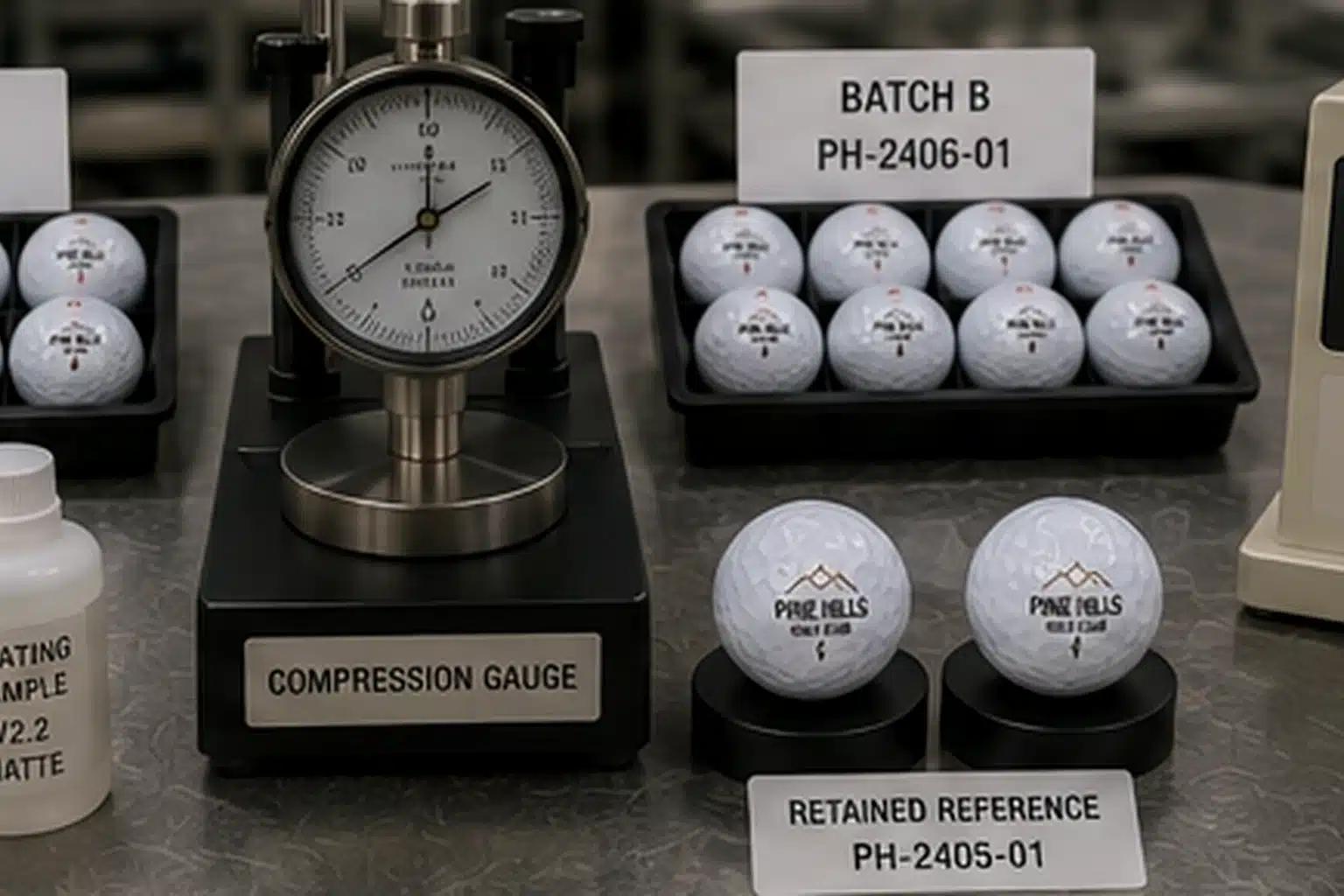
Batch feel can drift through compression, cover hardness, or coating changes. Your team should separate whole-ball compression data from cover hardness checks and coating-version records, then compare the new lot against the previous retained sample using the same test method.
Core, cover, or clear coat?
Compression is one of the strongest reorder comparison points because it helps describe whole-ball response. But one average compression number can hide spread. Two batches can share a similar mean while the reorder has a wider range, more outliers, or a different feel across the bucket.
Cover hardness is a separate proof point. Shore D can support cover or material hardness checks when relevant, but it is not the same as whole-ball compression. An ASTM D2240 durometer hardness reference can support Shore hardness language, but your PO should treat it as material or cover-side evidence, not a substitute for compression data.
| Spec area | What may drift | Buyer sensation | Evidence to request |
|---|---|---|---|
| Core compression | Mean or spread | Clicky or dead impact | 12-ball raw data |
| Cover hardness | Material hardness | Firmer surface feel | Shore D record |
| Clear coat | Route or cure | Slick or tacky surface | Coating declaration |
| Finish / gloss | Surface finish | Different hand feel | Retained sample comparison |
| Mixed lots | Lot blending | Inconsistent feel | Batch ID separation |
New batch report shows only average compression is a failure signal. Request a batch-to-batch technical comparison with 12-ball raw compression data, mean, standard deviation, range, cover hardness if relevant, coating version, and retained sample photos.
Use the same instrument type, method, and sample count when comparing batches. The reorder passes only if the new batch stays within buyer-agreed comparison criteria. If your team changes the method, sample count, or instrument, you may be measuring the test setup more than the batch.
✔ True — Compression and hardness are different proof points
Compression helps compare whole-ball response. Shore hardness can support cover or material checks when relevant, but one does not replace the other.
✘ False — “One average compression value explains every feel complaint”
Average compression can hide spread, outliers, coating changes, cover hardness changes, and mixed-lot problems.
Did the Supplier Change Anything?
Your supplier may say the SKU did not change, but the production route behind that SKU may have changed.
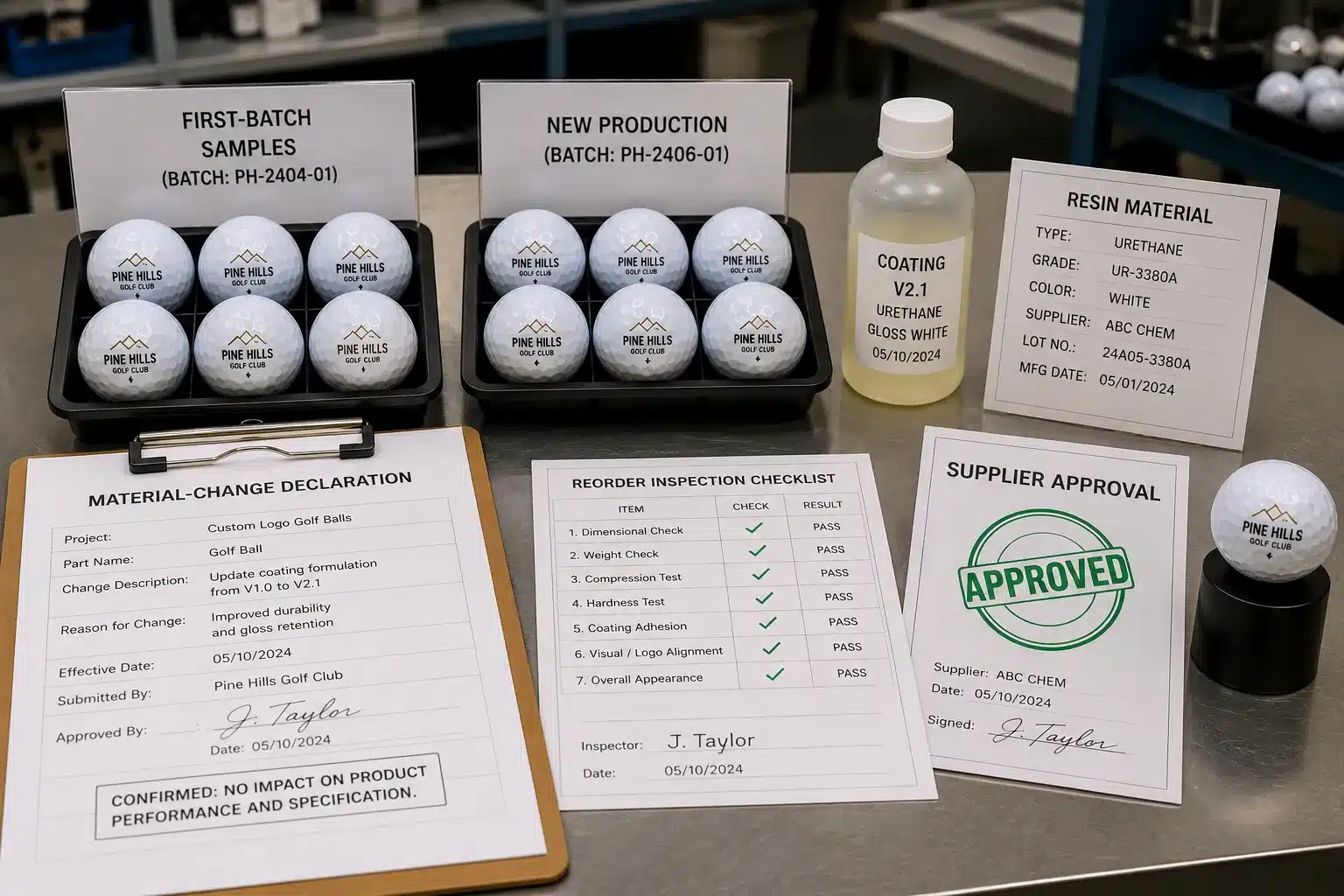
A reorder can change even when the SKU name stays the same. Your PO should require written approval for any change in core formula, cover resin, coating, ink, packaging, production facility, or sub-supplier, and the supplier should issue a material-change declaration before production.
Material, facility, or sub-supplier?
Repeat-order drift can be accidental, process-driven, cost-driven, or caused by weak buyer PO control. A raw material lot may change. A coating supplier may change. A finishing route may move to another line. A sub-supplier may support peak capacity. None of these should be treated as automatically suspicious, but none should happen silently either.
| Possible change | Risk | Buyer question | Required proof |
|---|---|---|---|
| Core material lot | Different impact response | Same supplier and grade? | BOM declaration |
| Cover resin | Different surface feel | Any resin change? | Material note |
| Coating supplier | Gloss or tackiness drift | Same coating version? | Coating lock |
| Facility route | Tolerance shift | Same production site? | Facility declaration |
| Sub-supplier | Unknown process drift | Any outsourcing? | Written approval |
Factory cannot confirm coating version or material route is a failure signal. Request a signed no-change declaration covering material, formula, cover resin, coating, ink, packaging, facility, and sub-supplier route. Compare that declaration against the previous batch record and current production confirmation.
No core formula, cover resin, coating system, clear-coat route, ink system, packaging material, production facility, sub-supplier, or process route may be changed from the referenced previous batch without written buyer authorization and updated pre-shipment comparison approval.
Any necessary change should trigger written buyer approval and updated pre-shipment comparison. That protects both sides: your team gets traceability, and the supplier avoids a subjective “this feels different” dispute after delivery.
What Should You Compare Before Reordering?
Your team may reorder quickly and skip cross-batch verification. That shortcut can move the problem from the factory floor to your warehouse.
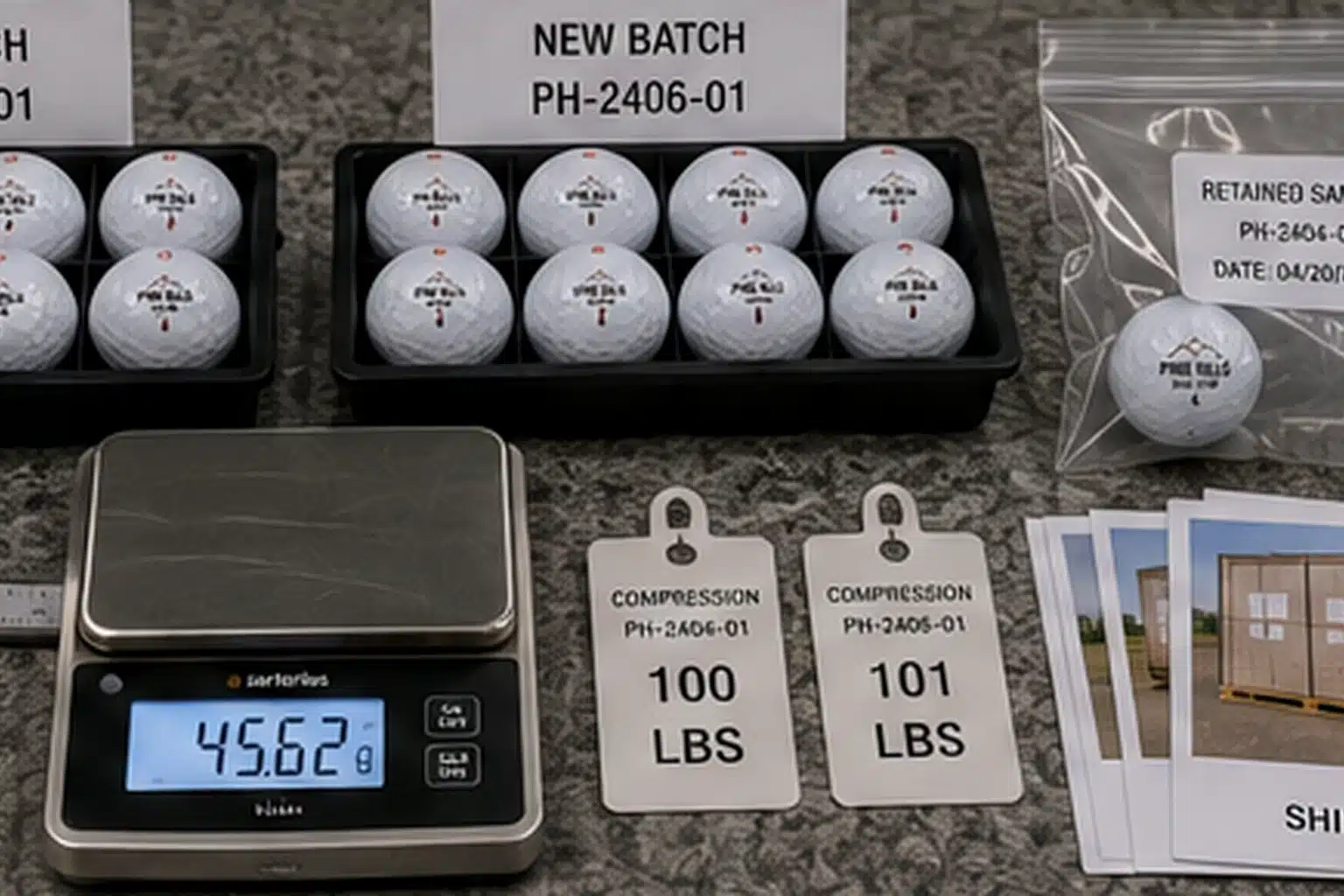
Before accepting a reorder, compare the new batch against the previous batch, not just the catalog SKU. Your team should review retained samples, batch IDs, 12-ball raw compression data, spread, weight, diameter, coating version, cover feel, and pre-shipment photos.
Old batch or new batch?
The old batch is your baseline. The new batch is your candidate. They should meet under the same inspection method before shipment release. A reorder sample that looks acceptable by itself may still be outside your previous batch feel, finish, or packaging expectation.
| Comparison point | Old batch evidence | New batch evidence | Decision |
|---|---|---|---|
| Batch ID | Previous lot | Current lot | Confirm traceability |
| Retained sample | First-batch sample | New sample | Compare feel and finish |
| Compression | Raw values and spread | Raw values and spread | Check window |
| Cover / coating | Version record | Current declaration | Approve or hold |
| Color / gloss | Reference photos | New photos | Check drift |
| Packaging | Previous version | Current version | Lock change |
Peak-season urgency increases the temptation to skip comparison checks. Protect lead time with earlier reorder planning, not weaker PO language. If your team waits until inventory is almost gone, you will feel pressure to accept weak proof. Golf balls can be round; reorder evidence cannot be.
Build a reorder comparison report covering previous batch, current batch, retained sample, compression, coating, visual finish, packaging, and supplier declaration. Review new batch evidence before shipment release. Shipment release should require cross-batch comparison approval, not only supplier assurance.
✔ True — Compare old batch and new batch before shipment
A reorder is acceptable only when the new lot is checked against the previous batch evidence, not merely judged as a standalone product.
✘ False — “A reorder sample only needs to look acceptable by itself”
A new sample can look fine and still fail the repeat-order promise if it does not match the first batch baseline.
What Should Your Reorder PO Require?
Your reorder PO may list price and quantity but fail to lock batch reference, compression range, coating version, material route, and inspection gate.
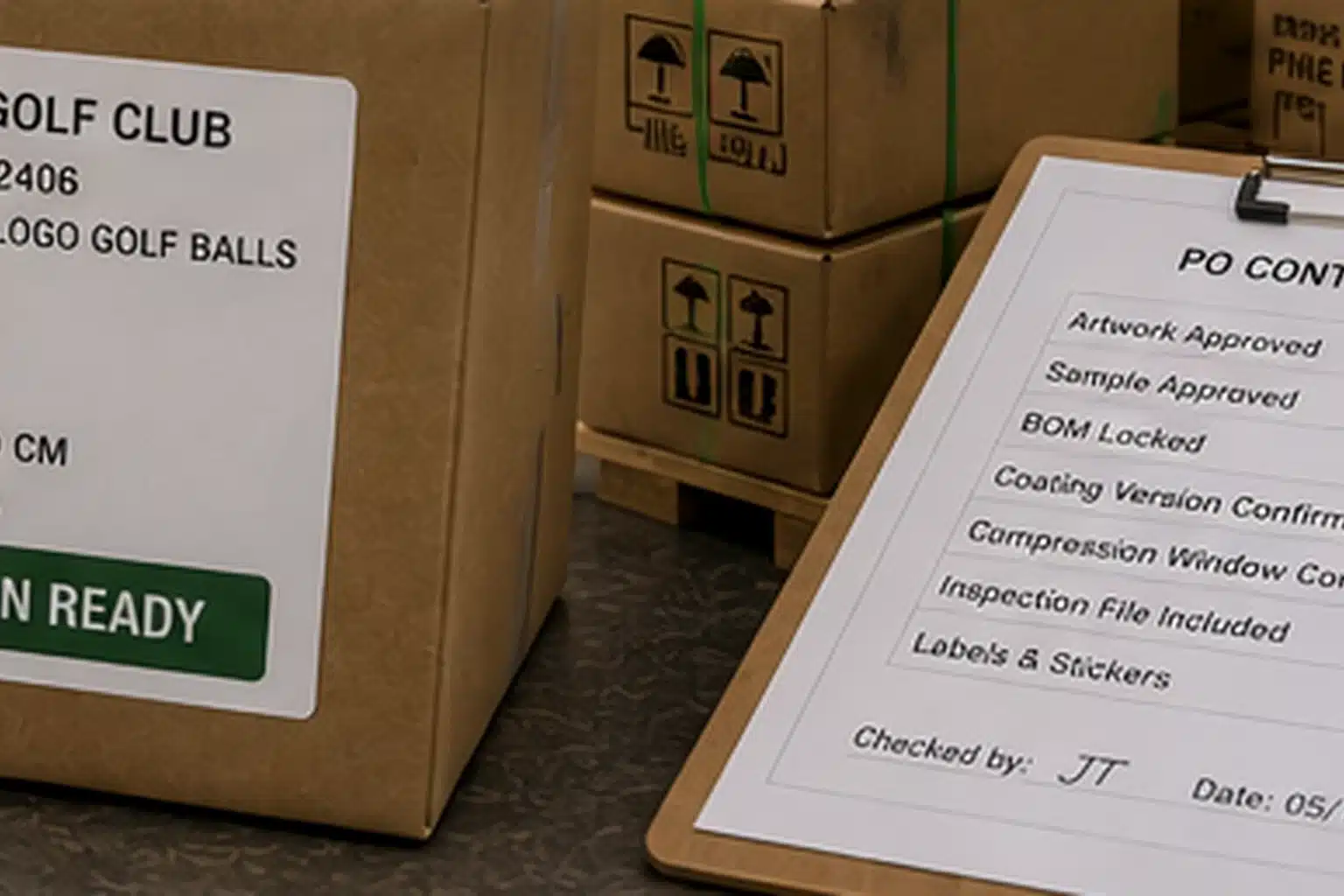
Your reorder PO should lock the previous batch reference and the new batch proof. Require previous batch ID, retained sample comparison, compression window, 12-ball raw data, coating version, material-change declaration, BOM lock, no facility change without approval, and pre-shipment inspection.
Batch ID, BOM lock, or tolerance?
A good reorder PO is a batch-linked quality-control document. It should not only repeat SKU name, quantity, price, and delivery date. It should identify the first batch, define the new batch proof, and state what happens if proof is missing.
| PO item | Why it matters | What to specify | Acceptance evidence |
|---|---|---|---|
| Previous batch ID | Reference control | Exact prior lot | ID match |
| Retained sample | Physical benchmark | Sample ID | Sample comparison |
| Compression window | Feel control | Buyer-agreed range | Raw 12-ball data |
| Coating version | Surface feel | No unapproved change | Declaration |
| BOM lock | Material control | Formula and supplier route | No-change statement |
| Facility route | Process control | No unapproved outsourcing | Written approval |
| Inspection plan | Shipment control | AQL or agreed method | Inspection report |
Supplier shall identify the previous order batch ID, retained sample ID, current production batch ID, 12-ball raw compression data, coating version, material declaration, and shipment lot under one reorder proof file before production release.
For lot-by-lot receiving inspection, an ISO 2859-1 reference can support AQL-style inspection language, but final pass/fail should follow buyer-agreed defect classification. If weight or diameter checks are included, remember that official golf ball conformance rules cover weight and diameter, while your reorder feel baseline still needs buyer-side comparison data. The R&A’s conformance rules state maximum weight and minimum diameter requirements for golf balls, but those rules do not replace your batch-to-batch feel controls. golf ball conformance reference
You can place this wording directly in your reorder RFQ:
“Please quote this reorder against previous Batch ID [insert]. Confirm current batch ID, retained sample comparison, compression target and buyer-agreed range, 12-ball raw QC data, coating version, cover hardness check where relevant, BOM lock, no material or facility change without written approval, and pre-shipment batch-to-batch verification.”
Buyer acceptance requires batch ID match, retained sample comparison, buyer-agreed compression window, no unapproved material or coating changes, and inspection pass.
FAQ
Why do my new golf balls feel different?
Your new golf balls may feel different because compression, cover hardness, coating, material lot, storage, or production route changed, or because the reorder lacked a previous batch reference.
Check retained samples, request 12-ball raw compression data, and compare coating and material declarations. Do not rely only on product name or supplier reassurance. The most useful question is whether the new batch matches the previous batch evidence.
Do golf balls vary from batch to batch?
Some manufacturing variation can exist, but B2B buyers should define buyer-agreed acceptance windows instead of accepting vague explanations about normal batch variation.
Use the same test method when comparing batches. Compare raw values, mean, standard deviation, and range. Tie acceptance to batch ID, retained sample comparison, and PO criteria. A supplier saying “it is within normal range” should be backed by data.
Why is my second batch of custom golf balls different?
Your second batch may use different material lots, coating routes, cure conditions, facility routing, or inspection standards if the reorder PO did not lock them.
Ask for a material-change declaration, current batch ID, coating version, and 12-ball QC report. Compare the new batch against the previous retained sample. If the PO only said “same as last time,” your reference may be too weak.
Can manufacturers change materials without telling you?
Your PO should prohibit material, formula, coating, facility, sub-supplier, or packaging changes without written buyer approval.
Use no-change clauses, require updated PPS or sample comparison when changes are necessary, and hold shipment if proof is missing. This is not about assuming bad faith. It is about keeping repeat orders traceable and enforceable.
Is Shore D the same as compression?
No. Shore D is a material hardness check often used for cover or layer hardness, while compression reflects whole-ball response and feel.
Use both only when relevant, and do not substitute one for the other. If cover feel is part of the complaint, Shore D may help. If impact response feels different, raw compression data and spread are usually more relevant.
How do you ensure quality on repeat OEM orders?
Use previous batch ID, retained sample comparison, 12-ball raw QC data, compression window, BOM lock, coating version lock, material-change declaration, and receiving inspection.
Do not rely on “same as last time.” Request raw values, not only averages. Approve the reorder before shipment through batch-to-batch comparison. Store retained samples so the next reorder has a real baseline.
What should I include in a repeat order PO?
Include previous order batch ID, retained sample ID, current batch ID, compression window, coating version, BOM lock, no-change clause, and inspection plan.
Define acceptance criteria and require supplier sign-off. Hold production if references are missing. A repeat order PO should describe the previous batch experience you want repeated, not only the item you want purchased.
What if I did not keep a retained sample?
You can still request old batch records, photos, QC reports, and customer complaint details, but the next order should create a retained sample system.
Rebuild reference data as well as possible, approve a new baseline, and store retained samples for future reorders. Keep buyer, supplier, and QC copies for higher-risk programs. Memory is not a long-term reorder control.
Conclusion
Repeat-order quality is protected by batch-linked evidence, not memory. “Same as last time” may be useful shorthand, but it is not enough to protect feel, surface, compression, coating, and supplier-route consistency.
The safest reorder path is to cite the previous batch ID, compare retained samples, request raw compression data, lock coating and BOM changes, require written material-change declaration, and inspect the new lot before shipment acceptance.
When your next golf ball reorder needs to feel like the first batch, your PO should not ask the supplier to remember. It should make the previous batch impossible to misunderstand.
You might also like — Golf Ball QC in China: 4 Must-Have Tests for OEM Buyers