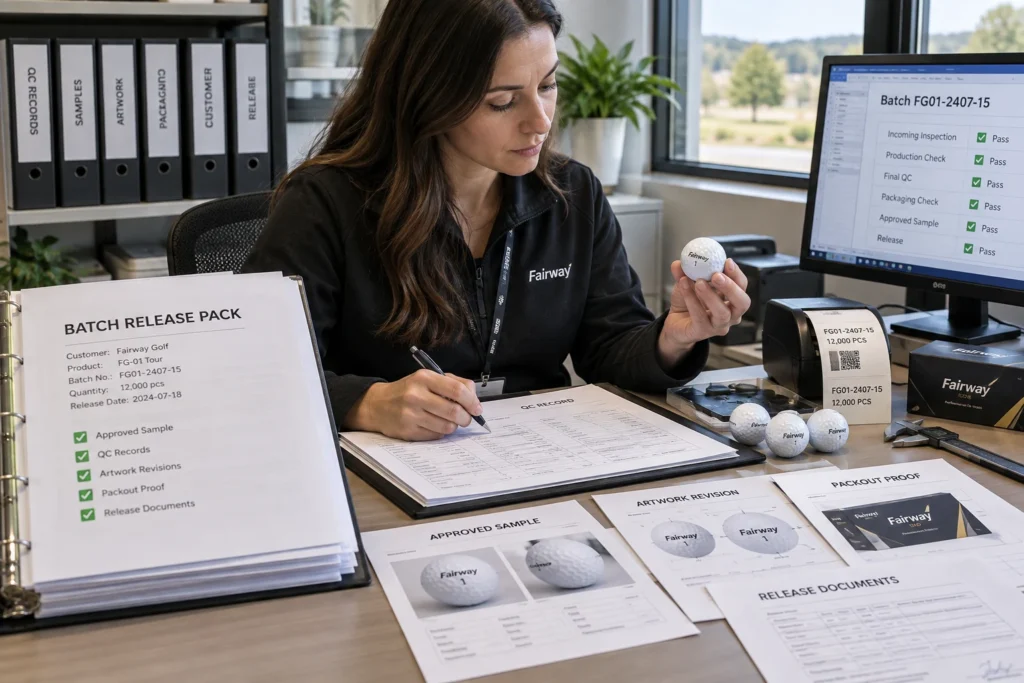
Your supplier can send a valid QC report, approved artwork, and packout photos—and still leave you unable to prove they all describe the exact batch waiting to ship.
A golf ball batch release pack should include one cross-referenced evidence set linking the approved product version, production batch ID, applicable QC evidence, closed exceptions, final packout, manufacturing release, and buyer shipment approval. The goal is one reconstructable approval decision—not more paperwork.
That distinction matters because a valid document can still support the wrong release decision. A PASS result may belong to another production batch. Approved artwork may be an older revision. Correct golf balls may be packed in the wrong commercial configuration.
Before shipment handoff, your team needs to answer one question: Do all release-critical records point to the exact goods you are authorizing to leave factory control?

What Makes a Batch Release Pack Complete?
The most common weakness is not missing paperwork. It is evidence fragmentation.
You may already have a QC report, production-complete notice, approved sample, artwork file, packaging proof, and retained-sample record. If those documents cannot be reconciled to one SKU, one approved version, and one production batch, your team still cannot reconstruct the release decision.
A complete batch release pack is not a folder full of QC files. It is one indexed evidence set that ties the approved product version, production batch, QC result, exception status, final packout, and release authority to the same lot. If those identifiers do not reconcile, your approval is still open.
The useful question is not:
How many documents did the factory send?
It is:
Can you move from the product you approved to the exact batch being released without losing identity anywhere in the chain?
The evidence path should remain intact:
Final SKU / Version → Batch → QC → Exceptions → Packout → Manufacturing Release → Buyer Approval
| Buyer decision | Evidence link | Failure signal | Buyer action |
|---|---|---|---|
| Correct version? | Final spec + approval reference | Obsolete revision | Hold and reconcile |
| Correct batch? | Production batch ID | No batch identity | Identify exact batch |
| QC closed? | Final QC reference | Generic “PASS” | Retrieve source record |
| Exceptions closed? | Disposition / closure record | “Fixed” only | Request closure |
| Packout matched? | Final packout revision | Wrong revision | Stop approval |
| Release authorized? | Release status / owner | No authority | Confirm approval |
The ASQ Quality Glossary defines a lot or batch as a definite quantity of product manufactured under production conditions considered uniform. For an OEM golf-ball buyer, that makes batch identity a practical release boundary: a QC result should be tied to the production batch it represents, not only to the product name or SKU.
Suppliers may use either “batch” or “lot” in their controlled records. In this article, we use “production batch” for consistency; whichever term appears in your supplier’s records, keep the same identifier consistent across the release pack.
A stronger chain is:
SKU → Final Spec Revision → Approved Sample / Pre-Production Sample (PPS) → Artwork Revision → [Production Batch ID]
Only then can the QC record, retained sample, exception record, packout proof, and release status attach to the correct product.
A practical Batch Release Cross-Reference Index should identify the PO/SKU, final specification revision, approved sample or PPS, production batch, final QC record, retained sample, artwork revision, packout revision, exception status, manufacturing-release status, and buyer-approval status.
Real manufacturing logic also matters here: printing finished does not equal batch released. Production can complete molding, finishing, coating, and printing while a final release condition remains open. The buyer does not need every process parameter; you need evidence showing whether the finished lot actually cleared the applicable release gates.
“QC PASS” that cannot be linked to the final SKU/version and production batch is a failure signal.
Supplier shall provide one batch-release index linking the final approved specification revision, approved sample or PPS reference, production batch ID, applicable QC record, retained-sample reference, final artwork and packout revisions, closed nonconformance records where applicable, and manufacturing-release status.
Before placing the order, test whether the supplier can support that structure:
Please provide a sample batch-release index showing how the quoted SKU will link the final specification revision, approved sample or PPS reference, production batch ID, applicable QC record, retained sample, final artwork and packout revisions, any closed release-blocking exception, and manufacturing-release status before shipment handoff.
A supplier sending a smaller set of well-linked records can give you stronger release control than one sending a much larger folder of unrelated PDFs.
Your goal is not the largest document folder. Your goal is one reconstructable approval decision.
✔ True — You need linked evidence that can be reconciled
A compact release pack can be strong when every record points clearly to the same approved SKU, revision, production batch, and release decision.
✘ False — “The largest document folder is automatically the safest release pack”
Document count does not repair broken identity. More files help only when your team can show which product, version, batch, and decision each one supports.

Which Approved Version Should the Pack Identify?
A technically correct QC report can still describe the wrong commercial product if production used an obsolete artwork, finish, specification, or packaging revision.
Your release pack should identify the exact product version the factory was expected to reproduce. Lock the final specification, approved sample or PPS reference, artwork, finish, and applicable packout revision to the production batch before you accept QC evidence or authorize shipment.
Your team needs to answer two separate questions:
What exactly did we approve?
What exactly did the factory produce?
Those answers should converge on one controlled version.
A practical Approved Version Reference can identify the final specification revision, approved sample or PPS, final artwork revision, applicable logo or print approval, approved color or finish reference, packout revision, and production batch ID.
Customization makes version control especially important. The commercial SKU name may stay unchanged while the artwork file changes. A logo can be printed cleanly and still be the wrong revision. A finish can be consistent and still differ from the physical reference your team signed off.
So statements such as “logo passed” or “same as approved” are weak unless the release pack answers:
Which artwork? Which sample? Which revision? Which batch?
The same discipline applies to the physical product. The final specification and approved sample/PPS establish what the factory was expected to reproduce; the release index then connects that approved definition to the actual production batch.
If the approval reference itself is unclear, move upstream to the approved golf ball sample and PPS process. This article assumes that approval already exists and asks whether the final batch points back to it.
Final artwork, finish, or packout identity that does not match the released production batch is a failure signal.
Put an Approved Version Reference into the release index. If one release-critical revision remains ambiguous, your shipment approval should remain open even when the QC results themselves are valid.
Which QC Records Should the Pack Link?
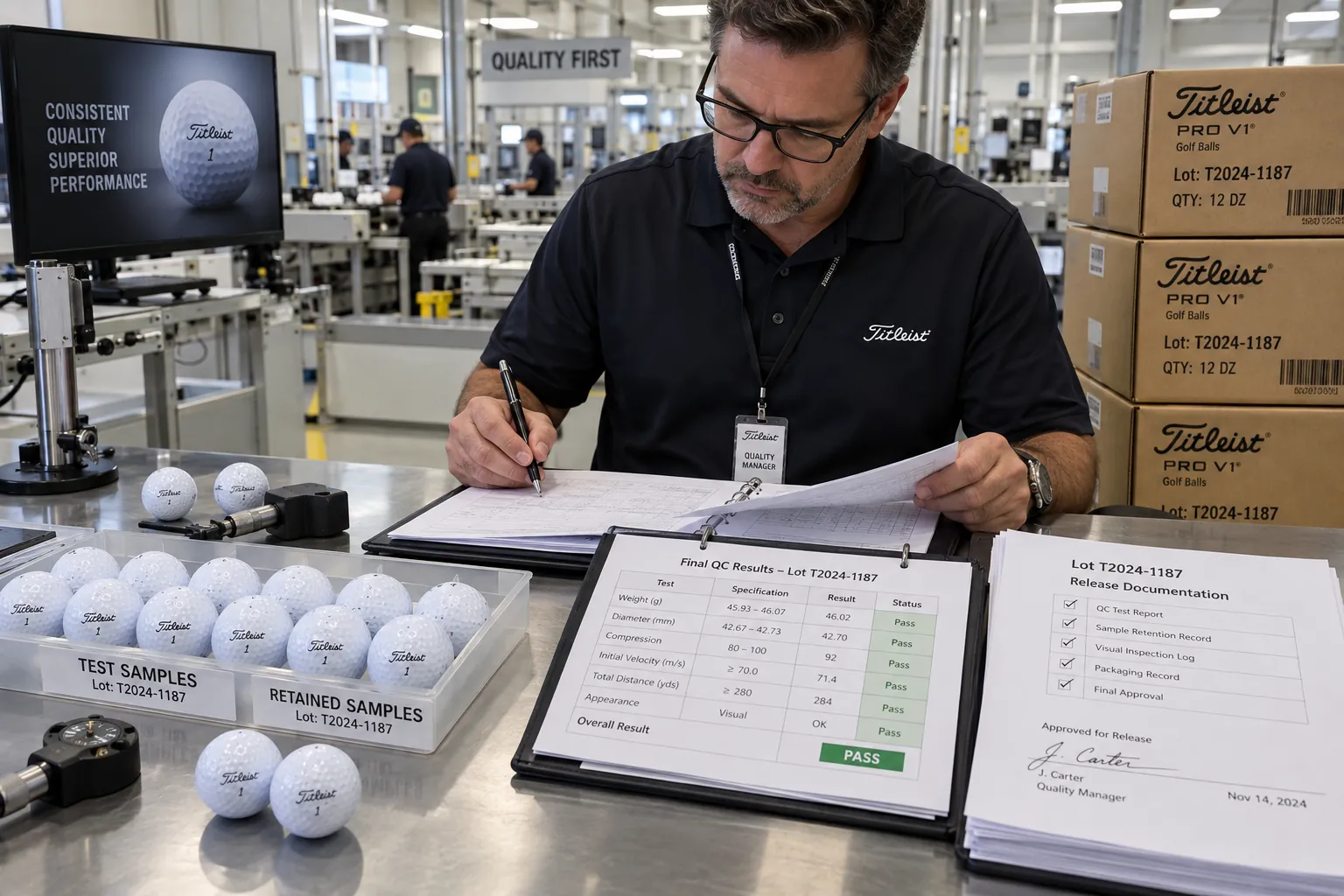
A QC report stamped PASS answers only part of the release question. Before approving shipment, you still need to know which production batch was represented by that result.
Do not turn the release pack into another laboratory report. Link the final QC record, tested-sample identity, production batch, acceptance status, and applicable method and retained-sample references to the batch you are approving.
A useful relationship is:
QC Record ID + Sample Reference + Batch ID
Depending on the SKU and agreed acceptance criteria, the referenced evidence might concern physical dimensions, compression, concentricity, durability, finish acceptance, appearance, or another release-critical characteristic.
Not every SKU needs every possible QC record.
A straightforward promotional SKU and a more technically demanding multilayer SKU can use the same release-control architecture while pointing to different underlying evidence. What matters is that the referenced records are appropriate to the actual product, process route, customization, and agreed acceptance criteria.
| Release question | Evidence link | Weak evidence | Buyer action |
|---|---|---|---|
| Which batch was tested? | Batch ID | No lot reference | Match exact batch |
| Which samples? | Sample IDs | Anonymous results | Identify samples |
| Which criteria? | Acceptance reference | “PASS” only | Confirm criteria |
| Which source record? | QC Record ID | Screenshot only | Retrieve source record |
| Which retained reference? | Retained Sample ID | No reference | Confirm retention |
A retained sample can strengthen this chain because it gives the released production batch a physical reference after production. Its value still depends on identity: the retained ball should point to the same production batch and approved version as the QC evidence.
This is why requesting “QC data” alone is not enough. The more useful buyer question is:
Which batch do these results, samples, and records actually describe?
If your question changes from evidence linkage to how compression, dimensions, concentricity, AQL, durability, or other characteristics should actually be tested, use the dedicated golf ball QC and batch verification guide.
The deliverable here is a Batch-Linked QC Reference that lets your team trace the final QC evidence back to the exact production batch being released.
✔ True — A QC report is one component of the Batch Release Pack
Its release value comes from showing which production batch and sample population the result represents and which acceptance reference was applied.
✘ False — “The QC report and the Batch Release Pack are the same thing”
QC can establish test or inspection results. Final batch approval must also reconcile product version, exception status, packout, and release authority.
Which Packout Records Must Match the Batch?
A batch can pass technical QC and still leave the factory in the wrong commercial configuration. Correct golf balls do not automatically mean correct finished goods.
Packaging evidence belongs in the batch release pack only when it proves the released product was packed as approved. Confirm the final packout revision, quantity configuration, required labels, and carton marks against the same SKU and production batch.
Leave freight, customs, and import documents to the shipment file.
A concise Final Packout Match should answer:
-
Which packout revision was approved?
-
What quantity configuration applies?
-
Which product labels are current?
-
Which carton marks are approved?
-
Does the finished-packout proof match those references?
-
Can the packed cartons still be traced to the released batch?
Packout belongs in the release decision because commercial identity can be lost at the last stage.
The balls may be correct while an earlier retail-box revision is used. The logo may be current while carton marks belong to another program. The product can pass technical QC yet be packed in the wrong unit configuration.
Those are reasons to verify the final physical commercial configuration, not reasons to turn the release pack into a logistics file.
If the question changes from “Did the final packout match approval?” to “Which box, sleeve, gift pack, or other format should we use?”, move to the guide on OEM golf-ball packaging options.
Here, the acceptance rule is simpler: keep Buyer Approval on hold when a release-critical packout, label, or carton-mark revision remains unresolved.
How Should Open Exceptions Block Release?
When a supplier says “the problem is fixed,” your next question should not be “Great—can we ship?” It should be “Show me how the release hold closed.”
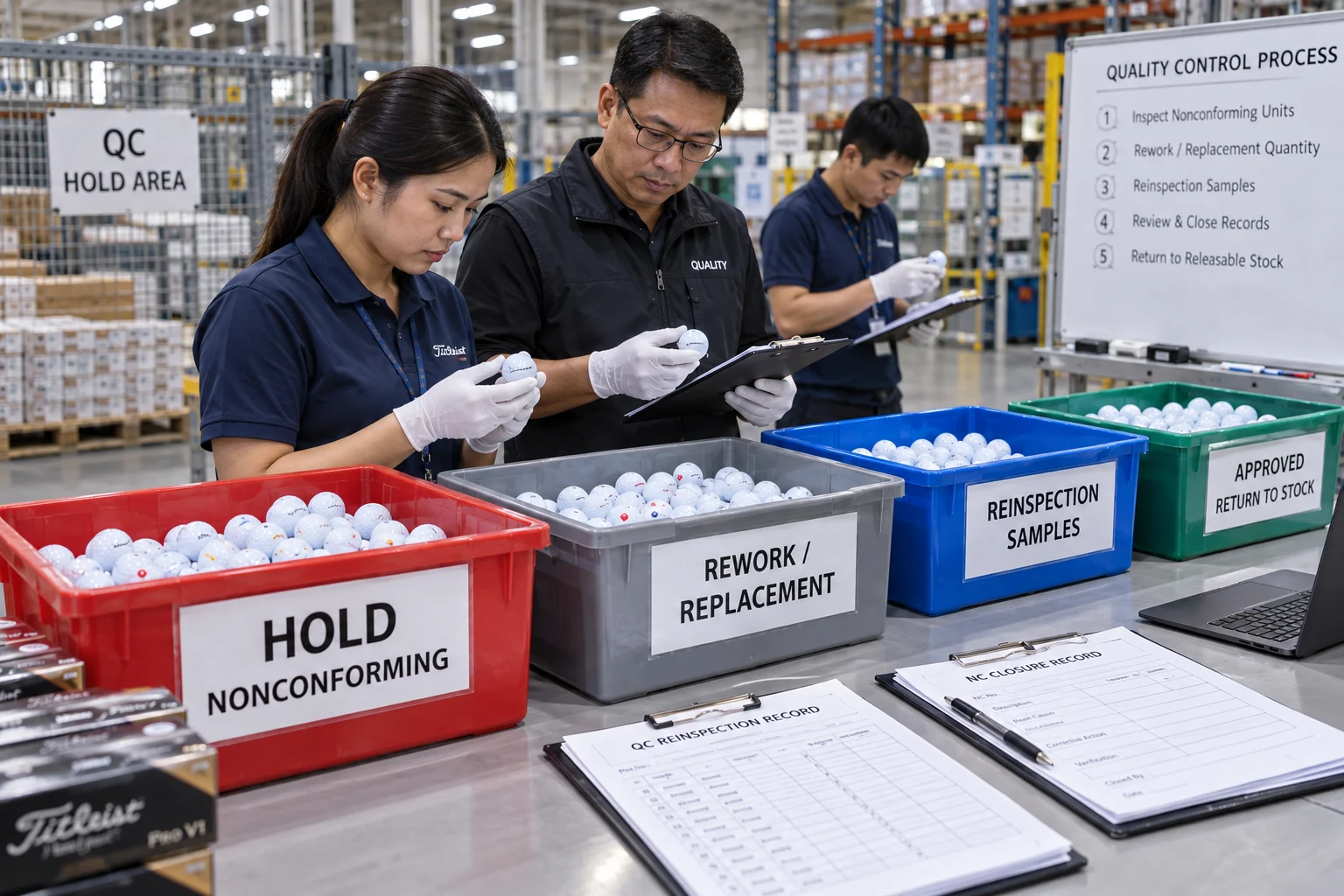
If any part of the batch was held, your release pack should show how the exception closed. Require the hold reason, affected quantity, disposition, correction or replacement quantity, applicable reinspection, and final release status before you approve shipment handoff.
“Fixed” is not a closure record.
The control chain should remain reconstructable:
Detection → Hold → Segregation → Disposition → Correction / Remake → Reinspection → Authorized Closure
This sequence reflects practical manufacturing control. Once a release-blocking issue is found, physically correcting the visible problem is only part of the evidence.
| Exception stage | Evidence | Weak response | Buyer action |
|---|---|---|---|
| Detected | Hold record | Verbal explanation | Record problem |
| Contained | Affected quantity | “Sorted” | Verify segregation |
| Dispositioned | Scrap / rework / remake | Unclear | Confirm disposition |
| Corrected | Corrected quantity | “Done” | Reconcile quantity |
| Reinspected | Reinspection result | Photo only | Review evidence |
| Closed | Release authority | No closure | Keep approval on hold |
A Closed Exception Record should show what population was affected, whether it was segregated, what disposition was authorized, what quantity was corrected or remade, what reinspection evidence applied, and who closed the hold.
That lets someone who was not standing on the factory floor reconstruct the decision later.
It is much stronger than:
Problem fixed. Please arrange shipment.
This article stops at pre-shipment exception closure. It does not determine post-delivery compensation, replacement freight, credit, claim windows, or other commercial remedies. If the issue moves beyond pre-shipment exception closure into post-delivery responsibility, use the separate guide to golf ball OEM warranty terms.
An exception marked “fixed” without disposition, applicable reinspection, or authorized closure is a failure signal.
Your team should be able to answer one question before release:
Can we prove what happened to every release-blocking exception?
✔ True — A batch can contain a defect and later become releasable after documented closure
A release decision becomes reconstructable when the affected population, segregation, disposition, correction, reinspection, and final authorization remain linked.
✘ False — “Correcting the defect automatically closes the release decision”
Correction addresses the physical problem. Shipment approval still needs evidence showing that the release-blocking exception was controlled and formally closed.
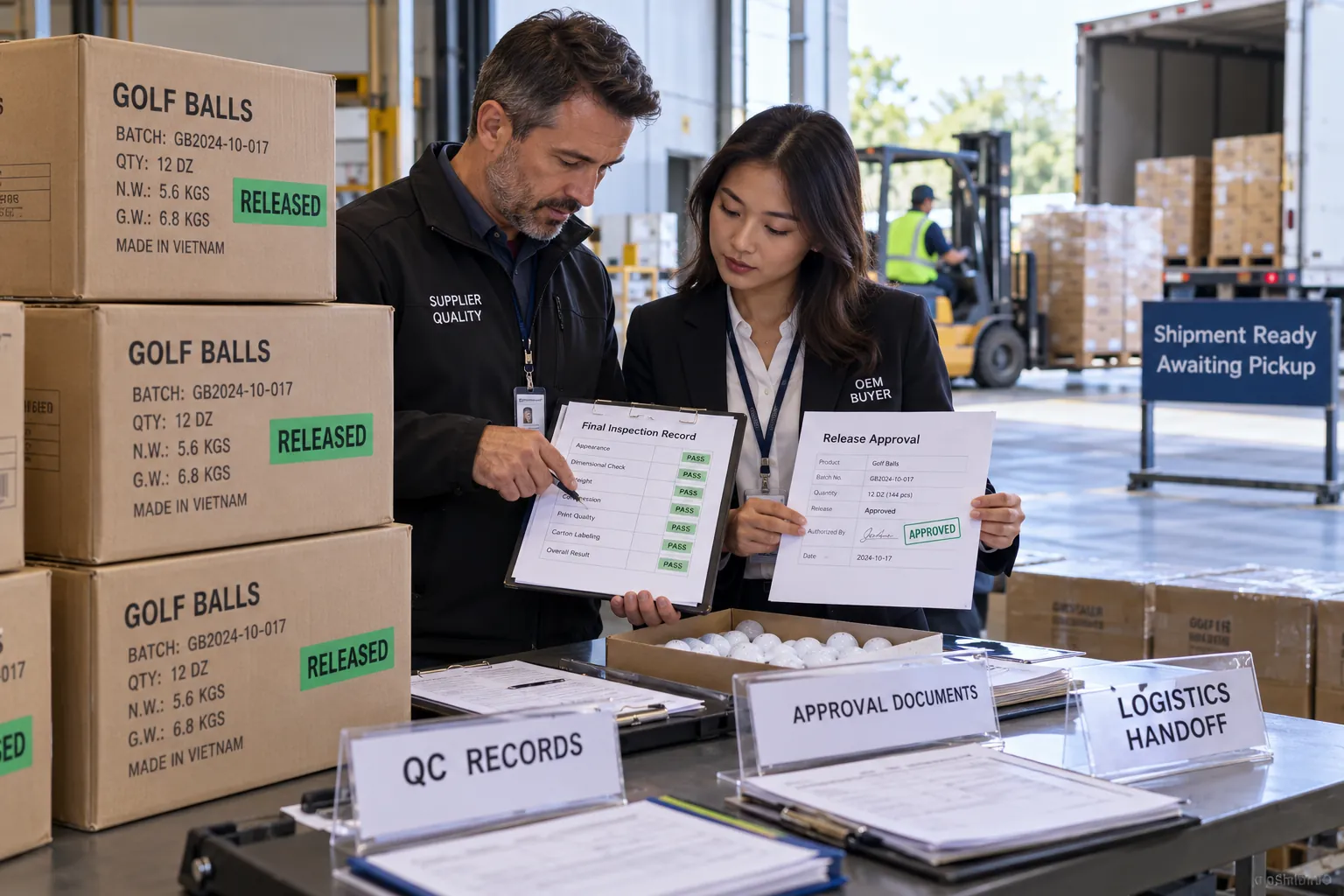
“Ready to ship” is often used as if it were a single status. For a B2B buyer, it is safer to treat it as three separate decisions controlled by different parties.
Factory manufacturing release, buyer approval, and logistics release are different decisions. Your release pack should record who authorized manufacturing release and whether your team accepted the linked evidence before shipment handoff.
Commercial invoices, customs execution, and freight documentation belong downstream.
The sequence is:
Manufacturing Release → Buyer Approval → Logistics Release
Manufacturing Release means the supplier-side authority considers the applicable production and release conditions closed.
Buyer Approval means your team has reviewed the agreed final evidence and accepts the exact SKU/version and production batch for shipment handoff.
Logistics Release means the approved goods may proceed into the forwarder or carrier process.
A QC PASS can support manufacturing release without automatically creating buyer approval. Likewise, buyer approval does not prove that the forwarder has collected or accepted the cargo.
The current ISO 9001:2026 quality-management framework emphasizes documented information and the planning, implementation, and control of processes needed to meet customer requirements. A buyer-side Batch Release Cross-Reference Index applies that discipline to the evidence used for this shipment decision; ISO does not prescribe this exact golf-ball release-pack format.
A useful Buyer Shipment Approval Record should show the supplier manufacturing-release authority, release status or date, whether agreed evidence is open or closed, buyer approval status, and shipment-handoff status.
Buyer shipment approval shall remain on hold until all agreed release evidence identifies the same approved SKU/version and production batch, and every release-blocking nonconformance has a documented disposition and applicable reinspection closure.
For a buyer with a fixed commercial commitment, this separation is more useful than treating “Production Finished” or “QC Passed” as automatic permission to ship.
Once Buyer Shipment Approval closes, the decision moves downstream to golf ball shipping and freight planning. Routing, cargo data, landed cost, and freight execution belong there.
Until then, keep asking:
Has the factory finished manufacturing, or have you actually approved this exact batch to leave factory control?
FAQ
Is a Batch Release Pack the Same as a QC Report?
No. A QC report records inspection or test results; a Batch Release Pack connects those results to the approved product version, production batch, exception status, packout, and final release decision.
The QC report can be one of the most important records in the pack, but it answers only part of the approval question. You still need to establish that the evidence belongs to the exact batch and version you are releasing.
Is a PSI Report Enough to Release the Batch?
Not necessarily. A pre-shipment inspection can provide important final evidence, but it does not automatically prove that every other release-critical requirement has closed.
Confirm what the PSI covered and which batch it identified. Then check whether your program also requires approved-version confirmation, retained-sample linkage, exception closure, or final packout evidence.
Is This the Same as a Shipment Document Pack?
No. The Batch Release Pack supports manufacturing release and buyer approval; the shipment file supports the transport, customs, commercial, and downstream logistics processes that follow.
Keep the sequence clear:
Manufacturing Release → Buyer Approval → Logistics Release → Receiving
Commercial invoices, packing lists, bills of lading, air waybills, customs filings, duties, and broker records belong downstream.
Does Every Golf Ball SKU Need the Same Release Pack?
The control structure can remain consistent, but the supporting evidence should follow the actual SKU, process route, customization, buyer specification, and release risk.
A straightforward promotional ball may require fewer specialized technical references than a more complex construction. Customized programs may add artwork, finish, or packaging references.
The goal is not a universal fixed-document checklist. It is evidence appropriate to the product being released.
What If the Batch Had a Corrected Defect?
A corrected batch can still become releasable if the hold, affected quantity, segregation, disposition, correction or remake, applicable reinspection, and final closure are documented.
A documented exception trail can be stronger evidence than a release record that simply omits the resolved issue, because it shows how the affected population was controlled before release.
Do Repeat Orders Need a New Release Pack?
Yes. The release framework can be reused, but every new production batch needs current batch-specific evidence. A previous batch’s QC result, retained sample, or release status cannot prove the status of a new production batch.
Link the new Batch ID to the current approved revision, applicable QC records, exception status, packout, and manufacturing release. For the broader cross-batch decision, use your repeat-order consistency controls.
Conclusion
A useful golf ball Batch Release Pack is not measured by how many certificates it contains. It is measured by whether your team can connect the approved version, production batch, applicable QC evidence, closed exceptions, final packout, and release authority without ambiguity.
Before shipment handoff, you should be able to answer seven questions: Is this the final approved version? Is this the actual production batch? Does the QC evidence belong to it? Are release-blocking exceptions closed? Does final packout match approval? Has manufacturing release been authorized? Has your team approved this exact batch to leave factory control?
You might also like — China Golf Ball Freight: The B2B Shipping & Landed Cost Guide