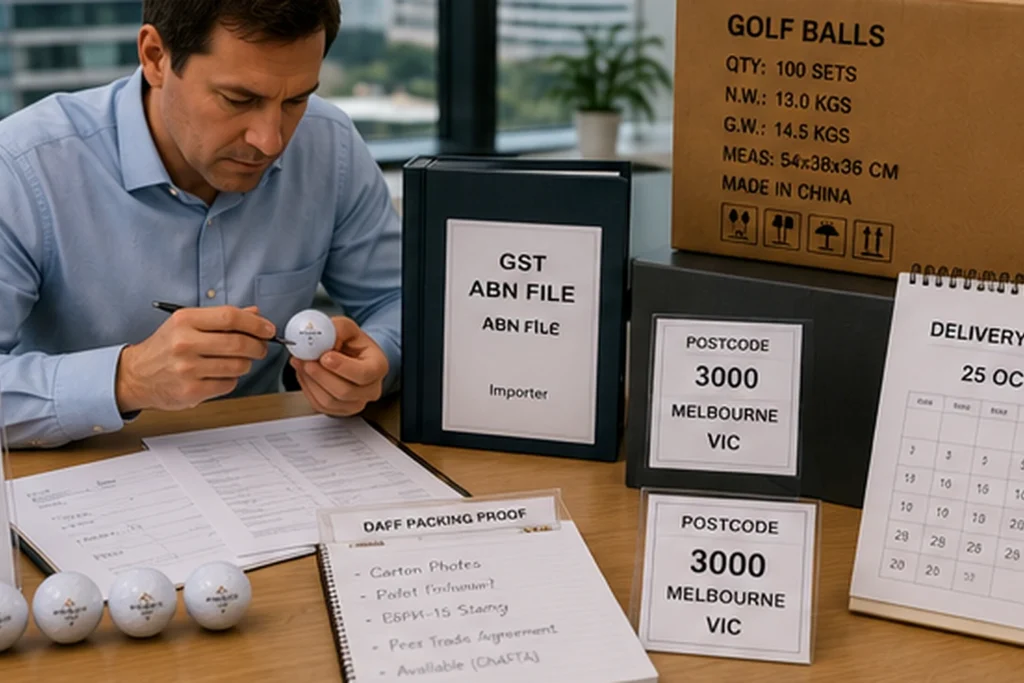
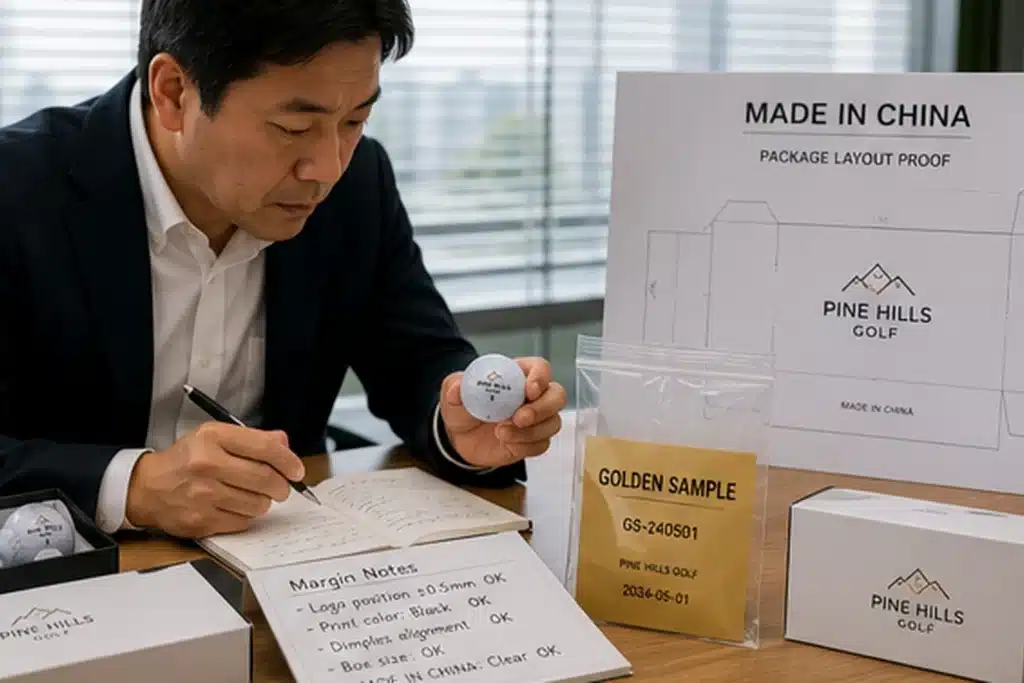
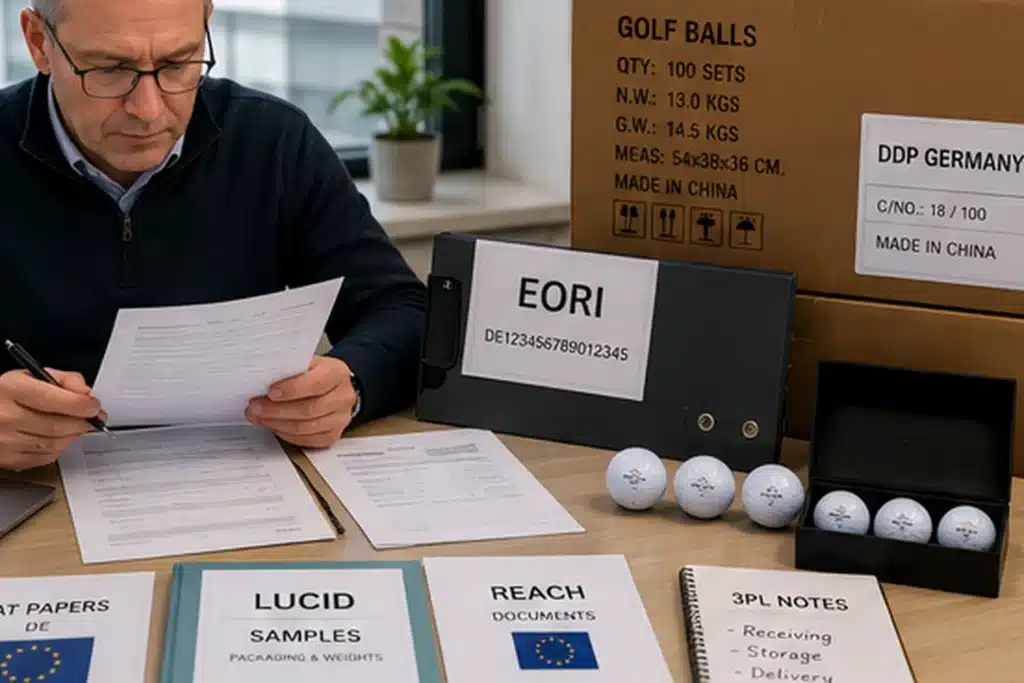
To request China golf ball OEM samples, use a two-step process: request 10–12 blank stock balls first to test weight, diameter, compression, feel, and flight; then order logo-printed prototypes only after the ball spec passes. Final approval should be locked with a signed Golden Sample, PPS, FAI, AQL criteria, and written bulk remedies.
A beautiful sample is not enough. Bulk production can still feel harder, fly shorter, print worse, or fail customer expectations if the sample has no batch ID, no measured data, no retained twin, and no bulk acceptance criteria.
Use this guide to avoid free-sample traps, request the right sample types, evaluate factory capability with 10–12 ball group data, and turn one approved sample into a measurable production control point.
Why are free samples risky?
You may think free samples reduce risk, but vague free samples often create the opposite: unclear specs, no sample ID, no refund terms, and no bulk-control value.
Free samples are useful only when they answer a real sourcing question. Ask for blank stock balls when you need feel and flight data; pay for custom prototypes only when the sample has a clear ID, setup scope, refund clause, and bulk-control purpose.
A serious factory sample is not a souvenir. It is a small production exercise that should predict bulk performance, logo durability, and buyer acceptance. If a supplier says “free sample” but cannot confirm structure, cover family, compression target, sample quantity, sample ID, or refund terms, your team is not reducing sourcing risk. You are collecting loose balls with weak evidence.
Blank stock samples may be free or low-cost, with the buyer paying courier. Custom logo or packaging samples are different. They can require plates, jigs, Pantone matching, print setup, alignment checks, sample handling, or packaging mockups. That is why a $50–$200 setup or sample fee can be reasonable when it buys traceability and a bulk-control reference.
Factory offers free custom samples but refuses sample ID or fee/refund terms is a failure signal. Professional buyers do not avoid every fee; they avoid fees that produce no usable evidence. Your sample budget should buy decisions, not desk clutter.
| Pain/decision | Sample path | Risk if vague | Action/evidence |
|---|---|---|---|
| Want to screen feel | Blank stock balls | Paying logo fee too early | Request same intended structure |
| Need logo proof | Custom print sample | No setup clarity | Confirm plate/setup fee |
| Need retail look | Packaging mockup | Pack cost distracts from ball fit | Move later if ball unproven |
| Supplier says free | Undefined sample | No traceability | Ask for sample ID |
| Fee feels risky | Refundable setup | Dispute later | Write offset trigger in PI |
✔ True — Professional buyers pay for traceable prototypes when needed
A paid sample can be smart when it includes sample ID, print method, setup scope, measured values, photos, and a written refund or offset trigger.
✘ False — “Free always means lower sourcing risk”
A free sample with no structure, batch, compression target, or bulk reference may be cheaper today and expensive after the PO.
When should you pay for prototypes?
Pay when the prototype proves something that a loose stock ball cannot prove: your logo, your Pantone color, your print position, your coating durability, or your packaging fit.
Request a sample PI showing sample type, setup fee, courier term, refund trigger, sample ID, and expected deliverables. Check whether the sample matches your intended bulk structure, not a display-only substitute.
All samples shall carry a visible sample ID and batch reference. Supplier shall provide sample quantity, ball structure, cover family, compression target, print method, color reference, photos, measured values, production date, retained-sample location, and courier tracking before buyer evaluation.
Which blank samples should you request first?
You can waste custom-logo money if the ball’s feel, compression, flight, or durability is wrong before the logo is ever printed.
Test the ball before you test the logo. Request blank stock balls that match your intended structure, cover family, and compression target; once feel, flight, and consistency pass, spend the setup fee on logo and packaging samples.
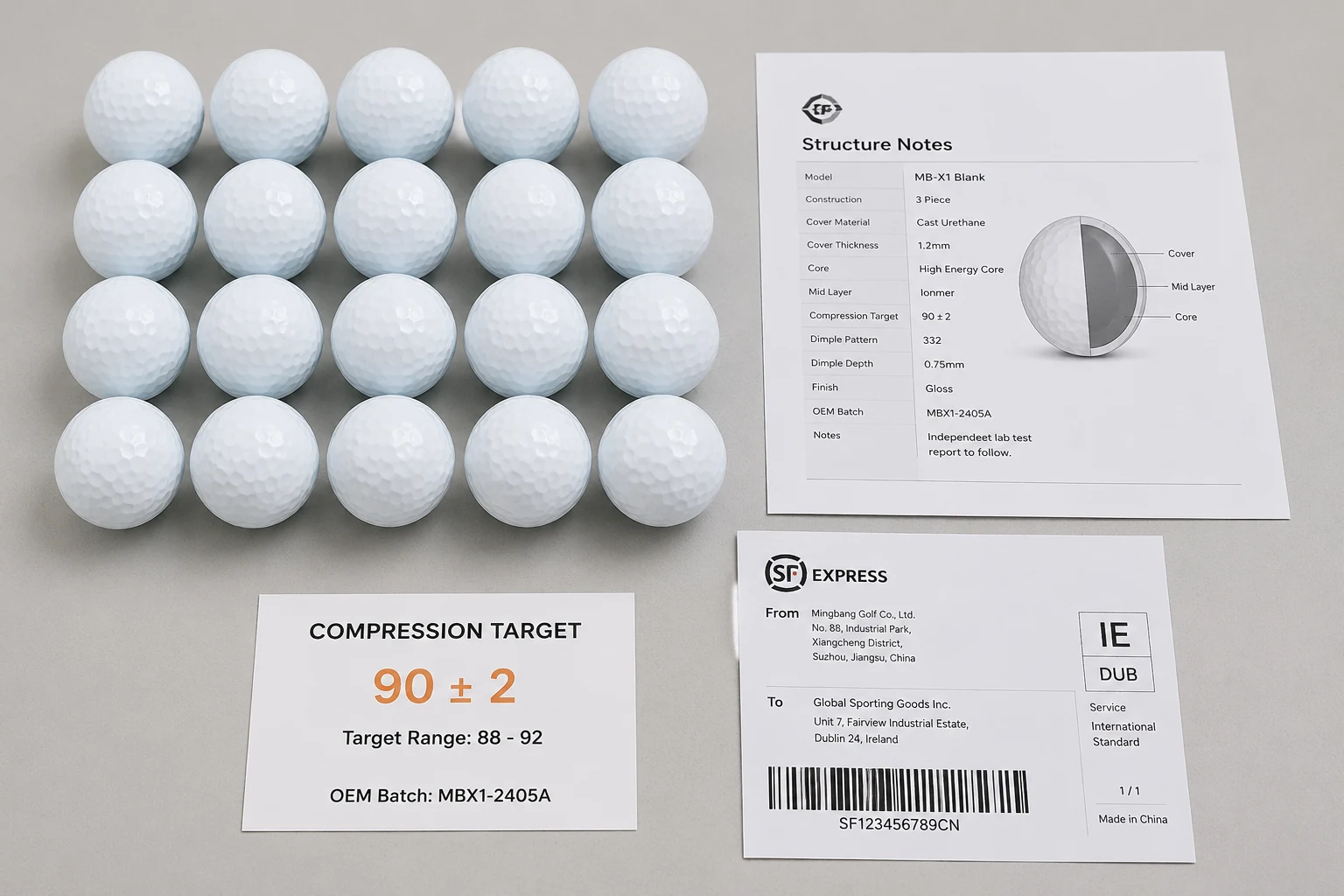
The smartest golf ball OEM prototyping sequence is usually not “print my logo first.” It is “send the blank ball that represents the intended bulk structure.” That keeps your first test focused on the product itself: compression, cover feel, durability, flight, and dispersion.
For range, promotional, and value retail programs, a 2-piece Surlyn blank often gives the cleanest first screen because durability and consistency matter more than tour-level spin. For mid-tier retail, compare 2-piece and 3-piece blanks. For premium feel, ask for the correct PU or urethane sample, but require coating evidence because cover and finishing risk increase.
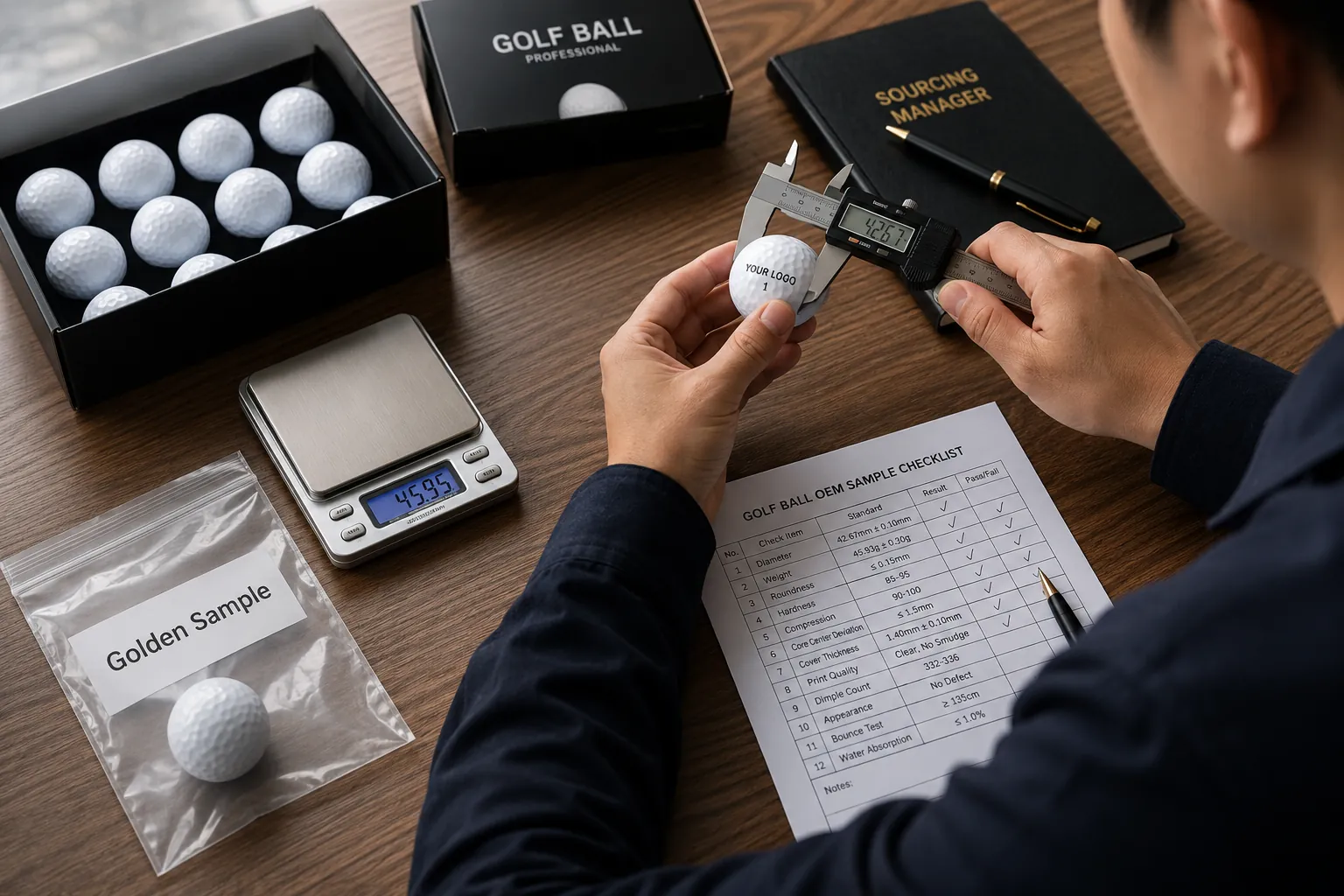
Do not ask for one or two loose balls and make a sourcing decision. Request 10–12 balls from the same sample batch. That gives your team enough pieces to see whether the factory controls weight, diameter, compression, and visual consistency before you spend money on artwork.
Serious buyers protect sample budget by testing the core ball first. If the blank sample fails feel, compression, or flight, your logo sample would only prove that the wrong ball can be decorated nicely.
| Buyer decision | Blank sample to request | What it tests | Action/evidence |
|---|---|---|---|
| Range/value product | 2-piece Surlyn blank | Durability and feel | Ask for same bulk compression |
| Retail mid-tier | 2-piece or 3-piece blank | Feel/spin balance | Request 12-ball set |
| Premium feel | PU/urethane sample | Cover and coating risk | Ask for coating evidence |
| Low-budget pilot | Existing stock ball | Fit before setup fee | Delay logo proof |
| Unsure spec | A/B blank set | Buyer preference | Compare side by side |
How do blank balls prevent wasted setup fees?
Blank balls prevent waste because they separate the core product decision from the branding decision.
Request 12 blank balls from the same intended structure and batch, with cover family, compression target, and sample ID. Confirm they are not display-only substitutes and can represent bulk production. Only move to logo sampling after blank samples pass your feel, compression, weight, diameter, and consistency checks.
This two-step sampling path also protects timing. If your team later needs a fast launch path, this China golf ball OEM lead time guide explains how simpler samples, blank boxes, and staged approvals can reduce schedule pressure.
How do you test sample consistency?
A single hero sample can feel great while the dozen shows compression spread, weight variation, diameter issues, or curing instability.
Do not approve a golf ball sample by one perfect shot. Evaluate 10–12 balls from the same sample batch, record weight, diameter, compression, hardness, launch data, print quality, and durability, then judge average, range, and standard deviation.
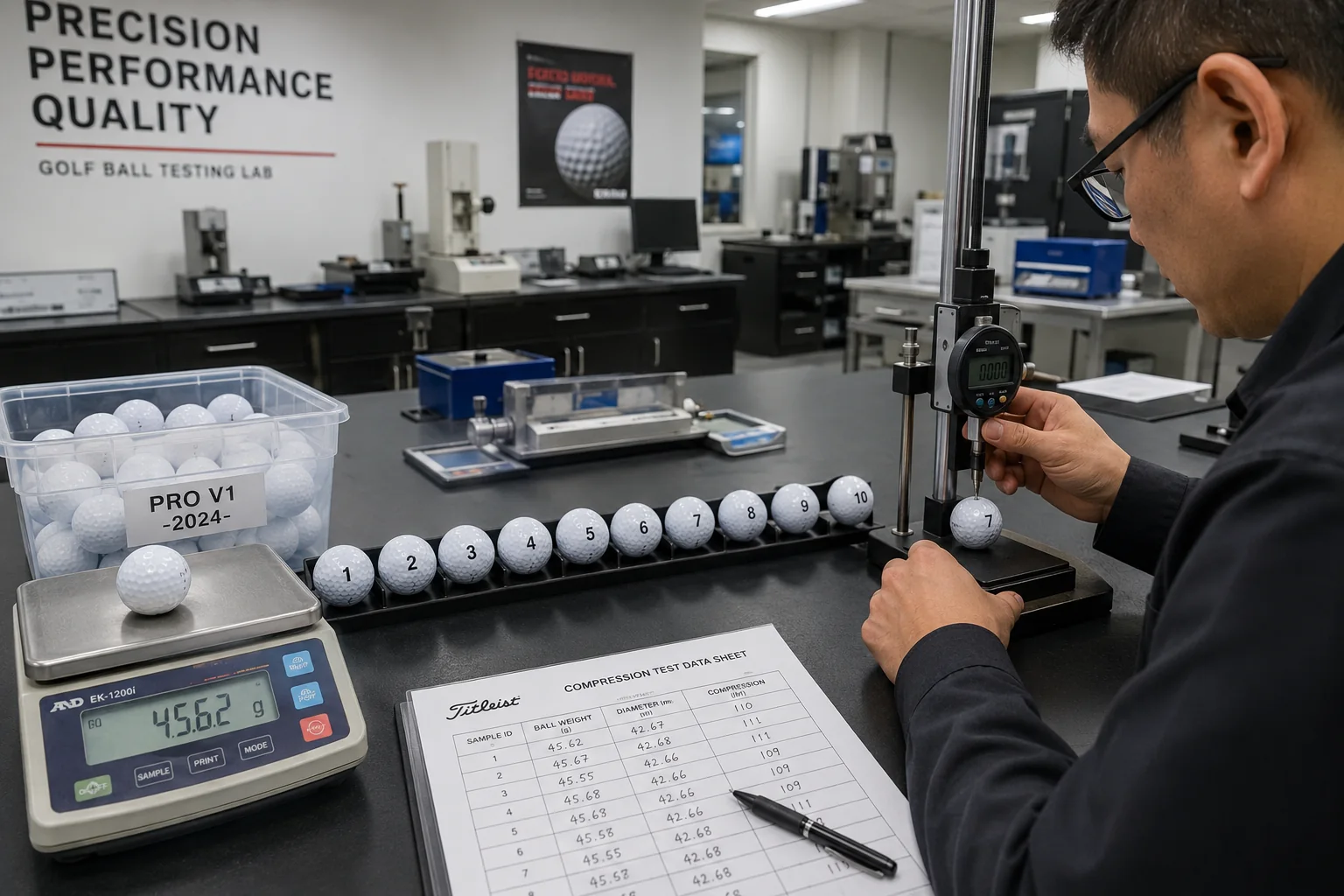
Your first sample test should not be on the course. It should be on a scale and a diameter gauge. Under USGA Equipment Rules, a conforming golf ball must not weigh more than 1.620 oz / 45.93 g and must have a diameter of not less than 1.680 in / 42.67 mm. These are not factory preferences. They are the first rejection gates.
Then test compression. Use ATTI or an equivalent compression method and ask for raw data, not only one average. A practical target may be compression ±5 points, but the report should show individual values, range, and standard deviation. Do not write weight tolerance as ±5%. Weight must stay within the agreed lot tolerance and never exceed the USGA limit.
Supplier sends only 1–2 balls for performance approval is a failure signal. One ball can be polished. A dozen reveals the process. If the same sample batch swings from soft to rock-hard, the issue may be curing control, core mixing, conditioning, or batch discipline.
| Test decision | Tool / method | Pass logic | Action/evidence |
|---|---|---|---|
| Weight gate | 0.01 g scale | Never exceed 45.93 g | Record min/max/avg |
| Diameter gate | Ring gauge / caliper | Never below 42.67 mm | Check every ball |
| Compression | ATTI/equivalent | Target ±5 points; track SD | Ask for raw data |
| Flight | Launch monitor | CV/SD/dispersion trend | Use same club/conditions |
| Durability | Wedge/rub test | No unacceptable chipping | Photo defects |
| Appearance | AQL-based check | Defect class limits | Use defect photos |
✔ True — Consistency beats one hero sample
A 10–12 ball set shows spread, not just peak performance. Track average, range, and standard deviation before approving a factory sample.
✘ False — “One good ball proves the factory”
A single sample can hide curing variation, compression drift, coating defects, or batch instability that shows up later in bulk.
What should a 10-ball test include?
A 10-ball test should include weight, diameter, compression, cover hardness, launch data, visual defects, durability, and photo evidence.
Request a 10–12 ball sample QC sheet with raw values, test method, equipment model, calibration date, batch ID, average, standard deviation, and range. Check whether compression spread, weight, and diameter are acceptable before visual approval.
Bulk acceptance should reference the agreed sample target and statistical window, not subjective feel alone. Your goal is to catch curing and consistency risk before your first PO.
How can you evaluate printing cheaply?
You may pay custom logo setup fees before knowing whether the supplier’s pad print, UV print, coating, or adhesion process is reliable.
You can test print capability before paying for your final logo run. Ask for non-confidential overrun or rejected printed balls, then check logo adhesion, rub resistance, edge clarity, and coating durability before approving a paid pad-print or UV sample.
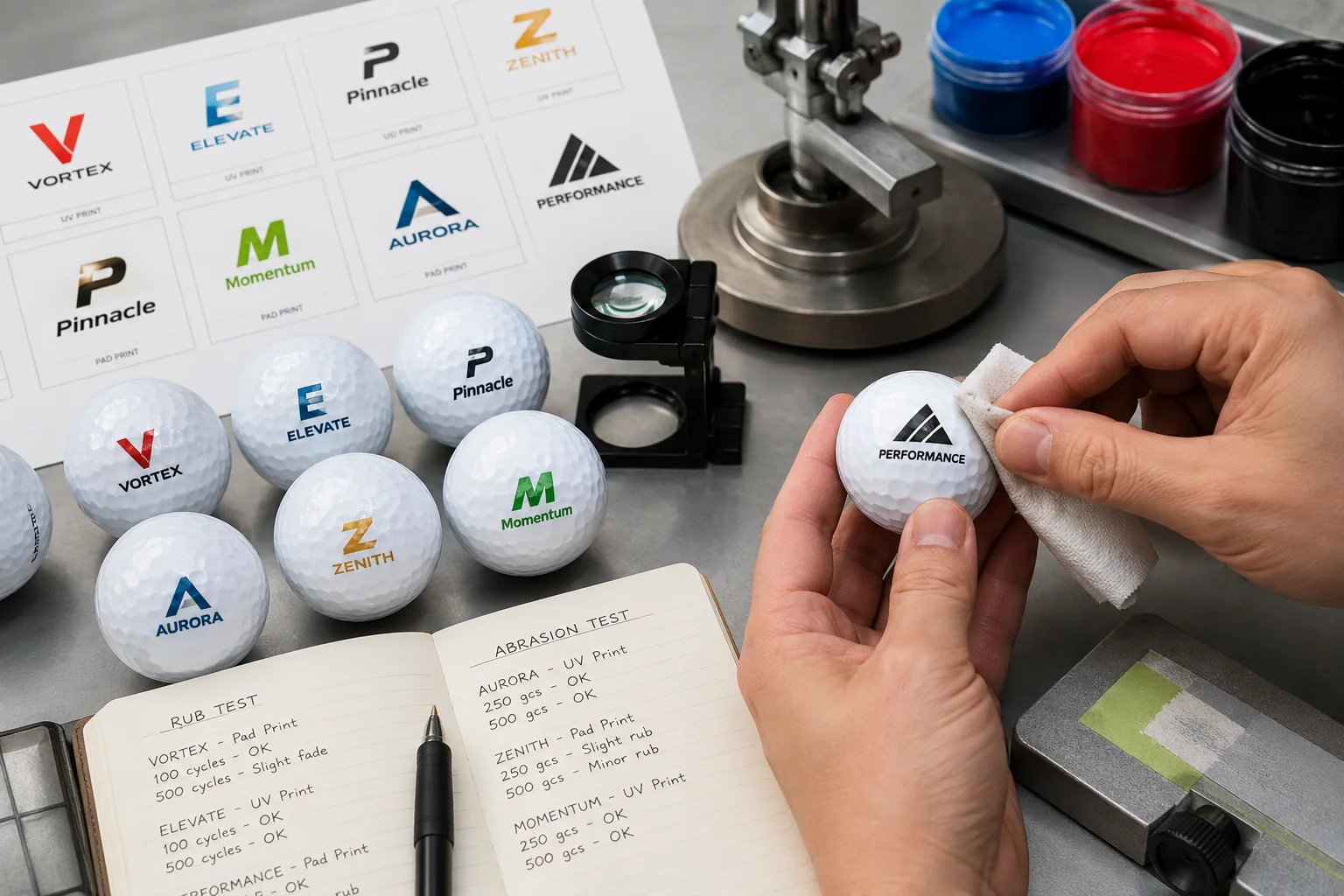
A factory overrun sample is not a shortcut around your final branded approval. It is a low-cost process screen. Where confidentiality allows, ask the supplier to include a few retained, rejected, or overrun printed balls from previous non-confidential work. Then test what matters: adhesion, edge clarity, coating compatibility, and rub resistance.
Pad printing is usually the better sample path for simple 1–4 color logos, repeated marks, and cost-sensitive programs. UV printing fits gradients, photo-style designs, personalization, and complex multi-color artwork. Both can work, but both need physical proof. A logo that looks sharp in a photo may fail after wedge abrasion, alcohol wipe, or repeated handling.
This is the cheapest way to avoid a painful mistake: paying for a perfect logo proof before you know whether the factory’s printing process survives real use. Overruns screen the process. Your final branded proof confirms your artwork.
For detailed print-method selection, use this golf ball logo printing methods guide before locking your final sample path.
| Print decision | Low-cost screen | What it reveals | Action/evidence |
|---|---|---|---|
| Need adhesion proof | Overrun printed balls | Real process durability | Run rub/wedge test |
| Simple logo | Pad print sample | Edge clarity and cost | Check plate fee |
| Gradient artwork | UV sample | Color and detail | Check curing/adhesion |
| Color dispute risk | Pantone/ΔE proof | Color control | Ask macro photos |
| Multiple positions | Fixture test | Registration risk | Confirm extra fee |
✔ True — Overruns can screen process capability
Non-confidential retained or rejected printed balls can reveal adhesion, edge clarity, coating behavior, and rub resistance before you pay for your final custom proof.
✘ False — “Overruns replace your final branded approval”
They only screen the factory’s process. Your final sample still needs your artwork, Pantone reference, print position, and physical sign-off.
Can factory overruns test print durability?
Yes, where confidentiality allows. Factory overruns, rejects, or retained printed samples can screen print durability before you pay for your own branded proof.
Request non-confidential overrun printed samples or factory-retained print samples plus print method notes. Run rub, wedge abrasion, alcohol wipe, and macro photo checks before paying for final artwork setup.
Final logo approval still requires your artwork, Pantone reference, print position, physical sample, and sign-off. Overruns screen the factory’s process. They do not replace your brand approval.
How do you lock a golden sample?
The approved sample can be forgotten, reinterpreted, or quietly replaced unless it is sealed, measured, photographed, and written into the PI or PO.
A Golden Sample is not a photo; it is a signed production control. Seal one approved sample set with your team and one retained twin with the factory, then reference sample ID, measured values, PPS, FAI, AQL plan, and remedies in the PO.
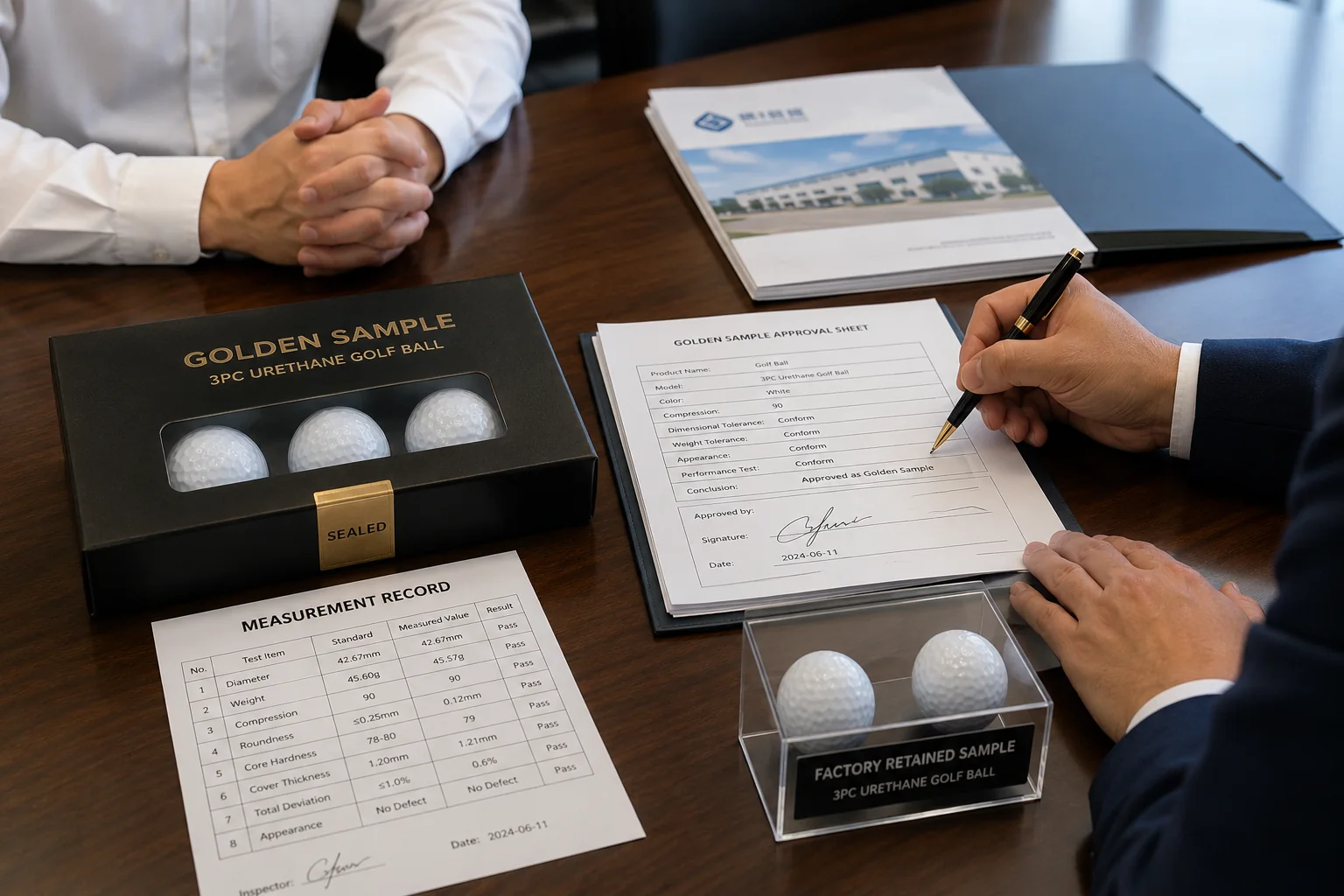
A Golden Sample should include more than a nice-looking ball. It should include sample ID, photos, measured weight, diameter, compression, cover notes, print method, logo position, color reference, defect standard, packaging decision, and approval date. One sealed set stays with the buyer. One sealed twin stays with the factory or inspector.
Then add gates before mass production. PPS, or Pre-Production Sample, confirms the factory can reproduce the approved sample after setup. FAI, or First Article Inspection, checks early production pieces before the full lot runs. Final inspection should use an AQL-based plan, not “looks good.” An ANSI overview of ISO 2859-1:2026 explains that the standard specifies sampling schemes indexed by acceptance quality limit for lot-by-lot inspection by attributes. A common consumer-goods baseline is Critical 0%, Major 2.5%, Minor 4.0%, then tighter limits for premium retail.
Product launch risk often begins when supplier sample parts fail specifications or validation results force late changes; that is why sample sign-off should feed directly into production release control. McKinsey change and release
Approved sample is not sealed or referenced in the PI is a failure signal. If nobody can physically compare bulk with the signed sample, the argument becomes memory versus memory. That is not quality control. That is a future dispute with nicer formatting.
| Control point | Evidence | Risk prevented | Action/evidence |
|---|---|---|---|
| Golden Sample | Signed sample ID + photos | Sample-bulk mismatch | Seal buyer/factory twins |
| PPS | Pre-production sample data | Setup drift | Approve before release |
| FAI | First article check | Early batch defects | Hold full production |
| AQL plan | Defect thresholds | Subjective disputes | Define major/minor |
| Remedies | Rework/replacement/credit | No recovery path | Write into PI |
What should PPS and FAI prove?
PPS should prove that setup can reproduce the Golden Sample. FAI should prove that the first production pieces match the approved sample before the lot is released.
Request signed Golden Sample confirmation, sealed twin samples, PPS/FAI plan, final AQL criteria, and remedy clause. Compare first-article and final-lot data against the Golden Sample ID and measured values.
Bulk production shall reference the signed Golden Sample ID, measured sample data, approved artwork, color tolerance, compression target, weight/diameter limits, print position tolerance, AQL plan, PPS/FAI approval, and remedies for rework, replacement, or credit if bulk deviates from approved criteria.
How should your sample email be written?
Good factories ignore weak sample requests because vague emails look like free-sample hunting, not serious sourcing.
Do not ask a factory to “send samples” with no spec. Send a short B2B email with use case, ball structure, compression target, blank-stock request, vector logo files, Pantone codes, courier account, sample-fee refund clause, and Golden Sample sign-off requirement.
Your first sample email should make the factory’s job easier. State the use case, target buyer, ball structure, cover family, compression target, sample quantity, logo files, Pantone references, courier method, and evaluation criteria in one message. That tells the factory you are not fishing for free balls; you are preparing a controlled OEM program.
Professional sample emails get faster factory responses because they reduce guessing. The supplier can quote the right lane, prepare the right blank sample, confirm the correct logo setup, and avoid repeated file loops. Your first email should make you look like a real buyer, not a free-sample collector.
Keep packaging simple unless the packaging itself is part of the test. Do not turn the first sample email into a long packaging development project. If timing is tight, connect the sample request to your launch schedule and ask for a realistic sample lane.
Please quote stock blank balls first for feel and consistency testing, then a separate logo-printed sample set after blank approval. Include ball structure, cover, compression target, sample quantity, setup fee, refund trigger, sample ID, courier method, Golden Sample sign-off, PPS/FAI process, and bulk acceptance criteria.
| Email section | What to include | Why it matters | Action/evidence |
|---|---|---|---|
| Use case | Range/value/retail/promo | Factory picks correct ball | State target channel |
| Ball spec | Structure/cover/compression | Avoids wrong sample | Attach Tech Pack |
| Blank sample | 12 balls first | Tests feel before fee | Request sample ID |
| Logo files | AI/SVG/Pantone | Prevents artwork loops | Attach vector files |
| Fees/refund | Setup + offset trigger | Avoids dispute | Write in PI |
| Courier | DHL/FedEx account or DDP | Speeds shipment | Confirm declaration |
What belongs in the first email?
Your first email should include use case, target spec, blank-stock-first request, artwork files, courier method, fee/refund terms, and sample evaluation criteria.
A practical email can read like this:
Hello, we are evaluating OEM golf balls for [range/value retail/promo/event]. Please quote blank stock samples first for performance testing. Target spec: [2-piece Surlyn / 3-piece / PU], compression [target], cover [family], quantity 12 balls from one batch. If blank samples pass, we will request logo-printed samples using attached vector artwork and Pantone references. Please confirm sample fee, setup fee, refund/offset trigger, sample ID, courier option, Golden Sample sign-off, PPS/FAI process, and bulk acceptance criteria.
Check the supplier reply for sample type, sample ID, schedule, fees, refund trigger, and evidence deliverables. Do not proceed until the supplier confirms both blank-stock evaluation and printed-sample approval sequence.
FAQ
How much do factory samples cost in China?
Blank stock golf balls are often free or low-cost, while the buyer usually pays courier. Custom logo or packaging samples can involve setup, plate, Pantone, jig, or packaging fees, commonly handled as a refundable or offsettable sample charge.
Ask which fees are refundable and write the MOQ or order-value trigger in the PI. Separate blank samples from logo prototypes. The blank set tests ball fit; the paid prototype tests your artwork, color, print method, and approval standard. A sample fee is easier to accept when it creates traceability and can be offset against a qualifying bulk order.
Should I request blank balls before logo samples?
Yes, when ball feel and performance are not yet proven. Blank stock balls let you test structure, compression, feel, and flight before spending money on logo setup.
Request the same intended bulk structure, ask for at least 10–12 balls, and move to logo samples only after the blank set passes. This protects your sample budget and prevents the painful mistake of approving a beautiful logo on the wrong ball. Your first sample decision should answer the product question, not the branding question.
How can I test logo durability cheaply?
Ask for non-confidential overrun or retained printed samples before paying for your own custom proof. Use rub, wedge abrasion, alcohol wipe, and macro photos to screen print adhesion and edge quality.
Use overruns only as a process screen. You still need to approve your own branded sample later. Confirm whether the factory uses pad print, UV, heat transfer, or another method, because each process has different cost and durability behavior. Good print testing is not only about whether the logo looks sharp on day one.
What is a Golden Sample in manufacturing?
A Golden Sample is the approved physical sample used as the bulk-production reference. It should have a sample ID, signed photos, measured values, and sealed buyer/factory twin samples.
Reference it in the PI or PO. Use it for PPS and FAI comparison. Tie deviations to remedies such as rework, replacement, credit, and responsibility for extra freight when the supplier-controlled deviation is confirmed. A Golden Sample turns “same as sample” from a vague promise into a physical standard.
How should I evaluate golf-ball samples?
Evaluate a group, not one ball. Check weight, diameter, compression, hardness, flight consistency, print registration, coating defects, and durability before approval.
Weight must not exceed 45.93 g, and diameter must not be below 42.67 mm under USGA rules. Track average, range, and standard deviation. Use AQL language for appearance so “looks fine” becomes a measurable acceptance decision. The best sample report shows raw values, photos, tools, methods, and pass/fail criteria.
How do I stop bulk from differing from samples?
Use a signed Golden Sample process with PPS, FAI, final-lot AQL, and written remedies. The bulk order should reference sample ID, measured data, artwork, color tolerance, and acceptance criteria.
Seal retained twins, approve PPS before full production, check FAI before release, and define rework, replacement, or credit. Evidence beats memory when bulk production drifts away from the approved sample. Your PO should make sample-to-bulk consistency measurable before the factory starts mass production.
Conclusion
The right sample request is not a request for free golf balls. It is a sourcing-control system: blank stock first, printed proof second, 10–12 ball consistency testing, USGA weight and diameter gates, print durability checks, Golden Sample sign-off, PPS/FAI, and a PI that makes bulk acceptance measurable.
If your sample request sounds professional, a serious factory can reply faster and prepare the right evidence. If your approval criteria are measurable, your bulk order has a better chance of matching what your team actually tested.
You might also like — What’s the Real MOQ for Custom Logo Golf Balls in Bulk?