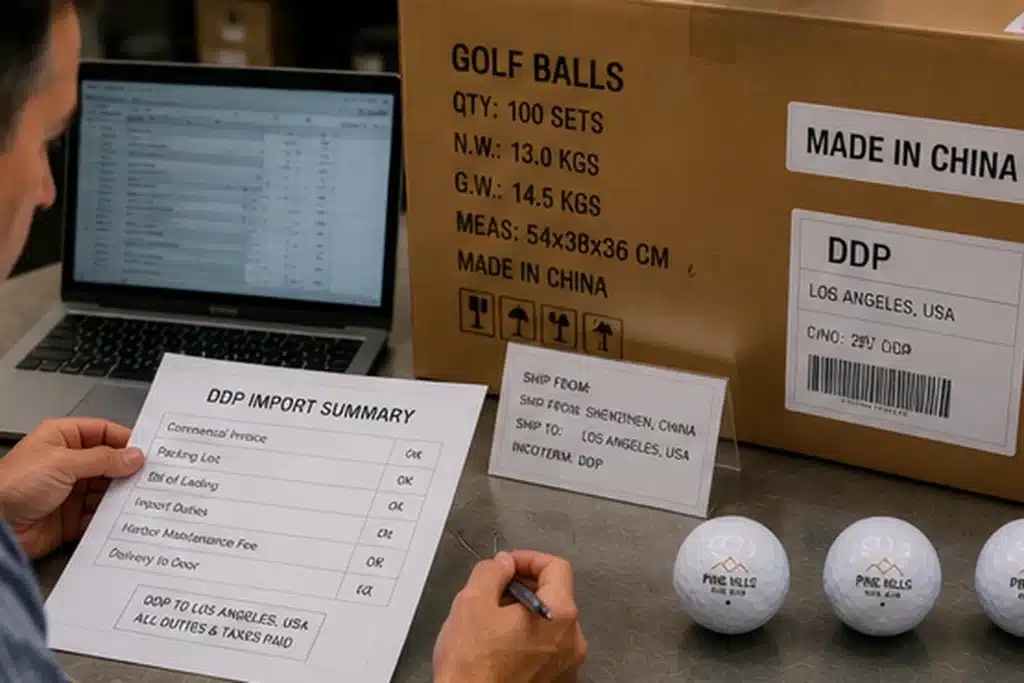
Moving golf ball production out of China can reduce risk, but moving the wrong SKU first can turn tariff savings into scrap, rework, late launches, and retailer headaches.
The best China+1 golf ball OEM strategy is SKU allocation, not China exit. Use Malaysia for tariff-sensitive 2-piece Surlyn balls, stock-ball reprints, regional event programs, ASEAN-origin orders, and ESG narratives; keep 3/4-layer cast urethane, complex DTC packaging, and CT/X-ray intensive SKUs in China until Malaysia proves FPY, shell thickness, compression distribution, coating stability, and retained-sample traceability.
Malaysia can create a real tariff-origin advantage when the SKU is simple enough to hold yield. China remains the stronger base when the product depends on cast urethane process control, fast engineering correction, packaging integration, and mature supplier ecosystems.
A safe China vs Malaysia golf ball manufacturing plan follows one rule: move low-risk Surlyn and reprint SKUs first, validate mid-tier TPU / PU through pilot gates, and keep premium urethane in China until the second origin proves the same yield window with batch-linked data.
Why are buyers considering Malaysia?
You may be under board pressure to reduce China exposure because of tariffs, retailer ESG reviews, origin diversification, or supply-chain resilience mandates.
Malaysia is attractive because it can support tariff, origin, ESG, and resilience goals. But China+1 does not mean moving every golf ball SKU out of China; it means building a second origin for the SKUs Malaysia can prove, while keeping complex builds in the most reliable production base.
The pressure is real. U.S.-bound buyers may worry about China-origin Section 301 exposure. Big-box retail teams may ask why a private-label golf program depends on one country. ESG and sourcing-compliance teams may want a credible ASEAN-origin story. CFOs want margin protection. CSCOs want backup capacity before the next disruption arrives wearing a suit and calling itself “the new normal.”
That direction fits the broader resilience playbook. McKinsey’s 2024 supply-chain research reported that companies were making progress on dual sourcing and regionalization, which is exactly how China+1 should be understood: not a dramatic exit, but a second-source design. McKinsey supply-chain resilience survey
Malaysia also has genuine industrial momentum. MIDA reported record approved investments in 2024, including a substantial manufacturing base and foreign-investment participation. Malaysia approved investments 2024 That supports Malaysia as a serious manufacturing destination, but it does not prove high-yield cast urethane golf ball maturity by itself. Capital attraction is macro evidence; a pilot lot with FPY, CT/X-ray, compression, and coating data is golf-ball evidence.
| Board pressure | What Malaysia can help | What it cannot prove alone | Buyer move |
|---|---|---|---|
| Section 301 exposure | Origin alternative | Stable urethane yield | Split by SKU |
| Retail ESG review | Compliance story | Product repeatability | Verify documents |
| Single-country risk | Second-source option | Full China replacement | Pilot first |
| Margin pressure | Possible tariff relief | Scrap control | Model yield |
| Regional events | Localized supply story | Premium ball maturity | Match use case |
Build a China+1 objective memo before RFQ. Write down whether the move is driven by tariff exposure, ESG / origin requirements, retailer pressure, capacity backup, or true cost advantage. Then attach an evidence gate to that reason. A tariff SKU needs origin proof. A urethane SKU needs yield proof. A retail ESG SKU needs documentation proof. A backup-source SKU needs repeatability proof.
The first failure signal is “move every SKU to Malaysia because of tariff.” That is not strategy. That is panic with columns.
✔ True — China+1 is dual sourcing, not automatic China exit.
The strongest strategy uses Malaysia as the second leg for suitable SKUs while China remains the base for complex, yield-sensitive, packaging-heavy, or validation-heavy programs.
✘ False — “China+1 means every SKU must leave China.”
Moving the wrong product first can turn tariff relief into scrap, rework, late launches, and retailer disappointment.
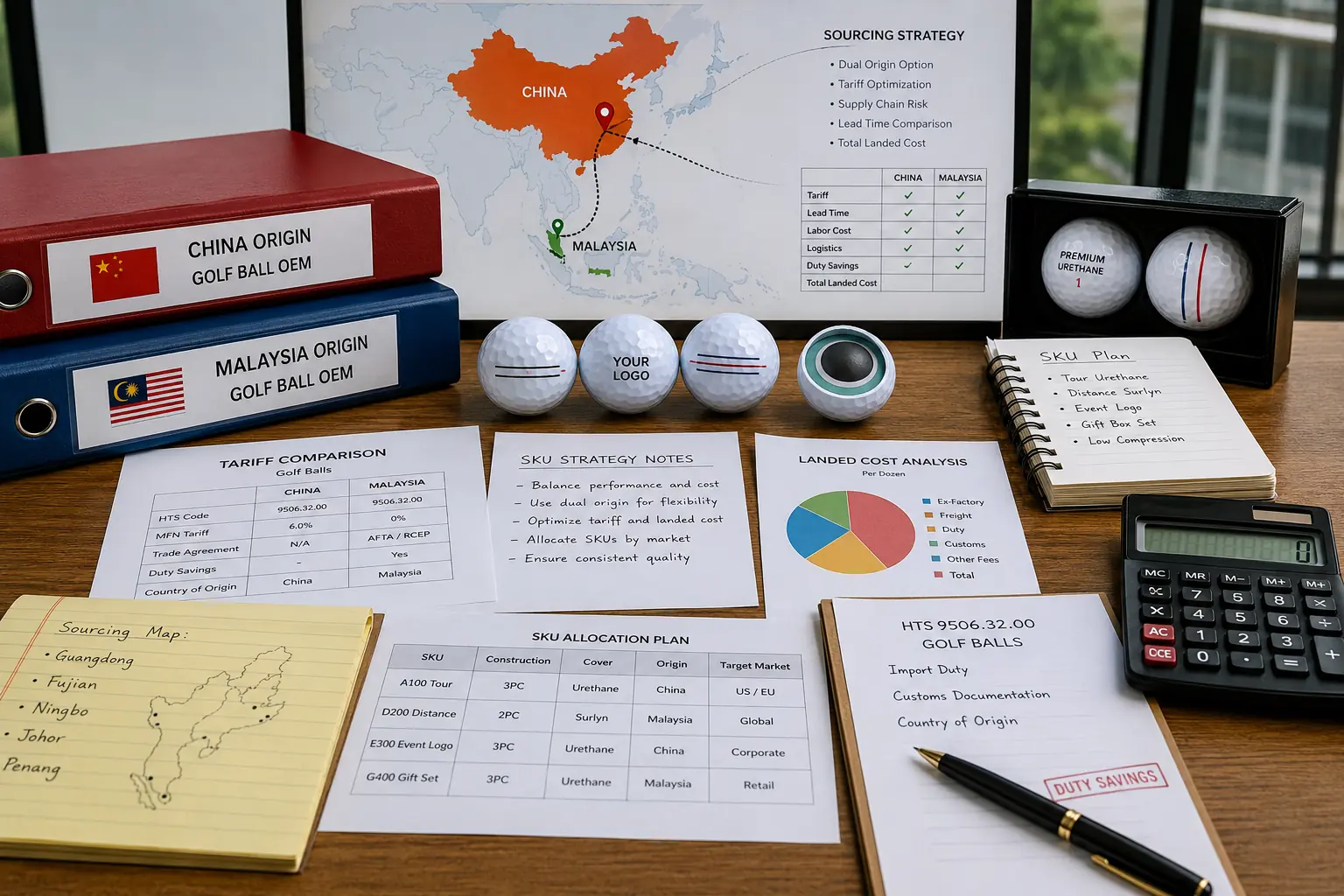
Why does urethane stay in China?
You may assume Malaysia’s lower labor cost can beat China on every ball, but high-end cast urethane cost is driven by yield and control.
Cheap labor cannot save bad urethane yield. If first-pass yield falls from a verified target to a lower pilot result, the cost per good ball rises before rework, resin loss, inspection, lost capacity, and delay are counted; that is why premium 3/4-layer urethane should stay in China until Malaysia proves the same process window.
A 2-piece Surlyn ball is forgiving compared with cast urethane. A premium 3-layer or 4-layer urethane ball asks the factory to control core alignment, mantle balance, cover curing, shell thickness, coating adhesion, compression distribution, and final cosmetic quality at the same time. The ball can look perfect in a sleeve and still fail under wedge abrasion, cut tests, off-center flight, inconsistent feel, or reviewer scrutiny.
The second failure signal is “labor is cheaper, so urethane is cheaper.” Not unless the good-ball cost proves it. In precision manufacturing, cost is paid per accepted ball, not per started ball. ASQ defines cost of poor quality as costs tied to poor quality products or services, including internal failures such as scrap and rework. ASQ cost of quality
Use this illustrative FPY model as a CFO screen. It assumes a $1.00 started-ball cost before scrap. Replace it with supplier pilot data before financial approval.
| FPY model | Good balls per 100 | Started cost per good ball | Buyer should verify |
|---|---|---|---|
| 95% | 95 | $1.053 | Benchmark if verified |
| 90% | 90 | $1.111 | Rework trend |
| 85% | 85 | $1.176 | Capacity loss |
| 80% | 80 | $1.250 | Scrap risk |
| 75% | 75 | $1.333 | Scale not ready |
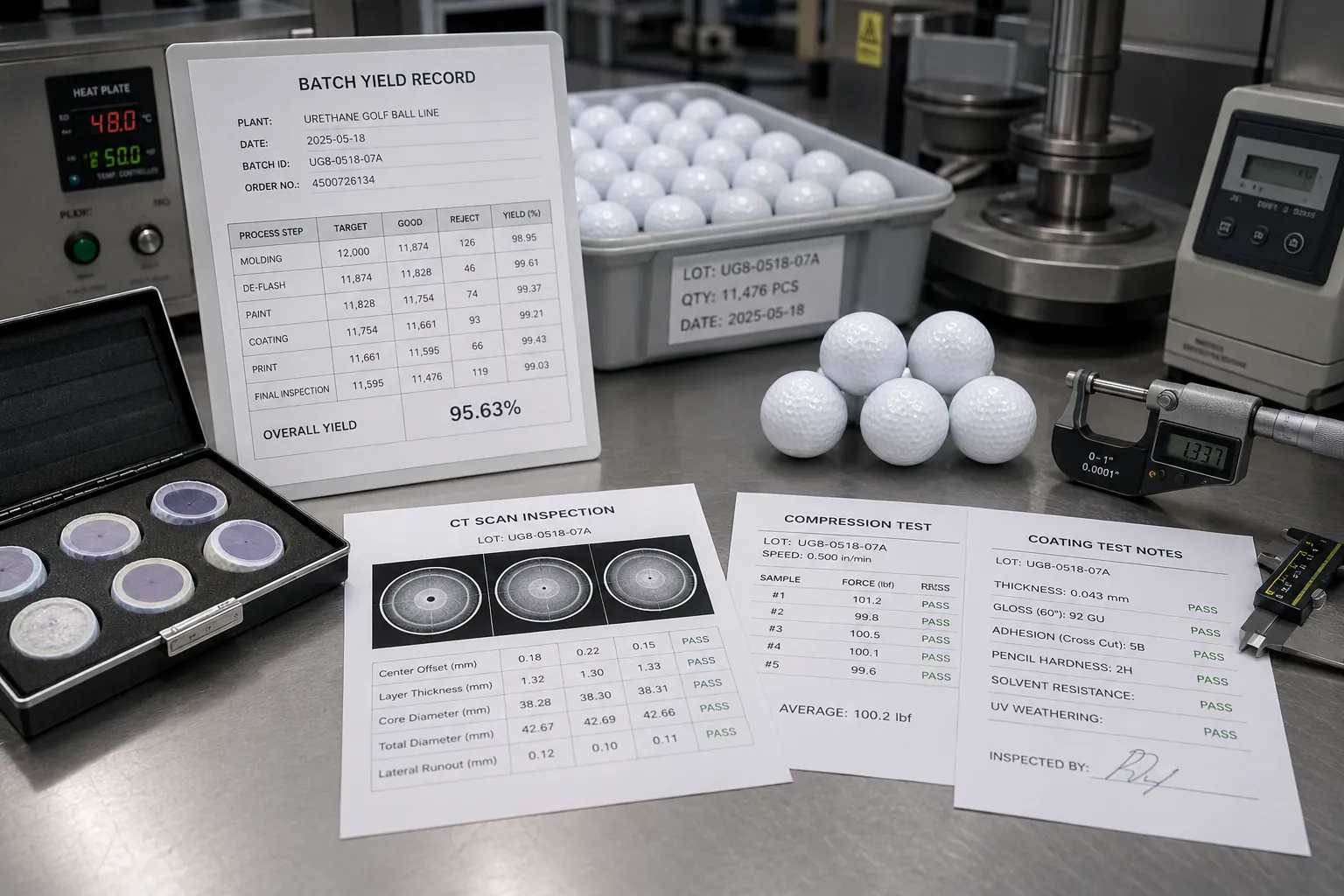
What proof should Malaysia show?
Malaysia should show batch-linked proof, not country-level confidence. For urethane, the evidence should include FPY, scrap, rework, CT/X-ray, shell thickness, compression, and retained samples.
The simple FPY table still understates the real pain. A bad urethane lot also consumes coating capacity, inspection time, mold time, engineering attention, replacement material, second pilots, urgent freight, and calendar space. That “cheap” production run gets expensive when the launch window moves and the sales team starts asking why the flagship ball is still in validation.
Before any 3-layer or 4-layer urethane SKU is transferred to Malaysia for mass production, supplier shall provide agreed FPY target, scrap rate, rework rate, CT/X-ray concentricity evidence, shell-thickness data, compression distribution, coating durability result, Cpk / SPC where available, equipment ID, calibration date, and retained samples linked to the approved pilot lot.
Require a Urethane Pilot Gate Pack. Check FPY, scrap rate, rework rate, CT/X-ray proof, shell thickness, compression distribution, coating durability, defect categories, and retained samples. No urethane scale-up without an agreed FPY gate and batch-linked evidence.
What tariff advantage does Malaysia offer?
You may shift production because of China-origin tariff pressure, but the saving only matters if origin and yield both work.
Malaysia’s tariff advantage is real only when origin and yield both work. Finished golf balls start under HTS 9506.32.0000 with a Free U.S. base duty, but China-origin entries must check Chapter 99 / Section 301; Malaysia-origin balls can avoid the China-origin layer if origin is properly supported.
The customs starting point is important. Finished golf balls should be reviewed under HTS 9506.32.0000, and CBP has classified golf balls under that heading with a Free base duty in a ruling that also shows golf tees may fall under a different subheading. CBP ruling on golf balls and golf tees The USITC HTS search is useful for the base tariff line, but shipment-date treatment belongs in your broker file.
China-origin finished golf balls still need Chapter 99 / Section 301 review. Current modeling may point to 9903.88.15 and a 7.5% List 4A layer where applicable, but this must be checked at shipment date. CBP’s guidance on the Tranche 4A decrease identifies 9903.88.15 and the 7.5% rate for covered products. CBP Section 301 Tranche 4A guidance
Malaysia-origin balls do not carry the China-origin Section 301 layer when origin is valid. That is the tariff-origin advantage. It is valuable, but it is not a license to skip proof.
| Customs factor | China-origin ball | Malaysia-origin ball | Buyer move |
|---|---|---|---|
| Base HTS | 9506.32.0000 | 9506.32.0000 | Confirm with broker |
| Base duty | Free | Free | Do not stop here |
| Section 301 | Check Chapter 99 | Not China-origin layer | Verify origin |
| Accessories | May need separate codes | May need separate codes | Split PI |
| Origin proof | China COO | Malaysia COO if valid | Keep evidence |
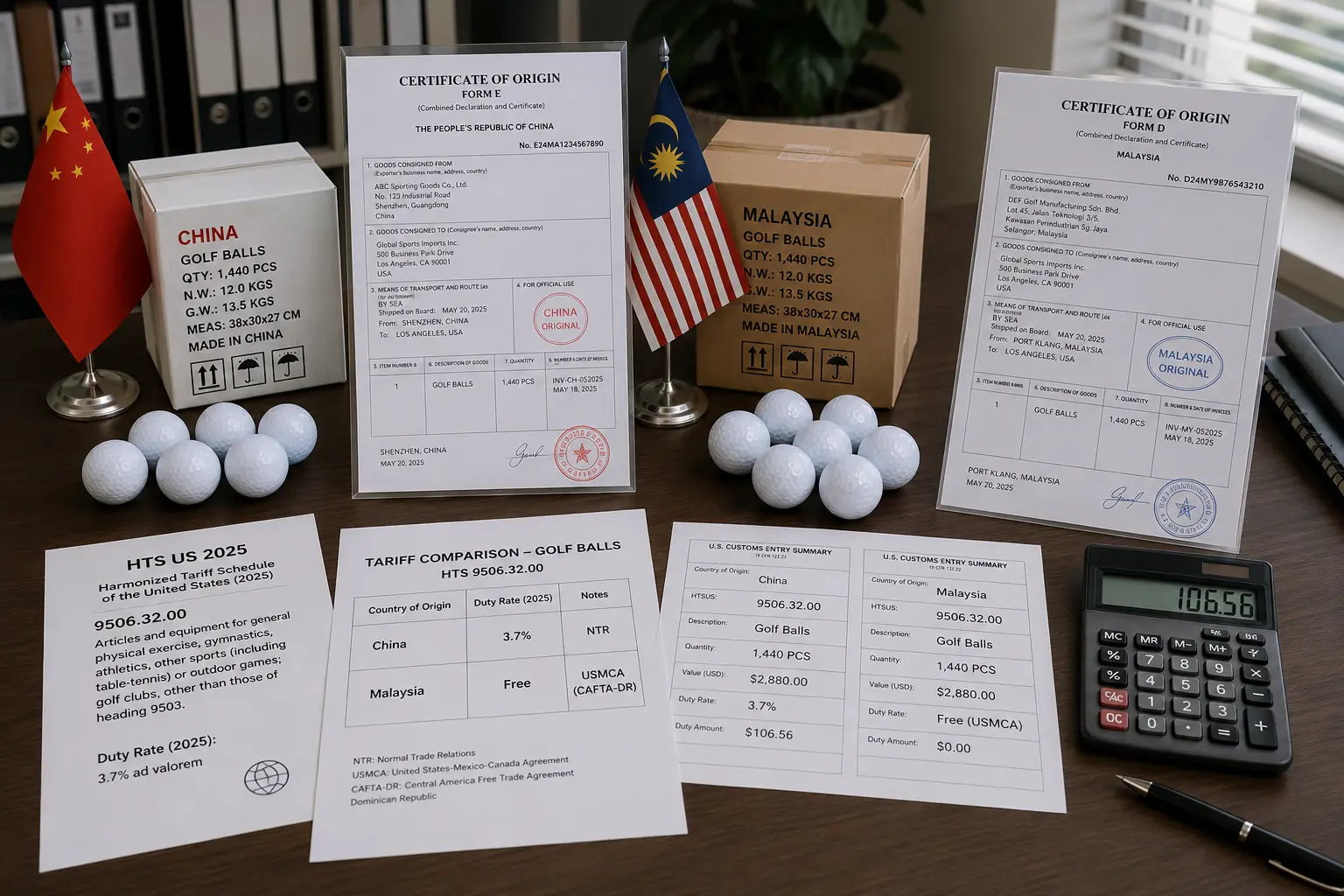
How does Section 301 change the math?
Section 301 can create a China-origin penalty, but it does not make Malaysia automatically cheaper. The origin benefit must survive FPY, scrap, packaging, and launch timing.
CFO buyers prefer margin protection, so the real model is not “China tariff versus Malaysia no tariff.” It is tariff-adjusted, yield-adjusted landed cost per accepted ball. If a simple Surlyn SKU carries tariff exposure and Malaysia can hold print quality, packaging, origin proof, and delivery timing, the Malaysia lane can make sense. If a cast urethane SKU loses yield, the 7.5% tariff advantage can disappear into resin scrap, rework, and delayed shipment.
A Malaysia-origin claim also needs support. Ask for the manufacturing process description, material route, COO documents, and evidence that the required origin basis is met. Gift sets need extra care: tees, towels, bags, tools, display boxes, or accessories may require separate classification, even when the finished ball itself is under HTS 9506.32.0000.
Supplier shall identify country of origin, manufacturing process location, material source route, HTS line, Chapter 99 / Section 301 treatment if applicable, pilot batch ID, retained sample ID, defect categories, and whether any key processing, printing, coating, or packaging steps are subcontracted.
Ask for a Tariff × Yield Matrix. Confirm HTS, Chapter 99, COO basis, FPY, scrap, packaging, and landed cost. Do not approve a Malaysia shift using tariff savings alone.
✔ True — Malaysia is an origin option, not a magic cost eraser.
Malaysia may remove the China-origin Section 301 layer for valid-origin goods, but the advantage still has to survive yield, packaging, documentation, and delivery risk.
✘ False — “Malaysia automatically makes golf balls cheaper.”
A lower tariff model can still lose if FPY drops, rework rises, or packaging takes too long to approve.
Which SKUs should move first?
You may ask “China or Malaysia?” when the better question is which construction, margin profile, customer, and channel should use each origin.
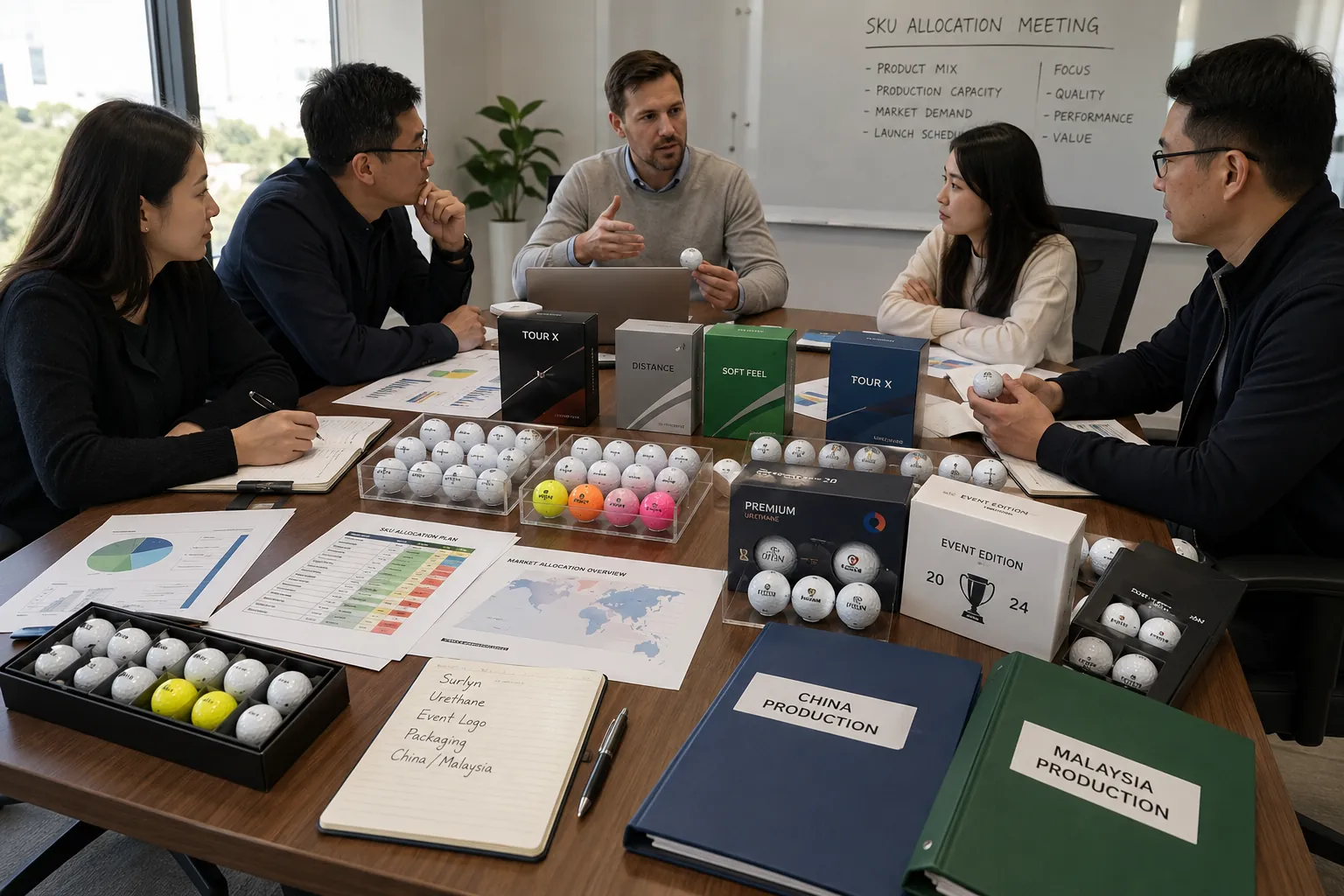
The right China+1 answer is SKU split. Move simple Surlyn, reprint, regional event, ASEAN-origin, and tariff-sensitive basic SKUs to Malaysia first; keep high-margin cast urethane, complex DTC packaging, and CT/X-ray intensive SKUs in China until Malaysia proves repeatable pilot data.
The cleanest portfolio design starts with technical risk. Malaysia can be a strong pilot lane for 2-piece Surlyn logo balls, stock-ball reprints, regional event balls, simple promotional orders, ASEAN-origin stories, and U.S.-bound basic SKUs where tariff exposure is the main board concern.
China remains the safer base for 3-piece cast urethane, 4-layer urethane, thin-cover premium SKUs, CT/X-ray intensive products, packaging-complex DTC flagship launches, and projects needing rapid engineering correction. This is not about national pride. It is about protecting approved performance at scale.
Retail-channel buyers prefer compliance narratives, so Malaysia can help when a retailer wants origin diversification, ESG support, or a non-China sourcing story. China still protects the mature-line role when the SKU has high margin, high review risk, complex packaging, or little tolerance for launch slippage.
| SKU type | China role | Malaysia role | Allocation decision |
|---|---|---|---|
| 2-piece Surlyn | Mature volume | Strong pilot candidate | Test Malaysia |
| Stock reprint | Fast and mature | Strong fit | Compare route |
| Regional event ball | Strong | Strong origin story | Use if timing works |
| 3-piece TPU / PU | Strong | Needs pilot | Gate by FPY |
| 3-piece cast urethane | Strong | High proof burden | Keep China first |
| 4-layer urethane | Strong | Very high proof burden | Deep audit before move |
| Premium gift set | Strong packaging ecosystem | Possible if pack proven | Compare CBM and quality |
Which SKUs go to ASEAN first?
ASEAN-first SKUs should be simple, price-sensitive, origin-sensitive, and lower-risk. Start with Surlyn, reprint, event, and basic logo programs.
A SKU Allocation Matrix should classify each SKU by construction, yield risk, tariff sensitivity, packaging complexity, customer requirement, annual volume, and margin. Do not move a technical product just because the board wants a Malaysia line item. Give the board a Malaysia line item that will not explode later.
The strongest model is staged. First, move simple SKUs. Then validate mid-tier TPU / PU through a pilot. Only then discuss cast urethane scale-up. China and Malaysia are not zero-sum alternatives. Malaysia is the tariff / origin / compliance / backup lever. China is the yield / engineering / packaging / scale base.
Create a SKU Allocation Matrix. Classify each SKU by construction, yield risk, tariff sensitivity, packaging complexity, customer requirement, and margin. No country shift without SKU-level decision logic.
How do you approve Malaysia scale-up?
You may complete a small Malaysia sample run and assume retail-scale production is ready, even though repeatability and origin proof are not locked.
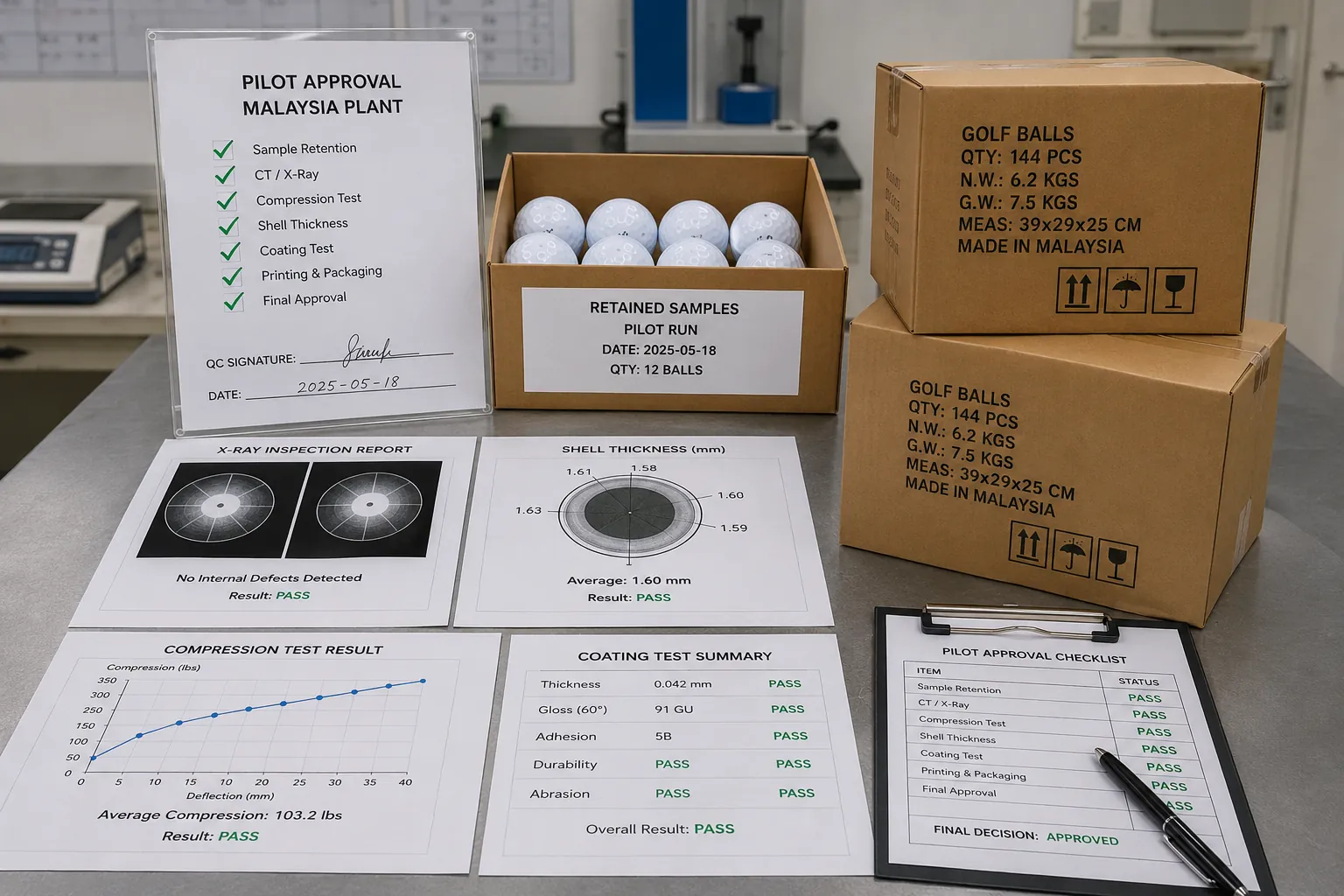
Approve Malaysia scale-up only after the pilot proves both origin and process control. The evidence pack should include FPY, scrap and rework rates, CT/X-ray data, shell thickness, compression distribution, coating durability, retained samples, COO documentation, packaging CBM, and component-level invoice structure.
A good sample is not a production system. One sleeve can hide weak yield, missing inspection data, unclear origin documentation, packaging CBM surprises, or a route that is actually stock-ball reprint rather than true OEM.
The third failure signal is “three-week delivery means true OEM speed.” A three-week promise often means the blank ball already exists and the job is a reprint. Reprint can be excellent for events, quick campaigns, and simple regional programs. It should not be compared with a new construction build that needs mold status, material route, dimple family, compression target, cover process, coating window, and validation work.
Malaysia’s ESG story can also be useful, but it should stay in its lane. TNB’s Green Electricity Tariff and REC-related programs can support renewable-electricity narratives where a supplier is eligible and properly documented. TNB Green Electricity Tariff ESG proof helps the retail story; it does not replace FPY, CT/X-ray, compression, coating, or retained samples.
| Gate | Evidence | Why it matters | Buyer move |
|---|---|---|---|
| Origin | COO / process description | Tariff claim | Verify broker |
| FPY | pilot yield report | Cost reality | Set minimum target |
| Concentricity | CT/X-ray | Flight risk | Compare sample lot |
| Compression | histogram | Feel consistency | Lock window |
| Coating | adhesion / durability | Review risk | Test before scale |
| Packaging | CBM / dieline / print | Landed cost | Check pack route |
| Reprint route | stock-ball proof | Timeline truth | Separate from OEM |
Is it reprint or true OEM?
A reprint is a speed route; true OEM is a manufacturing route. Both can be useful, but they do not prove the same capability.
Before reallocating any SKU from China to Malaysia, ask both suppliers for the same evidence pack: HTS 9506.32.0000 treatment, country-of-origin basis, Chapter 99 / Section 301 status if China-origin, first-pass yield, scrap rate, rework rate, defect categories, CT/X-ray concentricity proof, shell-thickness data, compression distribution, coating durability, packaging CBM, COO documents, and pilot batch retained samples.
Require a Malaysia Pilot Approval Pack. Match every report to batch ID, retained sample, equipment ID, calibration date, and approved construction. Do not scale Malaysia production until process data and origin evidence are repeatable.
✔ True — A good sample is not mass-production approval.
Scale-up needs batch-linked yield, inspection, origin, packaging, and documentation proof. Photos and fast samples do not prove repeatability.
✘ False — “The Malaysia sample looked good, so volume is safe.”
Pilot success is the beginning of approval, not the end of it.
FAQ
Is it cheaper to make golf balls in China or Malaysia?
It depends on the SKU: Malaysia may win on tariff-sensitive 2-piece Surlyn, stock reprint, regional event, or ESG-origin programs, while China often wins complex urethane when yield, packaging, validation speed, and repeatability are counted.
Do not compare labor alone. Model tariff savings and FPY together. Use pilot data for urethane. Compare landed cost per accepted ball, not quote price per started ball. For a simple Surlyn logo ball, Malaysia may be a smart second origin. For cast urethane, lower labor can vanish if scrap, rework, coating instability, and late validation rise.
What is China+1 in golf ball manufacturing?
China+1 means building a second sourcing option without abandoning China’s mature production base; it is a resilience strategy that assigns each SKU to the country best suited for tariff, origin, yield, packaging, and launch risk.
Use Malaysia for suitable simple SKUs. Keep complex urethane in China until Malaysia proves the process. Treat dual sourcing as resilience, not evacuation. Reassess by SKU, not country stereotype. The best China+1 plan gives your board options while protecting product consistency, retailer confidence, and launch timing.
Why might Malaysia help U.S. golf ball importers?
Malaysia can help when a SKU needs a non-China origin story, Section 301 exposure reduction, ASEAN sourcing narrative, ESG review support, or regional diversification, provided the origin claim and production process are documented.
Confirm valid country of origin. Keep broker review in the file. Check component HS codes for gift sets. Do not assume tariff benefit without origin proof. Malaysia is most useful when the product is simple enough for the second origin to hold quality while also supporting the retailer or tariff objective.
Does Section 301 apply to China-made golf balls?
China-origin finished golf balls should be reviewed under HTS 9506.32.0000 and checked against Chapter 99 / Section 301 treatment at shipment date, because base duty and China-origin additional duty are separate questions.
The base duty line is Free, but current modeling may require 9903.88.15 / 7.5% if applicable. Broker confirmation is required. Accessories and gift kits may need separate classification. A supplier can support the paperwork, but your customs broker should confirm the entry logic before commercial approval.
Can Malaysia make tour-grade cast urethane golf balls?
Malaysia may support pilots or specialty programs, but tour-grade cast urethane should not be scaled without proof of FPY, CT/X-ray concentricity, shell thickness, compression distribution, coating durability, Cpk / SPC where available, and retained samples.
Do not rely on country claims. Ask for pilot-batch evidence. Compare against China mature-line data. Keep a China fallback until Malaysia passes gates. The issue is not whether Malaysia can make golf balls; the issue is whether a specific Malaysia line can repeat your premium urethane window at volume.
Why does yield matter more than labor cost?
Yield determines how many good balls you get from the materials, labor, machine time, coating capacity, inspection bandwidth, and calendar space you already paid for, so weak FPY can erase a lower labor rate quickly.
Scrap consumes resin and process time. Rework consumes inspection and labor. Delays can trigger urgent freight or missed launch windows. FPY should be part of the CFO model because a cheaper quote per started ball is not the same as a cheaper accepted ball.
What should move to Malaysia first?
Start with lower-risk SKUs: 2-piece Surlyn, stock-ball reprints, regional event balls, simple logo programs, ASEAN-origin campaigns, and tariff-sensitive basic SKUs where Malaysia can prove quality, origin, and packaging control.
Use true OEM only after the route is clear. Validate packaging and origin proof. Keep premium urethane in China until Malaysia proves repeatability. Move in stages, not all at once. A good China+1 program should lower risk, not create a new factory qualification crisis.
Is Malaysia’s ESG story useful?
Yes, when it is documented and relevant to the retail buyer, but ESG does not replace quality proof, origin proof, or process evidence for golf ball manufacturing.
Malaysia’s renewable-electricity and REC-related programs can support a sourcing narrative where the supplier participates and can document the claim. Match the claim to channel requirements. Still require FPY, QC, packaging, and origin evidence. ESG can help sell the program; it cannot make an unstable urethane line stable.
Conclusion
China+1 is not a panic exit. Malaysia can be a useful second origin for simple Surlyn, stock reprint, regional event, ESG, and tariff-sensitive basic programs. China remains the safer base for yield-sensitive cast urethane, complex DTC packaging, fast engineering correction, and multi-SKU validation.
The right decision is not China or Malaysia. It is SKU allocation backed by tariff proof, origin documents, pilot yield, CT/X-ray evidence, compression data, coating tests, retained samples, and packaging numbers.
You might also like — China’s Golf Ball Manufacturing Hubs: 2026 Capability & Selection Guide