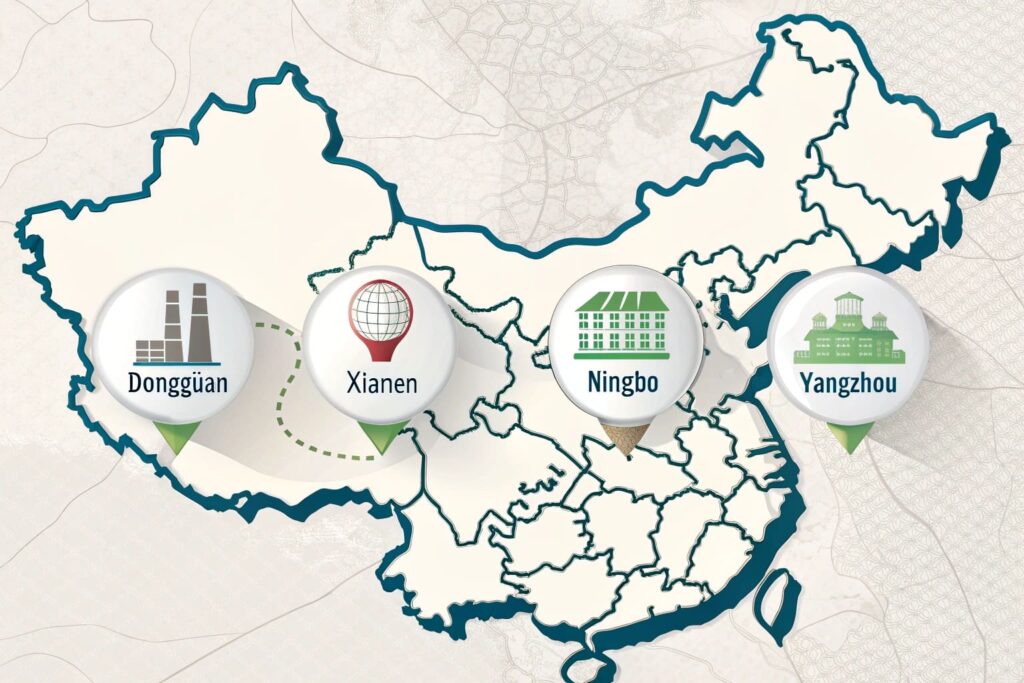
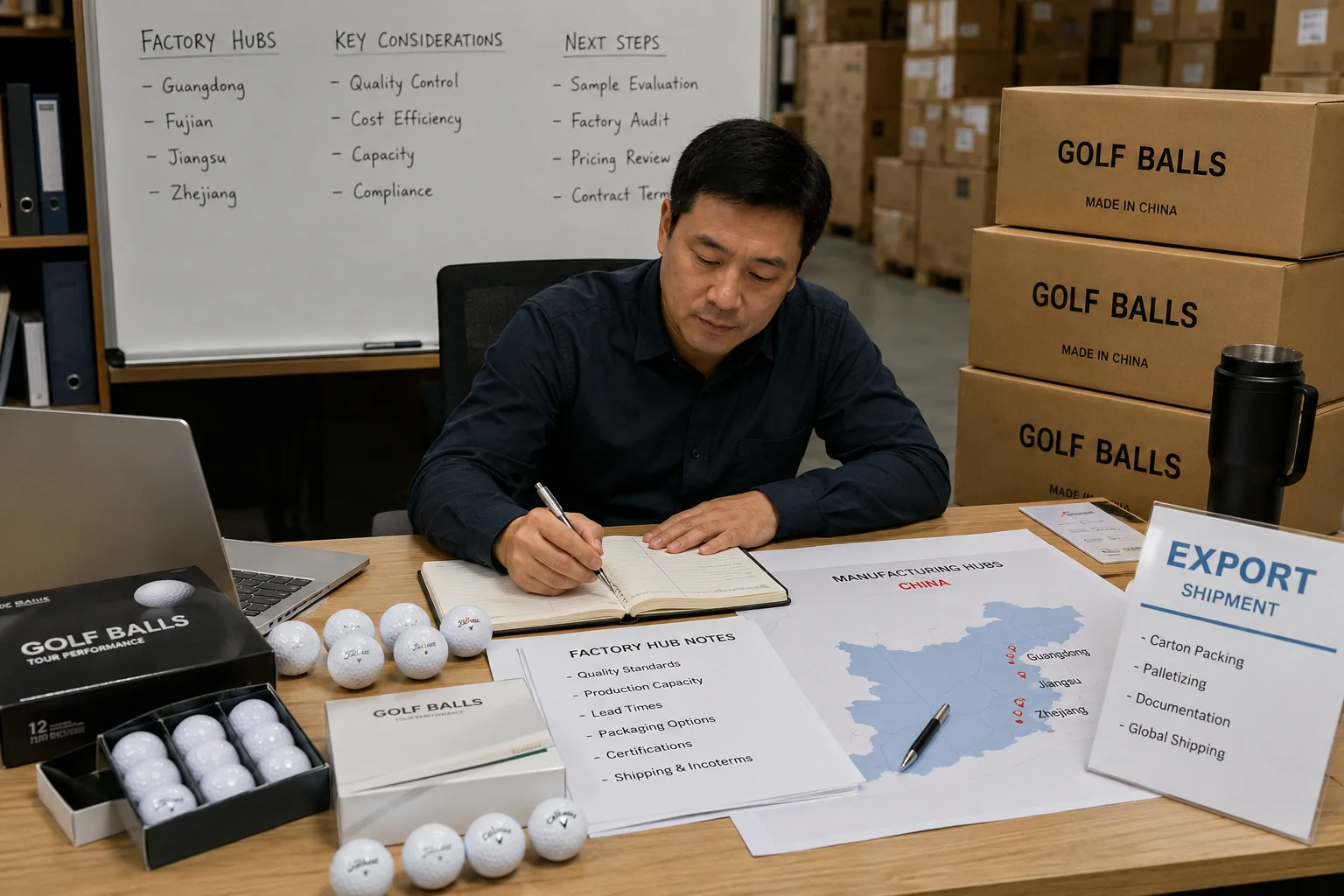
Golf ball factories in China are concentrated around production hubs, not spread evenly across the country.
For OEM, wholesale, and private-label buyers, the main China golf ball factory hubs should be compared by order behavior: Guangdong for fast promo and packaging-heavy work, Fujian for stable mid-volume OEM runs, and Zhejiang for low-MOQ private-label pilot lots. The safest hub is not the biggest cluster; it is the one whose MOQ, cover process, batch QC, packaging path, and peak-season capacity match your order.
If you are sourcing golf balls from China, do not choose a region by map position alone. Decide whether your SKU needs 2-piece promo speed, 3-piece TPU retail continuity, lower-MOQ testing, custom packaging, or batch-linked QC proof.
Use this guide to compare China’s golf ball manufacturing hubs, match each region to the product types it produces best, and know what evidence to request before PO release.
Which China hub fits your golf ball order?
You do not need a geographic tour of China. You need to know which region best matches your order size, packaging complexity, target retail price, and replenishment risk.
Choose the hub by production behavior: Guangdong for fast packaging, Fujian for yield continuity, and Zhejiang for low-MOQ private-label testing. If your first order is small, your risk is not factory location; it is whether the hub can protect samples, packaging, and repeat supply.
The old way to compare China golf ball manufacturing hubs was simple: list Guangdong, Fujian, Zhejiang, and Jiangsu, then describe what each area makes. That helps with basic research, but it does not help you make a safer PO decision. A procurement manager needs to know whether the factory system can handle your SKU type, packaging path, reorder rhythm, and internal risk review.
A 2-piece logo ball for a corporate giveaway does not need the same supplier logic as a 3-piece TPU private-label retail SKU. A 1,000-ball pilot order should not be forced into a system optimized for large replenishment. A complex gift box can delay an otherwise simple order if the packaging flow is weak.
| Buyer decision | Best-fit hub | Typical order logic | Risk to watch | Proof to request |
|---|---|---|---|---|
| Fast promo or gift order | Guangdong | 2-piece, practice, logo, or packaging-heavy orders | Artwork or packaging delay | Lock box type, label file, carton mark, and ship window before PO. |
| Stable mid-volume retail SKU | Fujian | 5,000–10,000 pcs repeat OEM runs | Longer ramp-up if specs change | Request recent batch yield, QC history, and repeat-order records. |
| Pilot private-label launch | Zhejiang | 1,000–3,000 pcs test order | Over-customization on the first run | Use existing mold, standard formula, and simple packaging. |
| Niche finish or prototype | Other flexible suppliers | Small design validation or special finish testing | Scale-up uncertainty | Confirm repeat-production plan before launch. |
A useful supplier should answer MOQ by construction, not only by total quantity. Ask separate MOQ for ball construction, logo printing, sleeves, retail boxes, gift boxes, and reorder runs. Then compare quoted lead time against packaging complexity and peak-season pressure before you pay a deposit.
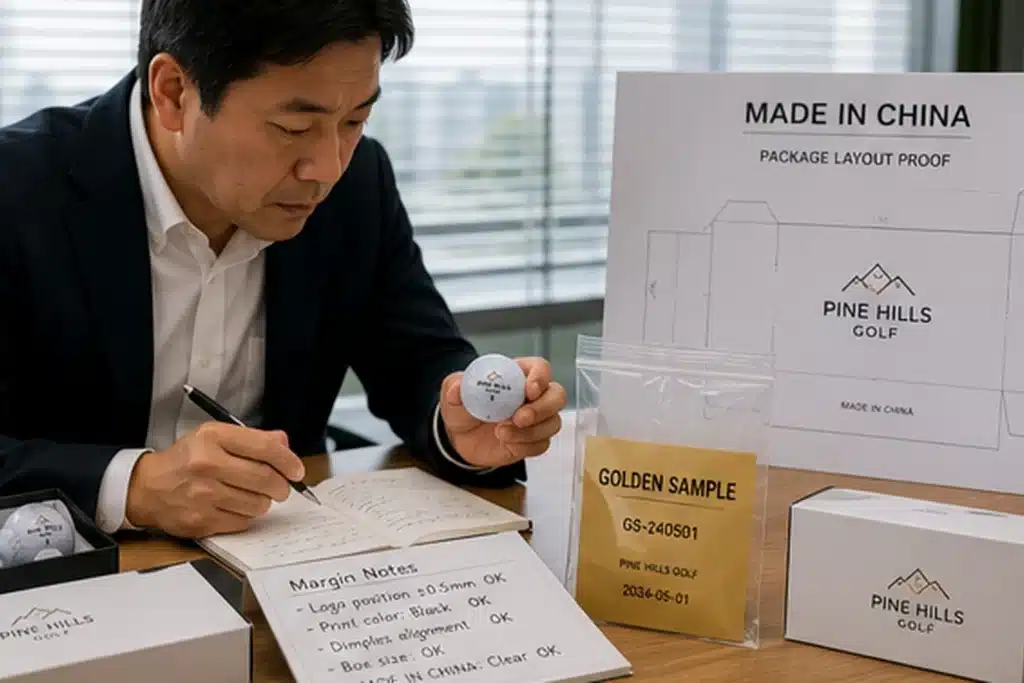
If your internal team still needs to verify factory identity, ask for production photos, process flow, QC equipment, export records, and sample-to-bulk traceability before treating a low quote as real capacity.
Guangdong: fast packaging and promotional velocity
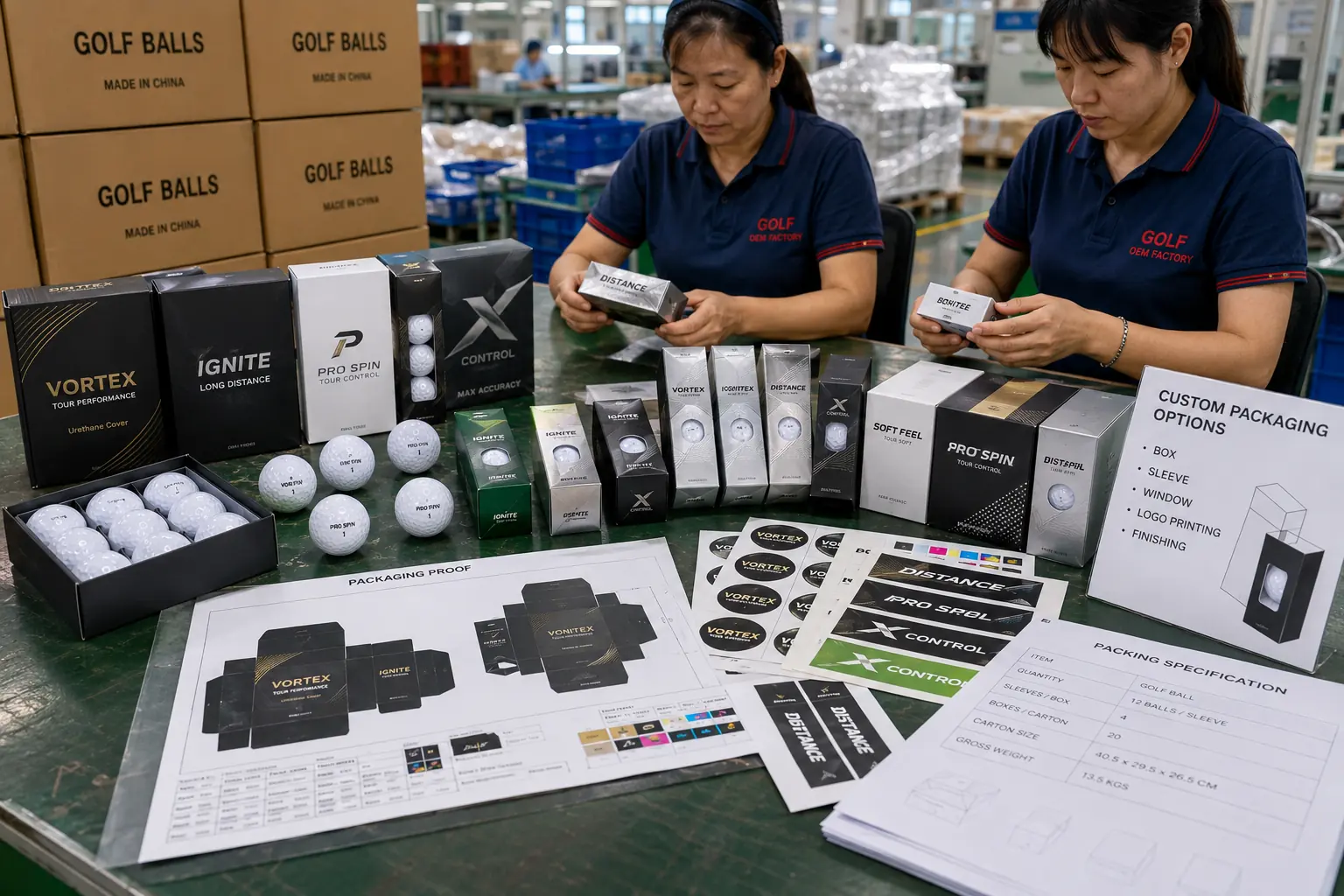
Guangdong is strongest when speed, packaging variety, and promotional execution matter more than deep material customization. If you need practice balls, driving range balls, logo balls, event-use balls, white boxes, PET boxes, net bags, or accessory bundles, Guangdong’s value is not only ball production. It is the surrounding packaging and accessory ecosystem.
That ecosystem is useful when your sales team has a short event window or your distributor needs fast replenishment. The weakness is that quick packaging can create false confidence. If artwork, box structure, barcode, and carton mark are not locked, the ball may be ready before the packaging is. Require written confirmation of mold, material, packaging artwork, and shipment window before deposit.
Fujian: continuity for larger OEM runs
Fujian fits buyers who need process continuity across larger OEM runs, especially 2-piece, 3-piece, and mid-tier urethane projects. When your SKU has repeat demand, the goal is not only to receive the first batch. The goal is to make the second, third, and fourth batch feel like the approved sample.
This matters for retail programs where repeat buyers expect the same distance feel, logo durability, coating appearance, and sleeve presentation. Fujian can be a strong fit when your volume is high enough to justify a more stable production rhythm. Your PO should still define material version, compression window, cover process, packaging version, and batch traceability. Verbal “same as sample” language is too weak.
Zhejiang: agile pilot lots and private labels
Zhejiang, especially Ningbo and Hangzhou, is better suited to agile private-label testing, lower MOQ discussion, and practical customization. For a newer DTC brand, regional distributor, golf event company, or niche retail channel, the first order is often a market test rather than a full-scale national launch.
This is where a Ningbo-based manufacturer such as Golfara can fit naturally. A 1,000-ball custom MOQ is most practical when the project uses existing molds, proven formulas, standard ball constructions, and controlled packaging. That gives you a cleaner pilot lot without tying up too much cash in untested inventory. It also gives your team a real batch to evaluate before upgrading to custom sleeves, premium boxes, or larger quarterly replenishment.
✔ True — The best hub is the one that matches your order behavior.
A large factory cluster is not automatically the safest choice. Your better supplier is the one whose MOQ, packaging flow, QC method, and reorder rhythm match your channel.
✘ False — “The biggest cluster must be the best supplier for every order.”
That logic can push a pilot order into a system designed for volume. Small private-label launches need flexibility first, then scale after the market gives you proof.
Which Cover Process Fits Each Hub?
You may ask for urethane because premium brands use that word, but the wrong urethane process can destroy your margin, yield, and reorder stability.
Do not approve a golf ball PO that only says urethane. You need the supplier to state TPU injection or cast thermoset, because that one wording choice changes yield, cost, wedge spin, feel, and whether your value-to-mid program can still make money.
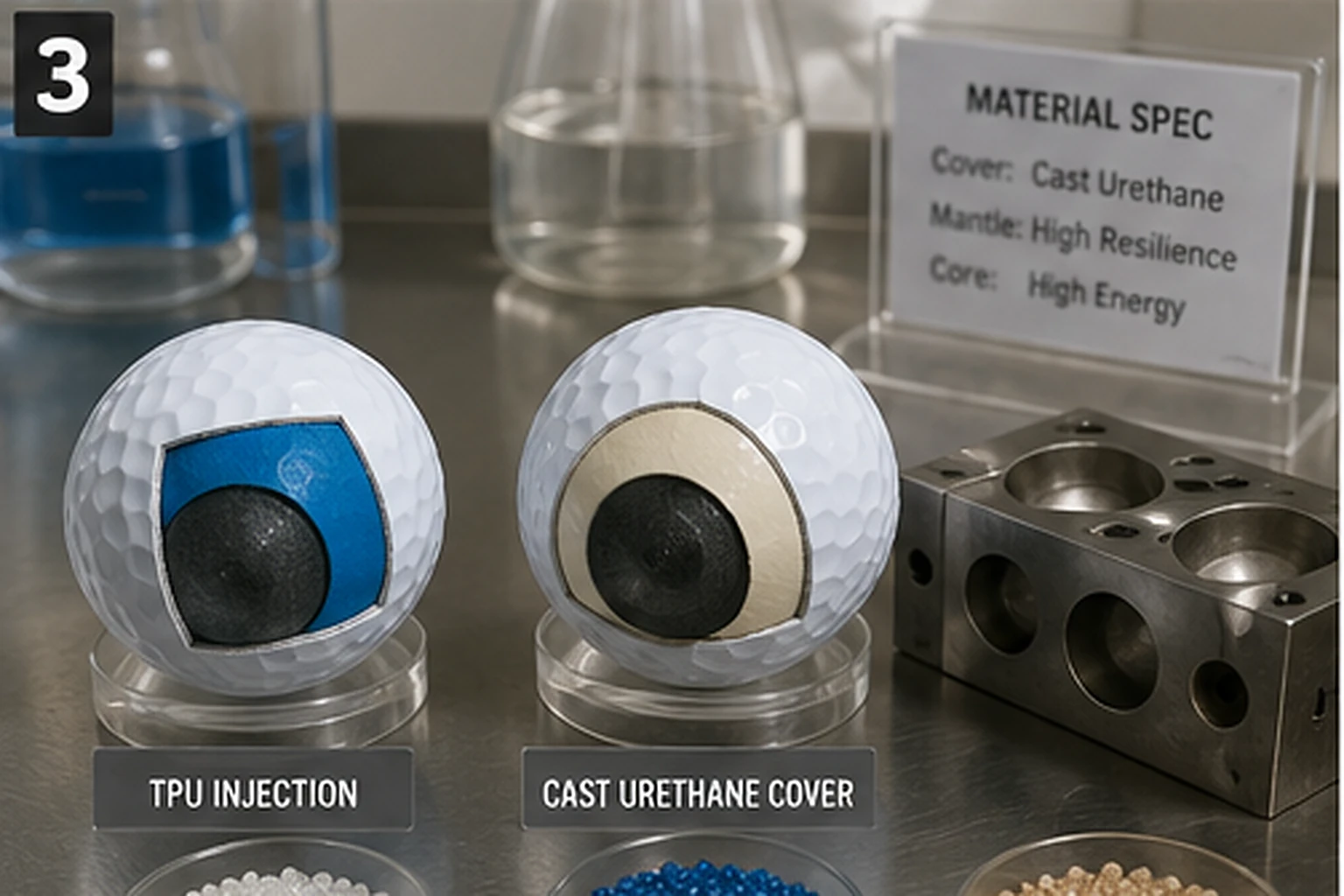
This is one of the most expensive misunderstandings in golf ball sourcing. “Urethane” sounds premium, but it is not a complete specification. TPU injection and cast thermoset urethane are both discussed under the urethane umbrella, yet they behave differently in manufacturing, cost, feel, greenside spin, and scrap risk.
In technical terms, TPU uses pelletized urethane that can be injection-molded or compression-molded, while cast thermoset urethane forms through a chemical reaction inside the cover mold. That process difference is why two balls can both be marketed as urethane-covered while serving very different channel economics.
For Chinese OEM projects, many 3-piece urethane golf balls are more accurately described as injection-molded TPU urethane cover balls. That is not a weakness when the product is positioned correctly. TPU injection is more mass-production friendly, easier to control at B2B value price points, and often a better fit for logo, private-label, and mid-market retail programs.
| Decision | TPU injection | Cast thermoset | Buyer risk | PO control |
|---|---|---|---|---|
| Retail price pressure | Better fit for value urethane | Higher cost pressure | Margin collapse | Match process to target retail price |
| Greenside spin promise | Good value performance | Higher premium spin potential | Overpromising performance | Define launch monitor test method |
| Yield stability | More mass-production friendly | More process-sensitive | Scrap, delay, and claims | Ask for batch yield history |
| Specification clarity | Often used in China OEM | Must be explicitly confirmed | Generic urethane wording | Write exact cover process in PO |
Cast thermoset urethane can support a softer premium cover and higher short-game spin potential, but the process is more sensitive and the margin math becomes harder. If your buyer promise is “premium tour-like control,” cast thermoset may be worth discussing. If your retail target, wholesale price, or distributor margin sits in the value-to-mid range, TPU may protect the business better.
A supplier that only says “urethane” but cannot explain TPU injection or cast thermoset is giving you a failure signal. The issue may not be bad faith. It may simply be loose wording. Loose wording becomes expensive when your sales deck, packaging copy, and customer promise imply one process while the factory is quoting another.
Specify cover process, cover material, sample ID, batch link, and acceptance test method for TPU injection or cast thermoset urethane before PO release. For a deeper process comparison, use the TPU vs cast urethane golf balls OEM guide. This turns TPU vs cast urethane golf ball OEM from a vague technical debate into a commercial control point.
✔ True — Urethane must be defined by process, not only by name.
TPU injection and cast thermoset urethane can both sit under the urethane umbrella, but they behave differently in cost, yield, feel, and spin control.
✘ False — “If the supplier says urethane, the ball is comparable to premium cast urethane.”
That assumption can lead to overpromised retail positioning and weak margin. Put the exact process and acceptance method in writing.
What QC Proof Should Each Hub Provide?
Your real fear is not whether the sample looks good. Your risk is that bulk production changes weight distribution, compression, cover feel, logo durability, or packaging quality after approval.
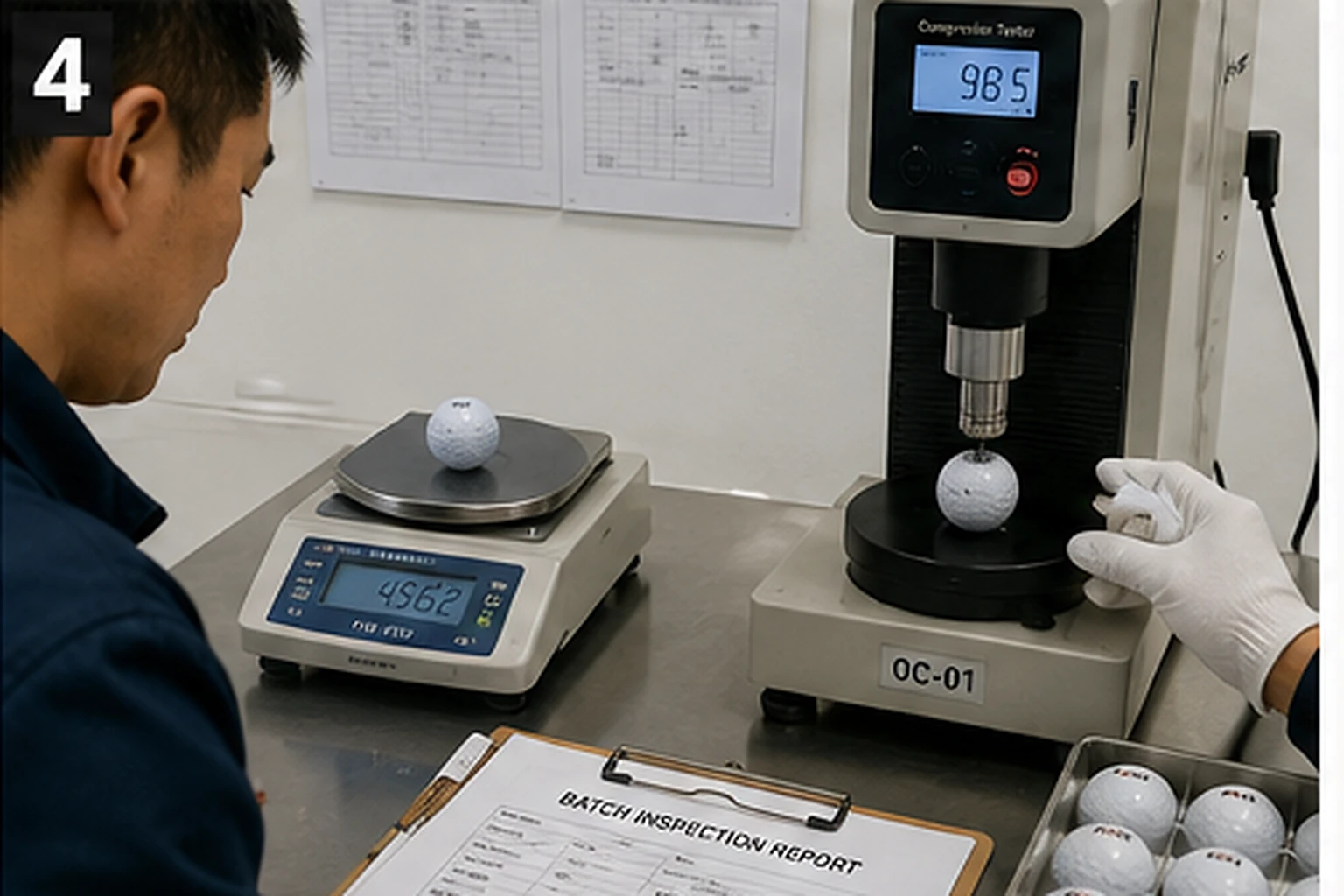
A good sample is not proof of a stable production batch. Before you release bulk payment, ask for a random QC report with raw data, not only pass/fail photos. Weight, compression, hardness, coating, and concentricity tell you more than hand feel.
This is where many overseas golf ball orders go wrong. The sample is approved by sight, touch, and a few test shots. Then bulk production arrives with a slightly different sound, inconsistent print durability, wider compression spread, or packaging that looks close but not identical. The supplier says it is “within normal tolerance.” Your sales team says customers can feel the difference. Now the argument starts after the goods have already shipped.
Move acceptance away from hand-feel approval and into batch-linked evidence. For pilot orders, a 12-ball random batch QC report is a buyer-friendly minimum. It should include the approved sample ID, production batch number, test date, equipment model, calibration date, raw values, mean, range, and sigma where the factory can provide it.
| Pain/decision | What to request | Business reason | Risk blocked | Buyer move |
|---|---|---|---|---|
| Sample looks perfect | Approved sample ID | Locks the reference | Sample switching | Put sample ID in PO |
| Compression varies | ATTI compression values | Shows batch spread | Unstable feel or distance | Ask for mean and sigma |
| Weight concern | Raw weight data | Checks rule boundary | Nonconforming batch risk | Set acceptance window |
| Off-center flight | X-ray/CT or balance check | Checks concentricity | Erratic ball flight | Request image or report |
| Logo durability | Abrasion, alcohol, or rub test | Protects brand presentation | Print complaints | Approve test method before mass print |
For rule boundaries, the ball must not exceed 45.93 g in weight and must not be smaller than 42.67 mm in diameter, but these limits do not replace batch consistency checks. A ball can sit inside the rule boundary and still create buyer problems if compression spread, coating thickness, or concentricity varies too much.
Before final payment, ask the supplier to submit a random batch QC report showing test method, equipment ID, calibration date, sample quantity, raw values, mean, range, and sigma for weight, diameter, compression, hardness, coating, and concentricity. For the full supplier evidence workflow, use the China Golf Ball OEM Supplier Verification Checklist. If sample approval has no batch-linked QC file, your team is buying trust instead of evidence.
✔ True — A sample needs a data chain behind it.
The approved sample ID, production batch number, and random QC report should connect. Without that chain, your sample is only a nice object on a desk.
✘ False — “A beautiful sample means mass production will be identical.”
Bulk stability depends on material control, compression spread, coating, print process, packaging execution, and batch inspection. Photos alone do not prove those points.
Does USGA approval prove factory quality?
You may worry that a factory without current USGA/R&A listing cannot make serious golf balls. That can be true for tournament eligibility, but it is not a complete factory-quality judgment.
USGA/R&A listing answers eligibility, not the full quality question. If your SKU must enter regulated competition, verify the current list. If your SKU is for retail, practice, logo, or DTC channels, verify current batch data, equipment, and sample control.
This distinction matters. For competition-use products USGA approval can be a hard requirement. If your customer, event, or channel requires the conforming ball list, write active eligibility into the PO and verify it before shipment. In that case, “we tested something similar before” is not enough.
For many B2B programs, however, the ball is used for practice, corporate events, gift sets, club resale, DTC testing, or value retail. Those channels may care more about durability, distance feel, logo quality, packaging appearance, and reorder consistency than formal tournament eligibility. A missing or expired listing does not automatically mean the factory lacks capability. It may mean the factory did not renew because the channel did not require it.
That does not give any supplier a free pass. It simply changes the verification path. Ask for current QC data, equipment list, sample-to-batch traceability, and historical submission experience where available. If the product must be competition-eligible, require active listing. If it does not, evaluate manufacturing proof directly.
✔ True — Conforming-list status is a channel requirement when competition use demands it.
For tournament programs, active eligibility belongs in the PO. For retail, practice, or logo channels, batch data and process control often carry more day-to-day sourcing value.
✘ False — “If a model is not currently listed, the factory must be unprofessional.”
That shortcut can reject capable suppliers. Verify the channel need first, then check current QC proof and sample-to-bulk control.
Recent supply-chain disruptions show why buyers should qualify backup capacity before peak season. The practical response is not to abandon Taiwan, Thailand, or the USA. It is to separate backup capacity by process: 2-piece ionomer, TPU-route urethane, logo balls, and mid-premium multilayer programs should each be qualified before price comparison. The practical response is not to abandon Taiwan, Thailand, or the USA. It is to qualify backup capacity by process: TPU-injection urethane, 2-piece Surlyn, logo balls, and mid-premium multilayer programs should be separated in the PO before price comparison.
When should you reserve production slots?
You can approve the right ball and still lose the season if packaging, PO timing, payment, or shipping planning is late.
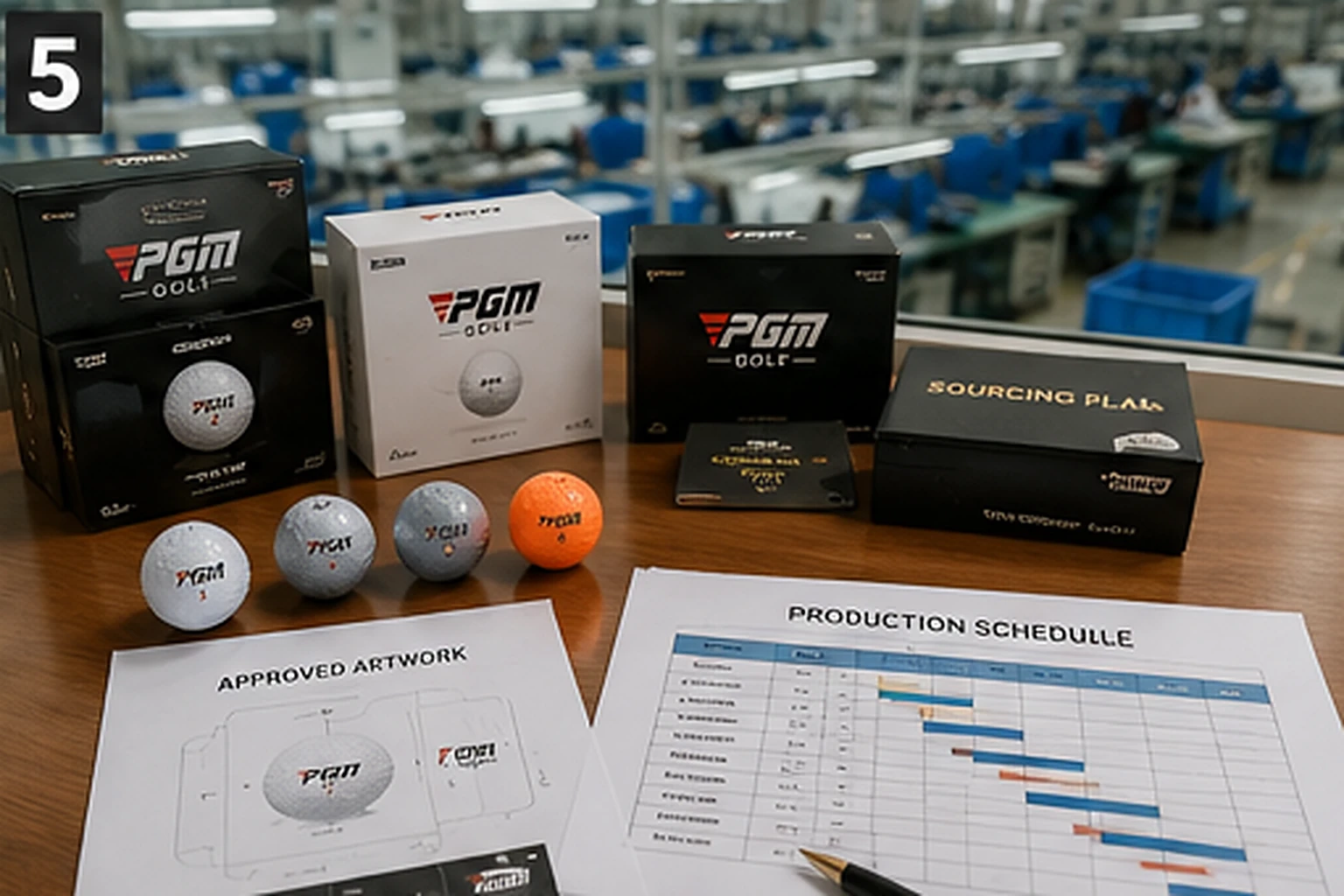
Your lead time starts when specs, artwork, packaging, and payment are locked—not when the first email is sent. For pilot lots, standard packaging and existing formulas can protect your launch window better than complex gift-box customization.
Golf ball factory MOQ China searches usually focus on the number of balls. That is only half the story. The real schedule is controlled by five locks: approved sample, confirmed construction, final artwork, packaging availability, and production slot. If any one of those remains open, the quoted lead time is still conditional.
This becomes more painful during pre-holiday production pressure, pre-CNY shipping congestion, and spring-summer replenishment windows. Factories protect confirmed orders first. Larger customers, repeat SKUs, and paid deposits usually get priority. A small pilot order can still move quickly, but only if you remove avoidable friction.
| Pain/decision | Hidden cause | Safer first-order choice | When to upgrade | Proof to request |
|---|---|---|---|---|
| Need fast pilot lot | New mold or formula | Existing mold/formula | After market validation | Confirm sample ID and mold status |
| Packaging delay | Custom color box | White box + label | After repeat forecast | Lock dieline and artwork date |
| Peak-season risk | No reserved slot | Early PO + deposit | Rolling reorder plan | Ask for slot confirmation |
| Logistics burden | Multiple handoffs | DDP evaluation | After landed-cost review | Request incoterm comparison |
| Reorder stability | One-off supplier quote | Batch-linked production plan | Quarterly replenishment | Confirm capacity window |
Packaging artwork still open after PO is a clear failure signal. It sounds small, but it can delay sleeves, boxes, carton marks, barcodes, and retail-ready presentation. For a first order, white box plus label often beats a beautiful custom box that arrives too late. Use complex packaging after the SKU proves repeat demand.
Supplier shall identify the approved sample ID, material version, cover process, packaging artwork version, and production batch number on the PO confirmation. Any material, mold, cover-process, printing, coating, or packaging change requires written buyer approval before mass production.
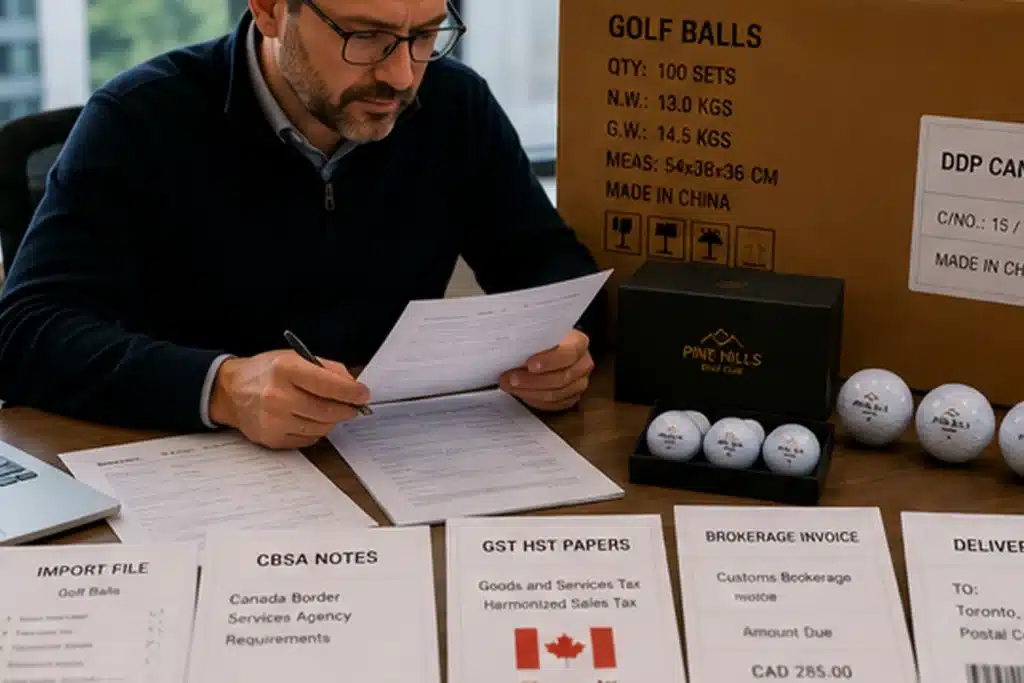
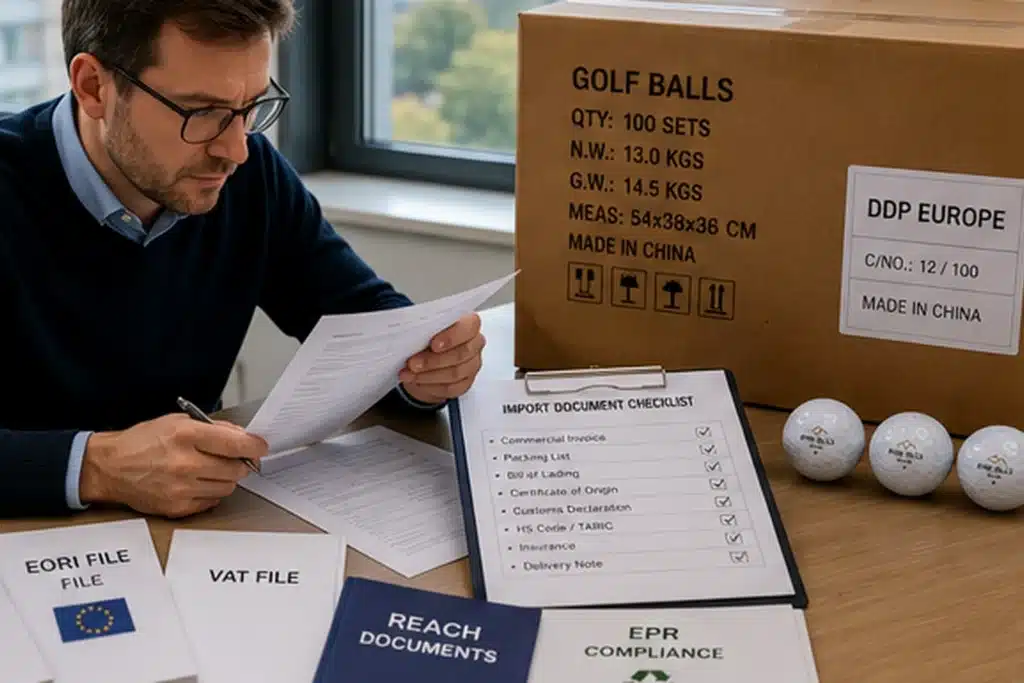
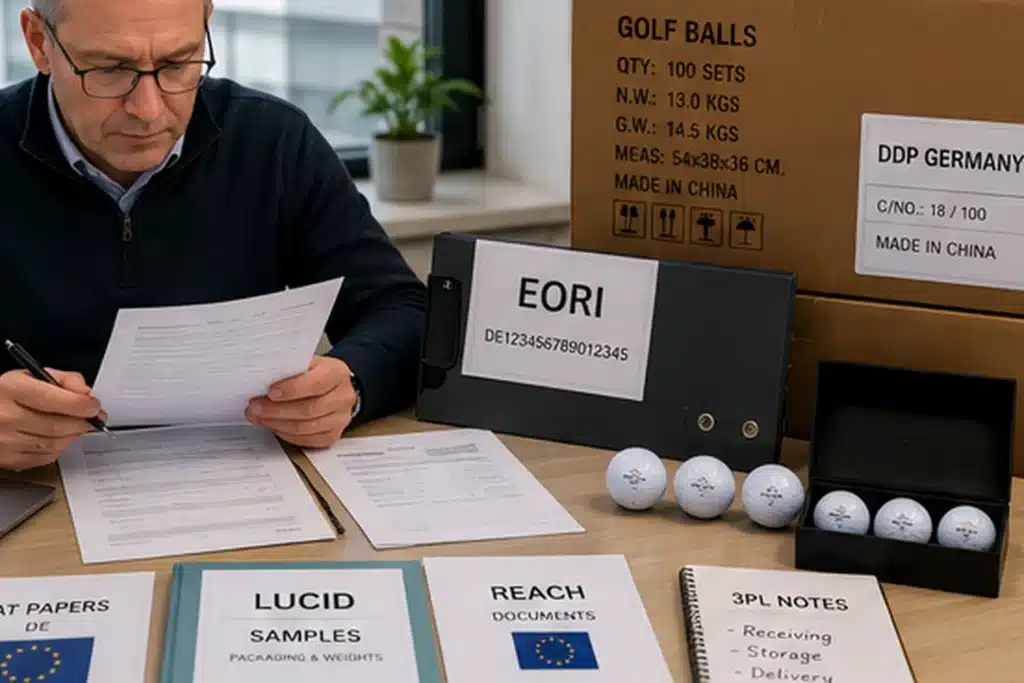
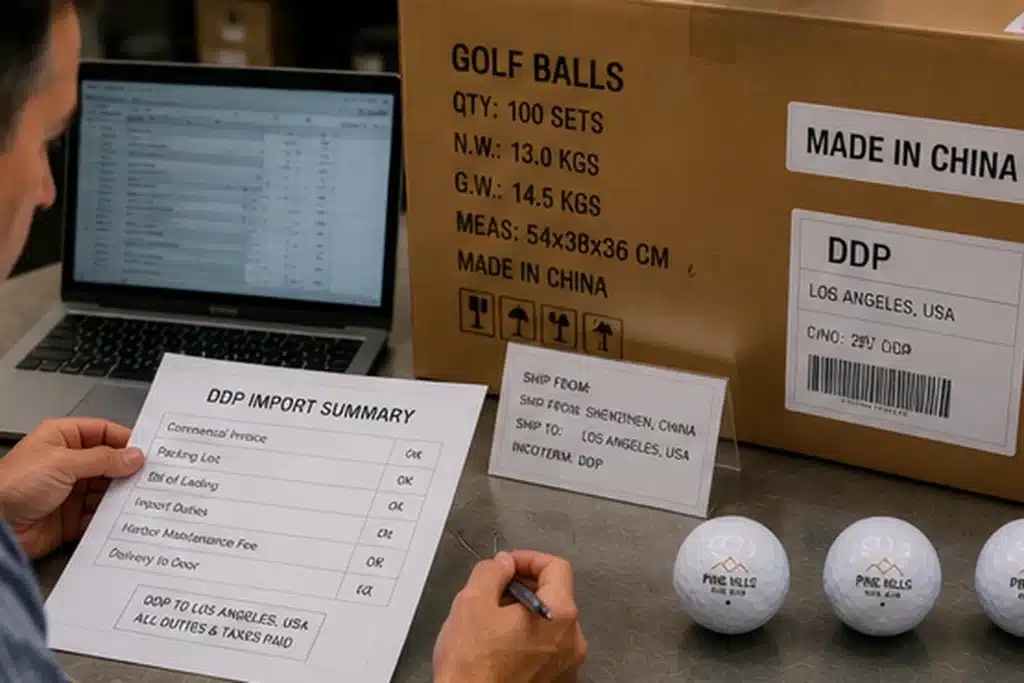
DDP can reduce coordination work for overseas buyers, especially when your team wants one supplier to help with export, freight, and delivery. Still, DDP should not hide tariff, customs, labeling, or delivery assumptions. Ask for FOB, CIF, and DDP using the same destination and carton data. Golf ball landed cost China comparisons only work when the same shipment assumptions are used.
✔ True — Lead time begins after commercial and technical locks are complete.
Sample approval, artwork, packaging, deposit, and production slot must align. A fast email reply cannot overcome late artwork or an unconfirmed box structure.
✘ False — “A 30-day quote means the order ships in 30 calendar days.”
That quote usually assumes approved specs, confirmed packaging, available materials, and a reserved slot. Remove one assumption and the schedule changes.
FAQ
Are major golf ball brands made in China?
Some value, distance, practice, logo, and mid-tier golf ball programs rely on Asian manufacturing capacity, including China. Your safer decision is to match your SKU to the right process and hub, not assume one country equals one quality level.
- Separate 2-piece Surlyn, 3-piece TPU, and cast thermoset programs before quoting.
- Use China for flexible OEM, logo balls, practice balls, and value-to-mid programs.
- Treat trade scale as proof of commercial capability, not proof that every supplier can make tour-level balls.
How much does it cost to manufacture golf balls in China?
For B2B sourcing, avoid ultra-low teaser pricing. Your real cost depends on construction, cover material, tolerance, print method, packaging, order quantity, QC requirements, and whether you compare FOB or landed cost.
- Compare 2-piece Surlyn, 3-piece TPU, and cast urethane as separate cost buckets.
- Ask whether logo printing, sleeves, retail boxes, cartons, and inspection are included.
- Compare landed cost before accepting the lowest unit price.
What is the MOQ for custom golf balls from China?
MOQ depends on hub, construction, packaging, and whether the supplier can reuse existing molds and formulas. A pilot lot can be lower than a fully custom new construction with new tooling and complex retail packaging.
- Ask for MOQ by ball construction and packaging type separately.
- Use existing molds and formulas for first-market validation.
- Treat 1,000–3,000 pcs as a pilot logic, not a universal promise for every custom project.
Do Chinese golf ball factories have USGA approval?
Some do, some have historical submissions, and some do not maintain active listing because their target channels do not require it. For competition use, verify current list status; for retail or practice use, verify batch data.
- Confirm whether your channel actually requires conforming-list eligibility.
- Ask for current or historical submission proof if relevant.
- Do not replace QC verification with a certificate screenshot.
What should be written in a custom golf ball PO?
Your PO should prevent ambiguity. The most important fields are construction, cover process, approved sample ID, packaging version, QC method, batch link, shipment terms, and acceptance criteria used before final payment.
- State TPU injection or cast thermoset clearly if urethane is involved.
- Attach artwork files, sleeve or box dielines, carton marks, and sample references.
- Define QC acceptance before deposit, not after production.
How can you reduce lead time for a first order?
Use an existing mold, standard formula, simple packaging, and a supplier with a realistic production slot. Complex box design should wait until your SKU proves repeat demand and your reorder forecast is clearer.
- Use white box plus label for the first run.
- Avoid changing artwork after sample approval.
- Ask whether piggyback production is available for a compatible batch.
Is DDP shipping safe for golf ball importers?
DDP can reduce coordination work, but it should not hide tariff, customs, labeling, or delivery assumptions. You still need a landed cost comparison before importing golf balls from China.
- Ask for FOB, CIF, and DDP options using the same quantity, carton size, and destination.
- For U.S. entries, golf balls are commonly classified under HTSUS 9506.32.0000, but China-origin exposure and Chapter 99 / Section 301 treatment should still be checked by your broker.
- Convenience is useful only when the assumptions are visible.
How do you compare China, Taiwan, Thailand, and the USA?
Compare them by program fit. China is strong for flexible OEM, pilot lots, packaging, and value-to-mid programs; Taiwan, Thailand, and the USA may fit stricter high-end or domestic-branding requirements.
- Use China for pilot lots, logo balls, fast packaging, and repeatable value SKUs.
- Consider higher-cost alternatives when your margin supports stricter process cost.
- Keep backup capacity qualified before peak season instead of relying on one region.
Conclusion
China’s golf ball manufacturing hubs are easier to evaluate when you stop reading them as a map and start reading them as production systems. Guangdong helps with fast promo and packaging-heavy work, Fujian helps with stable mid-volume OEM continuity, and Zhejiang helps with low-MOQ private-label testing.
Your safest path is to choose the hub by order behavior, define the cover process in writing, require batch-linked QC proof, confirm packaging before PO release, and reserve production before the peak rush.
After you understand the hub logic, use a manufacturer shortlist to compare specific supplier candidates.
You might also like — Top 10 Golf Ball Manufacturers in China for OEM