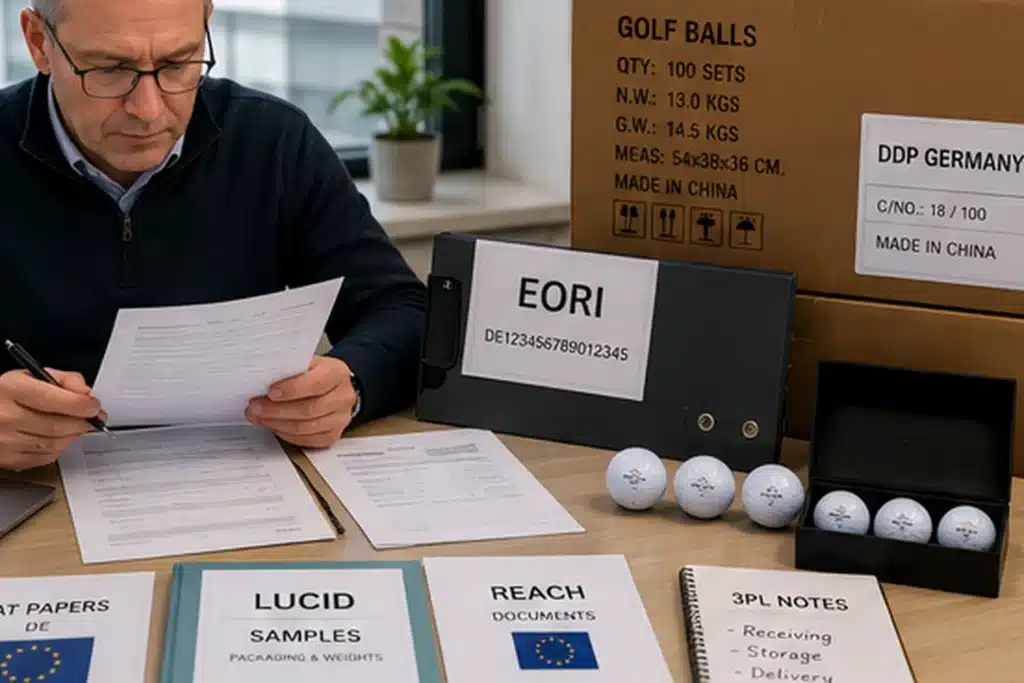
A real golf-ball manufacturer can still be the wrong supplier if it does not accept your OEM program, cannot run your exact SKU, or cannot prove who controls production.
To compare golf ball manufacturers in China, check six things: manufacturing role, current OEM access, exact SKU and production-route fit, MOQ basis, available production capacity, and batch-linked production evidence. Use a Top 10 list to build a shortlist—not to assume the largest or most visible factory is automatically the best fit.
The ten companies below are representative sourcing candidates for OEM buyers, not an absolute quality ranking or a complete directory of China golf ball factories. Each candidate is evaluated by the same evidence standard, including Ningbo Golfara.
Your goal is to narrow the list to manufacturers that are eligible for your program, fit your SKU, and can prove the production route behind their claims.
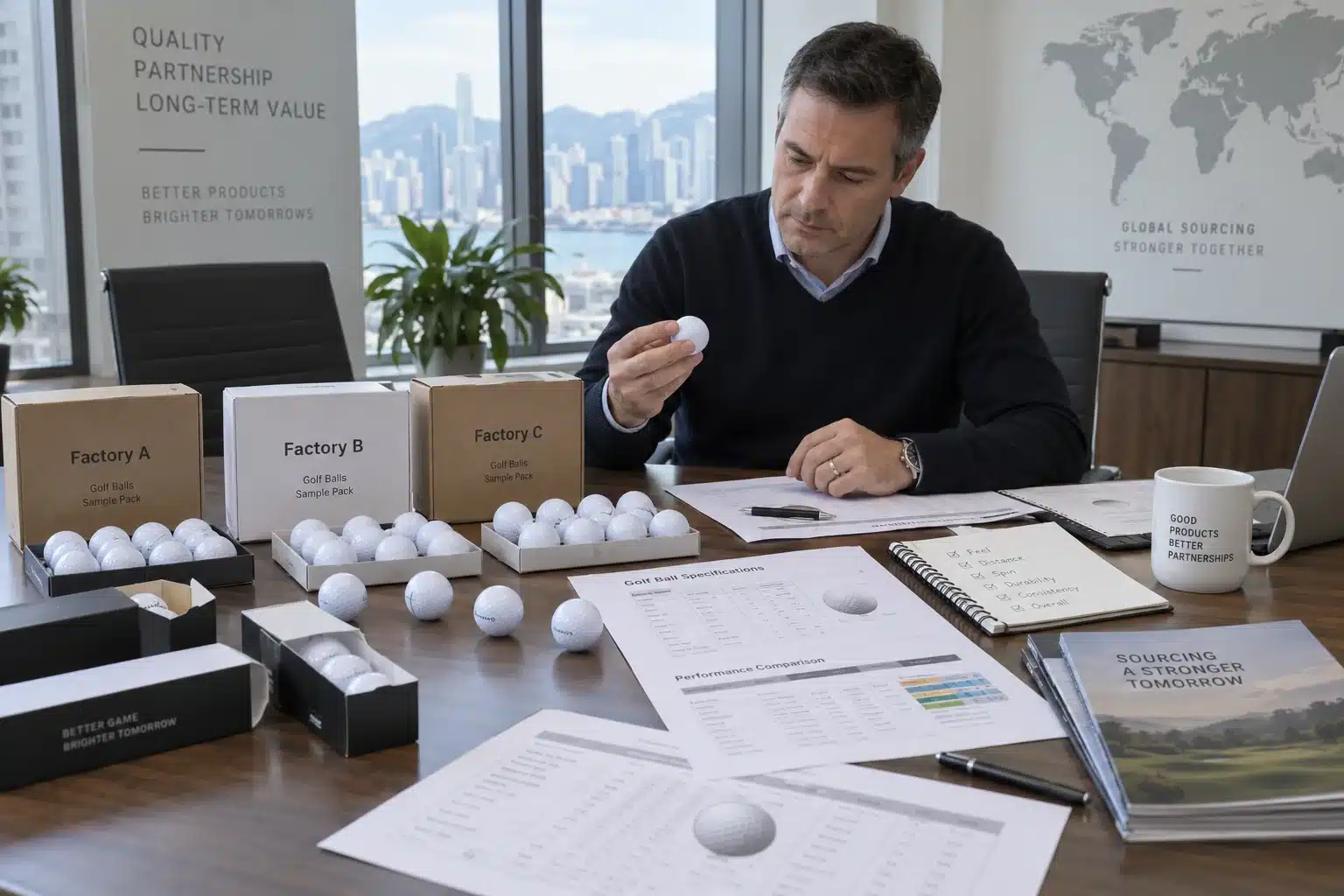
Which 10 China Golf Ball Makers Should You Shortlist?
Search for golf ball manufacturers in China and you can collect dozens of names quickly. The harder job is deciding which ones deserve your team’s time after search results mix manufacturers, contract factories, OEM coordinators, brands, and commercial suppliers.
Use these ten companies as an OEM sourcing shortlist, not an absolute quality ranking. A candidate deserves deeper review only when you can establish its manufacturing role, current OEM access, product-route fit, commercial basis, and evidence status for the golf ball program you actually intend to buy.
Status reviewed for 2026 sourcing; reconfirm current commercial terms during RFQ.
How Were the 10 Candidates Included?
The inclusion rule is deliberately stricter than “the company sells golf balls.”
A useful candidate should give you enough evidence to investigate six questions:
-
Can the company or operating entity be identified?
-
Is there current golf-ball manufacturing or contract-manufacturing evidence?
-
Is there identifiable golf-ball product capability?
-
Can its OEM, ODM, private-label, or external-access role be classified?
-
Can the production location or production model be investigated?
-
Is there enough current evidence to justify another buyer-verification step?
That does not mean every company below has already passed a full supplier audit.
It means there is enough evidence to justify asking the next question.
The shortlist is representative, not exhaustive. A company outside the list is not automatically a weaker manufacturer.
The table below compares all ten candidates using the same five sourcing fields, so you can separate manufacturing evidence from current OEM access before moving any supplier into RFQ.
| Manufacturer | Production / Location | OEM Access | MOQ Reference | Evidence / Buyer Check |
|---|---|---|---|---|
| Chengdu Sunshine Founder Sports Goods Co., Ltd. | Chengdu, Sichuan / production evidence available | Publicly indicated | Verify by SKU | Confirm current route and in-house stages |
| Qingdao Nexen Co., Ltd. | Qingdao, Shandong / current golf-ball manufacturing and contract-production evidence | Verify current external access | Not publicly confirmed | Confirm external OEM access, exact construction, and available production slot |
| GTS Golf (China) LLC | Dongguan, Guangdong / contract-manufacturing footprint | Verify current external access | 5,000 pcs reference | Confirm external OEM access and current slot |
| Hangzhou Grasbird Golf Manufacturing Co., Ltd. | Hangzhou, Zhejiang / dedicated golf-ball manufacturing | Verify current external access | 5,000 pcs reference | Confirm current constructions and commercial route |
| JTS (Xiamen) Sports Equipment Co., Ltd. | Xiamen, Fujian / OEM platform + ball capability | Publicly indicated | 3,000 pcs reference | Confirm golf-ball-specific in-house stages |
| Ningbo Golfara | Ningbo, Zhejiang / OEM-private-label manufacturer | Current / Open | 1,000 pcs current — bulk balls | Apply the same evidence rule as every candidate |
| Qingdao Oudun Sports Goods Co., Ltd. | Qingdao, Shandong / golf-ball contract manufacturing | Verify current external access | Not publicly confirmed | Confirm external OEM access and SKU route |
| Qingdao SM Parker Golf Co., Ltd. | Qingdao, Shandong / established contract manufacturing | Verify current external access | Not publicly confirmed | Confirm current external OEM policy |
| Shenzhen Hongzhou Sports Goods Co., Ltd. | Shenzhen / Huizhou, Guangdong / production signal | Publicly indicated | Verify by SKU | Confirm manufacturing entity, exact construction, and production scope |
| Shenzhen Xinjintian Sports Goods Co., Ltd. / XJT Golf | Shenzhen commercial entity / Dongguan, Guangdong production | Publicly indicated | 3,000 pcs reference | Confirm exact SKU route and available slot |
MOQ figures labeled “reference” reflect previously observed or published commercial conditions and are not fixed current terms. Construction, customization, printing, packaging, tooling, and production scheduling can change the applicable minimum. Reconfirm the current MOQ directly with each manufacturer during RFQ.
Ningbo Golfara’s current bulk-ball MOQ remains 1,000 pcs; custom packaging can create a separate packaging minimum.
A reference MOQ is useful for early screening because it can indicate whether a manufacturer has historically operated closer to pilot-size or larger commercial programs. It is not a current quotation, and strong manufacturing evidence does not automatically prove that the factory is currently accepting new external OEM accounts.
That distinction matters because manufacturing capability, OEM access, and current commercial fit are three different sourcing questions.
If minimum-order mechanics become a major part of your decision, use the dedicated custom golf ball MOQ guide instead of assuming one table value controls every version of the program.
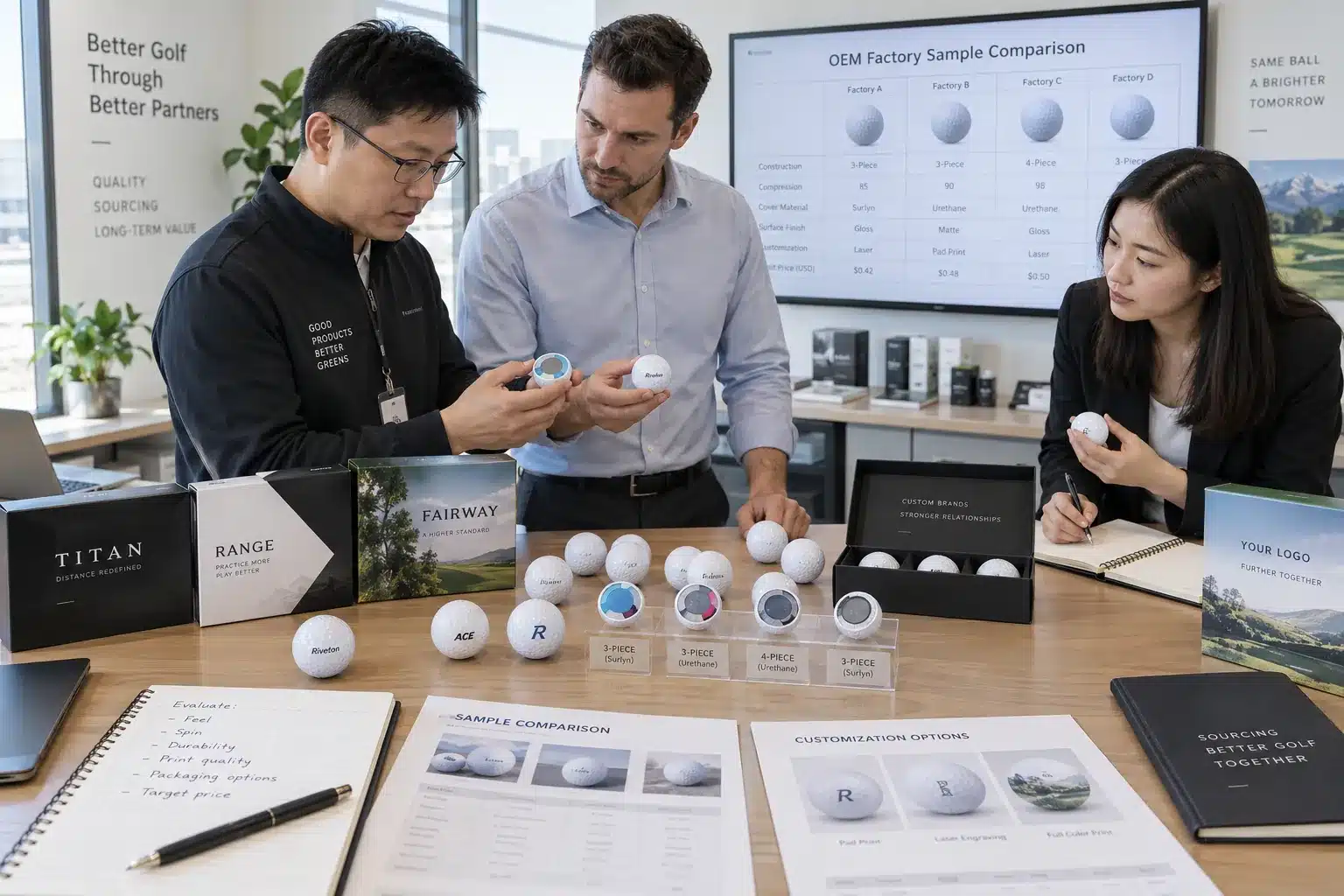
The profiles below are intentionally concise. Each answers three questions: what currently supports inclusion, what sourcing role may be relevant, and what still needs to be verified.
Chengdu Sunshine Founder Sports Goods Co., Ltd.
Current manufacturing and golf-ball product evidence provides the basis for keeping Chengdu Sunshine Founder in the shortlist. That supports further review as a production candidate rather than a generic golf reseller. Your next step is SKU-specific: confirm which constructions are currently active, which production stages are controlled at the identified site, and whether the exact ball you want is available for external OEM work. Public capability should get the company into your research round; only a current route declaration should move it into your final RFQ group.
Qingdao Nexen Co., Ltd.
Current corporate and trade evidence supports Qingdao Nexen as an established golf-ball manufacturer with active contract-production relevance. NEXEN’s golf-ball business is tied to its Qingdao operation, and recent export records show golf-ball shipments to established outside golf brands. That makes the company a strong manufacturing candidate, but it does not prove open access for every new OEM account. Keep its status as Verify current external access, then confirm which constructions are available, whether your program can access the relevant production route, what MOQ applies, and whether capacity is available in your required production window.
GTS Golf (China) LLC
Major-brand contract-production evidence and current manufacturing/export activity are the strongest reasons to keep GTS on a China golf ball manufacturer shortlist. That evidence points to a real Dongguan manufacturing footprint rather than a catalog-only claim. What remains unresolved is current external access for your account. Record the status as Verify current external access, then confirm whether new outside brands are accepted, which constructions are open, and whether capacity is actually available for your required window.
Hangzhou Grasbird Golf Manufacturing Co., Ltd.
Company-registration and current golf-ball product evidence support Grasbird’s inclusion as a dedicated golf-ball production candidate in Hangzhou. That makes it relevant for buyers trying to separate golf-ball-focused manufacturers from broad sporting-goods suppliers. The commercial side still needs current confirmation: which constructions are active, which stages are controlled internally, whether external OEM programs are open, and what minimum applies to your exact SKU. Historical MOQ references provide context, not current commercial proof.
JTS (Xiamen) Sports Equipment Co., Ltd.
Current OEM/ODM material and JTS’s own manufacturer-platform positioning are the evidence basis for inclusion. That combination suggests both golf-ball capability and a broader manufacturing-network role, which makes production-role transparency particularly important. Confirm the golf-ball manufacturing entity, which stages are directly controlled, sample-approval responsibility, QC-release ownership, and current MOQ. The historical 3,000-pc reference helps initial screening but does not replace current program evidence.
Ningbo Golfara
At Golfara, we currently support external OEM and private-label programs across 2-piece, 3-piece, and 4-piece golf-ball categories when the quoted SKU fits an available production route. Our current bulk-ball MOQ remains 1,000 pcs. Custom retail packaging can create a separate minimum, so the ball MOQ should not be treated as the complete commercial minimum for every program.
Because we publish this shortlist, our own entry should receive the same scrutiny. Your team should still verify the exact construction, production route, batch evidence, print and packaging path, and current production availability before moving Golfara into your final shortlist.
Qingdao Oudun Sports Goods Co., Ltd.
Current production and export evidence provides the basis for treating Qingdao Oudun as a golf-ball manufacturing or contract-manufacturing candidate. That answers an important eligibility question: there is enough real production signal to justify a closer look. It does not answer whether a new outside brand can currently access the same production system. Keep the status as Verify current external access, then confirm which constructions are open, which site makes the quoted SKU, and whether the required route has available capacity.
Qingdao SM Parker Golf Co., Ltd.
Established contract-manufacturing and export evidence supports SM Parker’s place in the shortlist. That evidence is useful for establishing manufacturing relevance, but contract-manufacturing history and current external-OEM policy are different facts. Keep the access status as Verify current external access until the company confirms its current policy. Ask whether new private-label accounts are accepted, which product families are open, what qualification conditions apply, and whether your expected volume fits the current commercial model.
Shenzhen Hongzhou Sports Goods Co., Ltd.
Current OEM/ODM material and production-site information linking the commercial operation with a Huizhou manufacturing base provide the evidence basis for Hongzhou’s inclusion. Public material also indicates multiple golf-ball categories, which makes the company relevant for custom programs beyond one stock model. Confirm whether Shenzhen Hongzhou Sports Goods Co., Ltd. or Huizhou Hongzhou Sporting Goods Co., Ltd. is the manufacturing entity for the quoted SKU, then verify which construction and cover routes are active, what is controlled internally, and whether the current MOQ and production window match your launch.
Shenzhen Xinjintian Sports Goods Co., Ltd. / XJT Golf
Current company/factory-structure material and public custom/OEM product information make XJT a useful candidate for buyers who need to map a commercial entity to its production entity. The Shenzhen-facing business and identified Dongguan production operation should be treated as a structure to verify, not a problem by itself. Historical MOQ references around 3,000 pcs can support initial screening. For your RFQ, confirm the exact construction, route ownership, production site, current MOQ, and available production slot.
What matters across these ten profiles is not which company sounds strongest on paper, but whether the same sourcing criteria help you identify the right fit for your program.
A manufacturer can be a credible producer and still be the wrong choice for your SKU, volume, OEM model, production window, or evidence requirements.
It may simply be:
-
closed to new external programs;
-
outside your current volume range;
-
unsuitable for your exact construction;
-
using a production route that does not match your product promise;
-
unable to document current batch evidence;
-
lacking an available production slot;
-
dependent on an unverified production layer.
Your first deliverable should therefore be a China Golf Ball Manufacturer Shortlist Matrix containing:
-
manufacturer;
-
production location;
-
production role;
-
current OEM access;
-
quoted SKU;
-
MOQ status;
-
route status;
-
capacity status;
-
evidence status;
-
next buyer verification.
If you cannot establish one field, write:
Needs verification
Do not turn uncertainty into a clean-looking spreadsheet value.
For a deadline-sensitive private-label program, the market lens is straightforward:
Use a Top 10 list to eliminate weak-fit suppliers until only two to four candidates deserve deeper RFQ and verification.
Are You Buying from a Factory or Trading Company?
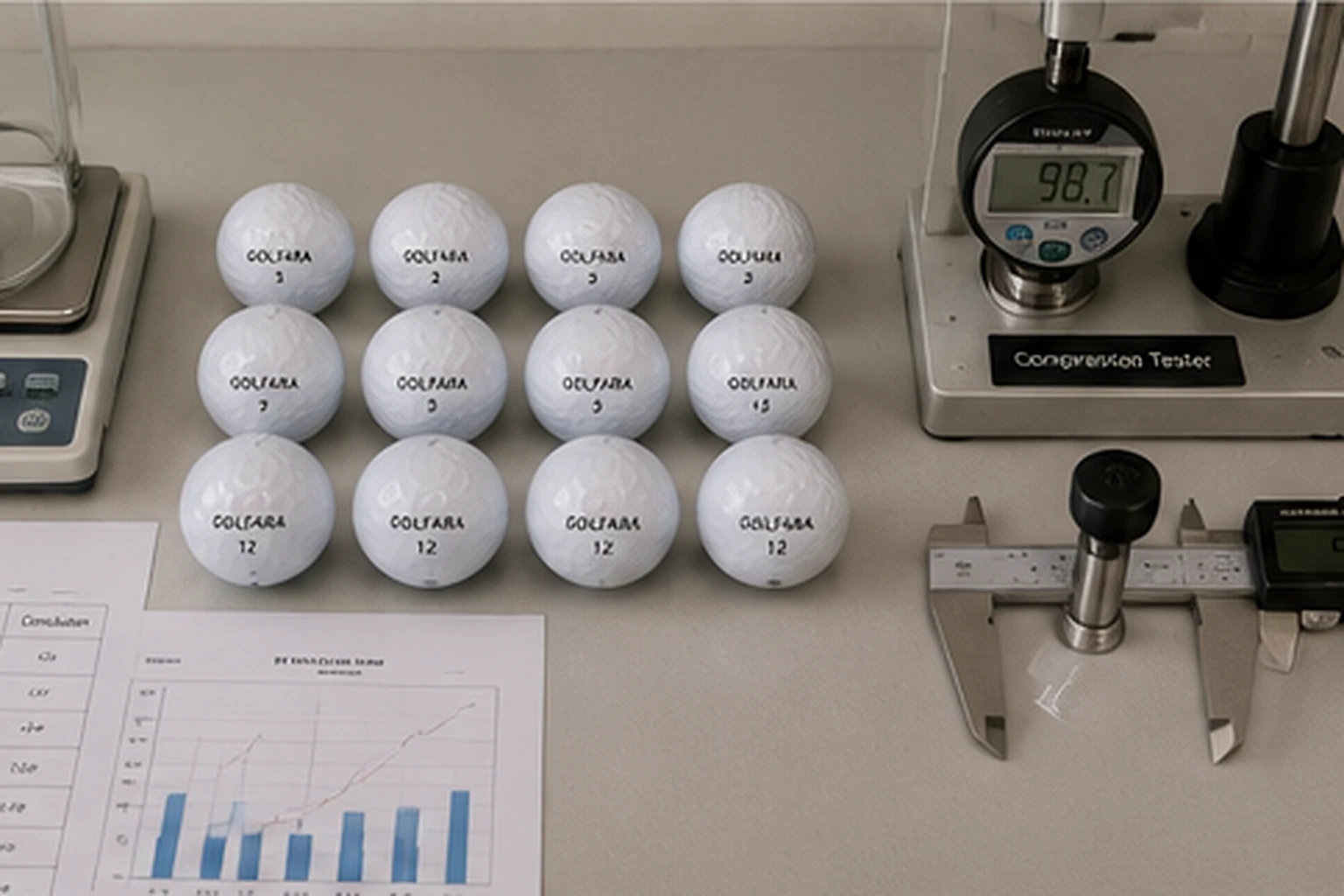
A polished supplier can own the factory. It can coordinate a partner factory. Or it can hide a production layer you never see until bulk quality changes.
Factory versus trader is not a simple good-versus-bad test. Your real risk is a hidden production layer: if you cannot identify who controls the quoted SKU, sample approval, QC release, and repeat orders, you cannot judge whether the supplier can reproduce what you approved.
When Is an Agent or Hybrid Acceptable?
You do not need every commercial supplier to own every machine.
You need the production relationship to be visible.
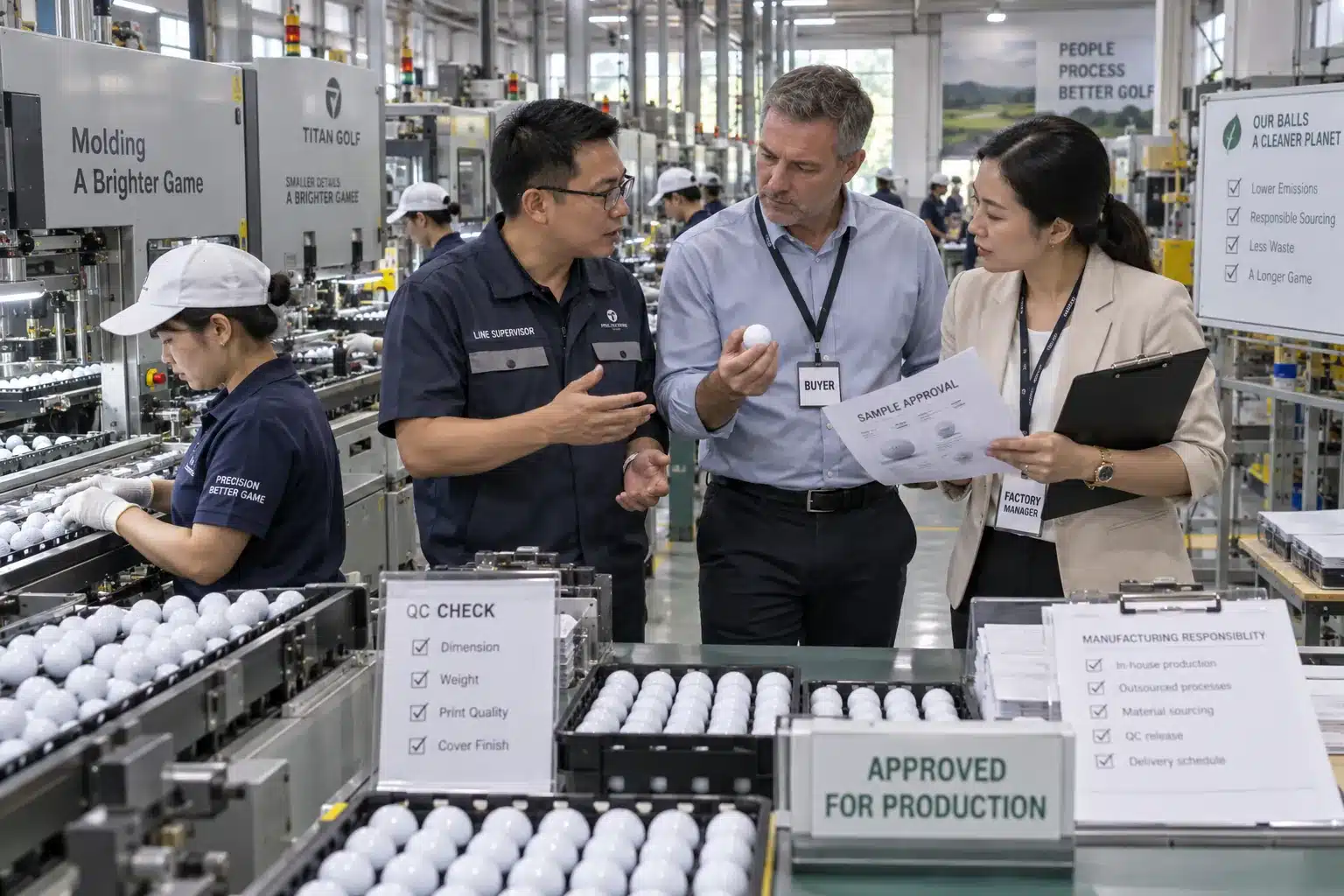
A real manufacturer can sell directly. A transparent agent may coordinate a specialist factory. A hybrid group can use separate sales and production entities. A contract-manufacturing network can also be workable if responsibilities stay stable from approved sample through repeat production.
The buyer questions are operational:
Who manufactures this exact SKU?
Who approves the production sample?
Who owns the QC-release decision?
Who holds the batch evidence?
Who controls the repeat order when you come back six months later?
Those questions tell you more than “Are you a factory?”
A supplier with a broad catalog is not automatically a trader. Golf equipment categories often involve specialized manufacturing sites.
The reverse is also true: a website footer saying “direct factory” does not prove the website owner controls the golf-ball line.
Before moving the supplier forward, request a one-page Production-Control Declaration covering:
-
quoted commercial entity;
-
golf-ball manufacturing entity;
-
production site;
-
relevant in-house stages;
-
relevant outsourced stages;
-
sample-approval owner;
-
QC-release owner;
-
repeat-order control.
If those answers are clear, a transparent agent or hybrid can remain in your shortlist.
If they are not, you have a production-control gap.
Once your investigation starts moving into business licenses, Unified Social Credit Codes, legal representatives, payee matching, bank accounts, and address forensics, stop expanding this page. Use the dedicated guide to verify a China golf ball OEM supplier.
Use this line in your supplier file:
Supplier shall identify the manufacturing entity, production location, quoted SKU and construction, current OEM/private-label status, and the in-house or outsourced production stages relevant to the quoted product.
That wording does not demand vertical integration.
It demands visibility.
✔ True — A transparent agent or hybrid can remain on your shortlist
If the manufacturing entity, outsourced stages, sample responsibility, QC release, and repeat-order control are visible, you can evaluate the actual production system instead of the label on the website.
✘ False — “A broad catalog proves trading, while a self-described factory proves production ownership”
Neither conclusion is safe from presentation alone. Follow control of your quoted golf ball from approved sample to bulk production.
Is This Manufacturer Open to Your OEM Program?
You can qualify a genuine golf-ball factory and still discover that it is not taking your account, your construction, or your order size.
A company can be a real golf-ball manufacturer and still be unavailable for your external OEM order. Confirm whether it currently accepts OEM, ODM, private-label, contract-manufacturing, or established-account programs—and verify that access for the exact construction and volume you plan to buy.
Manufacturer status ≠ open OEM status.
A plant can have excellent production credentials and reserve most of its capacity for existing customers.
Another can accept private-label orders but only on established stock constructions.
Another may accept ODM work only above a certain volume.
Another may offer custom printing while keeping the underlying ball specification fixed.
These are different business models, not automatic red flags.
| Access Status | What It Means | What You Still Need | Risk | Buyer Action |
|---|---|---|---|---|
| Current / Open | Current external OEM or private-label access is confirmed | Exact SKU, volume, and route | Access may still vary by construction or production window | Request current program terms |
| Publicly indicated | Public material indicates OEM, ODM, or private-label activity | Exact program eligibility | Public capability may not apply to your SKU or order size | Confirm your program |
| Confirmed conditional access | Supplier confirms that access depends on account, SKU, volume, geography, or program conditions | Exact eligibility criteria | Qualification may take longer or the available route may be restricted | Confirm conditions |
| Verify current external access | Manufacturing evidence exists, but current external OEM access is not sufficiently confirmed | Current commercial policy | You may spend time qualifying a factory that is not open to your program | Verify before RFQ |
| Unknown | Public evidence is insufficient to classify current access | OEM status, eligible products, volume range, and program conditions | Weak shortlist confidence | Investigate before moving forward |
This is why GTS, Qingdao Oudun, and Qingdao SM Parker should not be assigned an assumed Selective status simply because manufacturing evidence is strong.
The evidence supports their production relevance.
Their current external-access policy should still be verified.
That distinction protects you from two opposite mistakes:
Assuming a famous contract manufacturer will welcome a small outside program.
Or discarding a manufacturer simply because public information does not publish its account-access policy.
Your first inquiry should describe the actual program rather than ask only:
“Do you offer OEM?”
Give the supplier:
-
exact construction or existing-model requirement;
-
channel;
-
first-order volume;
-
expected repeat volume;
-
OEM, ODM, or private-label requirement;
-
customization scope;
-
desired sample path;
-
target production period.
Then ask what is currently open.
“We are an OEM manufacturer” with no current access status for your exact program is a failure signal.
It does not prove the supplier lacks capability.
It means the commercial-access question is unresolved.
Request an OEM Access Status for the quoted program containing:
-
exact SKU or construction;
-
expected volume basis;
-
OEM/private-label/ODM route;
-
sample path;
-
current production availability.
Your decision should ultimately be more specific than:
“This company makes golf balls.”
It should become:
“This manufacturer currently accepts my type of program, on this route, at this volume.”
Which Factory Fits Your Product Program?
The largest factory in your spreadsheet can still be the wrong supplier if your SKU is outside its mature route or its available capacity is committed elsewhere.
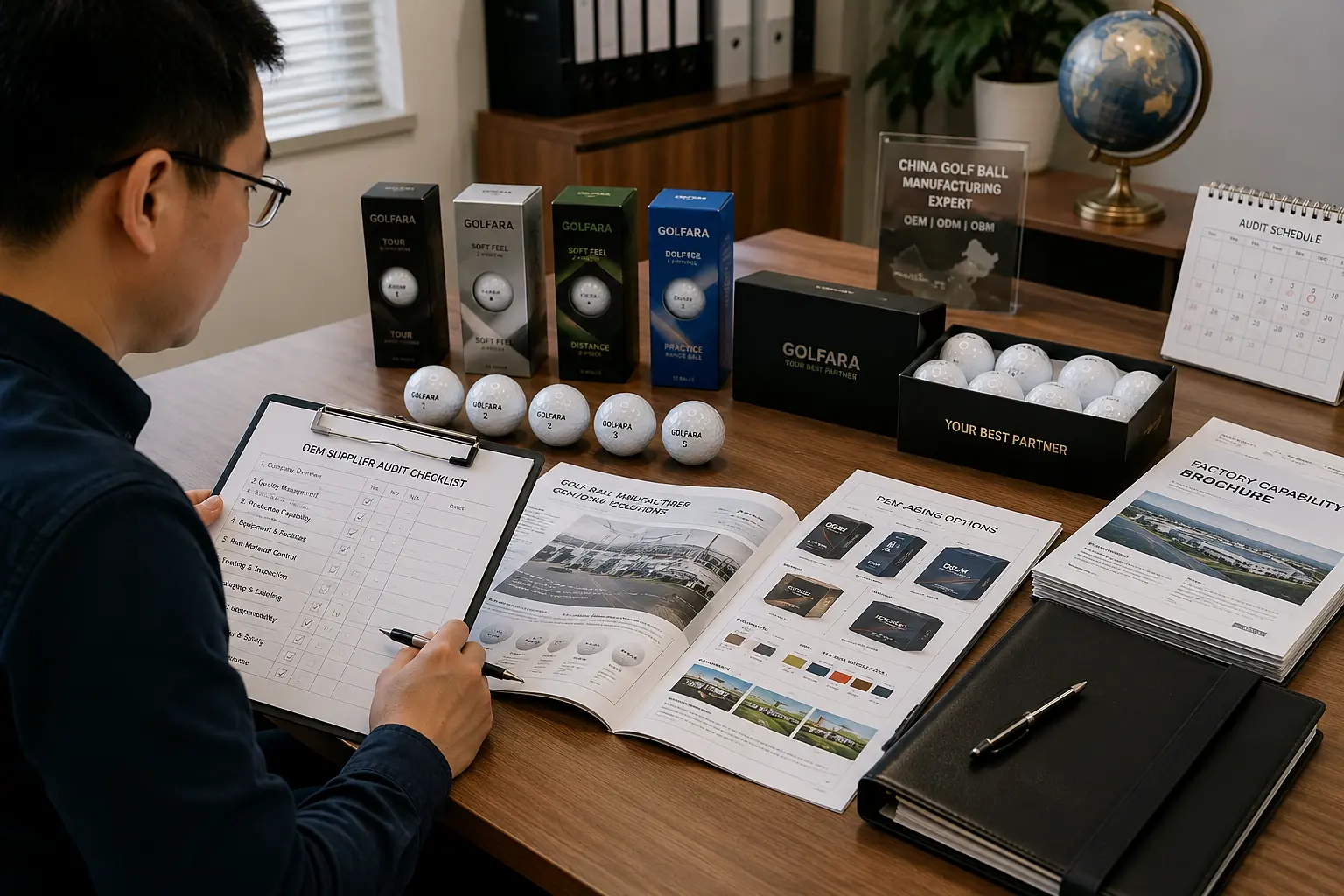
The biggest factory is not automatically the best factory for your program. Match your SKU, construction, cover route, channel, launch stage, volume, packaging needs, and current production slot first; then normalize any capacity or MOQ claim before you use it to rank suppliers.
Begin with the product you are trying to sell.
A range operator, promotional-goods distributor, DTC golf brand, and premium retail label may all buy golf balls from China, but they should not necessarily shortlist the same manufacturer.
A 2-piece ionomer construction is often a practical starting point for range, promotional, high-consumption, and value-oriented programs.
Multilayer and urethane routes are more likely to become relevant when your channel depends on a more performance-oriented retail proposition.
For supplier selection, the relevant question is not which construction is “best,” but which manufacturer has a proven production route for the SKU you intend to source.
For a construction-specific program, narrow the supplier set further through the 3-piece golf ball manufacturers or 4-piece golf ball manufacturers guides.
One capability claim deserves particular caution:
“Urethane” is not a complete manufacturing-route description.
If a supplier says:
“We manufacture urethane golf balls.”
Continue with:
-
Injection-molded TPU?
-
Cast thermoset urethane?
-
Which construction?
-
Which production stages are controlled?
-
Which stages are outsourced?
Injection-molded TPU and cast thermoset urethane are different manufacturing routes. That distinction is relevant to Manufacturer Fit even though the technical comparison belongs in the dedicated TPU vs cast urethane golf balls guide.
How Should You Normalize Capacity Claims?
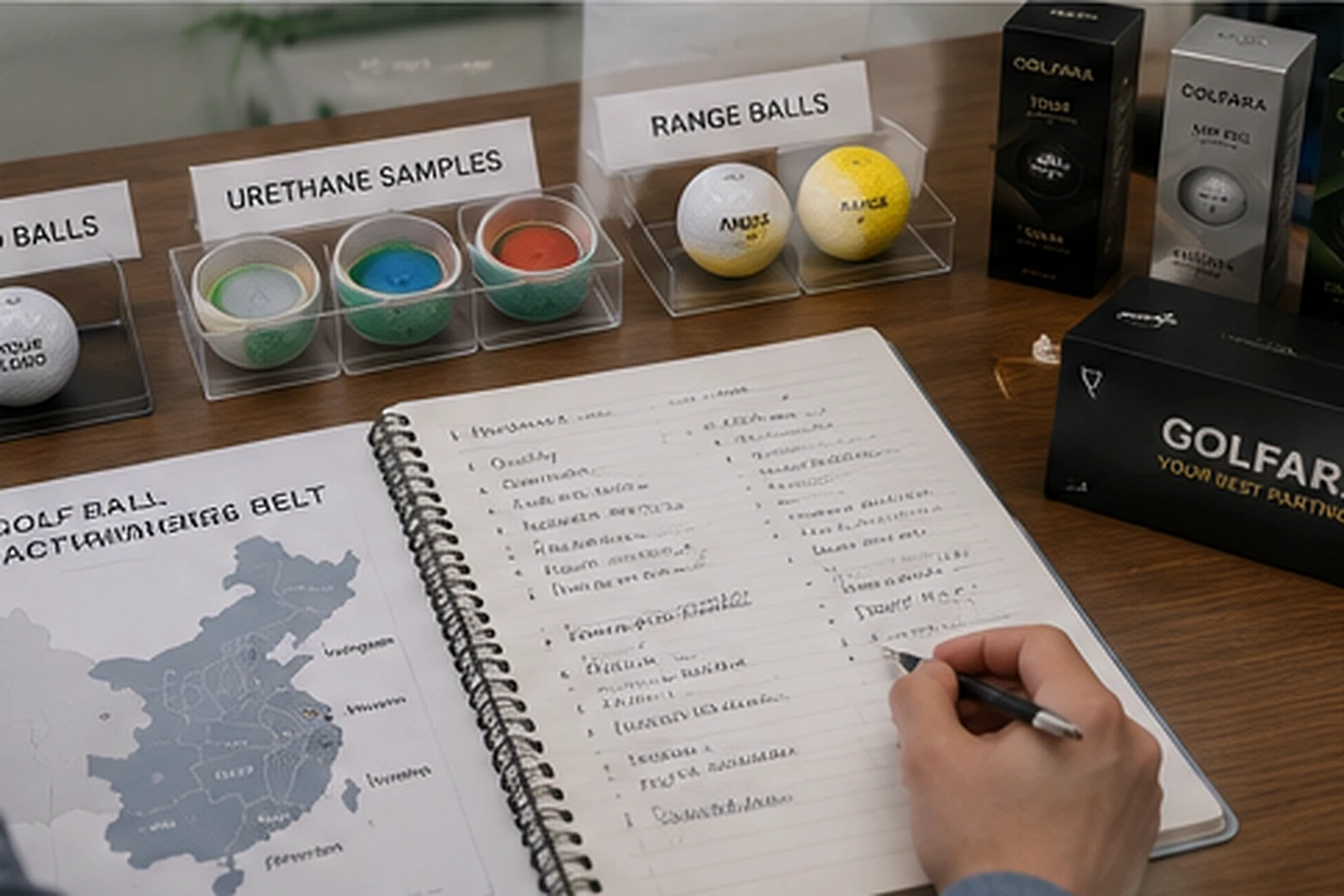
Published capacity can look precise while remaining commercially useless.
Supplier A says:
X balls per day.
Supplier B says:
Y dozen per year.
Supplier C gives total factory output.
Supplier D gives the number of production lines.
Which supplier has usable capacity for your 3-piece private-label SKU next month?
You still cannot tell.
| Capacity Question | Supplier Claim | Missing Scope | Why It Matters | Buyer Action |
|---|---|---|---|---|
| Unit | X | Balls or dozens? | Changes scale | Normalize |
| Period | X | Day, month, or year? | Changes comparison | Align period |
| Production scope | X | Line or whole factory? | Can inflate headline | Define scope |
| Product scope | X | All balls or your SKU? | Routes differ | Tie to SKU |
| Capacity type | X | Rated or actual? | Can overstate output | Request basis |
| Availability | X | Installed or open slot? | Your PO needs a slot | Confirm availability |
The rule is:
Headline Capacity ≠ Available Capacity for Your SKU.
Installed capacity can be large while current available capacity is small.
A factory may also quote capacity across 2-piece balls even though your RFQ is for a multilayer product using another line or process.
Capacity comparisons therefore need:
-
unit;
-
period;
-
line versus factory scope;
-
product/construction scope;
-
rated versus actual basis;
-
installed versus available capacity;
-
current production slot.
A headline capacity number with no unit, period, SKU route, scope, or available production slot is a failure signal.
MOQ should be handled the same way.
A historical minimum can help you understand a manufacturer’s past commercial model.
It should not decide your current RFQ.
At Golfara, our current bulk-ball MOQ remains 1,000 pcs across our golf-ball programs, while a separate custom-packaging minimum can still become the binding commercial constraint.
That does not mean every 1,000-ball project is a good manufacturing fit.
MOQ is one variable inside the program.
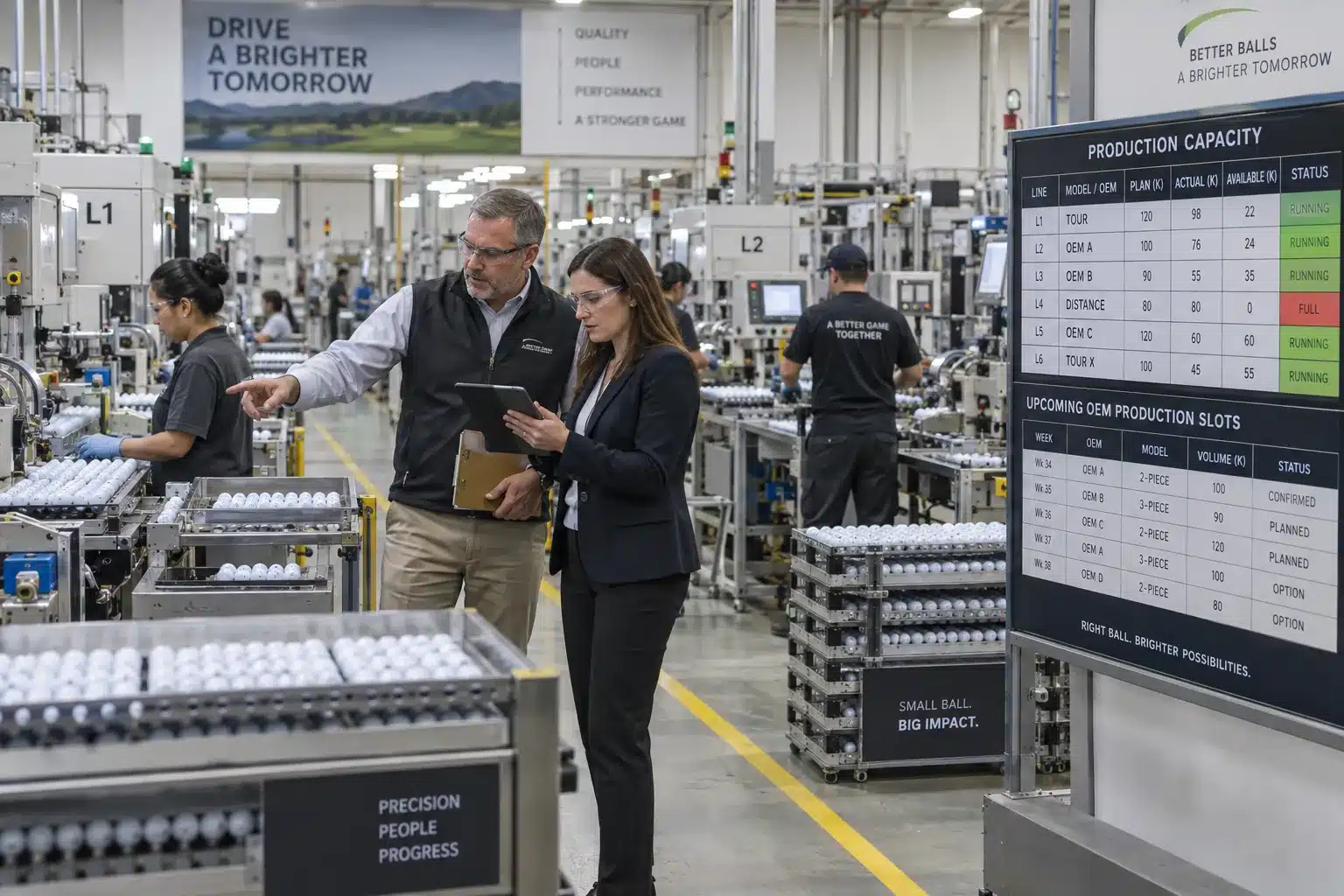
Create a Capacity & Program-Fit Sheet for each finalist:
-
exact SKU;
-
production route;
-
channel;
-
pilot or repeat stage;
-
quoted MOQ basis;
-
capacity unit;
-
capacity period;
-
line/factory scope;
-
product scope;
-
rated/actual basis;
-
installed/available basis;
-
current slot.
Do not rank a supplier by capacity until the claim is normalized to your SKU and available production window.
Prefer the manufacturer that fits your program and proves the route—not the factory with the largest headline capacity.
✔ True — A smaller or more flexible manufacturer may fit your exact program better
Your SKU, route, volume, launch stage, packaging requirements, and open production slot determine fit. Installed factory scale is only one variable.
✘ False — “The highest published annual capacity automatically means the best OEM sourcing fit”
The headline may cover other products, other lines, or already committed production. Normalize it before it enters your supplier ranking.
Which Manufacturing Belt Fits Your Project?
A Ningbo, Xiamen, Dongguan, Shenzhen, Hangzhou, Qingdao, or Chengdu address can point you toward a useful supplier cluster. It cannot prove what the individual manufacturer can do for your SKU.
Manufacturing region can help you discover candidates, but it cannot qualify a supplier for your order. Use Guangdong, Fujian, Zhejiang, Qingdao, Chengdu, and other locations as sourcing context; your shortlist should still be decided by current production address, SKU capability, OEM access, and supplier-specific evidence.
China’s golf-ball manufacturing base is substantial.
Official World Bank WITS data for China golf-ball exports in 2024 records approximately 370.3 million golf balls exported, valued at about US$147.3 million, under HS 9506.32.
That macro evidence confirms a substantial commercial golf-ball manufacturing and export base.
Manufacturing-base scale ≠ individual-supplier qualification.
| Region | Directional Context | Do Not Assume | Buyer Action |
|---|---|---|---|
| Guangdong / Dongguan–Shenzhen | Scale, contract manufacturing, packaging coordination | Every plant is open OEM | Verify site + route |
| Fujian / Xiamen | OEM networks and process coordination | Every supplier owns the ball plant | Verify production role |
| Zhejiang / Ningbo–Hangzhou | Flexible OEM/customization signals in historical sourcing data | Every factory has low MOQ | Verify current MOQ |
| Qingdao / Chengdu / other locations | Important named factories exist outside common clusters | One company creates a regional rule | Judge company evidence |
Historical sourcing references support the idea that China’s major golf manufacturing regions have developed different supply-chain structures and commercial tendencies.
That helps discovery.
It should not become a shortcut.
A Ningbo address does not prove 1,000-pc MOQ.
A Xiamen address does not prove premium multilayer capability.
A Dongguan factory does not prove your private-label account can access the line.
A Qingdao manufacturing footprint does not prove current open OEM policy.
One Chengdu manufacturer does not create a universal “Chengdu factory model.”
Record three separate fields:
-
commercial/company location;
-
actual production location;
-
exact SKU capability.
If you only know the office address, do not treat it as the production address.
If you only know the regional reputation, do not use it to fill missing supplier evidence.
For deeper geographic sourcing analysis, use the dedicated China golf ball manufacturing hubs guide.
This page needs only one regional rule:
Region helps you discover. Supplier-specific evidence decides the shortlist.
What Evidence Should Each Manufacturer Provide?
A supplier can send you a perfect sample, a capacity number, an ISO certificate, and a conformity claim—and still leave the most important production questions unanswered.
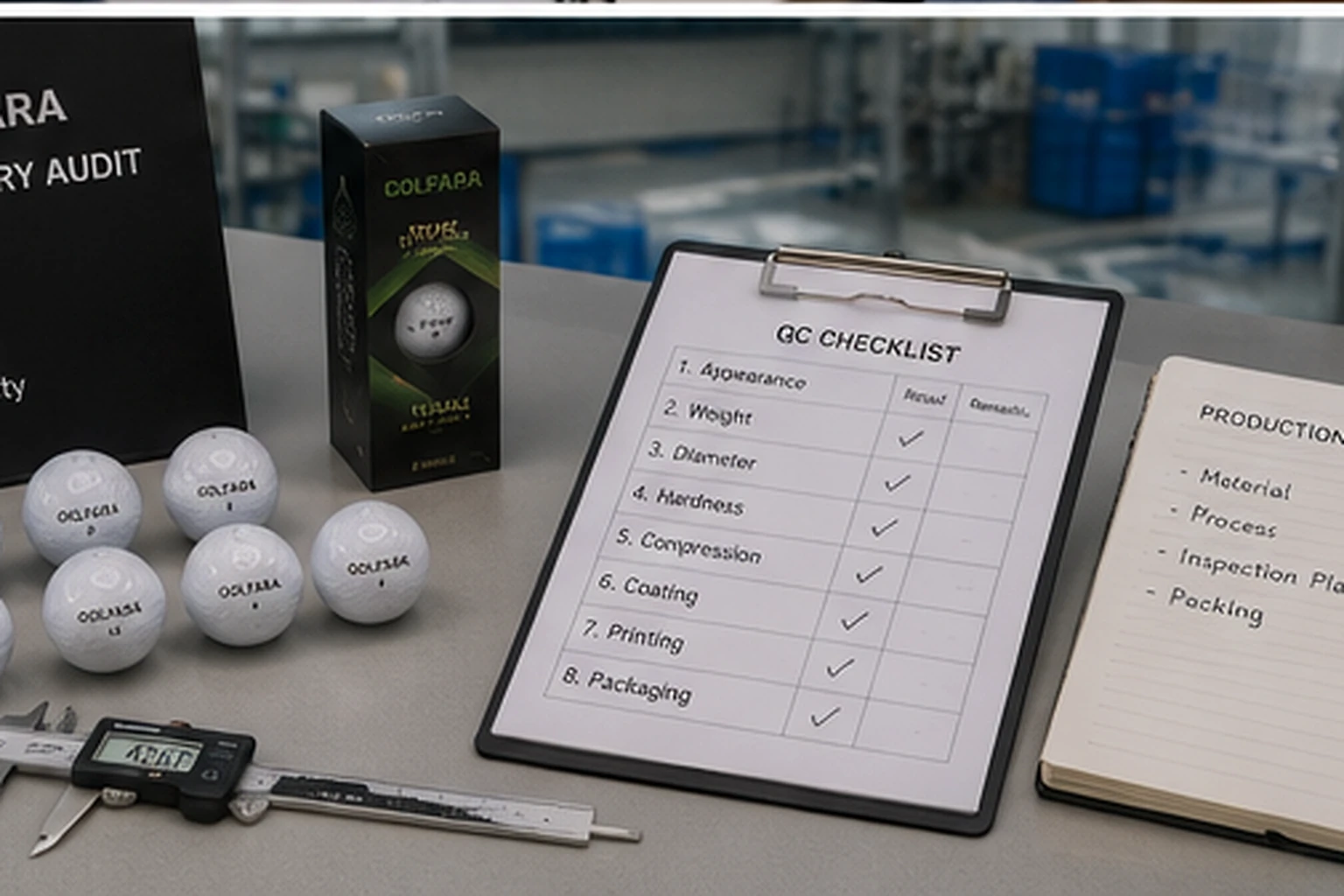
A manufacturer should move forward only when its claims are tied to auditable evidence. Ask for the manufacturing entity, production location, OEM status, route, commercial basis, batch-linked QC evidence, packaging path, and exact model-level conformity evidence where claimed—not a generic certificate stack or marketing brochure.
Think of the evidence pack as separate layers.
Each layer answers a different question.
Entity / Production
Record:
-
manufacturing entity;
-
commercial entity where different;
-
production site;
-
exact quoted SKU;
-
relevant in-house stages;
-
relevant outsourced stages.
This tells you who controls production.
Commercial Access
Record:
-
current OEM/private-label status;
-
current or reference MOQ basis;
-
capacity basis;
-
current production-slot basis.
This tells you whether your program can enter that manufacturing system.
Product / Process
Record:
-
exact construction;
-
cover family;
-
production route where relevant;
-
print route where material;
-
packaging route where material.
This prevents broad capability language from replacing SKU-specific evidence.
For example, “custom logo available” is not enough if your program depends on a specific print route or durability gate. Ask whether the supplier controls or transparently manages the required printing route, then use the dedicated custom golf ball printing methods guide when pad printing, UV printing, adhesion, curing, or print durability becomes the actual buying decision.
Batch Evidence
At shortlist stage, you do not need another full golf-ball QC tutorial.
You need evidence architecture:
-
method;
-
sample identity;
-
production batch ID;
-
raw-data availability;
-
spread or distribution;
-
equipment/method reference where relevant;
-
retained sample.
That evidence answers a central OEM risk:
Can the factory link what you approved to what it actually produced?
For deeper testing details, use the golf ball batch QC evidence guide.
If the primary risk is whether bulk production will repeat the approved sample, continue with the sample-to-bulk consistency process.
| Claim / Field | Minimum Proof | Stronger Evidence | Failure Signal | Buyer Action |
|---|---|---|---|---|
| Manufacturing entity | Entity + site | Production linkage | Vague supplier name | Verify |
| OEM access | Written current status | Program-specific approval | “OEM available” only | Confirm route |
| Process capability | Construction + route | In-house/outsource map | Generic “urethane” | Declare route |
| MOQ | Current/reference status | SKU-specific basis | Old fixed number | Reconfirm |
| Capacity | Unit + period + scope | Available-slot basis | Headline number | Normalize |
| Batch quality | Method + batch link | Raw values + retained sample | Sample photos only | Request evidence |
| Packaging / print | Required route | Controlled workflow | “Custom available” | Confirm route |
| Conformance | Exact model | Markings + current listing | “Certified factory” | Verify model |
Which Consistency Metrics Matter Most?
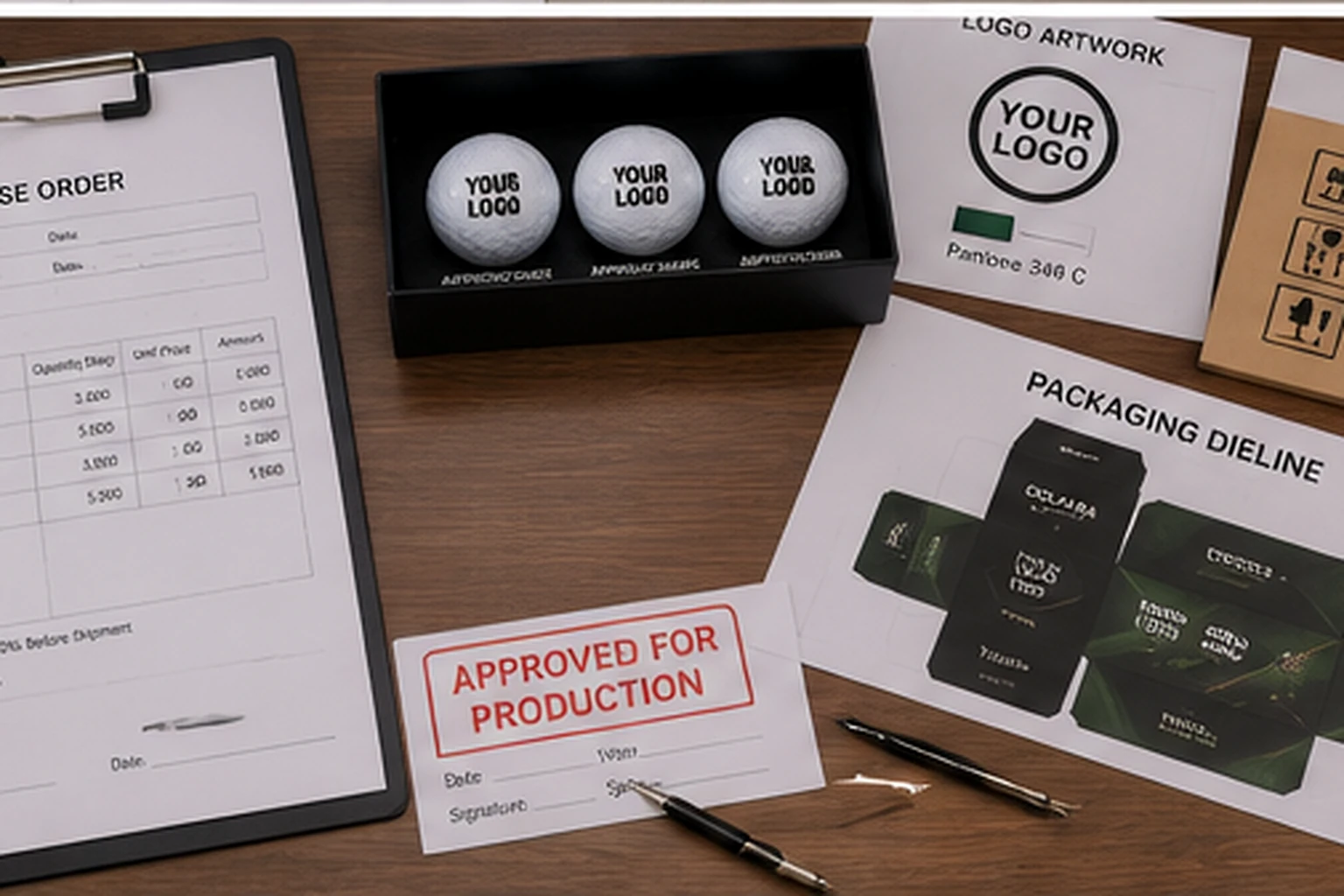
At shortlist stage, consistency evidence should expose spread, not just one attractive average. Depending on the quoted SKU, the tracked fields may include weight, diameter, compression, hardness, and concentricity. The shortlist decision is not the threshold itself; it is whether those values are method-defined, batch-linked, and shown as a distribution rather than a single attractive average.
A perfect sample can prove that the supplier is capable of producing a good sample.
It cannot prove that the next production batch will have the same distribution.
Request evidence tied to a current production batch:
-
sample identity;
-
batch identity;
-
test method;
-
raw values where relevant;
-
spread or distribution;
-
retained reference.
The purpose is not to prescribe a universal compression sigma or OOR limit here.
It is to establish whether the factory can show production-linked data instead of presentation samples alone.
Model-Level Conformance
If a supplier says:
“We are USGA/R&A certified.”
Your next question should not be:
“Can you send the factory certificate?”
Ask:
“What exact golf-ball model is conforming?”
The official R&A Conforming Ball List is built around submitted golf-ball models and the identification markings used to distinguish them.
That leads to an important sourcing rule:
USGA/R&A conformance is model-level evidence, not factory-wide certification.
A manufacturer can produce one conforming model and other non-listed models.
A private-label construction can differ from a listed model.
A generic claim that “our factory is certified” therefore skips the information you actually need.
Check:
-
exact model;
-
identification markings;
-
current list status;
-
relationship between the listed model and your quoted SKU.
“USGA/R&A-certified factory” with no exact conforming model or identification markings is a failure signal.
Quality-Management-System Evidence
ISO 9001 answers another question.
Official ISO 9001 quality-management-system information concerns the framework an organization uses to manage and improve its quality processes.
It can be useful evidence when its entity, site, scope, issuing body, and current status match the supplier you are evaluating.
It does not prove that a specific golf-ball model conforms to the Rules of Golf.
And neither ISO 9001 nor model conformity proves that your current production batch matches your approved sample.
Keep the scopes separate:
ISO 9001 → organizational QMS evidence
R&A / USGA conformity → exact golf-ball model evidence
Batch QC → production-lot evidence
Those are three evidence layers, not one certification score.
Use this clause when a supplier relies on capacity, certification, or conformity claims:
Where production capacity, quality-system certification, batch quality, or golf-ball conformity is claimed, the supplier shall provide the applicable scope, entity, SKU or model reference, current evidence version, and the batch or model identification required to verify the claim.
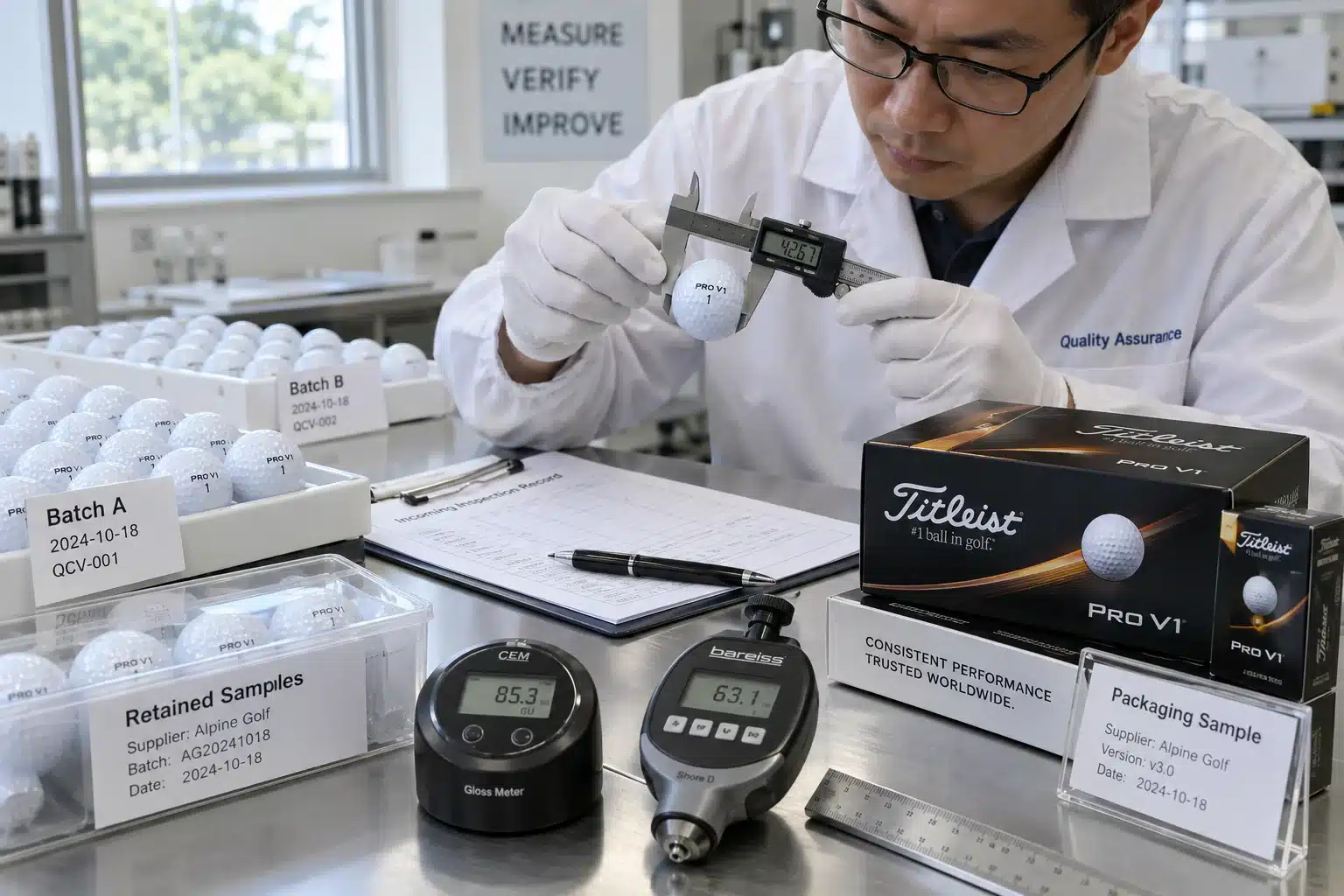
Your final Manufacturer Shortlist Verification Pack should contain:
-
manufacturing entity;
-
production location;
-
current OEM/private-label status;
-
exact construction;
-
cover/process route;
-
in-house versus outsourced stages;
-
current MOQ basis;
-
capacity basis;
-
batch-QC example;
-
printing and packaging route where relevant;
-
model-specific conformity evidence where claimed.
Use this RFQ verification request once:
Provide a Manufacturer Shortlist Verification Pack for the quoted SKU showing the manufacturing entity, production location, current OEM/private-label status, exact construction and cover route, in-house versus outsourced stages, current MOQ basis, capacity basis, batch-QC example, packaging route, and exact-model conformity evidence where claimed.
✔ True — QMS, model conformity, and batch evidence can all be useful when their scopes are clear
An organizational quality system, a conforming ball model, and a current production-batch record answer different sourcing questions. Keeping them separate makes your shortlist easier to audit.
✘ False — “ISO certification proves the ball conforms, or one conforming model certifies the entire factory”
Neither conclusion follows. Match every claim to the correct entity, site, model, batch, and evidence scope before moving the supplier forward.
At this point, your Top 10 list should have done its job.
You should have:
Named candidates
→ Eligibility
→ Program fit
→ Evidence
→ 2–4 suppliers worth deeper qualification
The next stage is no longer a manufacturer-list question.
Quotation normalization, sample approval, production planning, PO terms, and shipping belong to the next sourcing workflow. Use the guide on how to source OEM golf balls from China after your shortlist is defensible.
FAQ
What if a supplier will not disclose its brand customers?
That is not automatically a red flag. Customer confidentiality can limit name disclosure, so ask for anonymized production evidence instead of treating famous client logos as the only proof of manufacturing capability.
Request anonymized batch or production records that still show relevant process, sample, batch, or production evidence without exposing the customer’s brand.
You can also verify the production site and manufacturing route independently.
An NDA can be legitimate.
An unverifiable page full of major-brand logos is a different issue.
The useful distinction is whether the supplier can provide alternative evidence when customer names cannot be disclosed.
Can two suppliers quote from the same underlying factory?
Yes. Agents, OEM coordinators, factory alliances, and separate commercial entities can sometimes route orders through the same production base. Compare the manufacturing entity and production route—not only the supplier name printed on the quotation.
Ask each supplier:
-
Who manufactures this exact SKU?
-
Who owns the sample and batch reference?
-
Who releases QC?
-
Who controls the factory relationship on repeat orders?
Two company names can therefore represent different commercial channels into one production base.
That is not automatically a problem.
It becomes a problem when you believe you have diversified production while both quotations depend on the same unverified factory.
What if the production site changes after sample approval?
Treat a production-site or manufacturing-route change as a material sourcing change. An approved sample may no longer represent bulk production if the factory, route, or responsible manufacturing entity changes before production.
Require written disclosure before the change is implemented.
Then:
-
reconfirm the manufacturing entity;
-
record the new production site;
-
identify any route changes;
-
revalidate the approved sample where needed;
-
connect the new site and batch reference to production evidence.
Sample approval protects you only when the production path remains traceable to the sample you approved.
What if the office and factory are in different cities?
That is not automatically a red flag. A Chinese golf ball supplier can operate a commercial office in one city and manufacture through a plant in another. Your job is to map the entities and identify who controls your SKU, sample approval, QC release, and repeat order.
Record the office and production addresses separately.
Then identify the manufacturing entity and ask who holds the batch evidence.
A transparent Shenzhen office with a clearly identified Dongguan factory can be easier to evaluate than a supplier claiming “factory direct” while refusing to disclose the production site.
If the structure becomes a legal-entity or payee question, move into the Supplier Verification workflow.
Should you reject a manufacturer with no published capacity?
No. A manufacturer does not need a public headline-capacity number to remain on your shortlist if it can confirm the production route, realistic MOQ, available slot, and achievable production window for your exact SKU.
A public annual-capacity figure can help with background research, but it is not the same as capacity available to your order.
Ask instead:
-
Which line or route will make this SKU?
-
What volume can that route realistically accept?
-
Is capacity currently available in your required window?
-
Is the commitment based on rated output or an actual production plan?
Missing public capacity is an information gap.
An inability to confirm production availability for your program is the sourcing problem.
Is outsourced printing or packaging a disqualifier?
No. Outsourcing a specialist printing or packaging stage is not automatically a sourcing failure if the supplier discloses the production layer, controls the approved specification, owns acceptance, and manages changes before bulk release.
For an outsourced stage, confirm:
-
which company performs the work;
-
which artwork or process version is approved;
-
who checks the finished result;
-
who owns corrective action;
-
whether a supplier change requires your approval.
Your risk is not outsourcing by itself.
Your risk is an invisible supplier change that breaks the link between the sample you approved and the product you receive.
Conclusion
A Top 10 list should help you eliminate suppliers, not just collect names.
The right China golf ball manufacturer is not automatically the factory with the largest footprint, lowest reference MOQ, broadest catalog, or strongest capacity headline. It is the manufacturer whose production role is clear, whose current commercial access fits your program, whose route matches your exact SKU, and whose capability claims can be audited.
Use the list to reduce ten names to two to four serious candidates. Reconfirm commercial terms, normalize capacity claims, verify production ownership, separate model-level conformity from organization-level QMS evidence, and require batch-linked proof before moving forward.
Eligibility → Program Fit → Evidence.
That gives your team a more defensible China golf ball manufacturer shortlist than any unexplained No.1-to-No.10 ranking.
You might also like — How to Choose the Right Golf Ball Manufacturer in China?