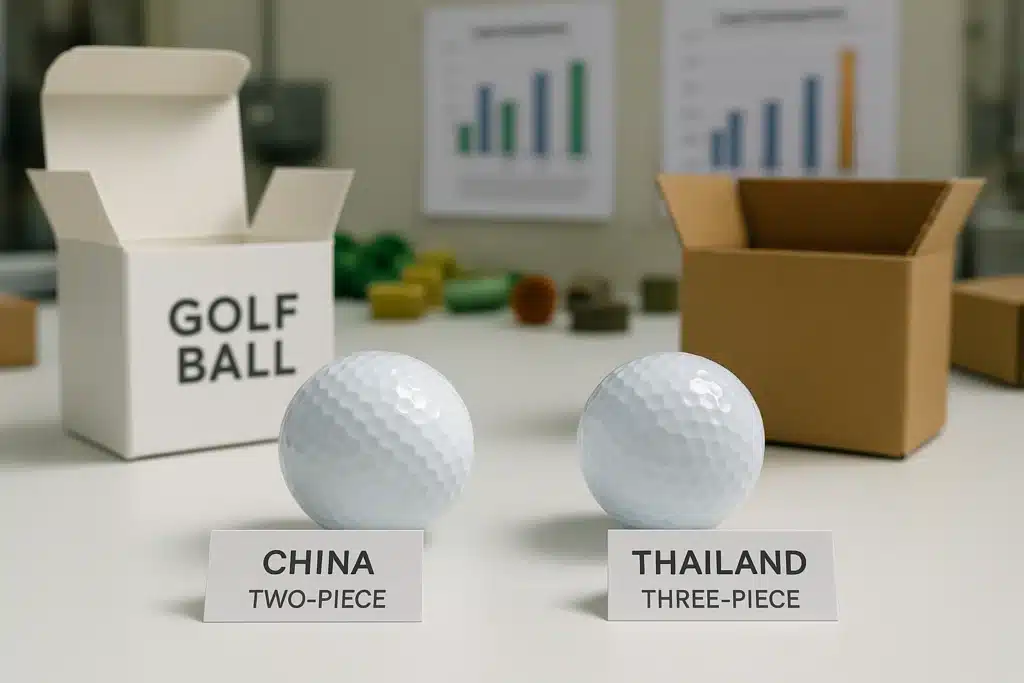
A 0% duty headline does not automatically make Thailand cheaper than China for golf ball OEM.
China can still be cheaper than Thailand when its lower FOB price outweighs the China-origin U.S. Section 301 duty layer. Thailand can win when its origin value, premium capacity, BOI pass-through, and lower duty exposure survive the full landed-cost model. Buyers should compare landed cost per accepted ball: FOB price + customs entered value duty exposure + MPF/HMF + freight per ball + packaging density + yield and scrap allowance + USGA amortization.
If you are comparing China vs Thailand golf ball costs, start with a golf ball landed cost calculator, not a tariff headline. Your worksheet should include HTSUS 9506.32.0000 import duty, US Section 301 tariffs on sporting goods, golf ball customs entered value, Thailand BOI tax incentives for manufacturing, golf ball OEM COGS, cast urethane yield rate manufacturing, packaging density, freight per ball, and USGA amortization.
The core question is simple: does Thailand’s tariff and origin advantage exceed its FOB premium, BOI pass-through uncertainty, cast urethane yield risk, packaging freight burden, and small-run compliance cost? This guide keeps the finance lens and helps you test that answer before approving China or Thailand.
What Is the True Landed Cost Formula?
You may compare China and Thailand by FOB or duty rate, but your real cost appears after tariff exposure, yield loss, packaging density, compliance cost, and destination charges.
A China vs Thailand golf ball landed cost calculator should include FOB price, customs entered value, Section 301 or origin treatment, MPF/HMF, freight per ball, packaging density, yield and rework allowance, inland delivery, and USGA amortization. The lowest duty rate is not always the lowest landed cost.
| Cost layer | China variable | Thailand variable | Buyer action |
|---|---|---|---|
| FOB baseline | Often lower | Often higher | Normalize construction |
| U.S. tariff overlay | Check Section 301 | No China 301 layer | Broker verifies treatment |
| BOI / EEC claim | Not applicable | Factory-side incentive | Ask for pass-through |
| Yield / scrap | Scale absorbs trials | Premium lane discipline needed | Request yield data |
| Freight density | Denser port network | Narrower route options | Model per ball |
| Compliance cost | Channel-specific | Channel-specific | Amortize by volume |
The formula is simple, but it changes the whole conversation:
Landed Cost per Ball = FOB Price + Section 301 / Import Duty + MPF / HMF / Customs Fees + Ocean Freight per Ball + Inland Delivery + Defect & Rework Allowance + Packaging Density Penalty + Compliance Amortization.
That formula stops the “Thailand has no China tariff, so Thailand wins” shortcut. A Thailand-origin ball may avoid the China Section 301 layer, but the buyer still has to pay for the higher FOB base, possible premium capacity, container space lost to packaging, yield loss, rework, compliance fees, and destination delivery.
For U.S. import modeling, tariff math should be based on the golf ball customs entered value confirmed by the importer or broker. Do not use casual FOB shorthand from a sales email as if it were the customs basis. Fees such as MPF, HMF, brokerage, and inland delivery vary by shipment size, entry method, destination, and logistics scope, so they belong in the worksheet as variables.
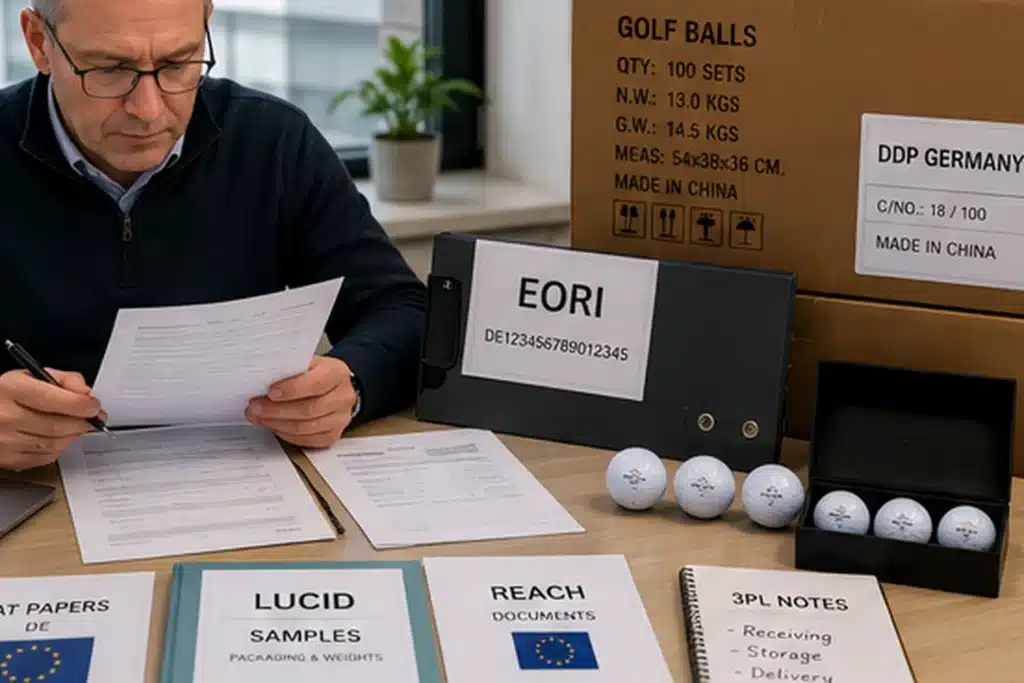
Place this in your RFQ: “Please quote FOB, customs entered-value basis, HTS/HS classification, country of origin, Section 301 or Thailand-origin assumptions, MPF/HMF or destination customs fees, packaging dimensions, loaded balls per 40HC, yield/scrap allowance, USGA/R&A listing cost, and included/excluded logistics scope.”
Ask your supplier to state country of origin, HTS/HS classification support, customs entered-value basis, COO evidence, and whether the quote assumes China Section 301 exposure, Thailand-origin treatment, MPF/HMF, freight, brokerage, or inland delivery.

✔ True — landed cost means accepted cost per usable ball.
A ball that looks cheaper at duty level can still lose after FOB gap, rework, packaging density, freight, and compliance amortization are added.
✘ False — “Thailand wins if China has a tariff.”
Duty rate is only one layer. Your team should compare accepted landed cost per ball under the same construction, packaging, volume, and destination.
Does Thailand’s Tariff Shield Beat China?
You may see China’s Section 301 overlay and Thailand’s no-China-tariff position, then assume Thailand is always cheaper.
Thailand’s tariff shield only beats China when the duty saving is larger than Thailand’s FOB premium and other cost layers. If China is $1.00 before duty and Thailand is $1.10–$1.15, a 7.5% China tariff overlay may still leave China lower before freight, compliance, and destination costs.
| Scenario | FOB / customs value | Added tariff | Before freight result |
|---|---|---|---|
| China lower FOB | $1.00 | +7.5% | $1.075 |
| Thailand 10% higher FOB | $1.10 | $0 | $1.100 |
| Thailand 15% higher FOB | $1.15 | $0 | $1.150 |
| Thailand 20% higher FOB | $1.20 | $0 | $1.200 |
Golf balls entering the United States are commonly classified under HTSUS 9506.32.0000, where the general base duty is Free. That base-duty line is not the end of the check for China-origin goods. China-origin golf balls should still be reviewed for Chapter 99 / Section 301 treatment. When a 7.5% layer applies, it is calculated against customs entered value.
This is the tariff illusion. A buyer sees China plus 7.5% and Thailand plus zero China Section 301 exposure, then stops thinking. The missing question is: what was the factory-price gap before the duty layer? If Thailand’s FOB starts 10–20% higher, the tariff shield may already be consumed before freight, packaging density, yield, or compliance is added.
“0% duty claim, no FOB gap model” is a failure signal. It tells you the supplier is selling an origin story without proving whether the duty advantage survives the factory-price gap. Thailand can absolutely win in the right model, especially when the channel values origin and the supplier has proven premium consistency. But it does not win automatically.
Request tariff treatment assumptions for both China-origin and Thailand-origin balls. Ask your broker or importer to verify HTSUS 9506.32.0000, Chapter 99 / Section 301 exposure, customs entered value, MPF/HMF, and documentary origin proof. Use Thailand for tariff reasons only when the duty saving exceeds the FOB premium and other landed-cost penalties.

How Does 7.5% Change the Math?
A 7.5% duty layer sounds decisive until your team compares it with the FOB gap. If China is $1.00 and Thailand is $1.15, Thailand does not automatically win because China’s tariff-adjusted value may still be lower before freight.
The simple model is not a final customs entry. It is a screening tool. Once the screening result is close, add MPF/HMF, brokerage, ocean freight per ball, inland delivery, packaging density, yield allowance, and compliance amortization. If the result still favors Thailand, the tariff shield is real. If not, the shield is only a headline.
Do BOI and EEC Incentives Lower Your Price?
You may hear that Thailand has BOI or EEC incentives and assume your purchase order receives an automatic discount.
BOI incentives should not be confused with buyer discounts. Thailand BOI and EEC incentives may reduce a factory’s machinery duty, raw-material duty, or corporate income tax burden, but those savings accrue first to the investor. A small trial buyer only benefits if the supplier passes the saving into the quote.
| BOI incentive type | Who benefits first? | Automatic buyer discount? | Buyer action |
|---|---|---|---|
| Machinery import duty exemption | Factory / investor | No | Ask for pass-through |
| Export raw-material duty benefit | Approved factory project | Not automatic | Verify quote basis |
| Corporate income tax incentive | Factory / investor | No | Negotiate long-term |
| Non-tax incentives | Factory / investor | No | Do not model as unit discount |
Thailand BOI tax incentives for manufacturing can be attractive for factories. They may support machinery investment, raw-material import treatment for approved export production, corporate income tax incentives, or non-tax benefits. EEC Thailand foreign investment programs can also support industrial development and make Thailand a serious manufacturing location for long-term investors.
But buyer-side math is different. A BOI benefit first belongs to the approved project, the factory, or the investor. Your 1,000-ball or 3,000-ball trial order does not automatically receive that benefit as a unit-price discount. The supplier may use BOI to improve its return on equipment, reduce investment burden, or support large programs. That does not mean the saving appears in your small-run FOB.
BOI claim, no pass-through proof is a failure signal. It means the supplier is asking you to treat a factory-side incentive as if it were a buyer-side discount. For long-term, high-volume, brand-style allocations, some pass-through may be negotiated. For short trials, buyers should model the quote as written unless the supplier documents how the incentive reduces the actual unit price.
Request a BOI/EEC pass-through statement if the supplier uses incentives as a selling point. Ask whether the incentive affects machinery, raw materials, corporate tax, or your exact quote. Do not include BOI savings in your landed-cost model unless the supplier documents the pass-through.
✔ True — BOI is usually a factory-side benefit first.
BOI and EEC incentives can improve a factory’s investment economics. They only lower your golf ball price if the supplier passes the benefit into your actual quote.
✘ False — “BOI means my small trial order should be cheaper.”
A small buyer should model the quote as given unless the supplier provides a written pass-through explanation.
What Are 2026 FOB Baselines?
You need the original factory-price baseline before tariff, BOI, yield, and freight analysis can mean anything.
FOB baselines matter because Thailand’s tariff advantage can disappear if its factory price is 10–20% higher than China’s. Start with construction-specific FOB ranges, then add Section 301 exposure, BOI pass-through, yield risk, freight density, and USGA amortization.
| Construction | China FOB | Thailand FOB | Landed-cost trigger |
|---|---|---|---|
| 2-piece Surlyn | $10–15/dozen | $11–16/dozen | Tariff and freight decide |
| 3-piece Surlyn | $15–22/dozen | $16–24/dozen | FOB gap often matters |
| 3-piece PU | $20–30/dozen | $22–33/dozen | Yield drives COGS |
| 4-piece PU | $28–45/dozen | $32–48/dozen | Brand capacity and scrap risk |
These are planning ranges, not fixed quotes. Your actual price depends on construction, cover material, compression target, cosmetic standard, print complexity, packaging, order volume, incoterm, and approval schedule. Still, the pattern is useful: China often begins with a lower FOB baseline, while Thailand may carry an origin or premium-line story that needs to earn its place in the landed-cost model.
For 2-piece Surlyn and 3-piece Surlyn, the final answer often depends on the FOB gap, packaging, freight density, and destination fees. For 3-piece PU and 4-piece PU, the calculation becomes more sensitive to first-pass yield, scrap, rework, and brand-linked capacity. A few cents saved on duty can disappear if the line has to recoat, repaint, or reject more finished balls.
This is where buyers should separate FOB price from golf ball OEM COGS. FOB is the quote you see. COGS is the factory’s underlying reality: material usage, labor balance, electricity, packaging, scrap, and rework. If a supplier’s COGS is unstable, today’s FOB may be tomorrow’s surcharge.
Tariff math cannot start without FOB normalization. Compare identical construction, packaging, and volume first. If the China quote is for compact sleeves and the Thailand quote is for premium gift packaging, your spreadsheet is already broken.
Request construction-specific FOB quotes with the same construction, cover process, packaging, volume, and incoterm. Compare FOB, cover type, packaging, yield assumption, and payment term before applying tariff math. Reject comparisons where Thailand and China quotes do not match construction, packaging, or order volume.
How Do Labor, Energy, and Yield Move COGS?
You may focus on wage or electricity deltas, while cast urethane scrap and rework quietly dominate real COGS.
For golf ball OEM COGS, labor and electricity matter, but yield can matter more. In cast urethane manufacturing, a 3–5% scrap or rework gap can erase apparent energy, labor, or tariff advantages because premium resin, paint, curing time, and line capacity are lost together.
| Cost item | China estimate / ball | Thailand estimate / ball | What decides the final COGS? |
|---|---|---|---|
| Materials | $0.64 | $0.72 | Recipe and usage efficiency |
| Electricity | $0.0445 | $0.0600 | Cure and dwell discipline |
| Labor | $0.10 | $0.15 | Automation and line balance |
| Packaging | $0.05 | $0.06 | Pack type and density |
| Yield / scrap | Variable | Variable | First-pass yield and rework |
The original 3-piece PU model is valuable because it forces buyers to think like factory finance. Materials may represent a large share of COGS, but material purchase price is not the whole story. Usage efficiency, cosmetic rejects, re-spray, curing loss, retained samples, and line downtime can move the real cost per accepted ball.
Thailand is not a cheap-labor-only sourcing base. Advanced manufacturing locations carry real wage and power costs, and China’s coastal ecosystem does too. The better question is not “Which country has cheaper electricity?” The better question is “Which line converts premium material into accepted golf balls with less scrap, less rework, and fewer calendar losses?”
Cast urethane quote, no yield data is a failure signal. It tells you the most important COGS driver may be hidden inside the FOB. A supplier can make a quote look clean by burying scrap risk inside a higher base price, stricter MOQ, or later adjustment clause. Your team should ask for the assumptions before approving the program.
Request first-pass yield, scrap rate, rework rate, and cosmetic reject breakdown for the quoted construction. Compare yield records with pilot-lot retained samples and lot-level QC data. Do not approve a cast urethane quote without yield and scrap assumptions in writing.

Why Does Cast Urethane Scrap Destroy Margin?
Cast thermoset urethane is slower and less forgiving than simpler cover systems. When a ball fails late in the process, the factory has not only lost resin. It has lost curing time, paint, handling, labor, machine capacity, and calendar space.
A 3–5% yield gap may sound small in a boardroom. On a premium PU line, it can dominate the cost model. Scrap and rework are not only quality topics; they are financial topics. If a Thailand premium lane has excellent first-pass yield, it may justify the premium. If yield is not proven, the origin story is not enough.
This is especially important when a buyer wants a Pro V1-style story from a factory that has not proven cast urethane discipline. The process is not just “urethane cover.” It is material mixing, degassing, casting, curing, coating, finishing, cosmetic sorting, and controlled rejection. Every failed step has a cost, and that cost eventually lands somewhere in the quote.
You may approve a small Thailand or China test order, then let packaging density and USGA listing amortization destroy the margin.
Small runs can be killed by packaging density and USGA amortization. A 3,000-ball test order that absorbs one $1,200 annual USGA listing cost adds $0.40 per ball before manufacturing, freight, or duty. Oversized gift packaging can add another hidden freight penalty.
| Hidden cost | Where it appears | Small-run risk | Buyer action |
|---|---|---|---|
| USGA listing | $1,200/model/year | $0.40/ball on 3,000 balls | Use only if channel requires |
| Four listed models | $4,800 before support costs | Can overwhelm test order | Limit listing scope |
| Premium gift box | Lower balls per 40HC | Freight per ball rises | Model load density |
| BOI claim | Factory incentive | No automatic discount | Ask pass-through |
| Yield loss | Scrap/rework | COGS rises quietly | Request yield data |
Small orders feel safe because the PO is smaller. That can be misleading. A small trial absorbs fixed costs harshly. If one ball type needs $1,200 of annual USGA/R&A listing cost and the order is only 3,000 balls, the listing alone adds $0.40 per ball. Four models can create $4,800 before support costs, sample preparation, administration, and logistics are even discussed.
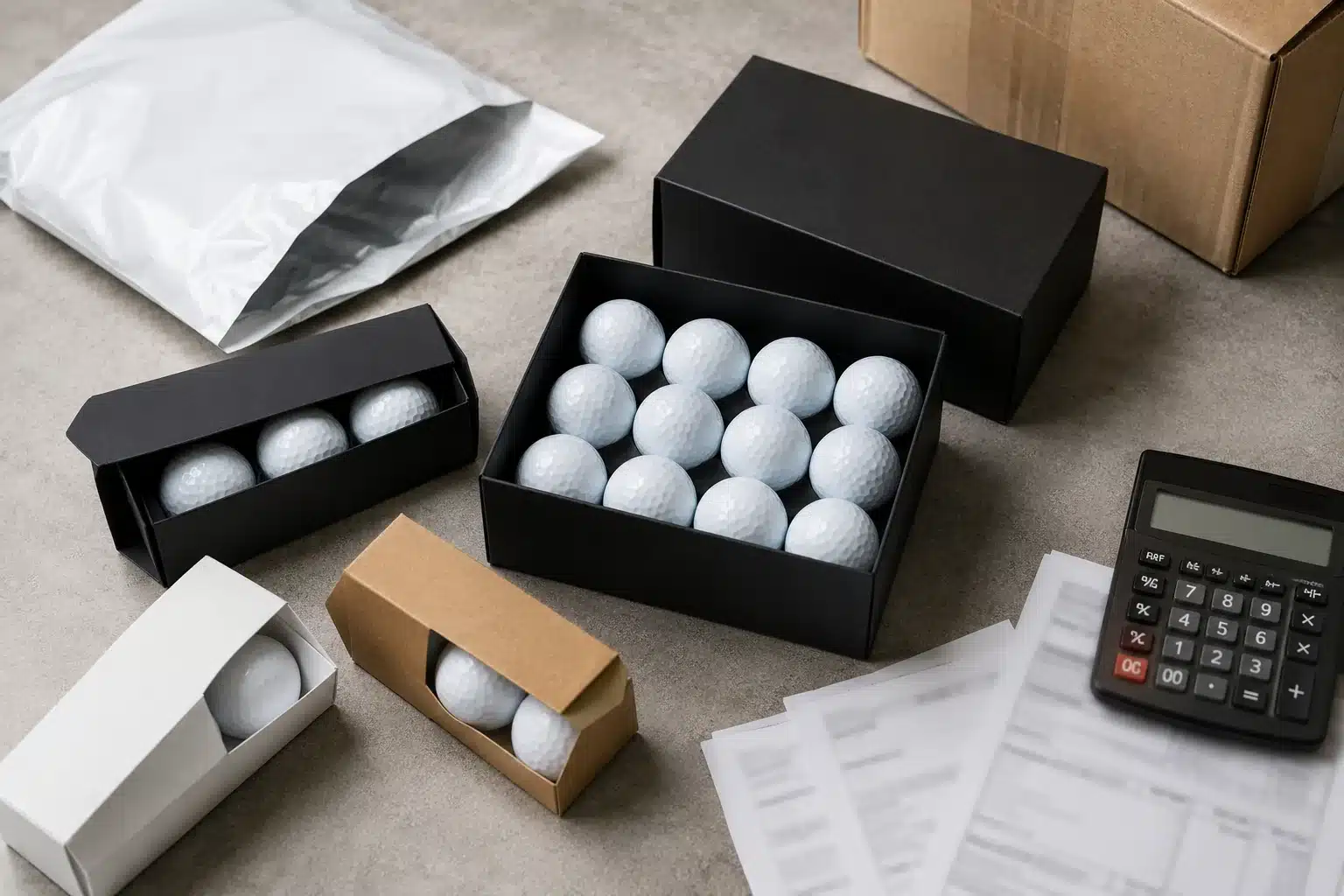
Packaging can do the same damage in a quieter way. A compact sleeve keeps freight density high. Oversized EVA gift boxes, display cartons, and premium inserts reduce loaded balls per container and raise freight per ball. Thailand may have origin appeal, but a lower loading density can erase that advantage quickly.
Ocean freight is not only about distance. It is about container load, sailing options, carrier competition, and backup routing. China’s major ports often provide stronger booking flexibility and route alternatives, while Thailand can work well for planned premium programs when shipment timing is stable.
Request listing-cost treatment, packaging dimensions, balls per carton, cartons per 40HC, and freight per ball. Check whether USGA/R&A listing is channel-required and whether packaging density supports the margin. Do not approve USGA listing or oversized packaging unless the channel margin justifies the added per-ball cost.
For small-run financial control, it also helps to negotiate MOQ with Chinese golf ball manufacturers before locking volume into a high-fixed-cost program.
When Does USGA Listing Become a Tax?
USGA listing becomes a tax when the channel does not need it but the buyer still forces the cost into a small run.
Tournament, elite amateur, or conformance-sensitive retail channels may justify listing. DTC trials, practice balls, range balls, corporate gifts, and early packaging tests may not. If the channel does not require current listing, the fee can act like a margin leak rather than a value driver.
Buyer approval requires a landed-cost worksheet showing FOB, tariff/duty assumptions, first-pass yield, scrap/rework allowance, packaging density, freight per ball, USGA/R&A listing cost, and order-volume amortization.
✔ True — small orders can carry big hidden fixed costs.
A test order can be distorted by listing fees, gift packaging, freight density, and yield loss before you ever compare sell-through.
✘ False — “A small trial order is automatically low risk.”
Small volume reduces purchase exposure, but it also increases the per-ball burden of fixed compliance and packaging costs.
FAQ
Are golf balls manufactured in Thailand cheaper than China?
Generally, not automatically. Thailand may avoid the China Section 301 layer, but China often starts from a lower FOB baseline. Buyers should compare FOB, customs entered value, tariff exposure, yield, freight density, packaging, and compliance amortization before choosing either route.
Normalize construction and packaging first. A 3-piece PU quote should be compared against another 3-piece PU quote with the same cover process, packaging, volume, and approval standard. Then add tariff and fee assumptions, yield and scrap allowance, freight per ball, and compliance cost. The right comparison is landed cost per accepted ball, not origin reputation.
Do golf balls imported from China face U.S. tariffs?
Golf balls under HTSUS 9506.32.0000 have a Free base duty rate, but China-origin entries should still be checked for Section 301 / Chapter 99 treatment. If the 7.5% layer applies, it is calculated on customs entered value, not casual product-cost shorthand.
Do not rely on the base duty line alone. Ask your broker to confirm the HTSUS classification, Chapter 99 exposure, customs entered value, and documentary origin support. The same tariff percentage can produce different cost outcomes depending on declared value, fees, freight, and destination charges.
What are Thailand BOI tax incentives for manufacturing?
Thailand BOI incentives may include machinery duty benefits, raw-material duty benefits for approved export production, corporate income tax incentives, and non-tax incentives. These benefits accrue first to the factory or investor, not automatically to a small buyer.
Ask whether BOI affects your quote. If the supplier says Thailand is cheaper because of BOI, request pass-through evidence. A long-term, high-volume buyer may negotiate some benefit into pricing. A 1,000-ball or 3,000-ball trial should not assume automatic savings.
Why does cast urethane yield affect golf ball cost?
Cast thermoset urethane is slower and harder to control than injection TPU. When first-pass yield falls, premium resin, paint, curing time, labor, and line capacity are wasted. A 3–5% yield gap can erase energy, labor, or tariff savings.
Ask for first-pass yield, scrap rate, rework rate, and cosmetic reject breakdown. Separate cosmetic and functional rejects. If the supplier cannot explain yield assumptions, the FOB may be hiding a risk premium that shows up later as price increases, delays, or tighter acceptance disputes.
Is Thailand better for premium golf ball OEM?
Thailand can be strong for premium brand-linked lines, especially when the origin story supports price positioning. But premium positioning does not guarantee lower landed cost; buyers still need FOB, yield, MOQ, freight density, packaging, and compliance math.
Verify cast urethane capability, MOQ, capacity access, and yield data. A premium origin story only pays when it improves channel pricing, conversion, or trust enough to offset the higher cost layers. If the channel cannot monetize the origin story, China may still win the landed-cost model.
When is USGA listing worth the cost?
USGA/R&A listing is worth paying for when the sales channel requires conforming-list status. For DTC trials, practice balls, range use, or gifting, the annual listing cost may become a hidden compliance tax if order volume is small.
Divide listing cost by order volume before adding it to the quote. Confirm who pays the fee, whether the model already exists, and whether annual resubmission is needed. Do not require listing by habit if the channel does not need it.
How does packaging density affect landed cost?
Packaging density changes how many balls fit in each carton and container. Oversized gift packaging can raise freight per ball enough to erase FOB or tariff advantages, especially on small or premium-pack orders.
Ask for carton dimensions, balls per carton, cartons per 40HC, gross weight, CBM, and freight per ball. Approve premium packaging only when the channel margin supports it. A beautiful gift box that cuts container load too far can become a landed-cost trap.
What should my RFQ ask for?
Your RFQ should request FOB, entered-value basis, country of origin, tariff assumptions, BOI pass-through if claimed, yield/scrap data, packaging dimensions, loaded balls per 40HC, USGA/R&A cost treatment, and excluded logistics fees.
Ask for tariff assumptions, yield evidence, packaging density, compliance-cost ownership, and logistics scope in one worksheet. If the supplier cannot show the math, your team is not comparing China and Thailand; it is comparing sales claims.
Conclusion
China vs Thailand golf ball costs should be decided by tariff-adjusted landed cost per accepted ball, not by FOB alone, duty rate alone, BOI headlines, or premium origin story. Thailand can be attractive when origin value, stable premium capacity, and tariff treatment survive the full worksheet. China can still win when lower FOB, stronger yield absorption, better packaging density, and small-run control outweigh the tariff layer.
For finance-minded buyers, the safe rule is simple: start with construction-specific FOB, then add customs entered value, Section 301 or Thailand-origin assumptions, BOI pass-through, yield and scrap, freight per ball, packaging density, and USGA amortization.
You might also like — Top 3 Golf Ball Manufacturers in Thailand for OEM (2026 Directory)