One practice ball can simplify purchasing, but it cannot optimize lessons, driving ranges, indoor simulators, home nets, and greens practice at the same time.
The best golf ball for practice depends on the setting. Use forgiving low- to mid-compression 2-piece ionomer balls for lessons, dedicated durable range balls for driving ranges, RCT or marker-ready balls for indoor radar simulators, clean matte high-contrast balls for camera-based simulators, and the same model or same-feel ball for putting and short-game practice.
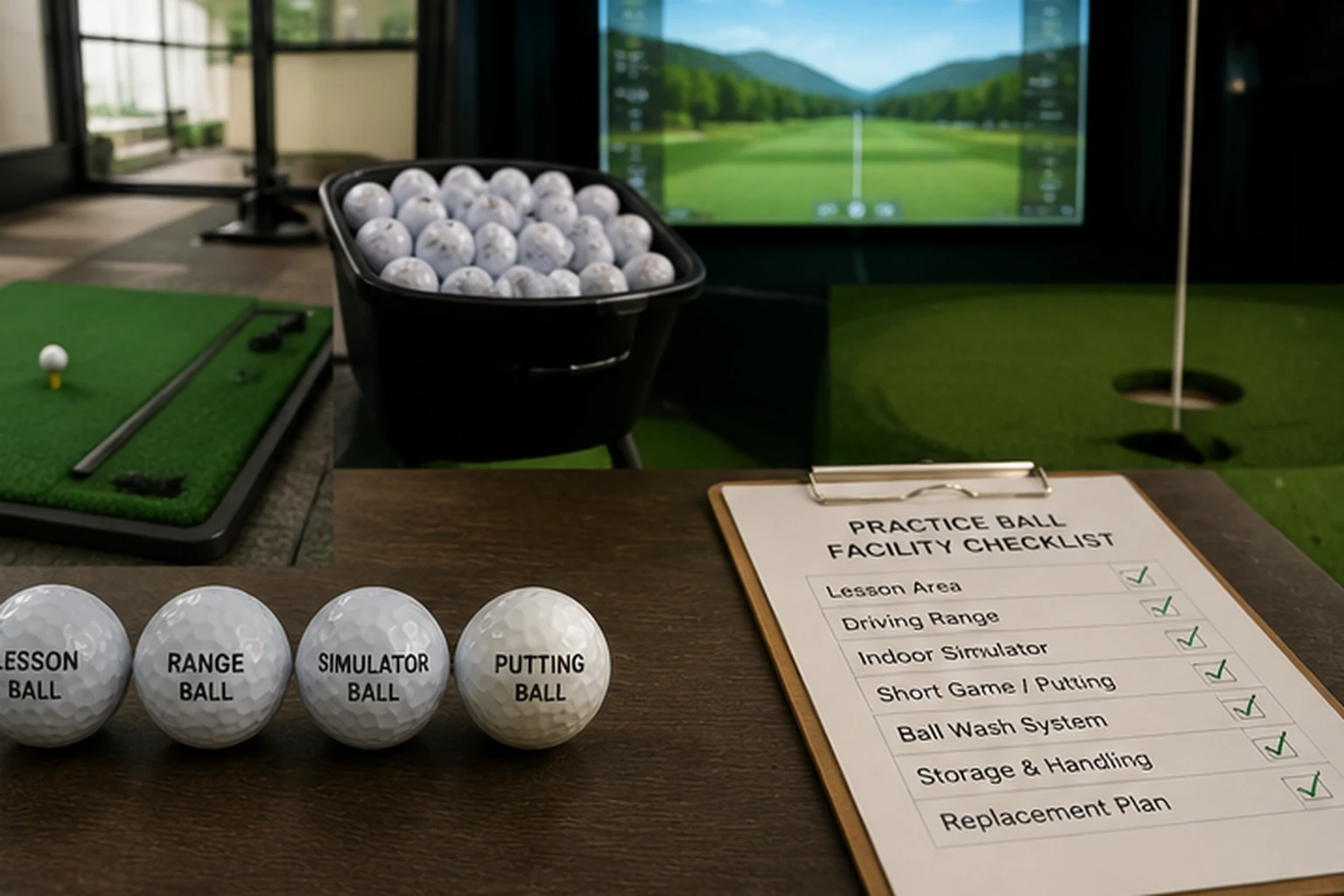
Use this guide to match each practice setting with the right ball type, then verify supplier proof, 12-ball QC data, receiving checks, retained samples, and repeat-order controls before your facility scales inventory.
Which ball fits each practice setting?
Your facility may want one simple practice-ball SKU, but lessons, ranges, indoor bays, nets, and greens each create different feedback, durability, tracking, safety, and feel requirements.
The best practice golf ball depends on the setting because one ball cannot optimize feedback, durability, tracking, safety, and feel at the same time. Your team should separate lessons, driving ranges, indoor radar, indoor camera, home/net, and greens practice before requesting supplier samples.
A golf academy, driving range, club, or simulator venue is not really buying “practice balls.” You are buying different operating inputs for different spaces. A lesson ball has to keep coaching feedback stable without burning class budget. A range ball has to survive impact, washing, sorting, retrieval, and repeat circulation. An indoor simulator ball has to protect the screen and help the tracking system read reliably. A short-game ball has to preserve pace, rollout, and feel.
That is why one practice ball can be acceptable in more than one area, but it rarely optimizes all of them. A low-compression two-piece ball may work well for beginner lessons and casual mats, but it may not give the same short-game response players need on the practice green. A urethane ball may improve short-game realism, but it can raise cost and wear risk in high-volume range buckets. Your facility should choose by setting first, then by price, then by supplier proof.
| Pain/decision | Best ball type | Buyer priority | Evidence to request |
|---|---|---|---|
| Lessons | 2-piece ionomer / low-mid compression | Feedback + cost per class | Same-batch sample |
| Driving range | Dedicated range ball / durable cover | Washability + fleet life | Washer-cycle check |
| Indoor radar | RCT or marker-ready ball | Spin/data capture | Read-stability test |
| Indoor camera | Matte clean high-contrast ball | Optical detection + screen cleanliness | Glare/mark check |
| Putting / greens | Same model or same-feel ball | Pace + roll consistency | Model lock |
| Home / office net | Foam or limited-flight | Safety + noise control | Space-risk review |
Facilities should buy by setting, not by a generic practice-ball label.
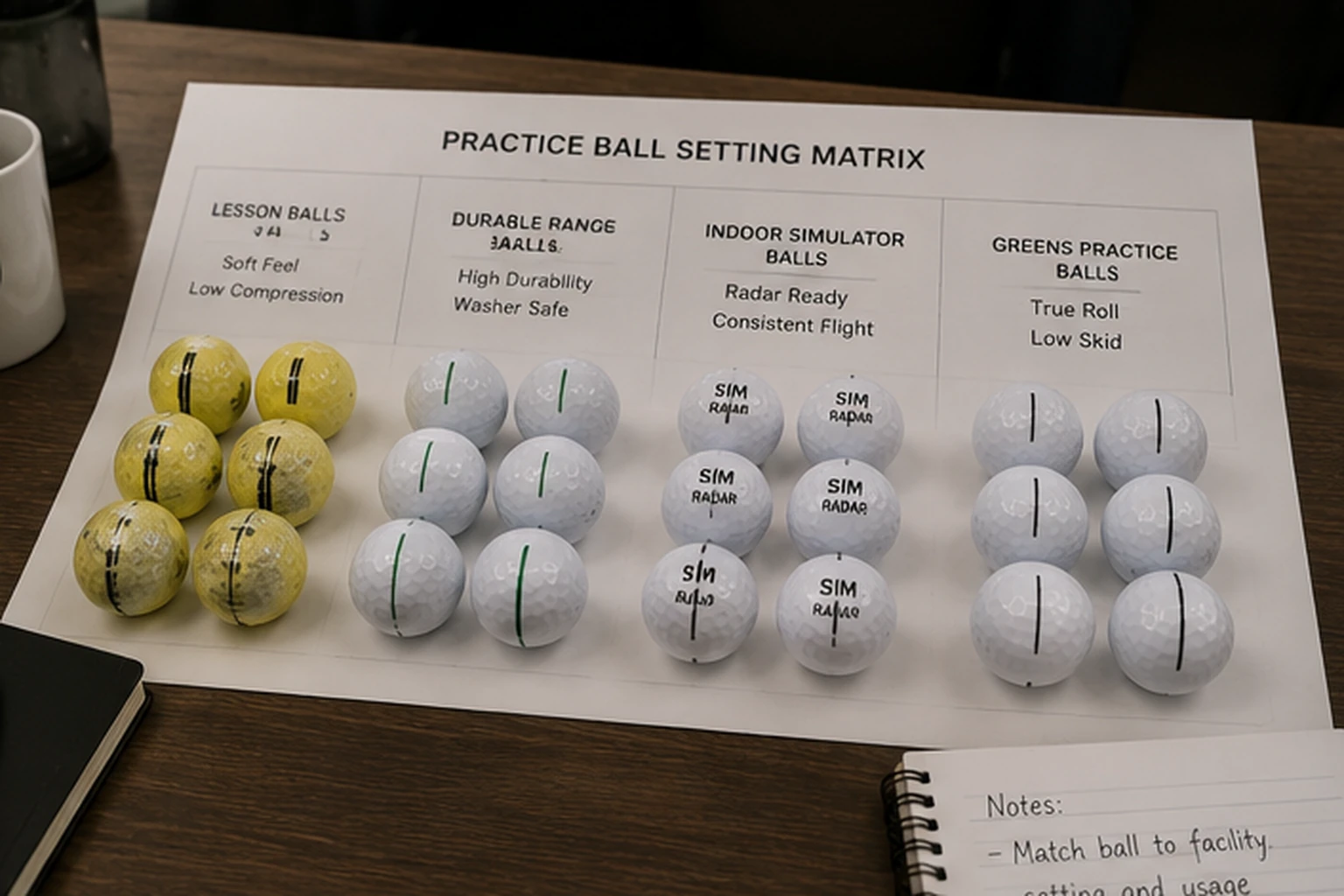
Create a setting-to-ball matrix before supplier sampling. Check whether each ball type is linked to the setting’s main risk: feedback, washability, tracking, screen cleanliness, roll feel, or safety.
Do not approve one generic practice-ball SKU unless your team accepts the trade-offs in every setting.
✔ True — One ball can be acceptable in several settings
A single model may work across a few facility areas if the trade-offs are understood. That is different from saying it optimizes lesson feedback, range durability, indoor tracking, screen protection, and green-side feel everywhere.
✘ False — “A generic practice ball is enough for every area”
That shortcut often creates hidden costs: noisy lesson feedback, faster range wear, missed simulator reads, screen marks, or inconsistent short-game touch.
Fast setting-to-ball matrix?
Your facility should choose by setting first, then by price.
A good supplier conversation starts with the use environment, not the product label. Ask where the ball will be used, what failure would hurt most, and what proof the supplier can show for that setting. The better your setting matrix is, the fewer “practice ball” surprises your staff has to explain later.
What should lessons prioritize?
Your coach may lose teaching clarity if every student hits a different-feeling ball, or your academy may overpay for spin that full-swing lessons do not use.
Lessons should prioritize forgiving launch, repeatable feedback, and cost per class before tour-level spin. Your team can start with durable low- to mid-compression two-piece ionomer balls, then move advanced or short-game lessons toward same-model urethane only when the lesson goal requires it.
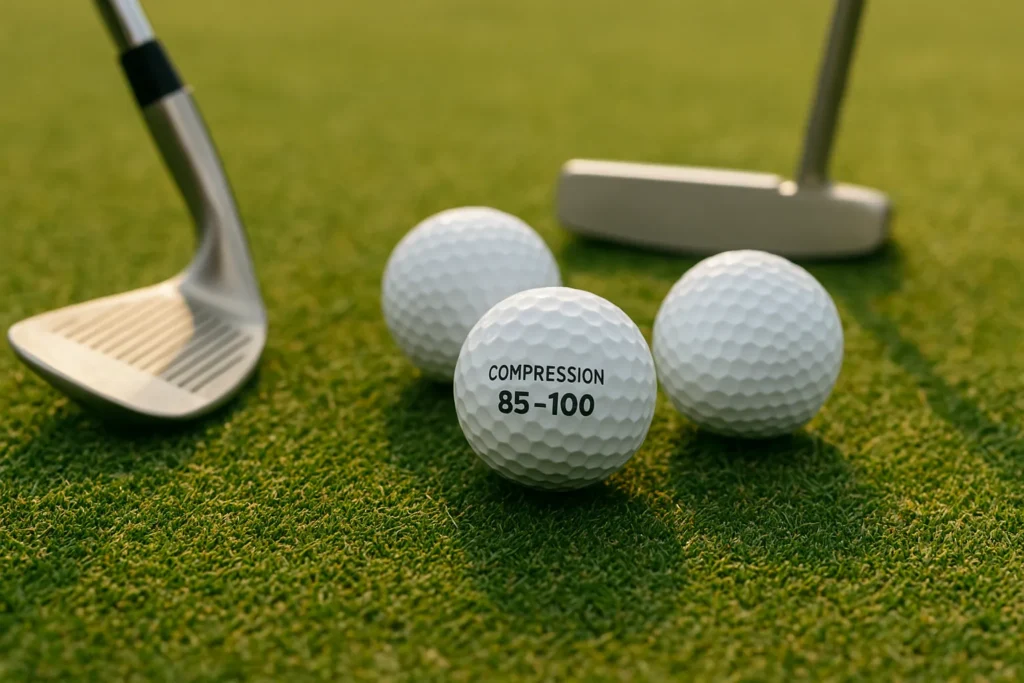
For most beginner, junior, and high-volume group lessons, a durable two-piece ionomer ball is the practical starting point. It usually supports easier launch, lower cost per hit, and less harsh feedback for slower or developing swings. Compression should be treated as a planning range, not a universal rule; compression affects energy transfer, distance, ball speed, and control, but swing speed, contact quality, mat condition, and lesson objective still decide whether the ball fits the class.
The bigger coaching issue is feedback noise. If one student group hits mixed batches, mixed constructions, or old range rejects, the coach has to explain ball behavior instead of teaching the swing. For adult average-speed groups, keep one model and one batch where possible. For faster players, a firmer option may prevent overly soft feedback. For short-game lessons, move toward the same ball or same-feel model the player uses on course.
A lesson ball should make instruction cleaner. If the student launches one ball high, another low, and another with a different feel because the bucket is mixed, the coach loses a clean feedback loop. The ball becomes a variable in the lesson, and variables are expensive when you are selling progress.
Request a lesson-ball sample set with compression range, batch ID, and same-model group-class option. Test launch, feel, dispersion, and feedback consistency across multiple students, not one or two balls.
Do not approve a lesson ball if ball variation interferes with your coach’s feedback.
Forgiveness, feedback, and cost per class?
Your coach should be teaching the swing, not explaining away ball variation.
The best lesson ball is not always the most premium ball. It is the ball that gives your coach repeatable feedback at a cost your program can sustain. Save higher-spin options for short-game calibration, advanced player work, or on-course transfer sessions where spin and rollout are part of the lesson.
What should driving ranges prioritize?
Your range may buy for durability, then discover the ball still fails daily operations through washer wear, mixed inventory, unreadable ID marks, or damaged recirculation.
Driving ranges should prioritize washable durability, readable ID marks, broken-ball rejection, and fleet control—not only impact life. Your team should verify washer compatibility, cover scuff grade, sorting marks, batch tracking, and reject-bin rules before a range ball re-enters daily circulation.
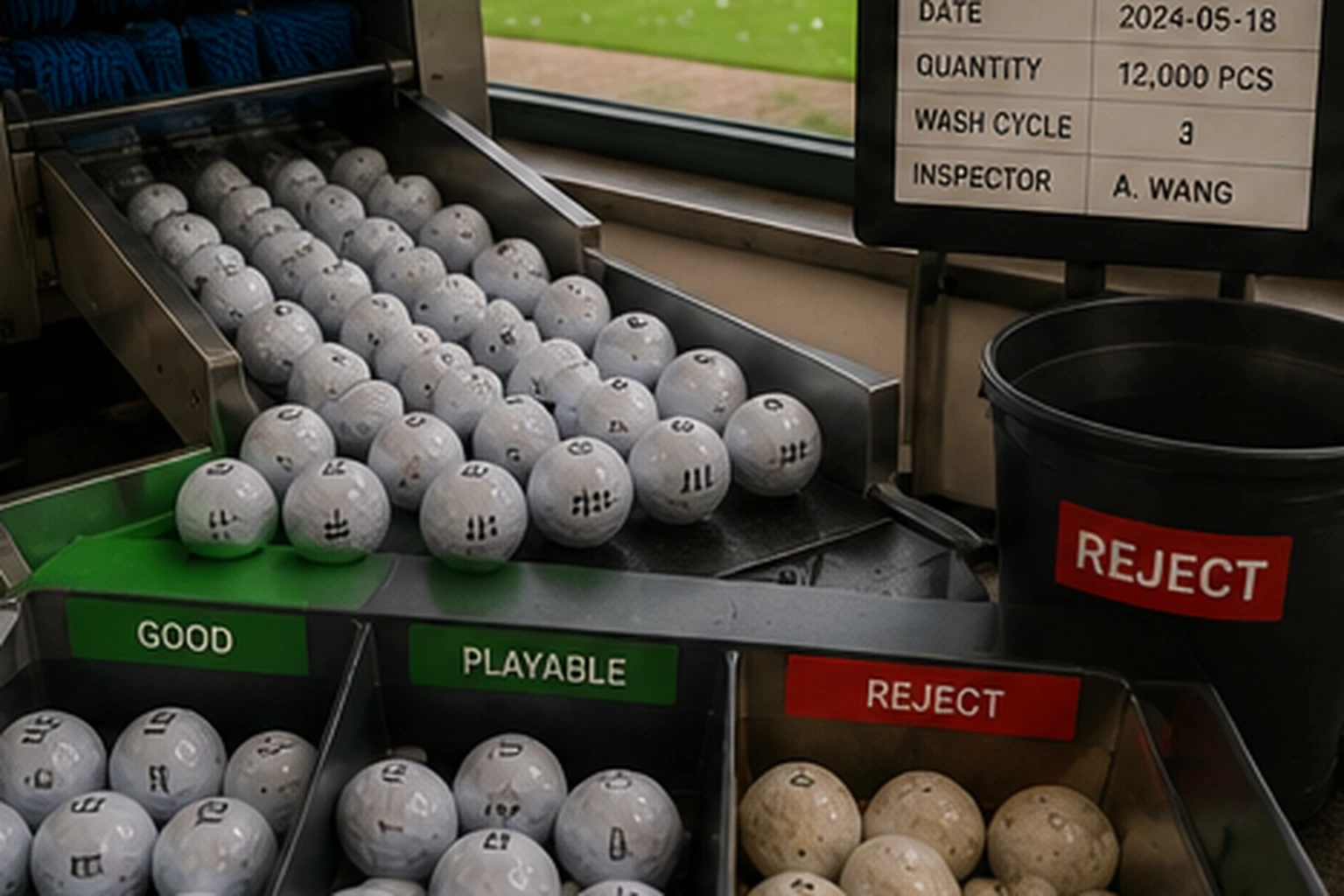
A range ball is part of a ball-management system, not just a tougher golf ball. Commercial range-ball washing systems are designed to clean and return large volumes of balls, so your buying decision should include washing, sorting, storage, dispensing, and repeat circulation.
Range procurement should look at daily flow. The cover must resist scuffing. The printed stripe, band, or ID mark must stay readable enough for sorting, ownership control, and fleet separation. The ball should survive washing without shedding, smearing, or creating debris. Washer guidance also tells operators to remove sticks, rocks, broken tees, broken balls, and other debris before cleaning, which supports a clear reject-bin rule before damaged balls re-enter circulation. washer maintenance guidance
Range ball approved with no washer or reject rule is a failure signal.
| Pain/decision | Range check | Why it matters | Evidence to request |
|---|---|---|---|
| Mixed fleet | ID mark / stripe | Sorting and fleet control | Legibility after use |
| Washer downtime | Washer compatibility | Avoid debris and jams | Wash-cycle result |
| Damaged recirculation | Reject bin rule | Stops broken balls returning | Staff SOP |
| Visual decline | Cover scuff grade | Controls lifetime | Scuff inspection |
| Reorder drift | Batch mark | Tracks age and supplier lot | Batch record |
| False durability | Replacement log | Turns life into data | Cost-per-hit file |
Still hittable does not always mean safe to re-enter the washer, dispenser, or picker workflow. A cracked ball can create machine issues. A heavily scuffed ball can drag down the range image. A faded stripe can increase sorting time. A washed-out fleet can look tired even when the balls technically still fly.
Graphics are not decoration in a range fleet. They help staff sort inventory, separate bays or programs, identify ownership, track supplier batches, and recognize when a ball is no longer fit for circulation. A beautiful new stripe is less important than a readable stripe after real range handling.
Create a range-ball operating checklist for washing, sorting, ID marks, reject bins, scuff grade, and replacement logging. Run the same candidate ball through hitting, washing, sorting, and visual inspection before bulk approval.
Do not approve range balls from impact durability alone if washer, ID, and reject-bin rules are missing.
Durability, washing, and fleet control?
Your range should buy a controlled fleet, not just a durable ball.
The best range-ball program is not the one that survives one impressive abuse test. It is the one your staff can wash, sort, track, reject, reorder, and present consistently. That is what turns “durable range balls” into operational control.
✔ True — A range ball is part of a fleet system
Durability matters, but daily range operations also depend on washability, readable marks, reject rules, staff handling, and batch tracking.
✘ False — “If it can still be hit, it belongs back in the bucket”
A damaged ball may still fly, but it can hurt washers, dispensers, screens, sorting accuracy, or guest perception.
What should indoor simulators prioritize?
Your indoor venue may blame the launch monitor when the real issue is mixed balls, dirty covers, glossy graphics, weak radar capture, or screen marking.
Indoor simulator balls should be selected by tracking system and screen risk, not by cover material alone. Your team should test RCT or marker-ready balls for radar bays, clean matte high-contrast balls for camera bays, and foam or limited-flight balls where space and safety control the session.
Indoor simulator golf balls have two jobs: help the system read the shot and avoid damaging the room. That means the starting question is not “Surlyn or urethane?” It is “What does this bay need to read, and what surface risk does the ball create?”

Radar-based launch monitors may benefit from RCT-style or marker-ready balls when spin capture is weak. Titleist RCT golf balls are designed to enhance launch-condition data capture in indoor radar environments, and TrackMan explains that the embedded radar-reflective pattern can remove the need for external markers or specific pre-shot ball orientation in compatible systems. TrackMan RCT guidance
Camera-based or optical systems are different. They often care more about clean covers, matte finish, high contrast, and consistent visual edges. Premium simulator venues should also screen for scuffs, chipped paint, dye transfer, and ink that marks the screen. Home or office nets may need foam or limited-flight balls because space, safety, and noise matter more than full-ball-flight realism.
RCT claim applied to camera simulators is a failure signal.
| Pain/decision | Indoor system | Ball priority | Evidence to request |
|---|---|---|---|
| Missed spin reads | Radar launch monitor | RCT / marker-ready | Read-stability test |
| Camera glare | Camera / optical | Matte clean high contrast | Edge-detection check |
| Screen marks | Premium simulator venue | Low-scuff clean surface | Screen test |
| Dye transfer | Shared indoor bucket | Non-smearing graphics | White-cloth rub |
| Tight space | Home / office net | Foam / limited-flight | Safety review |
A simulator guest rarely says, “The ball surface was wrong.” They say the launch monitor missed spin, the bay gave weird numbers, or the screen looks marked. That is why indoor inventory should be cleaner and more controlled than outdoor range inventory. Dirty covers, sand, chipped paint, smearing ink, and glossy glare all create trust problems.
Request an indoor-ball compatibility test for the exact simulator type. Check radar spin capture, camera detection, screen marking, dye transfer, scuffing, and graphic consistency on the same sample batch.
Do not approve indoor balls until your team tests the tracking system and screen surface together.
✔ True — RCT is mainly a radar-side solution
Radar bays may need stronger spin capture. Camera systems usually care more about clean surfaces, matte finish, high contrast, and consistent optical edges.
✘ False — “Every indoor simulator needs RCT or urethane balls”
The right indoor ball depends on the tracking system, screen risk, lighting, graphics, surface cleanliness, and space limitations.
Screen safety and tracking reliability?
Your guests judge the data, but your ball choice often controls whether that data looks trustworthy.
Keep indoor-only balls clean. Remove chipped, dirty, or scuffed balls before they reach premium bays. One damaged ball can create a screen mark, a bad read, or a complaint that sounds like a technology failure.
What should greens practice prioritize?
Your players may practice putting, chipping, and pitching with mixed range balls, soft two-piece balls, and urethane gamers, then wonder why touch does not transfer.
Greens practice should prioritize pace, rollout, spin response, and model consistency. Your team should use the same model as the play ball when touch matters, or at least keep one consistent construction and compression window so putting and short-game feedback does not drift.
Putting and short-game practice are not only about whether a ball rolls. They are about pace control, launch, friction, first bounce, and the rollout players carry onto the course. Putting-speed practice guidance focuses on distance control and reducing costly three-putts, which supports a simple facility rule: keep the practice ball consistent when pace and feel are the training goal. putting speed-control guidance
Mixed constructions teach mixed touch. A range ball may roll and release differently from a urethane gamer. A soft two-piece ball may feel pleasant but fail to represent scoring shots around the green.
For putting warm-ups, use the same model when possible. For chipping and pitching, use the player’s gamer or a practice-marked version of the same build when cost matters. For beginner putting classes, one consistent model is better than a premium mix. The goal is to remove ball variation from the lesson.
Not every green requires a tour-level ball. A beginner putting station can run well on one consistent model. A short-game academy area should move closer to the ball players use on course because friction, spin, and rollout become part of the teaching outcome. A club short-game area serving better players should avoid mixing range balls with premium urethane balls in the same practice basket.
Create a short-game ball rule for putting, chipping, pitching, beginner classes, and budget practice areas. Compare rollout, launch, spin response, and feel using the intended practice model versus mixed balls.
Do not mix constructions on a feedback-sensitive green unless your team accepts inconsistent rollout and feel.
Rollout, spin, and model consistency?
Your players should calibrate touch, not learn around random ball behavior.
A greens program does not always need the most expensive ball. It needs consistency. Use the same model, the same construction, or at least the same feel window so players build pace memory that travels.
How should buyers verify practice balls?
Your supplier may sell one product as a “practice ball,” but your facility needs proof that the same batch works on lesson mats, range washers, simulator screens, and short-game greens.
Do not approve one “practice ball” from a pretty sample; approve each setting ball as a controlled version. Your team should request 12-ball QC, setting tests, retained samples, batch ID, receiving checks, and change control before the first bulk PO.
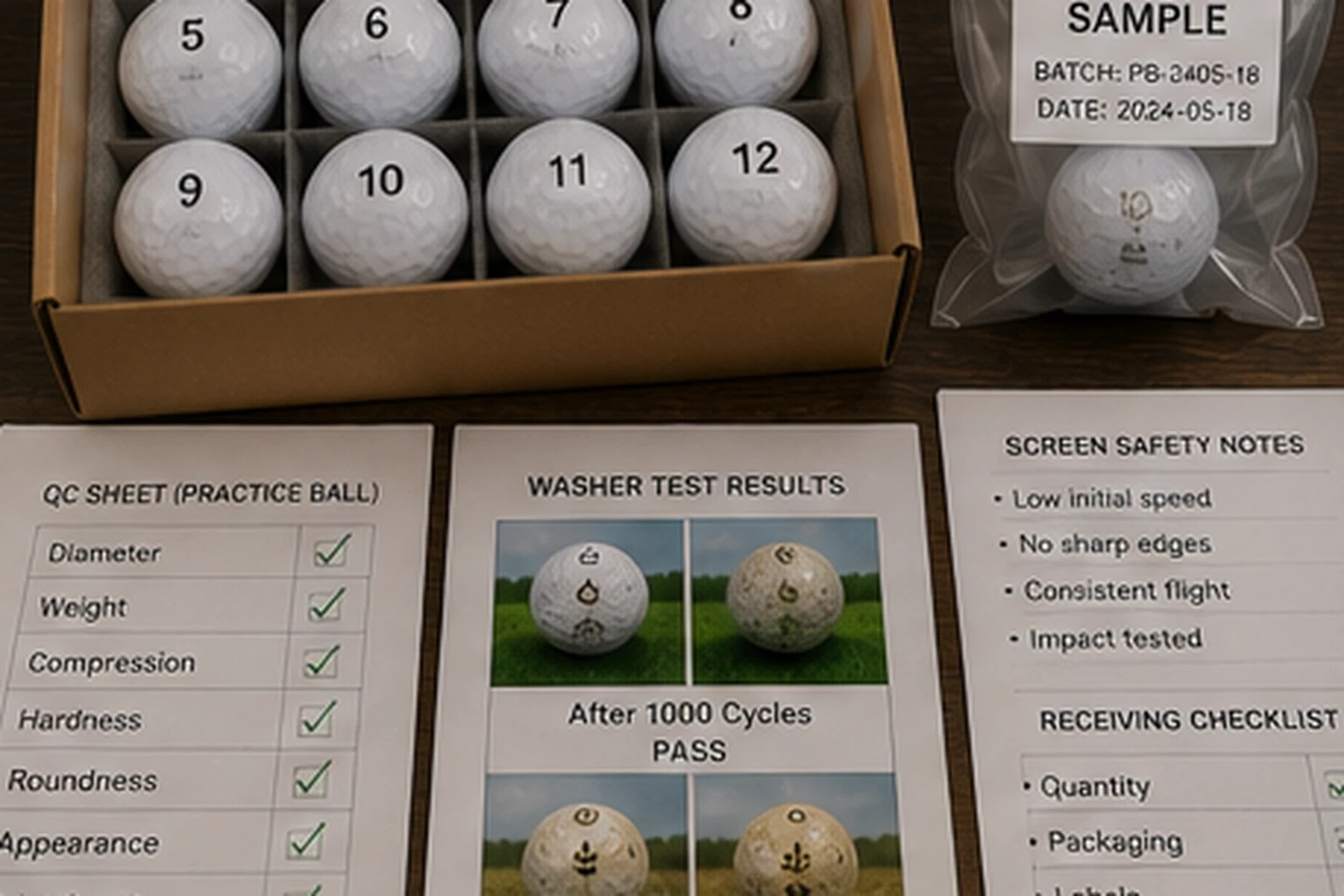
Do not approve practice balls by appearance or price alone. Independent golf-ball testing compares balls through distance, spin, accuracy, and consistency, which is the same logic your facility should apply by setting. 2025 golf ball testing shows why one generic “practice ball” claim is too thin for B2B buying.
A lesson ball should prove compression and feedback consistency. A range ball should prove washer-cycle durability, scuff resistance, ID-mark survival, and broken-ball rejection rules. An indoor ball should prove tracking stability, screen-safety behavior, and dye-transfer control. A greens-practice ball should prove rollout, pace, spin response, and same-model consistency.
Ask the supplier to provide one setting-specific practice-ball proof pack with sample IDs, 12-ball QC raw data, compression and hardness spread, cover/scuff evidence, washer-cycle or screen-safety checks where relevant, tracking test where relevant, retained sample, batch ID, receiving checklist, and written change-control rule.
Supplier says “practice ball” with no setting test is a failure signal.
| Pain/decision | Proof item | Settings affected | Evidence to request |
|---|---|---|---|
| Feedback drift | Compression raw values | Lessons / indoor / greens | Spread review |
| Batch variation | Weight / diameter data | All settings | Statistics |
| Wear risk | Cover hardness / scuff | Lessons / range / indoor | Wear screen |
| Washer issue | Washer-cycle check | Range | Circulation test |
| Bad recirculation | Broken-ball reject rule | Range | Written SOP |
| Data trust | Tracking test | Indoor | Radar/camera result |
| Screen complaint | Screen mark / dye transfer | Indoor | Surface record |
| Touch drift | Roll / pace consistency | Greens | Model comparison |
| Sample drift | Retained sample / batch ID | All settings | Locked version |
Mold, compression, coating, and printing control all affect practice-ball consistency. Size, weight, shape, hardness, gloss, graphic clarity, and scuff behavior are not cosmetic details when your facility depends on repeatable feedback and smooth operations. A facility that buys four settings from one supplier should not accept one generic data sheet for all four.
Supplier shall identify the approved practice-setting model, construction, compression window, cover/finish route, printed mark or tracking pattern where relevant, retained sample ID, batch ID, 12-ball QC report, setting-specific test record, packing list, and receiving inspection file for every production lot.
Buyer acceptance requires setting-specific sample testing, raw QC values with average, range, and standard deviation; retained sample match; washer-cycle or screen-safety evidence where relevant; tracking check where relevant; AQL receiving rule; and written approval before any material, compression, cover, coating, print, packaging, or process change.
Request a practice-ball proof pack with 12-ball QC, setting tests, retained sample, receiving checklist, and change-control rule. Check whether the same batch has been tested across your actual settings: mats, washers, simulators, greens, and receiving inspection.
Hold approval if raw QC data, retained sample, setting proof, batch ID, or written change control is missing.
✔ True — Supplier proof must be setting-specific
A lesson ball, range ball, simulator ball, and greens-practice ball can fail in different ways. The proof pack should test the setting, not only the sample appearance.
✘ False — “One attractive sample proves a full practice-ball program”
A clean sample starts the review. It does not prove batch consistency, washer life, screen safety, tracking, rollout, receiving quality, or reorder stability.
Samples, batch data, and receiving checks?
Your PO should protect the practice experience your facility actually sells.
Approve each practice-setting ball as a controlled version. The retained sample, spec sheet, batch QC, receiving checklist, and change-control rule should all point to the same model—not a generic practice-ball promise.
FAQ
What golf balls should each practice setting use?
Use forgiving two-piece ionomer balls for lessons, dedicated durable range balls for driving ranges, RCT or marker-ready balls for indoor radar bays, clean matte high-contrast balls for camera bays, and the same model or same-feel ball for greens practice.
Home or office nets may need foam or limited-flight balls for safety and noise. This is the simplest setting-to-ball rule, but your facility should still verify samples in the real environment. Mats, washers, simulator lighting, screens, and greens all expose different failure modes.
Are range balls different from regular balls?
Yes. Range balls are built for durability, washing, sorting, retrieval, and repeat circulation, while regular play balls usually prioritize scoring performance, on-course feel, and spin control.
A range ball should survive more abuse than a regular play ball. It also needs visible ID marks, washer compatibility, reject-bin rules, and batch tracking. Use range balls for mechanics and volume. Use the play ball or a close match when distance gapping, wedge spin, or scoring feedback matters.
Should lesson programs use low-compression balls?
Low- to mid-compression two-piece balls are a strong starting point for many full-swing lessons, especially beginner or group classes. Your team should still verify launch, feel, and feedback consistency.
Compression is a starting range, not a universal rule. Keep one class on the same model and batch so the coach is not fighting ball variation. Move to urethane or a same-model gamer only when short-game feedback, rollout, and spin response become the lesson goal.
Can indoor simulators use regular golf balls?
They can, but the ball must fit the tracking system and protect the screen. Radar, camera, and home/net setups need different checks before your facility puts balls into daily service.
Radar bays may need RCT or marker-ready balls. Camera bays usually need clean, matte, high-contrast surfaces. Home or office nets may need foam or limited-flight balls for space and safety. Regular balls can work, but mixed, dirty, glossy, or damaged balls can create tracking and screen issues.
Which balls work best for indoor simulators?
Radar-based simulator bays often benefit from RCT or marker-ready balls, while camera-based systems usually need clean matte balls with high-contrast, consistent graphics. Premium venues should also test screen marking and dye transfer.
The best indoor simulator ball is not always the softest or most expensive ball. It is the ball your tracking system reads consistently and your screen can handle. Test the same batch under your actual lighting, launch monitor, screen, mat, and cleaning workflow.
Should putting practice use the same ball as play?
For pace, rollout, and short-game feel, yes whenever the practice goal is transfer to the course. Budget programs can use practice-marked versions or a fixed same-feel model.
Putting and chipping are calibration work. If players practice with mixed constructions, they learn mixed touch. Use one model for serious touch work, avoid mixing range balls with urethane gamers, and use a consistent ball for beginner putting classes.
Do practice sessions need urethane balls?
Not all practice sessions need urethane. Full-swing lessons and range use often benefit more from durable ionomer balls, while short-game and scoring practice may need urethane-like spin and feel.
Choose by lesson goal, not prestige. Ionomer works well for high-volume durability, cost control, and forgiving launch. Urethane becomes more useful when greenside control, rollout, and scoring feedback matter. Your facility may need both, but not in the same bucket.
Can golf balls mark simulator screens?
Yes. Dirty covers, worn covers, smearing ink, glossy graphics, and damaged balls can create screen or tracking issues, so indoor inventory needs a surface check.
Use clean indoor-only balls when possible. Test screen marks, dye transfer, and scuff behavior before bulk use. Remove chipped, dirty, or deeply scuffed balls from simulator bays. A ball that is fine outdoors may still be wrong for a premium indoor screen.
What proof should suppliers provide for practice balls?
Ask for setting-specific proof, not a generic practice-ball claim. The proof pack should connect the sample, batch data, setting tests, retained sample, receiving checklist, and change-control rule.
Request 12-ball QC raw data, compression and hardness spread, cover/scuff evidence, washer or screen tests where relevant, tracking checks where relevant, and rollout tests for greens practice. Keep retained samples and batch IDs so reorders can be compared against the approved version.
Conclusion
One practice ball cannot optimize every setting.
Lessons need forgiving and repeatable feedback, ranges need washable fleet durability, indoor bays need tracking and screen-safe surfaces, and greens practice needs consistent roll and feel.
Choose by setting first, then verify the supplier’s proof before you scale. The best practice-ball program is not the simplest SKU list; it is the one that protects coaching quality, facility uptime, simulator trust, and short-game feedback in the places your customers actually practice.
You might also like — 2-Piece vs 3-Piece Golf Balls: The Ultimate B2B Bulk Sourcing & QC Guide