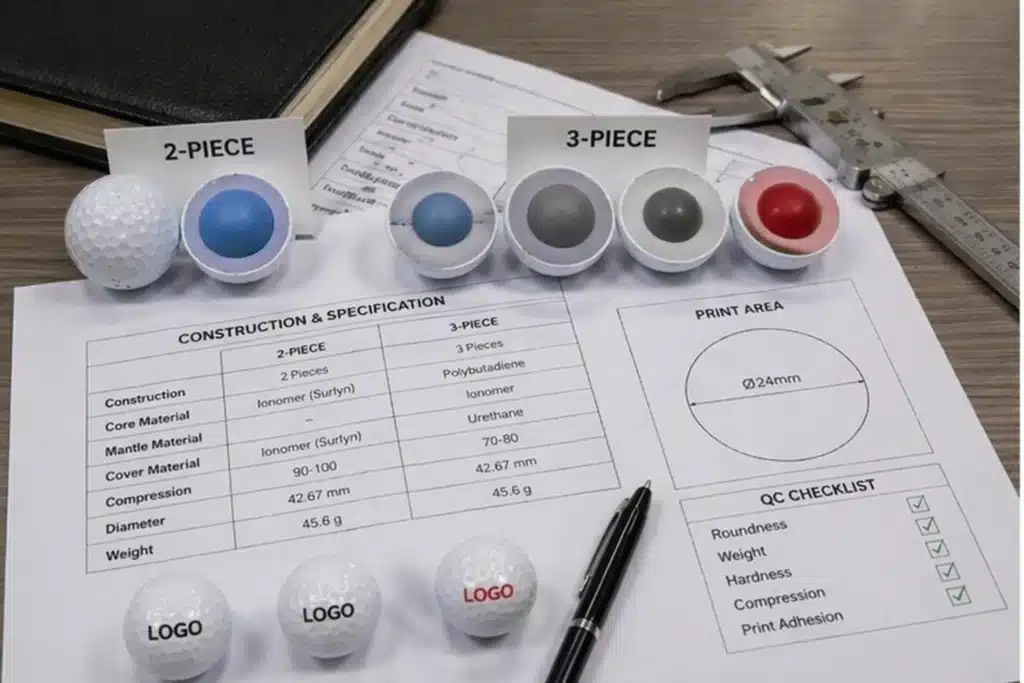
A 2-piece golf ball uses a core and cover, while a 3-piece ball adds a mantle between them. For OEM sourcing, stay with 2-piece when the baseline already meets your product goal. Move to 3-piece only when the mantle has a defined job and the finished SKU proves a useful difference.
A supplier may quote 3-piece as a premium upgrade, but your team should still be able to explain what that extra layer is intended to change.
Piece count describes architecture, not quality. The real decision is whether the added tuning variable solves an unmet product or commercial need.
If you cannot name that need, the third layer has not yet earned its added cost and complexity.
How Do 2-Piece and 3-Piece Golf Balls Differ?
You may see “3-piece” on a supplier quote and assume softer feel, more spin, or higher quality. That shortcut turns an architectural description into a performance promise it cannot make by itself.
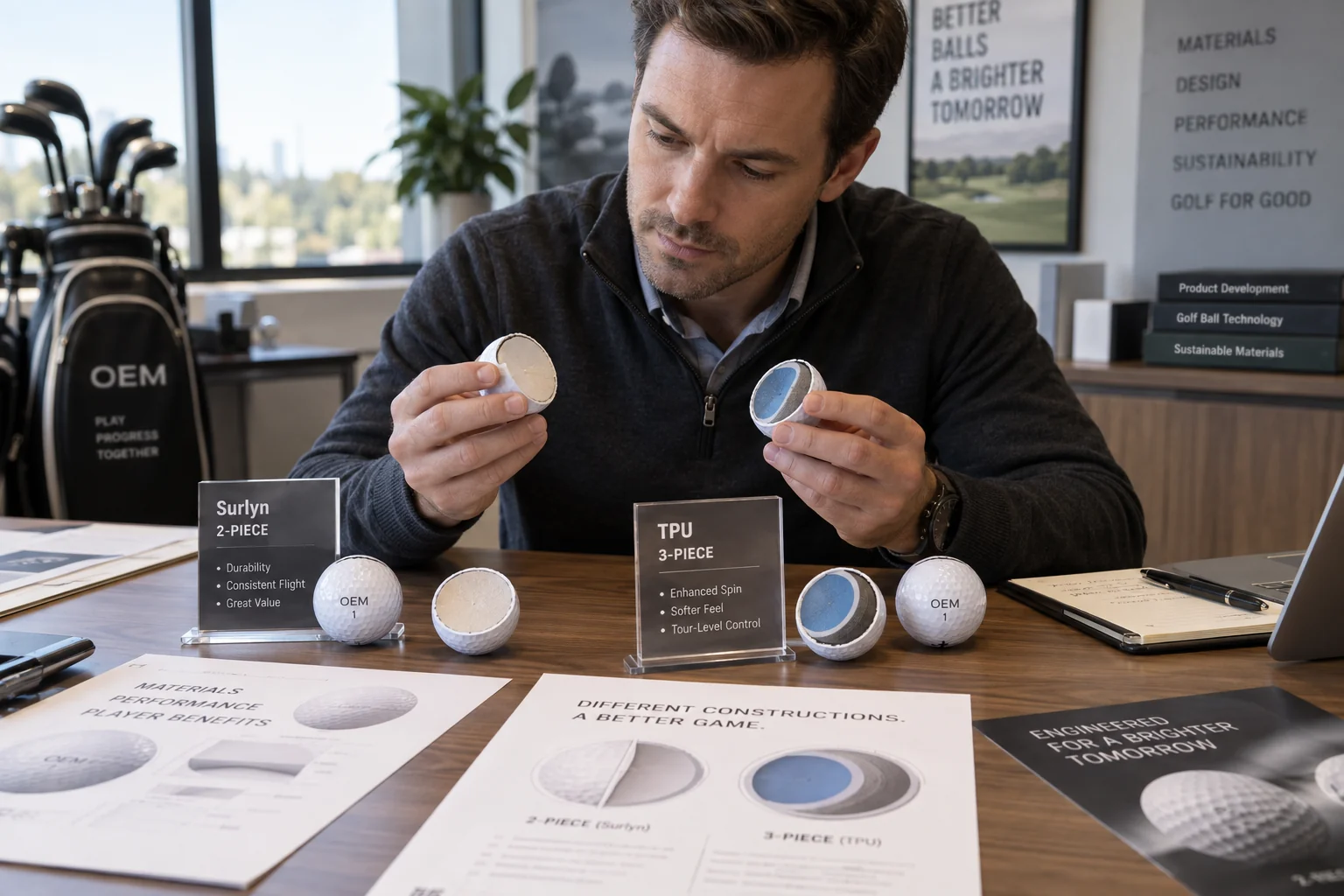
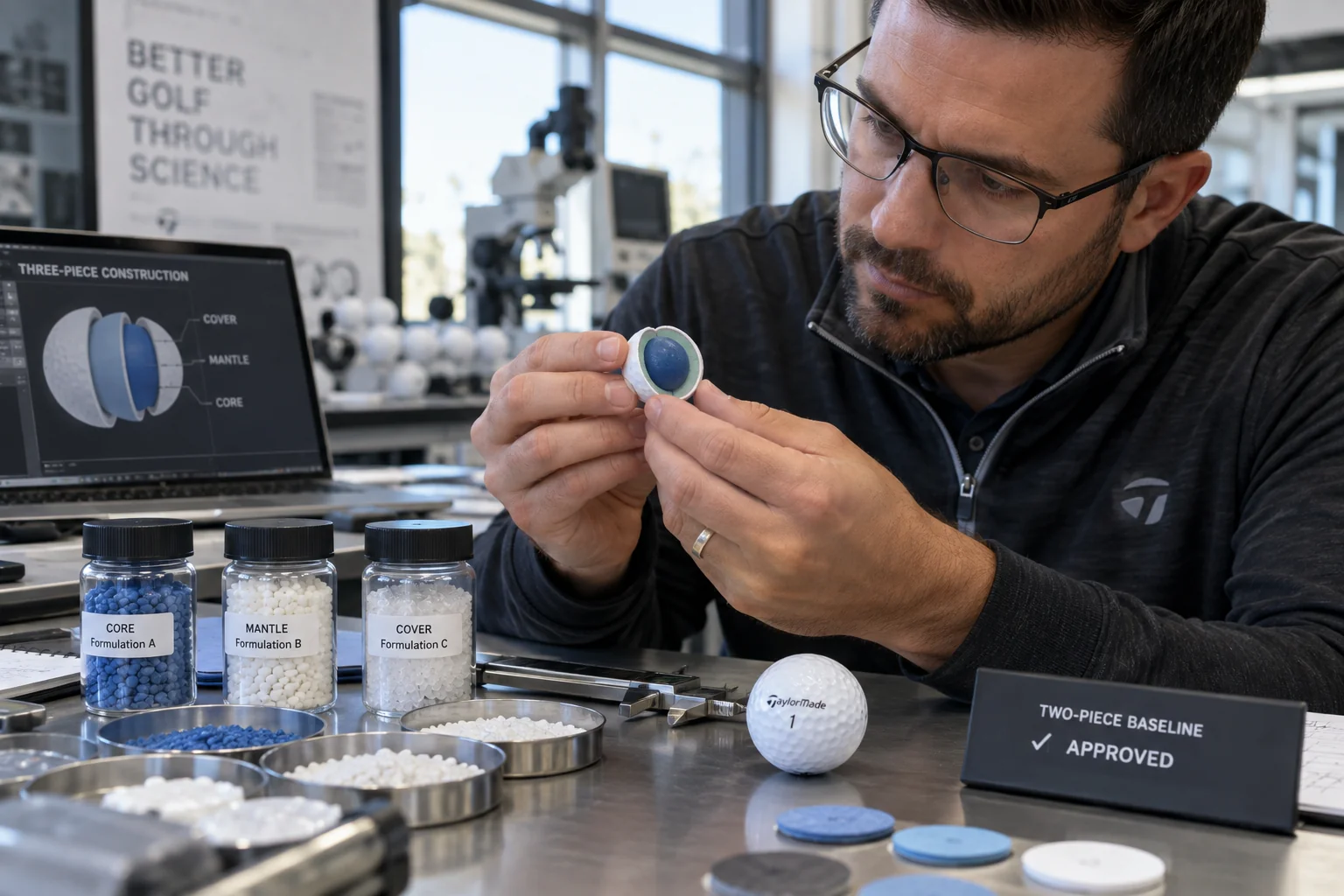
A 2-piece golf ball uses a core and cover, while a 3-piece ball adds a mantle between them. The extra layer gives the designer another tuning variable, but it does not automatically make the finished ball softer, higher-spinning, or better. You still need to evaluate the complete SKU.
The physical construction is straightforward. A 2-piece ball asks the core and cover to do most of the design work. A 3-piece ball introduces a mantle between them, adding another material, interface, and controllable dimension.
That additional layer can matter. It simply does not tell you the finished result by itself.
Compression is a good example. A 2-piece golf ball can be tuned softer than buyers expect, while a 3-piece model can still feel comparatively firm. Core formulation, mantle design, cover family, hardness, compression target, dimples, and the wider aerodynamic system all contribute to the finished profile.
Architecture can matter. Layer count alone does not tell you what the finished SKU will do.
Layer count and cover family are also separate specification decisions. If your actual sourcing question is material selection, compare Surlyn vs urethane golf ball covers separately rather than treating a cover change as evidence of a layer-count effect.
What Does the Mantle Actually Add?
The mantle adds another design variable between the core and cover. Depending on the exact construction, that variable may be used toward energy transfer, feel, spin behavior, cover support, or another declared product objective.
Your supplier should therefore be able to answer one precise question: What is the mantle engineered to change in this exact SKU?
We reviewed finished production-test profiles from a 2-piece Surlyn SKU and a 3-piece Injection TPU SKU. The 2-piece averaged 84.25 compression, 62.67 Shore D, and about 0.781 COR; the 3-piece averaged about 86.92 compression, 57.75 Shore D, and 0.790 COR. We did not treat those differences as proof that the mantle caused the result because the cover system changed too, and other recipe variables could also differ. Both models also passed their respective internal impact-test conditions, but the programs used different conditions, so we did not use them as a direct durability ranking. Ask what the mantle is supposed to change, then verify the finished ball—not the layer count.
The buyer-facing comparison only needs the fields that help interpret the two finished SKUs:
| Real SKU | Construction | Compression Avg. | Shore D Avg. | COR Avg. |
|---|---|---|---|---|
| SKU A | 2-piece Surlyn | 84.25 | 62.67 | ~0.781 |
| SKU B | 3-piece Injection TPU | ~86.92 | 57.75 | ~0.790 |
These results do not prove that one construction is better. They show why piece count alone cannot predict the finished-ball profile.
The evidence you need at this stage is simple: ask the supplier to identify the exact construction, cover family, intended mantle role, and approved sample reference in one construction/spec declaration.
✔ True — A mantle gives the designer another tuning variable.
That variable can be useful when it has a defined objective and the finished SKU demonstrates the intended difference.
✘ False — “More layers automatically mean better performance.”
The finished result depends on the complete construction, materials, and tuning objective. Piece count is architecture, not a quality score.
What Must the Mantle Earn in Your OEM SKU?
A supplier may recommend 3-piece because it sounds premium or because the factory already manufactures it. Neither explanation tells your procurement team why your product needs another layer.
A 3-piece ball earns its place only when the mantle has a defined job in your SKU. Ask what it should change versus the 2-piece baseline, then require finished-ball evidence for that difference. “3-piece premium” is positioning language, not a complete OEM product specification.
A useful Mantle Function Statement should answer four questions:
-
What is the intended function of the mantle?
-
Which 2-piece candidate is the baseline?
-
What finished-ball difference is being targeted?
-
What evidence will show whether that target was achieved?
The answer will vary by product. A mantle might support an energy-transfer objective, feel differentiation, spin tuning, the selected cover system, or another clearly stated target. The point is not to assign a universal benefit to every middle layer.
A useful illustration comes from Titleist’s description of the 2025 Pro V1 and Pro V1x architecture. Its product architecture assigns different jobs to different components: the core, casing layer, dimple system, and urethane cover are each described in relation to specific design objectives. That does not prove every mantle performs the same function. It illustrates the product-development discipline you should expect: a component should have a job.
The sourcing side has a trade-off too. More tuning freedom also means more variables to control. Adding a mantle can introduce another material/interface, another thickness target, another molding or control stage, and additional concentricity or process-window considerations.
That complexity can be entirely justified. It just needs a reason.
A supplier who answers only “3-piece is premium” without naming the mantle’s intended function is giving you a positioning statement instead of a construction rationale. That is a failure signal.
Construction availability does not decide construction fit. A factory’s ability to manufacture 2-piece, 3-piece, or 4-piece balls is supply capability; it is not proof that your SKU needs those architectures.
You should be able to explain the purchase internally with a sentence such as, “We are paying for the mantle because it is intended to improve ____ relative to our approved baseline.”
Supplier shall identify the exact construction, cover family, intended product profile, and approved sample reference for each quoted candidate. Any comparison used to support a construction upgrade shall identify the variables that differ between the two finished SKUs.
Your deliverable is a Mantle Function Statement that product, procurement, and sales teams can all understand.

When Is 2-Piece the Better OEM Baseline?
You may feel pressure to move beyond 2-piece because it sounds basic, even when your program mainly values repeatability, durability, or a straightforward product proposition.
Stay with a 2-piece baseline when it already delivers the product promise and your channel has no clear reason to pay for another tuning variable. A simpler architecture is not automatically lower quality; it can be the better commercial choice when durability, repeatability, or straightforward value matter most.
A 2-piece ball is often a practical starting architecture for repeated-use programs, high-loss environments, promotional projects, value-oriented retail, or a straightforward first private-label SKU.
Those are starting points rather than universal rules.
Before requesting a 3-piece alternative, your team should work through four questions:
-
Does the current 2-piece candidate already deliver the intended product promise?
-
What complaint, limitation, or unmet requirement remains?
-
Is the added mantle intended to address that requirement?
-
Will your channel notice, use, or monetize the difference?
If the second question has no clear answer, the architecture upgrade is already difficult to defend.
| Program Signal | What You Need | Starting Architecture | Buyer Action |
|---|---|---|---|
| High-use / high-loss | Repeatability and durability | 2-piece baseline | Pilot the finished SKU |
| Promotional | Clear value + branding | 2-piece baseline | Approve finished sample |
| Value retail | Price/performance balance | Compare both | Define what 3-piece must add |
| Premium/member program | More differentiation | Evaluate 3-piece | Define mantle objective |
The table deliberately says “starting architecture.” It does not declare a universal winner.
A promotional program can justify 3-piece if a meaningful product objective supports it. A premium-positioned program may also discover that its 2-piece candidate already delivers the experience customers expect.
If your channel cannot name or monetize the improvement expected beyond the 2-piece baseline, do not buy extra architecture for the specification sheet.
Keep an approved 2-piece baseline sample and an intended-use statement. That gives every 3-piece proposal something real to improve upon.
If you are still deciding what category of golf ball your channel actually needs, use the dedicated range vs game vs tour golf balls framework before turning that broader use-case question into a layer-count decision.
✔ True — A simpler construction can be the correct specification.
If the 2-piece baseline already meets the product promise, another layer needs a new requirement before it earns its place.
✘ False — “2-piece automatically means cheap or low quality.”
Architecture and execution are separate questions. Evaluate the finished SKU against your program rather than a layer-count hierarchy.
When Is 3-Piece Worth the Extra Complexity?
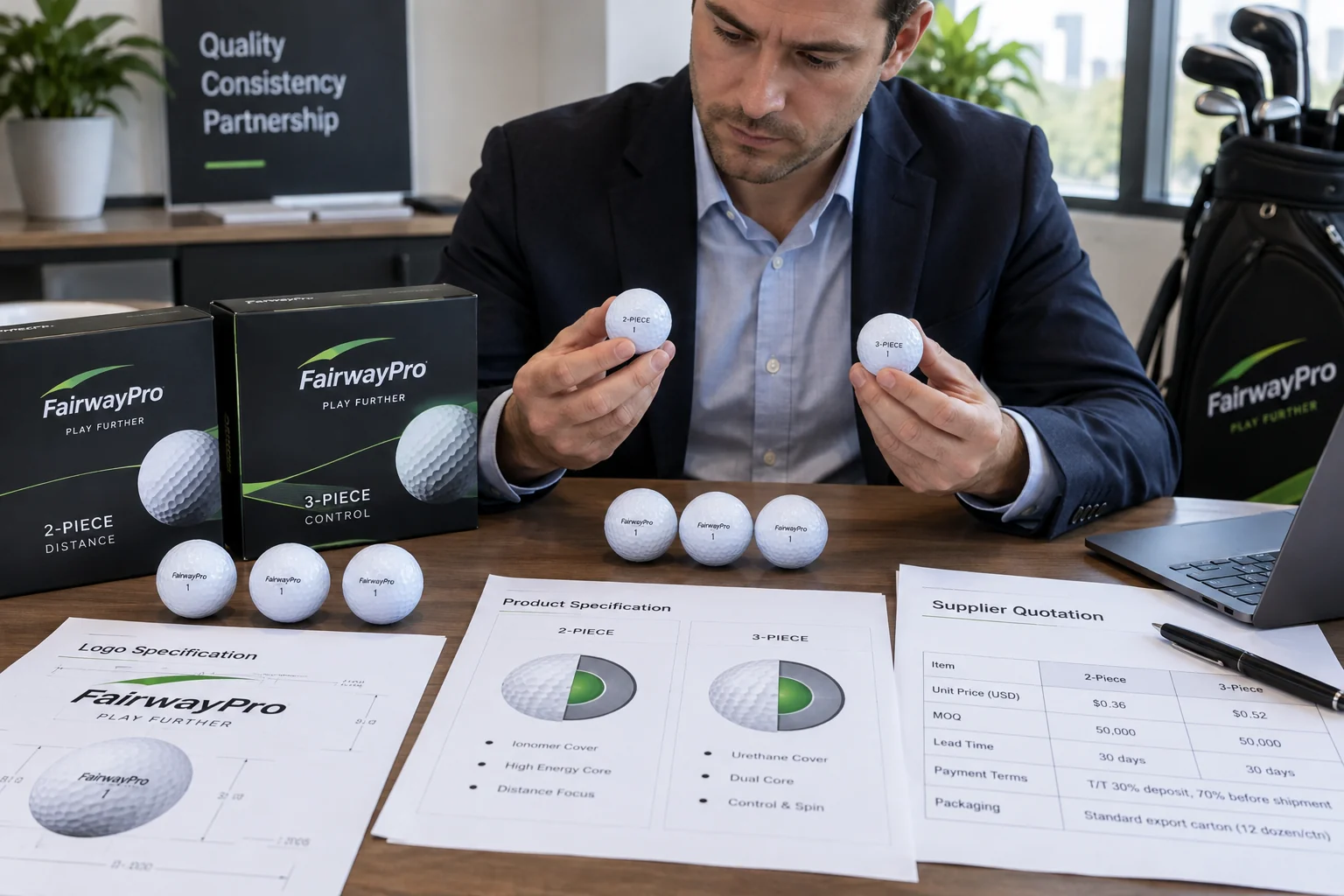
A viable 2-piece baseline may still leave an unmet need in feel, product differentiation, or another finished-ball behavior. The mistake is approving 3-piece before defining what must improve.
Move to 3-piece when you can name the product or commercial problem the mantle is expected to solve. The upgrade makes sense when the finished SKU creates a useful difference over your 2-piece baseline—not simply because your channel wants a specification that sounds more premium.
Your team should first answer one question: What must improve beyond the 2-piece baseline?
The answer might involve more tuning freedom, clearer feel differentiation, a more specific long-game or short-game objective, support for a particular product concept, or another goal your market can recognize.
Not every useful difference needs to become a universal performance claim. A repeatable feel target can matter commercially. So can a supportable product proposition that gives your retail, distributor, or member program meaningful differentiation.
The sequence should still be disciplined:
2-piece baseline works → unmet requirement remains → mantle has a defined function → finished SKU demonstrates the intended difference → channel can use the difference → 3-piece earns the upgrade
This order prevents the specification from becoming the justification.
Starting with “we want a premium 3-piece” makes it easy to reverse-engineer a reason afterward. Starting with an unmet product need forces the proposed architecture to prove why it belongs.
Your team should be able to complete the sentence, “We are moving to 3-piece because ____.” If the blank contains only “it sounds more premium,” keep evaluating.
A 3-piece candidate shall not be approved as an upgrade solely on piece count. Supplier shall state the intended function of the mantle and provide finished-ball evidence showing the difference the candidate is designed to deliver against the agreed baseline.
Verify the candidate against the exact improvement you are buying. Your acceptance decision should be based on the finished SKU’s demonstrated difference, not on the layer count printed in the specification.

How Should You Compare Two Construction Paths?
You can compare a basic 2-piece Surlyn SKU with a 3-piece TPU or urethane SKU, notice different feel or spin, and still misunderstand what caused the difference.
First decide whether you are comparing architecture or two complete commercial SKUs. If you want to isolate the value of the mantle, control other major variables as closely as practical. If you are comparing finished products, compare the full package—but do not claim the extra layer caused every difference.
Are You Comparing Layers or Finished SKUs?
Most two piece vs three piece golf ball comparisons hide two different questions. One asks what the architecture changed; the other asks which complete product your business should buy.
A controlled architecture comparison is appropriate when your question is, “What does adding the mantle change?” Other major variables should then be kept as comparable as practical, including intended use, cover family where feasible, compression basis, aerodynamic system, testing approach, and other relevant specifications.
A 2019 controlled golf-ball structure study shows why that discipline matters. The researchers compared 2-, 3-, and 4-piece structures while holding weight, dimple count, and compression strength constant. The useful sourcing lesson is methodological: architecture can influence finished behavior, but controlling other major variables makes any attribution to construction more meaningful.
A finished-SKU commercial comparison answers a different question: “Which complete product should I buy?”
That comparison is completely legitimate even when the cover, hardness, formula, or other design variables differ. Your purchasing team often has to choose between real products, not laboratory abstractions.
The interpretation simply needs to stay honest.
A Sports Engineering study on wedge/ball interaction compared a 2-piece ionomer-covered ball with a 3-piece polyurethane-covered ball and observed differences in friction and backspin under the study conditions. Construction changed, but so did cover material and hardness. That makes the study useful as a warning against simplifying the result into “3-piece spins more because it has three layers.”
A finished-SKU comparison can tell you what to buy. It does not automatically tell you what one layer caused.
That distinction is especially important when you compare supplier quotes.
| Comparison Field | 2-Piece Option | 3-Piece Option | Buyer Check |
|---|---|---|---|
| Intended channel | Same | Same | Comparable use case |
| Quantity / packaging / decoration | Same basis | Same basis | Comparable quote |
| Construction | Declared | Declared | Architecture clear |
| Cover family | Explicit | Explicit | Separate cover effect |
| Sample / target profile | Explicit | Explicit | Comparable evidence |
| Mantle intended function | — | Required | Upgrade rationale |
A pair quote stops being useful when the 2-piece candidate uses bulk packaging while the 3-piece candidate uses a different cover, different decoration, different packaging, and a different sample basis—and the unit-price difference is then described as “the cost of 3-piece.”
That is a failure signal because multiple commercial variables changed while architecture receives all the credit or blame.
Please quote comparable 2-piece and 3-piece candidates on the same quantity, packaging, decoration scope, Incoterm, and sample basis. State the exact construction, cover family, intended product profile, sample reference, and the intended function of the mantle in the 3-piece option.
The resulting Pair-Quote Comparison should make every material difference visible before your team attributes price, feel, performance, or positioning to the third layer.
If the candidates also use different urethane manufacturing routes, move that separate decision to TPU vs cast urethane golf balls rather than turning this construction comparison into a cover-process article.
✔ True — A finished-SKU comparison can help you choose what to buy.
You can compare complete products even when several specifications differ, provided you describe the conclusion as a finished-SKU difference.
✘ False — “Every difference between a 2-piece Surlyn ball and a 3-piece TPU ball was caused by the mantle.”
When construction, cover, hardness, formula, or other variables change together, a more controlled comparison is needed before isolating the layer effect.
When Should You Consider 4-Piece Instead?
Once a 3-piece construction earns its place, you may assume another layer is the logical next upgrade. That repeats the same specification mistake at a higher piece count.
Do not move to 4-piece simply because 3-piece proved useful. If the 3-piece candidate already delivers your intended product profile, stop there. Consider 4-piece only when you can define an additional tuning objective that matters commercially enough to justify another level of construction complexity.
If the 3-piece SKU already achieves the product and commercial objective, there is no procurement benefit in adding another layer just to make the specification look more advanced.
If a meaningful requirement remains unresolved, define it before opening a 4-piece evaluation.
The evidence action is a short escalation rationale: identify what the 3-piece candidate cannot deliver and what additional objective the next architecture would be expected to address.
If your program genuinely has that next requirement, compare 3-piece vs 4-piece golf ball architecture on the dedicated page.
If 3-piece already solves your problem, you do not need another layer.
FAQ
Does a 3-Piece Golf Ball Always Feel Softer?
No. A 3-piece golf ball does not automatically feel softer than a 2-piece ball. Finished feel depends on the complete construction, including core formulation, mantle design, cover material, hardness, compression target, and other design choices—not simply the number of golf ball layers.
That is why “2-piece = hard” and “3-piece = soft” are weak OEM specification rules. A 2-piece ball can be tuned softer than buyers expect, while a 3-piece design can remain comparatively firm. When evaluating private-label candidates, compare the finished samples you are actually considering and ask how each construction was designed to reach its stated feel target. Piece count tells you that another design variable exists; it does not tell you how the final ball will feel.
Does a Mantle Always Increase Spin?
No. A mantle does not automatically increase spin. It gives the designer another variable that may support a spin objective, but finished spin also depends on the cover system, hardness, core and mantle recipes, club interaction, and the impact condition being evaluated.
This matters when buyers compare a 2-piece Surlyn or ionomer ball with a 3-piece TPU or urethane ball. If spin changes, both architecture and cover chemistry may have changed. Ask what the mantle is intended to do in that exact SKU and what finished-ball evidence supports the stated objective. Avoid turning “3-piece” into a universal proxy for “higher spin,” because a commercial SKU is the result of the complete design.
Can a 2-Piece Ball Still Be a Premium SKU?
Yes. A 2-piece ball can support a premium commercial proposition when the finished product delivers the intended quality, experience, consistency, branding, and value. “Premium” is not a layer-count standard, and adding a mantle is not automatically required for a higher-quality SKU.
For OEM sourcing, the more useful question is whether the architecture delivers your product promise. If a 2-piece build already provides the experience your channel needs, additional construction may create complexity without creating buyer value. If the premium proposition requires a product difference the baseline cannot deliver, then evaluate whether a 3-piece candidate can address that unmet requirement and prove it in the finished ball.
Can You Compare 2-Piece Surlyn With 3-Piece TPU Fairly?
Yes, if your question is which complete finished SKU better fits your program. No, if you intend to claim that every measured or perceived difference was caused by the extra mantle, because the cover system and potentially other design variables changed too.
Treat the first exercise as a finished-SKU commercial comparison. It is valid because buyers often choose between complete products rather than controlled laboratory constructions. If your question is specifically “What did the mantle change?”, use a more controlled architecture comparison and keep other major variables as similar as practical. Knowing which question you are asking determines what conclusion your evidence can support.
Should Your First Private-Label SKU Be 2-Piece or 3-Piece?
Begin with the simplest architecture that can deliver your product promise. A 2-piece candidate is a useful baseline when it already meets the use case; move to 3-piece when the added mantle has a defined function that solves a remaining product or commercial requirement.
This approach prevents specification creep during a private-label launch. Define the customer experience first, establish a finished-product baseline, and identify what still needs to improve. If a 3-piece candidate then solves that specific problem and the market can use the difference, the added layer has a business case. If the baseline already delivers the promise, you do not need a more complicated construction simply because it is available.
When Does a Third Layer Add Complexity Without Buyer Value?
A third layer adds complexity without enough buyer value when nobody can state what the mantle should improve, the finished 3-piece candidate does not demonstrate a useful difference from the baseline, or your channel has no practical way to use or monetize the proposed improvement.
This is where supplier capability can be mistaken for product need. A factory can manufacture the architecture and a salesperson can quote it while the customer proposition remains unchanged. Require the mantle function, the baseline being compared, the intended finished-ball difference, and evidence supporting it. If those pieces are missing, there is not yet a strong reason to move beyond the simpler construction.
Conclusion
A 2-piece architecture is the right choice when it already delivers your product promise. A 3-piece architecture earns the upgrade only when the mantle performs a defined job and the finished SKU creates a useful product or commercial difference.
Piece Count → Tuning Freedom → Finished-SKU Evidence → Buyer Decision
The safest construction decision is not the one with more layers. It is the one whose added complexity has a defined purpose your market can use.
Once the architecture is selected, the next job is proving that the approved finished-ball profile can be repeated in production.
You might also like — Golf Ball Quality Control in China: What OEM Buyers Should Verify Before Shipment