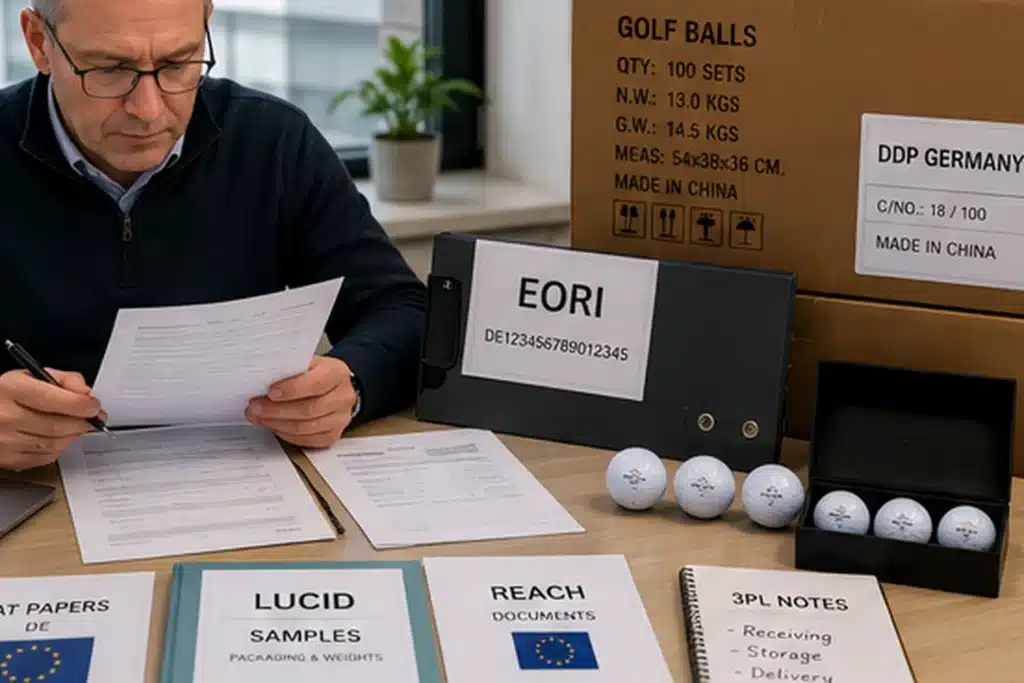
A long-distance golf ball SKU should not be approved from one long drive, one launch-monitor screenshot, or a supplier’s “low spin” claim.
For OEM buyers, a long-distance golf ball should prove ball speed retention, efficient launch/spin, carry, total distance, dispersion, cover durability, dimple/aero consistency, and batch repeatability. The best distance SKU is not the sample with the single longest shot; it is the ball that repeats the promised flight window in bulk.
To build a private-label distance golf ball:
-
Define the target player profile, speed band, channel, and price promise.
-
Set validation targets for ball speed, launch, spin, carry, total distance, and dispersion.
-
Choose the simplest construction that can prove the distance claim.
-
Treat low spin, compression, and dimples as test variables—not marketing shortcuts.
-
Compare every sample against a control ball under the same test setup.
-
Verify dimple geometry, coating consistency, cover durability, and wind-flight stability.
-
Require batch-linked QC data before scale-up, including raw values, retained samples, lot ID, and change-control notes.
This guide helps OEM, private-label, DTC, and retail buyers turn “long-distance golf balls” from a slogan into a measurable distance SKU with defined construction, validation proof, and repeatable production control.
What should a distance SKU prove?
You may ask whether a supplier can make a long-distance ball, but that question is too vague. Without a test method, “long distance” becomes a slogan with a warehouse risk attached.
Long distance is not a slogan; it is a measurable SKU promise. Your distance ball should prove ball speed retention, launch/spin efficiency, carry, total distance, dispersion, wind stability, cover durability, and lot-to-lot repeatability before you approve scale-up.
A distance SKU should start with a claim sheet, not a sales adjective. For a value retail line, the claim may be “easy distance and straighter flight for recreational players.” For a DTC distance SKU, it may be “stable driver distance with tighter dispersion than our current control ball.” For a premium distance-control SKU, it may be “lower driver spin without giving up approach control.”
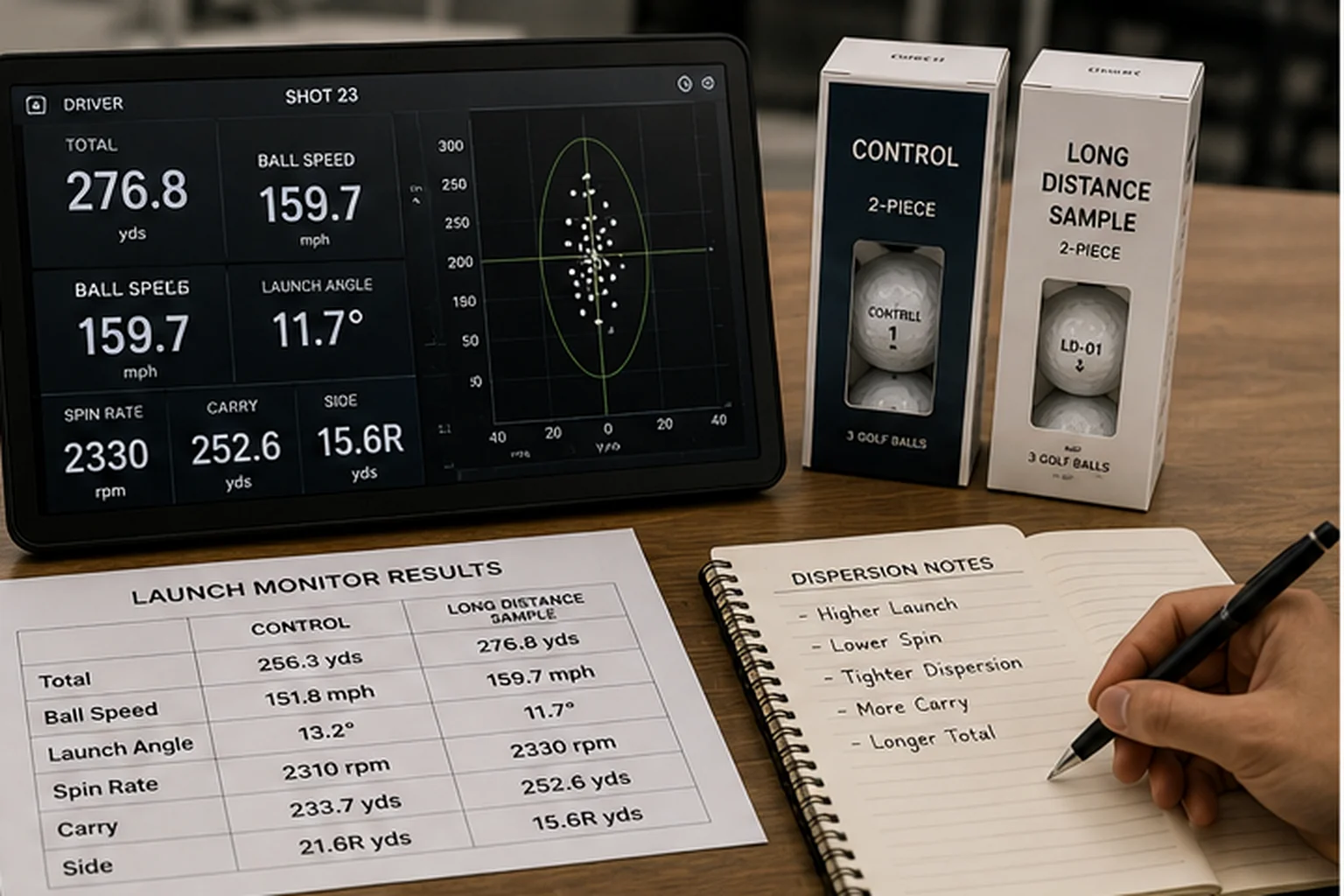
The proof changes by channel, but the logic stays the same. Use launch and spin windows as validation references, not universal promises. The sample should be tested against a control ball under the same club, launch monitor or robot setup, ball condition, player profile, and environment.
| Claim | What it should mean | Risk if unproven | Evidence to request | Buyer move |
|---|---|---|---|---|
| Longer distance | Ball speed + efficient launch/spin | One-shot outlier | Same-device A/B test | Compare average and range |
| Low spin | Controlled driver spin | Low launch or poor carry | Driver spin window | Define speed band |
| Stable flight | Repeatable aero window | Batch flight drift | Dimple tool + coating proof | Tie to lot ID |
| Durable distance | Cover resists scuff and wear | Bad reviews after play | Scuff / abrasion notes | Test use case |
| OEM repeatability | Sample matches bulk | Second batch changes | 12-ball QC + retained sample | Require batch proof |
A supplier who says “long distance” but cannot define the test method is giving you a label, not SKU evidence. Your distance brief should state the control ball, target buyer profile, club setup, test device, launch/spin reference window, durability check, and pilot acceptance method.
Ask your supplier for a distance-claim evidence sheet before you request bulk pricing. Do not approve a distance claim unless average distance, dispersion, durability, and repeatability all support it.
✔ True — The best distance SKU keeps the full window stable
A strong OEM distance SKU protects ball speed, launch, spin, dispersion, cover durability, and repeatability across samples and bulk production.
✘ False — “The longest sample is automatically the best SKU”
One long shot can hide poor dispersion, fragile cover behavior, or sample-to-bulk drift. Buyers should judge averages, range, and repeatability.
Which buyer profile fits distance?
You may want one distance SKU for every player, but slower-speed recreational buyers, mainstream players, and high-speed premium buyers need different construction and proof.
Your distance SKU should start with the buyer profile, not the ball label. Slower or moderate-speed recreational players usually need easier launch, low long-club spin, durability, and value; faster premium players may justify firmer compression or multilayer testing only if dispersion stays controlled.
How should speed bands guide the SKU?
Speed bands should guide product development, not turn the article into a consumer fitting chart. They help your team define compression, construction, and validation before sampling.
For slower or recreational players, a distance SKU usually needs easy launch, lower long-club spin, straighter flight, durability, and friendly pricing. A 2-piece ionomer or low/mid-compression ionomer route can work because the commercial promise is easy to understand: more usable yards, less curve, and better durability for high-consumption users.
For 90–105 mph mainstream players, the SKU needs balance. This audience may not want a narrow premium build. Your product must protect ball speed, carry, dispersion, feel, and reorder consistency. A tuned 2-piece or 3-piece ionomer baseline often makes more sense than a complex ball that needs a long explanation.
For 105+ mph players, firmer compression, stronger mantle design, or a premium distance-control route may be worth testing. The proof burden rises. Driver spin must not climb too high, dispersion must not widen, and cover durability must match the channel promise.
| Target buyer profile | Likely SKU need | Construction starting point | Main risk | Evidence to request |
|---|---|---|---|---|
| Slower / recreational | Easy launch and straight flight | Low/mid compression ionomer | Too firm, poor carry | Ball speed + launch data |
| High-loss / value channel | Durability and low cost per use | 2-piece ionomer | Scuff or price complaints | Durability + cost model |
| 90–105 mph mainstream | Stable distance and dispersion | 2/3-piece ionomer or tuned baseline | Overbuilt premium story | Launch/spin + dispersion |
| 105+ mph premium | Lower driver spin and wind stability | Firmer multilayer or premium route | Spin or dispersion misses | Driver/7-iron/wedge data |
| Tournament-facing buyer | Distance plus conforming claim | Exact model strategy | Compliance claim risk | Current list check |
Before sampling, define the target speed band, price band, loss-rate expectation, durability need, and channel promise. A distance SKU that promises everything to everyone usually fits no channel clearly. Approve the SKU only when the construction fits the target buyer profile and the test data supports that profile.
Which construction protects margin?
You may overbuild the distance SKU with urethane or extra layers when your target channel needs low long-club spin, durability, cost discipline, and repeatable bulk production.
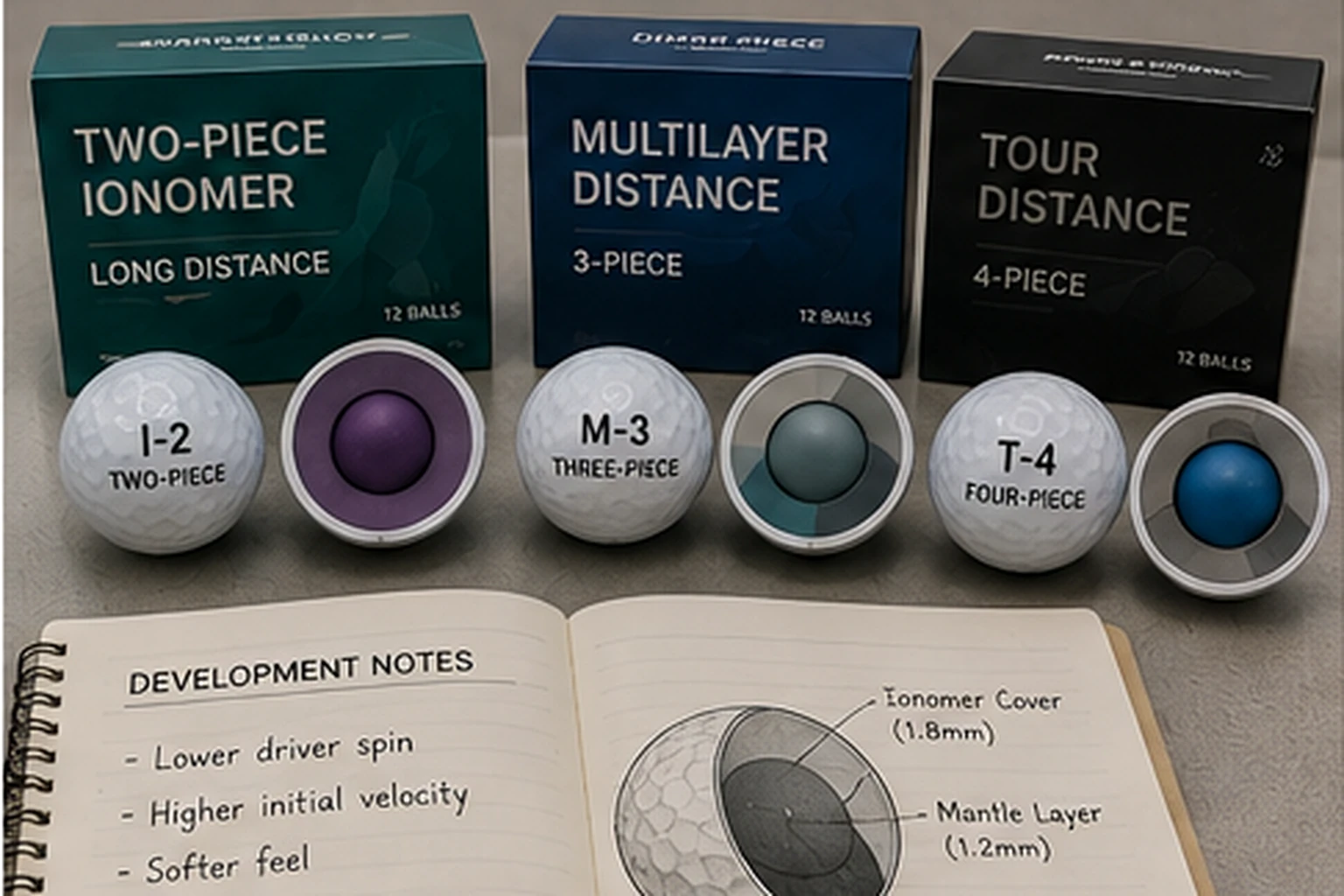
For many OEM distance golf balls, ionomer should remain the baseline because it protects low long-club spin, durability, and margin discipline. Urethane or multilayer routes can work, but only when your market pays for added control and your supplier proves driver efficiency and repeatability.
When should ionomer stay the baseline?
Ionomer often earns the first test because the commercial promise is easier to validate. It can support distance, durability, cost control, and repeatable bulk production for value and mainstream channels.
A value-distance SKU does not need to sound like a tour ball. It needs to fly far enough, stay straighter for the target buyer, resist scuffs, and protect margin. For corporate events, academies, high-loss recreational buyers, DTC testing, and retail value lines, an existing 2-piece ionomer mold is often the lowest-risk starting point.
A 3-piece ionomer route can add tuning room when your channel needs a stronger value-premium story. Premium multilayer or urethane routes may fit faster players or distance-control positioning, but they are not automatic distance upgrades. Urethane can support short-game control and a premium feel story, but your team still needs to prove that driver speed, launch, spin, and dispersion remain efficient.
| Construction route | Best fit | Distance advantage | Risk | Buyer move |
|---|---|---|---|---|
| Existing 2-piece ionomer | Value distance, events, DTC test | Low spin + durability | Too basic for premium channel | Validate baseline first |
| Existing 3-piece ionomer | Higher value-distance SKU | More tuning room | Cost without clear claim | Compare to 2-piece control |
| Premium multilayer | Fast-speed or control-distance SKU | Spin separation potential | Overbuilt for mainstream | Test driver dispersion |
| Urethane route | Premium control segment | Short-game story | Driver spin or scuff risk | Prove driver window |
| New formula | Differentiated hero SKU | Custom claim | Yield and validation burden | Use only if monetizable |
Request a construction comparison that links distance claim, cover route, compression window, durability, MOQ, and validation cost. A more complex build should beat the baseline in a buyer-paid metric, not only in a product deck. Choose the simplest route that delivers the promised launch/spin, dispersion, durability, and margin target.
✔ True — Ionomer can be the smarter distance baseline
For many OEM distance SKUs, ionomer protects low long-club spin, durability, cost control, and production repeatability better than an overbuilt premium route.
✘ False — “Urethane or more layers automatically make a longer OEM ball”
More layers and urethane can add tuning options, but distance still depends on speed, launch, spin, aerodynamics, durability, and repeatability.
How do dimples protect distance?
You may receive a dimple count but still lack the evidence needed to know whether the ball will repeat its flight window from sample to bulk.
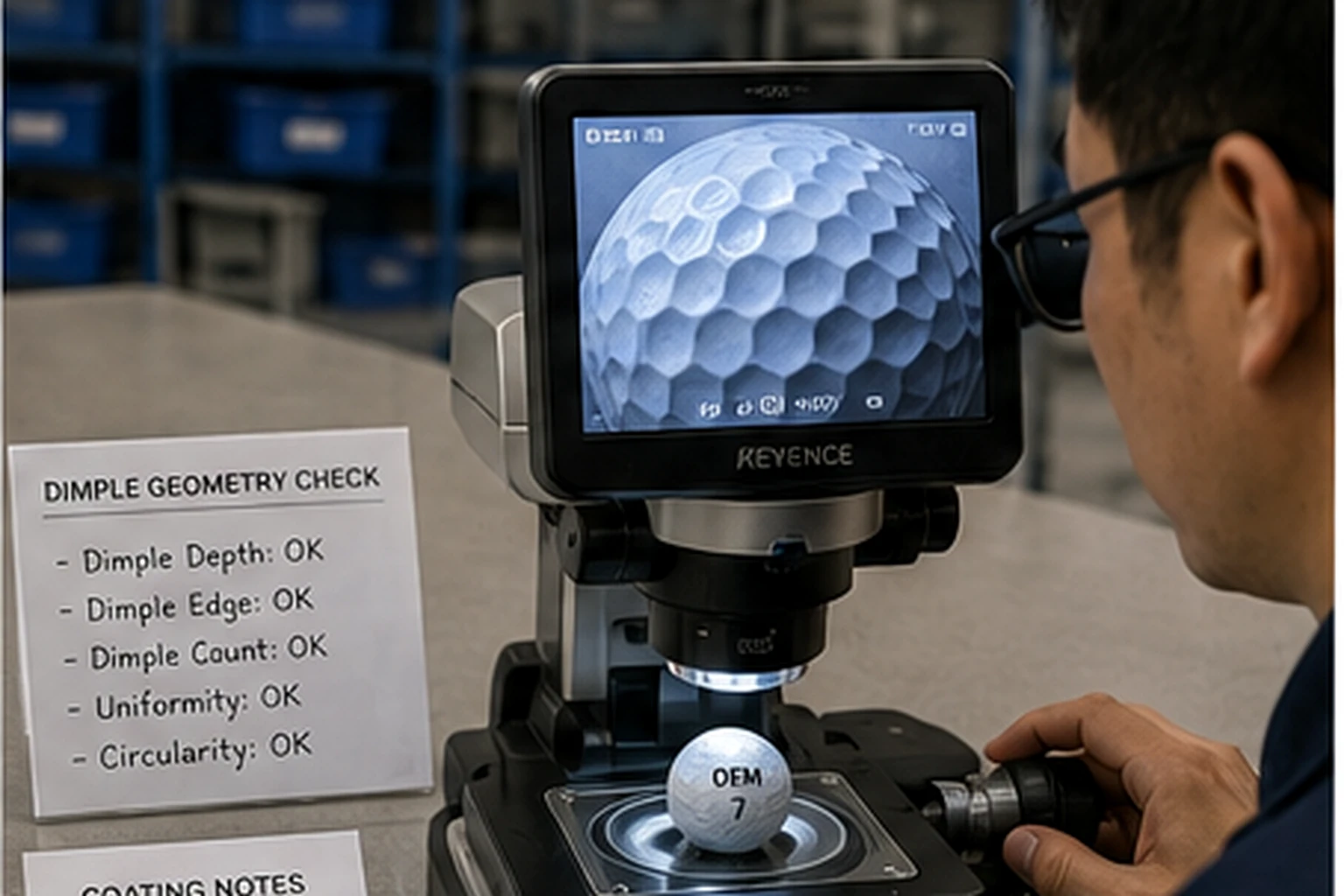
Dimple count is not distance proof. Your supplier should control dimple geometry, tool ID, mold wear, coating thickness, and batch-to-batch aero consistency because small changes in the surface can change peak height, drag, wind stability, and dispersion.
What dimple proof should suppliers provide?
Dimples are part of the distance engine, not surface decoration. The approved dimple family should stay tied to tooling, coating, finish, and lot records.
Search demand often asks whether more dimples mean more distance. For OEM buyers, that question is too shallow. Dimple depth, diameter, edge shape, layout, lift/drag balance, mold precision, and coating consistency matter more than count alone. Two balls with similar dimple counts can fly differently if the geometry or finish changes.
The practical aerodynamics are simple: dimples help manage airflow around the ball, reduce drag, and shape the trajectory window. If your sample was validated with one dimple tool and one coating stack, the bulk order should not quietly shift to another tool, another finish, or a different coating thickness.
| Aero proof | Why it matters | Risk if missing | Evidence to request | Buyer move |
|---|---|---|---|---|
| Dimple tool ID | Locks approved pattern | Wrong tool in bulk | Tooling record | Tie to lot ID |
| Depth / diameter tolerance | Protects lift/drag | Flight window drift | 3D profile data | Check sample vs bulk |
| Mold wear control | Preserves geometry | Gradual dispersion drift | Tool maintenance note | Set review interval |
| Coating thickness | Affects surface/aero | Peak height changes | Thickness method | Lock finish stack |
| Wind / launch proof | Shows real flight stability | Stable claim unproven | A/B or robot notes | Compare control ball |
A failure signal is a supplier giving only a dimple count with no dimple-tool or coating-control evidence. Ask for dimple tool ID, dimple geometry tolerance, coating thickness note, and sample-to-bulk aero proof. Do not approve a changed dimple family, coating stack, or finish without revalidating the flight window.
What QC data prevents false claims?
You may approve a sample that flies far, then receive bulk balls with different compression, hardness, coating, dimple geometry, concentricity, or dispersion.
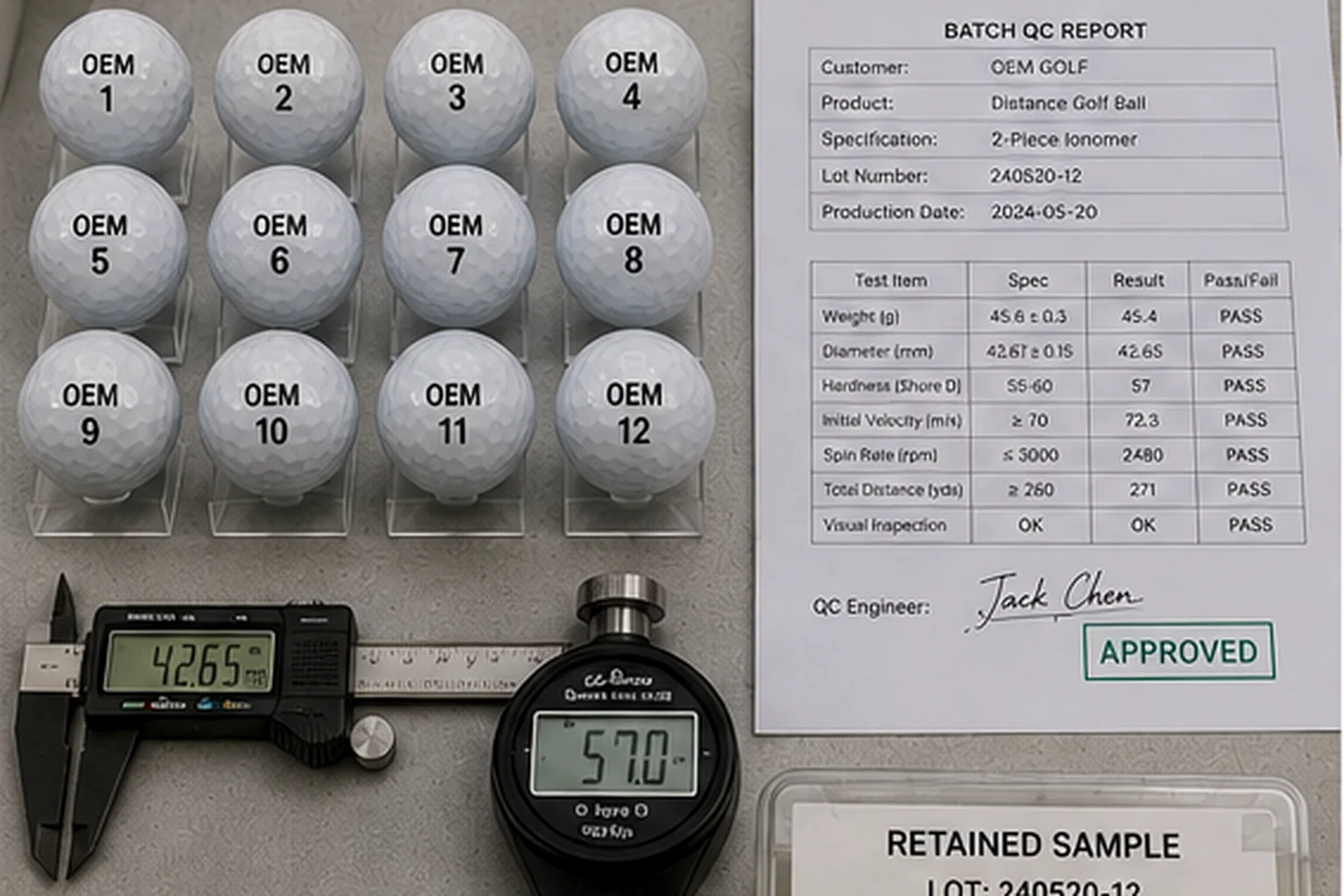
A distance claim should not be approved by one good launch-monitor session. Your RFQ should require batch-linked compression raw values, weight, diameter, Shore D hardness, dimple geometry, coating thickness, concentricity method, ball-speed or rebound evidence, retained samples, lot ID, and change-control notes.
What should your RFQ request?
Distance QC should protect the whole promise, not only the carry number. The report should connect the approved sample, pilot lot, mass lot, and receiving inspection.
For distance SKUs, consistency is the product. Weight and diameter protect rule-level basics. Compression and hardness affect speed response, feel, and launch. Concentricity affects flight stability. Dimple geometry and coating thickness protect aerodynamics. Ball-speed or rebound data helps connect construction to the distance claim. Retained samples and lot IDs give you a reference when reorders happen.
A complete 12-ball QC file should show raw individual values, average, standard deviation, range, method notes, equipment model, calibration status, batch ID, retained sample, and change-control notes. Averages alone can hide a wide batch. A single hero result can hide poor dispersion.
| QC proof | Distance risk controlled | Acceptable evidence | Weak evidence | Buyer move |
|---|---|---|---|---|
| Compression raw values | Ball speed and launch drift | 12-ball individual + avg/SD/range | Single average | Tie to lot ID |
| Weight and diameter | Rule-level consistency | Measured values + method | Pass/fail only | Check incoming lot |
| Shore D hardness | Cover feel and speed response | Hardness record | Verbal target | Compare sample/bulk |
| Concentricity | Flight stability | X-ray/CT method | No layer proof | Request method note |
| Dimple geometry | Aero repeatability | 3D profile or tool record | Dimple count only | Lock tool ID |
| Coating thickness | Surface and flight consistency | Thickness control note | Looks same | Control finish |
| Ball-speed/rebound data | Distance claim proof | A/B against control | Best shot only | Use average/range |
| Retained sample + change-control | Reorder drift | Signed sample + written changes | Verbal promise | Block silent changes |
Supplier shall provide batch-linked QC data for compression raw values, weight, diameter, Shore D hardness, dimple geometry, coating thickness, concentricity method, retained samples, lot ID, and any formula, tooling, coating, or process change before mass shipment.
The failure signal is sample approval based on one longest shot. Request a 12-ball distance QC file with raw results, statistics, equipment and method notes, calibration status, batch ID, retained samples, and change-control notes. Production should not scale until distance data, dispersion, construction QC, retained samples, and lot-linked records match the written specification.
For conforming-use claims, check the current model and marking status before relying on the SKU for competition channels. Keep exact-model verification separate from supplier marketing language.
✔ True — Distance validation needs batch-linked raw data
A 12-ball file with raw values, averages, range, method notes, calibration status, lot ID, and retained samples gives buyers real sample-to-bulk protection.
✘ False — “One long sample proves a distance SKU”
A single long result can hide poor dispersion, wide compression spread, surface drift, or a bulk lot that no longer matches the approved sample.
Which sourcing route should you choose?
You may want a differentiated long-distance hero SKU, but new tooling, new structure, or premium cover routes add MOQ, testing cost, and failure risk.
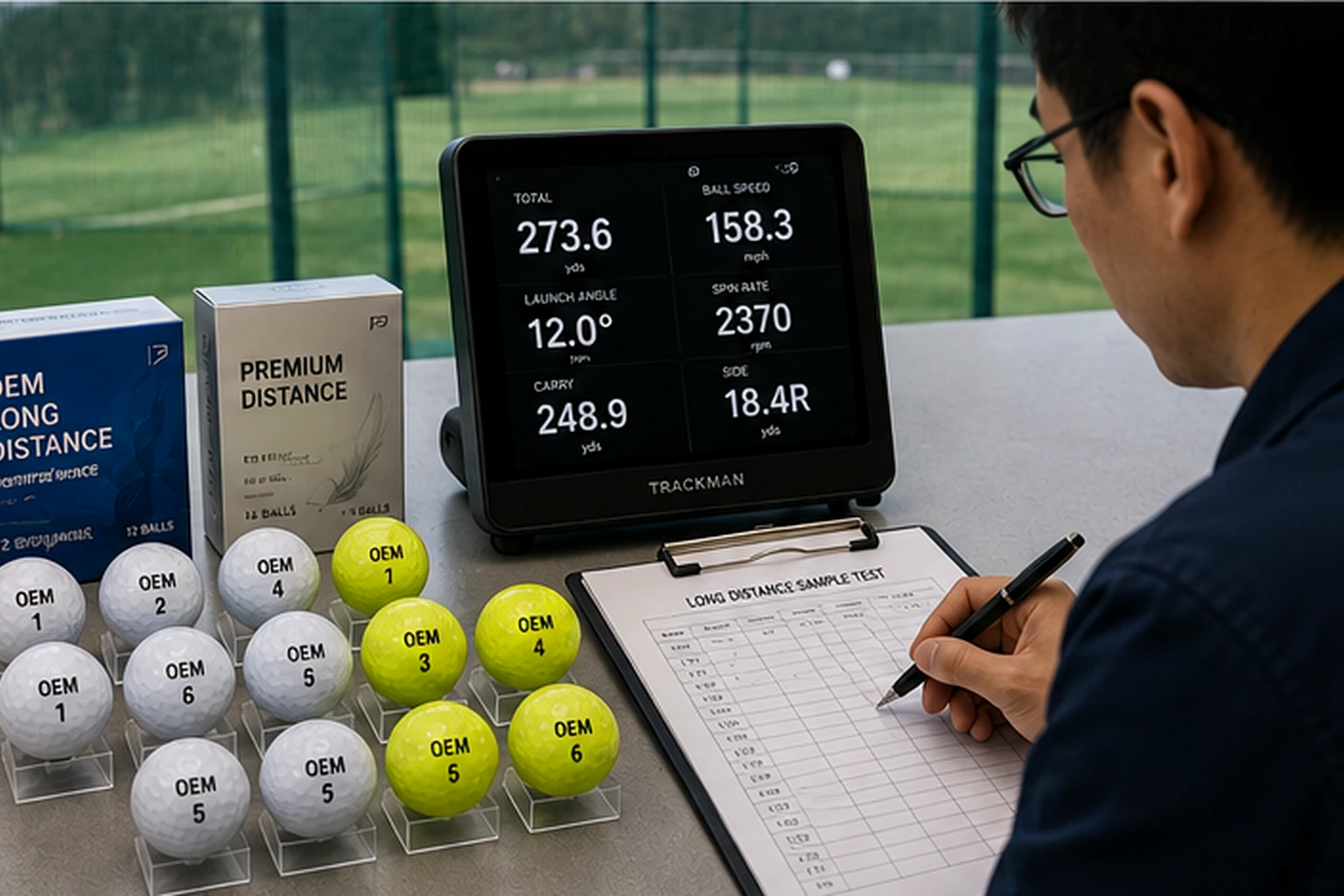
Start with an existing distance mold when you need market validation, fast launch, or value positioning. New dimple tooling makes sense only when your channel can monetize a differentiated flight story and your team can afford higher MOQ, testing cost, and failure risk.
When does new dimple tooling make sense?
New tooling is a business decision before it is an engineering decision. It should be reserved for a channel that can sell and defend the differentiated flight story.
Existing 2-piece ionomer molds are often the lowest-risk route for value distance, events, teams, academies, DTC testing, and bulk programs. Existing 3-piece ionomer or tuned hardness routes can support stronger positioning without starting from a blank page. Premium multilayer or urethane routes may work for a distance-control SKU, but they need longer pilot validation and tighter repeatability proof.
A factory-direct workflow can make sampling, logo printing, packaging, and export coordination easier, especially when you are testing demand before scaling. Still, the real filter is not only MOQ. It is whether the supplier can explain compression control, dimple tooling, coating stability, QC equipment, and change-control discipline in a way your procurement team can use.
| Route | Best for | Validation burden | Main risk | Buyer move |
|---|---|---|---|---|
| Existing 2-piece ionomer | Value distance, events, DTC test | Lower | Generic claim | Add QC proof |
| Existing 3-piece ionomer | Retail distance line | Medium | No clear upgrade story | A/B against baseline |
| Premium multilayer / urethane | Distance-control SKU | Higher | Driver spin or durability drift | Extend pilot validation |
| Private-label with tuned spec | Brand-owned repeat SKU | Medium | Spec not locked | Write acceptance criteria |
| New dimple tooling | Hero differentiated SKU | Highest | Tooling cost and failed claim | Use only with channel proof |
New-tooling approval should separate tooling ownership, dimple family, target flight window, validation method, pilot quantity, sample-retention plan, and change-control requirements from the standard bulk PO.
Ask suppliers to quote existing mold, tuned private-label route, premium route, and new-tooling route separately. Compare MOQ, lead time, test burden, tooling cost, QC proof, packaging scope, and reorder stability. Choose new tooling only if your channel can sell the differentiated flight story and your supplier can prove repeatability.
FAQ
What makes a golf ball long distance?
A long-distance ball should deliver ball speed retention, efficient launch/spin, aerodynamic stability, durable cover behavior, and repeatable dispersion for the intended player profile.
For OEM buyers, the claim should be tied to test data, not only marketing language. Use a control ball, the same test setup, and a defined target player profile. Review average distance, range, spin behavior, dispersion, and cover condition. A ball that is long once but unstable across shots or batches is not a dependable distance SKU.
Do low compression golf balls go farther?
Low compression golf balls can help slower-speed players compress the ball more efficiently, but low compression is not automatically longer for every target buyer.
Compression should be defined by the target speed band and validated with ball speed, launch, spin, carry, and dispersion. Soft feel alone is not proof. If the ball launches too low, spins poorly, or widens dispersion, the lower compression may hurt the SKU promise. Treat compression as a development window, not a slogan.
Are low spin golf balls better for distance?
Low spin can improve distance only when launch and ball speed stay efficient. Too little spin can reduce carry, while too much spin can balloon and lose rollout.
Ask for a driver spin window, not only a “low spin” claim. Compare carry distance, total distance, dispersion, and wind stability against a control ball. A low-spin OEM distance golf ball should still launch high enough for the target buyer and remain playable across normal strike variation.
Do more dimples mean more distance?
No. Dimple count alone does not prove distance. Dimple depth, edge shape, layout, coating thickness, mold wear, and lift/drag balance matter more.
A supplier should provide dimple tool ID, geometry control, and coating consistency notes when the SKU relies on stable flight. Revalidate the flight window if the dimple family, finish, coating thickness, or mold changes. A higher count may sound impressive, but the approved aerodynamic window is what protects the distance claim.
What construction fits a distance SKU?
For many value distance SKUs, 2-piece or 3-piece ionomer is the safer baseline. Premium multilayer or urethane routes can work when the market pays for added control and the supplier proves repeatability.
Start with the buyer profile and channel promise. If your market wants durable, affordable, easy distance, ionomer is often the better commercial baseline. If your market wants premium distance-control, a multilayer or urethane route may be worth testing. Avoid layer-count marketing unless the added structure improves a buyer-paid metric.
How should OEM buyers test samples?
Use a control ball, the same launch monitor or robot setup, the same club settings, and record ball speed, launch, spin, carry, total distance, dispersion, scuffing, and batch data.
Do not approve one longest shot. Compare averages, range, and dispersion. Keep retained samples from the approved pilot lot and compare them against first mass production. If the product will serve retail, DTC, team, or academy buyers, include cover durability and packaging condition in the pilot review.
What QC data should suppliers provide?
Request compression raw values, weight, diameter, Shore D hardness, dimple geometry, coating thickness, concentricity method, ball-speed or rebound data, retained samples, batch ID, and change-control notes.
A strong supplier should provide raw values, not only averages. Ask for a 12-ball QC file with average, standard deviation, range, method notes, equipment model, calibration status, lot linkage, and retained samples. That file turns “long distance” from a claim into a repeatable production standard.
Should OEM buyers consider revised distance testing?
Yes, for tournament-facing or long-lifecycle SKUs. Treat revised distance testing as future-proofing, not the main reason to choose a construction.
If the SKU will be marketed for conforming or tournament use, check the exact model status and ask whether the supplier has evaluated the ball against USGA revised distance-testing conditions. Do not approve long-term distance or legal-use claims from supplier language alone. Keep conforming-list checks, sample retention, and change-control records separate from marketing copy.
Conclusion
Start with a target buyer profile, define the launch/spin and dispersion window, choose the simplest construction that can deliver it, then validate compression, dimple geometry, coating consistency, and batch repeatability before scaling.
A long-distance golf ball SKU should not be built from one long sample or a supplier claim. It should be built from a measurable promise your target buyer can feel, your channel can sell, and your supplier can repeat.
You might also like — 2-Piece vs 3-Piece Golf Balls: The Ultimate B2B Bulk Sourcing & QC Guide