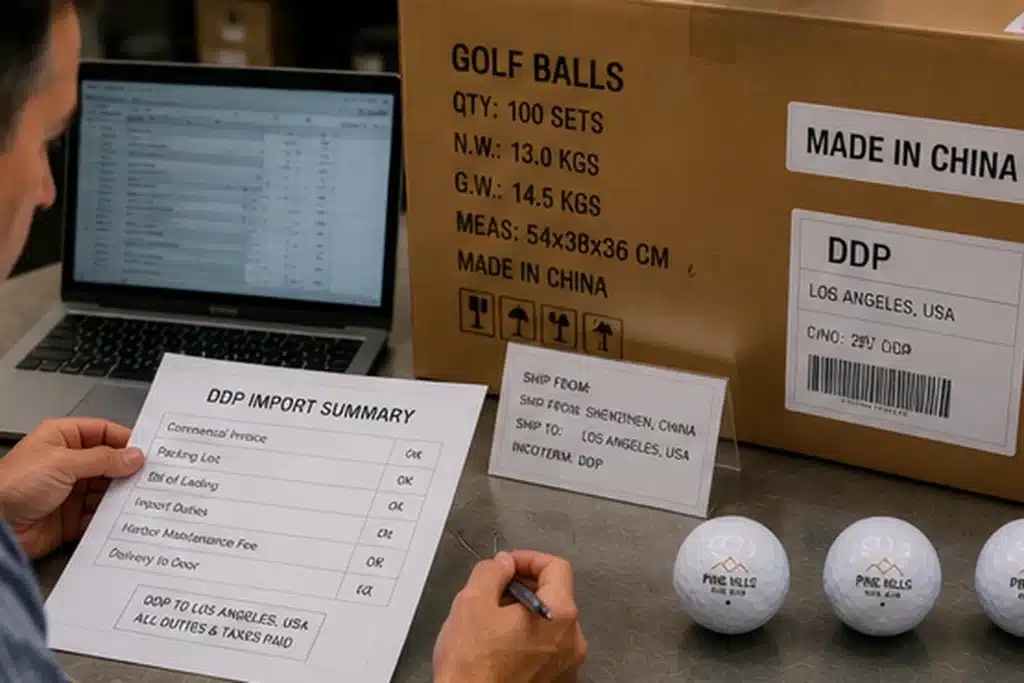
Your golf ball supply chain does not fail when one quote is expensive. It fails when the country strategy is wrong.
China is a top global golf ball export hub, with 2024 HS 9506.32 exports around USD 147M and 370M balls. Its value share is lower than its unit role because China remains volume-led in Surlyn, promotional, range, and mid-tier OEM programs while urethane-heavy hubs capture higher ASPs.
For the 2026 global golf ball OEM supply-chain review, the better question is not “Is China cheap?” It is “Which SKU belongs in which hub for the next three to five years?”
This article should not teach you how to search Alibaba, calculate freight, or test compression. It should help you decide where China fits in your next 3–5 year golf ball sourcing strategy: run-rate volume, DTC pilots, packaging-heavy programs, mid-tier urethane, or selected premium development.
Where are golf balls made today?
You may assume famous golf balls are made only inside brand-owned factories, but the real supply chain mixes captive plants, OEM hubs, export clusters, and quiet private-label networks.
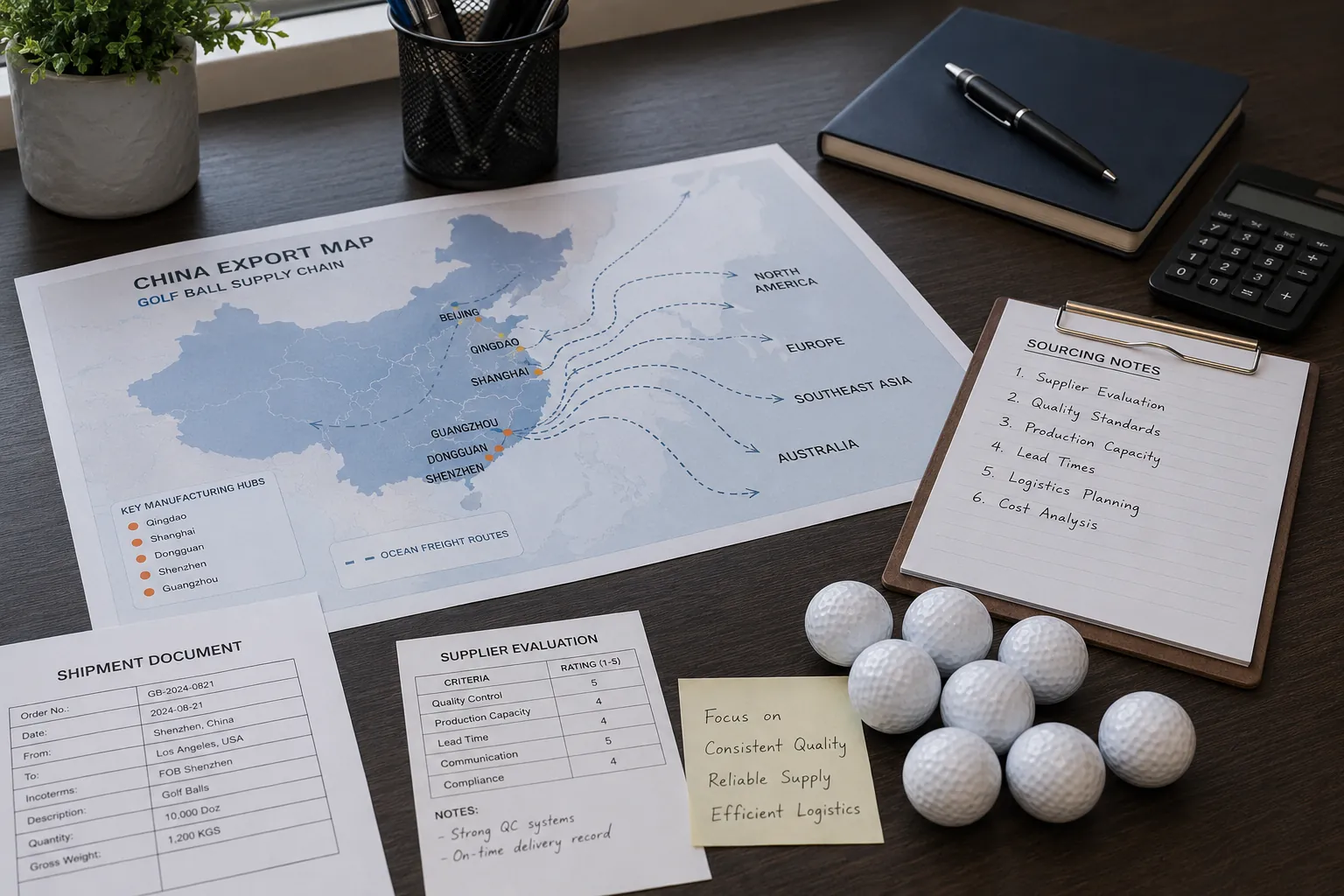
Golf balls are made through a global mix of captive brand plants and OEM hubs. The biggest strategic centers are Greater China, the United States, Thailand, and emerging Southeast Asian capacity; export data is the clearest public proxy, while true production share requires sourcing-map interpretation.
The golf ball market is small enough to be specialized, but large enough to support a global OEM ecosystem. Retail market estimates sit around the USD 1.2–1.3B range for the global golf ball market, while HS 9506.32 global golf ball trade reached roughly USD 978M in 2024. These are different lenses. Retail value reflects brand revenue and channel margin. Customs value reflects FOB trade flows, export declarations, and where shipments clear.
That difference matters for board-level sourcing decisions. A famous U.S. or Thailand plant may produce flagship models. A Taiwan-linked OEM may develop premium constructions. A mainland China factory may run Surlyn volume, DTC pilot programs, gift packs, and mid-tier urethane. A shipment can also clear through one jurisdiction while key upstream inputs come from another. So “where are golf balls made?” is not a single-country answer; it is a product-lane answer.
| Buyer decision | What the data shows | What it misses | Buyer move |
|---|---|---|---|
| Market size | Retail revenue | Factory output by country | Use as demand context |
| Export value | Customs trade flow | Retail margin | Use for rank |
| Export volume | Unit supply scale | Product quality | Compare mix |
| Production share | Private capacity | Full public proof | Treat as estimate |
| Hub selection | Capability pattern | One perfect country | Match SKU to hub |
Ask your team to separate export-value rank, unit-volume rank, and production-capacity estimate. Use HS 9506.32 for trade data and sourcing-map evidence for production assumptions. Do not build a country strategy from generic sports-equipment data or retail market size alone.
✔ True — Export share and production share are not the same.
Export share is measurable through customs data. Production share needs cautious interpretation because captive plants, private OEM output, bonded flows, and routing choices are not disclosed in one clean public census.
✘ False — “The biggest exporter is always the biggest producer.”
Country of export, factory ownership, brand captive production, and upstream component sourcing can all blur the picture.
You may still rely on an old estimate or a generic HS code, then underread China’s role in global golf ball supply.
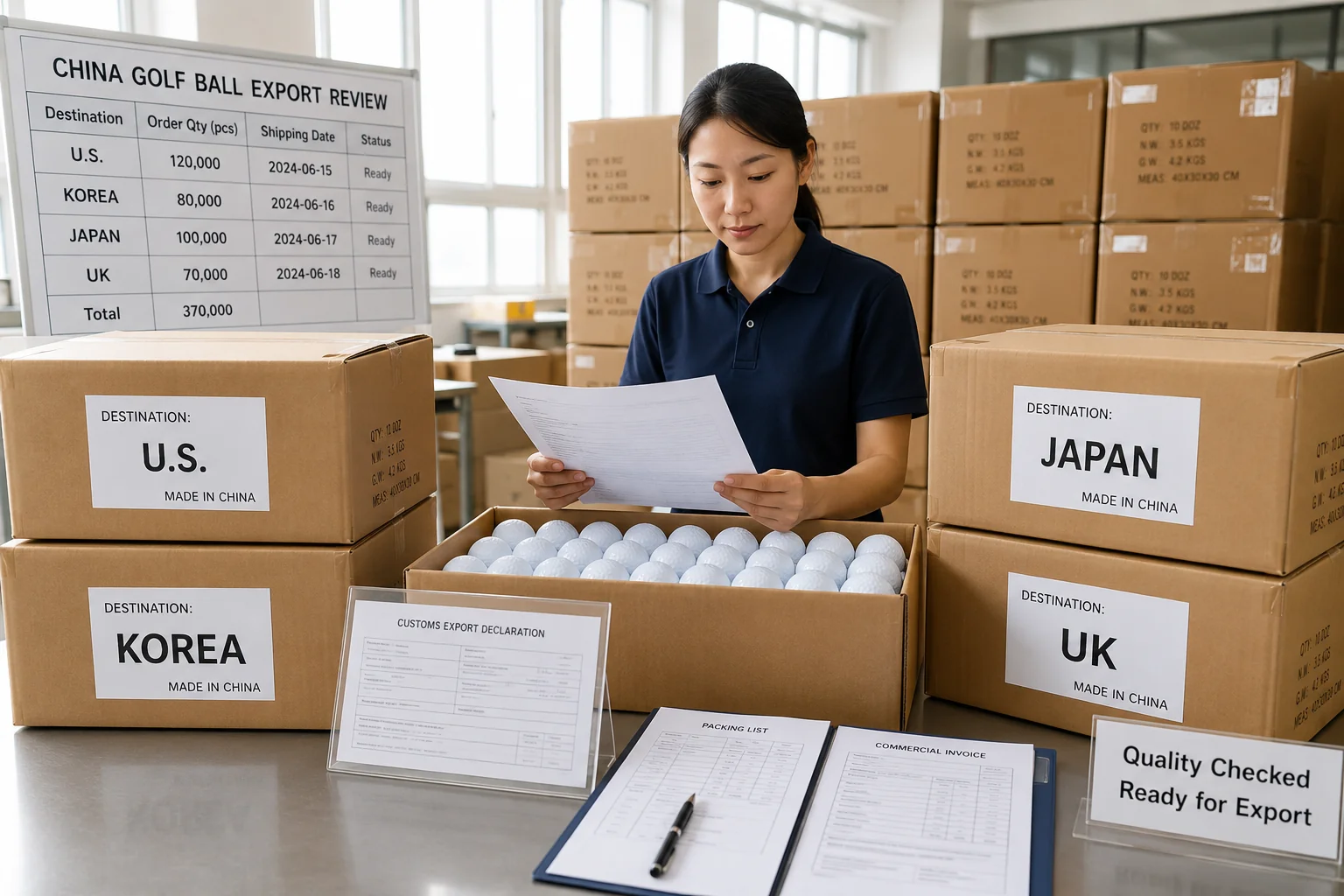
China is not a minor golf ball exporter; it is one of the world’s major volume engines. Under HS 9506.32, China reported about USD 147M and 370M golf balls exported in 2024, with the U.S., Korea, the U.K., and Japan as major destinations.
The safer 2024 planning number is higher than many older estimates. China HS 9506.32 golf ball exports show roughly USD 147.27M and 370.32M golf balls exported in 2024. The United States absorbed about USD 64.09M and 177.56M balls, followed by South Korea at about USD 29.53M and 64.60M balls, the U.K. at about USD 11.87M and 35.21M balls, and Japan at about USD 8.28M and 21.49M balls.
For executives, the exact percentage matters less than the method. China’s value role is roughly mid-teens depending on dataset and mirror method. Its unit role is stronger because China exports a large amount of Surlyn, range, promotional, logo, gifting, and mid-tier OEM volume. Urethane-heavy hubs often capture higher average selling prices with fewer pieces.
The hidden risk is false precision. If your strategy deck says China is “11%” or “17%” without explaining the dataset, HS code, value basis, and unit basis, the number may look clean but guide the wrong decision. Finished golf balls should be reviewed under HTS 9506.32 golf balls, not a generic sports-goods code.
| Metric | Updated planning number | What it means | Buyer move |
|---|---|---|---|
| China export value | ~USD 147M | Major value exporter | Update old estimate |
| China export units | ~370M balls | Strong volume role | Model supply depth |
| Global trade value | ~USD 978M | Market proxy | Compare share |
| Main U.S. flow | ~178M balls | U.S. dependence | Check SKU mix |
| HS code | 9506.32 | Golf balls | Avoid 9506.39 |
How should export share be calculated?
Export share should state the HS code, reporting year, value basis, unit basis, and dataset scope. Otherwise, a clean-looking percentage can mislead your board.
For market-share or sourcing-map claims used in executive planning, evidence should state method, dataset scope, HS code, reporting year, value basis, unit basis, and whether the number reflects customs exports, production estimate, or buyer-field sourcing data. No supplier should present export share as certified production share without a method.
Use an updated export-data table with source method and HS code. Confirm HS 9506.32 and dataset scope before publishing exact numbers. Do not use 9506.39 or an old 2024e number as the article’s main data spine.
Why does Greater China dominate OEM?
You may search public platforms and conclude China lacks top-tier factories because the strongest OEM capacity is not always visible through storefronts.
Greater China’s golf ball advantage is not one country label; it is a supply-chain bridge. Taiwan-linked engineering experience and mainland manufacturing ecosystems combine precision rubber, tooling, coating, packaging, and export execution in a way public online storefronts rarely reveal.
Many serious golf ball OEM networks grew from a practical division of strengths. Taiwan has long experience in precision rubber, mold design, process know-how, and golf ball engineering. Mainland China adds manufacturing depth, supplier density, packaging speed, export execution, and flexible scaling. That bridge is one reason Greater China matters more than a simple “China versus Taiwan” headline suggests.
The failure signal is: “The biggest factory is the one ranking first online.” Not usually. Many serious OEMs are quiet, relationship-driven, and built around repeat buyers, trade shows, and industry networks. The loudest public storefront may be a trader, not the strongest production operator.
This is where strategic buyers can misread the market. If your team judges China only through public listings, you may conclude the market is full of small traders and generic practice-ball sellers. The stronger view is to map who owns production capability, who controls tooling, who understands cover chemistry, who manages coating yield, and who can support repeatable export documentation.
| Executive blind spot | What is happening | Strategic risk | Buyer move |
|---|---|---|---|
| Search results look weak | Top OEMs may be quiet | Underestimate capacity | Use network mapping |
| Taiwan and China seem separate | Know-how and production overlap | Wrong hub view | Analyze Greater China |
| Marketplace looks like the market | Serious OEMs avoid public noise | Bad shortlist | Verify hidden capacity |
| Brand plant equals all supply | OEM networks still matter | Miss DTC options | Map SKU tiers |
| Low profile means low capability | Some leaders stay private | Overlook strong partners | Ask for process proof |
What is Taiwan brain, mainland muscle?
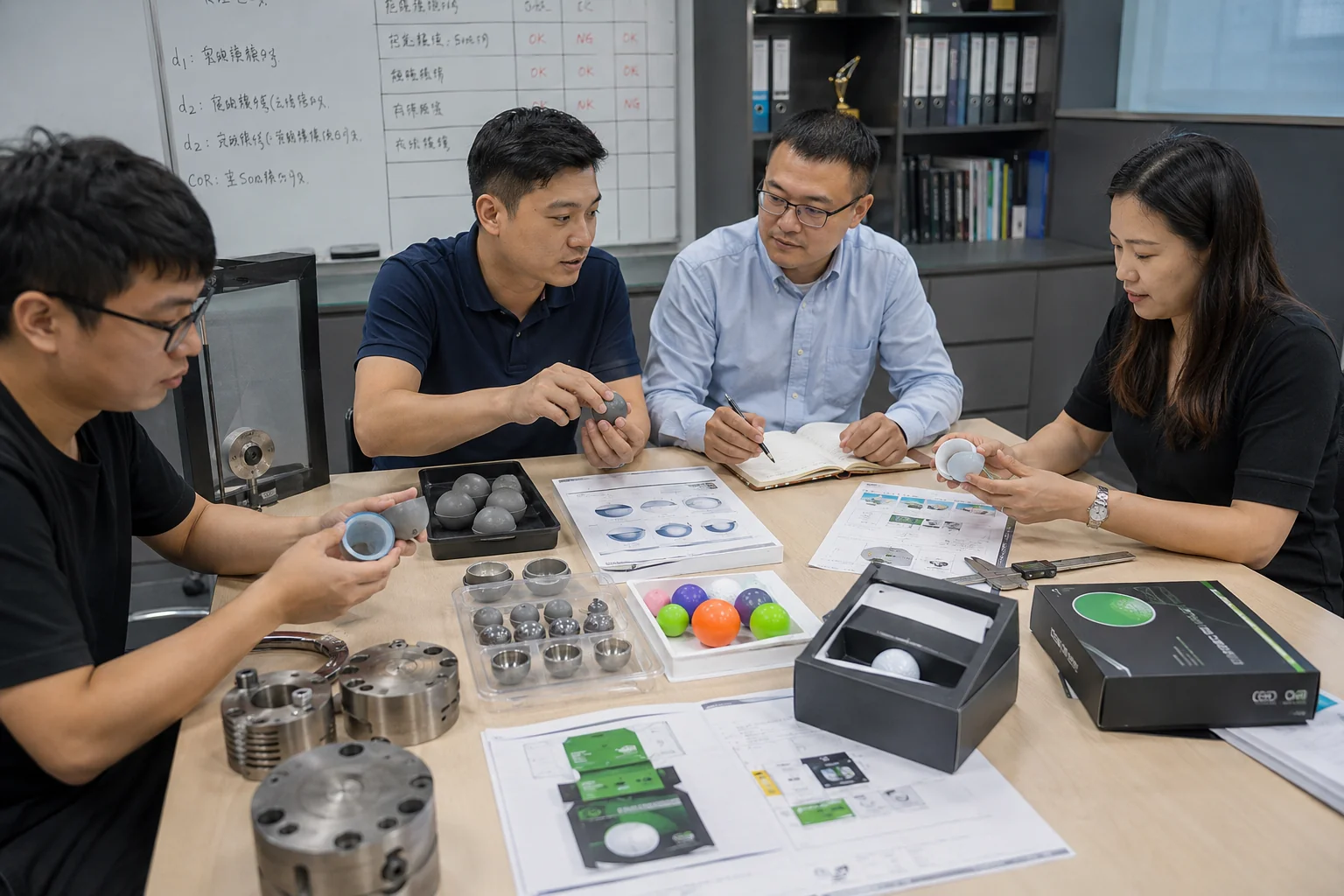
The phrase means engineering know-how and manufacturing depth often operate together, not separately. It is an industry-pattern lens, not a claim about every factory.
Ask for the actual factory role, technical decision maker, process ownership, and long-term OEM proof. Confirm whether the supplier owns production capability or only aggregates factories. Do not judge China’s top-tier capacity from storefront visibility alone.
Supplier shall identify the actual production location, export entity, product category under HS 9506.32, material family, cover route, packaging supplier role, and whether any key steps are subcontracted. Evidence shall include factory address, process ownership, sample batch link, and export-document consistency.
✔ True — Serious OEM capacity is not always loud online.
Many strong golf ball factories win through technical know-how, repeat buyers, and stable process control rather than public marketplace visibility.
✘ False — “The best factory is the easiest one to find online.”
Search visibility can reward traders and marketers. Strategic sourcing needs process proof, not just website confidence.
Which China clusters serve which SKUs?
You may treat China as one sourcing location, then choose the wrong province, supplier type, or supporting ecosystem for your SKU roadmap.
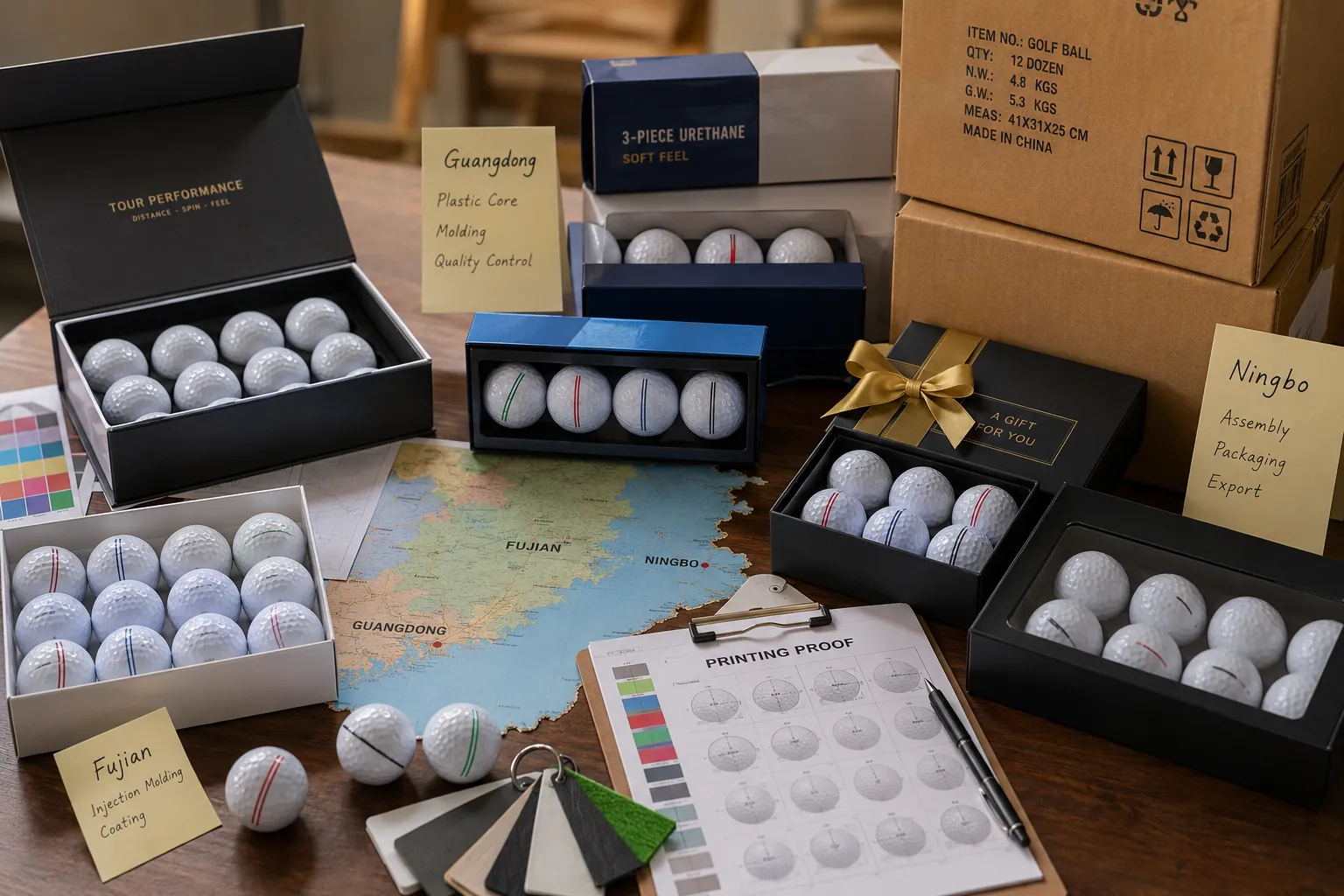
China’s golf ball capacity is cluster-based, not evenly distributed. Guangdong, Fujian, and Zhejiang / Ningbo serve different buyer needs: fast development, ball-focused OEM flexibility, packaging depth, gifting, e-commerce replenishment, and lower-MOQ customization.
A useful China sourcing map is more practical than a generic “China can make it” answer. South China, including Guangdong, Dongguan, Shenzhen, and Guangzhou, is strong in fast response, tooling, printing, export coordination, gifts, and promotional ecosystems. It is often useful when you need fast sample loops, many adjacent suppliers, and quick correction after artwork or packaging changes.
Fujian, including Xiamen, Zhangzhou, Quanzhou, and Jinjiang, often fits ball-focused OEM flexibility: 2/3-piece programs, mid-tier urethane routes, sports-equipment experience, DTC pilots, and repeat orders. Zhejiang, Ningbo, Hangzhou, Jinhua, and nearby East China support bring packaging, kitting, e-commerce replenishment, port execution, gift sets, and lower-MOQ customization strengths.
DTC founders prefer launch agility. A perfect unit quote does not help if carton revisions, print plates, sleeves, trays, and logo approvals take too long. Cluster fit matters because golf ball sourcing is not only molding the ball; it is also finishing, marking, packing, kitting, and shipping a sellable product.
Do not turn these clusters into stereotypes. The exact factory still matters more than the province label. But cluster fit helps you ask better questions before you waste six weeks with the wrong supplier type.
| Sourcing decision | Cluster fit | Main advantage | Buyer move |
|---|---|---|---|
| Fast sampling | Guangdong | tooling / printing speed | Use for pilot urgency |
| DTC pilot | Fujian | ball-focused flexibility | Test repeatability |
| Gift pack | Zhejiang / Ningbo | packaging and kitting | Audit box path |
| Range / promo | Guangdong / Zhejiang | volume and cost | Check consistency |
| Mid-tier urethane | Fujian / selected Guangdong | process control | Verify QC data |
| E-commerce replenishment | Zhejiang / Ningbo | port and packing | Plan SKU flow |
How do Guangdong, Fujian, and Zhejiang differ?
Guangdong often helps with speed and supplier coordination; Fujian often helps with ball-focused OEM work; Zhejiang / Ningbo often helps with packaging and replenishment.
Request a cluster-fit explanation from your supplier, including where molding, coating, printing, packaging, and export handling happen. Confirm whether key steps are in-house, nearby, or outsourced across distant vendors. Do not select a factory only by price; match the SKU to the cluster ecosystem.
What does China export by product mix?
You may assume China only exports low-end practice balls, or overcorrect and assume every China OEM can make tour-grade cast urethane consistently.
China’s golf ball exports are still volume-led by Surlyn and ionomer programs, but the strategic story is mix upgrade. For buyers, China is strongest as a run-rate engine for 2/3-piece balls, custom programs, and mid-tier urethane, while selected premium SKUs need tighter factory qualification.
China’s export base remains strongest in 2-piece Surlyn, 3-piece Surlyn / ionomer, range balls, logo balls, corporate gifts, promotional runs, and DTC pilot programs. That is not a weakness; it is why China moves so many units. Surlyn ionomers for golf balls have been used in covers and mantles for decades, and they remain central to the global golf ball materials stack.
The upgrade story is urethane. Mid-tier PU, TPU / PU routes, and selected cast-urethane programs are growing, but they are not universal. Cast urethane requires stronger process control, cover adhesion, curing, coating, spin performance, and yield management. Many emerging DTC brands use China or Greater China OEM pathways for mid-tier and premium-style programs, but buyers still need factory-specific proof.
The strategic sourcing error goes both directions. One team dismisses China as “practice balls only” and misses profitable mid-tier programs. Another team assumes every China supplier can make a tour-level cast urethane ball at Surlyn pricing. Both teams are guessing. The better route is segmentation.
| Product decision | China fit | Risk to check | Buyer move |
|---|---|---|---|
| 2-piece Surlyn | Very strong | cheap resin / print drift | Verify batch QC |
| 3-piece Surlyn | Strong | mantle consistency | Lock specs |
| Range / promo | Strong | durability variation | Test compression |
| Mid-tier urethane | Growing | cover adhesion / yield | Request test data |
| Cast urethane halo | Selected factories | curing / spin / coating | Audit deeply |
How is Surlyn volume different from urethane value?
Surlyn drives unit scale, while urethane raises value per ball. That is why China’s unit role can look stronger than its value share.
The failure signal is: “China is only cheap practice balls.” False. China remains strongest in Surlyn volume, but selected OEMs now support mid-tier and premium-style urethane programs when buyers apply the right QC and factory-selection discipline.
Ask the supplier to classify the SKU by cover material, layer structure, target channel, and required QC proof. Compare product mix against export positioning and factory process evidence. Do not buy urethane from a supplier that can only prove Surlyn volume.
Why do top brands still stay in China?
You may consider shifting production to Vietnam, India, or another lower-wage country, but golf ball manufacturing is not only assembly labor.
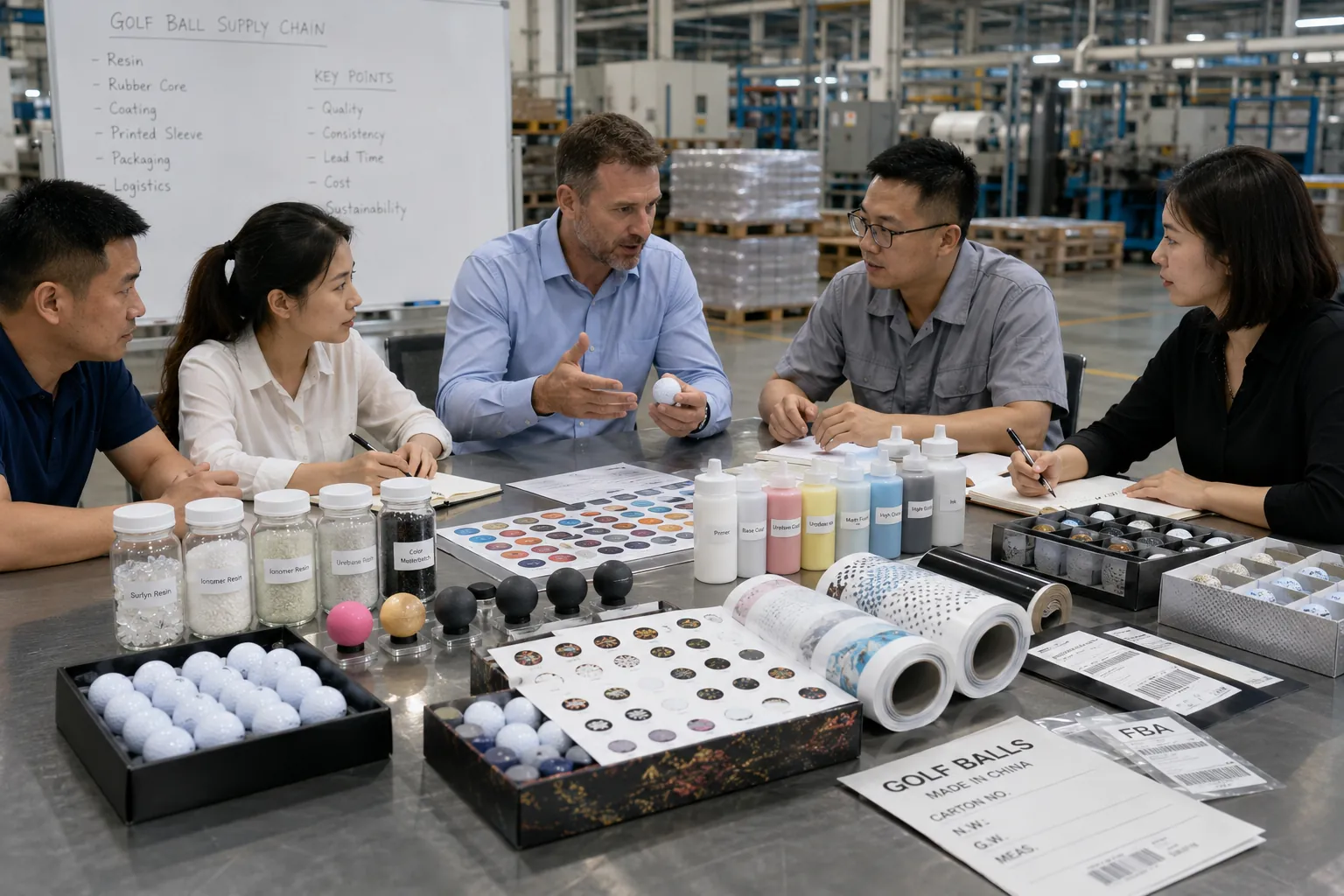
Top brands stay in China because the advantage is ecosystem speed, not only labor cost. A golf ball program needs resin, rubber, molds, coatings, printing, packaging, kitting, QC, and export execution; if those vendors are not nearby, lower wages can be erased by slower approvals and correction loops.
A golf ball factory is only as strong as the ecosystem around it. The supply chain begins upstream with ionomer pathways, polybutadiene rubber, polyurethane systems, coatings, titanium dioxide, clearcoat, molds, print plates, carton suppliers, insert trays, gift-box vendors, inspection support, and export logistics. Asia Pacific’s large role in the Asia Pacific polyurethane market and polybutadiene rubber market helps explain why chemical-access and supplier-radius questions belong in golf ball sourcing strategy. This is not a golf-ball-specific production census; it is an upstream-material signal buyers should include in their hub analysis.
When these vendors sit close to one another, corrections happen faster. When they are scattered, every change becomes a mini-project. A packaging revision, coating issue, print defect, mold repair, or tray change can move through the system quickly in a mature cluster. In a thin ecosystem, the same correction can bounce across unrelated vendors and slow the launch.
The 50-mile ecosystem rule is a simple executive test. Within the right China cluster, buyers can coordinate resin access, core molding, coating, pad printing, UV printing, sleeves, boxes, trays, QC, and export handling inside a short supplier radius. In an emerging hub, a lower labor rate can be offset by imported materials, slower packaging approvals, fewer corrective options, and longer vendor loops.
Strategic buyers prefer resilience over lowest wage. The answer is not “China forever” or “leave China now.” The answer is SKU allocation: keep run-rate Surlyn, DTC pilots, packaging-heavy programs, and proven mid-tier urethane in China; use Taiwan / Thailand / U.S. for selected halo urethane where brand positioning and budget justify it; pilot Vietnam or other emerging hubs where the supplier ecosystem is real, not promised.
| Relocation question | Macro illusion | Real constraint | Buyer move |
|---|---|---|---|
| Move to cheaper labor? | Assembly cost dominates | materials and vendors dominate | Map ecosystem |
| Use Vietnam? | Easy China replacement | capability varies by SKU | Pilot first |
| Use India? | wage advantage solves cost | supplier base may be thin | Check materials |
| Keep China? | only for cheap balls | speed and packaging matter | Retain run-rate |
| Split hubs? | complexity is bad | segmentation reduces risk | Match SKU tiers |
What is the 50-mile ecosystem rule?
The 50-mile ecosystem rule asks whether the factory’s critical suppliers are close enough to support fast samples, corrections, packaging changes, and repeat production.
Build a 50-mile ecosystem checklist for every alternative sourcing country. Confirm where each critical supplier sits and how fast sample and correction loops can run. Do not approve a country shift based only on labor-rate comparison.
The failure signal is: “Move to any lower-wage country and the supply chain follows.” Assembly can move faster than resin access, tooling repair, coating support, printing control, packaging depth, and export execution. Treat emerging hubs as diversification pilots, not automatic China replacements.
✔ True — Labor cost is only one part of golf ball sourcing strategy.
A lower wage rate can disappear if materials, packaging vendors, mold repair, coating support, or corrective-action loops are slower. The ecosystem is the real cost structure.
✘ False — “Golf ball production can move wherever labor is cheapest.”
Assembly can move. A mature chemical, tooling, printing, packaging, testing, and export ecosystem is harder to move.
FAQ
Where are most custom golf balls manufactured?
Custom golf balls are manufactured across several hubs, but Greater China remains one of the most important OEM centers for private-label, DTC, promotional, and mid-tier golf ball programs.
U.S. and Thailand capacity supports major brand-owned or premium lines. Taiwan and mainland China connect engineering know-how with flexible OEM production. China is especially strong in Surlyn, mid-tier urethane, packaging, gifting, and fast sampling. Use export data as a public proxy; exact private production share is not fully visible because captive and contract output are not disclosed in one unified dataset.
What is China’s share of global golf ball exports?
China’s share depends on dataset and method, but 2024 HS 9506.32 trade data places China among the world’s major golf ball exporters by value and one of the strongest by unit volume.
China-reporter customs data shows about USD 147M and 370M balls exported in 2024. Global HS 9506.32 trade data shows roughly USD 978M in cross-border golf ball trade. That implies a roughly mid-teens value role depending on dataset, while unit share is stronger because China exports a large volume of Surlyn, range, promotional, and mid-tier OEM balls.
Why do golf brands outsource to China?
Brands outsource to China for ecosystem speed, SKU flexibility, packaging depth, and cost structure, not just labor savings or a cheaper factory quote.
China supports fast sample-to-production loops, packaging, kitting, printing, export coordination, and flexible OEM programs. Surlyn and mid-tier programs can scale quickly. Premium urethane requires stricter factory selection and QC, but selected Chinese and Greater China OEM pathways can support more advanced builds when the buyer applies strong acceptance criteria.
Is China only good for cheap Surlyn golf balls?
No. China is still strongest in Surlyn volume, but selected OEMs can support mid-tier and premium-style urethane programs when buyers verify process control instead of relying on price alone.
Surlyn remains the run-rate export base because it supports durability, price ladders, range use, logo programs, and promotional demand. Mid-tier urethane is the upgrade story. Cast urethane capability is factory-specific, not universal. Buyers should verify cover adhesion, curing, compression, coating, spin consistency, and batch QC before assigning premium SKUs.
What is the difference between Guangdong and Zhejiang factories?
Guangdong tends to be stronger in fast supplier coordination, tooling, printing, and complex program execution, while Zhejiang / Ningbo often brings packaging, kitting, port, e-commerce, and lower-MOQ customization strengths.
Fujian often fits ball-focused OEM flexibility, especially for 2/3-piece and mid-tier programs. Guangdong can fit fast pilot and promo programs. Zhejiang / Ningbo can fit gift packs and replenishment. Exact factory capability still matters more than province labels, so buyers should verify where molding, coating, printing, packaging, and export handling actually happen.
Why are top China golf ball factories hard to find online?
Many serious OEM factories are relationship-driven and do not rely on public marketplace visibility, so search rankings can overrepresent traders and underrepresent real production capability.
Some factories serve long-term buyers and avoid public listing noise. Some are tied to Taiwanese technical know-how or private OEM networks. Trading companies may rank better online than true factories. Buyers should ask for process proof, factory role, technical decision maker, sample batch evidence, and export-document consistency instead of judging capability by search-result visibility alone.
Can Vietnam or India replace China golf ball production?
They can support selected diversification pilots, but replacing China’s full ecosystem is harder than moving assembly because golf balls depend on materials, tooling, coating, printing, packaging, QC, and export speed.
Labor cost is only one input. Alternative hubs must prove material access and corrective-action loops. Vietnam can be useful for selected spillover or diversification. India may require more ecosystem validation. Use SKU segmentation rather than all-or-nothing relocation, and test each hub against your actual product lane, not a country-level assumption.
Which SKUs should stay in China?
China is usually strongest for run-rate Surlyn, 2/3-piece programs, DTC pilots, promotional balls, gift packs, and mid-tier urethane where the factory can prove process control.
Keep high-volume, multi-SKU, packaging-heavy programs in China when speed and launch coordination matter. Use Taiwan / Thailand / U.S. for selected halo urethane if brand positioning, schedule, and budget require it. Pilot Vietnam for diversification, not blind replacement. Reassess annually by SKU, not by country stereotype.
Conclusion
China’s role in golf ball manufacturing is not captured by a cheap-labor stereotype. It is a top global export hub, a major unit-volume engine, and part of a Greater China supply chain shaped by Taiwan technical know-how, mainland cluster depth, material access, packaging speed, and export execution.
The right strategy is not “China or not China.” It is SKU segmentation: China for run-rate Surlyn, DTC pilots, mid-tier urethane, and packaging-heavy programs; Taiwan / Thailand / U.S. for selected halo urethane; emerging hubs for measured diversification.
You might also like — Golf Ball QC in China: The 4 Must-Have Testing Processes