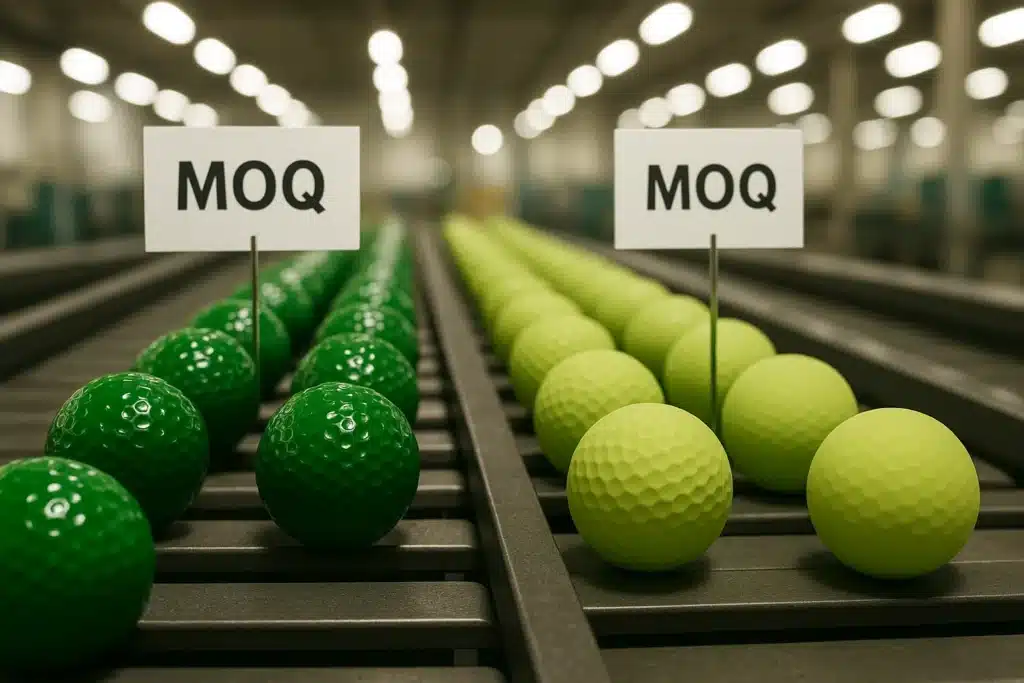
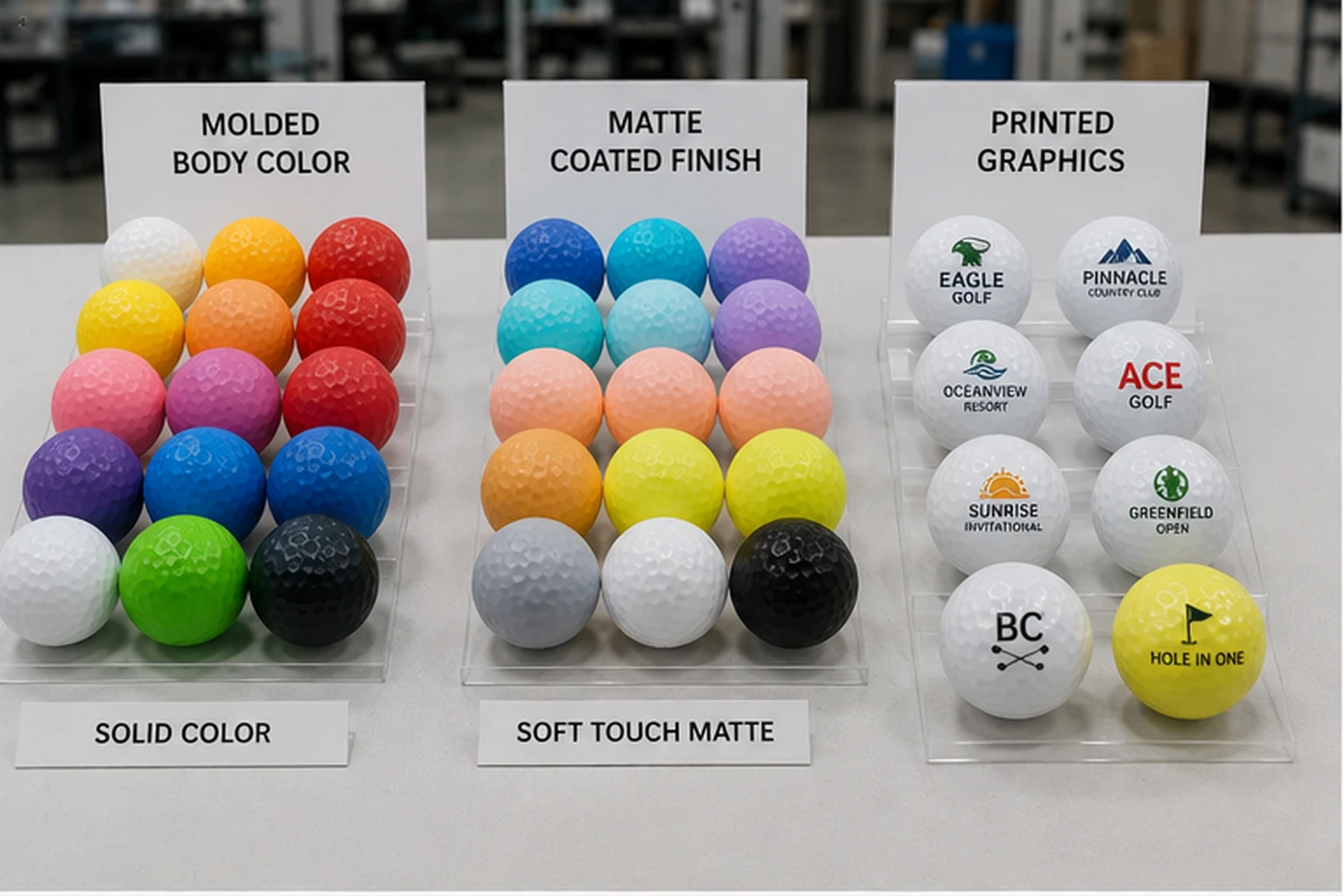
The MOQ for custom-colored golf balls depends on how the color is made—not just the color name. True molded body color usually requires about 8,000–20,000 pcs per color, coated or matte finishes often fit around 1,000–5,000 pcs, and printed graphics on stock white/yellow shells can start from hundreds to a few thousand.
Custom-colored golf balls are not the same as custom logo golf balls. If you only need colored graphics, logos, symbols, or event branding, printing on stock white or yellow shells is usually the lower-MOQ route. If you need the shell itself to be red, blue, pink, neon, or another brand color, molded body color usually needs a higher per-color MOQ because of pigment matching, purge, line wash, and changeover cost.
To choose the right custom-colored golf balls MOQ:
-
Decide whether you need true molded body color, a colored finish, or printed graphics.
-
Use molded body color when through-body durability and long-term color consistency justify higher per-color MOQ.
-
Use coating, matte finish, or tinted clear when you need a lower-MOQ colored look for events, gifts, pilots, or seasonal programs.
-
Use printing on white/yellow shells when you only need brand visuals, logos, symbols, numbers, or promotional graphics.
-
Confirm total MOQ, per-color MOQ, changeover fees, and lead-time impact before approving the quote.
-
Lock Pantone tolerance, UV proof, retained samples, and color QC requirements before mass production.
This guide helps you compare molded color, coated/matte finish, and print-on-stock-shell routes before you negotiate MOQ, Pantone tolerance, changeover fees, lead time, and QC proof.
Which color method sets your MOQ?
You may ask for custom-colored golf balls and think you are asking one simple question. In production terms, you may be asking for three different things with very different MOQ logic.
The MOQ is set by how the color is made, not by the word “custom.” Use molded body color for true shell color, coating or matte finish for colored-look pilots, and printing on white/yellow shells when you only need brand visuals.
Low-MOQ personalization pages shape buyer expectations. A corporate buyer may see small-quantity offers for names, symbols, numbers, or logo uploads and assume factory-molded custom color should work the same way. That is the first trap. Personalization usually changes the graphic on an existing ball. Molded body color changes the cover or shell material itself.
That difference changes everything: minimum quantity, setup cost, lead time, color stability, and quality control. A printed logo on a white ball may be enough for a corporate gift. A matte blue finish may work for an event pilot. A true molded blue shell for retail sale needs a different production route, a higher per-color threshold, and tighter color control.
| Color need | Best method | Typical MOQ | Main risk | Buyer move |
|---|---|---|---|---|
| True body color | Molded ionomer or PU/TPU | Higher per-color MOQ | Line wash and leftover color risk | Confirm material route |
| Colored look | Coated, matte, or tinted clear | Mid-range MOQ | Chipping, chalking, fading | Request coating proof |
| Brand color graphics | Pad print or UV print on stock shells | Lower MOQ | Not true body color | Define artwork and clearcoat |
| Low-risk pilot | White/yellow shell + print or coating | Lower pilot quantity | Brand effect may differ | Test before molded color |
| Tournament-facing color | Exact color/finish strategy | Depends on submission plan | Conforming claim risk | Check exact model logic |
As a practical baseline, molded body color often starts around 8,000–20,000 pcs per color. Coating or matte finish often sits around 1,000–5,000 pcs. Print-only routes on stock white or yellow shells can run from hundreds to a few thousand, depending on artwork, setup, finishing, and supplier workflow. These numbers are illustrative because line size, season, tooling, finish, packaging scope, and supplier capability can change the answer.
A failure signal is a supplier quoting low MOQ but never stating the color route. Ask your supplier to classify the project as molded body color, coated/matte finish, or print-only graphics before quoting MOQ. Do not approve a quote that says only “custom color” without stating how the color will be made.
✔ True — Custom-colored and custom logo are not the same decision
A logo or graphic can be printed on a stock shell at lower MOQ. True molded body color changes the shell material itself and usually needs a larger per-color run.
✘ False — “Low-MOQ personalization means low-MOQ molded body color”
Small personalization orders usually use printing, names, symbols, numbers, or stock colored balls. They do not prove that custom molded body color can run at the same quantity.
Why is molded body color MOQ higher?
You may think molded color MOQ is high because the factory is unwilling to support small buyers. Usually, the real issue is color changeover cost and production risk.
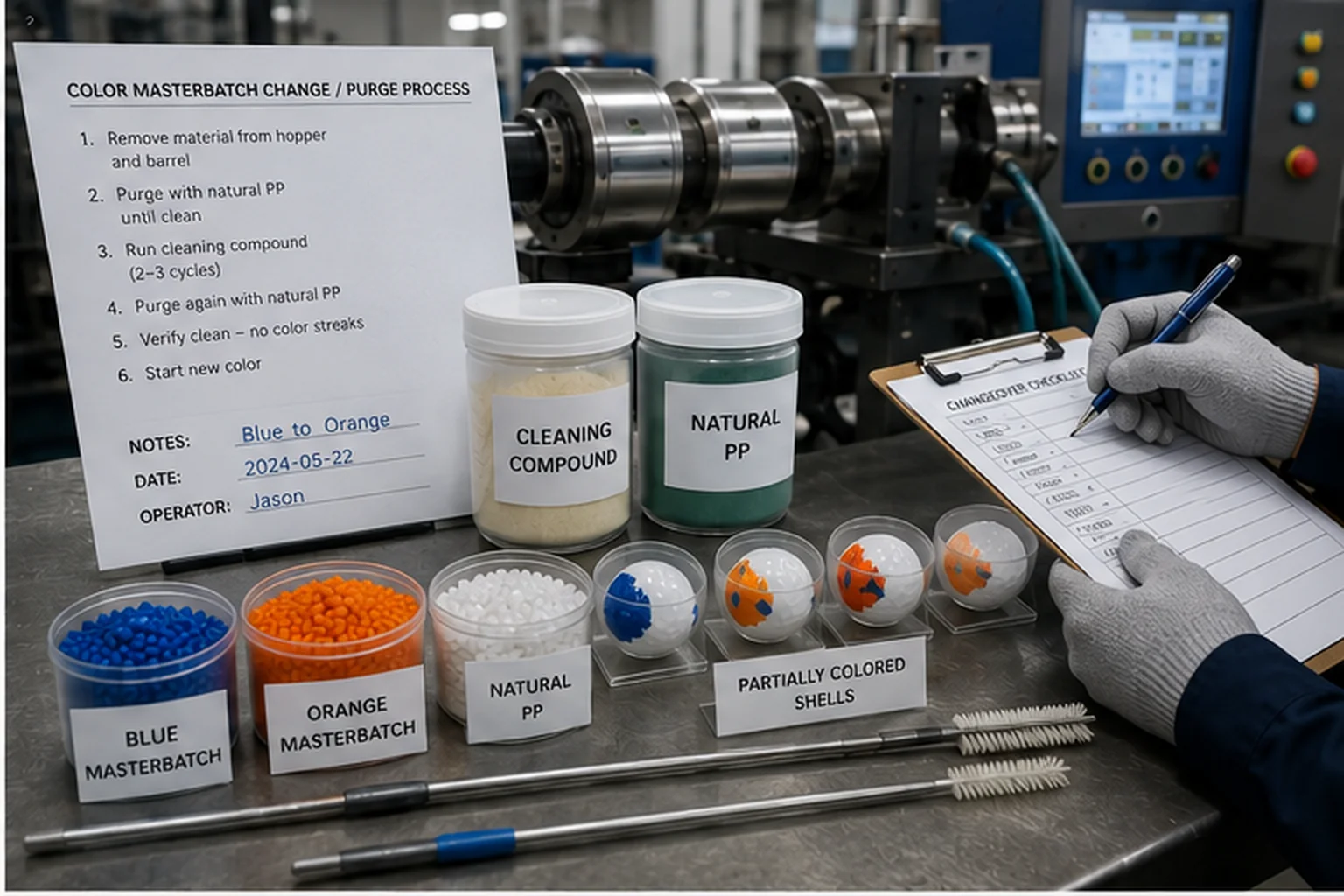
Molded body color MOQ is higher because every custom color consumes matching time, purge material, line-wash labor, early scrap, and production downtime. The MOQ protects color stability and line efficiency; it is not just a random quantity rule.
What do purge and line wash cost you?
Color changeover affects the whole production slot, not only the pigment cup. A custom masterbatch must be matched, stabilized, and cleared from the line before the next color can run.
In molded body color, pigment is compounded into the cover material before the shell is formed. The factory has to stabilize the shade, control early pieces, avoid color contamination, and clean the flow path before another color runs. That means custom red, neon green, or matte black is not just a different visual choice. It changes production behavior.
If the batch is too small, every color switch fragments capacity. The line stops, material is purged, tooling is cleaned, early scrap rises, and scheduling becomes less stable. MOQ is partly a quality tool and partly an efficiency tool. The factory is not only selling balls; it is reserving line time and protecting yield.
| Cost driver | What happens | Buyer impact | Wrong assumption | Buyer move |
|---|---|---|---|---|
| Masterbatch matching | Pigment must be stabilized | Longer sampling | Any color is easy | Approve lab/pilot sample |
| Early scrap | First pieces may drift | Yield cost rises | Small balls mean small waste | Ask how scrap is handled |
| Purge and line wash | Old pigment must be cleared | Setup fee and MOQ rise | Switching is instant | Confirm changeover fee |
| Idle time | Line stops during changeover | Lead time pressure | MOQ is arbitrary | Book production slot |
| Residual inventory | Custom color may not resell | Higher per-color risk | All colors behave like white | Consider stock shells |
White and yellow are exceptions in many factory conversations because they are stock colors with better inventory liquidity. A supplier may accept a lower commercial MOQ for white or yellow because leftover stock is easier to use later. A custom campaign color does not have the same resale path.
Request a quote that separates MOQ, color-match fee, changeover fee, and lead-time impact. Ask whether the factory will run the color as a true molded batch or as a commercial split from a larger internal run. Accept molded-color MOQ only when through-body durability, long-term program volume, or retail positioning justifies the changeover burden.
Which route fits 1,000–3,000 balls?
You may only need 1,000–3,000 balls for a gift program, event test, seasonal launch, pro-shop promotion, or retail pilot. True molded custom color may not fit that volume.
If you need only 1,000–3,000 balls, do not start with molded body color unless the color is stock or the factory has a special plan. Use coated/matte/tinted finishes for a colored look, or print on white/yellow shells for brand visuals.
Can coating simulate body color?
Coating can create a colored look for pilots, but it is not the same as through-body molded color. It works best when the buyer accepts a finish-based route and verifies durability.
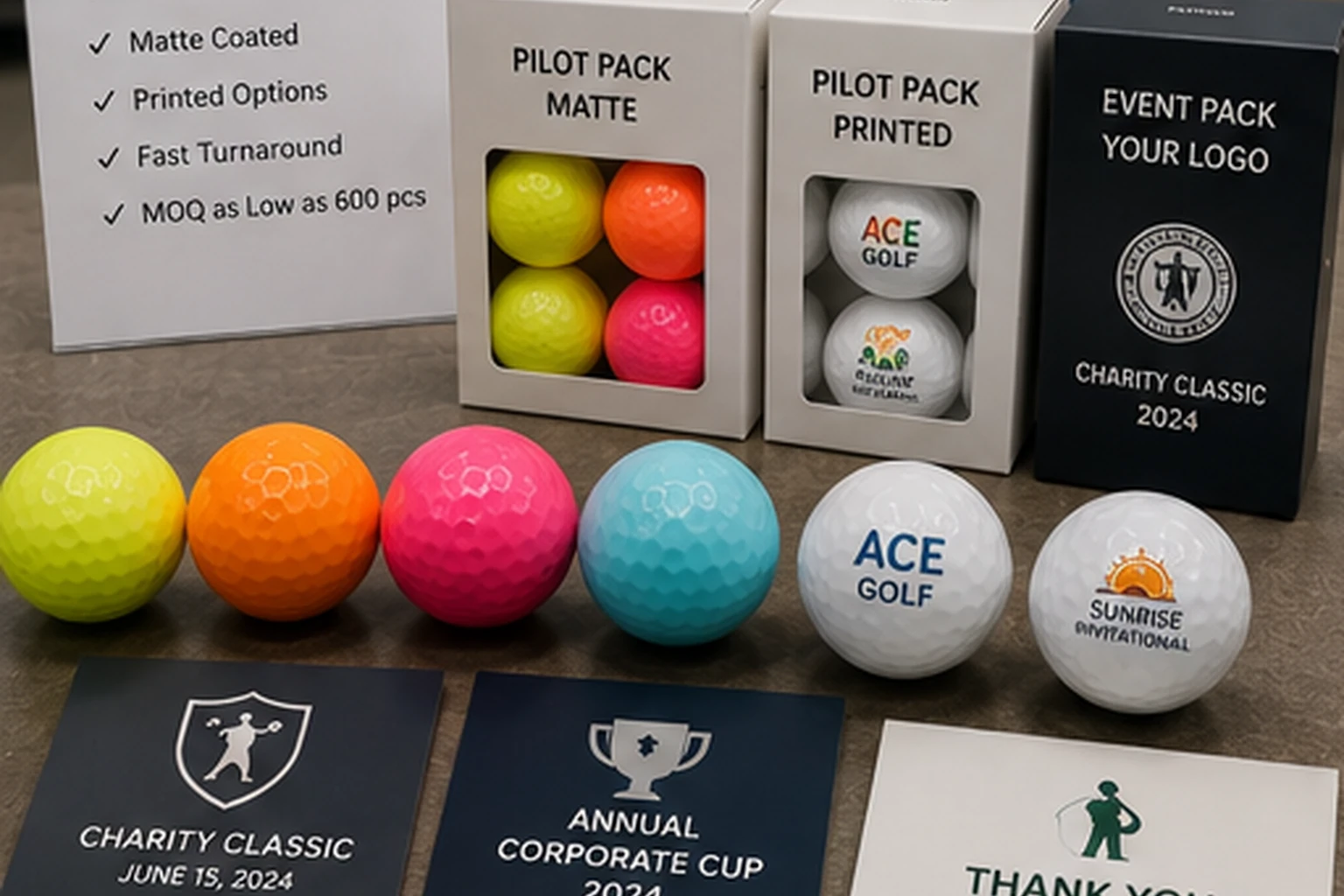
For gift, event, and pilot buyers, speed and lower MOQ often matter more than true shell color. A white or yellow stock ball with pad printing can work well for simple logos, spot colors, and repeated corporate artwork. UV printing can support smaller, multi-color, complex, gradient, or personalized graphics. The right method depends on artwork, quantity, finish expectation, and how the ball will be used.
A coating, matte, or tinted-clear route can make the ball appear colored at a lower MOQ. This works well for seasonal campaigns, branded giveaways, short retail tests, or academy programs where visual identity matters but true molded color is not yet justified. The trade-off is durability. Coating performance depends on surface preparation, clearcoat chemistry, curing, adhesion, UV package, and actual rub or hit testing.
| Low-MOQ goal | Best route | What it is not | Risk to check | Buyer move |
|---|---|---|---|---|
| Simple logo color | Pad print on stock shell | Not body color | Ink wear | Ask for clearcoat/rub proof |
| Complex graphic | UV print | Not molded color | Edge peel or scuff | Approve print sample |
| Seasonal colored look | Matte/tinted coating | Not through-body | Chipping or fading | Request coating QC |
| Gift/event test | White/yellow + print/packaging | Not custom shell color | Brand effect mismatch | Pilot before scale |
| Future retail SKU | Pilot coating, then molded color | Not final mass route | Color may shift by route | Plan upgrade path |
UV is not automatically more durable than pad printing. Durability depends on the full stack: ball surface, ink, curing strength, protective clear, and real abrasion or cleaning conditions. A premium matte system can hold up well; a weak finish can chalk, chip, or fade even if the first sample photo looks beautiful.
Ask your supplier for two routes: the lowest-MOQ visual route and the true body-color route. Compare color appearance, durability proof, sample lead time, packaging effect, and future scale-up path before you choose. Use a lower-MOQ route only if your buyer accepts that it may be a colored look or printed graphic, not true molded body color.
✔ True — Coating can simulate a colored look for pilots
A matte, coated, or tinted-clear finish can help you test a seasonal or promotional color before committing to molded body color MOQ.
✘ False — “A printed logo or graphic changes the ball’s body color”
Printing changes surface graphics. To change the ball’s body color, you need molded color or a colored coating route.
How should you specify Pantone color?
You may write “match our brand color” and then face disputes because the color looks different under another light source, gloss level, material route, or production batch.
Do not approve color by photo or vague Pantone language alone. Your RFQ should define Pantone code, ΔE tolerance, D65 viewing condition, gloss target, golden sample, UV exposure limit, and retained sample so color disputes have measurable evidence.
What proof should you approve before mass?
A Pantone code is a starting point, not the whole acceptance standard. Golf balls are curved, glossy or matte, and made from materials that can shift how color is perceived.
Your spec should name the Pantone or PMS code, the color tolerance, the viewing condition, the gloss target, and the physical golden sample. For many buyer programs, ΔE within a buyer-approved range under D65 viewing is a practical way to turn “close enough” into measurable acceptance. A recognized instrument-based color-difference method, such as ASTM D2244-style color difference calculation, can be referenced when the buyer and supplier need tighter control.
Gloss matters because matte and gloss can make the same color look different. Material also matters. Ionomer molded color is often the safer route for light, bright, or outdoor-exposed shades. PU or TPU colored routes may need a stronger UV package, especially for pale, fluorescent, or sun-exposed colors.
| Spec field | What to write | Why it matters | Risk if missing | Buyer move |
|---|---|---|---|---|
| Pantone / PMS | Exact code and surface version | Shared color language | Subjective color claim | Write in RFQ/PO |
| ΔE tolerance | Buyer-approved value | Measurable color difference | Endless visual dispute | Use instrument reading |
| Light source | D65 or agreed condition | Consistent viewing | Metamerism confusion | Define condition |
| Gloss target | 60° GU target/range | Matte vs gloss perception | Color looks different | Approve gloss sample |
| Golden sample | Signed physical sample | Batch comparison | Photo-only approval | Retain sample |
| UV exposure | Method and acceptance limit | Fading/yellowing risk | Outdoor complaint | Request UV proof |
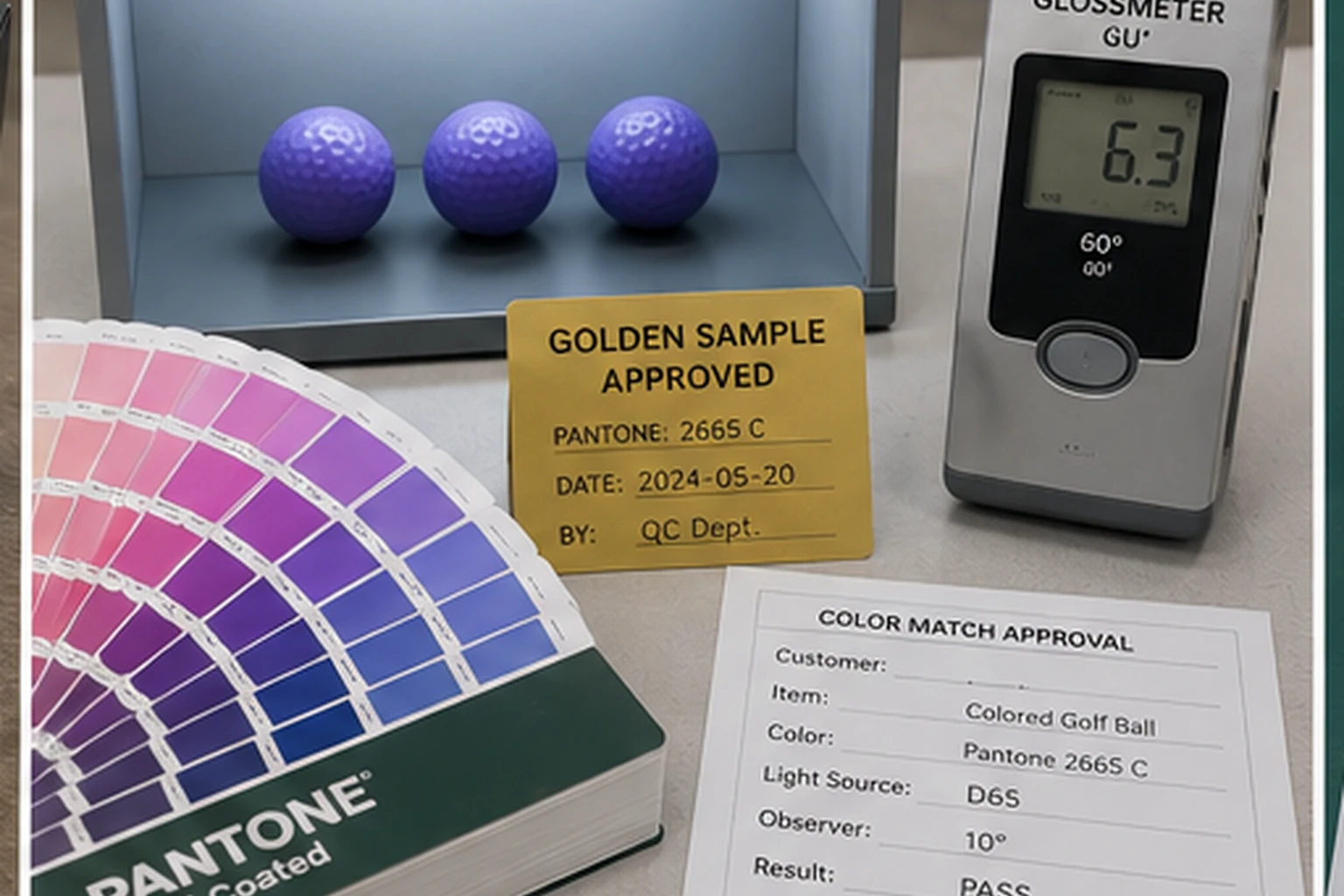
Production color shall match the approved golden sample within the agreed ΔE tolerance under D65, with the approved gloss target at 60°, and supplier shall retain pre-production and mass-production samples for batch comparison.
A failure signal is a quote that says “Pantone matched” but gives no ΔE tolerance, lighting condition, gloss target, or sample-retention plan. Mass production should not start until the pre-production sample meets the written color and finish criteria.
Can you mix colors in one PO?
You may assume meeting the total order quantity means each color can be split freely. In production, every added color can still create setup, wash, and schedule impact.
You can often mix colors in one PO, but the split is not free. Confirm total MOQ, per-color minimum, changeover fee, purge/line-wash time, and added lead time before assuming one 8,000-piece order can become unlimited small color lots.
How should you split total MOQ by color?
Total MOQ and per-color MOQ are different negotiation points. A factory may allow a full order to be split, but each color still needs a production or finishing path.
For molded body color, each new color can require matching, purge, line wash, first-off approval, and residual inventory planning. For PU or TPU color routes, color stability and UV behavior may also need closer review. For coated or matte colors, the split can be more flexible, but each tint still needs curing and QC. For white/yellow stock shells with multiple printed graphics, the split is usually easier because the shell color does not change.
A smarter split starts with fewer colors, near-neighbor colors, or staged shipment. If your sales forecast is not proven, do not force three molded custom colors only because the packaging deck looks nice. The warehouse will not applaud your creativity if two colors sit for six months.
| Scenario | Possible? | Main risk | What to confirm | Buyer move |
|---|---|---|---|---|
| Molded ionomer, 3 colors | Sometimes | Per-color line wash | Per-color minimum and fee | Group colors carefully |
| Molded PU/TPU, 2 colors | Harder | UV/color stability and waste | Setup + lead time | Limit color count |
| Coated/matte colors | More flexible | Cure and adhesion variation | Coating slot and QC | Approve each tint |
| Stock shell + multiple prints | Usually flexible | Print wear or registration | Print setup and clearcoat | Use for pilots |
| Full MOQ + staged shipment | Often negotiable | Storage and schedule | Storage terms and release dates | Write in PO |
Mixed-color PO shall list total MOQ, per-color MOQ, per-color setup or changeover fee, sample approval requirement, storage terms if staged, and release schedule by color.
Ask for a split-color quotation showing total MOQ, per-color MOQ, setup or changeover fees, and lead-time impact. Do not approve a mixed-color PO unless per-color minimums, fees, samples, and shipment schedule are written.
What QC proof prevents color disputes?
You may approve a beautiful sample and still receive mass production with color drift, matte chalking, coating chips, logo wear, UV fading, or edge peel.
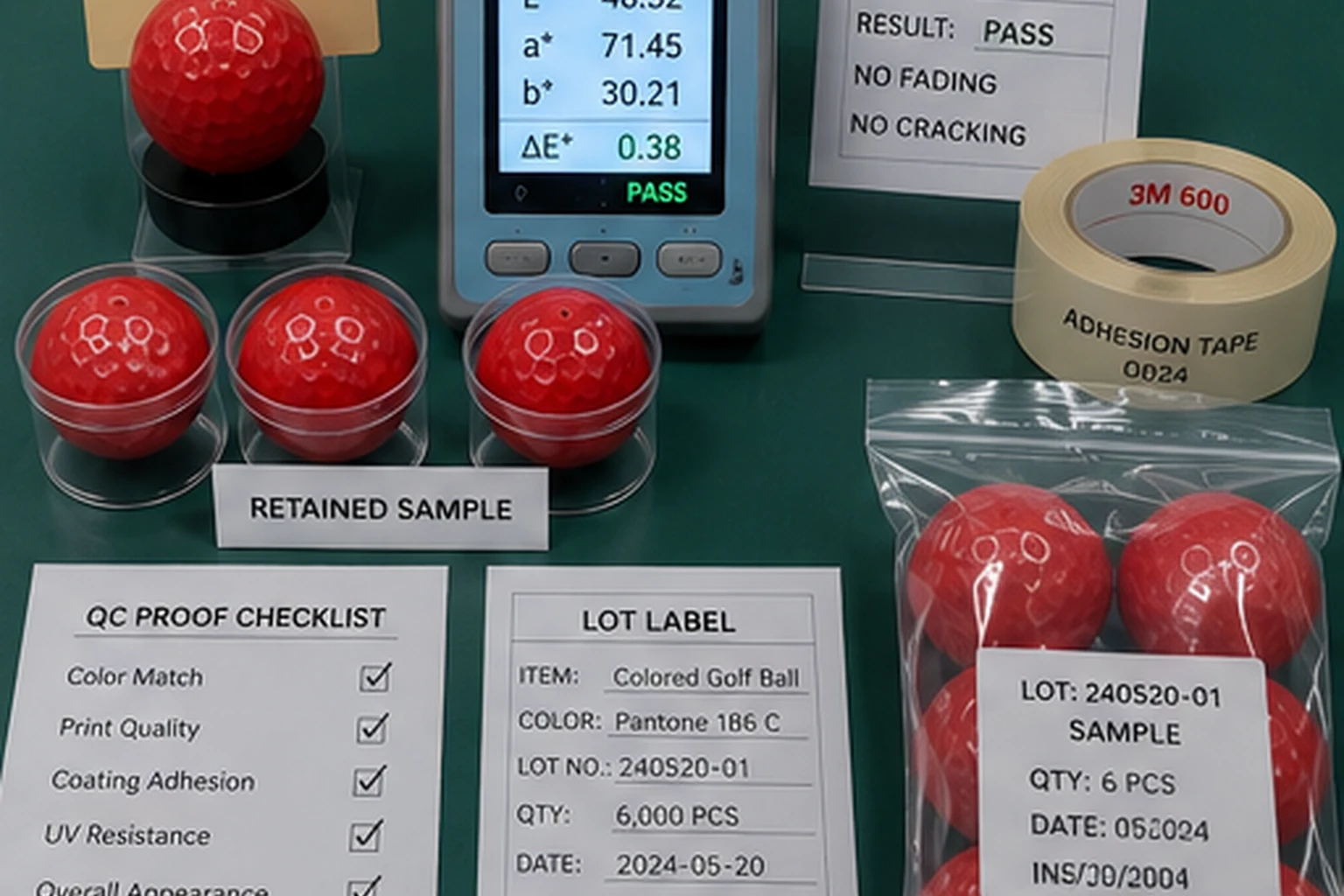
For color-sensitive orders, do not rely only on a nice sample photo. Ask for a pre-production sample, golden sample, batch color reading, ΔE under D65, gloss target, adhesion evidence, abrasion or rub result, UV exposure result, retained samples, and change-control notes.
What should your RFQ request?
Color QC should connect the approved sample to the production lot. Without lot linkage, a nice sample can become a weak memory instead of a usable acceptance reference.
Different color routes need different proof. Molded ionomer color needs ΔE control and purge quality. PU or TPU colored routes need UV stability checks, especially for pale or fluorescent colors. Coated and matte finishes need adhesion, UV, gloss, and abrasion or rub evidence. Pad printing needs adhesion, registration, and clearcoat checks. UV methods need scuff and edge-peel control.
Useful test language can reference color-difference readings, tape or crosshatch-style adhesion checks, fluorescent UV exposure, and abrasion or rub comparisons. These should be treated as method examples, not automatic requirements for every promotional order. The buyer and supplier should choose the proof level based on use case, budget, and failure risk.
| QC proof | Risk controlled | Useful method | Weak evidence | Buyer move |
|---|---|---|---|---|
| Batch color reading | Color drift | ΔE under D65 | Nice photo | Request raw reading |
| Golden sample | Subjective approval | Signed retained sample | Pantone only | Store reference |
| Gloss check | Matte/gloss dispute | 60° gloss reading | Visual only | Set GU range |
| Adhesion evidence | Coating or print peel | Tape/crosshatch method | Fresh sample photo | Ask for result |
| Abrasion/rub evidence | Wear and scuff complaints | Rub or Taber-style test | No wear test | Define use case |
| UV exposure result | Fading/yellowing | UV method + ΔE after exposure | UV resistant claim | Set exposure condition |
| Retained samples | Batch dispute | Pre-production and mass samples | No reference | Tie to lot ID |
| Change-control note | Formula/process drift | Written approval trail | Verbal promise | Require notice |
Request a batch-linked color QC pack covering approved golden sample, Pantone code, ΔE tolerance under D65, gloss target, UV exposure condition, adhesion/rub or abrasion method, retained samples, and any coating, pigment, clearcoat, or print-process change before mass shipment.
Supplier shall identify each color lot with a lot ID and link the approved golden sample, Pantone code, color route, coating or pigment version, print file, clearcoat system, QC report, retained samples, packaging version, and shipment record to that lot ID.
Production color acceptance shall be based on the approved golden sample and written specification, including Pantone code, ΔE tolerance under D65, gloss target, UV exposure condition, adhesion/rub or abrasion method, visible defect limit, and buyer-approved retained sample.
A failure signal is a matte or coated sample approved with no adhesion or UV proof. Production should not ship until color, finish, adhesion, abrasion or rub, UV, and retained-sample checks match the approved RFQ and PO criteria.
For tournament-facing colored balls, color and finish deserve extra caution. If an event requires a conforming ball, the exact model, cover color, finish, markings, and current list status may matter. Treat this as a listing and claim-control question, not a standard promotional-color decision.
✔ True — Color approval should be tied to QC proof and retained samples
A color-sensitive order needs more than a photo. Tie the approved sample to ΔE, gloss, UV, adhesion or rub proof, retained samples, and lot ID.
✘ False — “A good-looking sample photo is enough for mass production”
Photos change with lighting, screens, and gloss. A physical golden sample and written acceptance criteria protect both buyer and supplier.
FAQ
What is the MOQ for custom-colored golf balls?
The MOQ for custom-colored golf balls depends on the color method. Molded body color usually requires higher per-color MOQ, while coating, matte finish, or printing on stock white/yellow shells can work at lower quantities.
As a practical guide, molded body color often starts around 8,000–20,000 pcs per color. Coated or matte routes often work around 1,000–5,000 pcs. Print-only routes can be lower because they use stock shells and change the surface graphics rather than the body color. Treat all numbers as illustrative until the supplier confirms material, route, finish, packaging, season, and production slot.
Why is molded body color MOQ higher?
Molded body color requires masterbatch matching, early scrap control, purge, line wash, and per-color setup. The MOQ reflects production changeover cost, not the size of the golf ball.
A molded color run changes the cover material itself. The line needs time to stabilize the shade, clear old pigment, and avoid contamination between colors. If the batch is too small, the factory may lose more time switching than producing. That is why true molded custom body color usually has a higher per-color MOQ than printing or coating.
Can I order custom-colored golf balls at 1,000 pcs?
Yes, if you choose coating, matte finish, tinted clear, or printed graphics on stock shells. For true molded custom body color, 1,000 pcs is usually not realistic unless the color is stock or the supplier has a special inventory plan.
For 1,000–3,000 balls, use a pilot route. White or yellow stock shells with print can test brand visuals quickly. Matte or tinted coating can test a colored look. If demand is proven, you can later move to molded body color with a clearer forecast and a lower risk of leftover inventory.
What is the difference between molded and printed color?
Molded color changes the shell or body color itself, so the color is built into the cover material. Printed color adds graphics, logos, or colored visuals on top of a white or yellow shell.
Molded color is usually more durable because the color is through-body, but it needs higher MOQ and more changeover control. Printed color is more flexible for smaller runs, logos, events, and corporate gifts, but it is not true body color. Coating sits between the two: it can create a colored look, but its durability depends on the coating stack.
Can I mix multiple colors in one order?
Usually yes, but each color may still trigger changeover cost, line wash, color matching, and per-color minimum. Confirm total MOQ, per-color MOQ, setup fee, and lead-time impact before approving the PO.
A total order of 8,000 pcs does not automatically mean you can split into many tiny molded color lots. Molded routes are less flexible; coated and printed routes are usually easier to split. Ask for a split-color quote and make sure every color has its own approved sample, fee structure, and shipment plan.
Can golf balls be Pantone matched?
Yes, golf balls can be Pantone matched, but the PO should define Pantone code, ΔE tolerance, D65 or another viewing condition, gloss target, golden sample, and production sample approval.
Do not rely only on “make it close.” Curved surfaces, gloss level, coating route, material, and lighting can all change how the color appears. Use a physical golden sample and written acceptance criteria. For outdoor or light-color orders, add UV exposure expectations and retained sample requirements.
Are custom-colored balls legal for tournament use?
Color alone is not the only issue. If the event requires a conforming ball, the exact model, cover color, finish, markings, and current-list status may matter.
For tournament-facing SKUs, do not make broad “tournament ready” claims from a generic sample. Confirm the exact model, color, finish, pole or seam markings, and listing strategy before selling into competition channels. The USGA Conforming Golf Ball List page explains that the list is updated monthly and is used as a Local Rule in many high-level competitions. The R&A Conforming Ball List supports the same exact-model caution for buyers serving European and international markets. For color- or finish-specific development, review the 2026 USGA Golf Ball Conformance Submission Guidelines before approving tournament-use claims.
Conclusion
Use molded body color when true shell color and long-term durability justify higher per-color MOQ. Use coating, matte, tinted clear, or print-only routes when you need lower MOQ, market testing, seasonal color programs, or brand visuals on stock shells.
The right MOQ for custom-colored golf balls depends on the color route, not the color name. A buyer asking for “blue golf balls” may need molded blue shells, a matte blue finish, or a white shell with blue graphics. Each route carries different MOQ, durability, lead time, and QC requirements.
Golfara can help buyers compare molded color, coated/matte finish, and print-on-stock-shell routes based on target quantity, Pantone code, packaging scope, and durability expectations. For a custom-colored golf ball program, prepare your target quantity by color, preferred color route, Pantone code, finish requirement, artwork, packaging scope, mixed-color split, and durability expectations before asking for samples.
You might also like — Can Chinese Factories Manufacture Pro V1 & Pro V1x Level Golf Balls?