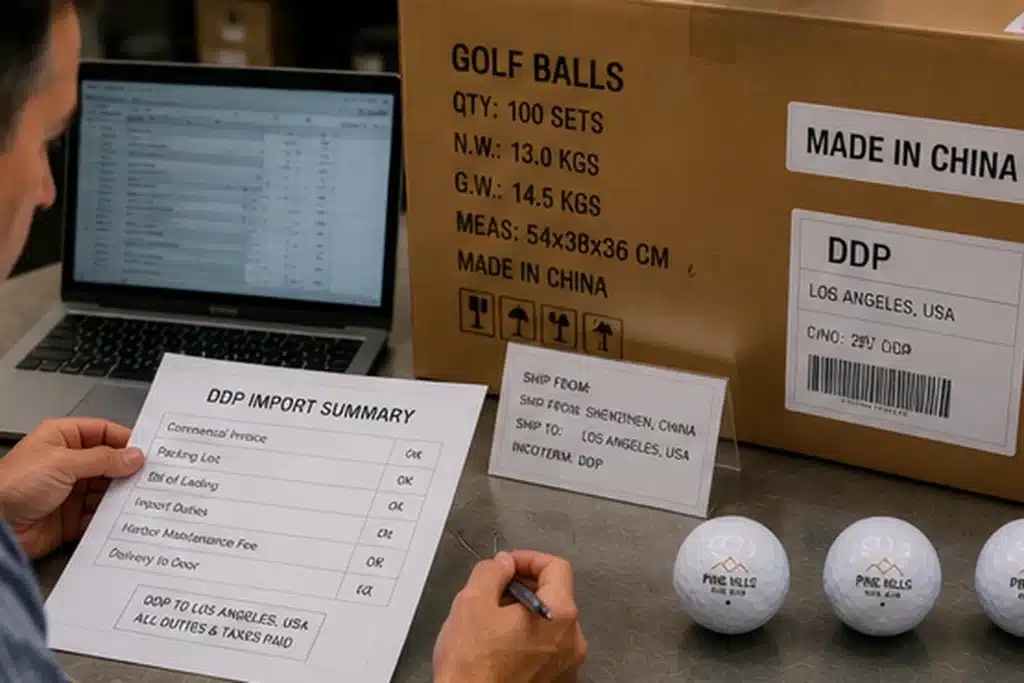
A supplier can quote the right golf ball and still fail your launch if materials, packaging, MOQ, or peak-season slots cannot move fast enough.
For golf ball OEM in 2026, China is usually better when you need fast lead times, low-MOQ testing, custom golf ball packaging OEM, frequent artwork changes, and peak-season recovery. Vietnam is better when your SKU is mature, volume is stable, packaging is locked, and the factory slot is already confirmed. The real choice is not China versus Vietnam by reputation; it is agility versus execution stability.
If you are comparing China vs Vietnam golf ball OEM, start with your launch risk. Do you need urgent replenishment, 1,000–3,000 pcs testing, seasonal packaging, mixed-color packs, and fast logo changes? Or do you have a stable retail SKU with fixed specs, repeat volume, and enough forecast to fit a controlled Vietnam production rhythm?
This guide removes tariff and landed-cost noise. You will compare China and Vietnam by golf ball supplier lead times, golf ball OEM minimum order quantity MOQ, supply-chain maturity, customization tolerance, packaging flexibility, and the sourcing stage your SKU is actually in.
Which Supply Chain Is More Mature?
You may compare China and Vietnam as two factory locations, but your real risk is whether the whole golf ball manufacturing supply chain can recover when schedules change.
China is the stronger golf ball OEM hub when your program needs supplier redundancy, local packaging, fast artwork changes, and backup logistics options. Vietnam can be a strong production node for stable, brand-style volume, but buyers should add more planning buffer when imported inputs or narrow production windows are involved.
| Buyer risk | China advantage | Vietnam caution | Best sourcing move |
|---|---|---|---|
| Peak-season replenishment | Deeper supplier and port network | More concentrated scheduling | Use China for urgent replenishment |
| Material delay | Core, cover, ink, packaging nearby | Some imported inputs | Pre-book materials in Vietnam |
| Missed sailing | More backup route options | Fewer fallback options on some lanes | Ask for 3 sailing options |
| Packaging innovation | Dense printing and box ecosystem | More standardized lines | Use China for gift packs |
| Stable large SKU | Strong, but not always needed | Good for locked specs | Use Vietnam if access is stable |
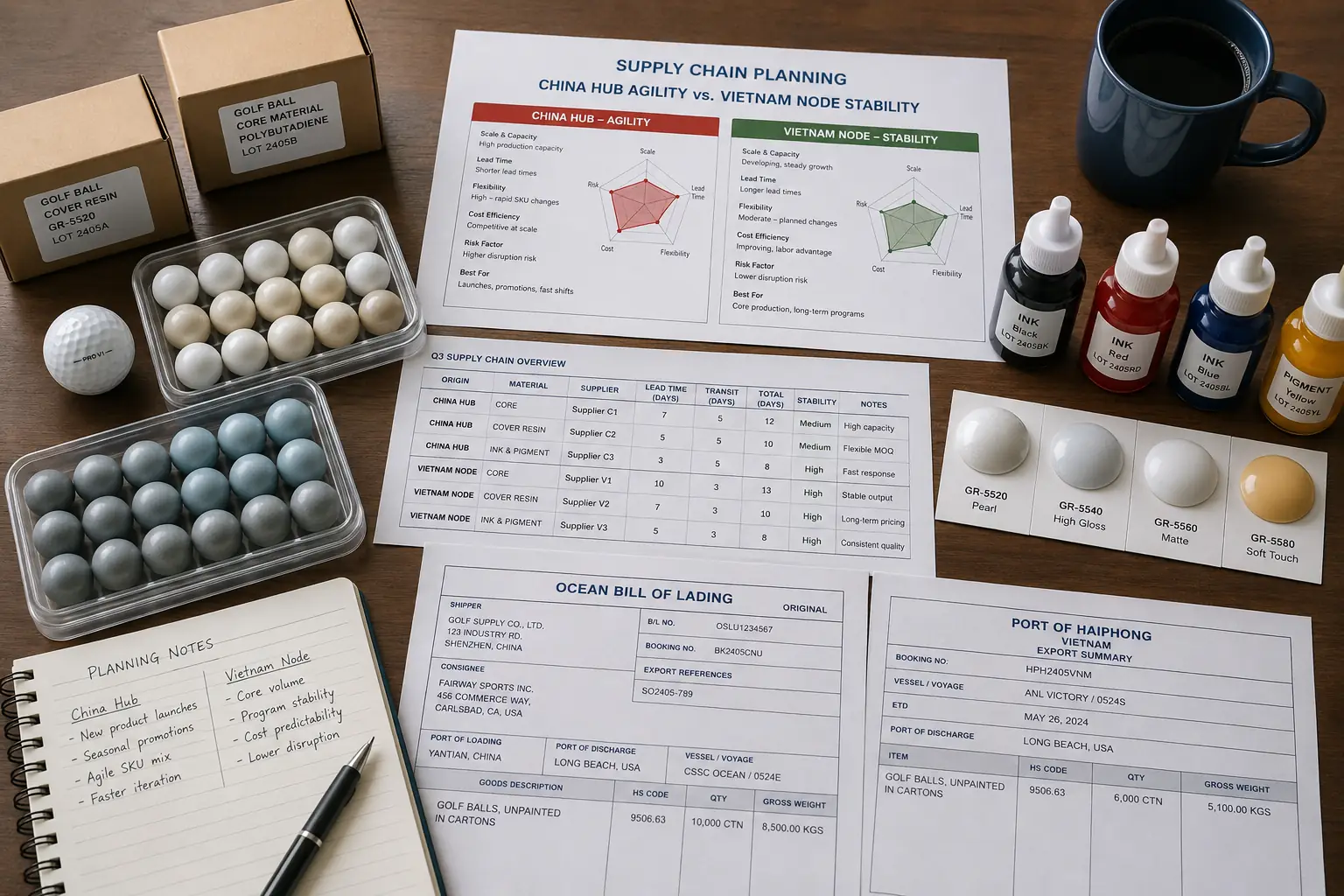
The China-versus-Vietnam decision starts outside the factory gate. A golf ball program depends on core compound, cover resin, ink, clear coat, sleeve, carton, gift packaging, labels, export cartons, trucking, forwarder coordination, and port access. When one piece slips, your launch calendar starts losing days.
China’s advantage is that it functions as a full supply-chain hub. Guangdong supports volume programs and broad supplier depth. Fujian can support full-process coordination and established golf-ball production ecosystems. Zhejiang and Ningbo are especially valuable for flexible customization, logo work, small-batch testing, and packaging experiments. That is why agile golf ball OEM manufacturing is usually easier to run in China.
Vietnam is improving and useful for locked-spec volume, but it is often a narrower production node. For some programs, cover materials, specialty inks, cartons, or packaging components may be externally coordinated or imported. That does not make Vietnam weak. It means your team should plan more buffer and verify the material path before promising delivery dates to retailers.
Ask each supplier for a supply-chain map covering core compound, cover resin, ink, clear coat, sleeve, carton, gift packaging, and export port. Check which inputs are local, which are imported, and which have approved backup suppliers. Choose Vietnam only when the material path and booking plan fit your launch calendar; choose China when your program needs supply-chain redundancy.
How Does Localized Supply Cut Delays?
Localized supply cuts delays because your factory can fix problems without waiting for a distant supplier, imported component, or separate packaging vendor to catch up.
In China’s key golf ball clusters, especially Zhejiang/Ningbo and Guangdong-style supply chains, the core compound supplier, cover vendor, ink supplier, carton printer, EVA gift-box factory, and export forwarder can often sit within the same province or a short 3-hour trucking radius. That physical proximity becomes a practical safety net. It allows same-day artwork corrections, overnight carton replacements, faster packaging revisions, and more realistic rush recovery when a retail buyer suddenly moves your launch date forward.
International logistics benchmarks also support the same practical point: China has stronger infrastructure and denser shipping connectivity than most competing manufacturing nodes. For OEM buyers, that means more backup routes, more carrier choices, more trucking options, and better recovery when one plan breaks. Vietnam is a serious manufacturing base, but its network is narrower and should be planned with more buffer.
✔ True — Vietnam is serious, but China has broader redundancy.
Vietnam can work well for forecasted volume. China usually gives buyers more supplier, packaging, trucking, port, and backup-route options when plans change.
✘ False — “A good factory alone protects the launch.”
The factory matters, but so do nearby materials, packaging vendors, sample teams, port options, and backup routes.
Who Survives Peak Season Better?
You may win retail demand and still lose the season if your supplier cannot rush materials, packaging, or shipping after the order changes.
China usually survives peak-season golf ball OEM pressure better because materials, printing, packaging, and export options sit closer together. Vietnam can handle stable forecasted orders, but sudden surges, new molds, imported inputs, or packaging changes can push planning windows toward 8–12 weeks.
| Timeline pressure | China response | Vietnam response | Buyer action |
|---|---|---|---|
| 2-piece replenishment | Often 12–18 days after approval | Longer if slot/materials wait | Use China for rescue orders |
| 3-piece PU order | Often 20–30 days depending spec | Plan longer booking windows | Freeze spec early |
| New mold/formula | Faster iteration path | Can stretch toward 8–12 weeks | Avoid last-minute changes |
| Packaging delay | Local box/printing backup | More schedule friction | Approve backup pack |
| Missed sailing | More route alternatives | Needs more buffer | Request 3 sailing options |
Peak season exposes the difference between a supply chain and a single factory. When a retailer pulls a delivery date forward, your supplier must answer several questions fast: Are core and cover materials ready? Is the ink approved? Is the sleeve printed? Is the export carton confirmed? Is the forwarder holding a realistic sailing? Can the packaging plan change without restarting the calendar?
China usually has stronger recovery options because more pieces sit closer together. For standard 2-piece programs, a China route can often be planned around 12–18 days after approval when specs and packaging are ready. For 3-piece PU programs, planning can be closer to 20–30 days depending on construction, artwork, and QC requirements. These are not magic timelines; they work because the supplier radius is short.
Vietnam can perform well when the order is stable and forecasted. The risk appears when the buyer asks for a new formula, a new mold, a late packaging change, or an urgent reorder after brand-linked capacity is already scheduled. New development or dedicated production planning can move toward 8–12 weeks, especially when materials or packaging are not already secured.
A promised lead time without a material-origin list should make your team pause. It means the factory is giving you a calendar without proving the inputs behind it.
Place this in your RFQ: “Please provide standard and rush lead times, material origin list for core, cover, ink, and packaging, closest export port, normal cut-off day, three sailing options for the target ship week, backup packaging plan, MOQ by SKU, and whether a 1,000 pcs pilot can run before mass MOQ.”
Buyer approval requires standard lead time, rush lead time, MOQ by SKU, packaging sample timeline, export-port plan, three sailing options for the target ship week, and a written backup plan for material or packaging delays.
What Logistics Proof Should You Request?
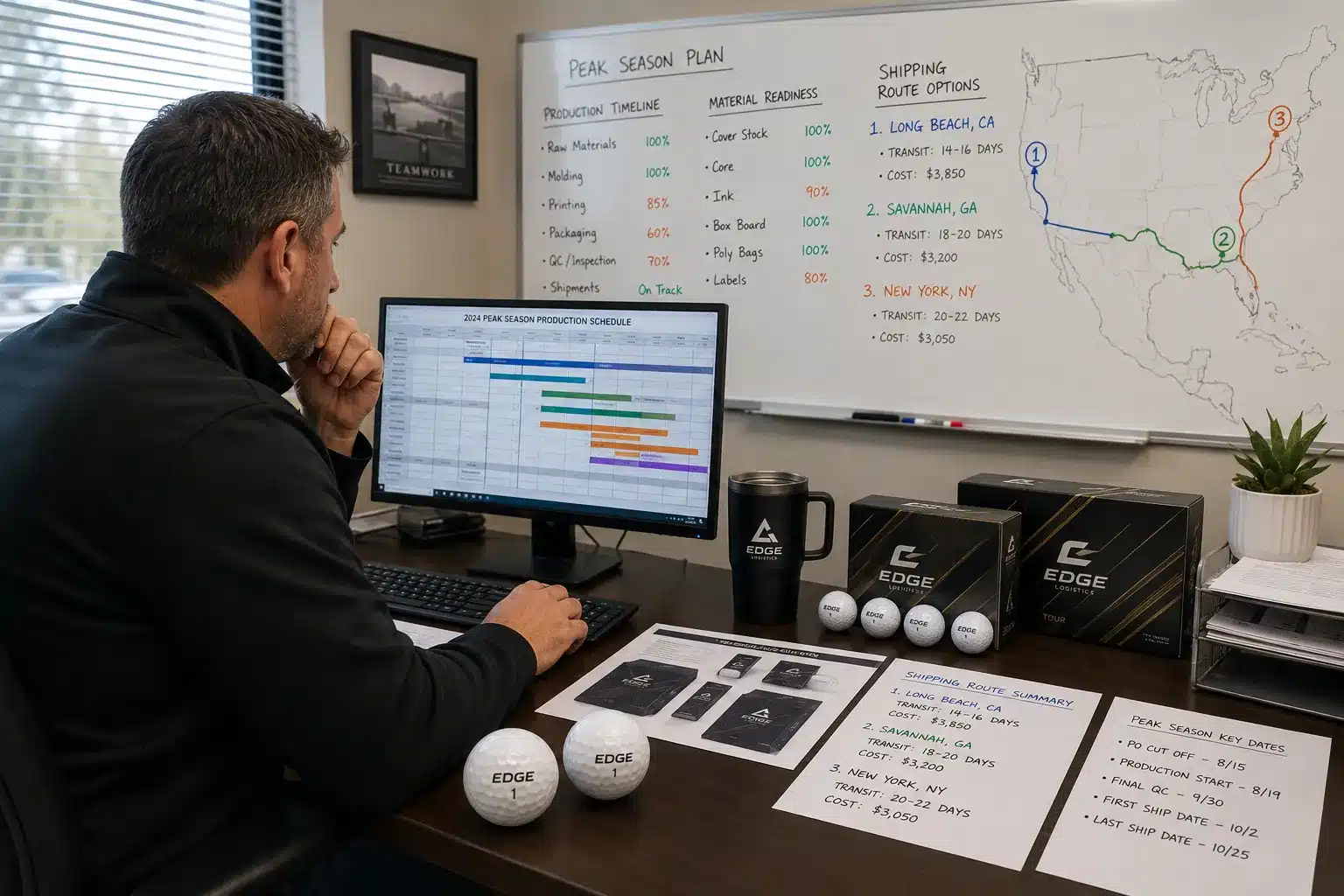
A generic “30–45 days” answer is not enough for peak-season golf ball supplier lead times. You need proof that materials, packaging, and export options are ready.
Ask for the material status of the core compound, cover resin, ink, clear coat, sleeve, carton, and gift packaging. Then ask for the closest export port, normal cut-off day, and three realistic sailing options for the target ship week. These sailing options do not need to be guaranteed before booking, but they should be realistic enough for your forwarder to check.
A good supplier should also show a backup packaging plan. If the EVA gift box is late, can the order ship in a compact white box first? If the sleeve printer misses a date, is there an approved alternate? If the normal port route slips, can the shipment move through another port without resetting the export plan?
Do not approve peak-season routing until the supplier confirms material readiness, packaging readiness, and export backup.
Where Does Customization Move Faster?
You may need seasonal colors, mixed packs, EVA gift boxes, or a DTC unboxing experience, then discover the factory is built for standardized brand orders.
China is usually better for custom golf ball packaging OEM because the ball factory, printing vendors, carton suppliers, gift-box makers, and design teams can coordinate quickly. Vietnam is stronger when the artwork, packaging, and product spec are already locked and the buyer needs repeat execution.
| Customization need | China fit | Vietnam fit | Buyer action |
|---|---|---|---|
| Mixed color pack | Strong | Limited if line is locked | Use China for high-mix testing |
| EVA gift box | Strong packaging ecosystem | May need longer approval | Ask for box sample timeline |
| Seasonal artwork | Fast artwork changes | Changeover friction possible | Freeze launch calendar |
| DTC unboxing | Flexible pack-out options | Better for standardized packs | Pilot pack before mass order |
| Brand-standard repeat | Good, but not always needed | Strong if access confirmed | Use Vietnam for locked specs |
The original China-versus-Vietnam difference can be explained as innovates versus executes. Vietnam is often strong at executing a fixed spec for a brand-style program. That is valuable. A locked SKU, stable artwork, repeat carton, and predictable order rhythm fit Vietnam’s strengths.
China is stronger when your team is still creating the product. Maybe you need four colors in one sleeve. Maybe the DTC team wants a gift box with foam insert, QR card, and seasonal wrap. Maybe the retailer asks for a tournament logo one week before approval. Those requests are not only factory changes; they are packaging, printing, sampling, and pack-out changes.
A gift box approved without a packaging supplier timeline can quietly break the whole shipment. The ball may be ready, but the packaging can still kill the ship date. China’s packaging ecosystem helps because sleeve printers, carton factories, UV printing vendors, EVA box makers, and sample teams can coordinate near the golf ball factory.
For DTC and retail private-label teams, this is where custom golf ball packaging OEM becomes a supply-chain question. It is not only “Can you make a nice box?” It is “Can you revise the box, print it, assemble it, carton it, and still ship on time if the launch calendar changes?”
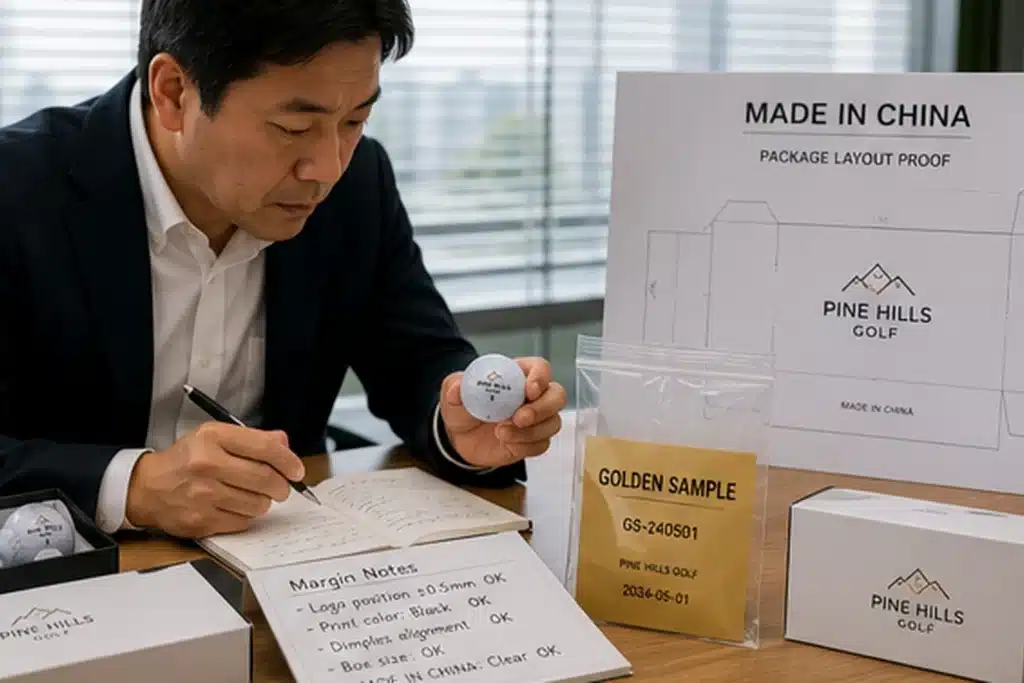
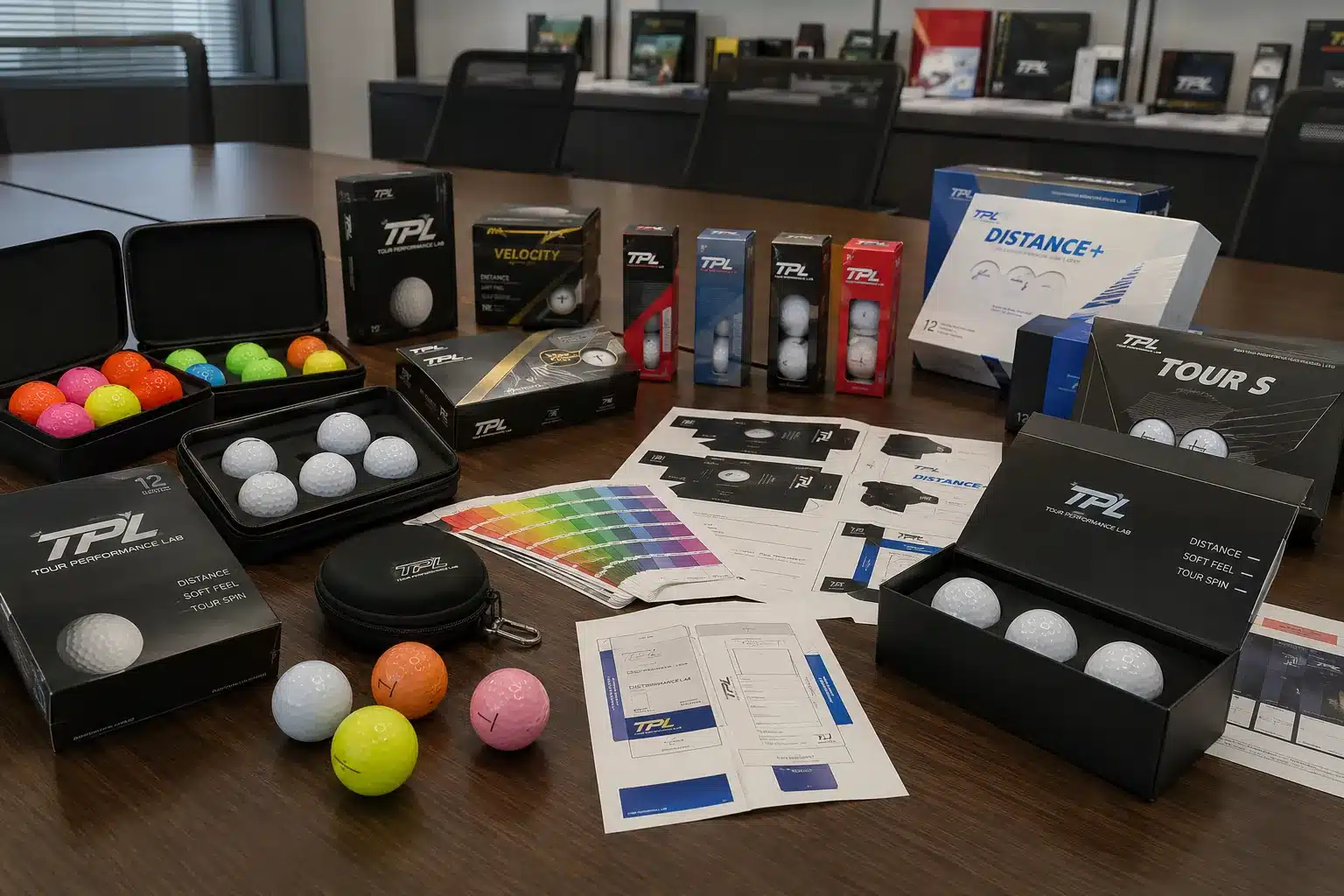
Ask for a customization feasibility sheet listing sample time, MOQ, setup limits, artwork-change rules, and packaging supplier timeline. Compare actual sample photos, box mockups, and pack-out schedules. Use China when customization is still changing; use Vietnam only when packaging and artwork are stable.
✔ True — Execution quality and customization tolerance are different.
Vietnam can execute stable brand programs well. China is usually better when artwork, packaging, colors, and SKU structure are still changing.
✘ False — “Better quality always means better customization.”
Customization speed depends on changeover tolerance, packaging vendors, sample workflow, and how many small revisions the supply chain can absorb.
How Should MOQ Control Risk?
You may treat MOQ as a supplier inconvenience, but for a new SKU it is the size of your commercial mistake if the market rejects the ball.
MOQ is a risk-control tool, not just a factory rule. A 50,000+ piece Vietnam threshold can trap a new brand in dead inventory if the market dislikes the hardness, logo, or packaging. A 1,000–3,000 piece China pilot lets you test, learn, and iterate before scaling.
| SKU stage | Buyer risk | Better route | Evidence to request |
|---|---|---|---|
| New DTC launch | Unknown sell-through | China low MOQ | 1,000 pcs pilot quote |
| New colorway | Wrong color or logo | China agile iteration | Printed sample + small batch |
| Custom mold | High setup lock-in | Vietnam only if mature | MOQ + mold restriction |
| Stable retail SKU | Underbooking capacity | Vietnam if access confirmed | Slot + repeat window |
| Mixed portfolio | Overbuying unproven SKUs | Hybrid | Scale trigger by SKU |
MOQ is not just a production threshold. It is the cost of your commercial experiment. If your first order is too large, every untested decision becomes expensive: ball hardness, cover feel, logo placement, packaging size, retail sleeve color, DTC bundle, and reorder rhythm.
For new formulas, custom molds, or dedicated production lanes, Vietnam-linked brand-style capacity can screen around 50,000+ pieces before the conversation becomes serious. That may be reasonable for a mature retail SKU. It is dangerous for a new DTC brand, an event pack, or a seasonal gift idea that has not proven demand.
50,000 pcs MOQ before market proof is a warning sign. It means your cash is being converted into inventory before the market has answered. If customers dislike the feel or packaging, you do not have a sourcing problem anymore; you have dead stock.
China’s flexible clusters help because low-thousand-piece programs are more realistic when the construction, artwork, and packaging fit. Golfara can support custom programs from about 1,000 pcs in suitable projects, with logo and packaging support. That lets your team test, learn, and improve before you scale.
This is golf ball supply chain risk mitigation in plain language: keep the first mistake small. Use the first run to test feel, logo durability, sleeve design, packaging density, channel response, and reorder timing. Scale only after your team has data.
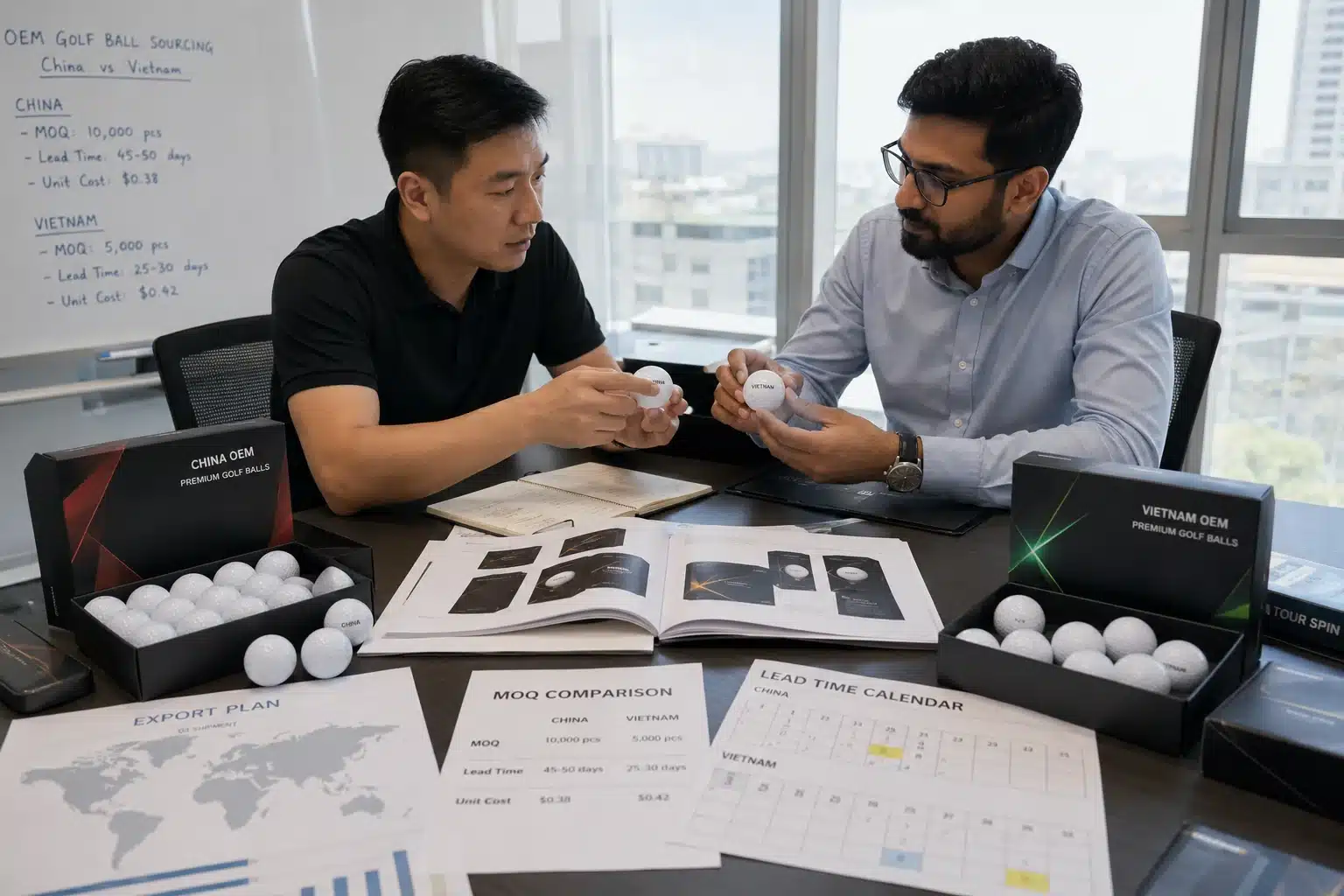
For more detail, see how to negotiate MOQ with Chinese golf ball manufacturers. Ask for MOQ by SKU, color, logo, cover type, packaging, and reorder stage. Do not move into 50,000+ pcs until market demand, packaging, and repeat-order assumptions are proven.
✔ True — MOQ is the cost of your experiment.
A mature SKU can absorb a large run. A new SKU needs smaller learning loops before your team commits serious inventory.
✘ False — “High MOQ proves a better factory.”
High MOQ may simply mean the supplier is built for stable volume, not buyer-side experimentation.
When Should You Choose China or Vietnam?
You may want a universal answer, but the better country changes by sourcing stage, SKU maturity, customization level, and launch risk.
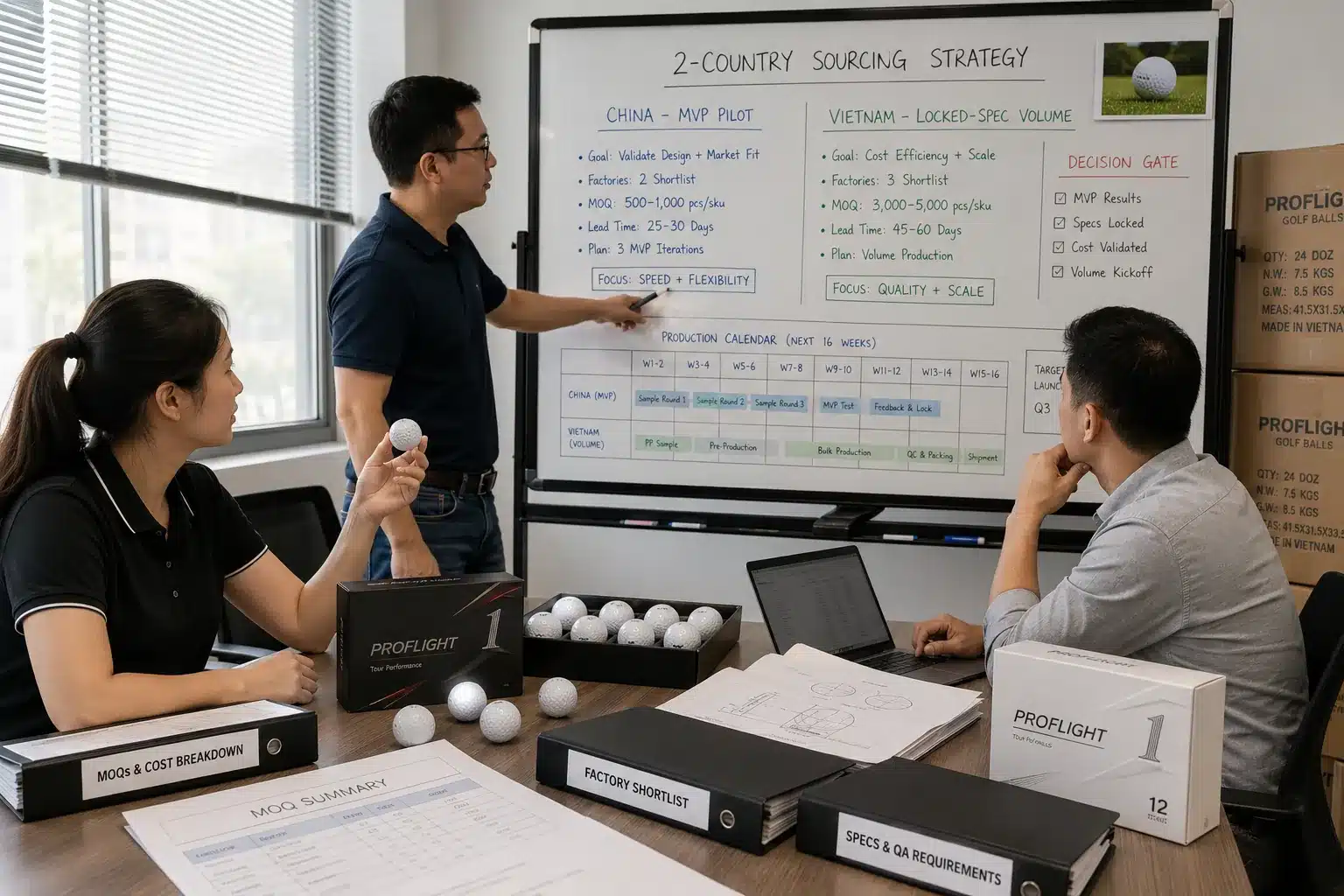
Choose China when your golf ball OEM program needs speed, low MOQ, packaging flexibility, and frequent iteration. Choose Vietnam when the SKU is mature, volume is stable, and the factory slot is confirmed. For many buyers, the safest route is China first for MVP validation, then Vietnam for locked-spec scale.
| Decision area | China advantage | Vietnam advantage | Best fit |
|---|---|---|---|
| Supply chain | Integrated hub | Focused production node | China for agility |
| Lead time | Faster recovery | Stable if forecasted | China for urgent orders |
| Customization | High artwork/pack flexibility | Better for locked packs | China for DTC/gifts |
| MOQ risk | 1,000–3,000 pcs pilots | High-volume discipline | China for new SKUs |
| Execution style | Iterates with buyer | Executes fixed specs | Vietnam for mature volume |
| Logistics redundancy | More backup options | Improving but narrower | China for peak-season risk |
Vietnam is best when the SKU is stable; China is best when the program still needs iteration. That is the cleanest way to answer the China-or-Vietnam question without turning it into a slogan.
Choose China for MVP launches, urgent replenishment, low MOQ testing, packaging-heavy programs, seasonal variants, multiple SKUs, event packs, and DTC experiments. China’s advantage is not only factory speed. It is the ability to revise artwork, adjust packaging, print samples, change cartons, and coordinate exports without waiting for a long chain to reset.
Choose Vietnam when the SKU is mature, the volume is stable, the packaging is fixed, and the supplier slot is confirmed. Vietnam can be a good route for stable brand-style execution when the buyer already knows what the market wants and does not need frequent changes.
For many teams, a staged route is safest: China first for agile validation, Vietnam later for stable volume if access and schedule make sense. If China is the right route, compare supplier options in the Top 10 Golf Ball Manufacturers in China for OEM guide. If Vietnam becomes the mature-volume route, use the Top 4 Golf Ball Manufacturers in Vietnam for OEM directory for factory due diligence.
Request three route quotes: China MVP pilot, China urgent replenishment, and Vietnam locked-spec volume. Compare MOQ, lead time, packaging flexibility, supplier radius, export backup, and changeover tolerance. Select the country only after the route matches SKU maturity, not before.
FAQ
How long does it take to manufacture golf balls in China vs Vietnam?
China is usually faster for flexible OEM programs because materials, printing, packaging, and export options are closer together. A China 2-piece program can often be planned around 12–18 days after approval, while Vietnam requires more planning buffer, especially for new molds or brand-linked capacity.
First-order timing and repeat-order timing are not the same. Repeats are faster when the golden sample, artwork, packaging, and material plan are already approved. Before peak season, ask for standard lead time, rush lead time, material readiness, packaging readiness, and three export sailing options. For urgent replenishment, China’s shorter supplier radius gives your team more recovery options.
Why do golf ball factories have high MOQ?
MOQ covers machine setup, raw material batching, printing setup, packaging runs, and capacity reservation. In Vietnam, brand-linked or custom programs can screen around much higher volumes; China’s flexible clusters can support smaller pilots when the spec fits.
Ask for pilot MOQ and mass MOQ separately. Also ask for MOQ by construction, cover type, color, artwork, sleeve, carton, and gift packaging. A low MOQ is valuable because it lets your team test demand before committing to a large run. For a new brand, MOQ is not just a supplier rule; it is the amount of inventory you are risking before the market responds.
What are the supply-chain risks of manufacturing in Vietnam?
The main risk is agility, not basic capability. Vietnam can work well for stable forecasted volume, but buyers should plan more buffer when the program needs imported inputs, late artwork changes, new packaging, or open OEM capacity.
Verify material origin, packaging readiness, booking windows, and backup routes before PO approval. A Vietnam route can be strong when the SKU is stable. It becomes riskier when the buyer needs frequent design changes, urgent replenishment, or last-minute packaging decisions. Keep a China backup when delivery dates or packaging requirements may move.
Can I customize golf ball packaging easily in OEM orders?
Yes, but location matters. China usually supports custom golf ball packaging OEM more easily because printing, box, EVA insert, sleeve, and pack-out suppliers are close to the golf ball factories. Vietnam is better when the packaging is already locked.
Ask for packaging sample time, carton supplier lead time, gift-box supplier timeline, changeover limits, and pack-out proof. For DTC unboxing, seasonal gift packs, mixed color sleeves, and event kits, pilot the packaging before mass order. A beautiful box that misses the ship date is still a failed launch.
Is Vietnam better than China for premium golf ball OEM?
Vietnam can be strong for stable, brand-style, locked-spec programs, but premium positioning does not automatically solve MOQ, lead time, or customization constraints. China may be better when your premium program still needs iteration.
Define SKU maturity first. If the ball, artwork, packaging, and order volume are stable, Vietnam can be a serious option. If your team is still testing feel, logo, box, or sales channel response, China may protect the launch better. Premium does not always mean “Vietnam first”; it means the route must match the stage.
When should a new DTC golf brand choose China first?
Choose China first when you need to test ball feel, logo, packaging, pricing, reviews, and reorder timing before committing to a large run. A low-MOQ pilot protects your cash and gives you data before scale.
Start with 1,000–3,000 pcs where available and keep packaging simple at first. Measure sell-through, customer feedback, returns, and reorder speed. Once the SKU proves demand, your team can decide whether to scale in China or move stable volume to Vietnam. The first order should teach you something, not trap your cash.
When should Vietnam be used in a hybrid sourcing plan?
Use Vietnam when your SKU is mature, volume is stable, packaging is fixed, and the supplier confirms capacity. Use China for MVP testing, urgent replenishment, seasonal packs, and frequent artwork changes.
Do not move all SKUs at once. Route by SKU stage. China can handle iteration and recovery, while Vietnam can support forecasted execution when the program is locked and the factory slot is real. A hybrid plan works best when each country has a clear job instead of competing for every SKU.
What should I ask suppliers before peak season?
Ask for material readiness, rush capacity, packaging readiness, closest export port, cut-off day, three sailing options, and a backup packaging plan. These answers matter more than a generic lead-time promise.
Check core and cover material status, ink availability, carton schedule, gift-box readiness, and export-port options. Write late-change rules into the PO so the supplier knows what happens if artwork, packaging, or shipping windows move. Peak-season sourcing is not about the best promise; it is about the best recovery plan.
Conclusion
China or Vietnam is not a reputation contest. It is a supply-chain fit decision. China is usually better for agility, low MOQ, customization, packaging changes, urgent replenishment, and peak-season recovery. Vietnam is better for stable, locked-spec volume when the supplier slot, materials, and packaging are already planned.
If your SKU is still being tested, use China to move quickly, learn from small batches, and protect cash. If your SKU is mature and your volume is stable, Vietnam may become a strong execution route.
The best sourcing plan often uses both countries by stage: China for MVP validation and flexible replenishment, Vietnam for forecasted scale when the program is ready.
You might also like — China vs Vietnam Golf Ball Costs: 2026 Tariff & Landed Cost Guide