A cheap FOB golf ball quote can still become your most expensive sourcing mistake.
Most golf balls are made in Asia because Asian OEM hubs combine lower production costs, mature molding and coating systems, material supply, logo printing, packaging, testing, and export logistics. In 2026, buyers should choose golf ball suppliers by landed cost, tariff exposure, MOQ flexibility, lead time, and factory control—not FOB price alone.
For sourcing teams comparing a golf ball OEM manufacturer, private label golf ball supplier, or custom golf ball factory in China, Thailand, or Vietnam, the real question is not simply “Why Asia?” It is whether the supplier can keep samples and bulk production consistent, document the process clearly, and protect your margin after freight, duties, packaging, inspection, and delivery.
Asia still offers one of the strongest golf ball supply chains in 2026, but the risk has shifted. Low FOB pricing can hide landed-cost surprises, vague “urethane” claims can blur TPU and cast urethane differences, and hidden subcontracting can turn a good sample into an unstable second shipment. This guide helps you evaluate Asia by sourcing control, not just manufacturing cost.
Why Does Asia Lead OEM Golf Ball Manufacturing?
Asia may look cheaper at first, but your real question is sharper: can the supplier hold quality, documentation, replenishment, and landed cost after the first sample?
Asia dominates OEM golf ball manufacturing because it connects material sourcing, molding, coating, printing, packaging, testing, and export logistics in one mature production ecosystem. For your sourcing team, the practical question is no longer whether Asia is cheap, but which Asian supplier can protect bulk consistency and margin.
Asia’s advantage is not one magic factory. It is a connected system. Rubber core compounds, ionomer and Surlyn cover materials, TPU or urethane cover options, dimple molds, spray coating, pad printing, UV marking, retail sleeves, gift boxes, cartons, and export packing can often be coordinated within the same region. That reduces handoff risk and shortens the path from sample approval to repeat orders.
For U.S. buyers, the import structure also supports the logic. In 2024, U.S. imports of HS 9506.32 golf balls reached about $382.25M, with the largest origins including Taiwan/Other Asia, Thailand, China, Vietnam, Korea, Indonesia, and Japan. This proves U.S. import dependence on Asian golf ball supply, not a standalone proof of the global 80% figure.
That concentration does not mean every Asian supplier is safe. It means the mature capacity is there, and your job is to separate real process control from a smooth sales email.
Ask suppliers for a process map showing which steps are in-house and which steps are outsourced. The map should identify the owner for core molding, cover molding, coating, logo printing, packaging, and final QC. Do not approve a supplier that cannot identify the production location and QC owner for each major process.
✔ True — Asia’s real advantage is supply-chain density.
Lower labor cost helps, but the bigger B2B advantage is faster coordination between materials, tooling, printing, packaging, testing, and export handling.
✘ False — “Asia wins only because wages are low.”
That view misses why repeat buyers stay: a good Asian OEM partner can turn a ball spec, logo file, retail pack, and export shipment into one controlled workflow.
Which Asian Hub Fits Your OEM Project?
You can lose money by choosing a country name instead of choosing a SKU strategy. China, Thailand, Vietnam, Taiwan, Korea, and Japan solve different sourcing problems.
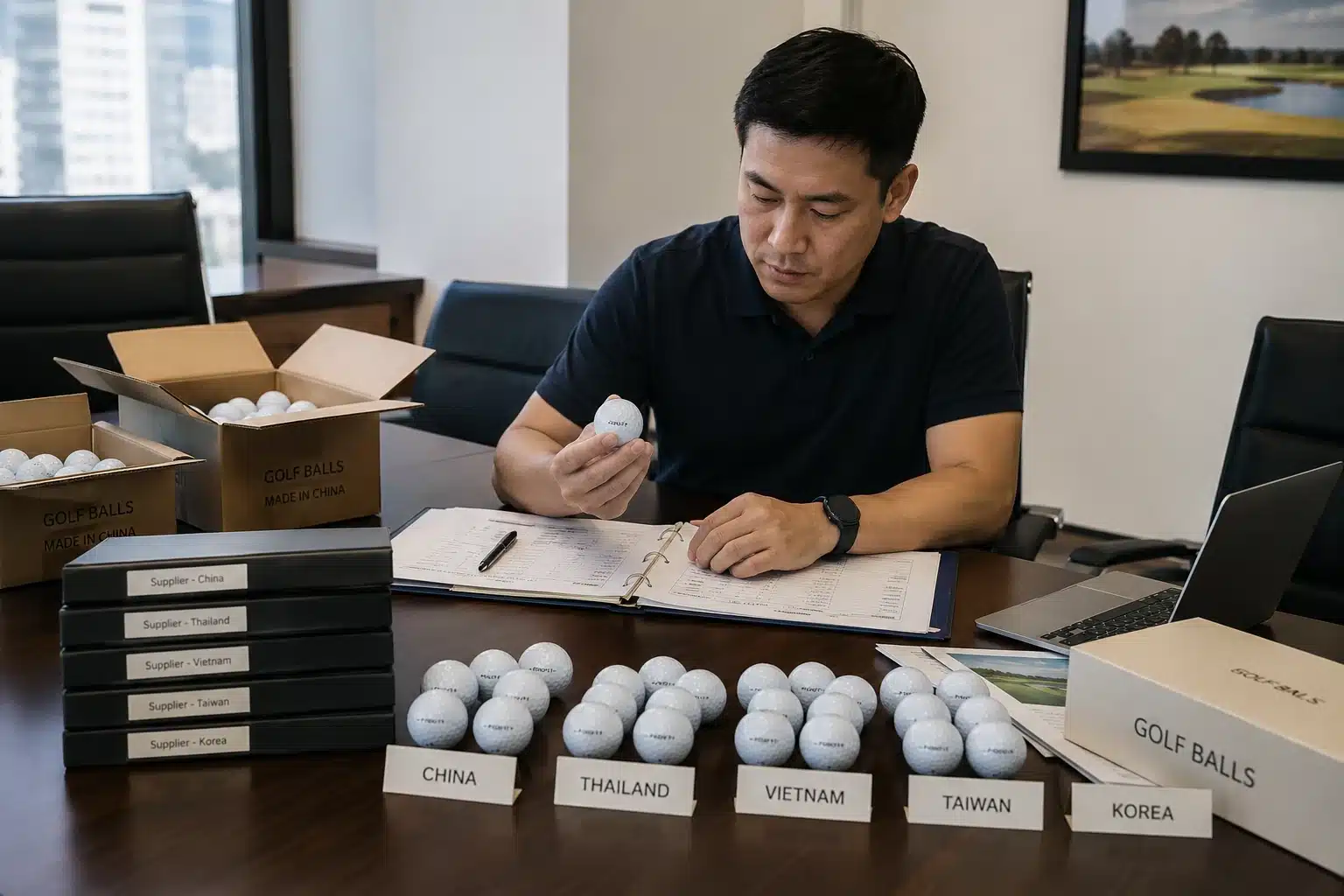
China is usually strongest for value-tier, private-label, logo, practice, and packaging-heavy golf ball programs. Thailand and Taiwan fit higher-performance urethane projects, while Vietnam is useful when your team needs China Plus One risk control. The best hub depends on your SKU, channel, packaging, and replenishment plan.
Use the country comparison as a sourcing filter, not as a fixed rule.
| Sourcing decision | Best-fit hub | Typical strength | Risk to check | Evidence to request |
|---|---|---|---|---|
| Low-to-mid OEM volume | China | Cost, MOQ flexibility, packaging | FOB-only comparison | Landed-cost model |
| Premium urethane SKU | Thailand/Taiwan | Cast urethane and QA depth | Higher MOQ or slower ramp | Cover-process proof |
| China Plus One program | Vietnam | Origin diversification | Limited upstream depth | Actual process location |
| Strict consistency program | Korea/Japan/Taiwan | Coating, color, QA control | Higher cost | Batch QC history |
| Gift or event-use packaging | China/Guangdong | Print and packaging ecosystem | Packaging cost creep | Ball + packaging quote |
A wholesale two-piece logo ball, a DTC premium sleeve, and a tournament-positioned urethane SKU should not be sourced with the same logic. China is often the practical starting point for 2-piece Surlyn balls, 3-piece Surlyn balls, practice balls, event balls, LED night golf balls, logo projects, and retail packaging experiments. Zhejiang, Guangdong, and Fujian each have different strengths, from flexible MOQ to larger-scale production and faster print/packaging support.
Mapping the Top B2B Golf Ball Sourcing Hubs
China suits programs where cost control, small-batch trials, logo customization, and packaging coordination matter. Thailand and Taiwan fit buyers who need stronger premium urethane capability.
Vietnam can help reduce single-origin exposure, but you still need to verify where the core, cover, coating, and packaging work actually happen. A China Plus One program is strongest when it is planned as a process strategy, not a flag on a carton. Mature buyers may use China for mold development, dimple pattern refinement, packaging, or early SKU testing, then evaluate Southeast Asia for final assembly or origin diversification when legally and operationally appropriate.
Private molds also deserve more attention than they usually get. If your brand wants a unique dimple pattern, require a written private mold agreement that defines dimple pattern ownership, mold maintenance responsibility, storage terms, replacement cost, and unauthorized reuse restrictions. The risk is not only tooling cost. It is seeing your pattern quietly reused for another private-label program after you paid for the development.
For packaging-heavy projects, Guangdong can beat a lower FOB quote elsewhere because you do not need to source gift boxes, PET boxes, sleeves, inserts, and specialty logo work across multiple provinces or countries. Request separate quotations for ball-only, ball-plus-logo, and ball-plus-retail-packaging. Choose the hub that protects your channel margin and reorder plan, not the one that wins one spreadsheet cell.
What Golf Ball Type Matches Your Channel?
Layer count sounds technical, but it can mislead purchasing. Your real decision is whether the construction matches your retail price, customer skill level, durability need, and reorder model.
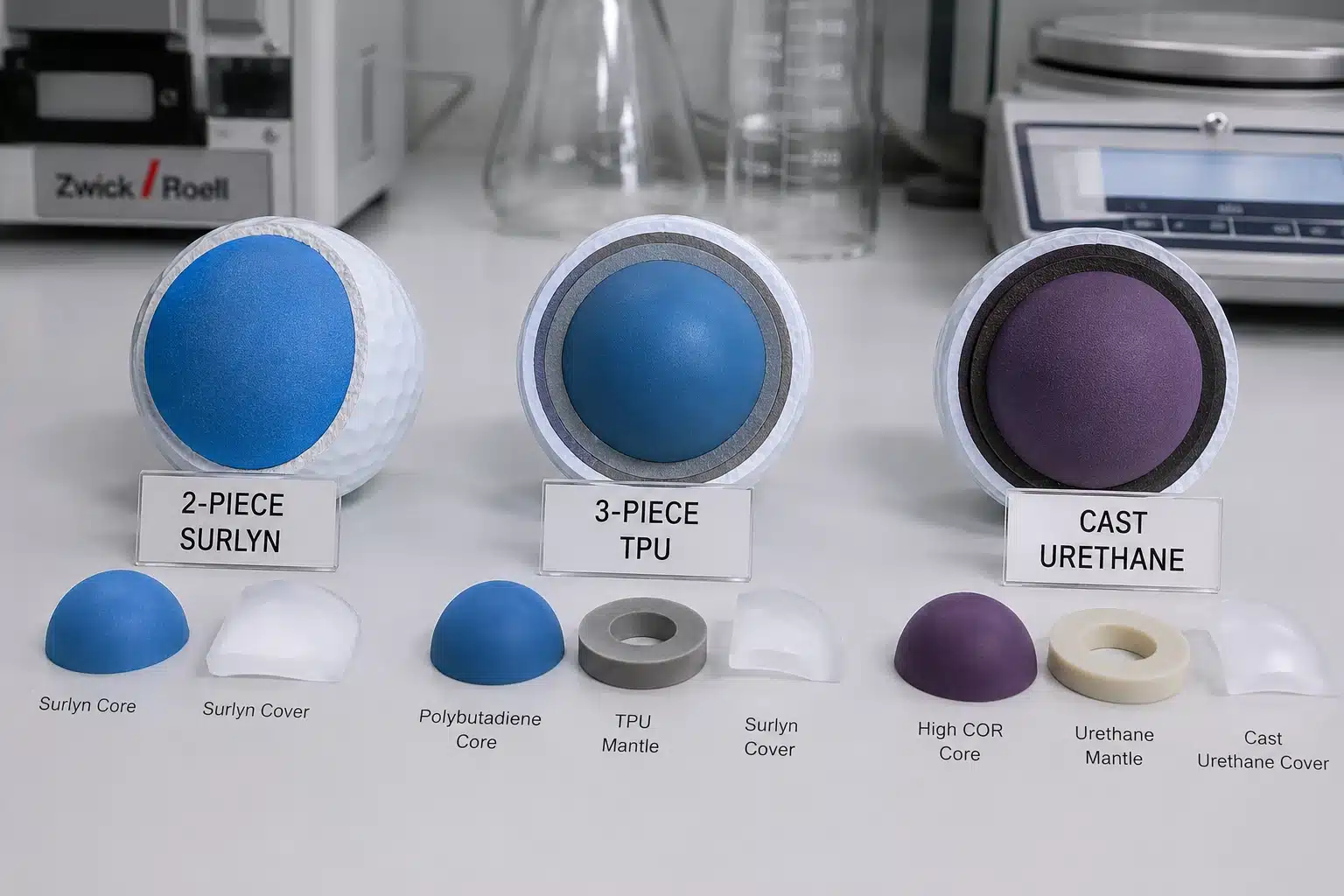
For private label golf balls wholesale, the right construction depends on your selling channel, not the layer count alone. Use 2-piece Surlyn for durable value programs, 3-piece Surlyn for mid-tier retail, injection TPU for cost-friendly urethane positioning, and cast urethane for premium performance claims.
A 2-piece Surlyn or ionomer ball is the workhorse for practice, event-use, corporate gift, range, and value retail programs. It is durable, efficient to produce, and easier to repeat at scale. A 3-piece Surlyn ball adds a mantle layer, giving your SKU a more refined feel and improved short-game positioning without jumping into full urethane cost.
Injection TPU urethane is common in Chinese OEM production because it supports efficient production, better yield, and a more cost-friendly “urethane” position. Cast thermoset urethane is more complex. It can support softer feel, stronger wedge spin, and better cut resistance, but it also raises cost, process difficulty, and QA demands.
A weak specification only says “urethane” without declaring the process. Your PO can state that bulk production shall match the approved sample in construction, cover material, compression window, logo durability, packaging specification, and visual finish. Any cover-process change requires written approval before production.
TPU vs Cast Urethane: What Buyers Must Confirm
Before sampling, require the supplier to state whether urethane means injection-molded TPU or cast thermoset urethane. The word alone does not define the performance ceiling.
Injection TPU can be a strong business choice for low-to-mid retail, private label, and premium-looking gift programs. It gives buyers a more advanced material story while keeping production more scalable. Cast urethane fits premium performance SKUs where the buyer can support higher cost, stricter testing, and a more demanding customer claim.
Ask for a material declaration naming Surlyn/ionomer, injection TPU, or cast thermoset urethane. Then request a Material CoC, cover-process declaration, abrasion evidence, and logo adhesion evidence. If your customer is buying a corporate gift ball, do not overpay for a tour story. If your channel promises greenside control, do not approve vague urethane wording.
✔ True — Urethane needs a process definition.
Injection TPU and cast thermoset urethane can both sit under the urethane umbrella, but they carry different cost, yield, feel, spin, and durability profiles.
✘ False — “Any urethane ball is automatically tour-level.”
For OEM purchasing, the useful question is not just the material name. It is the cover process, test evidence, and whether the SKU promise matches your channel.
Sourcing Strategy — 2-Piece vs 3-Piece Golf Balls: The Ultimate B2B Bulk Sourcing & QC Guide
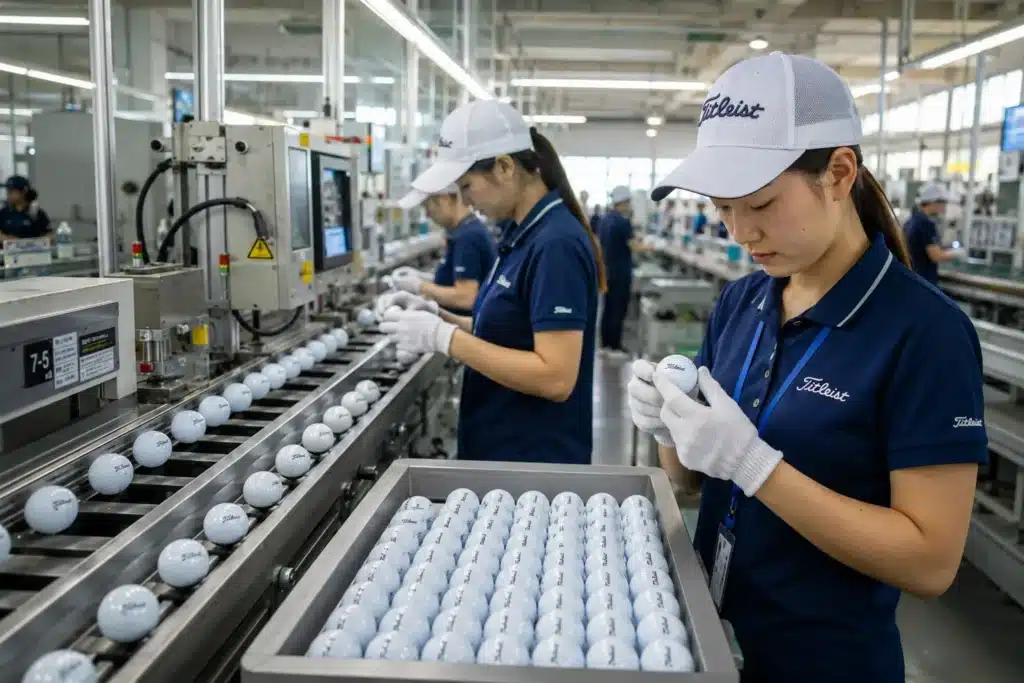
A factory video is useful only when it helps you verify process control, line ownership, and real production capability.
See how a working golf ball line looks in practice.
How Should You Model Landed Cost?
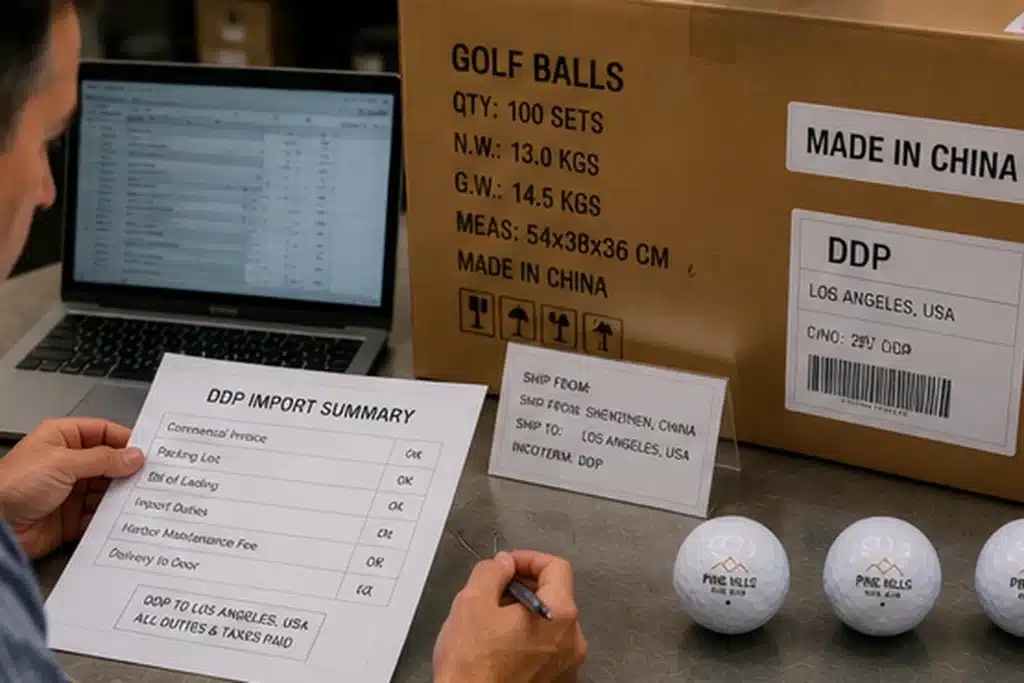
You can accept a low FOB price and still lose margin after tariff exposure, customs fees, freight, packaging, inspection, brokerage, and U.S. delivery.
FOB is no longer enough for golf ball OEM sourcing. You should model full landed cost by adding tariff exposure, MPF/HMF, freight, packaging, inspection, customs brokerage, and domestic delivery before choosing China, Vietnam, Thailand, or another Asian origin.
A buyer-friendly landed-cost model should split the cost items clearly.
| Cost item | Why it changes margin | What to request | Evidence to request |
|---|---|---|---|
| FOB ball price | Only factory gate cost | Ball construction and pack-out quote | SKU-level comparison |
| Tariffs and duties | Origin risk changes landed cost | HTS and broker confirmation | Current entry assumptions |
| MPF/HMF | Small but still relevant in many U.S. entries | Entry-cost estimate | Broker calculation |
| Packaging | Gift boxes and PET packs change unit economics | Packaging BOM | Pack-out sample |
| Inspection | Prevents batch failure | PSI or factory QC report | Pre-shipment record |
| U.S. delivery | Affects DTC and distributor margin | DDP or landed quote | Channel-based delivery cost |
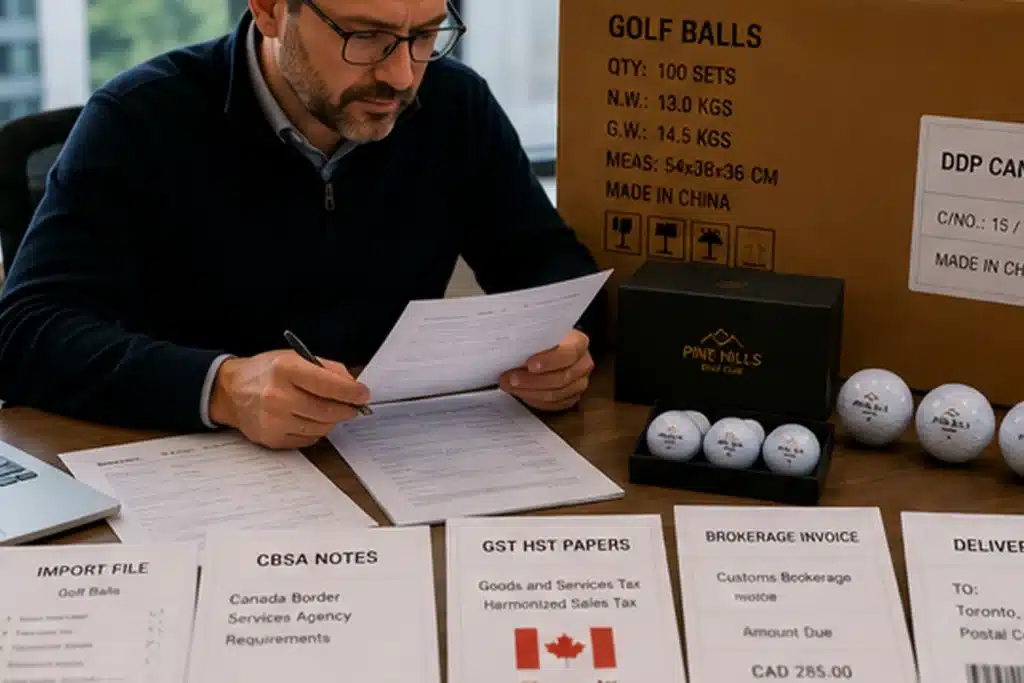
For U.S. imports, golf balls are commonly reviewed under HTS 9506.32.0000, where the base duty can be free. Free does not mean landed-cost-free. A formal entry can still involve tariff exposure, MPF, HMF for ocean cargo, customs brokerage, freight, inspection, insurance, carton handling, domestic delivery, and chargebacks if the pack-out is wrong.
2025–2026 U.S. Tariff Shock: Why FOB Pricing No Longer Works
Treat tariff volatility as a margin risk. The safe sourcing habit is to model scenarios, not memorize one rate and hope it stays still.
The 2025 tariff shock made the weakness of FOB-only buying obvious. China-related tariff exposure reached extreme reported levels during the escalation, and Vietnam was also listed for a threatened reciprocal tariff. Those figures should be framed as historical shock and policy volatility, not as current fixed rates. For current purchasing, your broker should confirm HTS classification, origin treatment, Section 301 exposure, temporary surcharge status, MPF/HMF, and entry assumptions before the PO.
U.S. buyers now compare origin risk, not just factory price. A supplier that quotes FOB only and avoids landed-cost discussion may be hiding weak export thinking. A low unit quote can be erased by packaging, inspection, customs, and delivery. A $0.45 FOB ball can become much higher once tariffs, freight, cartons, inspection, and U.S. delivery are modeled. Ask for FOB, CIF, and DDP versions when available, then compare them by wholesale, DTC, event-use, or distributor channel.
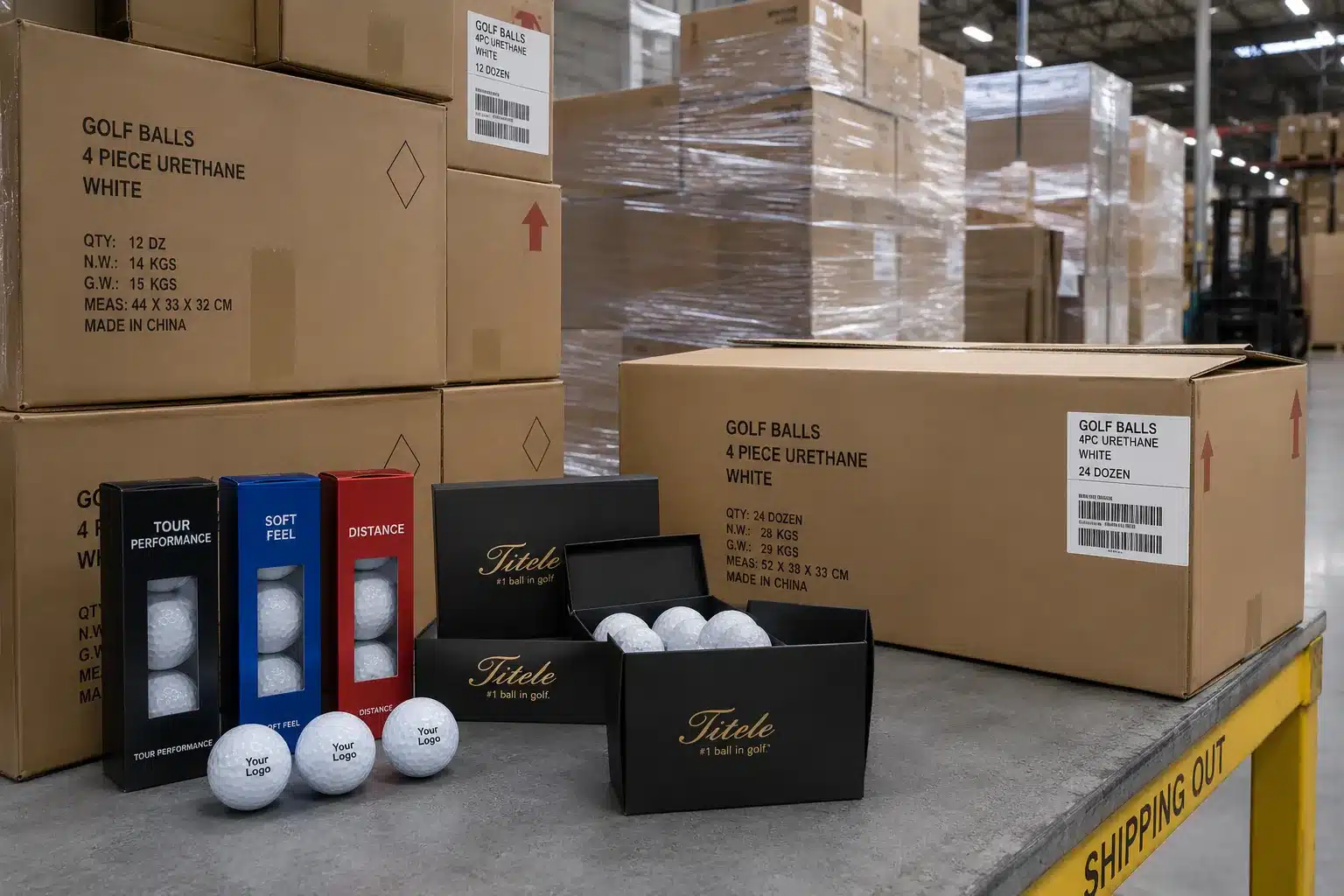
✔ True — HTS Free does not mean the shipment has no import cost.
Base duty is only one line. Added tariffs, customs fees, freight, packaging, inspection, brokerage, and domestic delivery can still change your landed margin.
✘ False — “The lowest FOB quote is the safest quote.”
The safest quote is the one that survives your landed-cost model under the channel you actually sell through.
You may think you are buying from a factory, but your order can be quietly passed to a smaller workshop after sampling.
The fastest way to reduce Hidden Subcontracting risk is to verify process control before approving the first order. You should ask who controls core molding, cover molding, coating, stamping, final QC, resin lot tracking, and batch records—not only who sends the quotation.
Hidden Subcontracting is dangerous because the first sample can look fine while the second shipment exposes the real process. That is where compression drift, off-center cores, paint adhesion failure, logo wear, mixed packaging, and weak corrective action appear. A supplier can be responsive and still not control production.
Factory Verification Checklist for OEM Buyers
A real golf ball supplier should connect its business identity, production line, testing equipment, batch records, and shipping entity without creating a document maze.
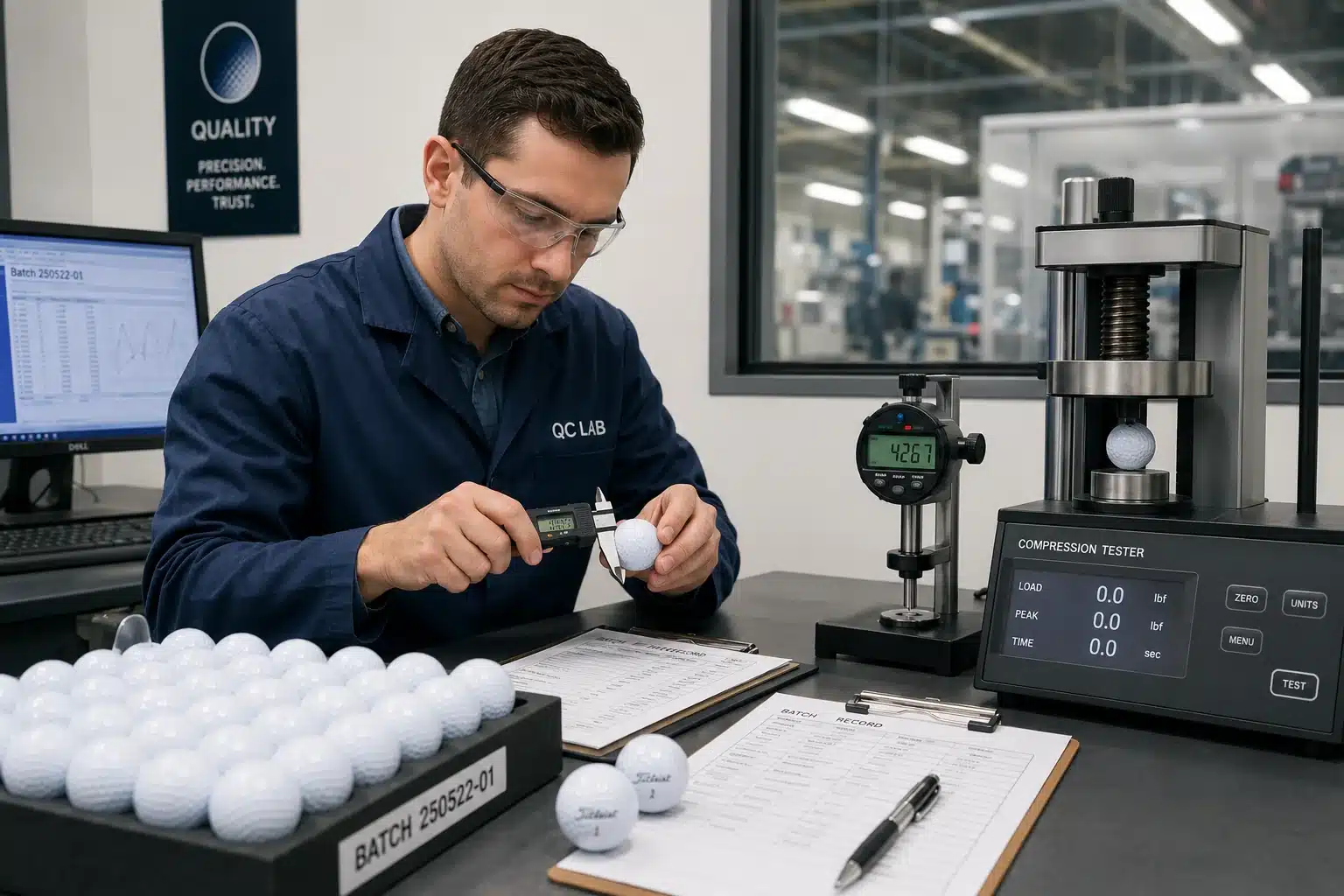
Ask for the business license, product focus evidence, live production-line video, equipment list, current calibration certificates, X-ray or CT report template, resin lot tracking sheet, and one pre-shipment QC report sample. The testing setup should fit the product claim: electronic scale, ring gauge, compression tester, Shore D hardness tester, X-ray or CT capability for concentricity, coating or adhesion checks, and records tied to lot IDs.
Place this RFQ verification line in the supplier request: “Please provide an in-house process list, live production-line video for the quoted SKU, current equipment calibration certificates, and one 12-ball pre-shipment QC report template.”
A supplier that refuses live line video creates a real verification gap, especially when it claims full factory control. Add a no-subcontract clause requiring written approval before any process is outsourced. Match the factory address, line video, QC report, commercial invoice entity, and packing list before scaling.
✔ True — Process ownership beats brochure polish.
A real factory should show how the quoted SKU moves through molding, finishing, QC, packing, and shipment. Clear batch records are harder to fake than nice photos.
✘ False — “A fast reply proves the supplier is a real factory.”
Speed helps, but it does not prove production control. Verify equipment, calibration records, lot tracking, and line ownership before the first PO.
Strategic Guide — 2026 Guide to Golf Ball OEM in China: Factory Audit Checklist & Sourcing Secrets
How Do You Control MOQ and Lead Time?
You can choose the right supplier and still miss the selling season if MOQ, artwork, packaging, curing, inspection, and freight are not locked early.
MOQ and lead time are not fixed numbers; they depend on construction, mold status, packaging, artwork approval, and production season. You should reserve capacity before final artwork approval, use existing molds for trial orders, and separate production lead time from final delivery date.
Use this planning table before you accept a lead-time promise.
| Decision | Risk | Better sourcing move | Acceptance proof |
|---|---|---|---|
| First trial order | Inventory pressure | Use existing mold/formula | Trial MOQ confirmation |
| Peak-season reorder | Line time unavailable | Reserve capacity early | Locked production window |
| Complex packaging | Approval delay | Approve box dieline early | Written artwork deadline |
| Unclear delivery term | FOB vs delivery confusion | Separate lead time and delivery date | PO with both dates |
| MOQ too high | Cash tied up | Split shipment or piggyback batch | Storage or split-shipment terms |
MOQ changes with construction, mold status, material, logo complexity, packaging, and line schedule. A simple 2-piece logo ball using an existing mold may support a smaller trial than a new dimple pattern, custom compression window, or premium retail pack. For cautious buyers, flexible MOQ reduces inventory pressure and lets your team validate channel fit before scaling.
MOQ Tactics for First-Time OEM Orders
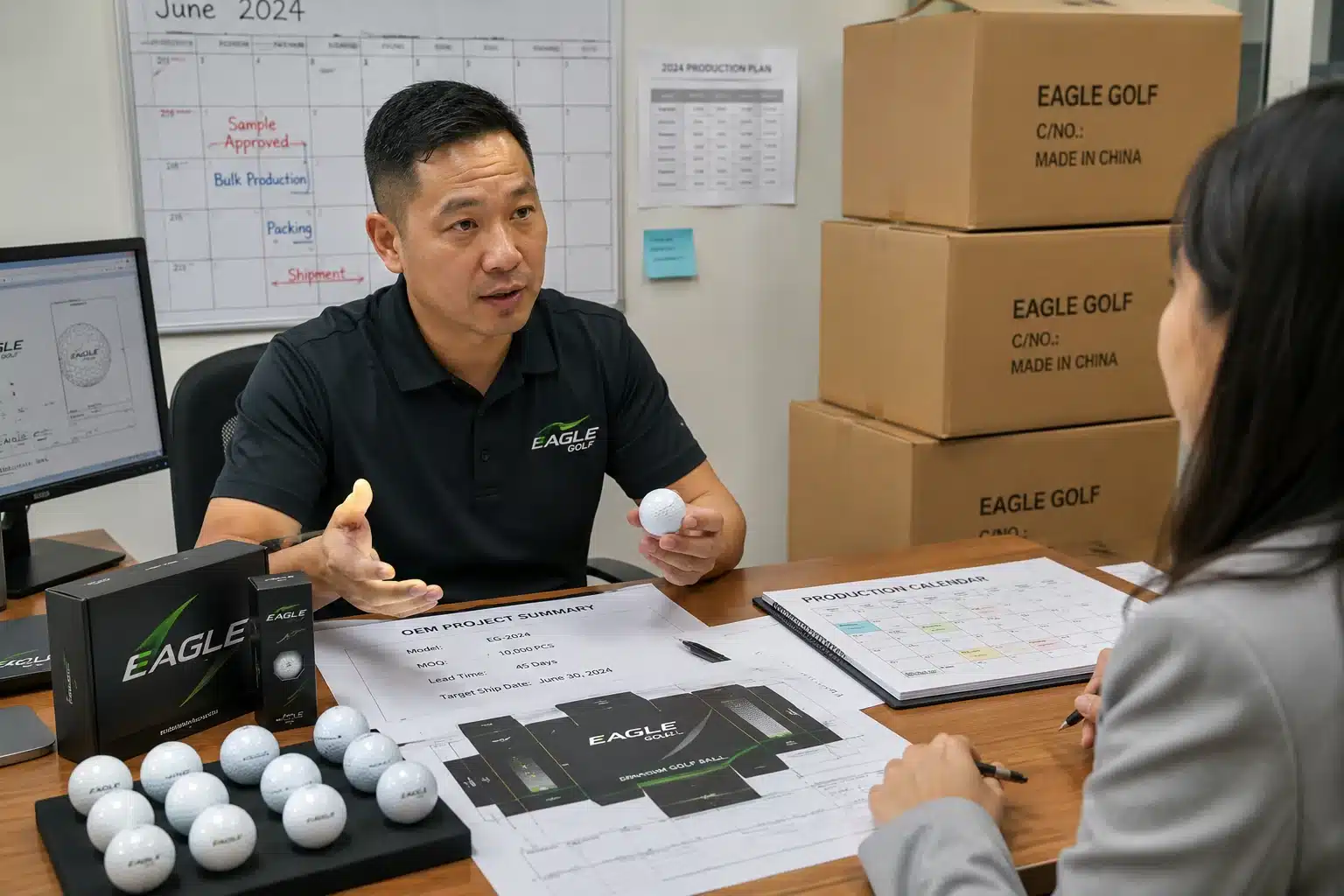
First orders should prove the supplier, not overload your warehouse. Existing molds, standard formulas, and staged delivery can reduce risk before your channel commits.
During peak season, the bottleneck is not only the mold. Line time, coating cure windows, logo approval, packaging production, final inspection, export documents, and sea freight space can all delay a shipment. Reserve capacity before artwork is fully polished, then approve dielines and print files on a written schedule.
Ask for a written production timeline from deposit and artwork approval to ready-to-ship date. Confirm whether the quoted lead time includes packaging production, logo printing, final inspection, and export document preparation. Your PO should define lead time, delivery date, Incoterm, packaging approval deadline, split-shipment option, and responsibility for late artwork changes. Boring? Absolutely. Useful when spring replenishment is at risk? Even more absolutely.
As one example, a China-based OEM partner with flexible MOQ and DDP support can help cautious buyers test demand before scaling. That works best when the supplier also gives written timeline control, clear pack-out details, and pre-shipment QC evidence.
FAQ
How do US tariffs affect golf ball manufacturing in 2026?
Tariffs affect your landed cost more than your factory quote, so you should confirm HTS classification, origin, Section 301 exposure, temporary surcharge status, MPF/HMF, and customs-broker assumptions before issuing the PO.
- Treat 2025 tariff spikes as policy-volatility evidence, not current fixed rates.
- Start the U.S. classification conversation with HTS 9506.32.0000, then let your broker confirm the current entry treatment.
- Model China, Vietnam, Thailand, Taiwan, and other origins separately.
- Compare wholesale, DTC, and promotional shipments separately because freight, packaging, and domestic delivery change the final unit cost.
Who manufactures private label golf balls for big brands?
Many OEM relationships are protected by NDA, so the safer answer is regional rather than brand-specific: private-label and global-brand programs are concentrated in Asian hubs with mature molding, coating, printing, packaging, and export systems.
- Do not rely on rumored brand-factory relationships.
- Ask for process ownership, material declarations, testing equipment, packaging experience, and export documents.
- Capability evidence is more useful than confidential customer names.
- A serious OEM partner should be able to prove repeatability without exposing another buyer’s private program.
What is the cost to manufacture a 3-piece golf ball in Asia?
There is no universal cost because cover material, construction, yield, logo printing, mold status, packaging, inspection, freight, and tariff exposure all change the final number. FOB is only the first line in your cost model.
- Separate 3-piece Surlyn, injection TPU urethane, and cast urethane before comparing quotes.
- Confirm whether the quote includes white box, sleeve, PET box, gift box, or bulk pack.
- Request tooling, testing, certification, and inspection costs separately.
- Do not compare prices unless construction, logo method, pack-out, and delivery term match.
How can you verify a Chinese supplier is a factory?
Verify process ownership, not only the company name. A real golf ball factory should be able to show relevant production lines, testing equipment, calibration records, batch QC documents, and clear process control.
- Ask for live line video, not only brochure photos.
- Check whether core molding, cover molding, coating, stamping, final QC, and packaging are in-house.
- Request current calibration certificates and one 12-ball pre-shipment QC report template.
- Add a no-subcontract clause before scaling the order.
Does urethane always mean tour-level cast urethane?
No. In OEM sourcing, urethane may mean injection-molded TPU or cast thermoset urethane. You should require the supplier to state the cover material and forming process before approving samples.
- Injection TPU is usually more cost-friendly and easier to mass-produce.
- Cast thermoset urethane is more complex and usually linked to premium spin and softer feel positioning.
- Neither option is automatically better for every sales channel.
- Ask for material CoC, cover-process declaration, abrasion evidence, and logo adhesion evidence.
Who should pay for USGA or R&A testing on OEM balls?
This should be decided in the contract. If your own brand name must appear on the conforming list, confirm who pays submission, renewal, sample, shipping, and resubmission costs.
- Do not rely on a factory white-label listing if your brand needs tournament eligibility.
- Confirm whether the project needs a new submission, annual renewal, or only proof of prior capability.
- Write fee responsibility, brand-name ownership, and renewal expectations into the PO.
- Keep certification documents tied to your exact model, marking, and approved construction.
How do you prevent sample-to-mass production drift?
You need a written approved-sample standard and batch QC record, so the production lot stays traceable to the same construction, material, compression window, coating, logo process, and packaging specification.
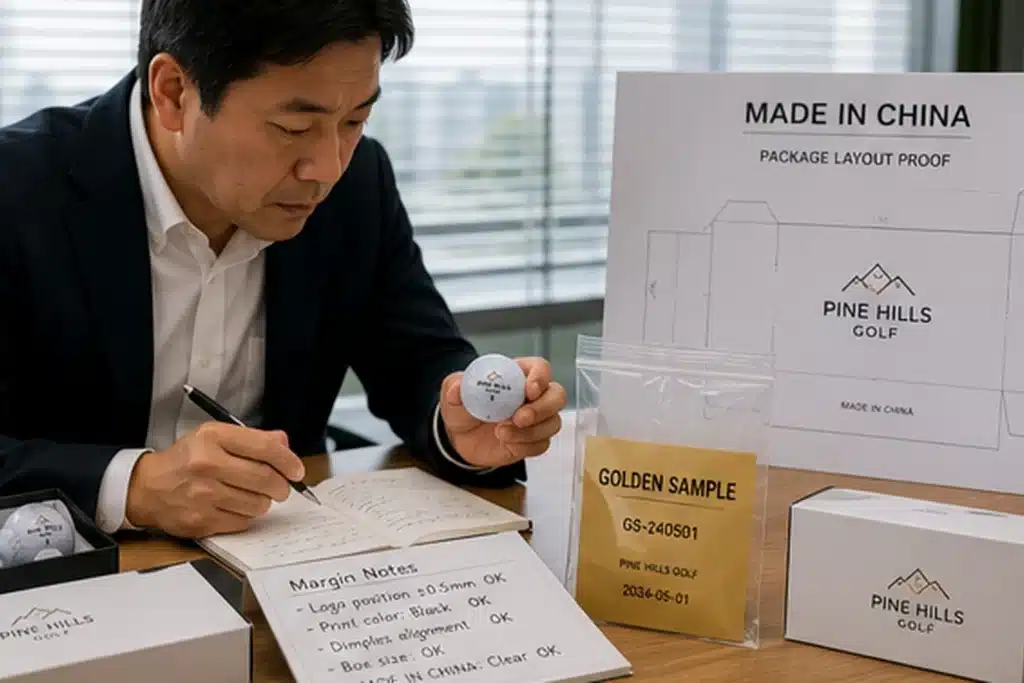
- Keep one sealed golden sample.
- Require a 12-ball statistical QC report before shipment.
- Compare weight, diameter, compression, appearance, logo durability, and packaging against the approved standard.
- Use third-party inspection or lot-linked factory records for the first order.
When should you choose DDP instead of FOB?
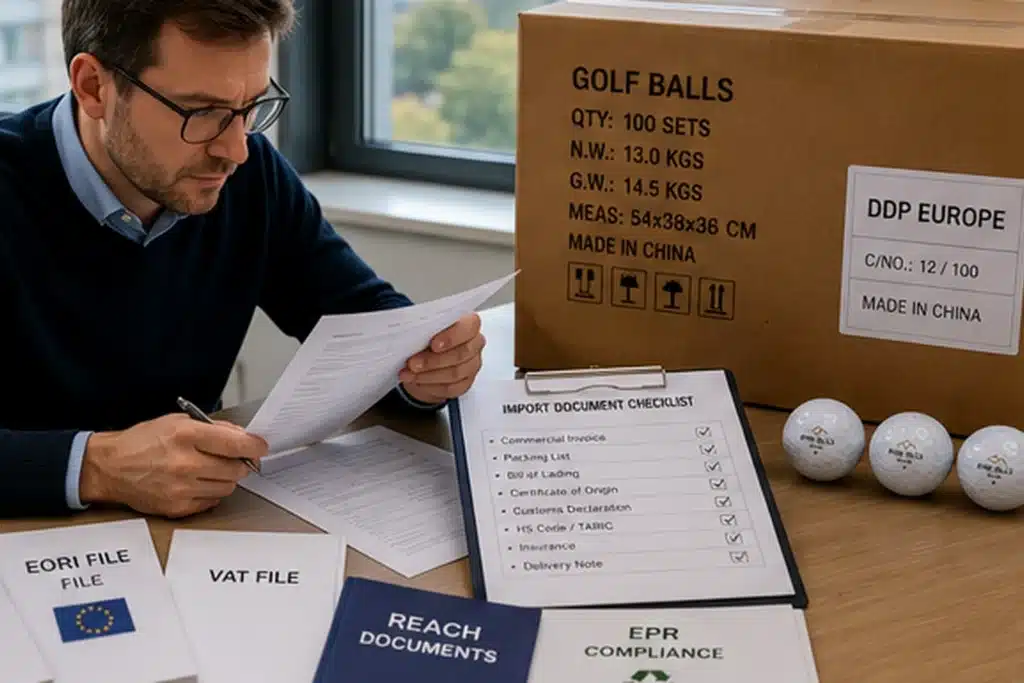
DDP can be useful when your team wants simpler execution and less logistics coordination, but you still need to compare the included tariff, freight, customs, delivery, insurance, and responsibility boundaries.
- Use FOB when you have strong broker and freight control.
- Use DDP when execution convenience matters and the supplier can itemize what is included.
- Compare FOB, CIF, and DDP under the same SKU, packaging, carton quantity, destination, and delivery deadline.
- Never compare DDP directly to FOB without normalizing missing cost items.
Conclusion
Asia remains the dominant OEM base for golf balls because it combines production scale, material access, packaging support, export experience, and flexible private-label execution. But the winning sourcing decision is no longer “Asia is cheaper.”
For your team, the stronger decision is to compare suppliers by landed cost, factory control, MOQ flexibility, lead-time discipline, and repeat-order reliability. Once those points are written into the quotation, sample approval, QC records, and PO, Asia’s manufacturing advantage becomes usable margin—not just a low number on a spreadsheet.
You might also like — How to Choose a Reliable Golf Ball Manufacturer in China?