A supplier can quote a 4-piece flagship as the premium upgrade and still leave your team with a basic unanswered question: what does the fourth layer actually change in this SKU?
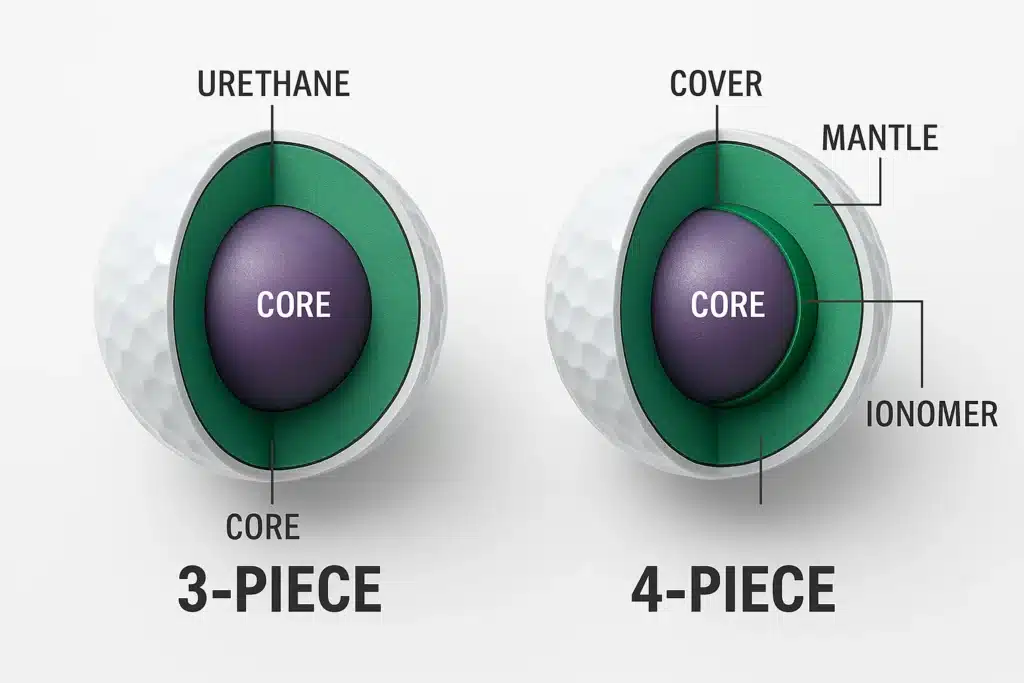
A 3-piece golf ball typically uses a core, mantle, and cover; a 4-piece adds another functional layer, often a second mantle or a dual-core design. Piece count describes architecture, not quality. For OEM sourcing, approve 4-piece only when that added layer creates a buyer-valued difference that production can repeat.
For OEM and private-label programs, use the 3-piece candidate as the comparison baseline. Then ask three questions: Did the added layer create the intended measurable difference? Will your target customer value it? Can your supplier reproduce it through pilot, bulk production, and reorder?
If your program has not yet established that premium multi-layer baseline, first choose between 2-piece and 3-piece golf ball constructions.
For this decision, keep one sequence in view:
Fourth-Layer Job → Measurable Difference → Buyer Value → Repeatability

Which SKU Should You Source First?
A 4-piece construction can make a premium launch look stronger on a product sheet. The commercial risk appears later if customers cannot identify the upgrade or your channel cannot explain why it deserves a separate SKU.
Your first premium SKU should be the simplest architecture that can prove the product promise. A 4-piece candidate should move ahead only when it challenges the 3-piece baseline on a named requirement and your target customers show that the resulting difference has real value.
For this article, 3-piece is the comparison baseline because you have already decided your program belongs in premium multi-layer construction. That does not make 3-piece the “mainstream” choice or 4-piece the “advanced-player” choice.
It gives your team a reference point.
Before discussing another layer, define what the finished ball should accomplish for the customer you actually serve. That may include a particular feel, flight behavior, spin relationship, or another performance-sensitive requirement. Swing speed may help describe a target group, but it should not become a universal architecture rule.
A first SKU and an upgrade SKU also perform different commercial jobs. The first needs to establish your product promise. The upgrade needs to show why somebody who already accepts the baseline should move.
In March 2024, we worked with a Toronto retailer planning a CAD 59.99 4-piece house-line launch for customers largely in the 88–98 mph swing-speed range. We suggested testing a tuned 3-piece candidate before locking the flagship SKU. Seventeen of 24 golfers—about 71%—preferred the 3-piece candidate. Dispersion tightened by about 8%, landed cost fell by about 18% for that launch, and the ball launched at CAD 49.99. Eight weeks later, sell-through ran about 22% above plan, while the 4-piece moved to an upgrade role.
The fourth layer should earn its launch position through customer response and commercial evidence—not through layer count alone.
Those results belong to this specific retail program. They do not show that 3-piece golf balls are generally better than 4-piece golf balls. They show something narrower and more useful: this buyer’s target market did not create enough first-launch value for the more complex candidate.
A simple comparison keeps flagship bias from replacing evidence:
| Buyer Decision | 3-Piece Baseline | 4-Piece Candidate | Evidence | Buyer Action |
|---|---|---|---|---|
| First premium launch | Establish product promise | Challenge the baseline | Target-customer pilot | Launch after demand proof |
| Established upgrade | Approved current SKU | Add a new product role | Candidate comparison | Define the upgrade job |
| Premium niche | May leave a specific need | Add tuning freedom | Segment feedback | Test exact target users |
| Unclear demand | Keep validated baseline | Do not escalate yet | No clear unmet need | Define the problem first |
More layers create more tuning options, not automatic buyer value. Your team should identify what remains unsolved after the baseline is established before development moves forward.
Prepare a Target Player / Performance Brief tied to the comparison baseline and intended channel. If the proposed fourth layer cannot be connected to an unmet requirement in that brief, hold the architecture decision.
✔ True — The baseline is the simplest architecture that already satisfies the product promise.
A 4-piece candidate can challenge that baseline, but it still needs a named customer requirement and evidence that the added architecture improves the exact product you plan to sell.
✘ False — “A flagship private-label launch should start with 4-piece because it looks more premium.”
Flagship positioning is a commercial role, not a layer-count rule. The fourth layer still has to earn that role.

What Must the Fourth Layer Actually Do?
“Dual mantle,” “tour construction,” and “premium 4-piece” sound specific until you ask what the additional layer is engineered to change. If the answer remains vague, you are buying architecture before the product objective is defined.
A fourth layer is another tuning variable, not a quality grade. Your supplier should state what the added mantle is intended to change, which 3-piece baseline it challenges, what trade-off is expected, and which finished-ball result will verify that the extra architecture performed its intended job.
The construction stack should be explicit: core, Mantle 1, Mantle 2, and cover.
A serious 4-piece proposal should assign an intended role to each intermediate layer in the exact SKU. One construction may use an added mantle toward an energy-transfer objective. Another may target long-game behavior, approach behavior, feel, support beneath the cover, or another declared outcome.
Those are possible design objectives, not universal 4-piece benefits.
A useful product-development illustration comes from Titleist’s current Pro V1 and Pro V1x engineering material. Its descriptions assign distinct jobs to the core or dual core, casing layer, dimple system, and urethane cover rather than presenting layer count itself as the benefit. That does not make one manufacturer’s design logic an industry rule. It demonstrates the discipline your supplier should be able to show: each important component should have an intended job.
What Should Each Mantle Be Designed to Do?
Your supplier should be able to explain which layer was added, what it is intended to change, which finished-ball outcome should move, what trade-off is expected, which 3-piece candidate serves as the baseline, and what evidence will verify the claimed difference.
Trade-off belongs in that conversation.
A mature 4-piece proposal should not suggest that one extra layer automatically improves speed, spin, feel, flight, durability, and every laboratory number at once. Additional architecture creates more tuning freedom; engineering choices determine how that freedom is used.
Our own finished-SKU records illustrate why that distinction matters. Both candidates below use an Injection TPU cover route, which removes one important cover-route difference, but their complete internal recipes are still different.
| Metric | 3-Piece Injection TPU | 4-Piece Injection TPU | Buyer Interpretation |
|---|---|---|---|
| Compression Avg. | 86.92 | 105.17 | Layer count does not define one compression profile |
| Shore D Avg. | 57.75 | 50.25 | Read hardness with the complete construction |
| COR Avg. | ~0.790 | ~0.775 | More layers do not make every metric move upward |
The 4-piece candidate recorded substantially higher average compression while its recorded Shore D and COR were lower than the 3-piece candidate. That pattern does not make either construction better.
It shows why layer count is a poor substitute for finished-SKU evidence.
These are two real finished SKUs, not a controlled experiment in which the fourth layer was the only variable. Their full internal recipes were not controlled as a one-variable experiment. Core formulation, mantle formulation, layer thickness, dimple design, compression target, coating, or other variables may also differ. The data show different finished-ball profiles; they do not isolate the fourth layer as the sole cause.
Both recorded candidates also passed the same room-temperature internal impact condition of 185 ft/s × 50 impacts. That supports only the narrow conclusion that both tested samples completed that recorded condition. Their low-temperature protocols differed, so those records should not be used as a direct durability ranking.
Be cautious when your supplier says “4-piece is premium” but cannot explain the function of the added mantle or what finished-ball result should demonstrate it.
Supplier shall identify the approved 3-piece baseline and 4-piece candidate by construction stack, intended mantle function, declared cover route, sample ID, and test reference. Any comparison used for SKU approval shall identify the samples and methods used.
Ask for a one-page Fourth-Layer Job Statement plus a Construction Stack Sheet. You are not paying for another layer as a label. You are paying for the function assigned to it.
How Should You Compare 3-Piece and 4-Piece?
A 3-piece baseline and a 4-piece candidate can differ in architecture, compression target, recipe, dimples, cover route, sample stage, and test method. If all of those move together, the test may still help you choose a product—but it cannot isolate what the fourth layer caused.
A fair 3-piece vs 4-piece golf ball comparison controls what it can and documents what it cannot. If cover route, target profile, sample condition, and test method all change at once, you can compare the finished SKUs commercially, but you cannot attribute every difference to the fourth layer.
A Finished-SKU Comparison answers a commercial question:
Which complete candidate better fits your program?
That comparison remains useful even when several specifications differ because your business ultimately buys a complete golf ball, not an isolated layer.
An Architecture Comparison asks a narrower question:
What did adding the fourth layer itself change?
That conclusion requires stronger control over the other important variables.
A 2019 controlled golf-ball structure study illustrates the methodological difference. When the researchers wanted to examine construction more directly, they held weight, dimple count, and compression strength constant while comparing different structures. The sourcing lesson is not that one architecture universally wins. It is that architecture attribution becomes more credible when other major variables are controlled.
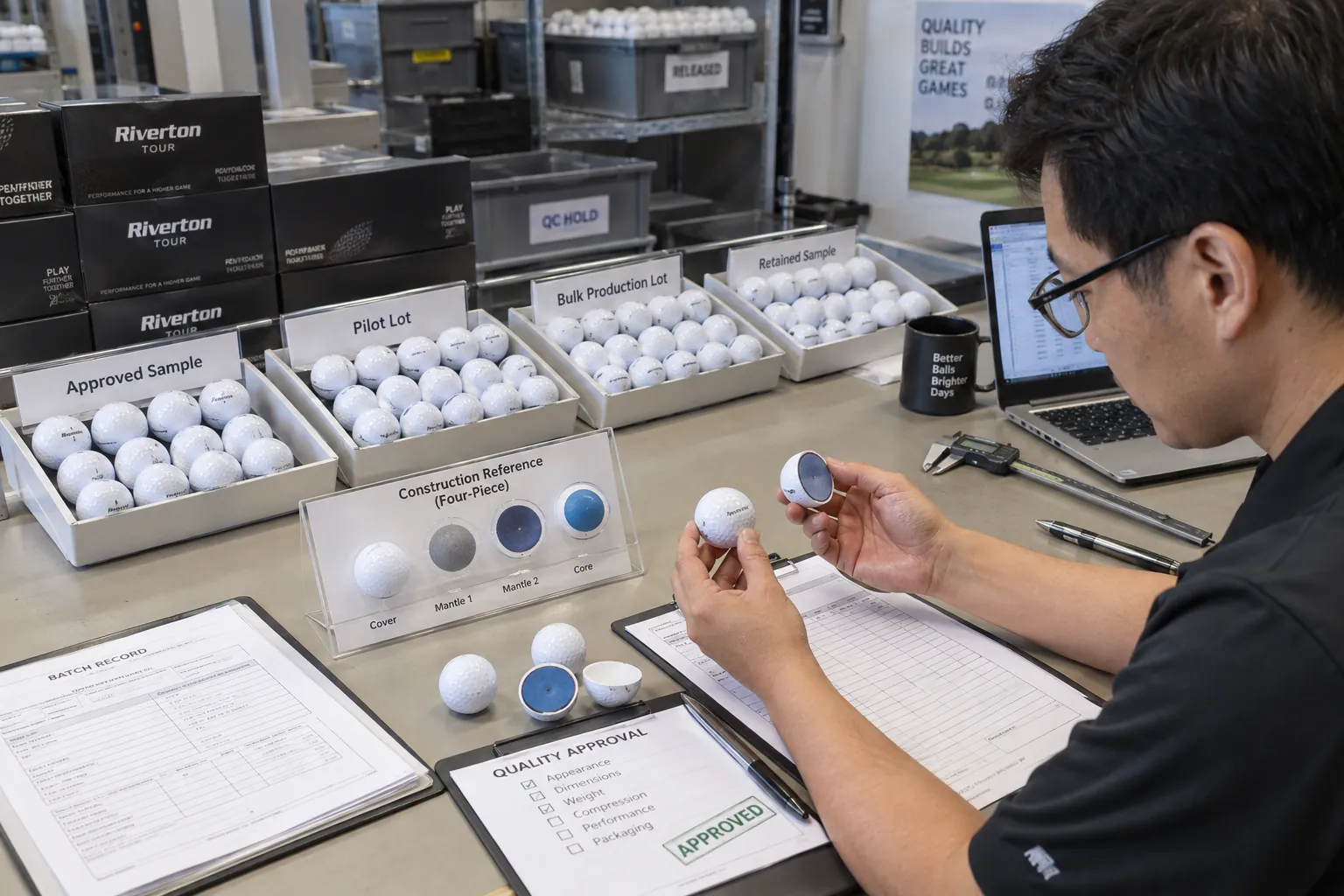
Are the Two Candidates Actually Comparable?
Before accepting a layer-count conclusion, identify what changed besides the architecture.
Your team should know which variables were intentionally kept comparable and which remain different. Intended use, target customer, cover route, target-compression basis, aerodynamic family, sample stage, sample identity, test method, and test condition can all affect how confidently you interpret the result.
Five questions usually expose a weak comparison quickly:
-
What changed besides layer count?
-
Which variables were intentionally held comparable?
-
Which variables remain different?
-
Were both samples evaluated using compatible methods and conditions?
-
Does the conclusion apply to the whole finished SKU or specifically to the fourth layer?
Architecture and cover route are separate specification decisions. A 3-piece and 4-piece candidate may both use Injection TPU and still have very different finished profiles. They may also use different urethane manufacturing routes.
When the real decision becomes the cover process, move that question to TPU vs cast urethane cover routes instead of letting a material-process difference masquerade as a layer-count conclusion.
If your supplier compares unrelated samples, methods, or conditions and then presents the result as proof of what the fourth layer caused, the comparison is not strong enough for architecture attribution.
Use one sourcing request to force the comparison onto a common basis:
Please provide one 3-piece baseline and one 4-piece candidate with the construction stack, intended function of each mantle, declared cover route, sample IDs, comparable test method, buyer-selected performance comparison, and pilot-verification deliverable.
Your 3-vs-4 Comparison Sheet should label the conclusion honestly. If several variables changed, describe the result as a finished-SKU difference. Reserve a specific fourth-layer attribution for evidence strong enough to support that narrower claim.
✔ True — Two complete candidates can be compared commercially even when several variables differ.
That comparison can tell you which finished SKU better fits your program. It does not automatically identify the fourth layer as the cause of every measured difference.
✘ False — “Any 3-piece vs 4-piece test proves what the fourth layer caused.”
Architecture attribution requires appropriate controls, identified samples, and compatible test methods and conditions.
When Does 4-Piece Earn the Extra Complexity?
Your testing may show that the 4-piece candidate behaves differently from the 3-piece baseline. That is useful, but it is not yet enough to justify a commercial SKU.
A measurable difference is only the first gate. Your 4-piece SKU also needs a target customer or channel that values that difference enough to support its positioning, price, inventory, and reorder burden. If the market cannot use the benefit, the fourth layer has not earned its commercial role.
The first gate asks whether the 4-piece delivered the result it was designed to create.
That target might involve a different long-game behavior, approach response, feel profile, spin relationship, flight objective, or another premium performance requirement.
These are development targets. They are not automatic characteristics of every 4-layer golf ball.
The second gate asks whether your customer values that result.
A launch monitor can help answer the technical question. It cannot tell you whether your retail buyer can explain the upgrade, whether your golfer prefers it, whether a DTC customer will pay for it, or whether the SKU generates enough repeat demand to justify inventory.
That is why Technical Difference ≠ Commercial Value.
Rules such as “105+ mph means 4-piece,” “4-piece means lower driver spin,” or “4-piece is better in wind” are too broad for an OEM architecture decision. A faster-swinging or performance-sensitive target group may create a reason to evaluate a specific candidate. The candidate still has to prove the intended result.
Independent robot testing across modern premium balls also illustrates why a single 4-piece performance template is risky. Different four-piece urethane models can produce different launch and spin profiles even when their layer count looks similar on paper. Architecture creates tuning capacity; engineering choices determine how that capacity is used.
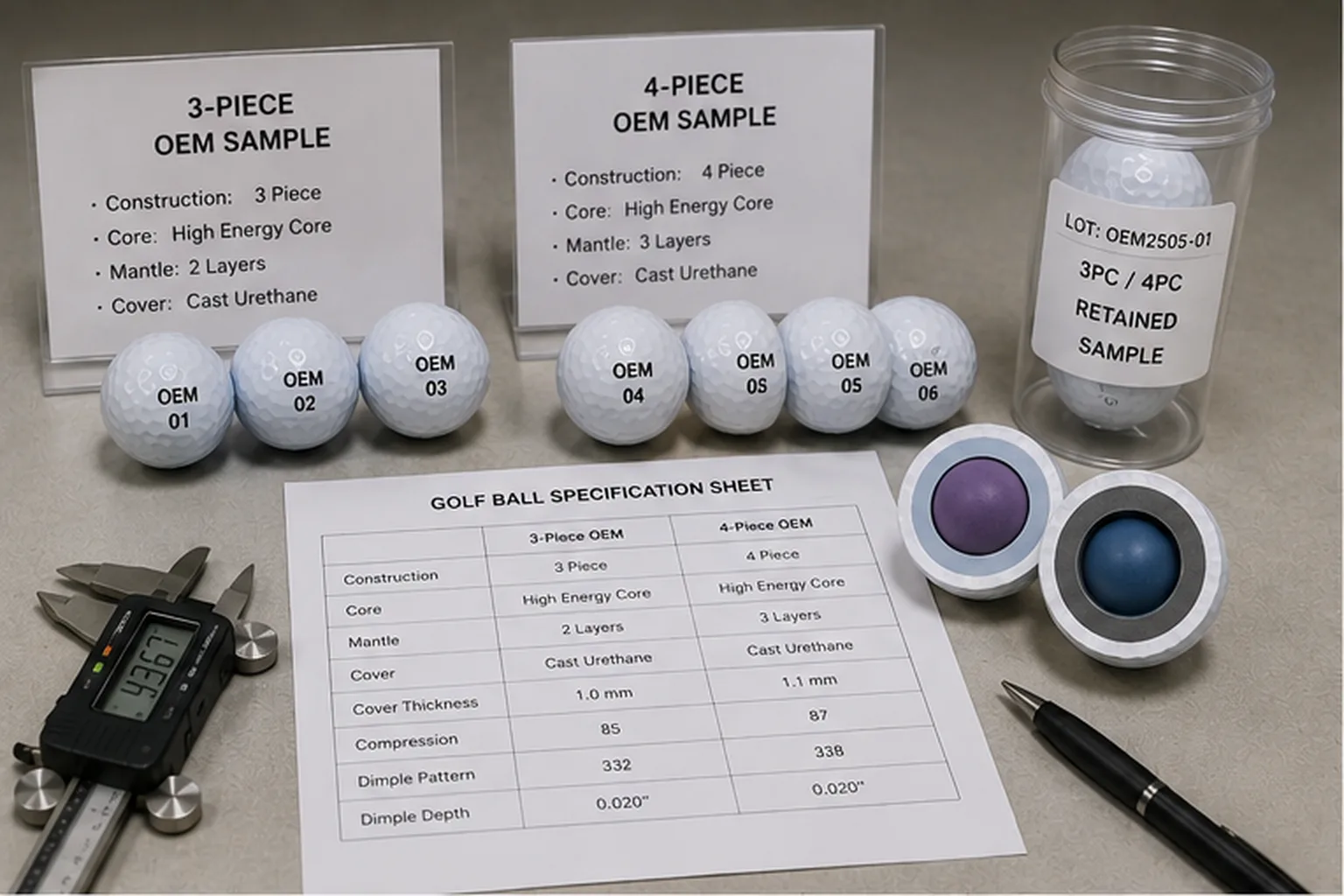
Will Your Buyer Pay for the Difference?
Your approval team should be able to complete this sentence:
We are approving the 4-piece candidate because our target customer values ____, and our pilot evidence is ____.
Both blanks matter.
| Buyer Need | 3-Piece Baseline | 4-Piece Trigger | Evidence | Buyer Action |
|---|---|---|---|---|
| Current promise works | Keep approved SKU | None yet | Customer acceptance | Do not escalate |
| Specific performance gap | Document baseline | Candidate targets gap | Same-basis comparison | Validate target |
| Premium niche | Baseline may be broad | More differentiated SKU | Target-user pilot | Test willingness to pay |
| Upgrade SKU | Proven current SKU | New trade-up reason | Preference / sell-through | Define upgrade role |
A measurable difference with no defined buyer or channel value leaves the 4-piece business case incomplete.
Your customer does not pay for an extra layer. Your customer pays for a useful difference.
That difference may be technically valid and still lack commercial value if the target customer cannot notice, understand, use, or justify paying for it in the intended channel.
When the technical case is established but your team needs a deeper review of margin, positioning, or unit economics, move that question to private-label golf ball economics rather than rebuilding a profitability model here.
Write the buyer-valued performance goal and the evidence supporting its commercial role into a Buyer-Value Approval Note. Approve the architecture only when both the technical gate and the commercial gate pass.
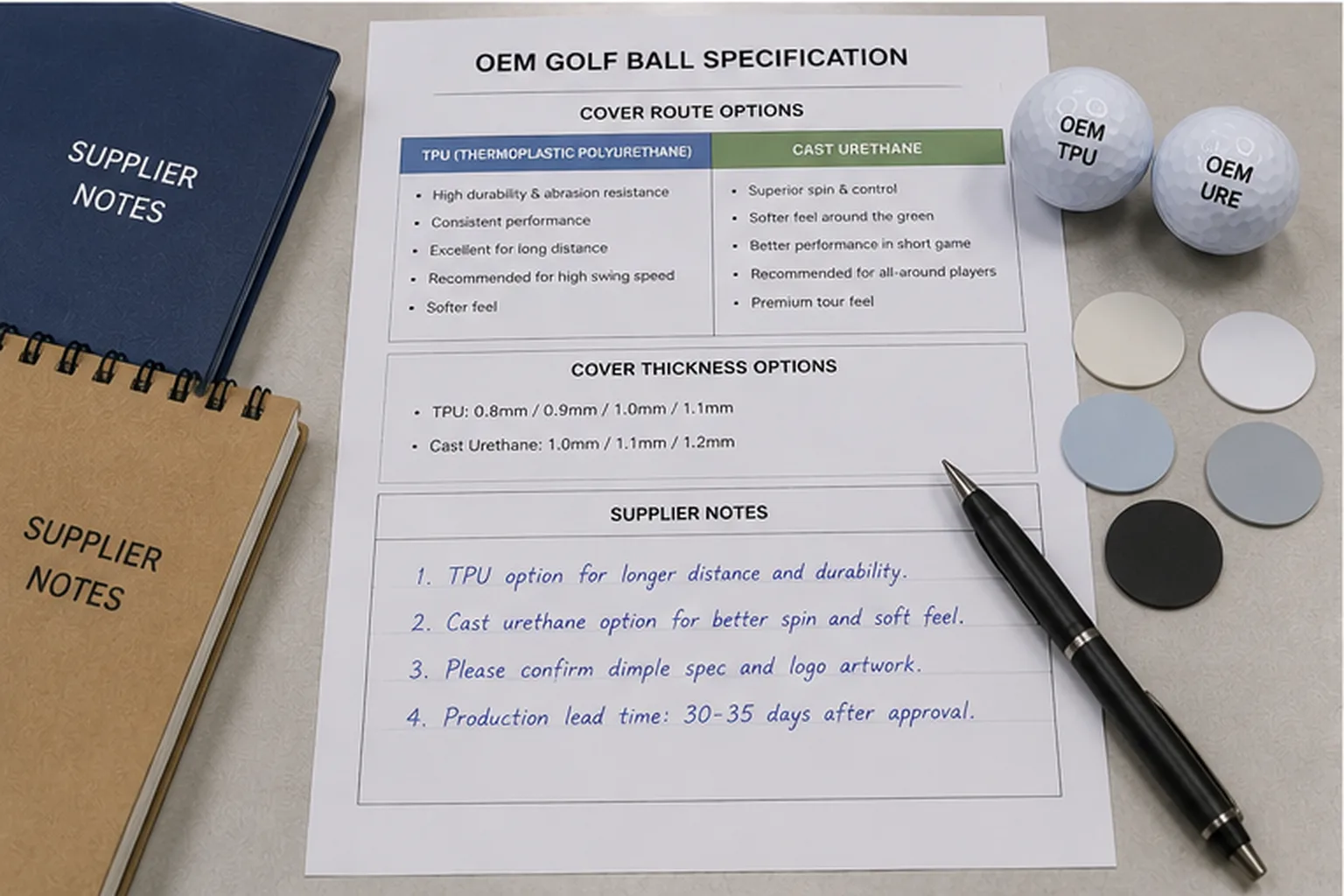
What Proof Should Survive Into Bulk Production?
A development sample can create exactly the difference your team wanted. The fourth layer still has not earned much if that profile disappears during pilot production, the first commercial lot, or a reorder.
Your 4-piece advantage is not proven when one prototype performs well. It is proven when the approved construction, sample reference, and buyer-selected performance difference remain representative through pilot, bulk production, and reorder without an unapproved change to the product you selected.
Keep the continuity visible:
Approved Baseline → Approved Candidate → Pilot Confirmation → Bulk Evidence → Reorder Reference
Preserve the approved 3-piece baseline reference and the 4-piece candidate ID. Record the construction stack and declared cover route. Connect pilot confirmation to the candidate. Preserve the batch-linked production reference, retained sample, and any approved change record.
For this architecture decision, focus on traceability: can your supplier show that the pilot, bulk lot, and reorder still represent the 4-piece candidate you approved? Detailed test methods and batch-release controls can be handled in the separate QC review.
A performance difference observed in one sample is not yet a repeatable product capability.
The sample shows that the development candidate can produce a result. Pilot production asks whether your supplier can reproduce the approved construction in a manufacturing setting. Bulk evidence asks whether the commercial order still represents the candidate that earned approval. The reorder reference prevents the next run from quietly becoming a new product.
Buyer approval of a 4-piece SKU shall require a documented difference against the agreed 3-piece baseline on buyer-selected criteria, followed by pilot confirmation that the approved construction and performance profile remain representative in production.
In our OEM production work, we treat an approved 4-piece construction as a version-controlled product. Another layer can add another material, interface, thickness target, alignment relationship, or process window that must remain controlled from the approved sample through reorder. That does not make 4-piece inherently unreliable; it makes version continuity more important.
You are not approving one impressive sample. You are approving a product your supplier must reproduce.
Manufacturing availability does not create buyer need, and the ability to build one successful candidate does not yet prove repeatability.
If your supplier cannot connect pilot or bulk evidence to the exact 4-piece candidate that earned approval, hold scale-up or reorder until that link is restored.
✔ True — The approved performance difference must survive production.
A 4-piece candidate creates sourcing value only when pilot, bulk production, and reorder still represent the architecture and product profile that earned approval.
✘ False — “One successful prototype proves you have a repeatable 4-piece SKU.”
One development sample proves a candidate result. Production continuity is what turns that result into a repeatable sourcing decision.
FAQ
Do 4-Piece Golf Balls Always Spin More Than 3-Piece?
No. Four-piece golf balls do not have one universal spin profile. The extra layer creates additional tuning options, but finished spin depends on the complete construction, mantle functions, cover system, aerodynamic design, club, and impact condition—not piece count by itself.
For an OEM comparison, first define the spin behavior you want the 4-piece candidate to change relative to the 3-piece baseline. Then evaluate the exact candidates using a compatible method and condition. If the 4-piece produces a different result, describe what that finished SKU did under the stated comparison. Do not turn one product’s result into a rule that every 4-piece golf ball must spin more—or less—than every 3-piece ball.
Can 3-Piece and 4-Piece Balls Use the Same Cover Route?
Yes. A 3-piece and a 4-piece golf ball can use the same declared cover route. Layer architecture and cover manufacturing route are separate specification decisions, so sharing an Injection TPU or other cover route does not mean the finished candidates will have the same profile.
Our internal 3-piece and 4-piece examples illustrate this point. Both recorded candidates used an Injection TPU route, yet their compression, Shore D, and COR profiles differed. Their internal recipes were still different, so the common cover route did not make this a one-variable experiment. Declare architecture and cover route separately, then evaluate deeper TPU-versus-cast questions on the dedicated cover-route page.
Should a New Private-Label Brand Launch Both at Once?
Not automatically. Launching both 3-piece and 4-piece golf balls creates two validation, positioning, inventory, and reorder decisions. Carry both only when each SKU has a distinct customer role and your program has evidence that both roles deserve separate inventory.
A baseline-and-upgrade structure can work when customers understand why the upgrade exists. It works poorly when two architectures tell almost the same story and divide the same demand. Define what the 3-piece promises, then state exactly what the 4-piece adds. If the answer is primarily “one more layer,” validate the stronger proposition before asking your channel to support two SKUs.
What Should a Supplier Explain About Dual Mantles?
A supplier should identify the complete 4-piece construction stack, the intended function of each mantle, the finished-ball target associated with those functions, the 3-piece baseline being challenged, the expected trade-off, and the evidence used to verify the difference.
“Dual mantle” describes where layers exist; it does not explain why they exist. Avoid accepting generic statements that one mantle always reduces driver spin while another always creates wedge spin. Different constructions can assign different jobs to their intermediate layers. Ask your supplier to connect each claimed function to the exact candidate and a buyer-selected finished-ball outcome.
Can One Sample Test Prove the Fourth Layer Works?
No. One sample can demonstrate how a particular 4-piece candidate behaved under stated conditions. It cannot prove that the difference was caused only by the fourth layer or that the approved profile will remain representative through pilot, bulk production, and reorder.
Use the sample to decide whether the candidate deserves the next gate. Then confirm the architecture and buyer-selected difference in pilot production and preserve the approved reference for later production. Detailed statistics, calibration, inspection methods, and batch-release procedures belong in the QC workflow. The architecture decision needs continuity between what earned approval and what is eventually produced.
Can a 3-Piece Remain the Premium SKU?
Yes. Premium positioning does not require four layers. If the 3-piece construction already delivers the defined premium product promise and a 4-piece candidate adds no measurable, buyer-valued, and repeatable improvement, the 3-piece can remain the premium commercial SKU.
That does not mean 3-piece is inherently better. It means the current architecture already solves the product problem. A 4-piece can become the stronger option when another tuning variable produces a useful difference your target market values. The deciding factor is whether the additional complexity earns a distinct commercial role—not whether “4-piece” sounds more advanced on a specification sheet.
Conclusion
A 3-piece baseline is sufficient when it already delivers the defined premium product promise. A 4-piece candidate earns approval only after the added architecture clears four gates:
Fourth-Layer Job → Measurable Difference → Buyer Value → Repeatability
The fourth layer should not earn its place because it sounds more premium. It should earn its place because your exact candidate solves a defined problem, your target buyer values the difference, and your supplier can repeat it in production.
Once the architecture and the performance difference you are paying for are approved, the next question is whether production evidence can reproduce them consistently.
You might also like — Golf Ball Quality Control in China: What OEM Buyers Should Verify Before Shipment