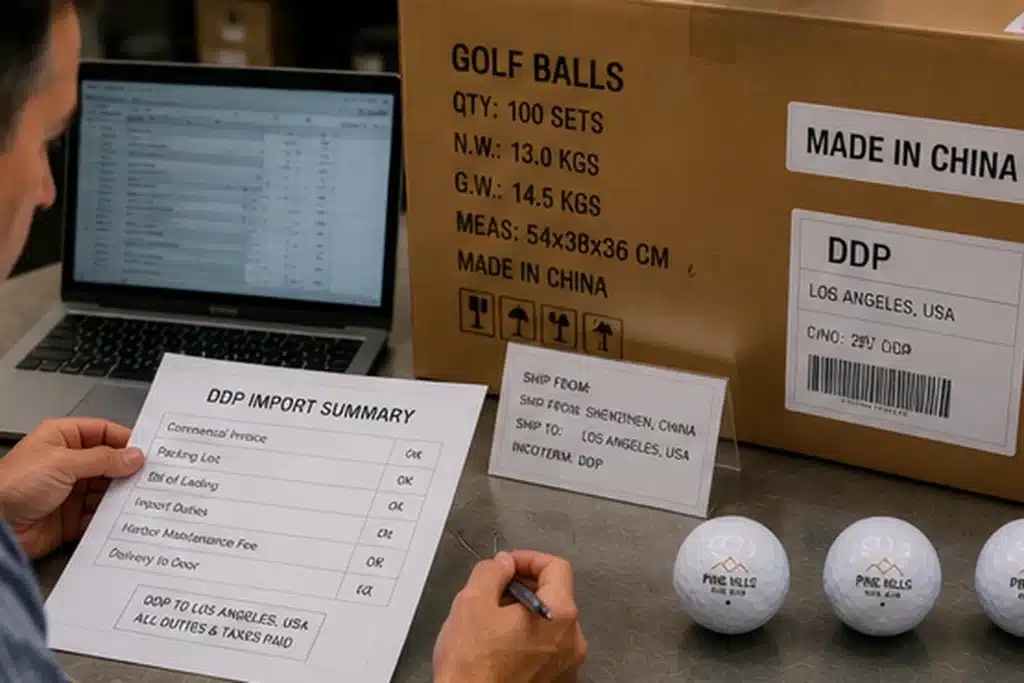
A Vietnam golf-ball supplier name can still hide the real question: does it manufacture balls, assemble exports, or control OEM capacity?
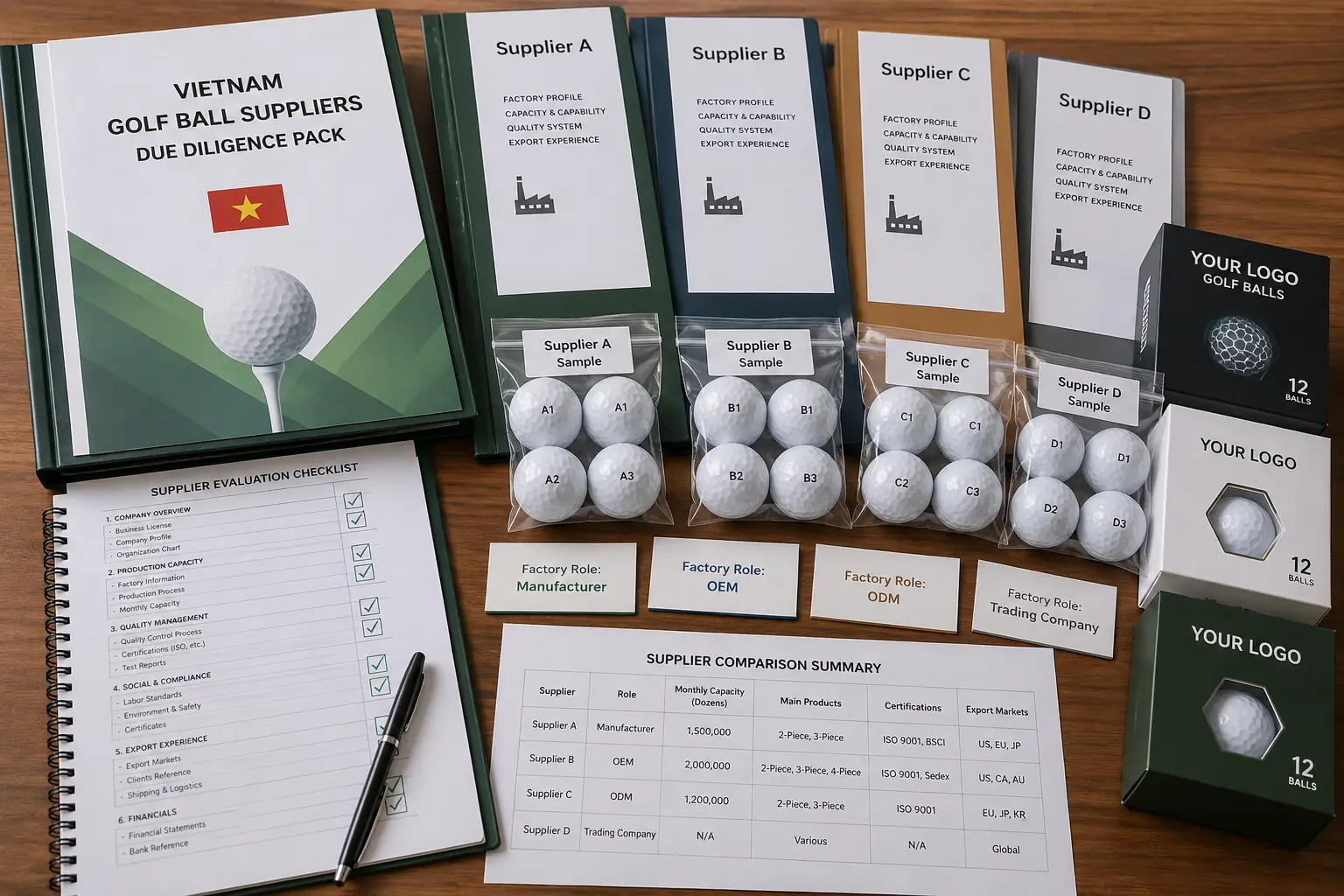
The Top 4 golf ball manufacturers and export nodes in Vietnam for OEM buyers are Vung Tau Orient / Feng Tay, SM Parker-linked Vietnam production, Eagle Vina / EV Vina, and Advanced International Multitech Vietnam. Vung Tau Orient / Feng Tay is the clearest heavy-manufacturing anchor; SM Parker-linked production is brand-linked; Eagle Vina / EV Vina is best treated as an export or assembly node until full-process proof is provided; Advanced International Multitech Vietnam requires complete-ball output verification.
If you are searching for Top golf ball OEM manufacturers Vietnam, use this directory as a Vietnam golf ball factory due diligence filter—not a simple supplier list. Before sending an RFQ, verify whether each company controls core molding, cover molding or casting, painting, stamping, final QC, COO support, MOQ, and private-label OEM access.
This guide helps you separate a real golf ball manufacturer from an assembly or export node. It also explains what Vietnam actually mass-produces, why “3-piece urethane” can mean different cover processes, and when a China route is more practical for low-MOQ testing.
Who Are the Top Vietnam OEM Names?
You want a fast Vietnam shortlist, but the names do not all represent the same level of manufacturing control, private-label access, or OEM openness.
Vietnam’s Top 4 golf-ball OEM names should be read as a directory of manufacturers, export nodes, and supply-chain anchors. Vung Tau Orient / Feng Tay is the clearest heavy-manufacturing anchor; SM Parker-linked Vietnam production is brand-linked; Eagle Vina appears as an active export/assembly node; Advanced International Multitech Vietnam needs complete-ball capability verification.
| Factory / node | Best classification | Evidence strength | Buyer warning |
|---|---|---|---|
| Vung Tau Orient / Feng Tay | Verified heavy manufacturing anchor | High | OEM access may be brand-bound or high MOQ |
| SM Parker-linked Vietnam production | Brand-linked production network | Medium–High | Verify legal manufacturer and exporter |
| Eagle Vina / EV Vina | Export / assembly / supply-chain node | Medium–High | Confirm full-process capability |
| Advanced International Multitech Vietnam | Golf-related ODM / composites group | Medium | Verify complete golf-ball output |
Vietnam is not a “maybe” golf-ball origin. Recent trade and shipment evidence points to Vietnam as a real retail-grade golf-ball export base, with North American channels receiving meaningful HS 950632 golf-ball volume. That matters because it proves the country has commercial scale. It does not prove every Vietnam-linked name is a source factory.
Vung Tau Orient / Feng Tay deserves the strongest manufacturing-anchor classification because its corporate footprint points to a long-running Vietnam manufacturing site with golf balls listed among its activities. If you are searching for Mizuno golf ball factory location, this is the Vietnam-linked manufacturing reference buyers usually need to investigate first.
SM Parker-linked Vietnam production is important because market attributions connect it with large retail programs, including Kirkland and PXG-related discussions. If you are asking where are Kirkland golf balls made, the practical answer is not “one factory forever.” It is SKU, version, lot, exporter, and package COO. Eagle Vina / EV Vina appears repeatedly in Vietnam golf-ball export flows and should be treated as an active export, assembly, or supply-chain node until full-process proof is provided. Advanced International Multitech Vietnam belongs on the list, but complete golf-ball OEM output should be verified program by program.
Request the supplier’s role before you compare prices: full-process factory, brand-linked producer, export node, assembler, or trader. Do not treat any directory name as an OEM source until production control and private-label access are confirmed.
✔ True — Vietnam is a real golf-ball export base.
The sourcing risk is not whether Vietnam has golf-ball activity. The risk is whether the specific company you contact controls molding, cover process, finishing, QC, and OEM access.
✘ False — “Every Vietnam Top 4 name is a full-process OEM factory.”
Classify the entity before sending your RFQ, especially when the supplier appears mainly as an export or assembly node.
Is It a Factory or Assembly Node?
You may contact a Vietnam golf-ball supplier and assume it makes the ball, when it may only pack, export, or coordinate finished goods.
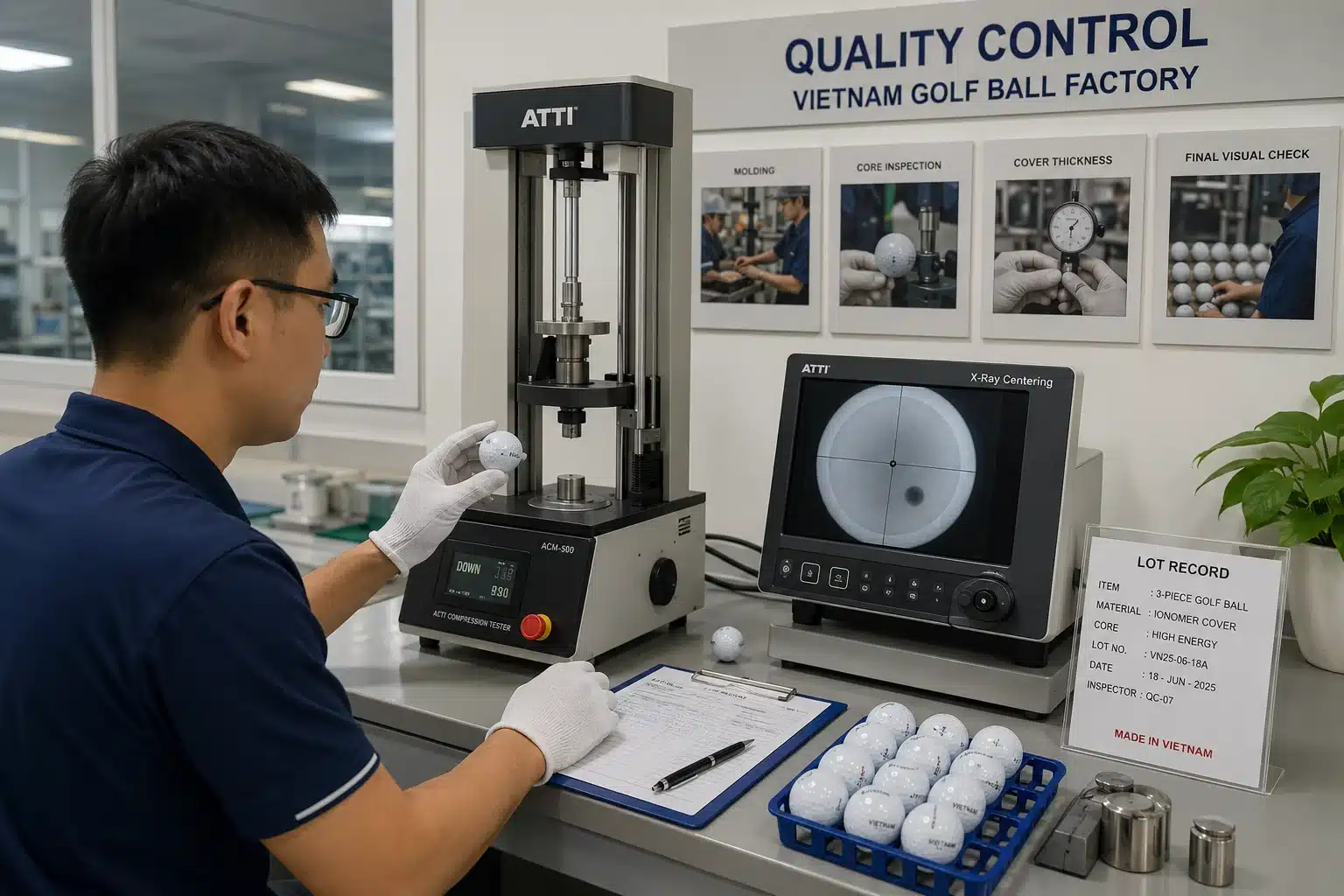
To verify a Vietnam golf-ball factory, ask for proof of core molding, cover molding or casting, painting, stamping, final QC, ATTI compression variance, and X-ray/CT concentricity. If a supplier can only show packing lines, carton photos, or export documents, treat it as an assembly or export node until proven otherwise.
| RFQ question | Why it filters fake factories | Evidence to request | Buyer action |
|---|---|---|---|
| Do you mold the core in Vietnam? | Packing nodes cannot prove it | Core-molding photos + lot record | Confirm process site |
| Do you mold or cast the cover? | Separates makers from exporters | Process declaration | Match to quote |
| Can you provide ATTI variance? | Shows batch-level control | Raw data + SD/range | Review lot data |
| Can you provide X-ray/CT proof? | Checks layer centering | Images + sample ID | Verify structure |
| Can you issue COO with flow evidence? | Prevents repacking confusion | Process map + documents | Check before PO |
This is where Vietnam golf ball factory due diligence becomes more useful than a supplier list. A real golf-ball factory should be able to show more than finished balls, boxes, and warehouse photos. Your team should ask for process evidence covering core molding, cover molding or casting, painting, stamping, final QC, packing, and export documentation.
Packing photos, no molding proof is a failure signal. It tells you the supplier may have logistics relevance but not manufacturing control. That matters for repeat quality, country-of-origin support, and recovery if the next shipment does not match the approved sample.
Use public shipment or bill-of-lading evidence as supporting context, not as a replacement for factory proof. Export records can show that a company participates in golf-ball flows. They cannot prove where the core was molded, where the cover was applied, or whether the supplier controls compression and concentricity by lot.
Place this in your RFQ: “Please confirm whether you mold cores in Vietnam, mold or cast covers in-house, control painting/stamping/QC, and can provide ATTI compression variance, X-ray/CT concentricity evidence, process photos, COO support, and recent export or lot records for the exact program.”
Ask your supplier to provide a process-flow map showing the country and site for core molding, cover molding or casting, painting, stamping, final QC, packing, and export documentation for the exact SKU and lot.
Why Do Some Sites Only Box Finished Balls?
Some Vietnam-linked entities may support packing, export, documentation, or channel logistics without controlling the full golf-ball manufacturing process. That can still be commercially useful, but it changes your risk.
A site that boxes finished balls can help with export execution, retail pack-out, or channel coordination. The problem starts when a buyer treats that site as a source factory and writes manufacturing, origin, or capacity assumptions into the PO. Packaging alone does not prove core molding, cover process, painting control, or final QC ownership.
A stronger verification pack should include equipment lists, process photos, lot IDs, retained-sample policy, compression variance, X-ray or CT centering evidence, and COO support. Approve factory status only when the supplier proves where the ball is actually molded, covered, finished, tested, and packed.
What Balls Does Vietnam Really Make?
You may assume a Vietnam-made 3-piece ball is automatically a tour-grade cast urethane product, but “urethane” can refer to very different process tiers.
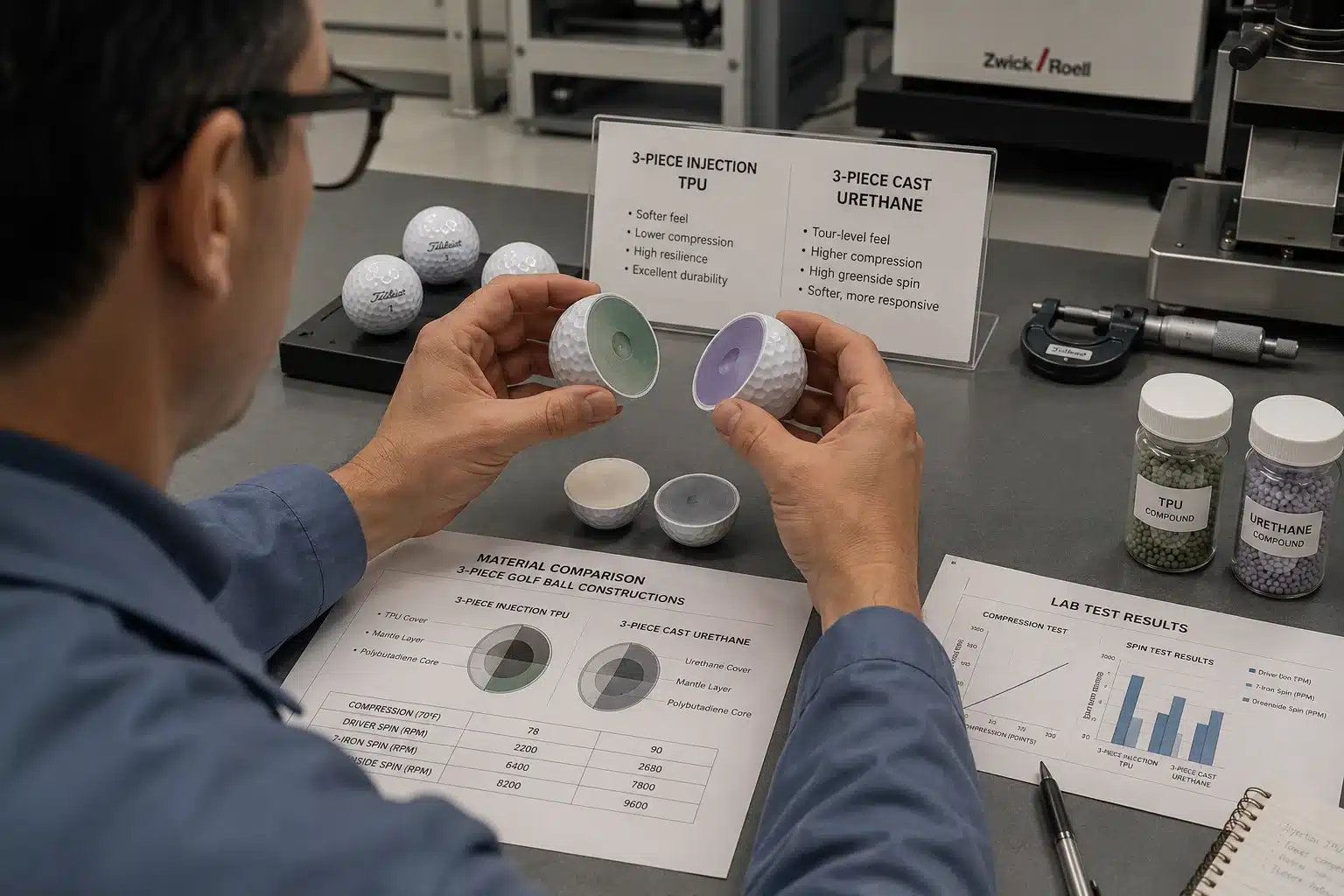
Vietnam does not make only one type of 3-piece golf ball. Much of the visible export base is retail-ready 3-piece TPU or urethane-style volume, while true cast thermoset urethane is a narrower, higher-threshold process. Your RFQ should state injection TPU or cast thermoset urethane before quotes are compared.
| Buyer wording | What it may hide | What to ask | Buyer risk |
|---|---|---|---|
| 3-piece PU | TPU or cast urethane | Injection TPU or cast thermoset? | Wrong price comparison |
| Urethane cover | Marketing umbrella | Cover process + TDS | Performance mismatch |
| Tour-level | Unverified claim | Durability + compression + centering | Retail complaints |
| Made in Vietnam | May not prove full process | Process map + COO proof | Origin confusion |
This is the material confusion that hurts real purchase decisions. A buyer asks for a “3-piece urethane ball,” receives two quotes, and assumes both factories are quoting the same construction. They may not be. One quote may refer to injection TPU or a retail urethane-style program. Another may refer to cast thermoset urethane with a slower and more demanding process window.
Vietnam output is best understood in two lanes. The first lane is high-volume retail-ready 3-piece TPU or urethane-style production associated with large channel programs, including Kirkland and PXG-related attributions. These balls can be commercially strong, consistent, and well suited for member-store or retail channels. They should not automatically be described as Pro V1-style tour balls.
The second lane is narrower: true cast thermoset urethane. This process is slower, harder to control, and usually tied to higher performance expectations. Vung Tau Orient / Feng Tay is the stronger Vietnam-linked reference for buyers searching for a cast urethane golf ball supplier Vietnam, especially because of Mizuno-related attributions. But even there, OEM access and exact process evidence must be confirmed before you build a program around the name.
Urethane claim, no process declaration is a failure signal. Your PO should name the cover system clearly: Injection TPU, Cast Thermoset Urethane, Surlyn/Ionomer, or another approved material system. Without that wording, two quotes may look comparable while describing very different products.
Is It Retail TPU or Cast Urethane?
A 3-piece retail TPU ball can be a smart commercial product, while cast thermoset urethane serves a different performance and pricing expectation. Both may be sold under loose “urethane” language.
Injection TPU is thermoplastic, efficient, and suitable for many retail or mid-premium channels. Cast thermoset urethane is chemically crosslinked and usually requires tighter process control, slower curing, stronger durability review, and better layer-centering discipline.
Request a signed cover-process declaration, cover TDS, pilot samples, wedge-scuff review, and lot-level compression/concentricity data. Do not approve “urethane” as a standalone spec in the PO.
✔ True — Vietnam can support serious retail golf-ball programs.
The question is which process lane you are buying. Retail TPU and cast thermoset urethane can both be valuable, but they are not the same sourcing decision.
✘ False — “Every Vietnam-made 3-piece urethane ball is tour-grade.”
Require a cover-process declaration and pilot-lot evidence before you compare pricing or make performance claims.
Can You Hire These Vietnam Giants?
You may assume the Top 4 list gives you open access, then discover the strongest factories prioritize major retail or brand programs.
The hardest part of Vietnam OEM sourcing is often access, not quality. The best-known Vietnam-linked golf-ball factories may prioritize large retail or brand programs, so new private-label buyers should confirm MOQ, booking windows, formula access, and OEM acceptance before building a launch plan around Vietnam.
| Supplier type | Access reality | Buyer risk | Practical route |
|---|---|---|---|
| Feng Tay / Vung Tau Orient type | Large brand contracts first | MOQ/capacity lockout | Use for mature volume |
| SM Parker-linked network | Brand/channel tied | Limited private-label window | Verify OEM access |
| Eagle Vina / EV Vina | Export/assembly node profile | Full-process uncertainty | Verify process control |
| Advanced International Multitech Vietnam | Golf-related ODM background | Complete-ball proof needed | Verify output scope |
| China flexible OEM | Lower MOQ and faster turns | Not Vietnam-origin | Use for MVP and testing |
Capacity lockout is the buyer problem most directories fail to explain. A factory can be capable, respected, and still unrealistic for your order. Vietnam’s best-known golf-ball names are often tied to large retail allocations, existing brand programs, or stable production calendars. If your program needs a new formula, a custom mold, or a dedicated production lane, you should be prepared for screening thresholds around 50,000+ pieces and planning windows that can stretch toward 8–12 weeks. If you are launching a small private-label test, your RFQ may not receive a serious quote until your volume, formula, and repeat-order plan look mature.
Famous factory, no OEM slot is a failure signal. It means your sourcing plan depends on capacity you do not control. Some Vietnam routes may require high MOQ, longer booking windows, or existing-platform discipline before the factory will treat your project seriously. That can work for mature retail SKUs; it is painful for early-stage DTC, event, gift, or test-market programs.
For a new buyer, the practical question is not “Can Vietnam make good balls?” It is “Can this specific Vietnam-linked supplier accept my private-label program at my volume, timeline, and process requirement?” Ask for written confirmation of private-label OEM access, MOQ, formula/mold restrictions, sample timeline, and repeat-order booking window.
Ask your supplier to provide OEM-access confirmation before sampling, not after sampling. Check whether the offer is true manufacturing access, finished-goods export coordination, or a standard platform with limited customization. Do not rely on a Vietnam factory for launch timing until capacity and MOQ are confirmed in writing.
China is not the “better” answer for every buyer, but it is often the more practical first step. Low-MOQ China programs can validate demand, logo printing, packaging, and replenishment rhythm before you chase brand-bound Vietnam capacity.

When Should You Use a Hybrid Route?
You may wait for Vietnam capacity before proving your SKU, tying up time and cash before demand is validated.
A hybrid route works when Vietnam is the right long-term production node but China is the safer MVP route. Use China for low-MOQ testing, logo approval, packaging validation, and early sell-through. Move mature, locked-spec, higher-volume SKUs to Vietnam only when access, MOQ, proof, and timing are confirmed.
| Buyer goal | Best route | Why it works | Evidence to request |
|---|---|---|---|
| MVP / test launch | China / Golfara | Low MOQ and fast feedback | Sample + sell-through data |
| Retail-grade repeat SKU | Vietnam if access confirmed | Stable volume and documentation | OEM slot + process proof |
| Cast urethane positioning | Vung Tau / verified capable route | Higher process threshold | Cast process evidence |
| Seasonal gift pack | China flexible OEM | Packaging speed and variants | Pack-out proof |
| Mixed portfolio | Hybrid | Right route per SKU stage | Route map by SKU |
The best Vietnam route is usually for stable, locked-spec volume, not early MVP experimentation. Vietnam makes sense when your SKU is mature, demand is proven, packaging is stable, and the supplier has confirmed private-label access. It can also make sense when a verified process lane supports a premium material claim.
China is stronger when your team needs speed, low MOQ, packaging experimentation, multiple logos, seasonal variants, or quick sample feedback. Zhejiang and Ningbo-style supply chains are built for low-thousand-piece flexibility, and Golfara can support custom programs from about 1,000 pcs when construction, artwork, and packaging requirements fit. That gives you room to test without locking cash into a large unproven order.
A hybrid route does not mean “low quality first, premium later.” It means your sourcing route follows SKU maturity. Use China to prove demand, artwork, packaging, and reorder cadence. Use Vietnam when the SKU is stable, the supplier role is verified, the MOQ fits your sales velocity, and the process evidence supports the positioning.
For route planning, ask for separate quotes: China MVP pilot, Vietnam locked-spec scale, and hybrid replenishment plan. Compare MOQ, lead time, process proof, COO, private-label access, packaging capability, and repeat-order control.
For lower-MOQ planning, see how to negotiate MOQ with Chinese golf ball manufacturers. If Vietnam access is locked, a China supplier map can help; start with the Top 10 Golf Ball Manufacturers in China for OEM guide.
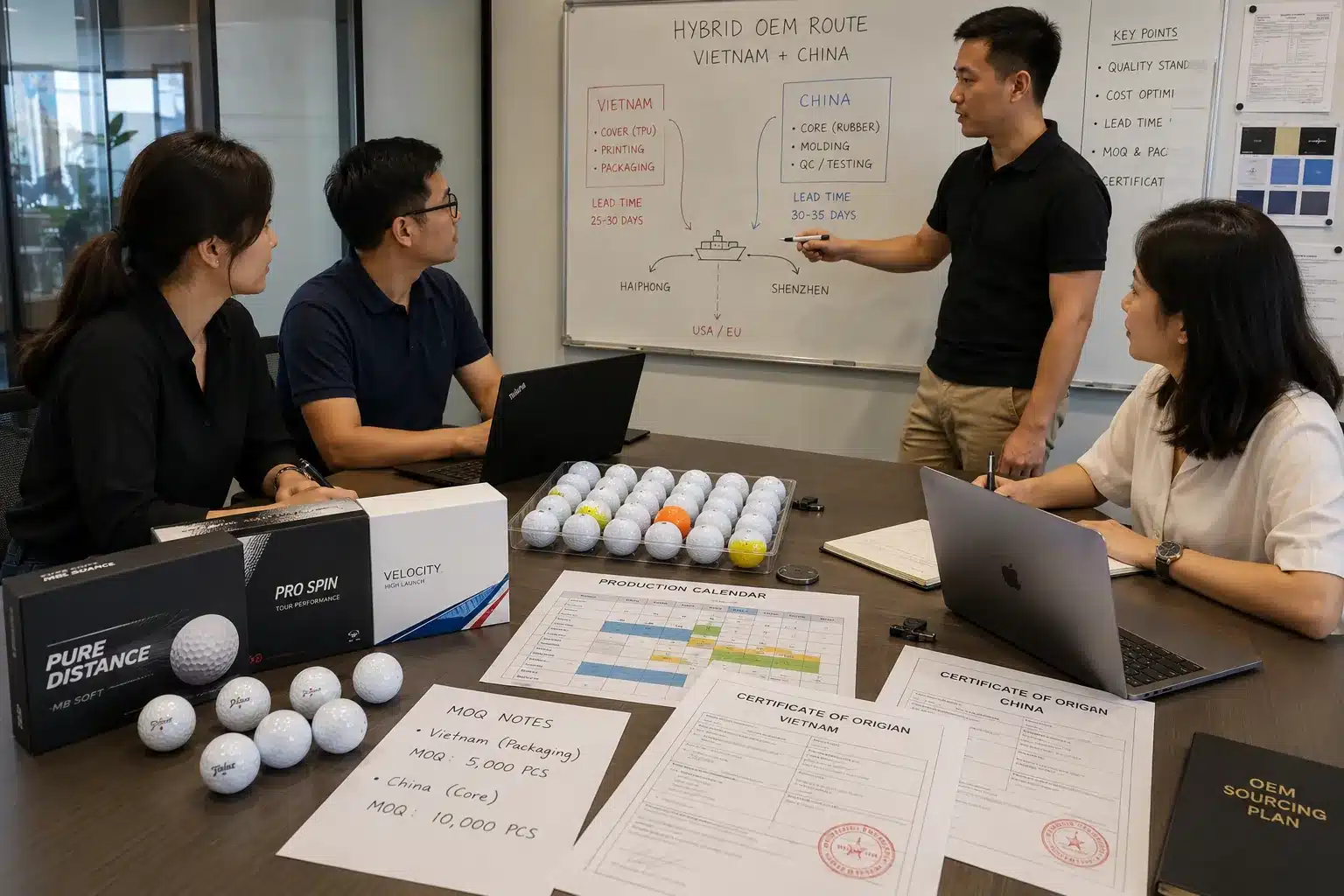
✔ True — China can strengthen a Vietnam strategy.
A low-MOQ China pilot can prove demand, packaging, and sell-through before you move stable volume to Vietnam.
✘ False — “Using China first weakens the Vietnam plan.”
You can use China for MVP validation and Vietnam for mature volume when access, MOQ, process proof, and timing are stable.
FAQ
Where are Kirkland Signature golf balls manufactured?
Recent Kirkland Performance+ golf balls have been publicly linked to SM Parker-related manufacturing in Vietnam, but buyers should not assume every Kirkland version, color, or market uses the same route. Verify the exact SKU, package COO, lot code, exporter, and version before using the attribution for sourcing.
Kirkland-related attributions are useful because they show Vietnam can support high-volume retail golf-ball programs. They are not a shortcut for your own due diligence. Package COO, ball version, lot marking, shipment route, and supplier role still matter. If your team is benchmarking against Kirkland-style retail balls, ask whether the supplier can prove similar process control and whether that capacity is actually open to private-label buyers.
What is the MOQ for golf balls in Vietnam?
Vietnam MOQ can be much higher than China when the buyer needs private-label access, new formulas, custom molds, or brand-linked capacity. For low-MOQ testing, China is usually more practical; for stable high-volume SKUs, Vietnam may become realistic once capacity is confirmed.
Ask whether private-label OEM is accepted, whether your program uses an existing platform or new formula, and how MOQ changes by construction, cover process, artwork, and packaging. New buyers should not assume a famous Vietnam-linked factory will accept small test orders. Use China for 1,000–3,000-piece pilots when your main goal is market validation, packaging testing, or fast feedback.
Are golf balls made in Vietnam good quality?
Yes, Vietnam can produce retail-grade golf balls and select higher-end programs, but quality depends on whether you are working with a true manufacturer or an assembly/export node. Request ATTI compression data, X-ray/CT centering evidence, process proof, and lot-level QC records.
Vietnam origin alone does not guarantee quality, and an assembly node can still look professional in catalogs. Verify factory role, raw QC data, cover process, sample IDs, retained samples, and repeat-order controls. The right question is not only whether the ball is made in Vietnam. It is whether the supplier controls the process behind the ball and can repeat it lot after lot.
How do I verify a golf ball factory in Vietnam?
Do not rely on address, catalog photos, or export records alone. Ask for process-flow evidence, core and cover manufacturing proof, ATTI compression variance, X-ray/CT concentricity scans, equipment list, lot ID, COO support, and retained-sample policy.
A true manufacturer should explain where the core is molded, where the cover is molded or cast, where painting and stamping happen, and how final QC is recorded. Export records can support the story, but they cannot replace process-level proof from the factory. Your approval should be tied to the exact SKU, lot, process map, and evidence pack.
Is Eagle Vina a golf ball factory or export node?
Eagle Vina should be treated carefully as an export, assembly, or supply-chain node unless the supplier proves full-process capability. Public shipment records can show active golf-ball export flows, but buyers still need process-level proof before calling it a full factory.
Ask whether the entity molds cores, controls cover molding or casting, operates painting and stamping lines, performs final QC, and issues COO support tied to the exact lot. Use export records as supporting evidence, not as the only basis for factory classification. If the supplier cannot prove molding, finishing, and QC control, treat it as a node rather than a complete source factory.
What is the difference between TPU and cast urethane?
Injection TPU is thermoplastic, efficient, and suitable for many retail or mid-premium programs. Cast thermoset urethane is chemically crosslinked, slower, harder to control, and associated with tour-style premium expectations. Both may be called urethane, so the RFQ must name the process.
Ask for Injection TPU or Cast Thermoset Urethane in writing. Request cover TDS, durability evidence, compression data, and centering proof. Do not accept “urethane” alone if your channel expects a specific feel, spin profile, durability level, or premium positioning. The process term protects both your quote comparison and your marketing claims.
Can new brands hire Vietnam’s top golf ball factories?
Sometimes, but not automatically. Vietnam’s best-known factories may prioritize major retail or brand programs. New buyers should expect tighter access, higher MOQ, longer booking windows, and more documentation requirements than flexible China OEM routes.
Confirm OEM access first, then ask for MOQ, lead time, formula restrictions, mold limitations, and repeat-order windows. If the supplier cannot confirm capacity in writing, use China for MVP testing and return to Vietnam when the SKU is mature and volume supports the route. A famous factory name helps only if you can actually book capacity.
When should I choose China instead of Vietnam?
Choose China when your program needs low MOQ, quick samples, seasonal packaging, frequent artwork changes, logo customization, or early-market testing. Choose Vietnam when the SKU is mature, volume is stable, access is confirmed, and the process proof supports the positioning.
China is usually the safer route for MVP launches, events, DTC tests, and packaging-heavy programs. Vietnam becomes stronger when the product is stable, the order is larger, the factory role is verified, and the OEM slot is real. A staged route protects your cash, timeline, and supplier leverage.
Conclusion
Vietnam is a credible retail-grade golf-ball export base, but a directory name is not the same as open OEM access. Your job is to separate heavy manufacturing anchors, brand-linked production networks, export/assembly nodes, and verify-required ODM options before you send a PO.
Use this Top 4 directory as a due-diligence map. Verify core molding, cover process, painting, stamping, QC, ATTI compression variance, X-ray/CT concentricity, COO support, MOQ, and private-label access by SKU and lot.
For many buyers, the practical route is staged: use China or Golfara for low-MOQ validation, packaging tests, and early sell-through, then consider Vietnam for mature, locked-spec, higher-volume programs when factory access and process proof are confirmed.
You might also like — China vs Vietnam Golf Ball Costs: 2026 Tariff & Landed Cost Guide