Women should choose golf balls by starting with driver swing speed, narrowing the compression window, choosing 2-piece ionomer for easier launch and durability or urethane/multilayer construction for more greenside control, then testing green-to-tee. The right women’s golf ball launches reliably, holds greens when scoring matters, stays stable with the driver, and repeats from sleeve to sleeve.
Women’s golf balls are no longer a novelty shelf or a pink-packaging exercise. Female participation data shows that U.S. female on-course golfers climbed to more than 8.1 million in 2025, representing 28% of the traditional golfer population, while women and girls accounted for 52% of green-grass net participation gains from 2020 to 2025.
For players, coaches, academies, retailers, and private-label buyers, the business lesson is clear: women’s golf balls deserve real fitting logic. A “Lady” label can be a useful product clue, but it is not a fitting result.
Use this guide to move from soft-feel claims and color preferences to a repeatable fitting path built around speed, launch, stopping power, driver stability, visibility, and batch proof.
What should women fit first?
You may think the first choice is women’s, Lady, pink, or soft feel, but the real starting point is swing speed, launch need, scoring goal, and feel preference.
Women should fit swing speed, launch, cover, and scoring need before choosing a Lady label or color. A softer ball can help many slower-swing players, but your team or your coach should verify the ball with launch, iron stopping, driver stability, wedge response, and putting feel.
A women’s golf ball is not automatically better because the box says “Lady.” That label often points toward lower compression, softer feel, higher launch, brighter color, or beginner-friendly positioning. Those are useful clues. They are not proof that the ball fits your swing.
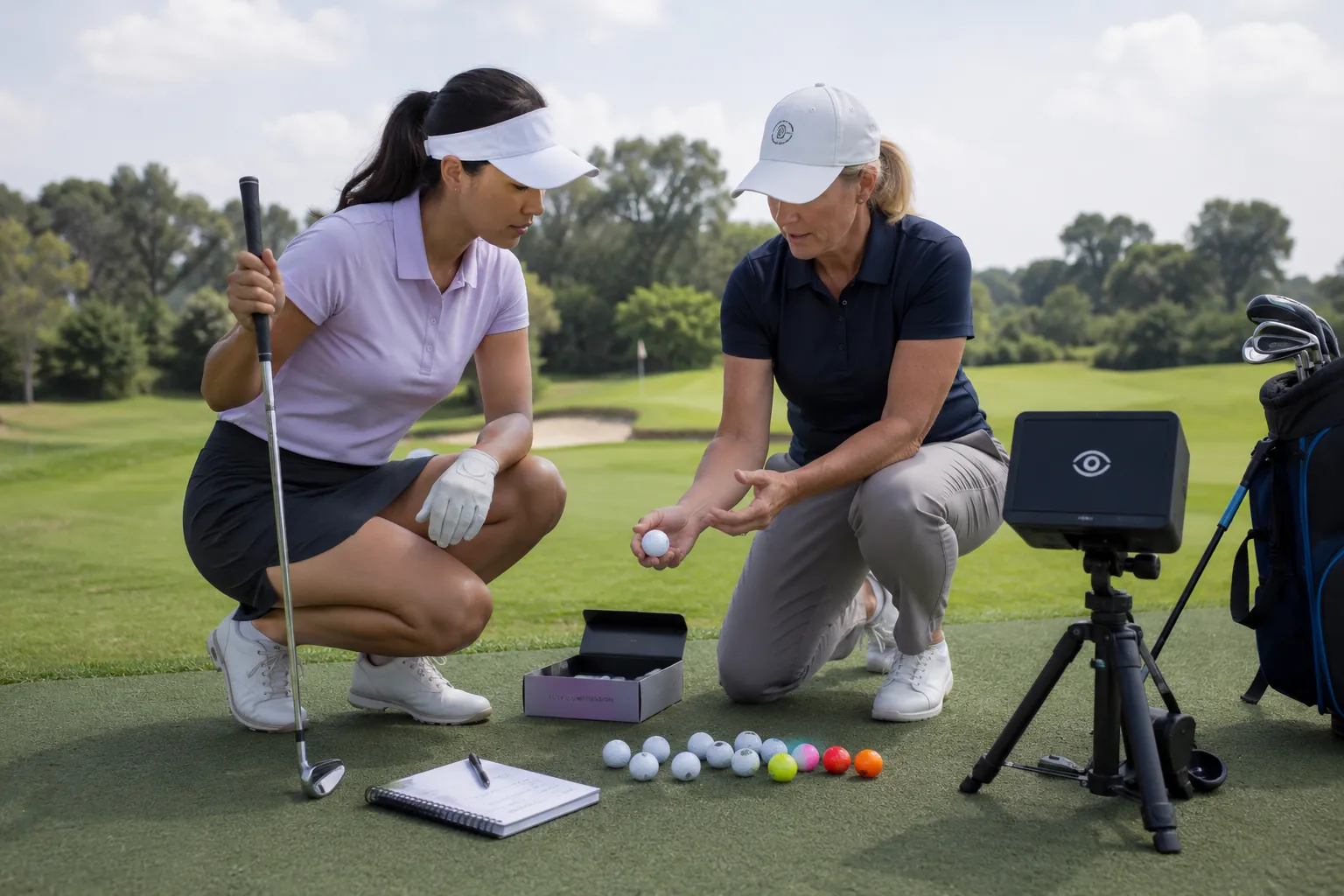
The first real question is what your golf ball must help you do. Do you need easier launch? Do your irons land too hot? Do your wedges skid instead of checking? Does a soft ball feel nice but float in the wind? Those answers matter more than a gender label.
A softer ball is a useful starting point for many players, not a gender rule. Club-speed data lists LPGA Tour averages at 96 mph with driver and 80 mph with 6-iron, which sits well above the “slow swing only” stereotype. A beginner with a 60–70 mph driver speed may benefit from a low-compression 2-piece ionomer ball; a stronger player near 90–100 mph may need a firmer, multilayer, or urethane option to control launch, wind, and stopping power.
For coaches and academies, the same rule protects lesson quality. Your baseline ball should help students learn from contact, launch, and rollout. For retailers and DTC brands, women’s golf balls should be planned as a fitting ladder, not a novelty shelf.
Create a first-fit checklist with swing speed, launch need, scoring goal, cover preference, visibility need, and current miss. Compare the chosen ball against launch, iron hold, driver dispersion, wedge feel, and putting pace.
Do not approve the ball simply because the box says Lady, Soft, Feel, or Women.
✔ True — Low compression can help many slower-swing players
A softer, lower-compression ball can make launch feel easier and reduce harsh impact for many players. It is a useful starting point, not a gender rule.
✘ False — “Every woman should automatically use the softest ball”
Some women swing fast enough to need firmer, multilayer, or urethane options. Fit the swing and scoring need, not the stereotype.
Swing speed before gender labels?
Your first decision is not the label. It is what the ball must help your launch, stopping power, driver stability, and confidence do under real playing conditions.
Women’s golf is not one swing-speed category. A beginner, returning player, competitive junior, academy student, low-handicap golfer, and club champion can all need different compression and cover routes. A soft ball may help one player launch higher; it may make another player lose driver stability. Your fitting path should respect that range.
What compression fits your swing speed?
You may use compression as a shortcut, but swing speed only creates a starting window; it does not automatically choose the best women’s golf ball.
Compression should bracket the test, not finish it. Slower driver speeds can often start with low-compression 2-piece ionomer balls, while faster or scoring-focused players may need mid-compression, multilayer, or urethane options after launch, dispersion, iron stopping, and feel are tested.
Compression is not just a number on the box. It reflects core formulation, molding control, layer design, and batch discipline. A low-compression women’s golf ball can feel lively for slower swings, but the same softness can create too much height, too much driver spin, or wider dispersion for stronger players.
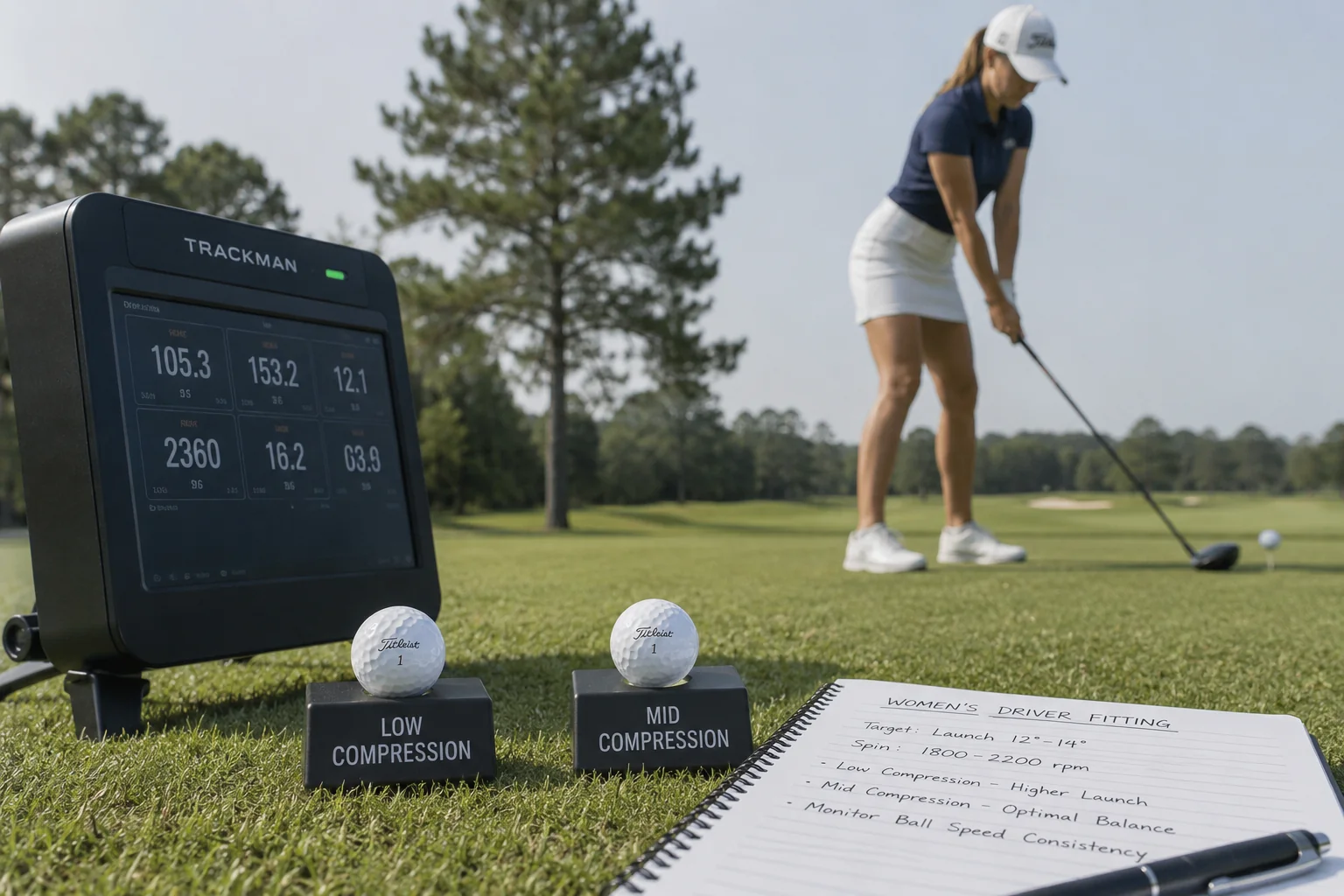
Use driver swing speed to create a shortlist, then let ball flight finish the decision. A player at 70 mph may need easier launch and straighter flight. A player around 85 mph may want more iron hold. A player near 95 mph may need a firmer multilayer or urethane option. Two women with the same swing speed can still need different balls if one needs higher launch and the other needs lower driver spin or more wedge bite.
Current women-positioned balls show the common market route: low compression, ionomer cover, softer feel, and higher launch. The Srixon Soft Feel series lists 2-piece ionomer models with softer feel and mid-high flight, while TaylorMade Kalea lists an ionomer cover and soft 60 compression for enhanced feel and responsive short-game performance. These are useful market examples, not universal recommendations for every female golfer.
| Pain/decision | Driver speed | Starting window | Better first test | Evidence to request |
|---|---|---|---|---|
| Hard feel / low launch | <65 mph | ~30–45 | Very soft 2-piece ionomer | Check launch |
| Average-speed fit | 65–85 mph | ~45–65 | Low-compression 2-piece or 3-piece | Check dispersion |
| Stronger player | 85–100 mph | ~70–90 | Mid-compression multilayer / urethane | Check stopping |
| High speed | 100+ mph | Tour window | Fitted urethane, not Lady default | Test driver |
| Same speed, different needs | Any band | Not enough alone | Launch + wedge + wind test | A/B test |
For academy or private-label programs, the PO should name the intended compression window, test batch, retained sample, and acceptable spread so the ball does not change feel between reorders.
Request or create a swing-speed-to-compression shortlist. Check launch angle, ball speed, dispersion, iron stopping, wedge feel, and putting feel after compression shortlisting.
Do not recommend a compression band as final until the ball is tested across scoring and driver needs.
Slow, average, and fast speed bands?
Your swing speed starts the decision; your ball flight finishes it.
A good fitting protects launch without losing driver stability, iron hold, or short-game feel. Retailers should avoid building a women’s SKU around “soft” alone. Coaches should avoid placing every female student into the same low-compression model. Players should treat speed bands as a shopping filter, not a verdict.
Which cover matches your scoring goal?
You may like a soft-feeling women’s ball, but your scoring goal decides whether you need durable ionomer, a 3-piece step-up, or urethane short-game control.
Choose 2-piece ionomer when durability, straighter flight, and budget matter; test urethane when wedges or irons will not stop. Your ball should match your scoring goal: easier launch and fewer penalties first, then more greenside spin when control becomes the bottleneck.
A 2-piece ionomer or Surlyn-style ball often makes sense for beginners, high-loss players, group lessons, and value-focused women’s SKUs. It can support durability, lower spin on mishits, straighter flight, and cost control. That is a strong starting route when the main job is easier launch and fewer penalties.
Urethane becomes more useful when scoring shots matter. If wedges skid, chips release too far, or mid-irons land and run through the target, a multilayer or urethane route deserves a test. It is not automatically better for every player, but it can open a better scoring window for players who make consistent enough contact to benefit from spin.
The buyer decision should follow the bottleneck. If the player loses balls off the tee, durable ionomer may help more. If the player finds fairways but cannot hold greens, test a higher-spin cover.
Request a cover-route decision rule for beginner, academy, DTC, and performance women’s SKUs. Compare launch, driver dispersion, wedge check, iron hold, scuff resistance, and cost per ball.
Do not sell “soft feel” as complete performance if the player’s scoring problem is green-holding or wedge control.
✔ True — Urethane is an upgrade when stopping power matters
If wedges skid and irons refuse to hold, a higher-spin cover can help the player test a better scoring window.
✘ False — “Every women’s golf ball should stay low-spin forever”
Low spin can help reduce penalties, but scoring players may need more greenside spin, firmer driver stability, or better short-game feedback.
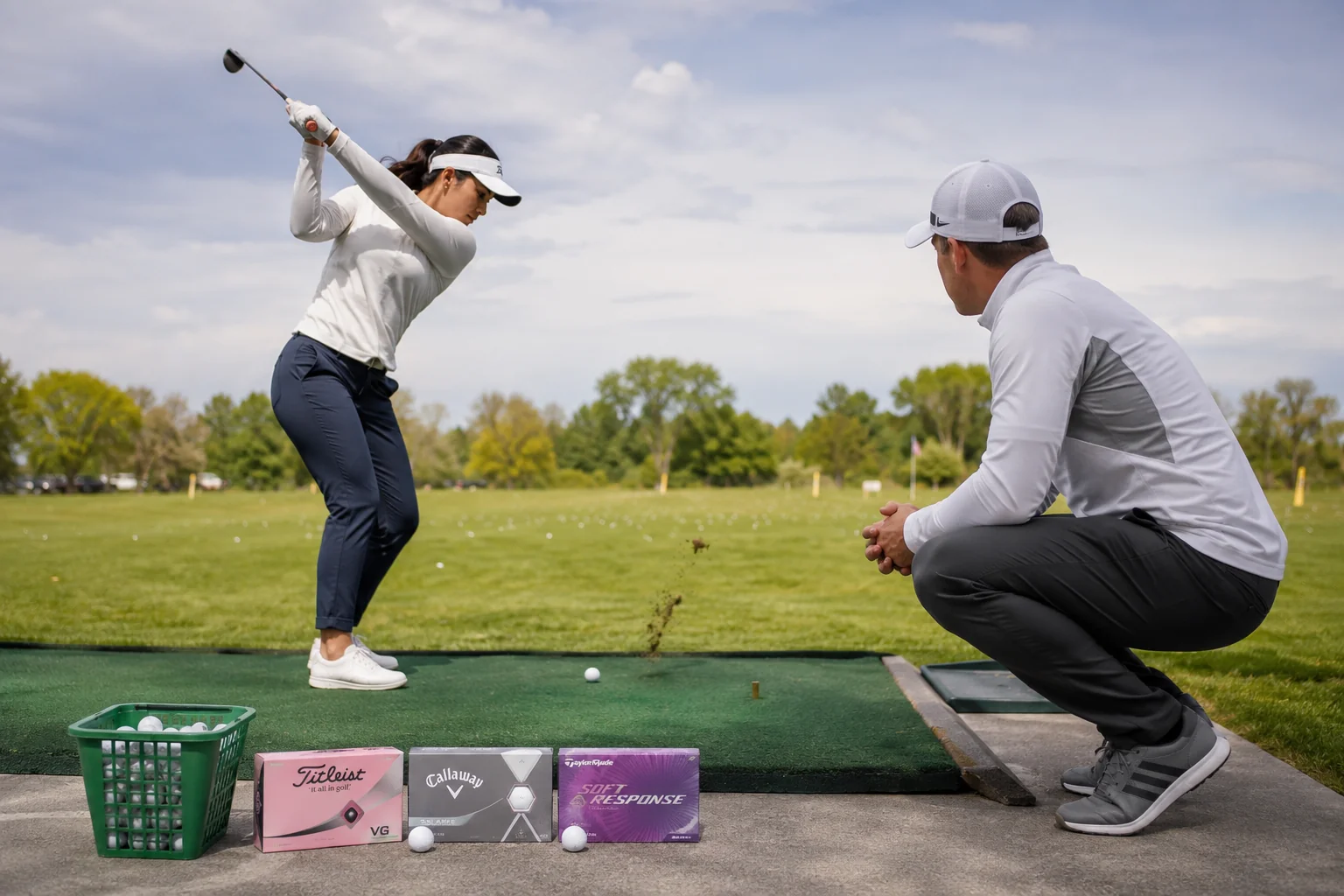
Ionomer durability vs urethane control?
Your cover choice should follow the shots you are trying to improve.
Do not make urethane a prestige purchase. Make it a scoring test. If the urethane option improves wedge check and iron stopping without creating driver problems, it may be worth the higher cost. If the player is still working on launch, contact, and keeping the ball in play, a durable low- or mid-compression ionomer ball may be the smarter choice.
How should you test green-to-tee?
You may pick the ball that flies farthest with driver, then discover it will not stop with wedges or stay stable in wind.
Test women’s golf balls green-to-tee: putting feel, chips, wedges, irons, driver, then wind. A ball that adds driver yards but refuses to stop with wedges may be wrong for a player trying to score, a coach building confidence, or a buyer launching a reliable women’s SKU.
Driver distance is seductive. It is also an easy way to choose the wrong ball. If a ball adds a few yards but creates hot iron landings, wedge skid, poor pace control, or wider driver dispersion, the scorecard may not thank you.
Independent golf ball testing compares balls through speed, flight, spin, accuracy, consistency, driver performance, iron performance, and wedge behavior. That is the same logic your green-to-tee test should use: do not choose a women’s golf ball from one driver number or one soft-feel impression.
Start where scoring happens. Roll putts and check pace. Hit short chips and watch first bounce. Test wedges for skid, check, and stopping. Move to a 7-iron or mid-iron and compare peak height and landing behavior. Only then confirm driver ball speed, launch, and dispersion. Retest two finalists in wind, because very soft balls can feel great on calm days and balloon when conditions change.
Driver-distance claim with no wedge or iron stopping test is a failure signal.
| Pain/decision | Test step | What to watch | Keep / reject signal | Evidence to request |
|---|---|---|---|---|
| Feel uncertainty | Putting | Pace and feel | Predictable, not clicky/dead | Roll test |
| Short-game doubt | Chipping | First bounce / rollout | Repeatable rollout | A/B balls |
| No stopping power | Wedge | Check / stop | No excessive skid | Track landing |
| Iron won’t hold | 7-iron | Peak and descent | Holds green | Compare windows |
| Driver-only trap | Driver | Ball speed + dispersion | No offline penalty | Use same setup |
| Wind risk | Wind test | Peak / curve | No ballooning | Retest finalists |
Create a green-to-tee A/B test sheet. Record putting feel, chipping rollout, wedge stop, 7-iron landing, driver dispersion, and windy-day stability.
Do not approve a women’s golf ball from driver distance alone.
Wedges, irons, driver, then wind?
Your scoring shots should protect your driver choice, not be sacrificed by it.
This test order also helps coaches and retailers. A coach can explain why one ball fits the lesson goal better than another. A retailer can build a women’s fitting conversation around scoring outcomes, not just packaging. A private-label buyer can test whether a proposed women’s ball actually supports the claim on the box.
Do color and visibility matter?
You may want pink, peach, yellow, or matte women’s golf balls, but color helps tracking and preference; it does not create distance, launch, or spin.
Color can help women track the ball, but it does not create distance or spin. Your team should treat pink, yellow, orange, or matte finishes as visibility and branding choices, then verify colorfastness, UV stability, print durability, and the underlying compression and cover.
Color has real value. A bright or matte finish can help a player see the ball in rough, low light, cloudy weather, or winter turf. It can also support confidence, shelf identity, and brand preference. A pink ball can be excellent. A white ball can be excellent. A bad formula does not become women-friendly because the ink is cute.
The performance engine is still core, compression, cover, layers, dimples, and manufacturing consistency. For B2B buyers, color should be specified as a visibility and branding variable. Then it should be tested. Paint adhesion, UV stability, colorfastness, logo clarity, and rub resistance matter because a visibility SKU that fades, smears, or yellows quickly can hurt trust.
Women’s SKU built only from pink colorway is a failure signal.
Request color, finish, and logo durability proof for visibility or private-label women’s SKUs. Check paint adhesion, UV stability, colorfastness, print clarity, rub resistance, and whether the core spec still matches the performance promise.
Do not approve a women’s SKU whose only differentiation is color.
✔ True — Color supports visibility and preference
Pink, yellow, orange, and matte finishes can help players track the ball and help brands stand out on shelf.
✘ False — “Pink or matte color is the performance specification”
Color can help you see the ball. It does not replace compression, cover, construction, launch, spin, and batch control.
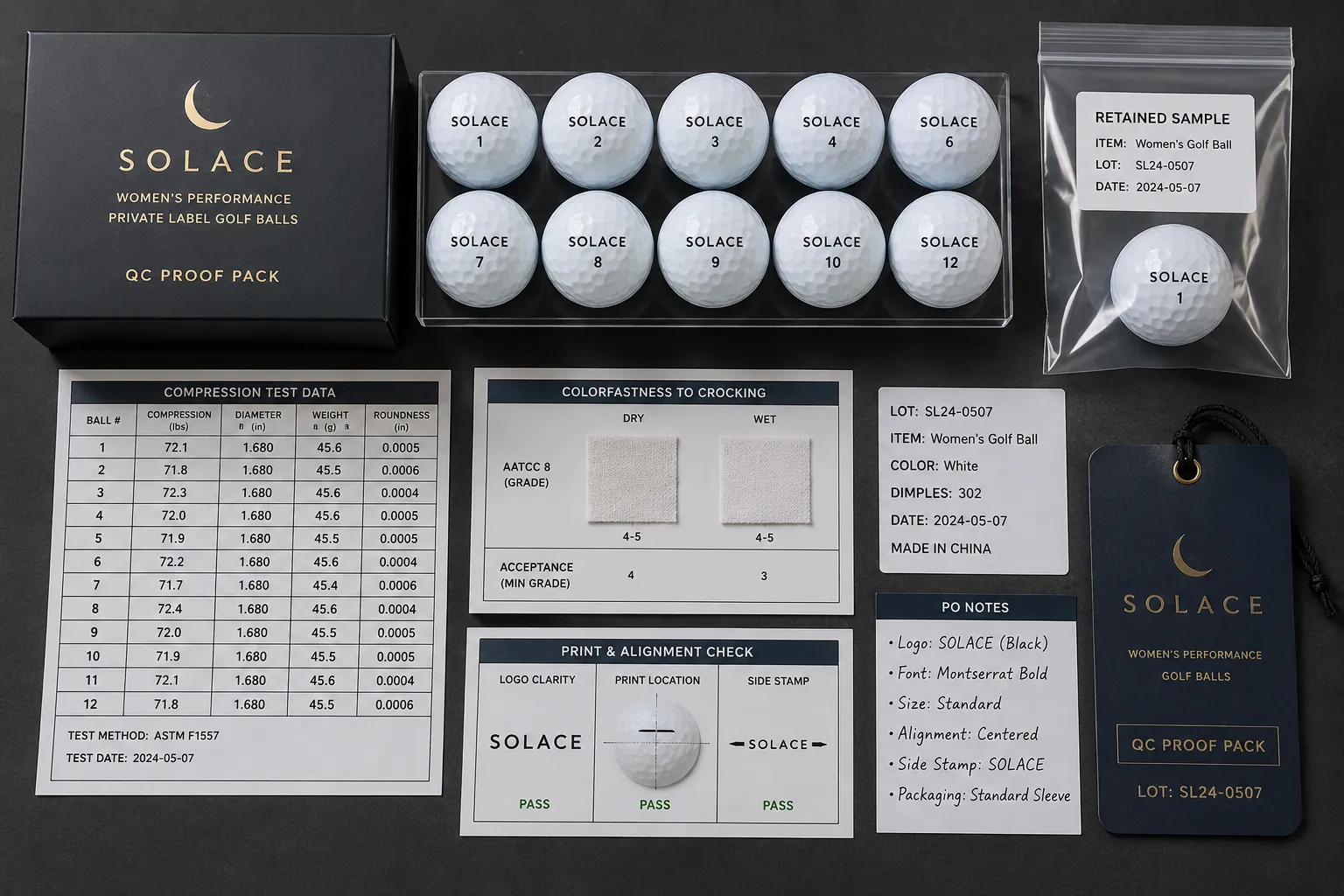
Tracking aid, not performance engine?
Your color choice can help you see the ball, but it should not replace the fitting work.
For private-label women’s golf balls, print method alone does not prove durability. Ink, coating, curing, surface preparation, protective layers, and actual rub or cleaning tests decide whether the finished ball stays presentable. A visibility SKU should stay visible after real handling, not only in a product photo.
What should OEM buyers verify?
Your retailer, academy, or DTC brand may approve one soft sample, but the women’s SKU can fail if bulk compression, cover feel, color, logo, or stopping power drifts.
Do not approve a women’s private-label golf ball from one soft-feel sample. Your PO should require compression spread, 12-ball QC raw data, weight, diameter, hardness, cover/scuff notes, color or print proof, lot ID, retained sample, COA, AQL receiving, and change control.
A women’s private-label ball should be a fit ladder, not a colorway. For retailers and DTC brands, the safest line logic usually starts with a low-compression launch SKU, then adds a baseline academy SKU, a mid-compression performance SKU, a urethane trial SKU, and a visibility SKU only when each route has proof.
| SKU route | Target player / buyer | Suggested spec direction | Buyer proof |
|---|---|---|---|
| Women / beginner launch SKU | <65–75 mph or high-launch need | Low compression, 2-piece ionomer, high launch | Compression spread + launch check |
| Academy baseline SKU | Mixed beginner groups | Same model / same batch | Lot ID + retained sample |
| Women’s performance SKU | 75–90 mph or improving ball-strikers | Mid compression, 2–3 piece, better stopping power | Iron/wedge test |
| Advanced women’s SKU | 85+ mph or scoring-focused players | Multilayer / urethane trial | Wedge spin + driver dispersion |
| Visibility SKU | Rough, winter, senior overlap, retail shelf identity | Matte yellow / pink / orange | Colorfastness + UV stability |
Ask the supplier to provide one women’s golf-ball SKU proof pack with compression spread, weight and diameter data, Shore hardness, cover/scuff notes, launch and stopping-power test, colorfastness or print durability where relevant, lot ID, 12-ball QC raw values, retained sample, COA, AQL receiving rule, and written change-control terms.
Soft-feel sample with no compression spread is a failure signal.
| Pain/decision | QC field | What it controls | Evidence to request |
|---|---|---|---|
| Sample soft, bulk harsh | Compression avg/range/SD | Feel window | Review raw data |
| Basic batch drift | Weight / diameter | Consistency | Compare spread |
| Cover feel varies | Shore hardness | Cover/core window | Ask method |
| Driver-only promise | Launch / stopping test | Fit claim | Green-to-tee test |
| Retail complaints | Cover scuff | Durability | Run wear screen |
| Visibility SKU fades | Colorfastness | Color promise | UV/rub proof |
| Private-label doubts | Logo durability | Brand perception | Print test |
| Reorder dispute | Lot ID / retained sample | Traceability | Seal sample |
Use reference methods carefully. ASTM D2240 can support Shore hardness language for material-consistency checks. ASTM D4060-25 can support relative coating-abrasion comparison for organic coatings on a plane, rigid surface, so use it as a finish-route reference rather than a finished golf-ball guarantee. ISO 2859-1:2026 can support AQL-indexed receiving inspection rules. These are B2B QC references, not women’s-golf-ball certifications.
Supplier shall lock one approved women’s golf-ball SKU version and reference that version on construction spec, compression window, cover route, color/finish record where relevant, 12-ball QC report, lot ID, retained sample, COA, packing list, and receiving inspection file.
Buyer acceptance requires batch-linked compression raw values with average/range/SD, weight and diameter spread, Shore hardness, cover/scuff check, launch and stopping-power evidence, colorfastness or print durability where relevant, retained sample match, AQL receiving rule, and written approval before any core, cover, coating, color, print, packaging, or process change.
Request a women’s golf-ball SKU proof pack before bulk approval. Check 12-ball QC, compression spread, launch/stopping proof, cover/scuff results, colorfastness, lot ID, retained sample, COA, and change-control rule.
Hold approval if the women’s SKU lacks batch-linked QC, retained sample, lot traceability, or proof that the production lot matches the approved sample.
QC data, lot IDs, and retained samples?
Your women’s SKU should be a controlled fitting ladder, not a colorway with a soft-feel claim.
The approved sample, QC report, PO, and received batch should all point to the same version. If the sample already misses the feel, flight, color, or stopping-power window, do not approve bulk production on the promise that mass production will somehow improve it. Fix the sample, then lock the proof.
FAQ
Do women really need women’s golf balls?
Not always. Many women’s-labeled balls are lower-compression, softer-feel, or higher-launch builds, but your fit should come from swing speed, launch, spin, feel, and short-game need rather than the word Lady on the box.
A Lady label can be a useful product clue. It often signals a design aimed at slower-to-moderate swing speeds, softer impact, or brighter visibility. But it is not a fitting result. Start with driver swing speed, then check iron stopping, wedge feel, putting pace, driver stability, and comfort. Your ball should help your shots, not just match a shelf category.
What compression should women use?
Use swing speed as the starting point. Slower driver speeds often fit lower compression; faster players may need mid or tour-level compression, especially if they need driver stability, wind control, or more precise iron and wedge response.
Treat speed bands as starting windows, not automatic answers. A player under 65 mph may start with very soft 2-piece ionomer. A player around 80 mph may test low-compression or mid-compression options. A player near 95 mph may need a firmer multilayer or urethane model. Validate launch, dispersion, stopping power, and feel before deciding.
Are soft golf balls always better for women?
No. Soft balls can help many slower-swing players launch the ball, but stronger players may need firmer or multilayer balls for driver stability, wind control, iron holding, or wedge stopping power.
A soft ball that feels good can still spin too much off the driver or fly too high into wind. It may also lack the short-game reaction a scoring player wants. Test the ball green-to-tee. If the soft model launches well and holds greens, keep it. If it balloons, drifts, or skids on approaches, test a firmer or higher-spin option.
Do pink golf balls perform differently?
Color helps visibility and preference, not core performance. Distance and spin come from compression, cover, layers, dimples, aerodynamics, and manufacturing consistency, not from pink, yellow, orange, or matte paint alone.
Color can still matter. A player may see a bright ball faster in rough, autumn turf, low light, or winter conditions. A retailer may use color for shelf identity. A private-label buyer may use color for brand personality. Just keep the technical claim separate: verify the core, cover, compression, flight, print durability, and colorfastness.
When should women switch to urethane balls?
Test urethane when wedges skid, irons will not hold, or short-game control limits scoring. Do not switch only because urethane sounds premium; switch when the scoring shots prove the need.
A urethane or multilayer ball can help create more greenside spin and stopping power. That matters when a player controls contact well enough to benefit from it. Test wedge check, 7-iron landing, chipping rollout, and driver stability. If the urethane option improves scoring shots without creating driver problems, it may be the right upgrade.
Should women test golf balls green-to-tee?
Yes. Start with putting feel, chips, wedges, and irons, then confirm driver speed and dispersion. This prevents a driver-only fitting from costing you stopping power, pace control, or short-game confidence.
Green-to-tee testing protects the shots that decide scoring. Roll putts, chip to a target, hit wedges, test mid-irons, then check driver performance. Retest finalists in wind. Keep the ball that gives predictable short-game feedback and stable driver flight, not simply the model that wins one distance swing.
Are women’s golf balls tournament legal?
They can be, but event legality depends on the exact model and current conforming-list status, not the Women, Lady, Soft, pink, or matte label printed on the packaging.
For tournament or event use, check the USGA Conforming Golf Ball List or the R&A Conforming Ball List when current-list status is required. The USGA page says the list is updated on the first Wednesday of each month, while the R&A page explains that exact Pole and Seam markings identify the model. A women’s label does not make a ball illegal, and a soft-feel label does not make it legal.
Conclusion
The right women’s golf ball is not the softest ball, the pinkest ball, or the one with a Lady label.
It is the ball that matches swing speed, launches consistently, holds the green when scoring matters, stays stable with the driver, and can be proven by testing or batch data.
Start with swing speed, narrow the compression window, choose the cover by scoring goal, test green-to-tee, use color for visibility, and require real proof before turning one nice sample into a full women’s SKU.
You might also like — Which Golf Ball Should Each Practice Setting Use?