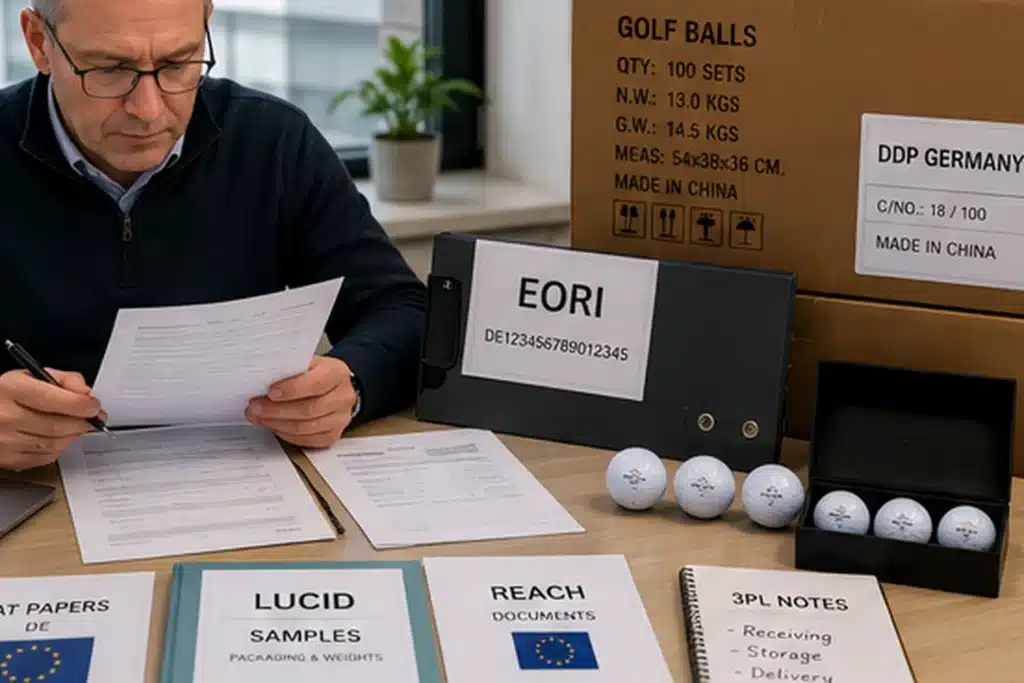
Summer vs winter golf balls should be planned around temperature, player profile, channel, visibility, storage risk, and QC proof—not compression alone. Cold weather can make golf balls feel firmer and reduce launch feedback, while summer conditions can expose heat, coating, packaging, logo, and reorder risks.
Winter golf balls are not just softer balls, and summer golf balls are not just normal balls. Low compression can help some cold-weather or slower-speed players, but your seasonal golf ball SKU still needs the right color, durability, storage guidance, batch consistency, and channel fit.
For OEM, private-label, range, academy, retail, and DTC buyers, seasonal golf ball planning should define:
-
The target temperature range and real use condition.
-
The buyer profile, player speed, and sales channel.
-
The compression window, feel target, and cold-weather test condition.
-
The visibility plan, including yellow, orange, matte, or standard white options.
-
The summer storage, coating, logo, packaging, and UV exposure risks.
-
The seasonal inventory plan, including sample approval, packaging proof, production slot, reorder buffer, and retained sample.
-
The QC proof required before bulk production, including compression data, hardness, weight, diameter, color sample, packaging proof, batch ID, and change-control terms.
Use this guide to compare summer vs winter golf balls as seasonal SKUs—not as a simple “soft ball for winter” or “regular ball for summer” decision.
What changes when temperature changes?
You may treat summer and winter golf ball choice as a player preference, but temperature affects SKU planning, sample approval, storage, and customer complaints.
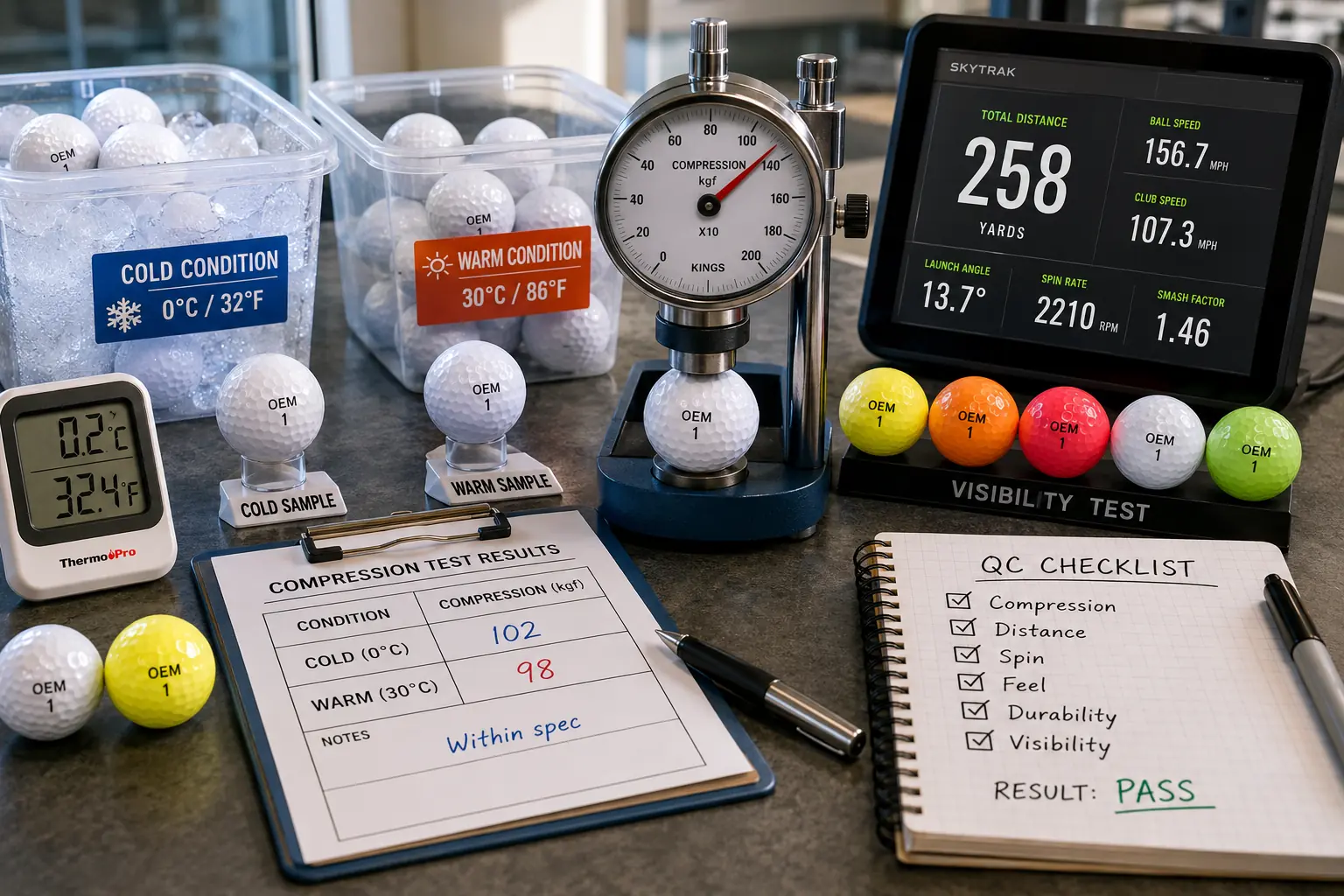
Temperature changes more than distance. Your seasonal SKU should define how cold or heat affects compression feel, ball speed, launch, carry, cover feel, visibility, storage behavior, and complaint risk before you approve a winter or summer golf ball.
Which metrics should buyers track?
Your team should track both performance and business risk. A seasonal golf ball is not only a ball flight decision; it is also a storage, packaging, and reorder decision.
Cold conditions can make golf balls feel firmer, especially for low-speed or recreational players. That can affect perceived compression, launch feedback, carry, and overall confidence. Summer conditions may make the ball response feel livelier, but heat creates a different risk set: warehouse exposure, truck transport, coating feel, surface durability, and packaging condition.
For OEM seasonal golf balls, the useful question is not only “does temperature affect golf balls?” It is “which seasonal condition will your buyers actually face?” A winter range program in Canada, a spring retail pack in the EU, and a summer event giveaway in Texas do not need the same seasonal promise.
| Seasonal variable | What buyers may notice | Buyer risk | Evidence to request | Buyer move |
|---|---|---|---|---|
| Compression feel | Ball feels firmer or softer | Wrong seasonal promise | Compression report | Define window |
| Ball speed / launch | Distance or trajectory shifts | Review complaints | Test comparison | Condition samples |
| Cover feel | Harder or tackier feel | Mismatch by market | Hardness data | Check target user |
| Visibility | Lost balls in low light or leaves | Poor winter usability | Color sample | Approve channel fit |
| Surface durability | Scuff or gloss changes | Returns or poor appearance | Coating/abrasion note | Inspect finish |
| Storage behavior | Heat or cold exposure risk | Batch inconsistency | Storage note | Control warehouse |
| Packaging condition | Box deformation or artwork issues | Retail display risk | Packaging proof | Approve before PO |
Request a seasonal performance brief before sampling. Compare room-temperature, cold-condition, and hot-storage notes where relevant. Do not approve a seasonal SKU without a target temperature range and channel use case.
✔ True — Temperature affects SKU planning, not only player feel
Cold and heat can change feel, flight feedback, storage behavior, packaging condition, and complaint patterns. That makes temperature a buyer-side planning variable.
✘ False — “Winter and summer ball decisions are only about distance”
Distance matters, but seasonal buying decisions also involve visibility, storage, coating durability, packaging timing, and batch consistency.
When does winter need lower compression?
You may assume winter ball means lowest compression, but cold-weather SKU planning should begin with target player profile, temperature range, channel, visibility, and proof.
Winter balls often benefit from softer compression, but winter does not automatically mean the lowest-compression SKU. Your team should validate target temperature, player speed, channel, feel, visibility, durability, and cold-condition data before locking a winter ball.
How should cold-weather samples be tested?
Test winter samples under the conditions your buyers actually face. A ball approved only at room temperature may not match winter feel, speed, or usability expectations.
Lower or softer compression can help slower-speed or recreational players because cold weather may make the ball feel harder to compress. That does not mean every winter golf ball should be the softest possible route. A premium winter retail SKU may still need predictable wedge feel, spin continuity, and short-game response. A winter range ball may need durability, visible color, clean surface, lot stability, and replacement control more than luxury feel.
The failure signal is simple: a supplier says “winter ball” and only offers the lowest-compression option. That may solve one problem while creating another. Your team should compare compression window, cover feel, surface durability, visibility, and target user feedback before approving the SKU.
| Winter buyer profile | Likely need | Compression direction | Risk if simplified | Buyer move |
|---|---|---|---|---|
| Low-speed recreational | Easier feel and launch | Lower / softer test route | Ball still feels dead | Test cold-condition feel |
| Mainstream retail | Balanced feel and control | Low-mid or mid comparison | Too soft for broad audience | Compare feedback |
| Premium player | Control and spin continuity | Do not over-soften | Short-game promise weakens | Test wedge/feel |
| Range / academy | Durability and stable feedback | Compression window + durability | Training data shifts | Lock model and lot |
| Corporate winter gift | Visibility and appearance | Compression secondary | Wrong buying priority | Approve color/packaging |
Ask for winter compression comparison by target temperature range. Condition samples before comparing winter performance. Approve lower compression only when it fits your target buyer, channel, and test result.
What should summer SKUs protect against?
You may treat summer as normal ball season, but summer creates heat, UV, coating, packaging, event, and reorder risks.
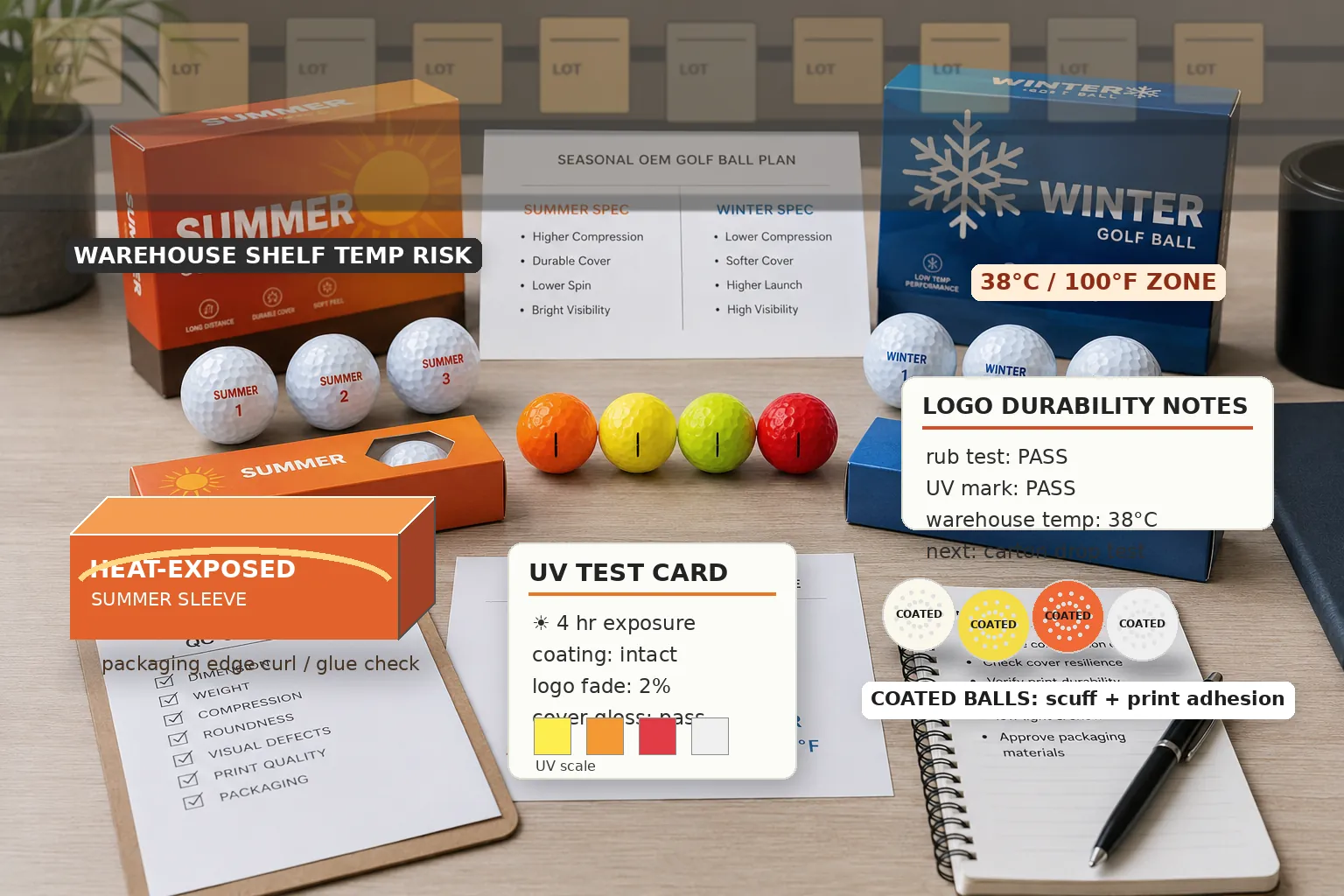
Summer SKU planning is not just about longer carry. Your team should control heat exposure, warehouse conditions, UV, coating gloss, logo durability, packaging deformation, event inventory, and reorder timing before calling a summer ball “safe.”
When do heat and storage matter?
Summer heat turns storage and surface stability into product risks. The ball may play well, but poor warehouse, transport, or display control can still create complaints.
Hot warehouse exposure, truck transport, car-trunk storage, and outdoor event inventory can all affect how the final customer experiences the ball. MyGolfSpy’s hot vs. cold golf balls test shows why temperature exposure should be treated as a storage and performance variable, not just a playing-condition detail. The risk is not only “do golf balls go farther in summer?” It is whether the cover feel, coating gloss, logo durability, packaging shape, and retail appearance survive summer handling.
Coating and spraying processes can influence surface hardness, gloss, and finish consistency. If your summer SKU depends on a premium look, bright color, event logo, or retail shelf presentation, your team should ask for coating, logo, and packaging proof before repeat orders.
| Summer risk | What can happen | Buyer impact | Evidence to request | Buyer move |
|---|---|---|---|---|
| Hot warehouse | Compression/feel may shift | Review inconsistency | Storage note | Control storage |
| Truck or trunk exposure | Heat stress before sale | Customer complaint | Handling guidance | Set limits |
| UV exposure | Color or surface aging | Retail display issue | Weathering note | Test display samples |
| Coating gloss | Appearance or feel changes | Brand quality risk | Coating record | Lock finish |
| Logo durability | Gift/event complaints | Brand image risk | Adhesion/rub note | Inspect sample |
| Packaging deformation | Shelf or gift damage | Retail/DTC review risk | Packaging proof | Approve carton |
| Peak reorder | Late replenishment | Missed summer demand | Production slot | Plan buffer |
A failure signal is a summer shipment with no storage, coating, or packaging note. Ask for storage and coating notes for summer orders. Check approved samples after heat or storage exposure when summer inventory sits before sale. Do not approve a summer reorder without packaging version, coating version, and storage guidance.
✔ True — Summer SKUs need storage and coating risk control
Summer demand often includes events, retail displays, warehouse heat, and fast replenishment. The surface and packaging have to survive that path.
✘ False — “Summer just means using the regular ball”
A regular ball may fit the player, but buyers still need to control heat exposure, coating condition, packaging proof, and reorder timing.
Which ball fits each seasonal channel?
You may try to use one seasonal ball for every channel, but ranges, academies, retail shelves, DTC packs, premium programs, and corporate gifts need different seasonal proof.
The right seasonal ball depends on your channel. A winter range ball needs visibility, durability, and stable averages; a premium retail SKU needs feel and review protection; a corporate gift ball needs appearance, logo durability, packaging, and timing.
How do range, retail, and gifts differ?
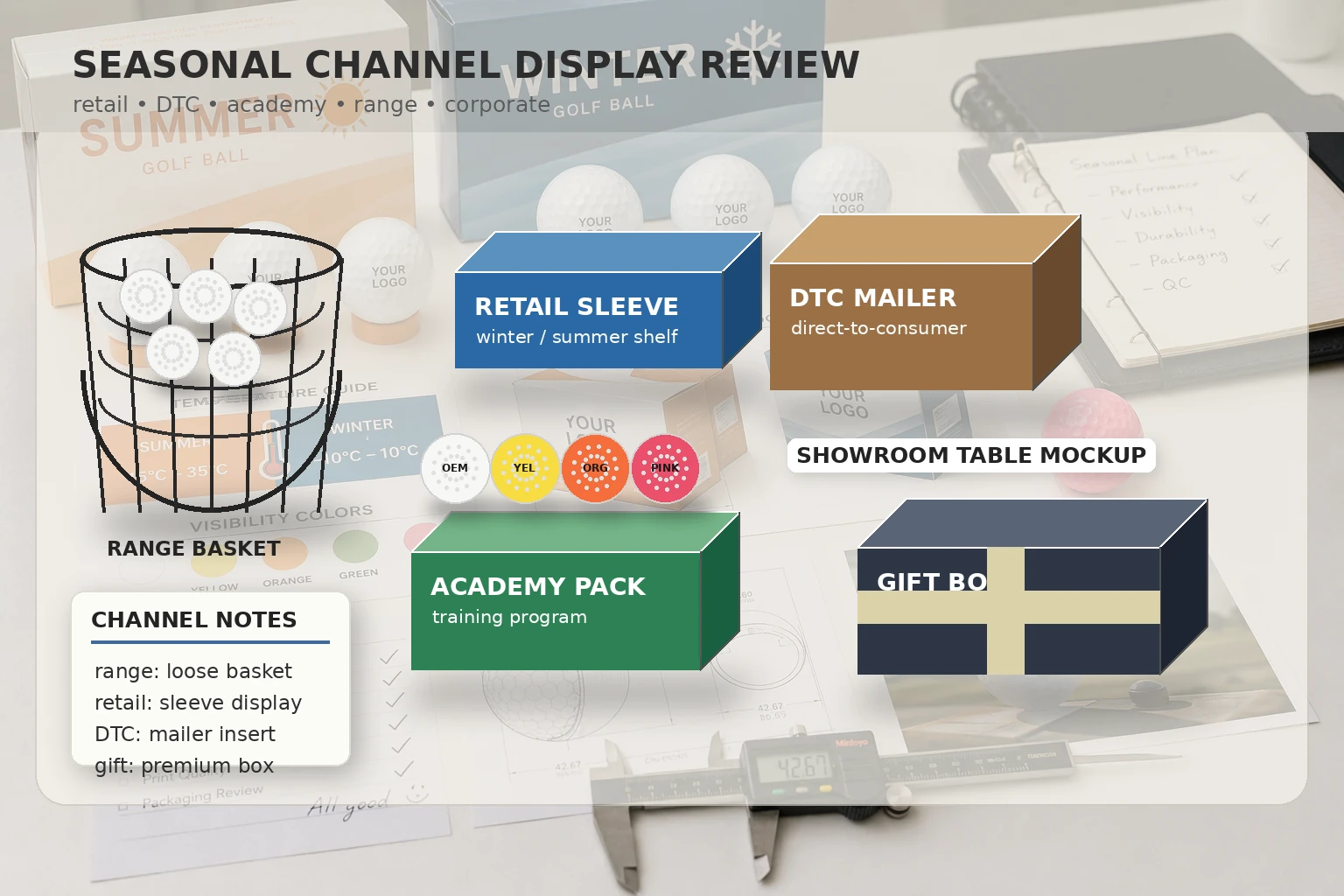
Seasonal golf ball planning should start with where the ball will be used and sold. A range, academy, retail shelf, and gift program do not measure success the same way.
For driving ranges and academies, the goal is not tour-level spin. The goal is repeatable training feedback. Foresight Sports’ guide to range balls vs premium golf balls is a useful reminder that range-ball data should be judged by averages and use conditions, not by one-shot outliers. Same model, same lot, visible color, durable cover, clean surface, and controlled replacement cycle matter more than a premium story. When launch-monitor numbers look inconsistent, evaluate averages instead of reacting to a single outlier.
Retail and DTC programs face a different problem. Seasonal messaging must match the user experience. A winter golf ball SKU should not promise distance it cannot prove. A summer SKU should not ignore storage or packaging risk. Corporate gift balls are different again: appearance, logo durability, delivery timing, and packaging may matter more than compression.
| Channel | Seasonal priority | Ball direction | Main risk | Buyer move |
|---|---|---|---|---|
| Driving range | Durability, color, replacement cycle | Visible value/range ball | Training feedback noise | Lock model/lot |
| Golf academy | Stable feedback and averages | Same model + compression window | Student data shifts | Track averages |
| Indoor winter practice | Clean, durable, consistent balls | Durability-first route | Screen topic drift | Avoid damage discussion |
| Retail shelf | Seasonal message and packaging | Winter/summer packaging route | Mismatch reviews | Control claims |
| DTC value pack | Review stability and reorder | Seasonal copy + QC proof | One batch feels different | Use retained samples |
| Premium seasonal SKU | Feel, spin, visibility | Premium route with proof | Over-softened winter SKU | Test target users |
| Corporate gift | Visual effect and delivery | Color/packaging focus | Late shipment or logo issue | Approve proof |
Create a channel-fit sheet before requesting samples. Compare ball, color, packaging, durability, and QC proof against your actual channel. Do not use the same seasonal promise across all channels unless the proof supports it.
What QC proof prevents seasonal complaints?
You may approve a seasonal ball from feel and color alone, then receive complaints because compression, hardness, coating, color, or packaging differs between sample and bulk.
Seasonal complaints are prevented by test conditions, not by seasonal slogans. Your RFQ should request compression data, hardness, weight, diameter, coating notes, color or visibility sample, packaging proof, storage note, batch ID, retained sample, calibration status, and change-control terms.
What should your RFQ request?
A seasonal QC file should show what was tested, how it was conditioned, and which lot it belongs to. Your team needs evidence that survives receiving inspection.
For winter and summer golf balls, ask for a 12-ball QC report when the program has meaningful volume or brand risk. The file should include compression raw values, average, standard deviation, range, weight, diameter, Shore D hardness, coating or surface notes, color or visibility sample approval, logo adhesion where relevant, packaging proof, batch ID, retained sample ID, equipment model, calibration status, and storage notes.
The seasonal angle is the test condition. Was the sample approved at room temperature only, or did the supplier compare cold-condition or hot-storage behavior where relevant? Without that context, “winter ball” and “summer ball” become labels.
| QC proof | Seasonal risk controlled | Strong evidence | Weak evidence | Buyer move |
|---|---|---|---|---|
| Target temperature / conditioning | Wrong use condition | Written range + conditioning note | Winter/summer label | Define condition |
| Compression raw values | Cold/hot feel drift | 12-ball raw + avg/SD/range | One average | Compare spread |
| Shore D hardness | Cover feel changes | Hardness record | Feel claim | Check sample/bulk |
| Weight / diameter | Basic consistency | Measured data | Pass/fail only | Inspect lot |
| Coating / surface notes | Gloss, scuff, aging risk | Coating/defect record | Photo only | Lock finish |
| Color / visibility sample | Winter usability | Approved physical sample | Digital mockup | Approve physical |
| Logo / packaging proof | Gift/DTC complaints | Adhesion + package proof | Artwork only | Test before PO |
| Batch / retained / change control | Reorder drift | Lot-linked record + approval rule | Verbal promise | Store reference |
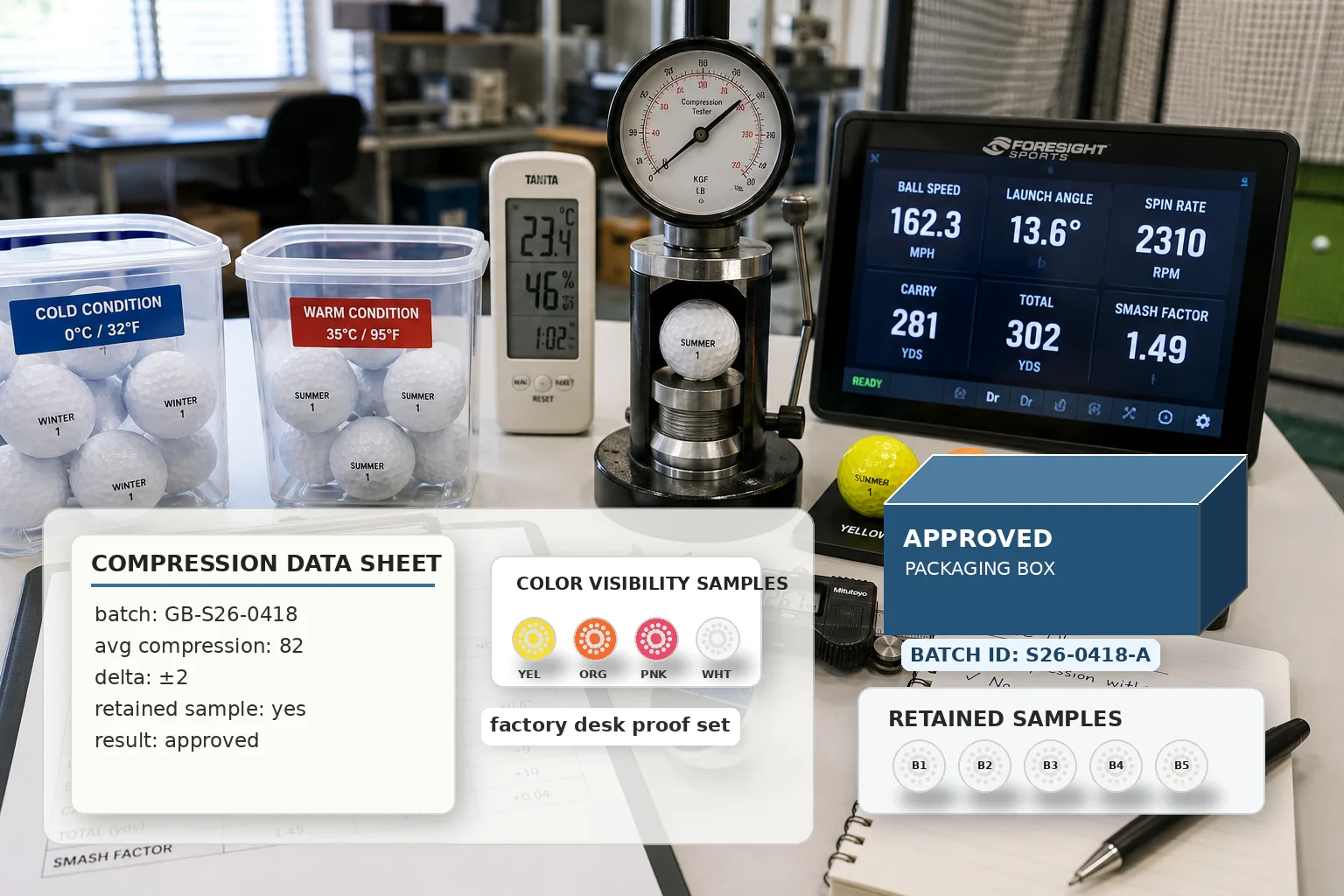
Supplier shall provide a seasonal QC pack showing target temperature range, sample conditioning condition, room-temperature versus cold or hot-condition comparison where relevant, compression raw values, average, standard deviation, range, weight, diameter, Shore D hardness, cover or coating notes, surface defect rate, color or visibility sample, logo adhesion where relevant, batch ID, retained sample ID, equipment model, calibration status, storage note, and change-control terms before seasonal bulk production.
Request a seasonal QC pack before seasonal bulk production. Compare approved sample, conditioned sample, first bulk lot, and retained sample. Supplier must provide batch-linked seasonal QC data before shipment approval.
✔ True — Seasonal QC needs conditioned samples and batch-linked proof
A winter or summer label is weak unless the QC file shows test condition, compression spread, hardness, surface notes, batch ID, and retained sample.
✘ False — “A seasonal label is enough”
Seasonal claims should be supported by tested samples, physical color approval, packaging proof, and change-control terms.
How should buyers plan seasonal inventory?
You may choose the right seasonal ball too late, then miss production slots, packaging proofs, reorder buffers, or peak-season shipment windows.
Seasonal SKU planning fails when samples, packaging, and reorders are locked too late. Your team should set sample approval dates, packaging proof dates, production slots, reorder buffers, version control, retained samples, and PO acceptance criteria before seasonal demand begins.
When should you lock samples and packaging?
Seasonal inventory is a product decision and a calendar decision. The right ball still fails if the approval timeline misses the selling window.
Start by deciding whether you need a separate seasonal SKU at all. If the issue is winter visibility, you may use the same ball body with seasonal color or packaging. If the issue is cold-weather feel, test compression and cover response. If the channel is range or academy, prioritize durability, visible color, and batch stability. If it is a premium retail winter SKU, balance feel, control, visibility, and packaging position.
Then lock the operating pieces: sample approval date, packaging proof date, production slot, forecast quantity, reorder buffer, split shipment plan, color version, packaging version, retained sample, and PO acceptance criteria.
| Planning decision | When it matters | Risk if late | Evidence / document | Buyer move |
|---|---|---|---|---|
| Seasonal SKU route | Before sampling | Overbuilt or underbuilt SKU | Channel-fit sheet | Choose route |
| Sample approval | Before production slot | No time to retest | Approved sample ID | Lock sample |
| Packaging proof | Before artwork release | Shelf/gift delay | Packaging version | Approve proof |
| Production slot | Before peak season | Missed demand | PO timeline | Reserve capacity |
| Color version | Before reorder | Mismatch batches | Color sample ID | Control version |
| Split shipment | Before logistics plan | Stockout risk | Shipment plan | Plan replenishment |
| Retained sample | Before shipment | No dispute reference | Retained sample ID | Store sample |
| PO acceptance criteria | Before payment balance | Weak receiving check | QC clause | Write criteria |
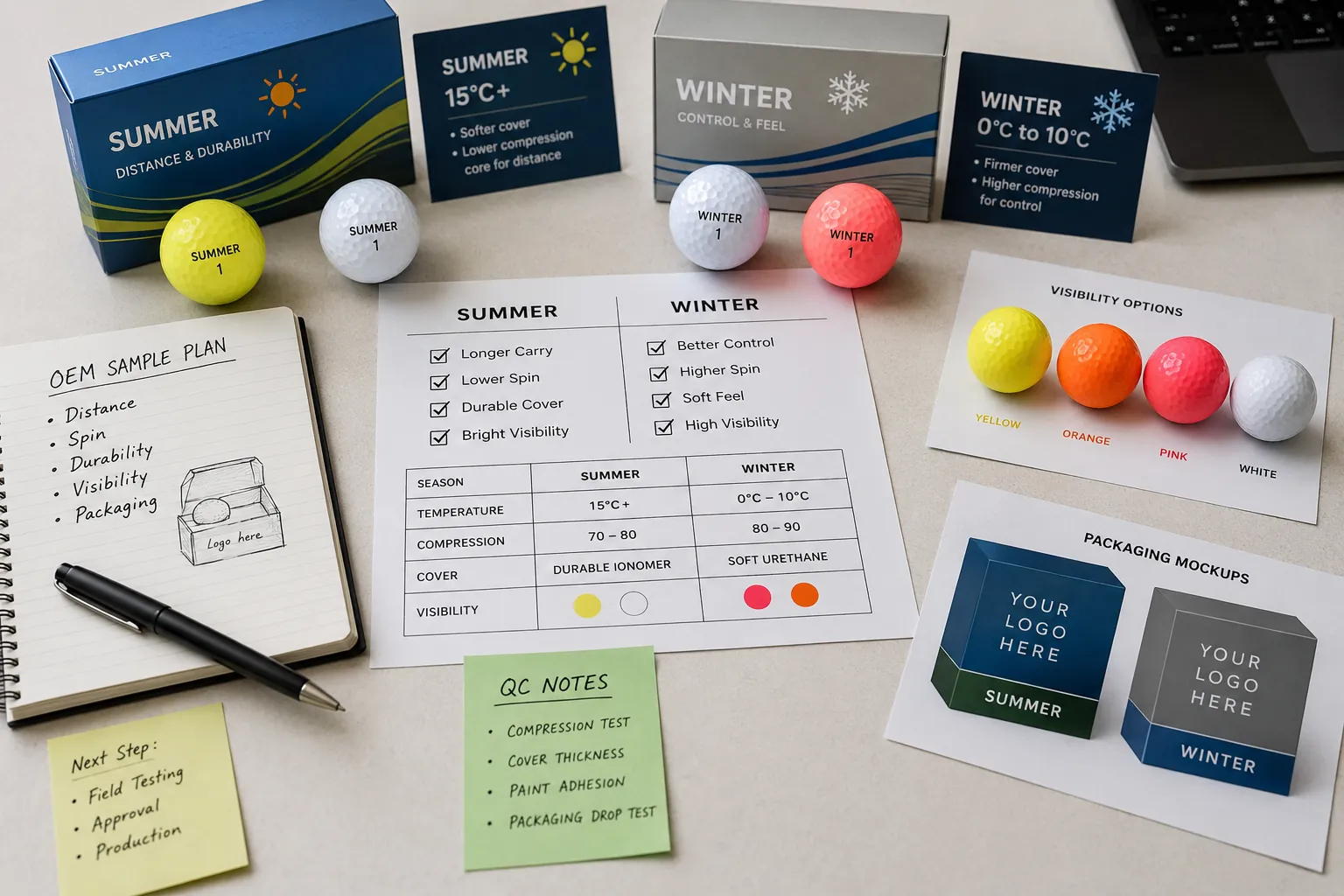
A failure signal is a seasonal reorder that changes color, compression, or packaging without a retained-sample check. Seasonal production acceptance should be based on the approved sample and written QC file, including compression raw values, average, standard deviation, range, weight, diameter, Shore D hardness, surface or coating notes, color and packaging approval, retained sample ID, and buyer-approved change-control terms.
Build a seasonal inventory timeline before sending a PO. Check sample approval, packaging proof, production slot, and reorder buffer against your seasonal demand window. Do not launch seasonal campaigns before samples, packaging, QC proof, and retained samples are locked.
FAQ
Do golf balls perform differently in cold weather?
Yes. Cold air and cold-soaked balls can change feel, ball speed, carry, and trajectory, so buyers should test winter SKUs under the conditions their customers actually face.
For B2B buyers, the important point is not a single distance number. It is whether the winter golf ball remains usable for the target player and channel. Define the temperature range, condition samples before comparison, and avoid absolute distance promises unless your own testing supports the claim.
Do golf balls go farther in summer?
They often can, because warmer conditions may support livelier response and different air behavior, but buyers should avoid making summer distance claims without controlled testing.
One long shot is not a product claim. Compare averages, not outliers. For summer golf balls, your team should also separate performance from storage exposure. A ball that performs well on course can still create complaints if heat, packaging, coating, or logo durability is ignored before sale.
Are low compression golf balls better in winter?
Often for slower-speed or recreational users, but not automatically for every market. Winter SKU planning should match temperature range, player speed, feel target, channel, and proof.
Low compression can improve cold-weather feel for the right player group, but over-softening can hurt a premium winter program if your buyers expect control and spin continuity. For range or academy programs, durability, visibility, and batch consistency may matter more than a soft-feel message.
What is the best golf ball for cold weather?
There is no universal best winter golf ball. Golf Monthly’s winter golf balls guide shows that cold-weather golf balls are a real search demand, but for B2B buyers, the better question is whether the SKU proves cold-weather feel, visibility, durability, and batch consistency.
A winter retail SKU, winter range ball, and corporate gift ball should not be judged by the same promise. Define your channel, approve physical color samples, request seasonal QC proof, and decide whether the product needs a new ball body or only seasonal color and packaging.
Are yellow golf balls better in winter?
They can be easier to see in low light, frost, leaves, or cloudy conditions, but color should still match the channel, packaging plan, and reorder strategy.
Winter visibility is a SKU decision, not only a player preference. Yellow, orange, or matte options can help some winter programs, especially for ranges, academies, and low-light play. Do not turn visibility into a custom-color project without controlling physical samples, packaging version, and reorder consistency.
How should golf balls be stored in hot or cold weather?
Avoid uncontrolled heat, prolonged extreme cold, and poor warehouse conditions. Buyers should ask suppliers for storage guidance, packaging protection, and retained samples.
Storage conditions can affect the customer’s final experience before the ball is ever played. For seasonal inventory, keep storage notes in the QC file, avoid long vehicle heat exposure, and use retained samples to compare future complaints or reorders against the approved lot.
Should ranges use different balls in winter?
They may need balls that remain visible, durable, clean, and consistent in cold or wet conditions. Stable feedback and replacement control matter more than premium spin.
A winter range ball does not need a tour-style story. It needs same model, same lot, clear visibility, durable cover, clean surface, and stable averages. Track averages rather than single-shot outliers, and use a controlled replacement cycle so academy feedback stays consistent.
What should buyers request before seasonal bulk orders?
Request approved samples, target temperature range, compression data, hardness, weight/diameter data, surface durability, color sample, packaging proof, storage notes, batch ID, retained sample, and change-control terms.
A strong seasonal order should include a 12-ball QC report when volume or brand risk is meaningful. Physical color and packaging proof matter because seasonal programs often rely on visibility and presentation. Put change-control terms into the PO so reorders cannot silently change the approved seasonal product.
Conclusion
Plan seasonal golf ball SKUs around temperature, channel, visibility, storage, QC proof, and reorder timing—not just low compression for winter or normal compression for summer. Your best seasonal SKU is the one your buyer can sell, store, repeat, and defend with data.
Summer and winter golf balls should not be chosen by slogans. Your seasonal plan should define the target temperature range, player profile, channel, color and visibility needs, storage condition, packaging schedule, QC requirement, and reorder timing before bulk production.
You might also like — How Are Golf Balls Made? The B2B Guide to Manufacturing CTQs