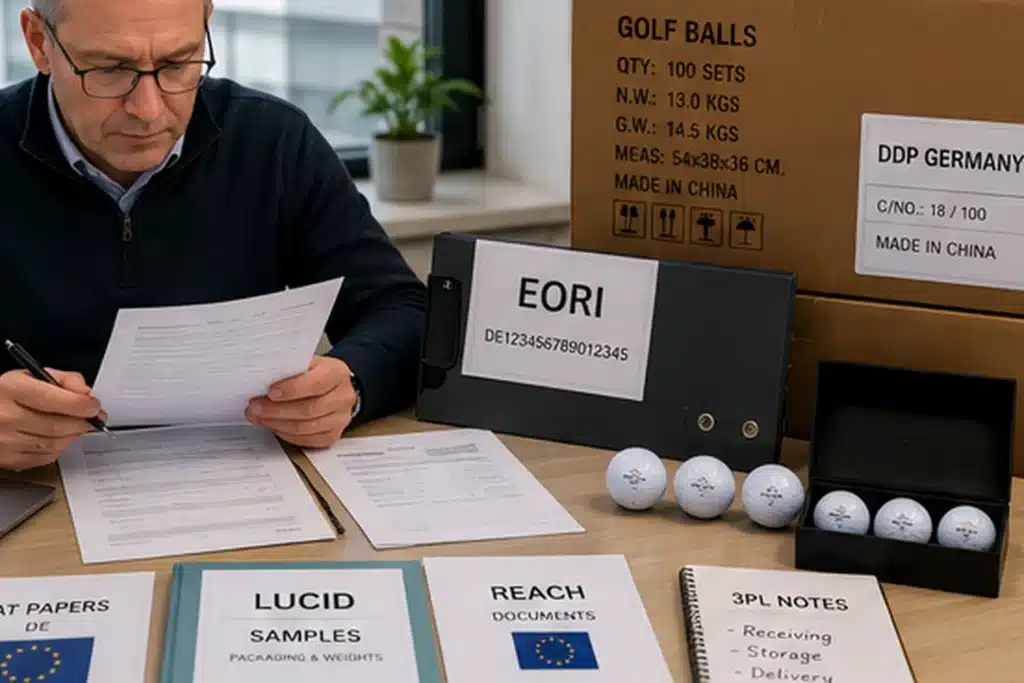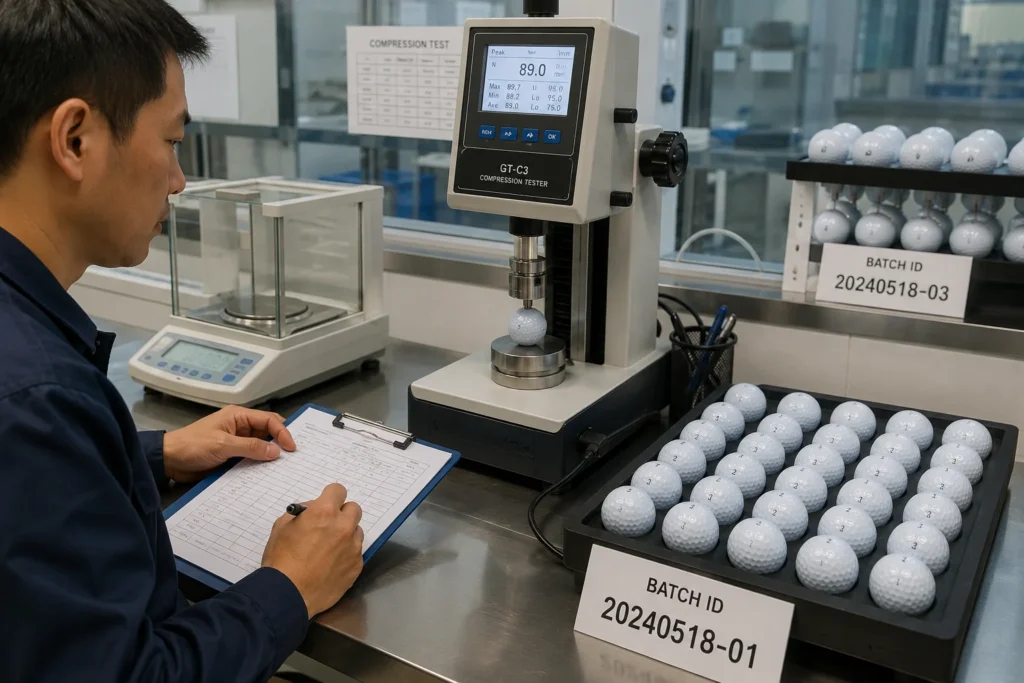
Golf balls are made through six main manufacturing stages: core mixing and curing, layer or cover forming, seam and dimple control, coating, logo printing, and final QA. For B2B buyers, each stage should be tied to a CTQ, test method, acceptance limit, and batch record before mass production starts.
Bulk golf balls usually fail for one reason: the supplier controls the sales story better than the production process. One unstable shipment can turn a low quote into returns, missed launch windows, refund pressure, and an awkward internal question: “Why did we approve this supplier?”
A consumer may ask how a golf ball is made. A sourcing buyer asks a sharper question: why did the sample feel fine, but the bulk order produced hard/soft variation, cover cracks, blurred logos, strange ball flight, or conformance risk? Use this guide as a manufacturing audit map. Each step shows what the process does, what can fail, and what evidence you should request before approving a PO.
Why do CTQs matter to bulk buyers?
You do not lose money because the ball-making story is incomplete. You lose money when the supplier cannot prove which process gates control feel, flight, logo durability, and conformity.
Golf ball manufacturing is a controlled sequence, not a mystery process. For bulk buyers, the useful question is whether core compression, layer concentricity, dimple fidelity, coating thickness, print adhesion, and final conformance are measured the same way from sample approval to shipment.
A golf ball OEM manufacturing process usually follows the same broad path: materials preparation, core mixing, core vulcanization, core finishing, mantle or cover forming, seam finishing, coating, logo printing, final inspection, and packaging. That timeline explains how a golf ball is made, but it does not protect your purchase order by itself.
Your protection comes from CTQs, or Critical to Quality points. A CTQ turns a factory step into a measurable buying control. Compression affects feel and distance consistency. Concentricity affects whether the ball flies neutrally. Dimple fidelity affects lift and drag. Coating uniformity affects appearance, durability, and sometimes flight stability. Weight, diameter, symmetry, and initial velocity logic protect conforming programs.
Before you get pulled into a factory’s long production story, map the process to the buyer risk.
| Manufacturing stage | Main CTQ | Buyer risk |
|---|---|---|
| Core mixing / curing | Compression distribution | Hard/soft feel variation |
| Layer / cover forming | Concentricity, cover thickness | Flight bias, cracking, scuffing |
| Seam / dimple control | Dimple fidelity, symmetry | Unstable trajectory |
| Coating / printing | Adhesion, abrasion, registration | Logo failure, peeling |
| Final QA | Weight, diameter, compression | Non-conforming shipment |
In B2B sourcing, process evidence matters more than factory storytelling. Ask for a one-page CTQ control plan before sample approval. Check whether every CTQ has a method, sample count, batch ID, acceptance limit, and reaction plan. Do not approve mass production until that plan is attached to the quotation or sample approval record.
This is also where low quotes become easier to judge. If one supplier quotes quickly but cannot show compression distribution, cover-thickness evidence, print adhesion results, or final QA records, the quote is not fully comparable. Your team is not only buying balls. You are buying control over the five complaints that hurt bulk buyers most: inconsistent feel, early cover damage, logo failure, odd flight, and unclear conformance status.
✔ True — CTQs turn factory claims into shipment controls
A useful CTQ links the process, test method, acceptance limit, and batch record. That gives your team something to defend if customers later question feel, flight, durability, or compliance.
✘ False — “A clean factory video proves production consistency”
Videos can show capability, but they do not prove batch control. You still need test data tied to the approved sample and the shipped lot.
How is core consistency controlled?
Your customer complaint may sound subjective: too hard, too soft, dead, hot, inconsistent. In production terms, the root cause is often measurable compression spread.
Do not accept “we tested compression” as a complete answer. You need average, SD, range, equipment model, calibration status, and batch ID, because one impressive average can hide a dozen balls that feel different in real customer use.
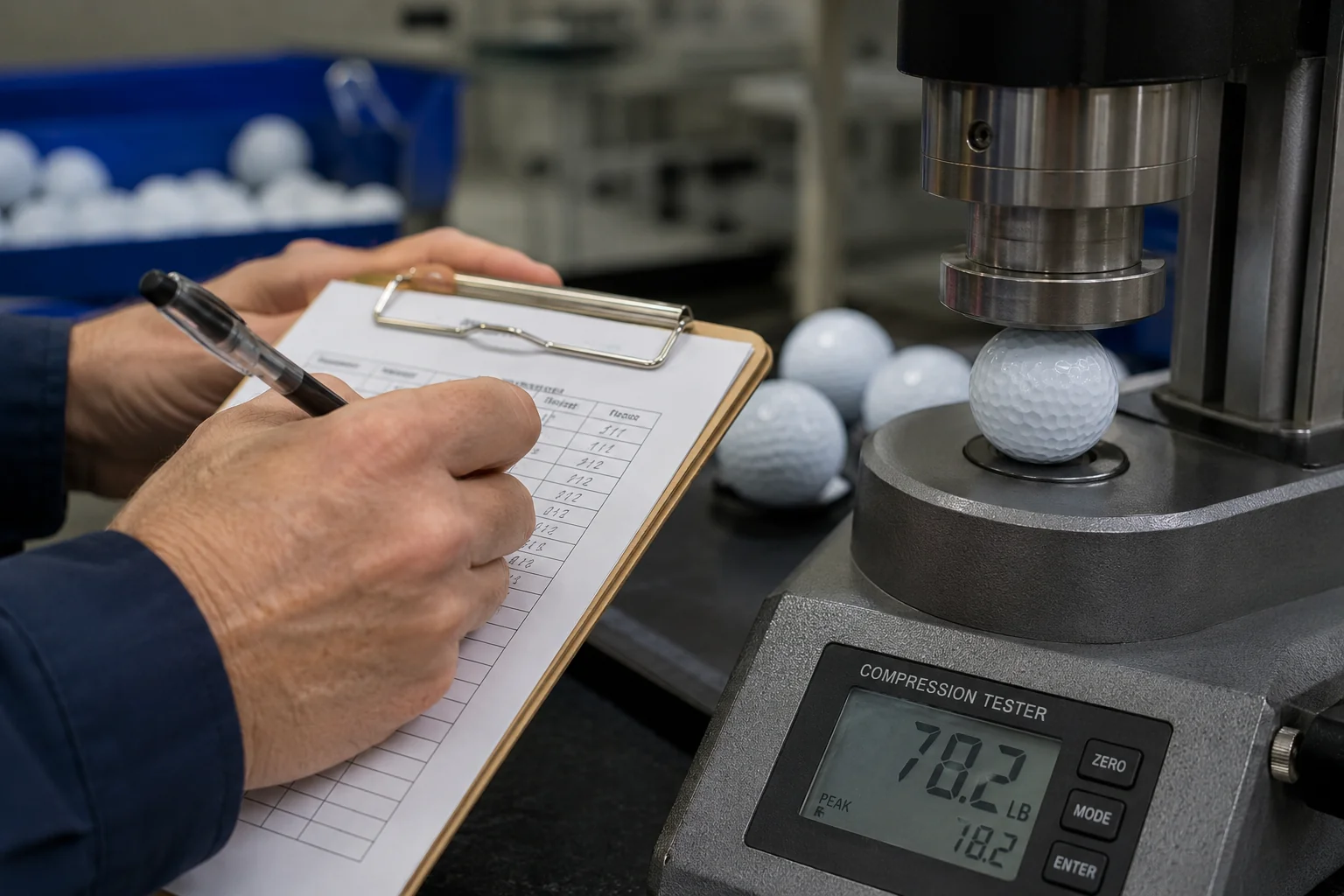
Core mixing and vulcanization set the baseline for compression, rebound, and feel. Your risk is not whether the core is made from rubber. Your risk is whether the factory can hold the same feel from approved sample to shipped cartons. Mixing dispersion, cure time, cure temperature, pressure, cooling, and conditioning can all move the compression distribution.
A wide compression spread within one dozen is an early failure signal. The buyer hears “some balls feel hard, some feel soft,” but the production team should hear “distribution drift.” If your distributor sells repeat orders, inconsistent feel does more than create one complaint. It weakens reorder confidence because the customer no longer trusts that the next dozen will match the last dozen.
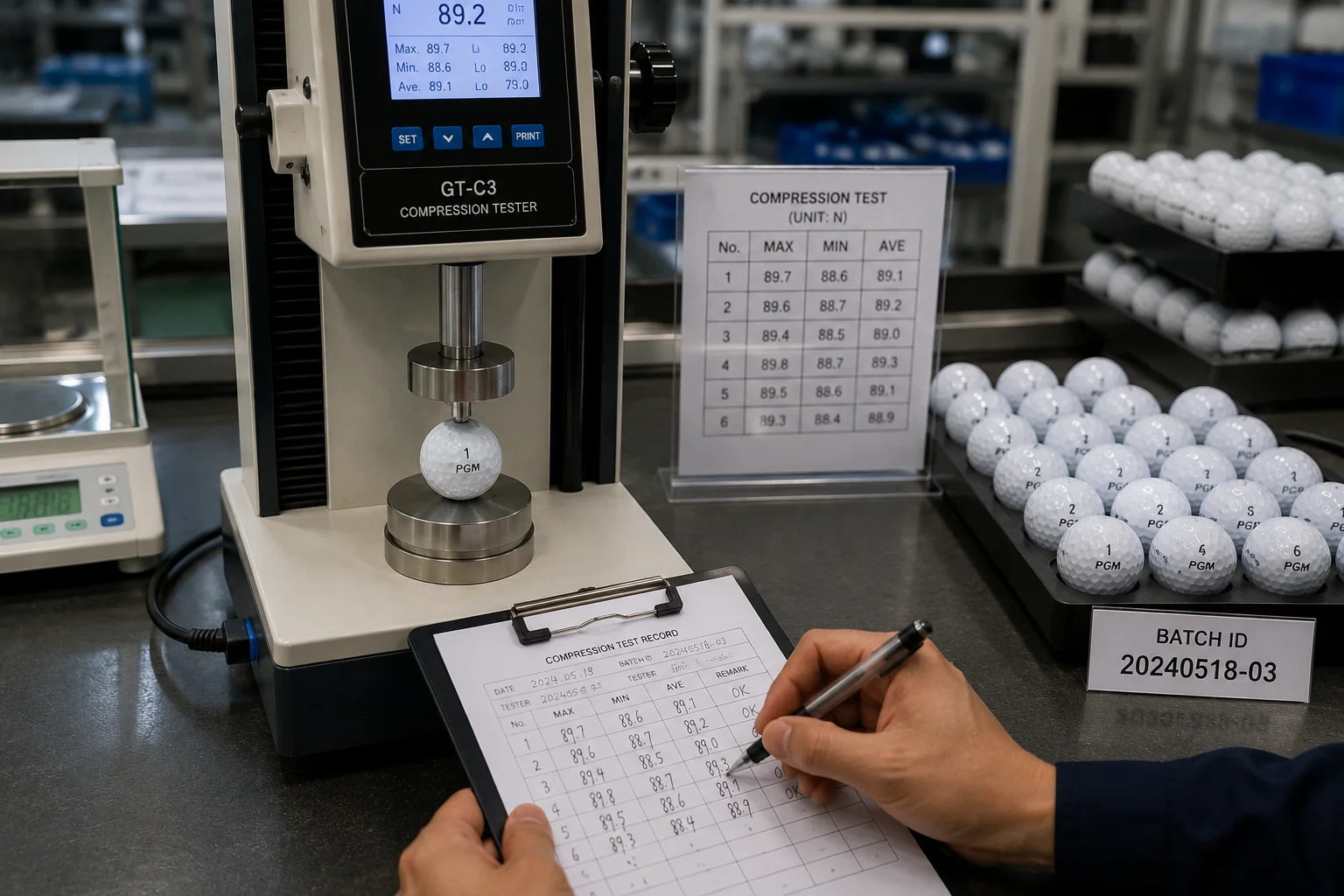
For a controlled program, require ATTI / OK Automation 55-M or equivalent compression data. The report should show raw values, average, SD, range, equipment model, calibration status, conditioning notes, and batch ID. Internal QC targets often treat σ≤2–3 as a good-to-excellent batch consistency window, but the exact limit should be agreed by product type and price tier.
Your PO can state that first-article release requires compression data within the approved average and SD window. Any out-of-limit result should trigger containment, root-cause review, corrective action, and buyer re-approval before shipment. Supplier shall link each approved sample, first-article lot, and shipped carton to one batch/lot ID, with QC records showing sample count, method notes, and retain-sample location.
| Pain/decision | CTQ | Method | Evidence to request |
|---|---|---|---|
| Bulk feels inconsistent | Compression spread | ATTI/equivalent | Average + SD + range before PO |
| Distance varies by batch | Core cure stability | Cure record + compression trend | Frozen process after sample approval |
| Supplier gives one number | Distribution quality | 12-ball report | Raw values, not only pass/fail |
| First order risk is high | Sample vs bulk match | Pre-production + first-article comparison | Approval only if both reports align |
How should ATTI compression be reported?
A useful compression report shows distribution, traceability, and method control. The average tells you the target; SD and range tell you whether the shipment will feel stable.
Ask whether the data comes from pre-production samples, first-article production, or random bulk goods. Those are not the same thing. Samples can receive extra attention; first articles prove whether the line can repeat the approved setup. A serious report should identify the batch or lot, because a beautiful PDF without traceability is just decoration with numbers.
How should covers and dimples be formed?
Your premium 3-piece project can fail if the cover is under-specified. Cracks, wedge scuffs, rough dimple edges, poor adhesion, or flight bias can appear even when the quote says “urethane.”
A cover claim is not a cover specification. You should ask what the cover family is, how thick it is, how thickness is measured, how dimples are protected, and whether the approved cover data will be repeated on first-article production.
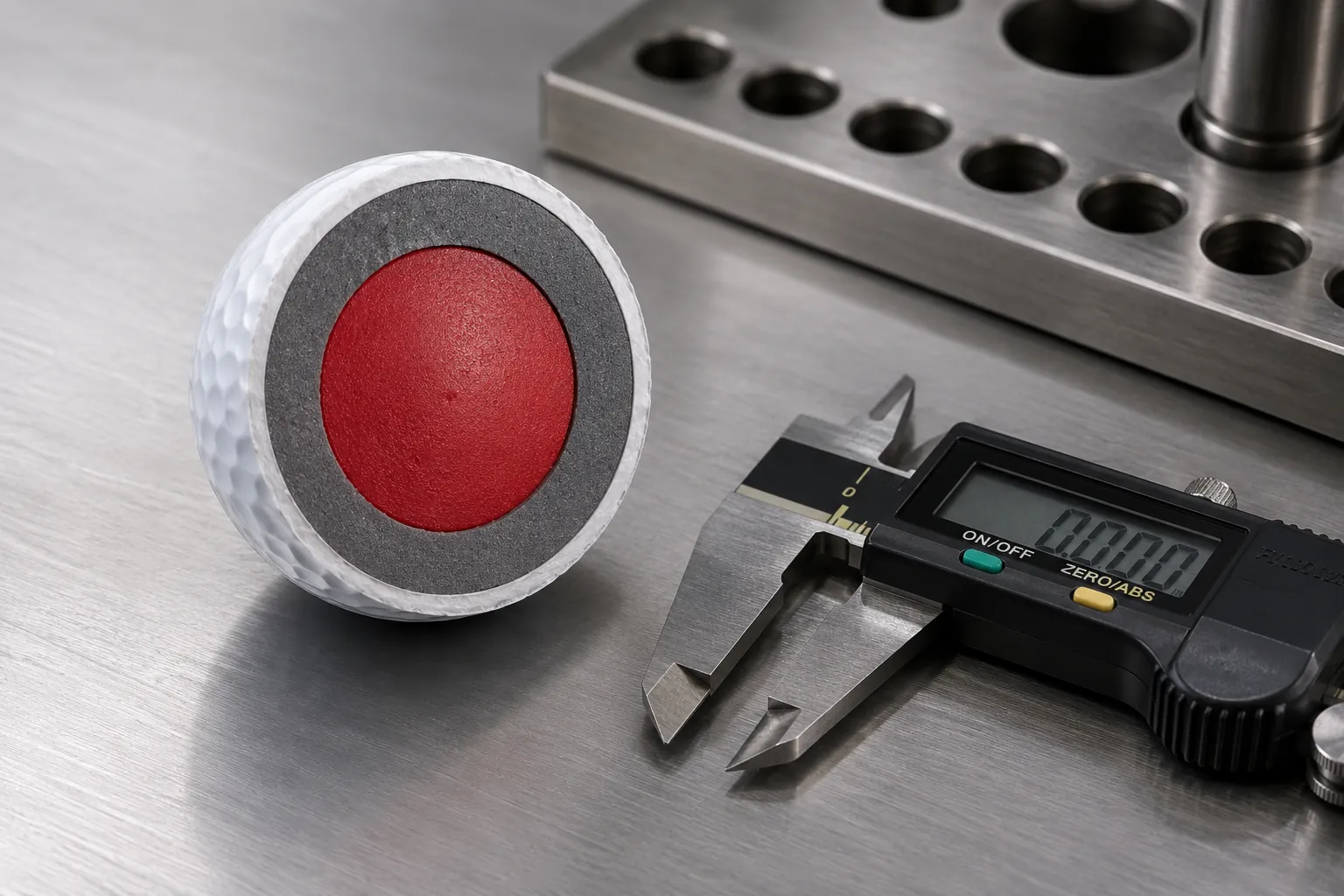
Cover forming is where many golf ball manufacturing process claims become fuzzy. “Urethane,” “premium,” and “tour-level” are not enough for a B2B purchase decision. Ask the supplier to declare the cover family clearly: ionomer/Surlyn, TPU or injection PU, or thermoset urethane. Then connect that claim to cover thickness, hardness, adhesion, abrasion, and dimple inspection.
This matters because buyers often discover cover risk too late. The first sample looks good. The logo proof looks clean. The carton photos look acceptable. Then the market reports early wedge scuffing, cracked covers, rough dimple edges, or unstable flight. At that point, the problem is expensive because your team is no longer debating a sample. You are dealing with inventory.
On verified Golfara 3-piece urethane programs, 0.0320 in / 0.81 mm cover thickness can be used as a program benchmark. Treat it as a measurable RFQ and QC reference, not a universal industry rule. This number should be verified by the specific sample, structure, and test method, not copied as a universal target for every 3-piece ball.
A buyer should ask for the cover-thickness map, cutaway photos, hardness target, and surface-durability evidence for both the approved sample and the first-article lot. No batch-linked cover thickness or adhesion proof is a warning sign. You are not buying “premium”; you are buying a cover system with measurable thickness, adhesion, durability, and dimple quality.
✔ True — 0.81 mm can be a verified design benchmark
Cover thickness matters when it is tied to a specific design, measurement method, and durability target. Used correctly, it helps you compare approved samples and first-article production.
✘ False — “Any supplier saying urethane is offering the same cover system”
The same label can hide different materials, molding routes, hardness windows, adhesion levels, and dimple quality. The purchase decision should be based on measured cover data.
When does 0.81 mm cover thickness matter?
Thin-cover discussion matters when the factory can prove thickness control, dimple integrity, and surface durability. Otherwise, the number becomes a marketing claim.
The better question is not “Can you make it thin?” It is “Can you repeat this cover thickness on the bulk lot without cracking, scuffing, dimple damage, or adhesion loss?” For multi-layer balls, concentricity also becomes more difficult as each layer adds another chance for offset. X-ray, CT, cutaway checks, or equivalent fixturing can help verify that the core, mantle, and cover are aligned closely enough for the intended program.
For related material and conformance discussion, see our guide on USGA conforming golf balls and China OEM production.
Which print method protects your logo?
Your logo complaint may come from the wrong print method, weak artwork confirmation, poor surface treatment, under-cured ink, or missing clear-coat protection. “Use UV” is not a complete answer.
UV printing is not automatically the stronger B2B choice. For 1–4 color repeat logos, pad printing can give sharper edges and better cost control; for complex gradients or photo-style artwork, UV printing may be the better fit if surface prep, curing, and clear coat are controlled.
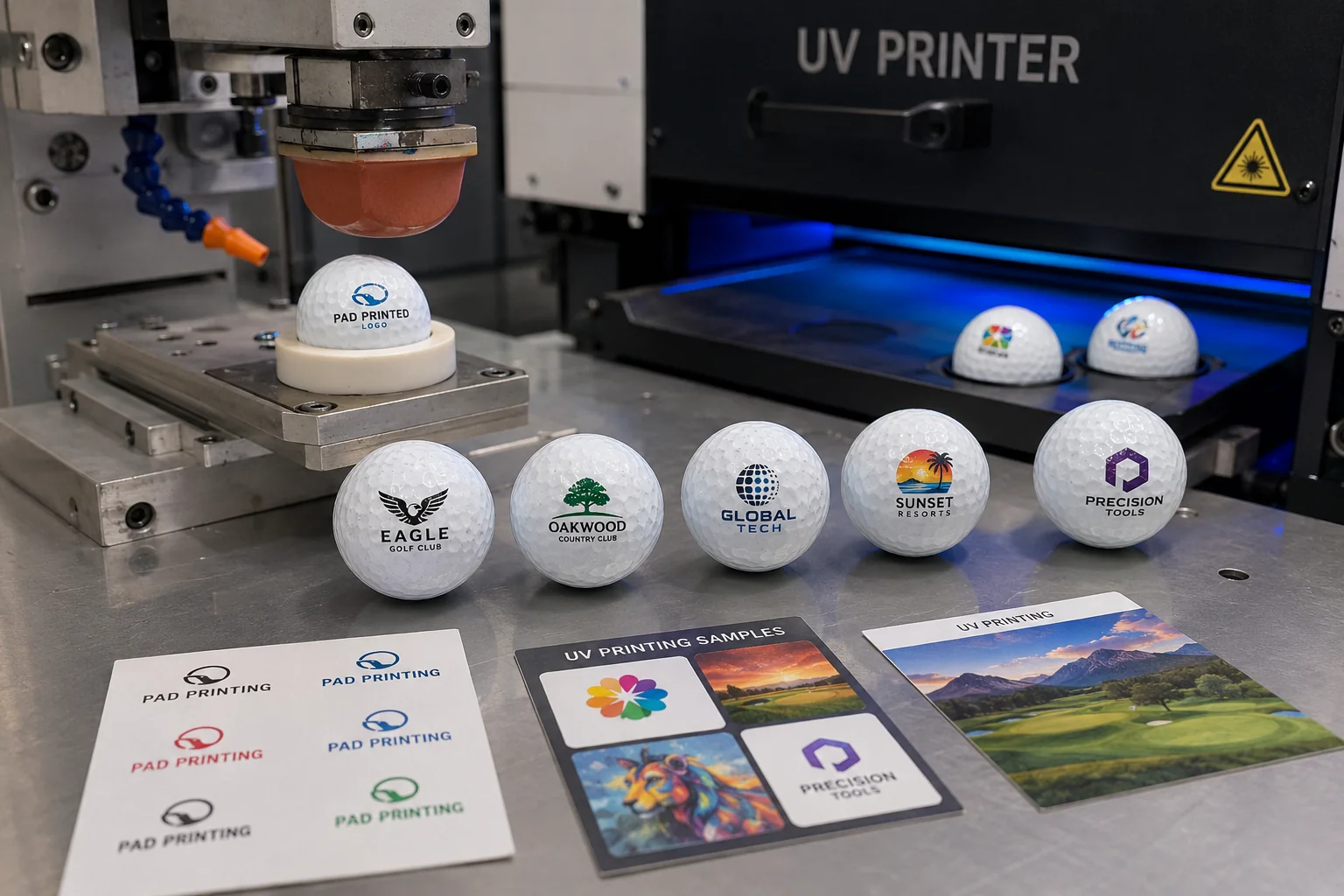
Custom golf ball printing is a production-risk decision, not only a visual decision. Pad printing transfers ink from a plate through a silicone pad onto the curved ball surface. It is usually efficient for large-volume, repeated, low-color logos, range-ball markings, simple text, and routine retail branding. UV printing is more flexible for smaller batches, multi-color artwork, gradients, personalization, and designs that are hard to separate into simple spot colors.
Durability depends on the full system: ball surface, coating, ink type, surface treatment, UV curing strength, protective clear coat, and actual rub or abrasion results. Your buyer, event sponsor, or distributor will not care why the logo failed. They will care whether the approved proof matched the shipped balls.
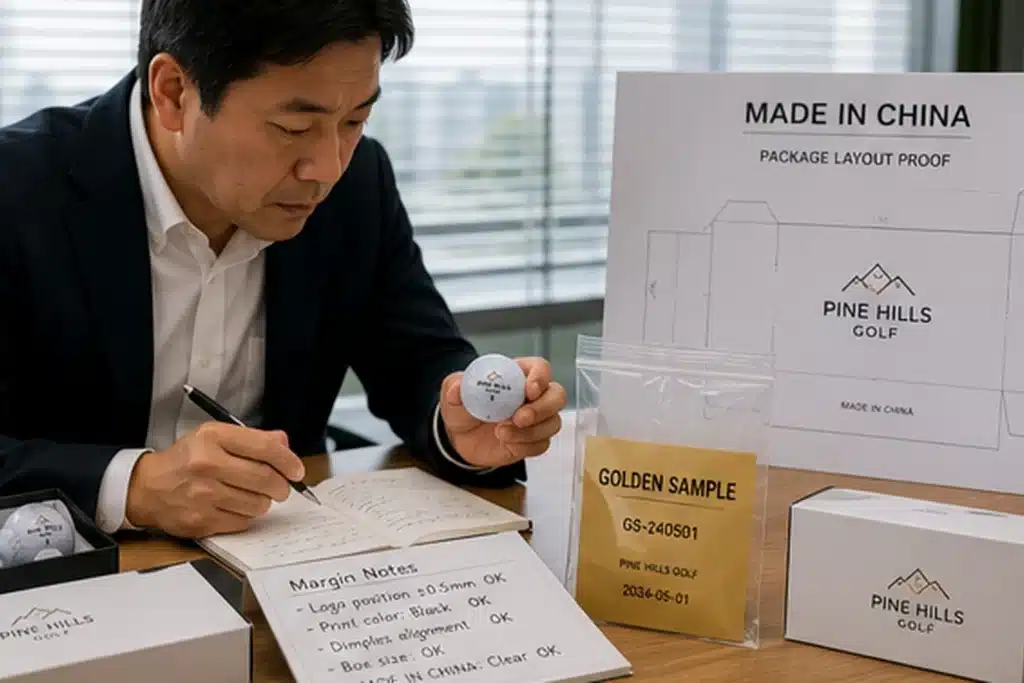
Request artwork proof, print method declaration, cured sample, and adhesion/abrasion test photos before mass printing. Check logo edge, color, placement, curing, and rub result. The buyer-approved print sample should become the production reference; any color, size, side count, or method change needs re-approval.
| Pain/decision | Better fit | Risk to control | Evidence to request |
|---|---|---|---|
| 1–4 color bulk logo | Pad printing | Unneeded UV cost | Vector file + print proof |
| Gradient or photo-style logo | UV printing | Color drift / weak adhesion | Cured sample + rub test |
| Range ball marking | Pad printing often first | Abrasion and washer wear | Abrasion photo report |
| Gift or event ball | UV or high-detail setup | Visual mismatch | Pantone + packaging proof |
| Fine text on curved surface | Pre-test required | Blurred edges | Actual-size printed sample |
When should you choose pad printing?
Choose pad printing when repeatability, edge sharpness, and unit-cost control matter more than full digital color freedom. It fits many B2B logo-ball programs.
Pad printing is often the safer first choice for simple corporate marks, one-side or two-side logos, range-ball numbers, and repeated retail markings. UV becomes stronger when the design itself demands it: gradients, many colors, photo-style images, short personalization runs, or artwork with complex transitions. Either way, start with vector artwork, Pantone references where needed, approved size and placement, and a physical printed sample.
For a deeper printing-method comparison, read Custom Golf Ball Printing Methods: Pad vs. UV & Adhesion Standards.
How does final QA protect conformity?
Your final shipment can look acceptable by eye and still fail a hard physical gate. For conforming programs, manual visual inspection alone exposes your brand to eligibility and reputation risk.
Final QA is where buyer promises meet hard limits. Weight, diameter, compression, symmetry, IV logic, coating, print, and AQL checks should be tied to the batch that ships, because a passed sample does not automatically prove every production lot is safe.
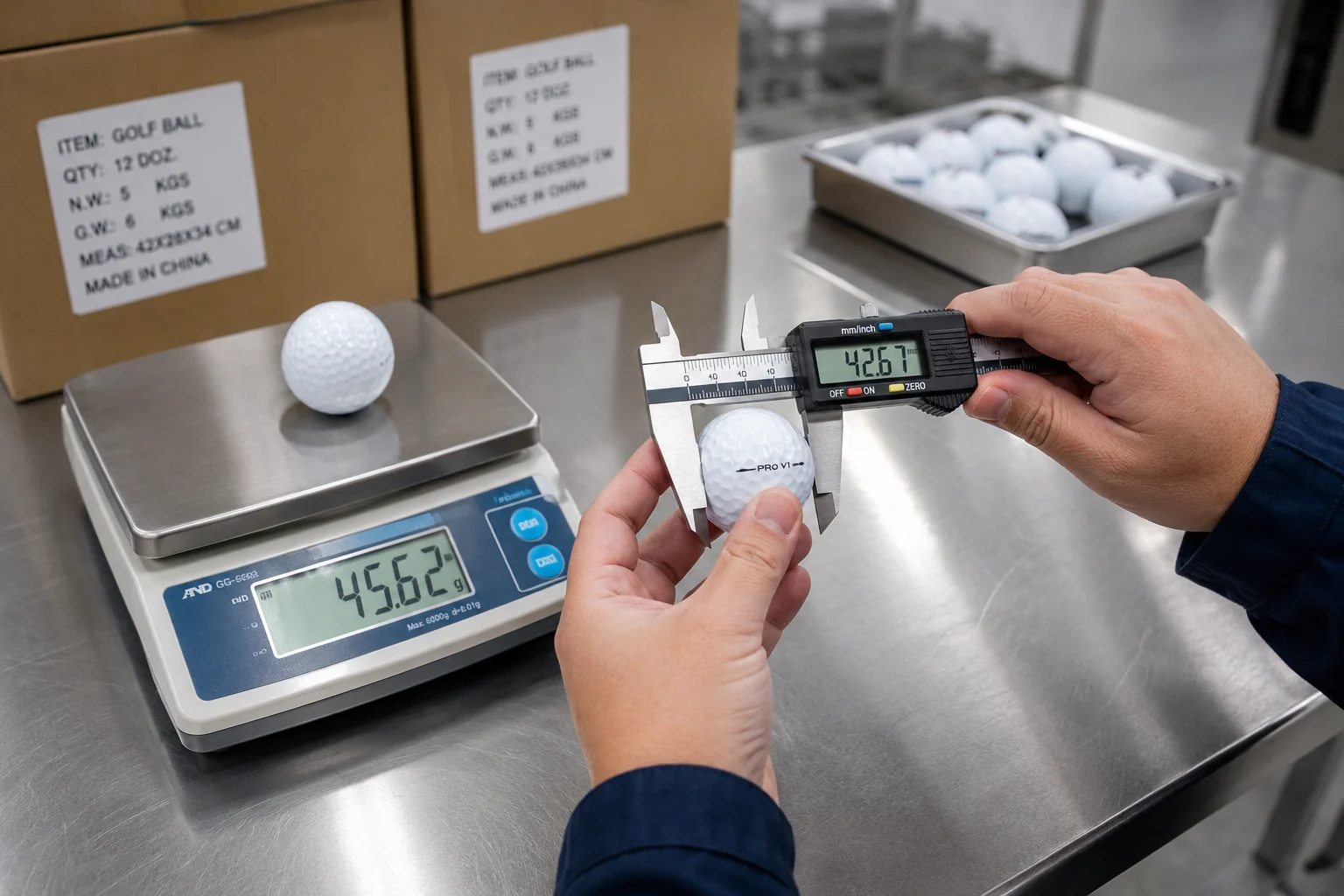
Final QA should combine physical measurement, performance-related checks, cosmetic grading, and traceability. For conforming programs, the hard physical limits buyers must know are simple: weight must not exceed 45.93 g, and diameter must not be below 42.67 mm. These figures come from the golf ball provisions in the Equipment Rules, and they are shipment-release gates for products sold as conforming golf balls.
For the 2026 conformance cycle, the USGA lists golf-ball conformance testing at $1,200 per ball type for a new submission and $1,200 per ball type for annual resubmission, each requiring 24 sample balls. Limited late submissions are listed at $1,500 per ball type. Four submitted ball types or colorways can therefore create a near-$5,000 annual compliance line before samples, courier, documentation, and internal QA time are counted. You can verify the fee and sample requirements in the 2026 Golf Ball Conformance Submission Guidelines.
A supplier saying “USGA Approved” without exact marking proof is a failure signal, not a shortcut. Once a ball appears on the current list, the safer wording is “Conforms with the Rules of Golf” when applicable; wording such as “USGA Approved” or “USGA Tested” should be avoided. If competition eligibility matters, verify the exact marking and model on the List of Conforming Golf Balls.
Request final inspection data with weight, diameter, compression, AQL cosmetics, coating/print checks, and retain-sample ID. Shipment release should require compression, weight, diameter, concentricity or center offset where applicable, coating/print adhesion, and abrasion results to meet the agreed PO limits. Any out-of-limit result should trigger containment, root-cause review, corrective action, and buyer re-approval before shipment.
✔ True — Current listing status can matter for competition eligibility
If your event, retail promise, or club rule requires a conforming ball, verify the exact marking and model. The listed sample and the production goods must represent the same product.
✘ False — “‘USGA Approved’ is safe marketing wording”
Compliance wording needs care. Do not treat conformance language as casual branding, and do not let unclear wording create avoidable channel or event risk.
Which USGA limits must buyers know?
At minimum, buyers should know weight, diameter, representative-sample, and marking-control requirements. The test file is not a decoration; it must match the goods sold.
For range or gift balls, current conforming-list status may not be the best ROI question. Durability, washer resistance, scuff resistance, logo life, and clear-coat performance can matter more. For Game or Tour-positioned retail balls, listing status and exact marking control may be part of the acceptance plan. Separate Range, Game, and Tour programs before you compare quotes, because they do not carry the same commercial risk.
How do you verify a supplier before PO?
Your biggest risk is not a supplier who lacks a polished presentation. It is a supplier who cannot connect sample approval, mass production, QC data, and carton-level traceability.
Your RFQ should make proof mandatory before the supplier quotes like-for-like. Ask for compression distribution, weight and diameter method, cover thickness map, concentricity evidence where applicable, coating/print adhesion, abrasion photos, calibration status, and batch ID linkage.
A serious supplier verification package should not be complicated, but it must be complete. Ask for a 12-ball pre-production report and a 12-ball first-article report. The report should include raw data, average, SD, range, method notes, equipment model, calibration status, and batch or lot ID. Add an equipment list and calibration certificates where quality risk is high.
For surface durability, request adhesion and abrasion evidence with method notes and photos. For multi-layer or premium programs, request cutaway photos, cover-thickness map, and concentricity evidence where applicable. For competition-related orders, verify exact marking and current listing status instead of relying on general compliance language.
PO approval should require signed sample approval, CTQ limits, first-article report, retain-sample plan, and corrective-action path before mass production release. Your quote comparison is only fair when every supplier proves the same specs with the same evidence.
Provide a 12-ball pre-production sample report and a 12-ball first-article report covering ATTI/equivalent compression average + SD + range, weight/diameter pass/fail, cover thickness map, X-ray/CT concentricity where applicable, and coating/print adhesion plus abrasion results, all linked to the production batch ID.
| Pain/decision | Ask | Verify | Acceptance/action |
|---|---|---|---|
| Sample vs bulk doubt | Pre-production + first-article reports | Compare statistics | Approve only if data aligns |
| Vague QC claims | Equipment + calibration list | Check method fit | Reject generic pass/fail only |
| Surface complaint risk | Adhesion + abrasion photos | Match same batch ID | Hold shipment if mismatch |
| Layer/control doubt | Cutaway + thickness map | Verify cover/concentricity | Require re-approval for changes |
| Compliance eligibility | Exact marking/list proof | Check current requirement | Assign submission cost/timing |
What proof should your RFQ require?
Your RFQ should require evidence before price becomes final, because unclear specs make every supplier look cheaper than they really are.
A practical RFQ asks for product structure, cover family, compression target, logo method, packaging, test methods, sample count, and batch traceability. It also defines what happens when data drifts: containment, root-cause review, corrective action, and buyer re-approval. Fast quoting is useful. Fast quoting without evidence only moves risk to your warehouse.
If you are still comparing China OEM options, this supplier-audit guide may help: Top 10 Golf Ball Manufacturers in China: 2026 OEM Audit Guide.
FAQ
What does CTQ mean in golf ball manufacturing?
CTQ means Critical to Quality. In golf ball manufacturing, CTQs are measurable production gates such as compression distribution, cover thickness, concentricity, dimple fidelity, coating thickness, print adhesion, weight, and diameter. For B2B buyers, every CTQ should connect to a method, sample count, limit, and batch record.
That connection matters because “strict QC” is too vague for supplier comparison. A 12-ball compression report with average, SD, range, equipment model, calibration status, and batch ID gives your team something measurable. CTQs are how you move from supplier claims to shipment control.
How many golf ball manufacturing steps matter to buyers?
Golf balls can pass through roughly 10–12 manufacturing stages, but buyers should focus on the gates that change shipment risk: core mixing and curing, layer or cover forming, seam and dimple control, coating and printing, final QA, and packaging.
The long process is useful as a factory map. The buying control points are narrower. Core data protects feel and distance consistency. Cover and dimple evidence protects durability and flight. Coating and printing checks protect shelf appearance and logo life. Final QA protects conformity, grading, and shipment release.
Why can samples feel better than bulk goods?
Samples can feel better than bulk goods because they may be produced under tighter attention than normal mass production. Your protection is first-article data proving that bulk compression, weight, diameter, surface quality, and traceability still match the approved sample.
This is why average-only reporting is weak. A supplier might hit the target average while the individual balls spread too widely. Compare SD and range between the approved sample, pre-production lot, and first-article production. If the factory cannot show the same process settings and batch records after sample approval, your bulk order is relying too much on trust.
Do all custom logo balls need UV printing?
No. Pad printing is often better for simple, repeated, low-color logos, while UV printing is useful for complex, multi-color, gradient, personalized, or photo-style artwork that pad printing cannot reproduce cleanly. The better choice depends on artwork, quantity, cost, curing, and clear-coat protection.
Confirm vector artwork, Pantone color where needed, size, placement, side count, and an actual-size printed sample. Then request rub or abrasion evidence. Durability depends on ink, surface treatment, curing, clear coat, and real test results, not the printing label alone.
Why do some golf ball covers crack easily?
Golf ball covers usually crack early because the cover system is poorly matched or poorly controlled. Common causes include the wrong material family, unstable molding window, weak adhesion, rough seam finishing, under-verified thickness, or surface durability that was never tested against real use.
Do not judge the cover only by the word “urethane” or “premium.” Ask for the cover family, cover thickness map, hardness window, cutaway photos, adhesion result, abrasion evidence, and first-article comparison. For multi-layer balls, also ask how the supplier checks concentricity, because layer offset can affect both durability and flight consistency.
Do you need current conforming-list status?
You need current conforming-list status only if your event, tournament, club rule, or retail promise requires competition eligibility for the exact marking and model. For range balls, corporate gifts, or many promotional balls, durability and surface performance may matter more than listing status.
A conforming-list claim should match the specific ball markings and product version being sold. If your order needs eligibility, assign submission or renewal responsibility in writing and confirm timing before production. If the order is for range, event gift, or promotional use, focus first on cover durability, clear-coat life, logo adhesion, wash resistance, and packaging quality.
What QC report should you request first?
Start with a 12-ball pre-production report and a 12-ball first-article report. Each report should show raw values, average, SD, range, method notes, equipment model, calibration status, and batch or lot ID, so your team can compare approved samples with production reality.
For most B2B orders, compression is the first consistency checkpoint. Weight and diameter confirm physical gates. Cover thickness, adhesion, abrasion, and print checks protect surface complaints. Concentricity evidence matters more for multi-layer or premium-positioned balls. The report should connect the sample ID to the production batch and, ideally, to carton labels and retained samples.
Conclusion
Golf balls are made through a predictable factory sequence: core mixing, layer forming, cover molding, seam and dimple control, coating, printing, final QA, and packaging. B2B quality depends on how tightly each sequence is controlled.
Lock CTQs, test methods, sample approval, first-article data, and batch traceability before mass production. When those records are clear, your sourcing decision becomes easier to defend internally, and your shipment depends less on promises and more on process control.
You might also like — How to Vet a China Golf Ball Factory: The 2026 4-Pillar Scorecard