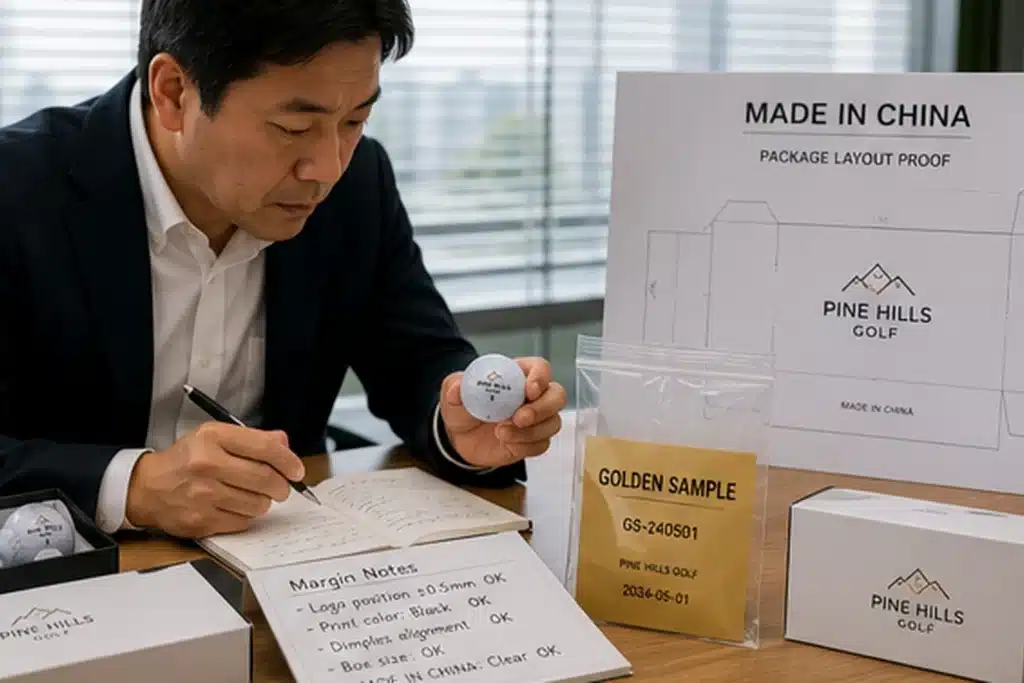
You may have verified the supplier and approved the sample, yet still face one critical question before PO approval: can you reconstruct how a real production lot was made and released?
To audit a China golf ball factory, trace one comparable lot through its declared process route, lot-linked production and QC records, exception handling, authorized release, and controlled changes. If that evidence cannot be backtraced to one controlled production history, machines, certificates, and polished QC files do not prove manufacturing control.
At this stage, supplier identity and whether the manufacturer fits your program should already be largely settled. A comparable lot should be close enough to your proposed SKU in construction, production route, finish, and relevant process controls for its records to expose the manufacturing risks your own SKU will face.
A deep factory audit therefore starts with the lot—not the showroom. Confirm its declared route, backtrace the production and QC records, follow any abnormal event through disposition and release, and verify that material changes cannot reach the next PO without controlled review.
Audit one comparable lot—not the showroom.
A factory tour shows what equipment exists. A comparable-lot backtrace shows what was actually made, tested, released, and controlled for repeat production.
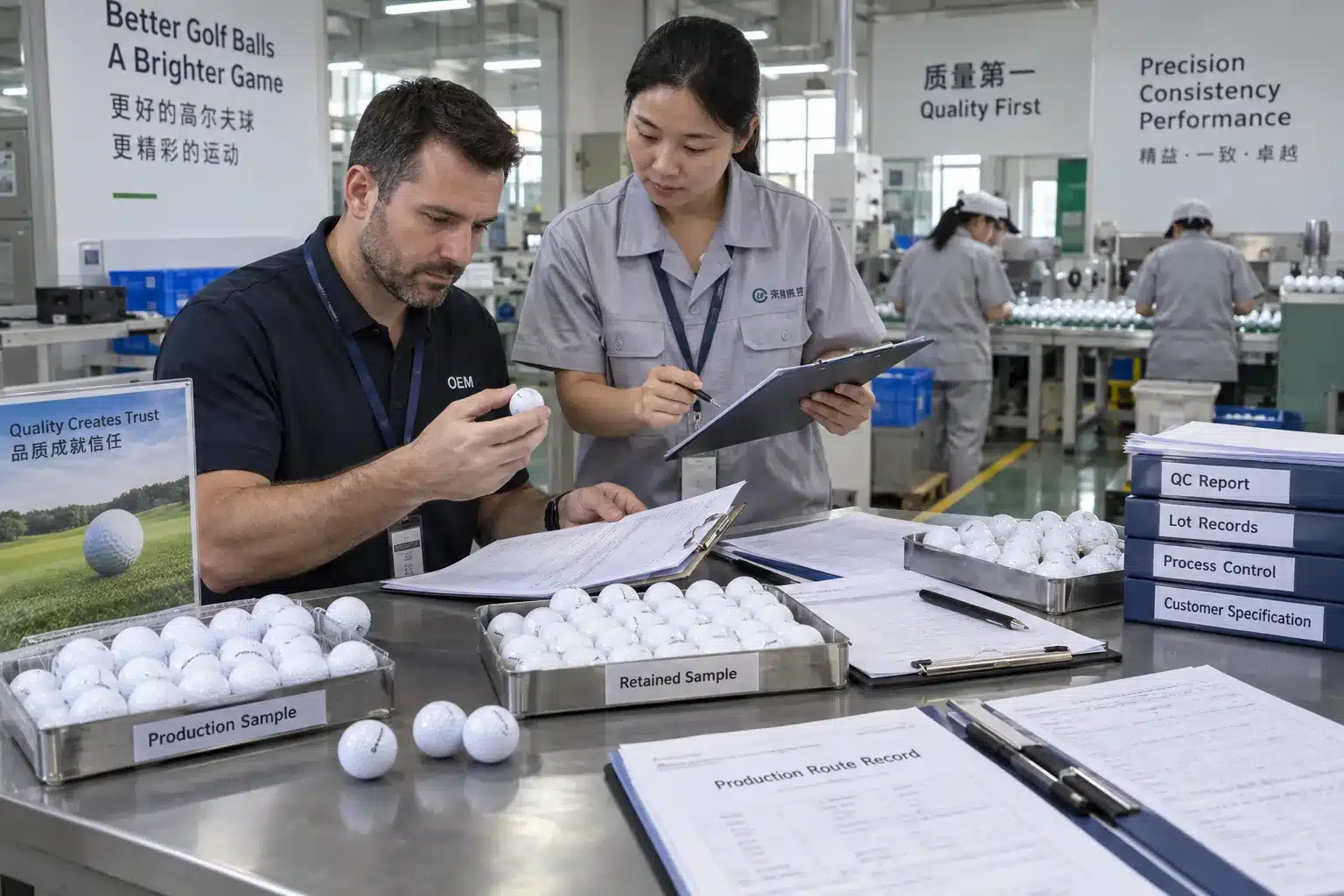
What Should a Golf Ball Factory Audit Prove?
A large facility, modern equipment, an ISO certificate, a polished sample, and a prepared factory tour can all be genuine. None independently proves that your production history is controlled.
A deep golf ball factory audit should prove that one comparable production lot can be followed through its declared route, linked records, abnormal events, final release, and controlled changes. Do not pass a factory because individual pieces of evidence look convincing; close the manufacturing evidence chain your team will rely on after PO approval.
The operating logic is:
Comparable Lot → Declared Route → Linked Records → Closed Exception → Authorized Release → Controlled Change
This is not a 1-to-5 supplier score. A missing release record cannot be offset by an impressive coating line, and weak traceability should not disappear because the supplier performed well in other areas.
Recognized management-system auditing guidance supports systematic, evidence-based and risk-based auditing, including confidentiality. The standard does not prescribe the comparable-lot chain used here; this article applies those principles to golf ball manufacturing by asking whether evidence can be traced to the production history your team intends to approve.
Audit depth should also follow commercial consequence. A straightforward promotional ionomer SKU and a process-sensitive multilayer retail ball should not automatically receive identical audit scopes.
Use the evidence gates below to reach a decision.
| Pain / Decision | Audit Gate | Evidence to Request | Failure Signal | Buyer Action |
|---|---|---|---|---|
| Machines look convincing | Process route | Route declaration + traveler | Equipment is not tied to SKU | Verify route |
| QC looks professional | Lot traceability | Lot-linked records + sample IDs | Records cannot backtrace | Hold gap |
| Quality claims sound strong | Exception control | NCR / disposition / CAPA trail | No closed abnormality | Request closure |
| Production is “finished” | Release control | Release record + authority | Production end equals release | Hold approval |
| Reorder looks identical | Change control | Revision + approval trail | Silent process change | Require review |
Pass, Conditional, or Hold?
The classification should follow the most important unresolved evidence, not an average score. A critical open link in route control, traceability, exception handling, release authority, or change control should remain visible in the approval decision.
-
Pass: critical evidence exists, records connect, and no material audit gap remains.
-
Conditional: the system may be acceptable, but named evidence gaps must close before PO or scale approval.
-
Hold: a critical manufacturing-control link cannot be demonstrated.
If project risk justifies onsite evidence but your team cannot travel to China, an independent audit provider can collect evidence against the scope and criteria your team defines. That does not replace your audit logic; it gives you another way to obtain the evidence.
If basic legal identity or site verification is still unresolved, complete China golf ball OEM supplier verification before using a deep manufacturing audit to make the approval decision.
Request one redacted comparable-lot audit pack and confirm that its core evidence connects to the same or clearly comparable manufacturing route.
✔ True — A factory audit proves connected manufacturing control
Machines, certificates, samples, and records become meaningful when your team can connect them to the manufacturing history relevant to your SKU.
✘ False — “A clean plant and impressive machine inventory are enough to pass”
Facility size and automation provide context. They do not prove the route, lot history, exception closure, release decision, or change control behind your order.
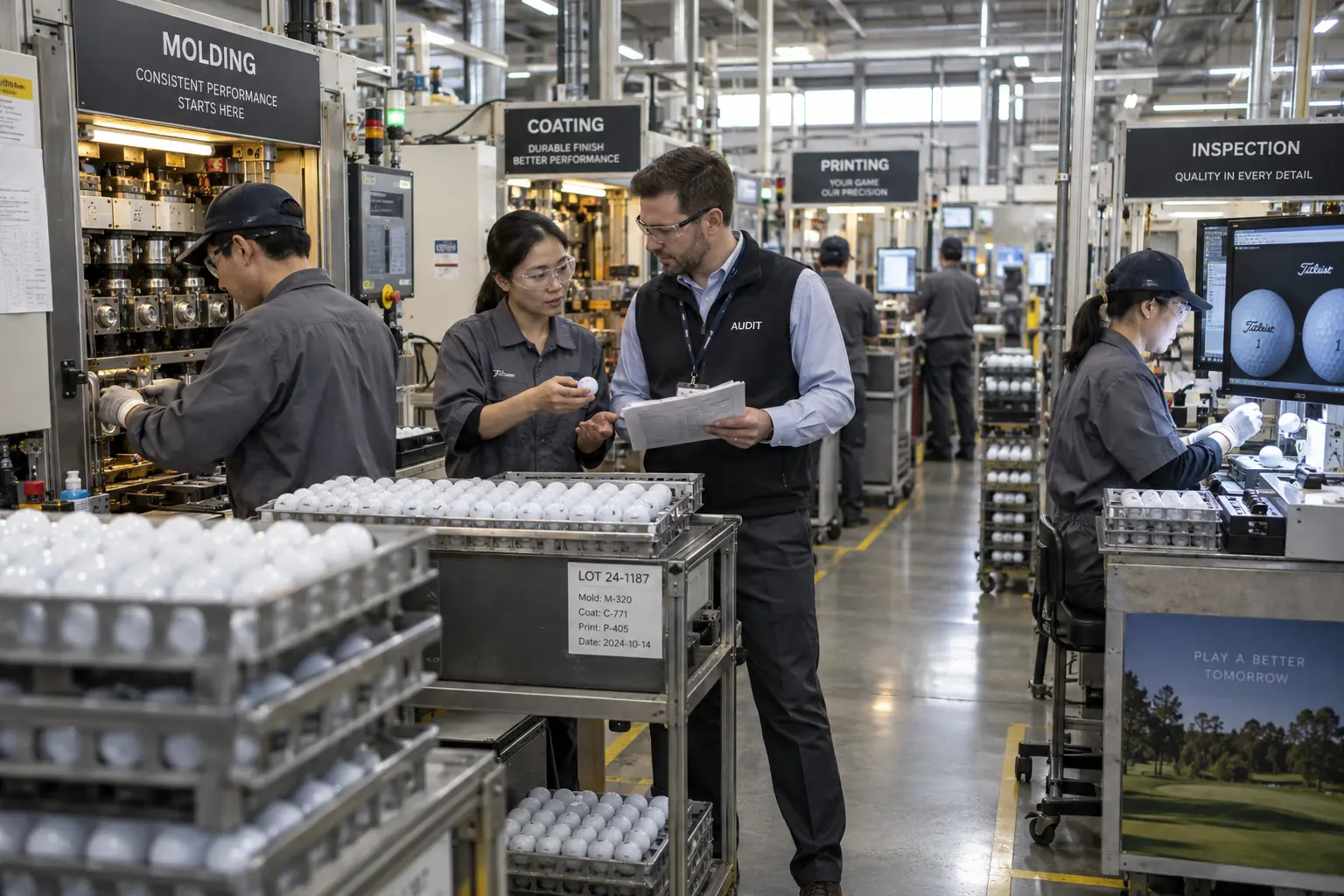
Does the Factory Control Your Process Route?
You can walk through a busy plant and still leave without knowing which molding, coating, printing, or external operations will actually produce the SKU quoted to you.
Manufacturing depth means the factory can explain and evidence the exact production route behind your SKU—not merely show machines. Ask for the route declaration, production traveler, applicable material or tooling references, and access to relevant stages. If one stage is external, its control and lot linkage still need to remain visible.
Start with a Process Route Declaration and the comparable lot’s Production Traveler or Route Map.
This matters because golf ball constructions do not create identical process risks. A 2-piece ionomer ball, multilayer ionomer design, injection-molded TPU cover, and cast thermoset urethane cover can involve different forming routes, process sensitivities, tooling references, and control points.
Your audit scope should therefore follow only what actually applies to your SKU.
Relevant evidence can include material or component references, tooling or dimple-tool identifiers, stage records, work-in-process lot identification, and disclosure of controlled external operations. During an onsite or remote audit, ask the factory to connect those records to the stages your team is viewing.
Do not use the old shortcut that every process must be in-house. An outsourced operation can remain auditable when responsibility, lot linkage, incoming acceptance, outgoing acceptance, and records stay visible.
A live factory tour with impressive equipment but no comparable-lot backtrace is a failure signal. You may have seen a real factory without proving that you saw your proposed manufacturing route.
If the issue becomes whether the supplier itself controls production, move to the factory vs trading company analysis. If the purchasing decision turns specifically on urethane processing, the TPU vs cast urethane manufacturing guide covers that technical distinction in greater depth.
The evidence gate closes when the declared route, traveler, applicable stage records, and what your team observes tell the same production story.
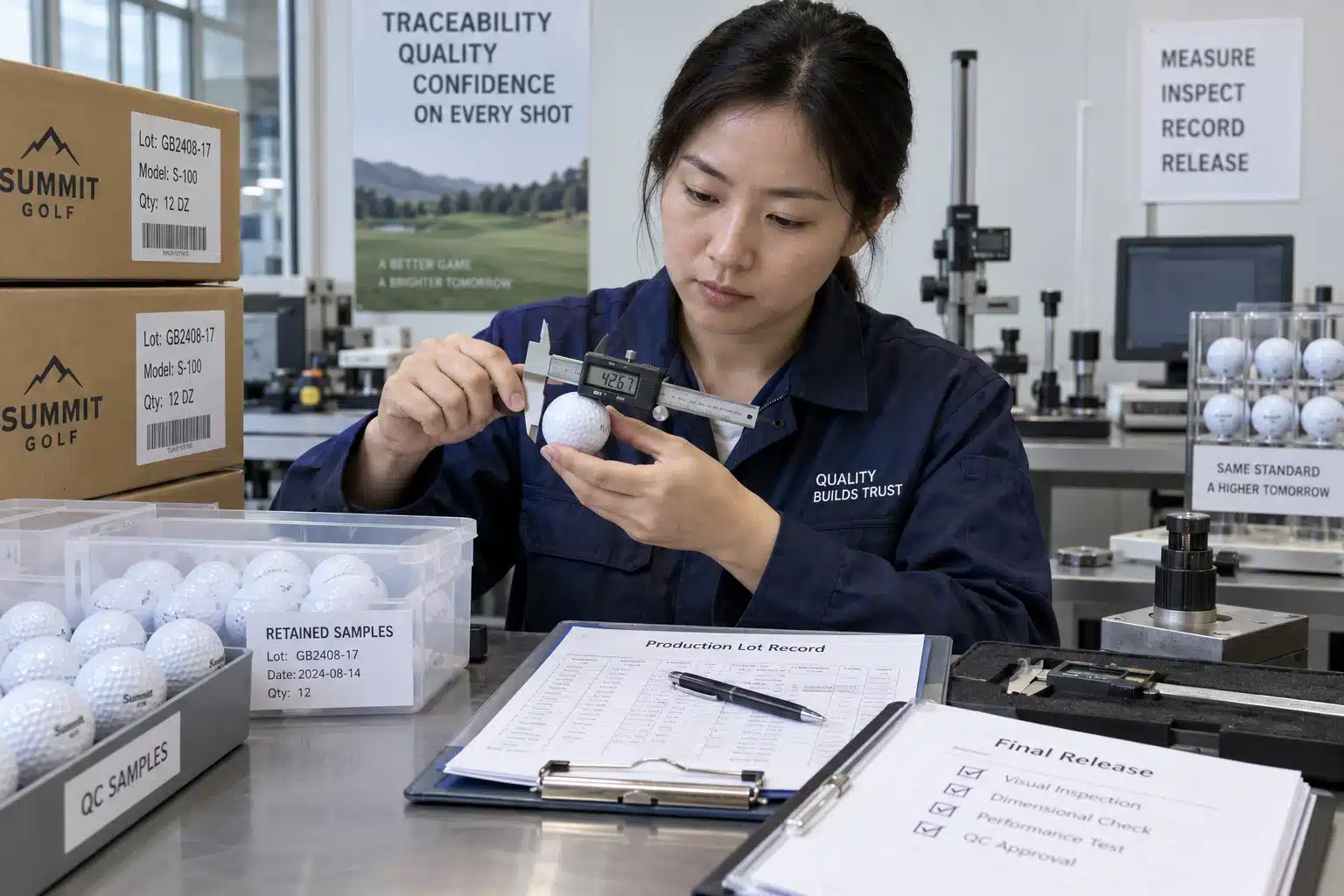
Can One Lot Be Traced from Input to Release?
Your inbox may contain a COA, QC sheet, test report, production photos, retained sample reference, CAPA file, and shipping record. Professional-looking files are not automatically connected evidence.
Traceability is proven when one lot identity survives from material or component receipt through production, QC, retained samples, final release, and shipment records. Your team should be able to start with a finished carton or lot and backtrace what was made, what was tested, which controlled version was used, and who released it.
A useful backtrace follows:
Material / Component Reference
→ Production Lot
→ Process Traveler
→ QC Sample ID
→ Method / Equipment / Calibration Reference
→ Retained Sample
→ Final Release
→ Shipment Reference
Where a nonconformance occurred, its NCR or CAPA record should remain part of the same production history rather than sitting in a separate folder with no batch connection.
This is where many seemingly complete audit packages become weak. A QC report may contain plausible measurements and still have limited audit value if your team cannot connect it to the comparable lot, inspection sample, relevant method, controlled equipment status, retained sample, and release decision.
Unless your specification or agreement makes the exact formulation a buyer-controlled requirement, the audit does not need proprietary recipe percentages. A supplier can protect its formulation while showing the material family, internal formula or revision ID, controlled material reference, route record, tooling reference, sample identifier, and retained-sample reference.
Your objective is to verify version and lot control—not to acquire the supplier’s proprietary chemistry.
For the PO or quality agreement, the traceability expectation can be written as:
Supplier shall link the approved sample ID, production lot ID, applicable material or component references, declared process-route version, QC record, retained-sample reference, and final release record under one traceable production record before shipment release.
Use the following request only for this audit stage:
Please provide one redacted comparable-lot evidence pack showing the declared production route, production lot and sample identifiers, linked QC evidence, retained-sample reference, final release authority, and applicable change-control record, plus one closed nonconformance/CAPA example where available.
Then choose a finished lot or carton and backtrace it yourself rather than allowing the supplier to assemble unrelated “best example” documents.
If your next question becomes whether specific instruments, measurements, or test methods are technically sufficient to release the lot, continue with the dedicated golf ball QC testing guidance.
✔ True — Redacted records can still prove lot and version linkage
Your team needs enough controlled identifiers to connect the lot, sample, process, retained reference, and release decision. It does not need confidential formulation percentages.
✘ False — “A polished QC certificate proves my production lot is traceable”
A standalone report has limited audit value until its identifiers can be backtraced to the comparable lot and manufacturing history your team is approving.
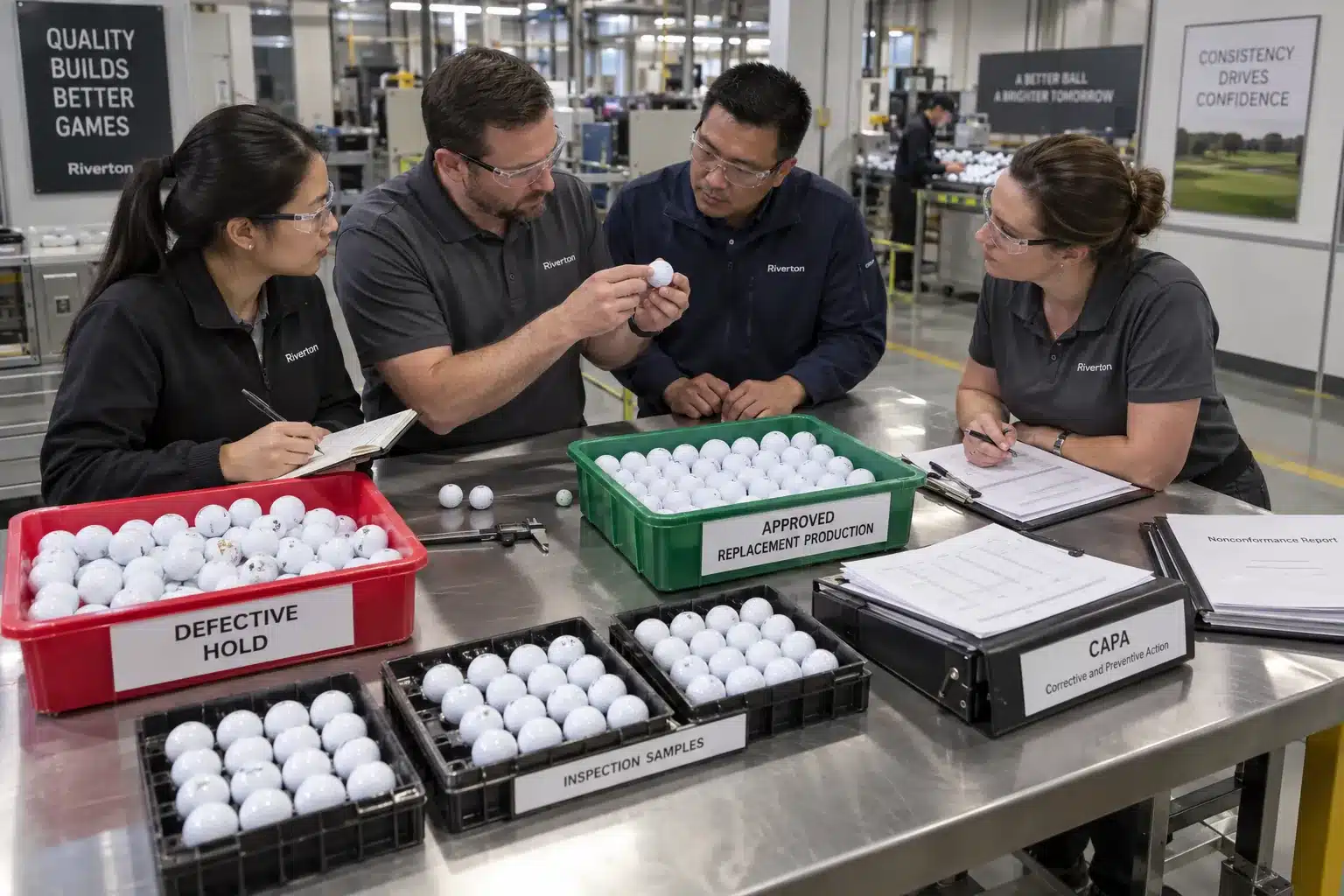
What Happens When the Process Goes Wrong?
“Zero defects,” “no scrap,” and “no rework” can sound reassuring. They tell you almost nothing about how your order will be protected when an actual abnormality appears.
A mature factory does not prove quality by claiming zero defects; it proves control by showing how nonconforming output is contained, investigated, corrected, rechecked, and released. Ask for a closed abnormal-event trail from a comparable route so you can see whether the system still works when production stops going according to plan.
Yield and scrap figures can provide useful context, but the audit should not revolve around finding a universal “good yield” percentage.
The stronger question is: what happened to the actual nonconforming output?
Follow the closure chain:
Detection → Segregation / Hold → Disposition → Correction → Reinspection → Authorized Release
The supporting record may include an NCR, hold or quarantine status, disposition decision, root-cause investigation where applicable, corrective action, remake or rework evidence, reinspection, and final release authority.
CAPA should not be treated as a decorative form. Your team should be able to see whether the affected output remained controlled while the factory decided what to scrap, remake, rework, or reinspect.
A “zero defects” claim with no closed abnormal-event trail is a failure signal. What matters for a repeat OEM program is whether the factory can stop questionable output from quietly returning to acceptable stock or moving forward because a shipment date is approaching.
Did the Nonconformance Actually Close?
A closed record should connect the abnormality to its final disposition. The audit question is not whether a CAPA document exists; it is whether detection, segregation, correction, reinspection, and authorized release can be followed without an unexplained break.
In 2024, our final QC identified a printing nonconformance in one production batch. We segregated and scrapped the affected balls, produced replacement output, and reinspected the replacements before the order moved through final release.
What mattered from an audit perspective was not that a defect occurred. It was that we could trace how the affected output was contained, dispositioned, replaced, reinspected, and ultimately released.
Request one redacted closed NCR/CAPA or comparable abnormal-event record from a relevant route where available. The evidence gate closes only when the abnormality reaches a documented disposition and release decision.
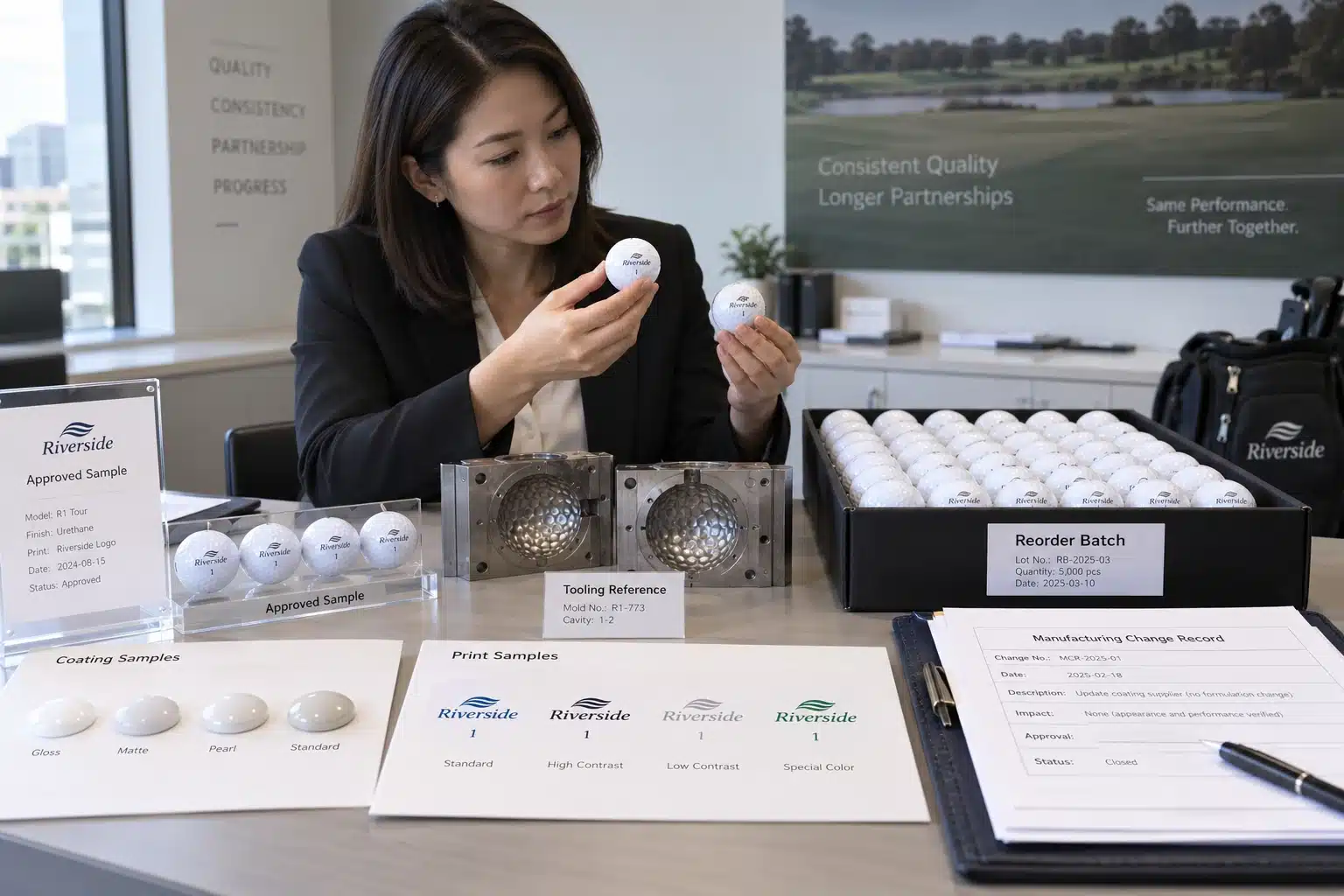
Can the Approved Build Survive a Reorder?
A good first production lot does not guarantee repeatability. Your second PO can drift if a material route, tool, coating, printing system, production site, or critical external stage changes silently.
Your approved sample is not protected unless the factory controls changes before the next production lot. Require visibility into the route, applicable material or formula reference, tooling, dimple tool, coating, print system, site, and other critical versions, plus a defined review path before a material change reaches your reorder.
Retained sample control gives your team a physical reference, but the retained ball is only one part of the approved manufacturing state.
Depending on the program, the baseline may also include the process-route revision, material or formula-family reference, tooling or dimple-tool identifier, coating system, printing system, production site, critical outsourced stage, and commercially relevant packaging version.
For repeat-production programs, exception handling, release discipline, and change control deserve more weight than factory size or automation claims. A sophisticated factory can still create reorder drift if the approved state is poorly versioned.
Compare the reorder against that baseline before release.
| Change Risk | Evidence to Compare | Why It Matters | Buyer Action |
|---|---|---|---|
| Material or process route | Approved vs current revision | Product may leave approved path | Require review |
| Tooling / dimple reference | Tool ID / revision | Geometry or process may shift | Verify tool |
| Coating / print system | System/version reference | Finish may drift | Review evidence |
| Site / external stage | Site/process record | Control ownership may change | Re-audit stage |
| Retained sample mismatch | Approved vs current lot | Reorder may have drifted | Hold and investigate |
A reorder change with no revision or approval trail is a failure signal.
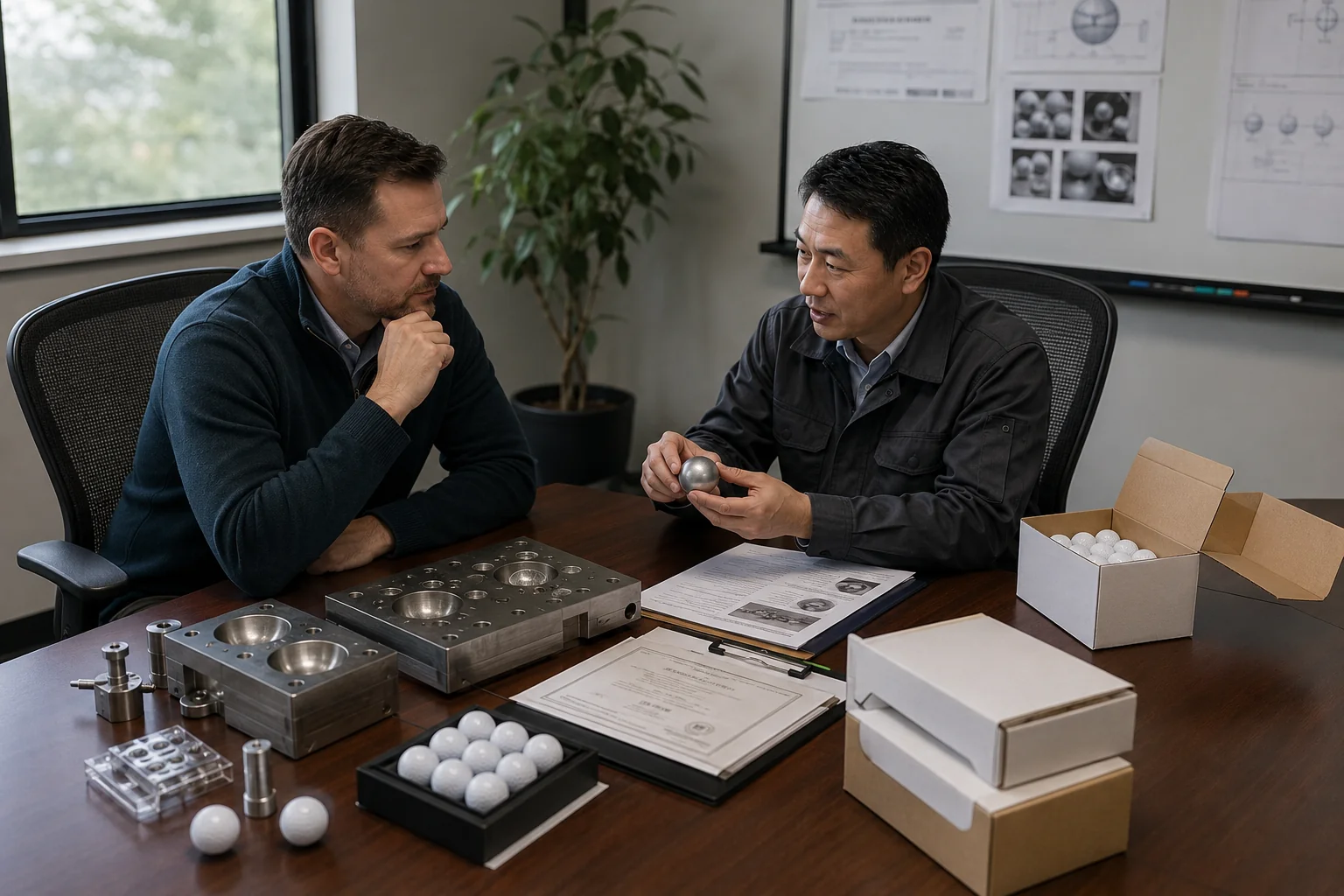
Which Changes Need Buyer Approval?
Not every internal adjustment requires your written permission. Separate informational changes, supplier-controlled internal changes, material changes requiring evidence review, and buyer-approval triggers created by your specification, quality agreement, PO, or supply contract.
A QMS can support disciplined change control, but certification does not automatically create your contractual approval rights.
Where these variables are critical to your program, the requirement can read:
Supplier shall not change the declared material route, applicable formula or recipe reference, tooling or dimple-tool reference, coating or print system, production site, or approved packaging version without written buyer approval and review of the agreed change evidence.
Before repeat-order release, compare the retained sample, current lot, process version, and change record. The reorder should remain linked to the approved manufacturing reference unless a defined change has been reviewed and accepted.
✔ True — Repeatability depends on controlled versions and visible changes
The approved sample becomes stronger evidence when it remains connected to the route, process references, finish system, retained sample, and change history used for repeat production.
✘ False — “Once the first sample is approved, every reorder is automatically frozen”
Manufacturing conditions can change. Your commercial documents determine which changes require disclosure, evidence review, or written buyer approval.
FAQ
Can I audit a China factory without visiting?
Yes—you can run a buyer-led remote audit or commission an independent audit provider to collect onsite evidence against the scope your team defines. Choose the method according to SKU complexity, unresolved evidence gaps, and the commercial consequence of approving the wrong manufacturing system.
-
For remote audits, direct the camera path through your SKU’s declared route rather than accepting a prepared showroom tour.
-
Ask the supplier to connect physical lot labels, work-in-process, QC areas, retained samples, and production records during the session.
-
For higher-risk programs, an independent manufacturing audit provider can collect onsite evidence against your own checklist.
-
V-Trust lists its standard factory audit at US$398 per man-day in major Asian manufacturing clusters. Treat that as one provider’s published rate, not an industry average, and request a quotation for your actual scope and factory location.
Under ISO audit terminology, if an independent service provider audits the supplier on your behalf, the engagement is normally a buyer-commissioned second-party supplier audit—not a third-party certification audit.
Is ISO 9001 enough for a deep factory audit?
No. A valid ISO 9001 certificate can support confidence in the supplier’s quality-management system, but it does not prove that your exact process route, production lot, exception history, retained sample, and final release form one controlled and backtraceable manufacturing history.
-
Verify certificate validity and the covered site where relevant.
-
Treat ISO 9001 as supporting QMS evidence, not golf ball product-performance certification.
-
Request lot-level manufacturing evidence separately.
-
Confirm that the route, records, exceptions, and release authority relevant to your SKU can actually be connected.
A certificate can support the audit. It cannot replace the comparable-lot evidence the audit is designed to test.
What if the factory will not share its formula?
Unless your specification or agreement gives you control of the exact formulation, you do not need the supplier’s proprietary recipe to prove manufacturing control. You need enough controlled evidence to verify that the approved material or formula version exists, was used for the audited lot, and remains linked to a defined change-control process.
-
Accept a material family or internal revision ID where appropriate.
-
Preserve lot and version linkage through the traveler and production records.
-
Ask for evidence of controlled change rather than confidential formulation percentages.
-
Treat legitimate IP protection differently from a refusal to provide any auditable linkage.
Audit the control of the formula—not the supplier’s trade secret.
Should USGA or R&A status be part of the audit?
Only when current conformity matters to your exact SKU, intended channel, or buyer claim. Exact-model conformity is compliance evidence; it is not proof that the factory’s process route, batch traceability, exception handling, release authority, and change-control system pass a deep manufacturing audit.
-
Verify the exact model and marking combination through the official USGA Conforming Club and Ball Lists.
-
Keep submission mechanics separate from the factory-audit decision.
-
Backtrace lot consistency through manufacturing evidence independently.
-
Do not accept “USGA-level” as a substitute for either exact-model conformity or factory-control evidence.
The two questions serve different procurement decisions and should remain separate.
What changes should trigger a re-audit?
A material change to the approved manufacturing route or the evidence supporting it can justify targeted re-verification. You do not necessarily need to repeat the entire audit; reopen the affected controls when the change materially alters the manufacturing system your team originally approved.
-
Recheck material or process-route changes.
-
Recheck tooling, dimple-tool, process-version, production-site, or critical external-stage changes.
-
Revisit repeated abnormalities, unresolved CAPA, or sustained evidence gaps.
-
Consider ownership or control changes only when they alter manufacturing-system risk.
The scope should follow the changed risk rather than automatically restarting every audit activity.
Should I use a pre-shipment inspection after the audit?
Often, yes, when shipment risk justifies it—but Factory Audit and Pre-Shipment Inspection solve different problems. A factory audit evaluates the manufacturing system, while a PSI evaluates whether the specific shipment meets the acceptance criteria agreed for that order.
-
Factory Audit supports supplier/manufacturing-system approval, onboarding, and scale-up.
-
PSI checks the actual order for items such as quantity, workmanship, agreed specifications, logo/artwork, packaging, labels, and carton marks.
-
A pre-shipment inspection does not replace process-route, traceability, CAPA, release-authority, or change-control auditing.
-
Use both when the consequence of manufacturing-system risk and shipment-specific risk justifies both controls.
A practical buyer journey is:
Supplier Verification → Manufacturer Fit → Factory Audit → Sample / Pilot Approval → Production → Pre-Shipment Inspection where justified → Shipment
Conclusion
You do not need the factory with the most machines, the most certificates, or the cleanest showroom. You need a manufacturing system your team can backtrace when production is normal, interrogate when something goes wrong, and control when the next order changes.
The decision logic is:
Comparable Lot → Declared Route → Linked Records → Closed Exception → Authorized Release → Controlled Change
When those links close, the factory can move toward approval. When defined gaps remain, keep the decision Conditional until they close. When a critical route, traceability, exception, release, or change-control link cannot be proven, Hold is the safer classification.
Audit one comparable lot—not the showroom.
Once the manufacturing system passes your audit, the next decision is whether the actual production lot meets your agreed testing and release criteria.
You might also like — Golf Ball QC in China: 4 Must-Have Tests for OEM Buyers