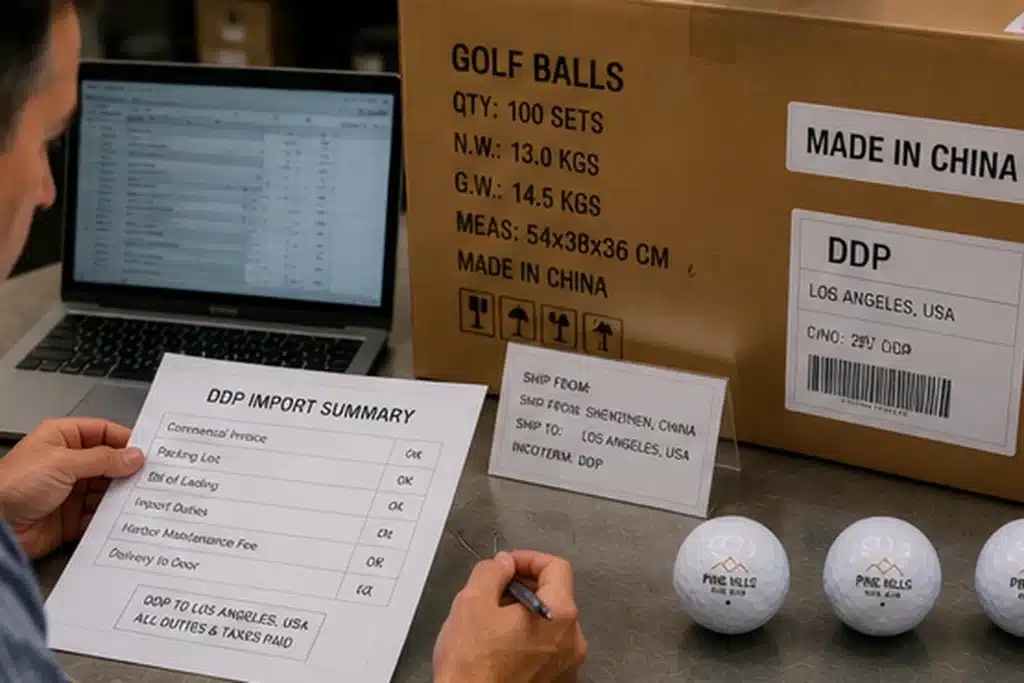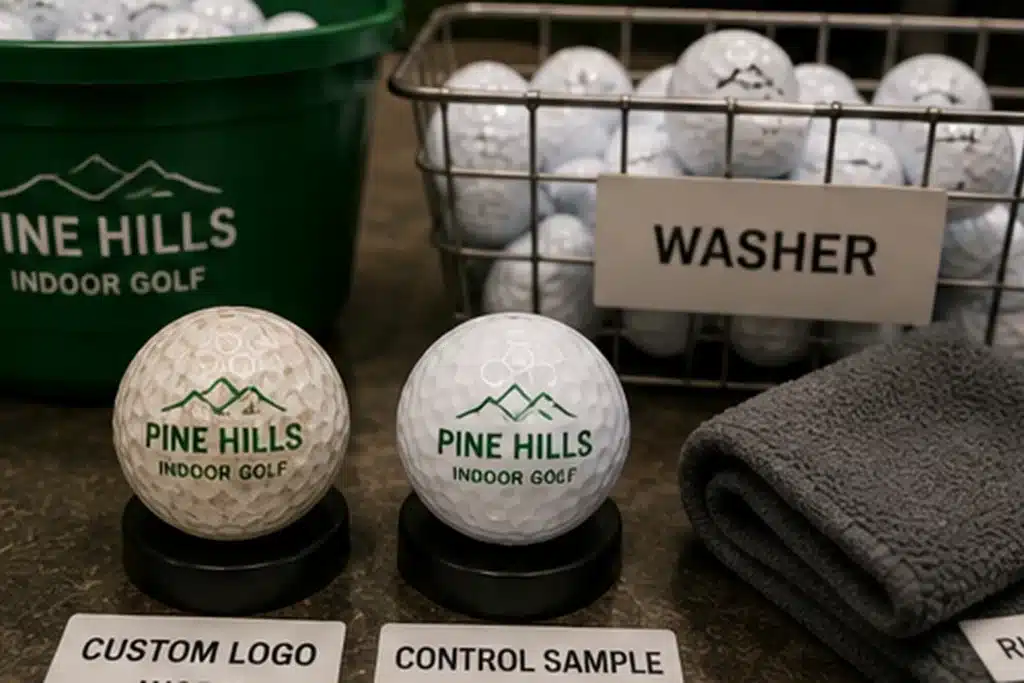
A sharp custom golf ball logo can become a costly complaint when it rubs off after handling, wiping, hitting, washing, or range use.
A custom golf ball logo usually wears off because the ink, cover, surface prep, curing, clear coat, sample control, or durability test did not match the real use case. Common signs include logo rubbing off, peeling, fading, smearing, scratching, or disappearing after play or cleaning.
| Failure cause | What happens | How to verify | Buyer action |
|---|---|---|---|
| Ink-cover mismatch | Logo flakes or peels | Adhesion-style check | Match ink to cover |
| Release residue | Ink bonds to residue | Surface-prep proof | Request prep SOP |
| Weak curing | Logo smears or rubs | Rub / wipe check | Hold approval |
| Poor clear coat | Logo scratches fast | Post-rub photos | Check coating system |
| Wrong use case | Gift logo fails on range | Use-case test | Define durability gate |
| Sample drift | Bulk differs from sample | Sample ID + batch ID | Link proof to lot |
Visual approval proves artwork, not adhesion. Use this guide to diagnose why custom golf ball logos peel, fade, or rub off, then build a sample-linked RFQ that verifies rub resistance, wipe resistance, after-hit appearance, washer durability, and batch consistency before bulk production.
Why Do Custom Logos Wear Off?
Your customer may approve the artwork, like the color, and still complain when the logo fades, peels, rubs, or scratches after real use.
Your custom golf ball logo is wearing off because the printed sample was not proven against the real cover, coating, and use case. Your team should verify ink compatibility, surface preparation, curing, clear-coat control, rub resistance, wipe resistance, and after-hit appearance before bulk approval.
A logo often fails before the first complaint appears. The failure may begin when ink is chosen without cover compatibility. It may begin when release-agent residue, oil, dust, or weak surface preparation blocks adhesion. It may begin when a curing step is rushed, the clear coat does not match the ink, or a gift-ball logo standard is used for a range-ball workload.
| Buyer symptom | Likely process gap | Proof to request | Action |
|---|---|---|---|
| Logo peels | Ink-cover mismatch | Adhesion evidence | Review ink system |
| Logo smears | Weak curing | Rub / wipe photos | Hold approval |
| Logo flakes | Surface residue | Prep declaration | Check cleaning step |
| Logo scratches | Weak topcoat | Post-rub photos | Review clear coat |
| Bulk differs | Sample drift | Sample ID + batch ID | Link proof to lot |
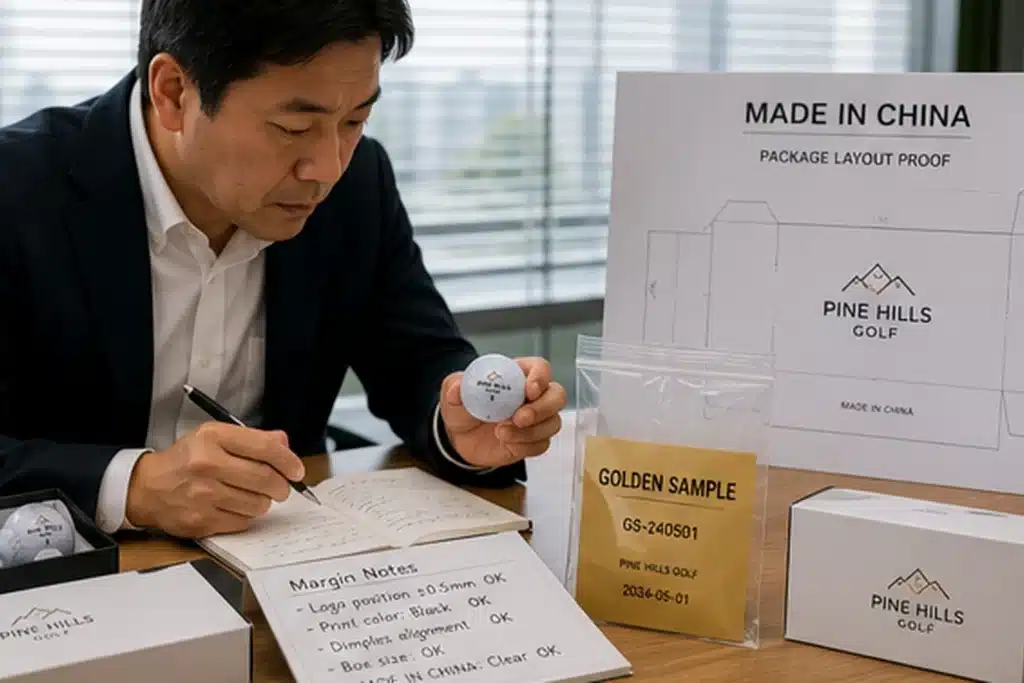
Corporate branding makes logo wear a reputation issue, not a cosmetic footnote. Your approval file should include a sample ID, printed sample photos, dry/wet rub result, wipe result, after-hit photos when relevant, and buyer approval status. Buyer approval should require physical sample proof, not only PDF artwork or a beauty photo.
✔ True — Visual approval does not prove logo durability
A render can confirm logo size, color direction, and placement. It cannot prove that ink bonded to the cover or survived handling, wiping, impact, or washing.
✘ False — “A good-looking sample guarantees the bulk logo will survive use”
A polished sample photo is only the start. Your approval file should prove the exact sample survived the agreed use case.
Which Process Step Failed First?
Your team may ask whether pad printing or UV printing caused the problem, but the deeper issue may sit elsewhere in the process.
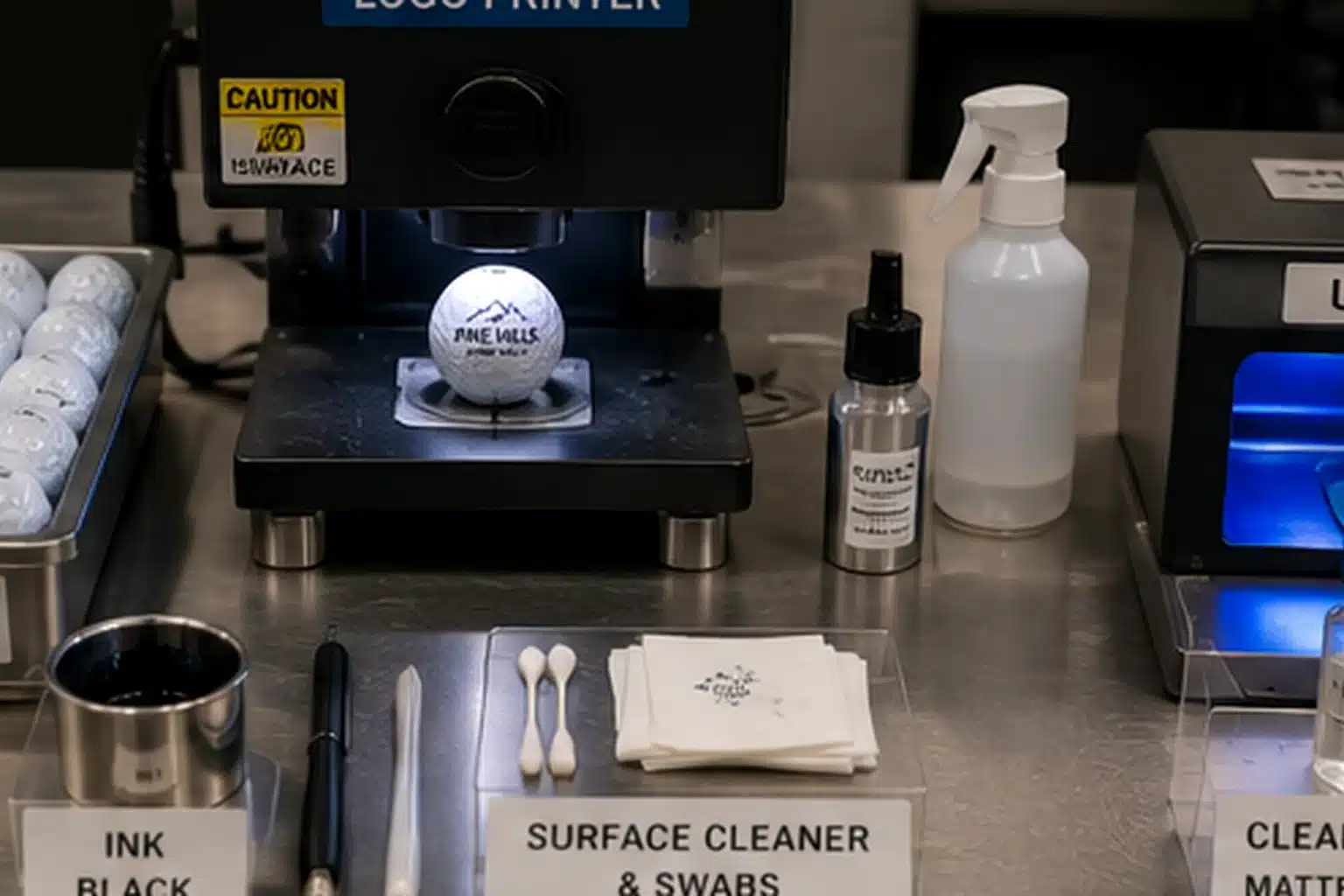
The first failed step is often not the printing method itself; it is the system around it. Your supplier must match ink to the cover, remove residue, prepare the surface, cure the print correctly, and control the clear coat before the logo can survive handling or play.
Ink, prep, cure, or clear coat?
Pad printing and UV printing can both fail when the process is weak. UV is not automatically tougher. Pad printing is not automatically safer. Durability depends on cover chemistry, ink system, surface treatment, curing condition, topcoat compatibility, and whether the approved sample was tested under real handling or play conditions.
| Process step | Failure mode | Buyer question | Evidence |
|---|---|---|---|
| Cover match | Ink will not bond | Which cover is used? | Ink compatibility note |
| Surface prep | Residue blocks adhesion | How is the surface cleaned? | Prep declaration |
| Print curing | Logo smears | How is curing verified? | Curing note |
| Clear coat | Logo scratches | What protects the logo? | Topcoat note |
| Process change | Bulk differs | What changed after sample? | Version control |
Factory cannot explain surface prep or clear coat is a failure signal. Request a print-process declaration covering printing method, cover material, ink system, surface-prep process, curing control, and clear-coat or topcoat control. Compare that declaration against the approved physical sample and the first production lot.
No production release should happen if the supplier cannot identify the process used on the approved sample. That is not picky paperwork. It is the only way to separate a true production defect from a weak approval process.
Is the Logo Fit for Its Use Case?
Your customer may complain because the print standard matched the wrong channel, not because the artwork was bad.
A logo that is acceptable for a gift ball may fail on a commercial range ball. Your RFQ should state whether the ball will be displayed, played, washed, used indoors, sorted by staff, resold, or hit repeatedly, because each use case needs a different durability gate.
Gift ball or range ball?
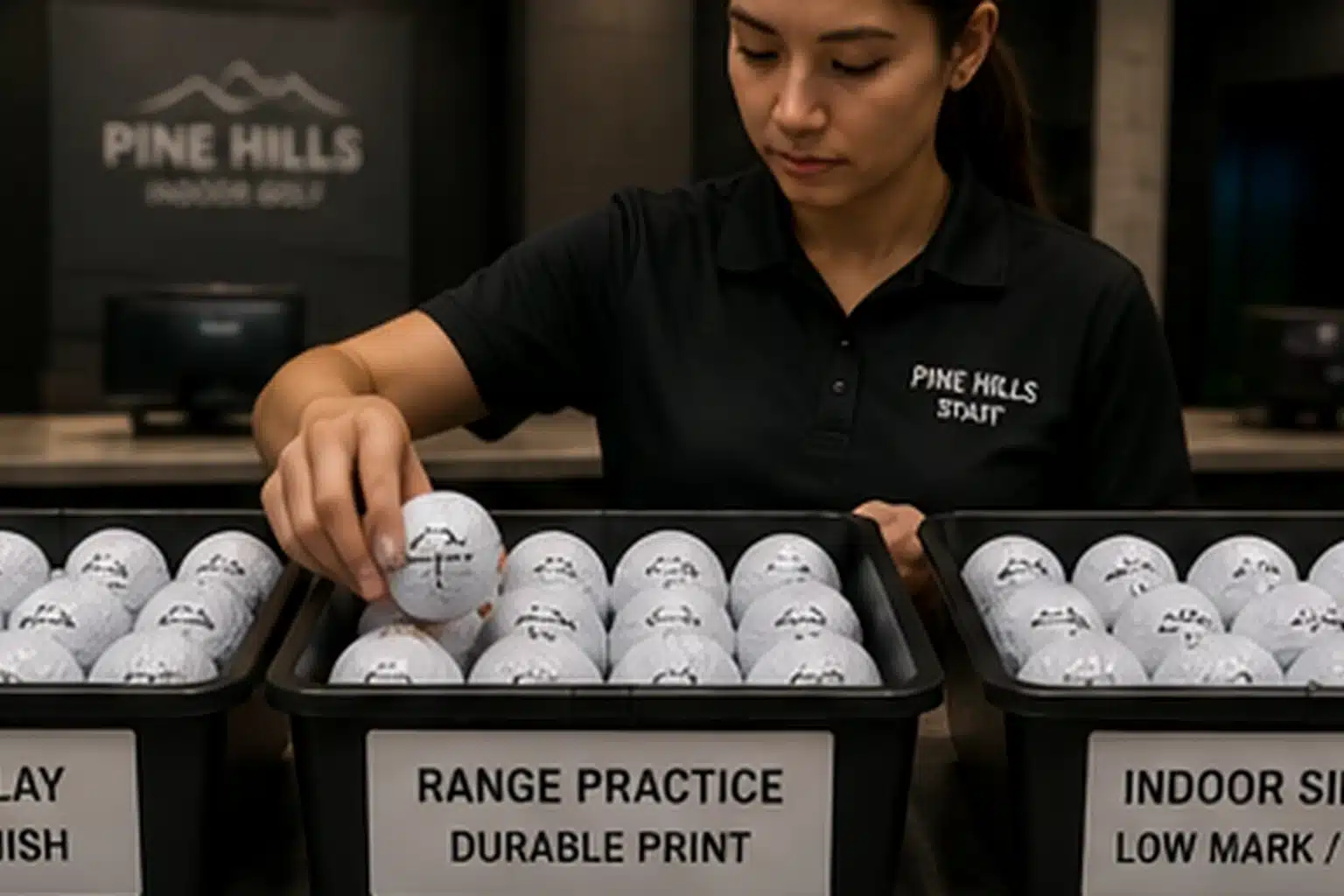
A corporate gift ball mainly protects brand presentation, packaging appearance, and light handling. An event play ball needs after-hit evidence. A commercial range ball faces repeated washing, sorting, bucket friction, abrasion, and logo visibility demands. An indoor simulator ball may need dye-transfer, rub, and clean-surface checks.
| Use case | Logo risk | Test priority | Buyer action |
|---|---|---|---|
| Corporate gift | Packaging rub or prestige loss | Visual + light rub | Approve sample and pack test |
| Event play | After-hit scuffing | After-hit photos | Set play-use expectation |
| Range ball | Washer and sorting wear | Washer-cycle check | Request stronger proof |
| Indoor simulator | Dye transfer or screen marks | Dry/wet rub | Use clean-surface rule |
| Branded resale | Complaint and return risk | Batch-linked inspection | Retain sample |
Range-ball logo has no washer or after-hit proof is a failure signal. Commercial range balls turn logo durability into operating evidence because the mark may support property ID, sorting, bucket presentation, and batch recognition.
Define the intended use case before approving print durability. Your deliverable is a use-case durability checklist tied to the sample ID and buyer acceptance criteria. The sample passes only the durability gate agreed for its actual channel.
✔ True — Durability should match the real use case
A display gift, event ball, range ball, and indoor simulator ball do not face the same contact, cleaning, and abrasion risks.
✘ False — “One beautiful logo sample proves the order is ready for every channel”
A beautiful sample proves appearance. Your test gate should prove the logo survives the channel where the ball will actually be used.
How Should Logo Durability Be Tested?
Your team may rely on supplier photos, but untouched photos do not prove that a logo survives rubbing, moisture, cleaning, packaging friction, hitting, or washing.
Logo durability should be tested with physical evidence, not assumed from a beauty photo. Your team can request dry rub, wet rub, alcohol-wipe, adhesion-style checks, after-hit photos, washer-cycle comparisons, and before/after close-ups, all linked to the exact sample ID.
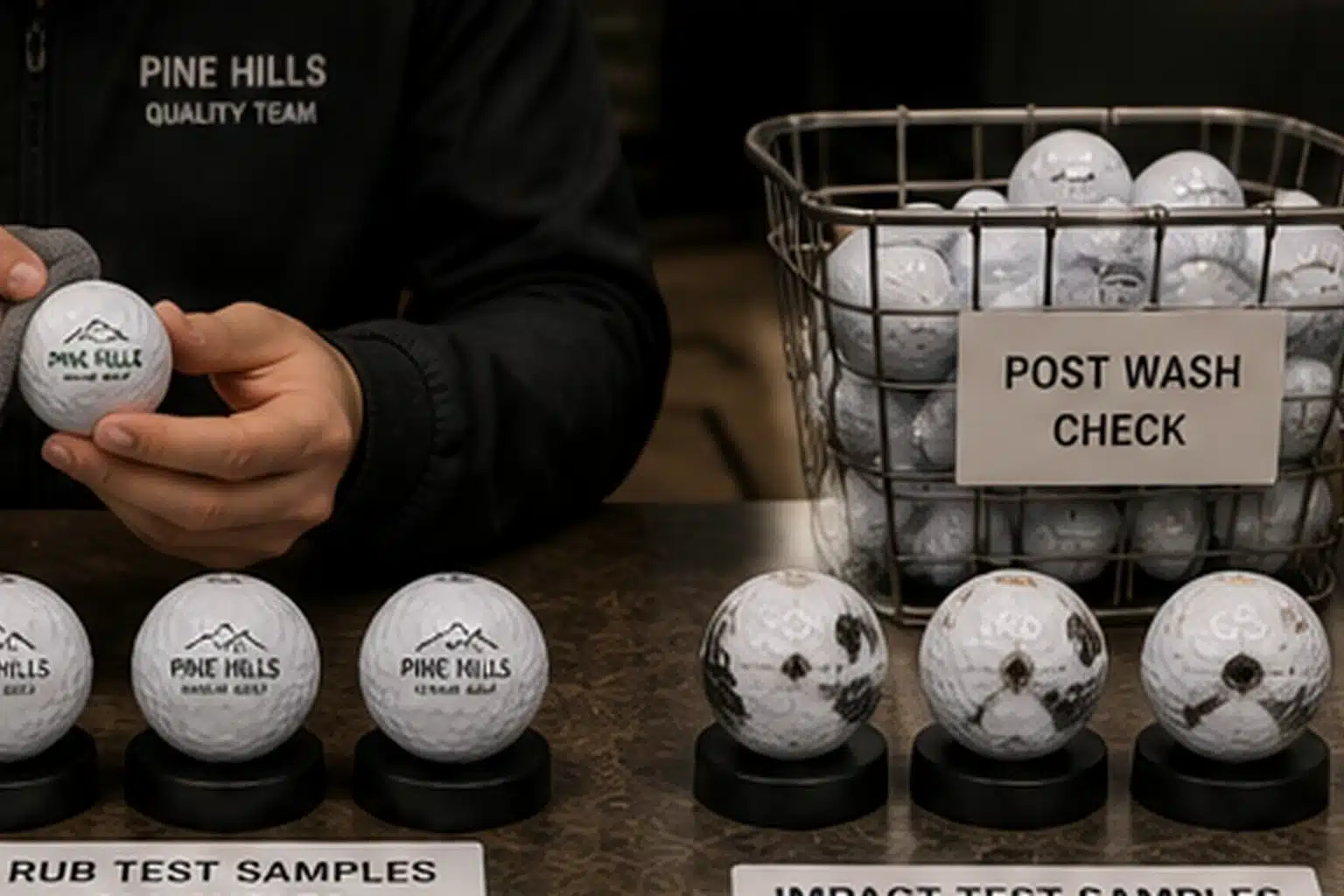
Rub, wipe, or after-hit?
Your test package should match the use case. Gift balls may need packaging rub and light handling checks. Playable event balls need after-hit photos. Indoor balls need dye-transfer and wipe checks. Range balls need washer-cycle comparison and post-wash visibility.
| Test | What it reveals | When to use | Evidence to request |
|---|---|---|---|
| Dry rub | Basic abrasion | Gift and resale | Before/after photos |
| Wet rub | Moisture sensitivity | Outdoor or cleaning risk | White-cloth result |
| Alcohol wipe | Cleaning resistance | Indoor or facility use | Wipe photo |
| After-hit photos | Impact wear | Playable logos | Post-hit close-ups |
| Washer comparison | Range durability | Commercial range balls | Post-wash visibility |
| Adhesion-style check | Bond weakness | Process validation | Sample-linked report |
For testing language, an adhesion tape-test reference can support adhesion-style thinking, while a printed-material rub reference can support abrasion and scuff-resistance discussions. Use them as reference logic adapted to curved, dimpled golf balls, not as golf-ball-specific certifications.
Run buyer-agreed rub, wipe, adhesion-style, and after-hit checks on the exact approved sample. Your test report should show sample ID, method, photos, result, and production release decision. Bulk approval requires passing the buyer-agreed test gate, not a supplier’s informal promise.
What Proof Should You Approve?
Your team may approve a PDF render, a color mockup, or one polished sample without knowing whether bulk production will use the same process.
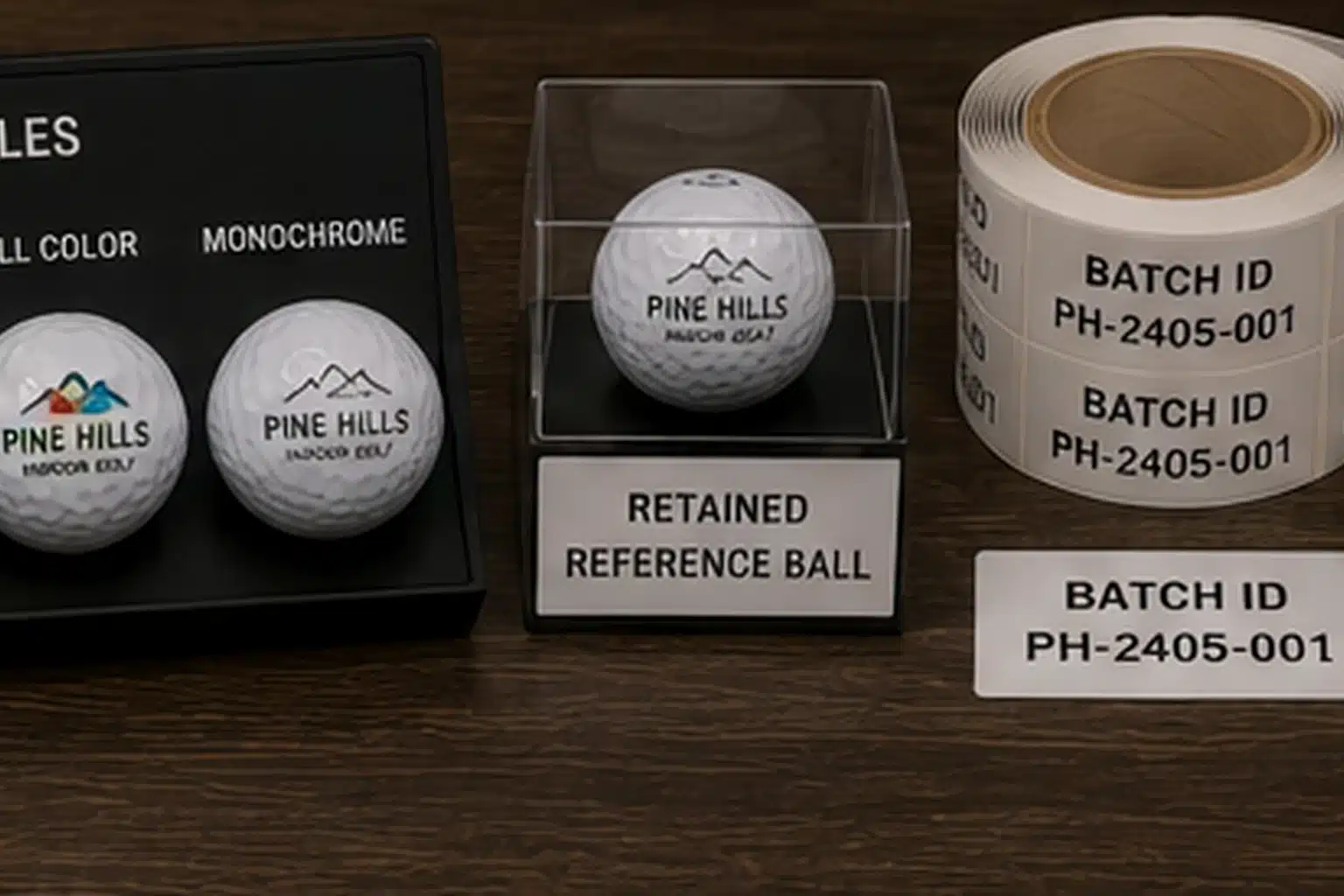
Approve the proof package, not only the logo appearance. Your approval file should include artwork, physical printed sample, sample ID, print method, use case, rub or wipe evidence, after-hit photos when needed, retained sample, batch ID, and first-batch comparison.
Visual proof or functional proof?
A PDF artwork proof confirms layout. A beauty sample confirms appearance. Neither proves the ink system, curing, topcoat, surface prep, or bulk production lot will behave the same way under real use.
| Proof type | What it proves | What it misses | Buyer action |
|---|---|---|---|
| PDF artwork | Logo layout | Adhesion | Approve design only |
| Beauty sample | Visual finish | Durability | Request testing |
| Rub / wipe photos | Surface resistance | Impact wear | Link to sample ID |
| After-hit photos | Play-use behavior | Washer durability | Use for playable orders |
| Retained sample | Dispute reference | Bulk drift | Seal and store |
| Batch ID | Traceability | Unlinked process change | Tie to shipment |
Supplier approves mass production from PDF artwork only is a failure signal. Create a sample approval pack with artwork proof, physical sample, sample ID, method note, test photos, retained sample, and batch ID. Compare first-batch production balls against the retained approved sample before shipment.
Production approval requires sample ID match, proof version match, and test evidence match. If the bulk lot cannot be compared to a retained approved sample, your team is approving from memory — and memory is not a quality-control document.
✔ True — Approval should be version-controlled
Your team needs a sample ID, retained sample, batch ID, and test record so the approved sample and bulk shipment can be compared fairly.
✘ False — “One attractive sample photo is enough to release a bulk order”
A photo can hide process drift, curing gaps, weak adhesion, or a sample that was not made the same way as the bulk lot.
What Should Your RFQ Require?
Your RFQ may ask for logo printing but fail to specify the actual risk controls that prevent peeling, smearing, fading, and delivery disputes.
Your RFQ should require print durability evidence before mass production. Ask for printing method, cover material, ink-cover compatibility, surface-prep protocol, curing and clear-coat note, rub test, alcohol-wipe check, after-hit photos, sample ID, retained sample, batch ID, and pre-shipment approval.
Method, sample ID, or test gate?
Your RFQ should make the supplier prove the logo system, not merely quote a logo price. Ask how the cover is prepared, what printing method is used, how curing is controlled, whether a clear coat or topcoat is applied, and which physical tests release production.
| RFQ item | Why it matters | What to request | Acceptance evidence |
|---|---|---|---|
| Print method | Process clarity | Method declaration | Sample-linked note |
| Ink-cover match | Adhesion | Compatibility statement | Tested sample |
| Surface prep | Residue control | Prep protocol | Supplier declaration |
| Curing / clear coat | Wear resistance | Process note | Rub photos |
| Use-case test | Real durability | Hit / wipe / washer proof | Before/after report |
| Sample ID | Approval control | ID label | Proof version match |
| Batch ID | Traceability | Lot record | Shipment match |
You can place this wording directly in your RFQ:
“Please quote custom logo golf balls for the stated use case. Confirm printing method, cover material, ink-cover compatibility, surface-prep protocol, curing process, clear-coat or topcoat control, dry/wet rub test, alcohol-wipe check, after-hit photos, washer-cycle evidence if used for range balls, sample ID, retained sample, batch ID, and pre-shipment approval gate. Do not release mass production from artwork approval alone.”
Supplier shall link approved artwork, physical printed sample, sample ID, printing method declaration, ink-cover compatibility note, surface-prep note, curing and clear-coat note, rub/wipe evidence, after-hit photos when required, retained sample, batch ID, and shipment lot under one proof version before dispatch.
A coating-abrasion reference can support clear-coat discussion when relevant, but do not turn it into a universal golf-ball pass/fail claim. Buyer acceptance requires proof version match, sample ID match, batch ID match, retained sample match, buyer-agreed test pass, and no unacceptable logo peeling, smearing, dye transfer, or print drift in inspected samples.
FAQ
Why do logos rub off golf balls so quickly?
Logos usually rub off quickly when ink, cover, surface preparation, curing, clear coat, or use-case testing does not work together. The visible failure may happen after handling or hitting, but the root cause often starts during process approval.
Check ink-cover compatibility, surface-prep proof, curing evidence, and clear-coat notes. Then request dry rub, wet rub, wipe, and after-hit evidence linked to the sample ID. Do not approve bulk production from a PDF render alone.
How long should a custom golf ball logo last?
There is no universal logo lifespan for every cover, printing method, clear coat, and use case. A gift ball, event ball, range ball, indoor simulator ball, and resale ball each need buyer-agreed test gates.
Avoid fixed claims without testing. Define the use case first, then set acceptance criteria. A corporate gift may need packaging rub proof, while a commercial range ball may need washer-cycle and post-wash visibility evidence.
How do you protect a logo on a golf ball?
A protected logo needs compatible ink, clean surface prep, proper curing, controlled clear coat, and physical test evidence. Clear coat can help, but it cannot rescue poor bonding by itself.
Do not rely on heavier coating alone. Ask for rub and wipe photos, after-hit photos when the ball will be played, and a process declaration showing how the ink, cover, curing, and topcoat work together.
Is UV printing more durable on golf balls?
Not automatically. UV printing can work well for certain logos and production needs, but durability still depends on surface prep, ink, curing, clear coat, and physical testing on the actual ball cover.
Do not approve by process name alone. Request proof on the real cover, compare sample and bulk output, and make the supplier link the approved sample to sample ID, batch ID, and test evidence.
Is pad printing better for golf ball logos?
Pad printing can be reliable for many simple logos and larger runs, but it still needs adhesion, rub, wipe, and use-case evidence before bulk approval. No method should bypass proof.
Ask for the exact method used, ink compatibility, surface preparation, curing control, and sample-linked testing. A good pad-printed sample is useful only when the same process is repeated in production.
How do you test golf ball print adhesion?
Use buyer-agreed adhesion-style checks, dry/wet rub checks, alcohol-wipe checks, after-hit photos, and sample-linked reports. Reference standards can guide the logic, but the golf ball’s curved, dimpled surface needs a practical agreed method.
Record before/after photos, sample ID, test date, method, pass/fail definition, and inspector notes. The goal is not a fancy report. The goal is evidence strong enough to release or hold production.
Can clear coat stop golf ball logo wear?
Clear coat can help protect a printed logo, but it cannot fix poor ink bonding, weak surface preparation, under-curing, or a mismatched ink-cover system. More coating is not automatically better.
Ask for clear-coat compatibility, coating-control notes, and rub or hit testing. Uncontrolled heavy coating may create appearance or performance concerns, so the buyer should verify the finished sample, not just request “more clear coat.”
Should range ball logos be tested differently?
Yes. Range ball logos face washer cycles, sorting, bucket friction, abrasion, and high-volume handling, so they need stronger use-case testing than display-only gift balls.
Request washer-cycle evidence, post-wash logo visibility, after-hit photos when relevant, batch ID, and retained sample. For range operations, a logo may function as property ID and sorting support, not just decoration.
Conclusion
A custom golf ball logo is approved by evidence, not appearance. A beautiful render can confirm design, but it cannot prove adhesion, rub resistance, wipe resistance, after-hit behavior, or washer durability.
The safest buyer path is to approve artwork for design, then approve the physical logo for durability through sample ID, surface-prep proof, ink-cover compatibility, rub and wipe testing, after-hit photos, retained samples, batch IDs, and RFQ acceptance criteria.
A logo should not be approved because it looks sharp. It should be approved because the exact printed sample survives the use case your buyer actually paid for.
You might also like — Custom Golf Ball Printing Methods: Pad vs UV & Adhesion Standards