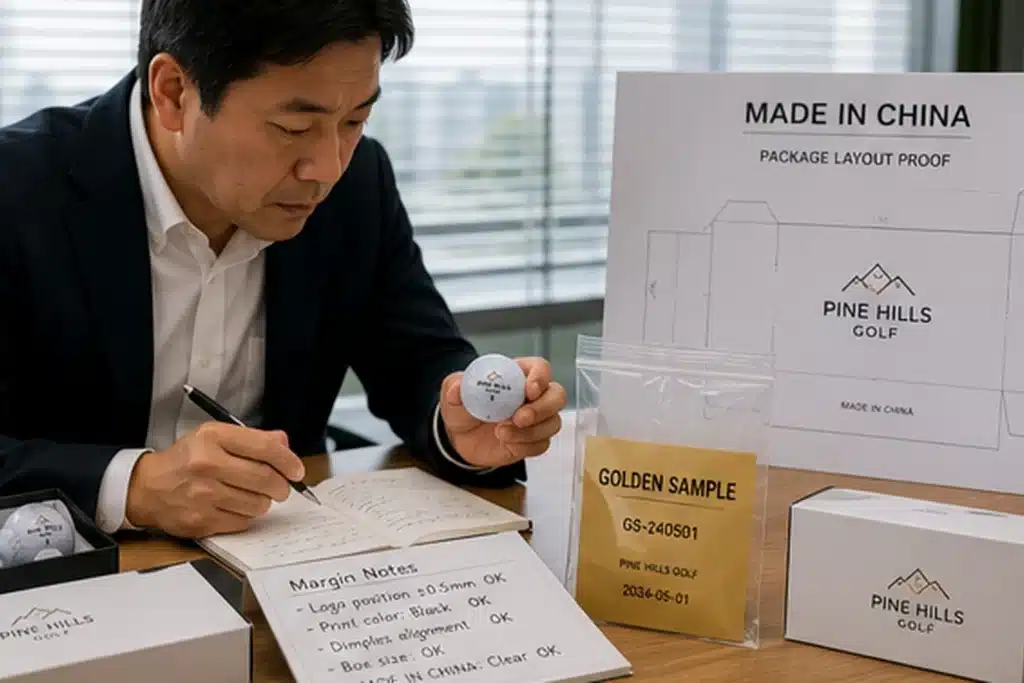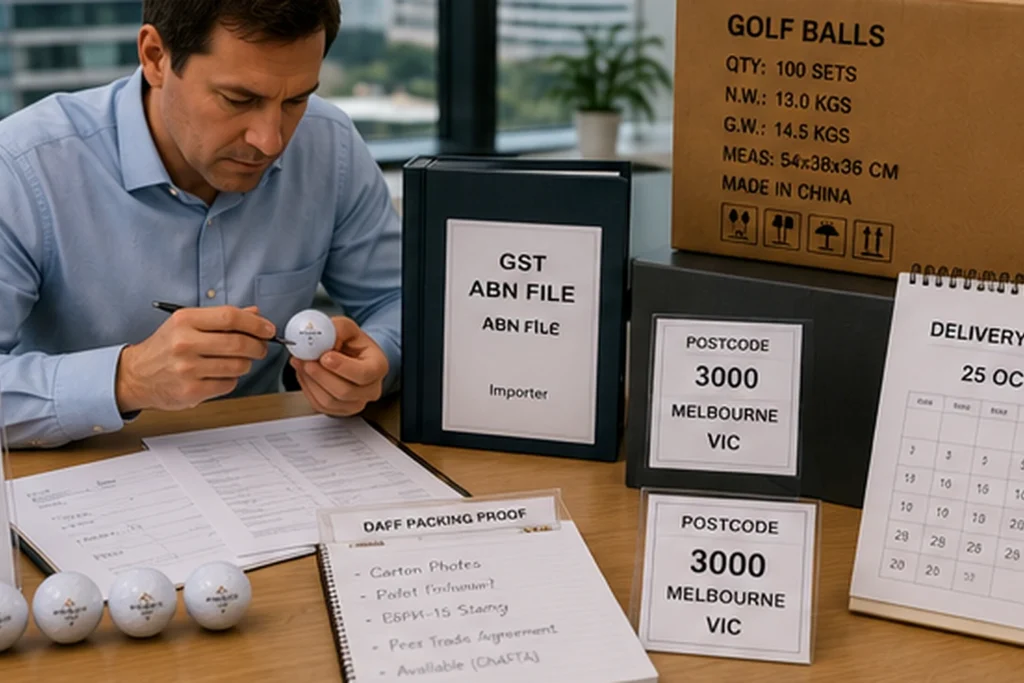
To import golf balls from China to Australia, verify the shipment file before accepting DDP—not after GST, DAFF, or postcode delivery issues appear.
Your Australia import file should confirm ABF classification, GST handling, importer / ABN route, DAFF biosecurity, ISPM-15 packing, final postcode delivery, remote surcharge coverage, and event-deadline routing before shipment.
| Australia import check | Buyer risk | What to request | Buyer action |
|---|---|---|---|
| ABF classification | Wrong file basis | HS 9506.32 review | Broker check |
| GST | Weak credit path | GST / ABN route | Accountant review |
| Importer role | BAS issue | Import file path | Confirm before quote |
| Biosecurity | DAFF hold | Timber / pallet statement | Check before packing |
| ISPM-15 | Pallet treatment risk | ISPM-15 proof | Approve before ship |
| Postcode | Remote surcharge | Final postcode quote | Lock delivery |
| Event deadline | Late arrival | Air / sea plan | Choose route early |
Use this guide to check whether your China golf ball shipment is Australia-ready before cargo leaves China.
What Should Australian Buyers Check First?
Your team may ask how to import golf balls from China to Australia and expect a freight answer. The stronger first check is whether the shipment file can support Australian customs, GST, biosecurity, postcode delivery, and deadline planning.
Your first Australia import check is not the cheapest DDP quote; it is whether the shipment is ABF-ready, GST-ready, DAFF-ready, postcode-ready, and deadline-ready. Before shipment, request ABF classification review, GST / ABN route, biosecurity packing proof, final postcode coverage, delivery-condition confirmation, and event timing.
Australia is not a “ship to metro and hope” market. A quote that works for a Sydney, Melbourne, or Brisbane warehouse may not cover a regional golf course, driving range, resort, club, event venue, or no-dock delivery address. Your quote should name the final 4-digit postcode before shipment booking, not after the pallets have landed.
| First check | Buyer risk | What to request | Buyer action |
|---|---|---|---|
| ABF class | Wrong file basis | HS review | Broker check |
| GST route | BAS gap | ABN / GST note | Ask accountant |
| DAFF status | Biosecurity hold | Packing statement | Approve before pack |
| ISPM-15 | Pallet risk | Stamp / proof | Check photos |
| Postcode | Remote surcharge | Final address | Lock quote |
| Deadline | Late event | Route plan | Choose early |
As of 2026, verify again at shipment date. ABF treatment, GST credit path, importer role, DAFF import conditions, carrier service zones, LTL pricing, and event-route timing can vary by product mix, broker, carrier, destination postcode, buyer status, and packaging version.
Build an Australia Import Readiness Pack before shipment approval. Match the supplier quote against ABF classification, GST / ABN route, DAFF / ISPM-15 packing, final postcode, delivery conditions, and event deadline. Shipment approval requires a postcode-locked Australia file, not only a DDP price.
✔ True — Australia import planning starts with customs, GST, biosecurity, postcode, and deadline visibility
A useful Australia quote should show your ABF review, GST route, pallet proof, final postcode, delivery conditions, and deadline plan before shipment.
✘ False — “A DDP Australia price proves every golf course or warehouse delivery is covered”
DDP can simplify execution, but it still needs written coverage for postcode, surcharge, appointment, tail-lift, and redelivery risks.
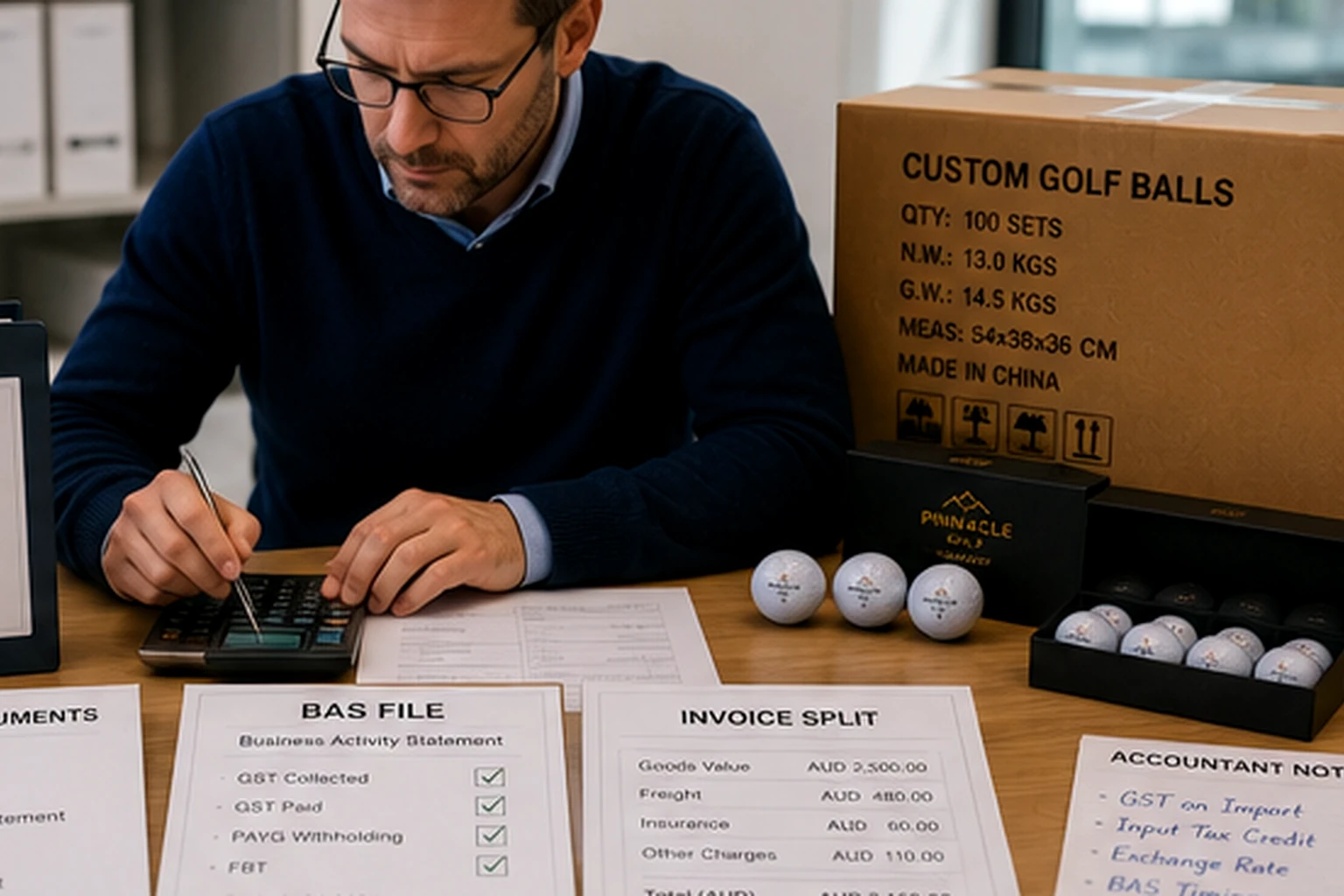
Is Duty the Real Australia Import Risk?
Your team may focus on whether golf balls have import duty in Australia. That matters, but it can distract from GST, product mix, origin documents, import declaration, biosecurity, and final-mile delivery.
Duty is not the main Australia import risk for finished golf balls. Your team should still review ABF 9506.32.00, product mix, origin documents, GST, import declaration, DAFF biosecurity, and delivery postcode because a favorable duty line does not make the shipment fully Australia-ready.
Finished golf balls can start from ABF 9506.32.00 for review, where the current Chapter 95 tariff schedule lists golf balls as Free. Use the official ABF Chapter 95 tariff reference for shipment-date review. If your order includes towels, tees, tools, ball markers, divot repair items, mixed gift kits, or accessories, list those items separately for broker review.
| Review item | Common mistake | What to request | Buyer action |
|---|---|---|---|
| Finished balls | Duty only | ABF review | Broker check |
| Gift kits | Accessories hidden | Item list | Classify separately |
| Origin file | COO ignored | Origin documents | Match invoice |
| GST | Duty confused with tax | GST route | Ask accountant |
| Biosecurity | Packing ignored | Timber statement | Check DAFF risk |
| Delivery | Port confused with door | Postcode quote | Confirm final mile |
DDP quoted without a final postcode is a failure signal, even when the duty line looks simple. Do not make ChAFTA the whole story for finished golf balls. Origin documents can still support file discipline, especially when a shipment includes mixed products or buyers need clean records, but a duty result does not replace invoice accuracy, GST handling, packing proof, or postcode delivery.
Your deliverable is an ABF Classification and Origin File. Confirm HS line, product mix, origin proof, commercial invoice, packing list, and broker review at shipment date. Any added accessory, gift component, or packaging bundle should trigger classification review before shipment.
How Should GST and ABN Be Handled?
Your supplier may say GST is included in DDP. That may sound convenient, but your finance team still needs to know who is importer, whose ABN route is used, and whether the import file supports BAS and GST credit review.
GST handling should support your accounting file, not just make the quote look simple. Your team should confirm the importer role, ABN route, GST payment path, import declaration access, BAS-supporting documents, and accountant review before accepting a GST-included or GST-unpaid DDP structure.
ABF states that GST on taxable importations is 10% of the Value of the Taxable Importation, and VoTI includes customs value plus certain international transport, insurance, and duty components. Use the official ABF GST importing guidance to understand why GST is separate from duty.
| GST question | Why it matters | What to request | Buyer action |
|---|---|---|---|
| Who imports? | GST file owner | Named importer | Confirm role |
| Whose ABN? | BAS review | ABN route | Ask accountant |
| Who pays GST? | Tax handling | GST note | Verify terms |
| What proof? | File access | Import declaration path | Keep records |
| DDP scope | Hidden assumption | Included / excluded | Add to RFQ |
| Invoice split | Audit trail | Value / freight split | Review before PO |
The ATO explains that GST credit claims for imported goods depend on the importer and required documentation. Use the official ATO GST credits for imported goods guidance and your accountant to verify your file path. Supplier-prepaid GST is not automatically better if your buyer-side BAS file becomes weak.
GST is “included” but importer / ABN route is unclear is a failure signal. Ask for GST Handling and Importer / ABN Confirmation before PO approval. DDP approval requires GST file visibility, not only a tax-included price.
✔ True — GST route and importer / ABN clarity should be confirmed before DDP approval
Your finance team needs to know who imports, whose ABN route is used, who pays GST, and what documents support the BAS file.
✘ False — “GST included automatically means your Australian business can use the import file for GST credit review”
A tax-included quote can still be weak if the importer role, ABN route, and supporting documentation are unclear.
Will DAFF Hold Your Pallets or Cartons?
Your golf balls may have little biosecurity risk as finished sports products, but the shipment can still create DAFF problems through timber pallets, dunnage, crates, packing blocks, or untreated wood packaging.
DAFF risk often comes from the packing material, not the golf ball itself. Before shipment, your team should confirm plastic slip sheets or ISPM-15 treated wood, no untreated timber packaging, pallet or dunnage photos, treatment proof where applicable, and biosecurity-ready packing before cargo leaves China.
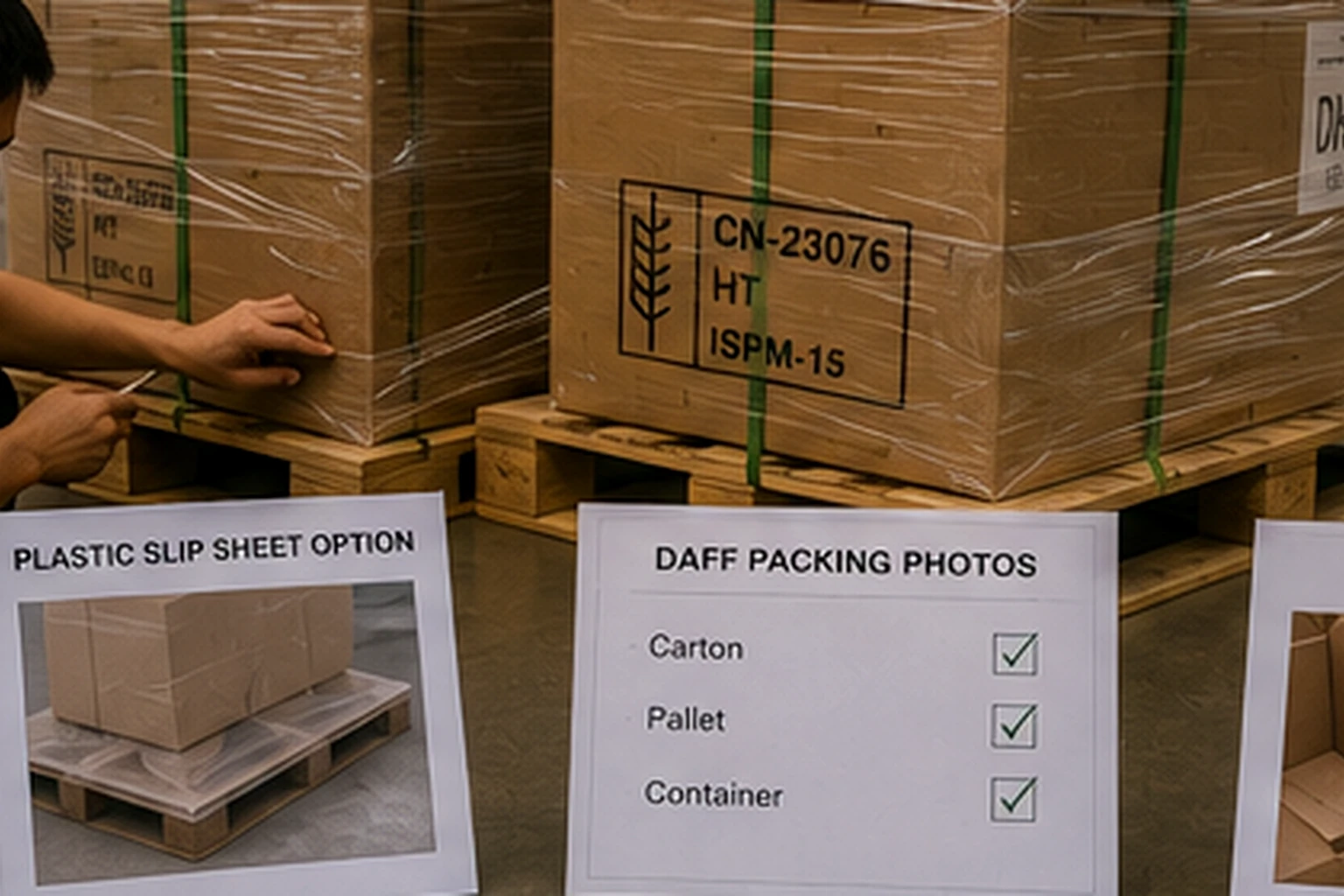
Australia accepts solid timber packaging that meets ISPM-15 or other applicable BICON import conditions. DAFF also states that solid timber packaging not treated according to ISPM-15 or acceptable offshore treatment may require mandatory treatment, export, or disposal at the importer’s expense. Use the official DAFF timber and bamboo packaging guidance and ISPM-15 guidance before approving packing materials.
| Packing item | Biosecurity risk | What to request | Buyer action |
|---|---|---|---|
| Wood pallet | Treatment issue | ISPM-15 stamp | Check photo |
| Dunnage | Hidden timber | Packing statement | Confirm material |
| Crate | Inspection risk | Treatment proof | Review before pack |
| Slip sheet | Lower timber risk | Plastic option | Approve route |
| Carton | Still inspectable | Packing photos | Keep proof |
| Supplier habit | Untreated wood | No-wood clause | Add to PO |
Pallet material confirmed after packing instead of before shipment is a failure signal. Your goods can be ready while the pallet is not. That is a painful way to learn that “sports product” and “packing material” are different biosecurity questions.
Your PO should state plastic slip sheets or ISPM-15 compliant treated wood only, with no untreated timber packaging. Your deliverable is DAFF Biosecurity and ISPM-15 Packing Proof. Check pallet type, timber treatment, ISPM-15 stamp, dunnage, crate material, and packing photos before shipment.
Air, Sea, or Split Shipment for Australia?
Your sample order, corporate gift order, event order, range-ball replenishment, and distributor stock shipment may not need the same route. Australia’s event deadlines, seasonal demand, postcode distance, and packaging density can change the right choice.
Your Australia route should match the deadline, packaging density, and final postcode. Your team should compare air, courier, sea, LCL, or split shipment by event date, carton count, CBM, gross weight, delivery appointment, tail-lift needs, and regional surcharge exposure before shipment booking.
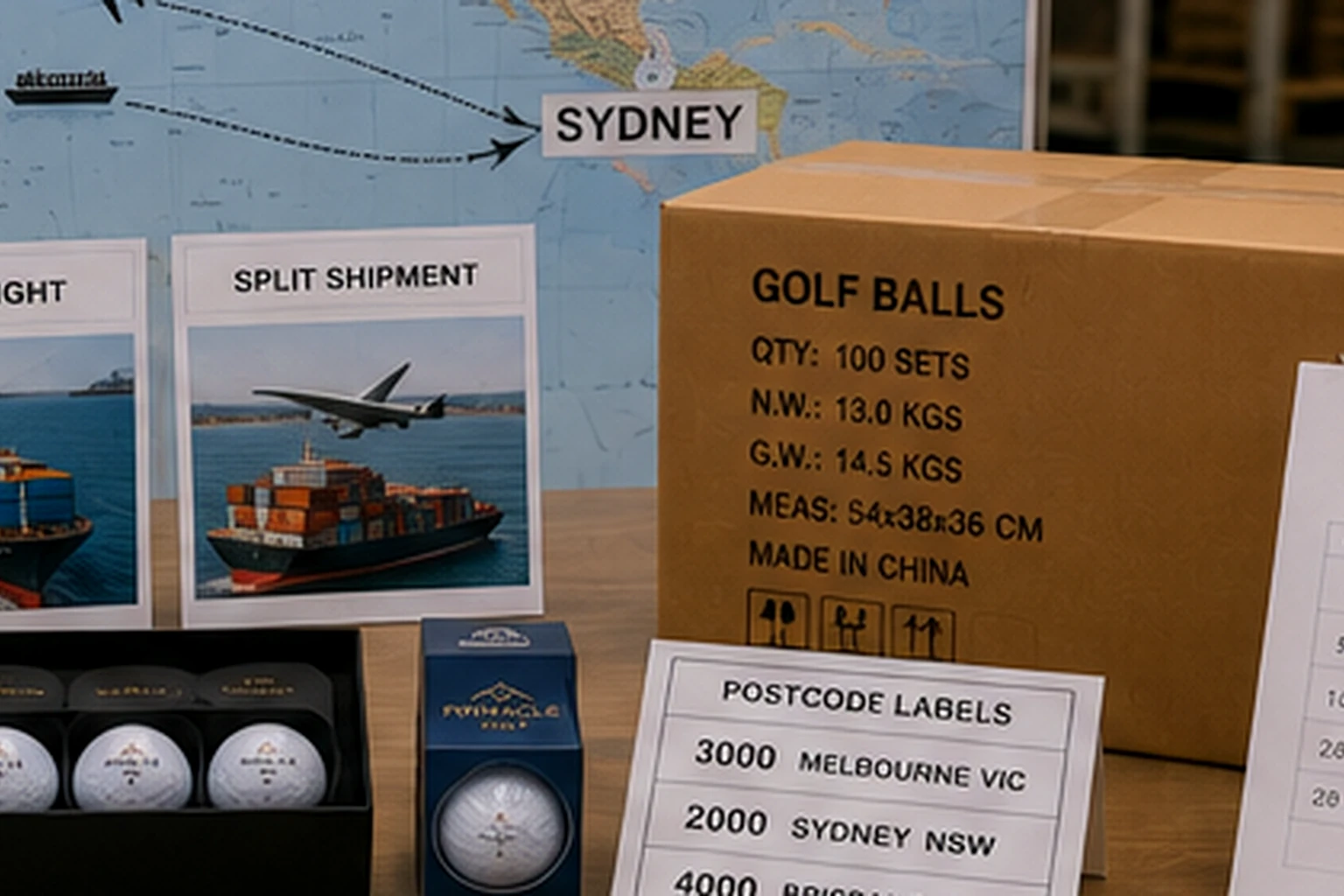
Air or courier may fit samples, urgent promo orders, and corporate gift deadlines. Sea or LCL may fit planned distributor stock, range balls, and replenishment orders. A split shipment can work when a small approved quantity must meet an event date while the main stock follows by sea.
| Shipment type | Route risk | What to verify | Buyer action |
|---|---|---|---|
| Samples | Late approval | Courier timing | Ship early |
| Event gifts | Deadline miss | Air / split option | Lock event date |
| Range balls | Heavy stock | Dense packing | Use CBM sheet |
| Gift boxes | Volume cost | Carton CBM | Compare route |
| Distributor stock | LCL planning | Deconsolidation | Confirm warehouse |
| Regional course | Final-mile gap | Postcode / tail-lift | Get written quote |
Gift boxes are not bad, but unmanaged CBM can damage freight efficiency. Range balls, mesh bags, white boxes, PET boxes, and premium gift boxes all behave differently in cartons and pallets. For Australia, an estimated packing list is not optional. It is the only way to quote regional delivery, tail-lift risk, DAFF packaging exposure, and event-deadline routing.
Request an Australia Route and Packing Density Memo before booking. Confirm event date, shipment purpose, packaging type, carton count, CBM, gross weight, entry plan, final postcode, appointment, and tail-lift needs. Route approval requires deadline and postcode confirmation, not only freight price.
✔ True — Route choice should follow deadline, packaging density, and postcode
A range-ball replenishment order, event gift order, and regional golf course delivery may need different route plans.
✘ False — “The cheapest China-to-Australia freight leg is automatically the safest route”
A cheap international leg can still miss your event date or fail on postcode delivery, tail-lift, appointment, or regional surcharge coverage.
What Should Your Australia RFQ Require?
Your RFQ may ask for unit price, logo printing, packaging, DDP Australia, and lead time. That is not enough if the supplier cannot show GST handling, ABN route, DAFF packing proof, postcode coverage, and delivery conditions.
Your Australia RFQ should lock postcode, GST, DAFF, packing, and delivery proof before accepting DDP. Require final postcode, ABF review, GST / ABN route, BAS-supporting documents, ISPM-15 or plastic pallet proof, packing list, CBM, tail-lift rules, appointment needs, and remote surcharge status.
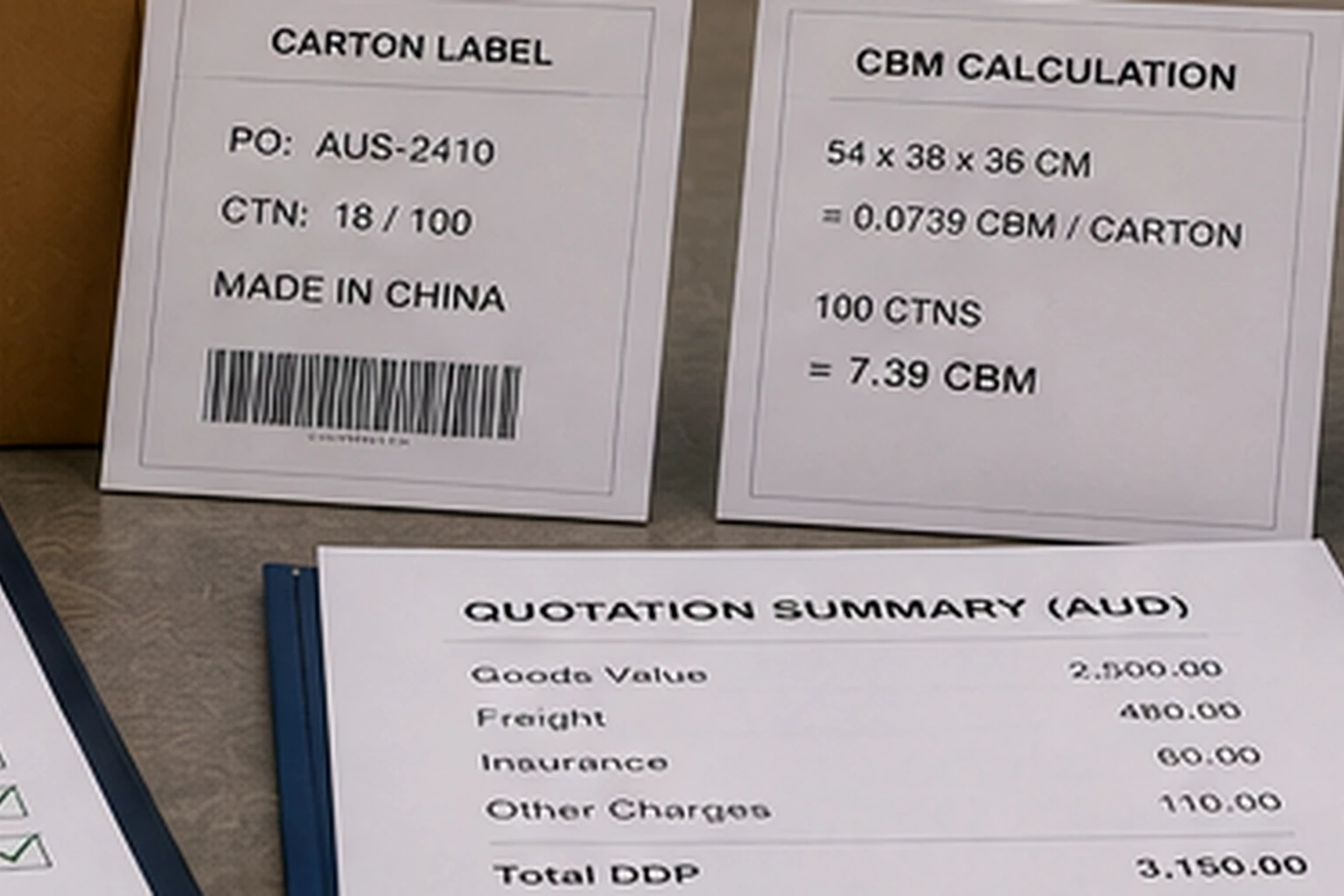
A useful Australia RFQ makes destination execution visible. It should not say only “DDP Australia.” It should define final delivery postcode, metro / regional / remote status, commercial dock, forklift access, tail-lift, delivery appointment, redelivery, inside delivery if needed, and all surcharge inclusions or exclusions.
| RFQ item | Why it matters | What to request | Acceptance evidence |
|---|---|---|---|
| Postcode | Final-mile cost | 4-digit postcode | Route confirmation |
| GST route | BAS review | ABN / GST note | Accountant check |
| ABF class | Import file | HS review | Broker note |
| DAFF status | Biosecurity risk | Packing statement | Biosecurity proof |
| ISPM-15 | Pallet risk | Stamp / cert | Photo proof |
| CBM / GW | LTL exposure | Packing list | EPL review |
| Delivery rules | Failed delivery | Tail-lift / appointment | Written scope |
| Surcharges | Margin leak | Included / excluded | Surcharge statement |
Supplier shall provide an Australia-bound shipment file before release, including ABF classification basis, product and accessory breakdown, GST handling route, importer / ABN route, BAS-supporting documentation path, commercial invoice, packing list, carton count, CBM, gross weight, pallet or slip-sheet material, ISPM-15 proof where timber is used, DAFF biosecurity packing statement, final delivery postcode, delivery appointment rules, tail-lift needs, and delivery proof.
Buyer approval of Australia-bound shipment requires written confirmation that the quote is based on the final destination postcode, shipment-date ABF review, verified GST / ABN route, approved DAFF-ready packing, ISPM-15 compliant or plastic pallet use, no untreated timber packaging, confirmed carton count and CBM, and written inclusion or exclusion of all metro, regional, remote, appointment, tail-lift, redelivery, and secondary delivery charges.
You can place this wording directly into your Australia-bound shipment RFQ:
“Please quote this Australia-bound golf ball shipment based on final delivery to Postcode [XXXX]. Confirm ABF classification review, GST handling, importer / ABN route, BAS-supporting documentation, broker review, DAFF biosecurity status, ISPM-15 or plastic pallet use, no untreated timber packaging, air / sea / LCL route, Sydney / Melbourne / Brisbane entry plan, carton count, CBM, gross weight, delivery appointment rules, tail-lift needs, and all metro, regional, remote, or secondary delivery surcharges before shipment approval.”
FAQ
Do I have to pay import duty on golf balls in Australia?
Finished golf balls can start from ABF 9506.32.00 for review, and the current Chapter 95 tariff schedule lists Balls as Free.
Your team should still verify shipment-date classification and product mix with a broker. Mixed kits, towels, tees, tools, markers, and accessories may need item-level review. Do not treat duty review as the whole import file, because GST, DAFF, and final-mile delivery still matter.
How much GST applies to imported goods in Australia?
GST on taxable importations is generally calculated at 10% of the Value of the Taxable Importation.
Confirm GST route, importer role, ABN path, and documentation with your broker or accountant. Duty Free does not mean GST Free. The GST file should support your BAS review, not just appear as a supplier promise that “tax is included.”
Can an Australian business claim GST credits on imports?
That depends on importer status, GST registration, and documentation.
Do not assume supplier-paid GST automatically supports your BAS file. Ask who is importer, whose ABN route is used, and what import declaration or tax proof your finance team can retain. Have your accountant review the file path before accepting DDP.
Does DDP include final delivery in Australia?
Not automatically. DDP should state exact postcode, metro / regional / remote status, delivery appointment, tail-lift, redelivery, and surcharge treatment.
Provide the final 4-digit postcode early. Request written delivery scope and surcharge inclusions or exclusions before PO approval. A quote to “Australia warehouse” is not enough for a regional golf course, resort, or no-dock delivery location.
What is ISPM-15 for Australia imports?
ISPM-15 relates to treated solid timber packaging used in international trade.
For Australia-bound shipments, your RFQ should require plastic slip sheets or ISPM-15 compliant treated wood where timber packaging is used. Request pallet photos, stamp proof, treatment proof where applicable, and a no-untreated-timber packing rule.
Can I use wooden pallets to ship golf balls to Australia?
Yes, when the timber packaging meets applicable import conditions, but untreated or non-compliant timber can create DAFF risk.
Ask your supplier to confirm pallet material before packing. Plastic slip sheets may reduce timber exposure. If wood is used, request ISPM-15 stamp photos and treatment proof. Do not let the factory choose untreated timber by habit.
Should I ship golf balls to Sydney, Melbourne, or Brisbane?
Choose the entry plan by final postcode, warehouse, deconsolidation, route, event deadline, and domestic delivery scope, not by port habit.
Sydney, Melbourne, Brisbane, Perth, Adelaide, and regional destinations can produce different final-mile outcomes. Quote by final postcode and confirm LCL, LTL, delivery appointment, tail-lift, and redelivery rules before shipment booking.
Are gift boxes risky for Australia delivery?
Gift boxes can increase carton CBM and make domestic freight less efficient, especially when deadlines push air or fast delivery.
Range balls and dense bulk packing behave differently from PET boxes, EVA inserts, magnetic gift boxes, and oversized display packaging. Request carton count, carton dimensions, total CBM, gross weight, and pallet plan before selecting route.
What should an Australia DDP quote include?
An Australia DDP quote should include final postcode, ABF review, GST route, importer / ABN path, DAFF packing proof, ISPM-15 status, packing list, CBM, delivery rules, and remote surcharge treatment.
Reject vague “door to door” wording. Ask for itemized inclusions, surcharge exclusions, delivery appointment rules, tail-lift requirements, redelivery terms, and proof before shipment release.
Conclusion
The safest Australia import is not the simplest DDP quote. It is the shipment your team can verify across ABF, GST, DAFF, postcode delivery, and event timing.
Before importing golf balls from China to Australia, confirm ABF classification, GST handling, importer / ABN route, DAFF biosecurity status, ISPM-15 or plastic pallet use, packing list, CBM, final postcode, delivery appointment, tail-lift needs, remote surcharge treatment, and event deadline.
If the supplier cannot prove those details before shipment, your order is not yet Australia-ready. The balls may be ready to play, but the pallet, GST file, or postcode delivery can still land in the rough.
You might also like — How Does Gift Box Packaging Affect Golf Ball Air Freight Cost?