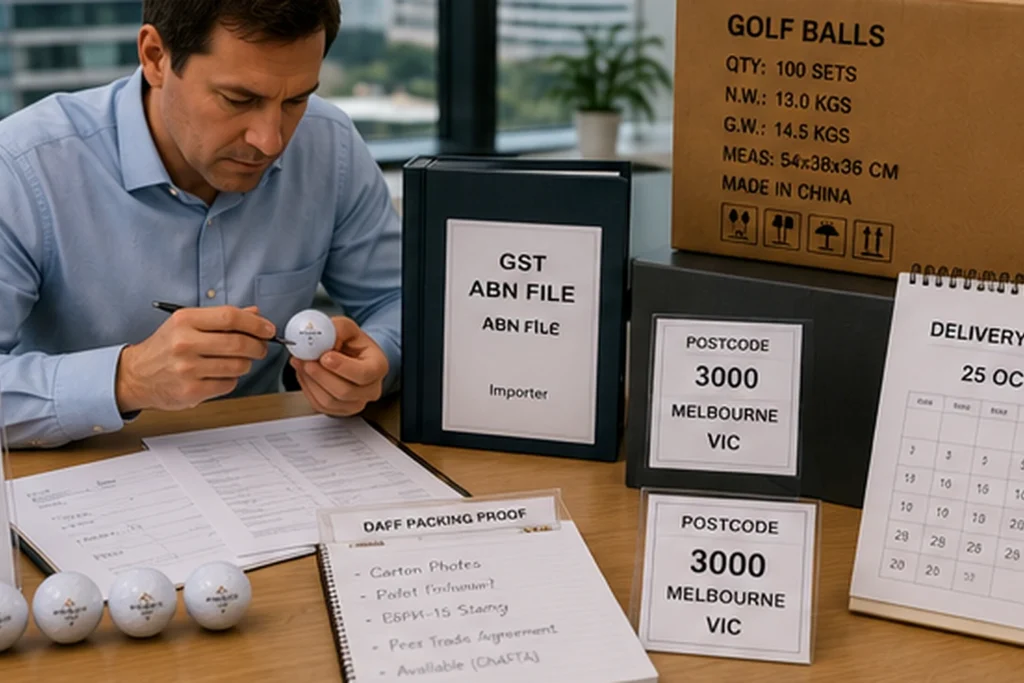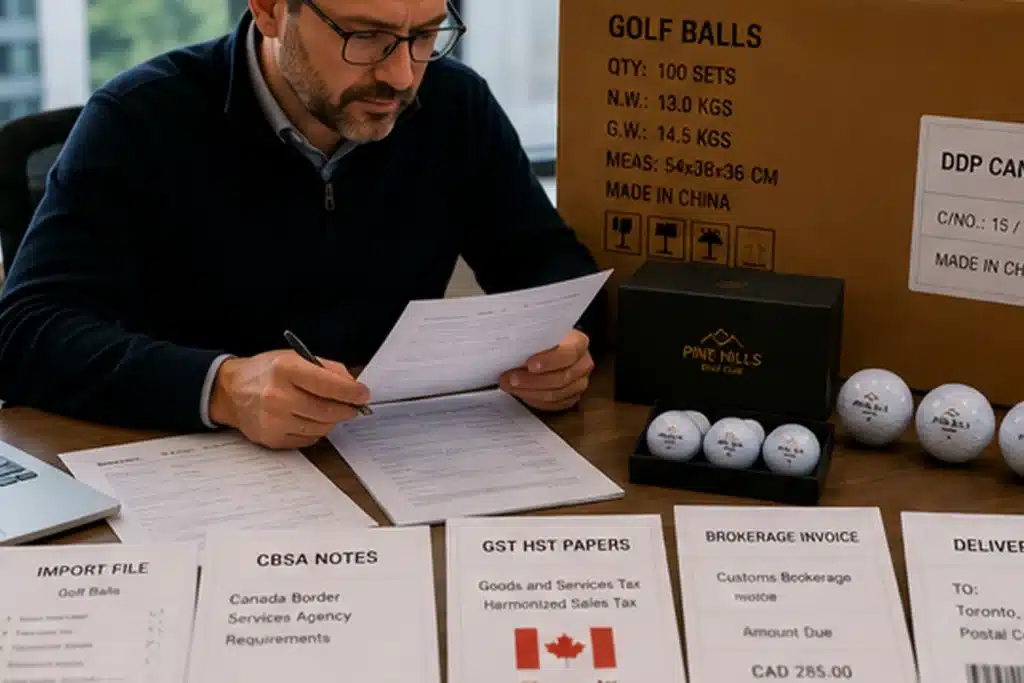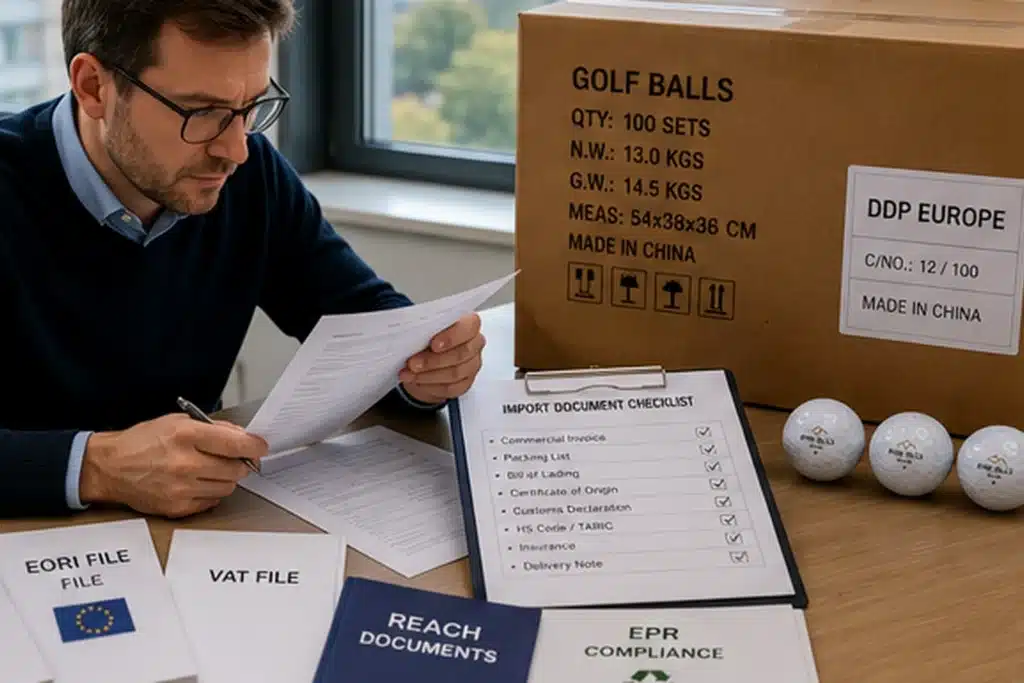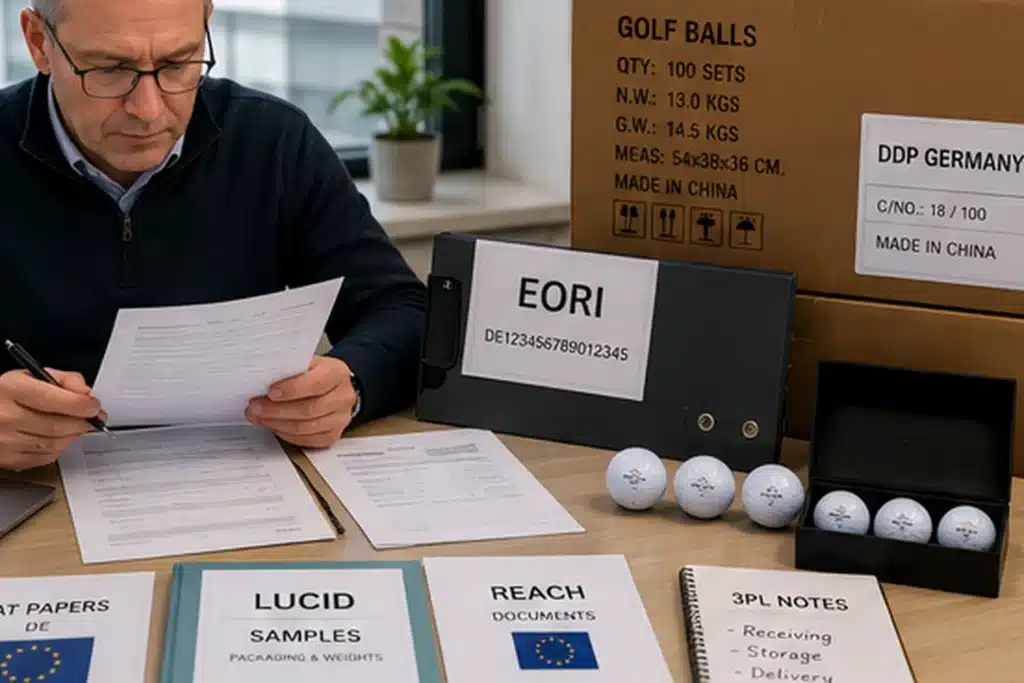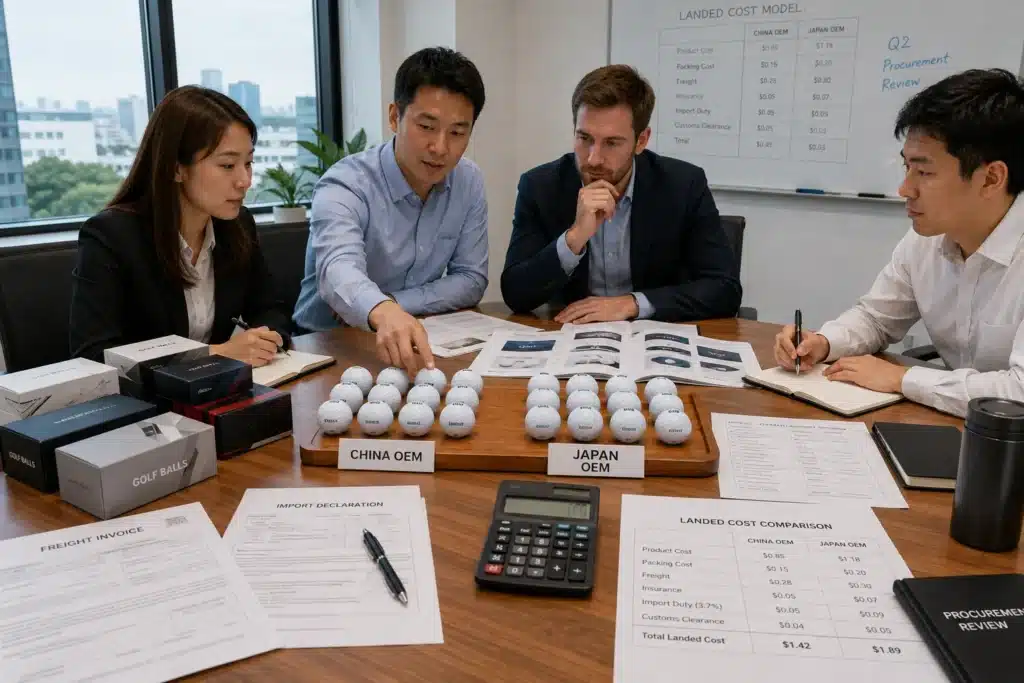
China is usually cheaper than Japan for golf ball OEM when buyers compare accepted landed cost, not FOB price. In 2026, the best comparison is: FOB price + freight per ball + customs fees + compliance amortization + defect loss + inventory cost.
A practical golf ball landed cost calculator should include golf ball packaging density, HTSUS 9506.32.00.00 customs treatment, MPF/HMF, possible Section 301 exposure for China-origin goods, USGA submission or annual resubmission amortization when current conforming-list status is required, and the compensation basis for rejected quantities.
If you are comparing China vs Japan golf ball OEM costs, do not start by asking, “Which country is cheaper?” Start by asking which supplier gives you the lowest accepted landed cost per ball after packaging, freight, customs, compliance, defects, cash tied in inventory, and replacement rules are counted. The dangerous quote is not always the expensive one; it is the quote that looks cheap because the costly parts are missing.
What Is the Landed Cost Formula?
You may compare a Japan quote and a China FOB quote as if the lower factory price is the final answer, but the real bill arrives after freight, customs, packaging, and defects.
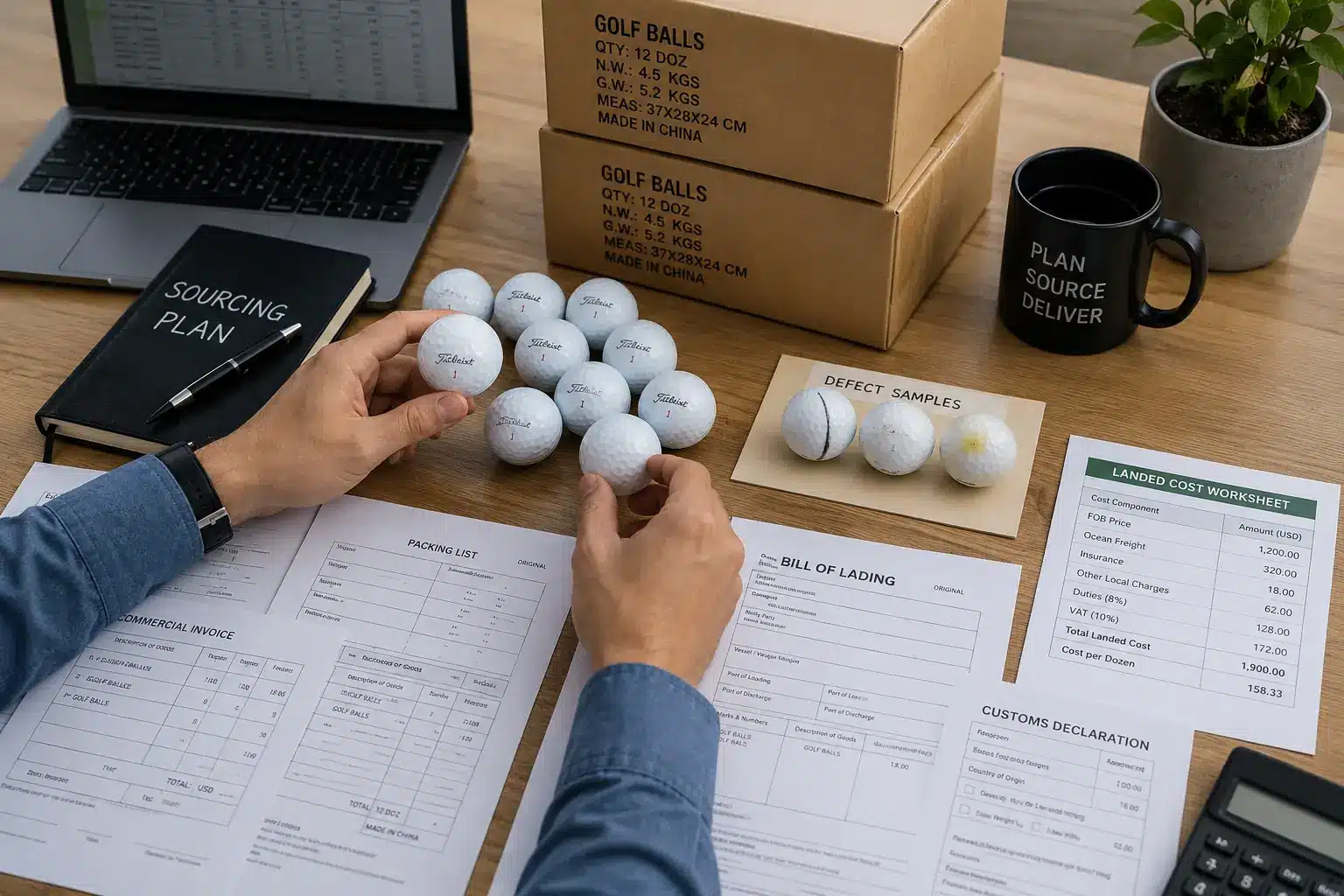
A golf ball landed cost calculator should add FOB price, freight per ball, customs user fees, duty or tariff exposure, destination delivery, packaging density, and defect loss. For U.S. imports, golf balls are generally classified under HTSUS 9506.32.00.00 with a Free base duty rate, but Free duty does not mean free clearance.
| Cost layer | Often ignored? | Why it matters | Buyer action |
|---|---|---|---|
| FOB price | No | Visible factory quote | Normalize construction and packaging |
| Freight per ball | Yes | Changes with packaging density | Calculate loaded balls per container |
| MPF/HMF | Often | Free duty is not free clearance | Ask broker to model fees |
| Section 301 / tariffs | Often | China-origin exposure may change cost | Verify Chapter 99 at entry |
| Destination delivery | Often | Moves margin after port | Quote door or warehouse delivery |
| Defect/yield loss | Very often | FOB refund may not cover landed loss | Add clawback clause |
The cleanest formula is:
Landed cost per accepted ball = FOB + freight per ball + customs/user fees + tariff exposure + destination/inland charges + defect/yield loss.
That last word, “accepted,” is what many sourcing spreadsheets miss. A produced ball is not the same as an accepted ball. If 5% of the shipment arrives with printing flaws, scuffed covers, cracked packaging, or cosmetic rejects, those balls have already consumed freight, customs processing, receiving labor, warehouse space, and customer-service time.
For U.S. imports, golf balls usually fall under HTSUS 9506.32.00.00 / 9506.32.0000. The general import duty on golf balls is Free, but that does not make the import file free. Buyers still need to model MPF, HMF for ocean imports, brokerage, destination charges, inland delivery, and possible China-origin Section 301 / Chapter 99 exposure.
FOB quote with no freight density is a failure signal. A China supplier quoting $0.60 per ball may still beat a Japan supplier quoting much higher, but only if the packaging, container loading, customs assumptions, and defect policy hold up. A DDP quote or a landed-cost quote can be more useful than FOB for smaller buyers because it exposes the hidden layers earlier.
Ask your supplier to state FOB price, packaging specification, carton density, carton count, gross weight, loading assumption, HTS/HS classification support, and included or excluded logistics scope before order confirmation. Your broker or forwarder should verify customs treatment and delivery assumptions. Your comparison should use the same destination, packaging style, and annual volume for every supplier.
✔ True — The lowest FOB quote is not always the lowest cost.
A China quote can be financially stronger than a Japan quote, but only after freight, customs, packaging density, defects, and delivery scope are modeled on the same worksheet.
✘ False — “China is cheaper if FOB is lower.”
You should compare China and Japan by landed cost per accepted ball, not FOB per produced ball.
What Are 2026 FOB Prices by Construction?
You need a clean FOB baseline before adding freight, compliance, packaging, and defect risk, but construction type can change the cost gap more than origin alone.
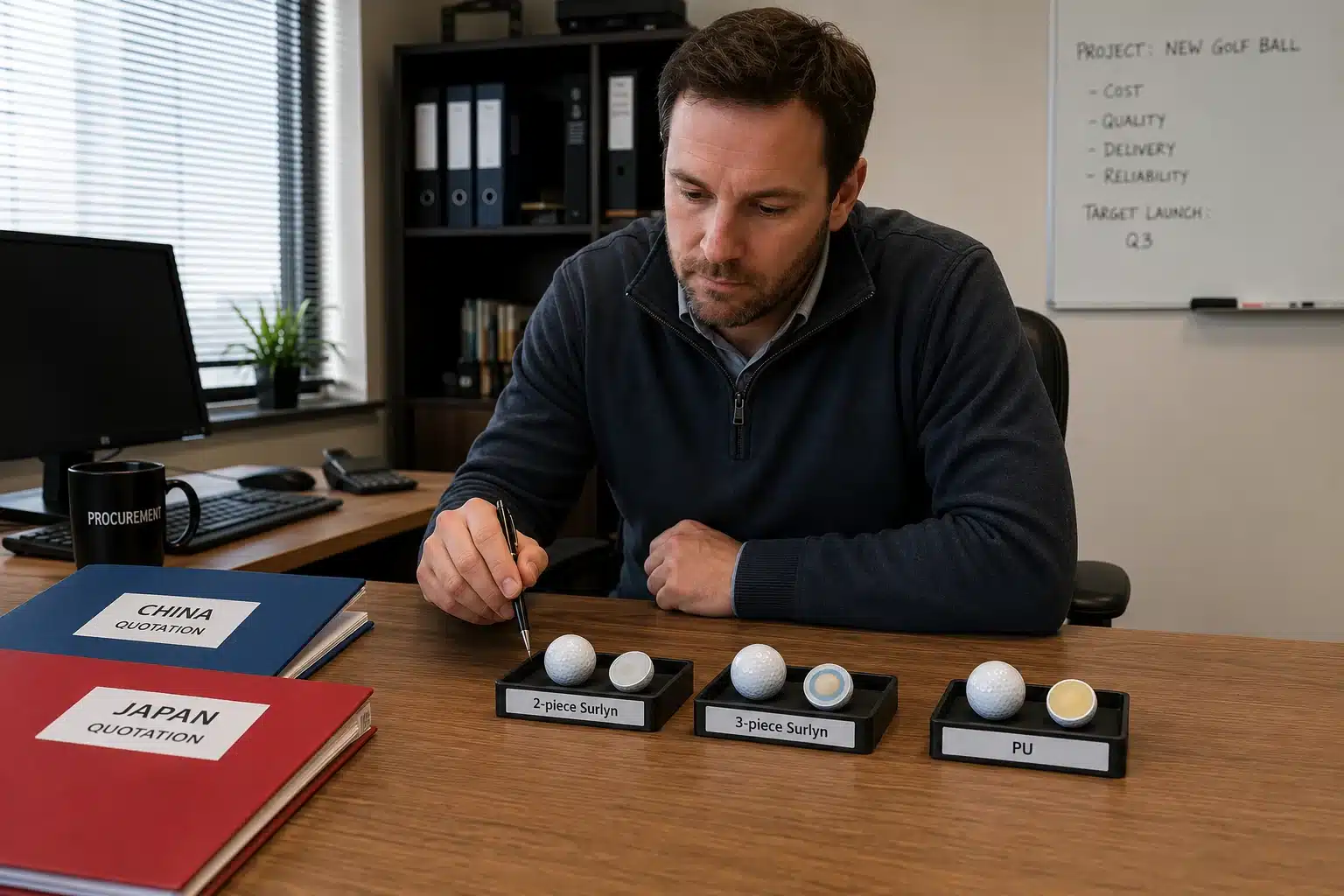
In golf ball OEM pricing 2026, China FOB can start around $0.40–0.80 per ball for 2-piece Surlyn, $0.60–1.00 for 3-piece Surlyn, and $1.50–2.50+ for 3-piece PU. Japan is usually higher because labor, energy, smaller batches, and premium overhead are harder to amortize.
| Construction | China FOB range | Japan cost position | Buyer action |
|---|---|---|---|
| 2-piece Surlyn | $0.40–0.80/ball | Higher, smaller premium lanes | Use for value, range, and gift programs |
| 3-piece Surlyn | $0.60–1.00/ball | Higher overhead | Compare by target retail price |
| 3-piece PU | $1.50–2.50+/ball | Premium-focused and costlier | Check yield and cover process |
| 4-piece PU | Quote-specific, volume-sensitive | Limited high-volume fit | Model MOQ and overhead |
These are planning ranges, not fixed offers. Actual quotes move with construction, volume, print complexity, packaging, QC scope, cover process, payment terms, rejected-goods policy, and whether the order uses an existing platform or a custom mold.
The original six cost dials still drive the quote:
-
Labor decides how much molding, finishing, QC, and pack-out time lands on each ball.
-
Energy matters more as curing, coating, UV, and rework steps increase.
-
Yield decides how many rejected balls the factory must price into the accepted batch.
-
Materials set the baseline for Surlyn, ionomer, TPU, PU, cores, mantles, inks, and coatings.
-
Packaging adds direct cost and changes freight density.
-
Scale decides whether fixed overhead is spread across thousands or hundreds of thousands of balls.
China’s advantage is strongest when standard constructions, repeat orders, and cluster suppliers keep the line moving. Japan can make financial sense when your sales channel monetizes origin, boutique control, or premium brand positioning. For low-to-mid priced private label, range, gift, DTC, and wholesale replenishment, China usually gives more room to manage margin.
The mistake is comparing a China 2-piece Surlyn quote to a Japan premium urethane quote and calling it a country comparison. Normalize the construction first. Then normalize annual quantity, packaging format, QC scope, and delivery term. Ask for FOB quotes by construction, volume tier, packaging option, and QC scope before you compare China vs Japan golf ball OEM costs.
Why Does 3-Piece PU Multiply the Gap?
Three-piece PU multiplies the margin gap because every added layer adds handling, curing, coating, inspection, slower takt time, and yield exposure.
The resin itself is not the whole story. Urethane programs are overhead-heavy. A multi-layer ball moves through more process gates than a simple 2-piece value ball. Each step adds labor, energy, fixture time, cosmetic risk, curing windows, coating sensitivity, and inspection workload.
Public electricity benchmarks show Japan’s business electricity price noticeably higher than China’s. That gap may look small at one station, but it compounds across core molding, mantle processing, cover work, curing, paint, UV, and rework. Labor behaves the same way. A few extra minutes per dozen may not sound serious until the order is small, the line is interrupted, and the fixed overhead has no volume to absorb it.
This is why 3-piece PU and 4-piece PU exaggerate the China–Japan cost gap. China’s cluster model can keep materials, molds, printing, coatings, cartons, and pack-out close to the factory, which helps protect utilization. Japan’s premium lanes may deliver strong control, but smaller batch economics push more overhead onto each ball. Ask for yield assumptions and cover-process wording when you compare PU programs. A cheap “urethane” quote without process clarity can become a different margin problem later.
Should You Pay the USGA Compliance Tax?
You may require current USGA/R&A conforming-list status for every program and unknowingly force a fixed annual submission or resubmission cost into a small batch that does not need competition eligibility.
A USGA submission or annual resubmission cost should be treated as amortized compliance overhead, not a free quality badge. If a $1,200 annual resubmission is spread over 1,000 balls, it adds $1.20 per ball; over 100,000 balls, it adds only $0.012 per ball.
| USGA cost | Annual volume | Cost/ball | Buyer decision |
|---|---|---|---|
| $1,200 | 1,000 balls | $1.20 | Too heavy for test runs |
| $1,200 | 5,000 balls | $0.24 | Pressures small DTC margin |
| $1,200 | 20,000 balls | $0.06 | Works if channel needs listing |
| $1,200 | 100,000 balls | $0.012 | Easy to amortize at scale |
USGA conformance fees amortization is a real landed-cost issue. A new submission or annual resubmission can cost $1,200 per ball type with 24 sample balls. If your business is buying a small DTC test run, a gift program, a range ball, or a practice SKU, forcing that cost into the quote can damage margin before the first unit is sold.
USGA required for non-elite channel is a failure signal. The USGA/R&A conforming list is a rules-compliance mechanism, not a universal quality score. Current conforming-list status matters when your channel needs tournament eligibility, elite amateur acceptance, club championship use, or formal conformance proof. It may not be commercially necessary for corporate gifting, recreational retail, practice packs, range programs, or low-volume market tests.
That does not mean conforming-list status is unimportant. It means the cost belongs in the right channel. If your customers require current model listing, put USGA submission and annual resubmission responsibility into the PO. If the channel does not require listing, spend the budget on inspection records, retained samples, packaging protection, and lot traceability. For many low-volume buyers, that produces a better risk return than forcing the supplier to maintain a listed model the end customer never checks.
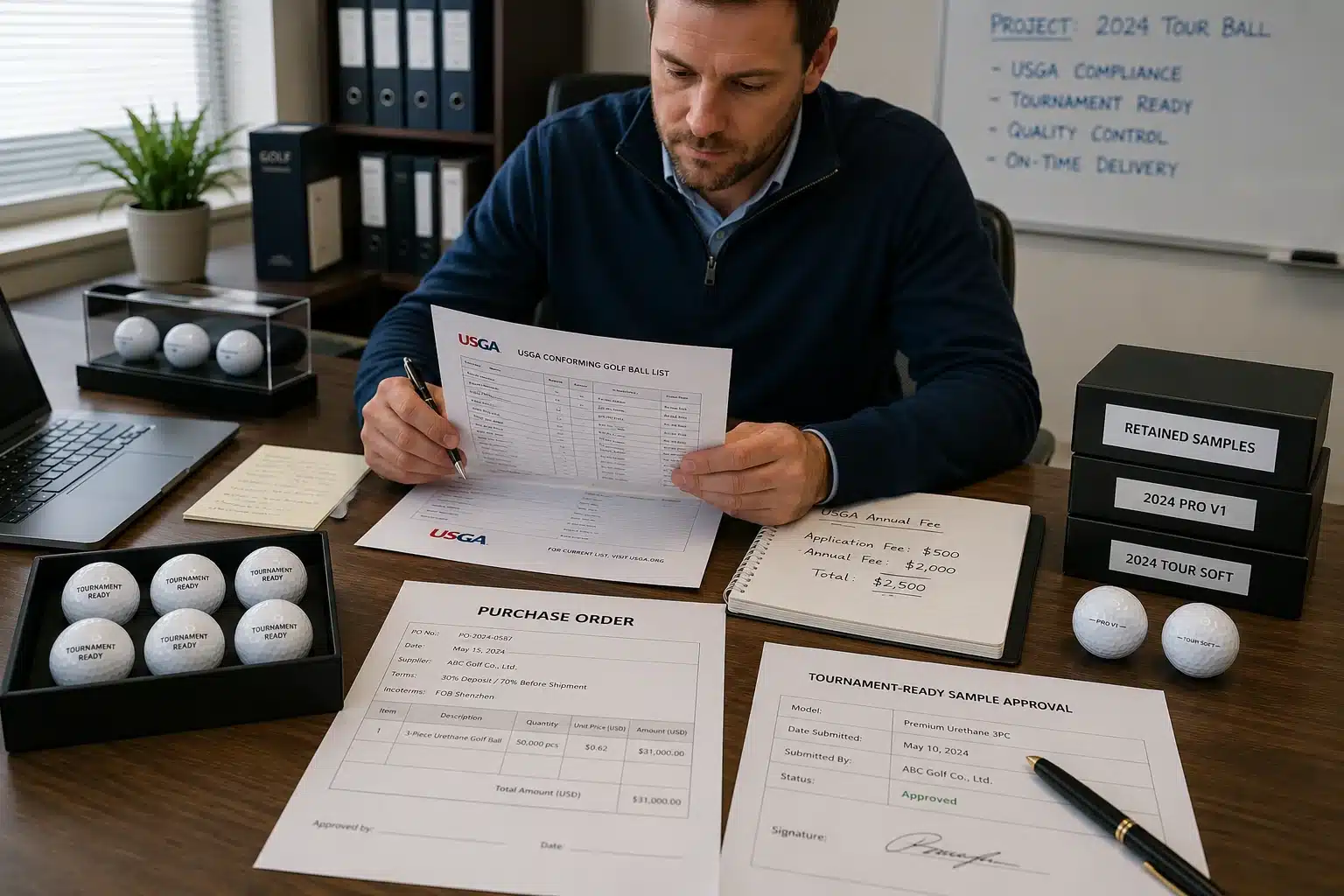
Ask whether the quote includes current conforming-list status, USGA submission support, annual resubmission support, or no listing. Check the exact model and marking only when your channel needs it. Your PO should define who pays USGA submission or annual resubmission fees and whether current conforming-list status is required before shipment.
✔ True — Listing is a channel decision.
Tournament and elite channels may need current USGA/R&A conforming-list status. Practice, gifting, range, and recreational programs may care more about QC reports, packaging durability, and replenishment cost.
✘ False — “No USGA/R&A listing means a bad golf ball.”
Decide whether your sales channel requires current listing, then verify quality through lot-level records, inspection reports, and retained samples.
How Does Packaging Density Change Freight?
You may think packaging is a branding cost, but it also controls how many golf balls fit into a container and how much freight lands on each ball.
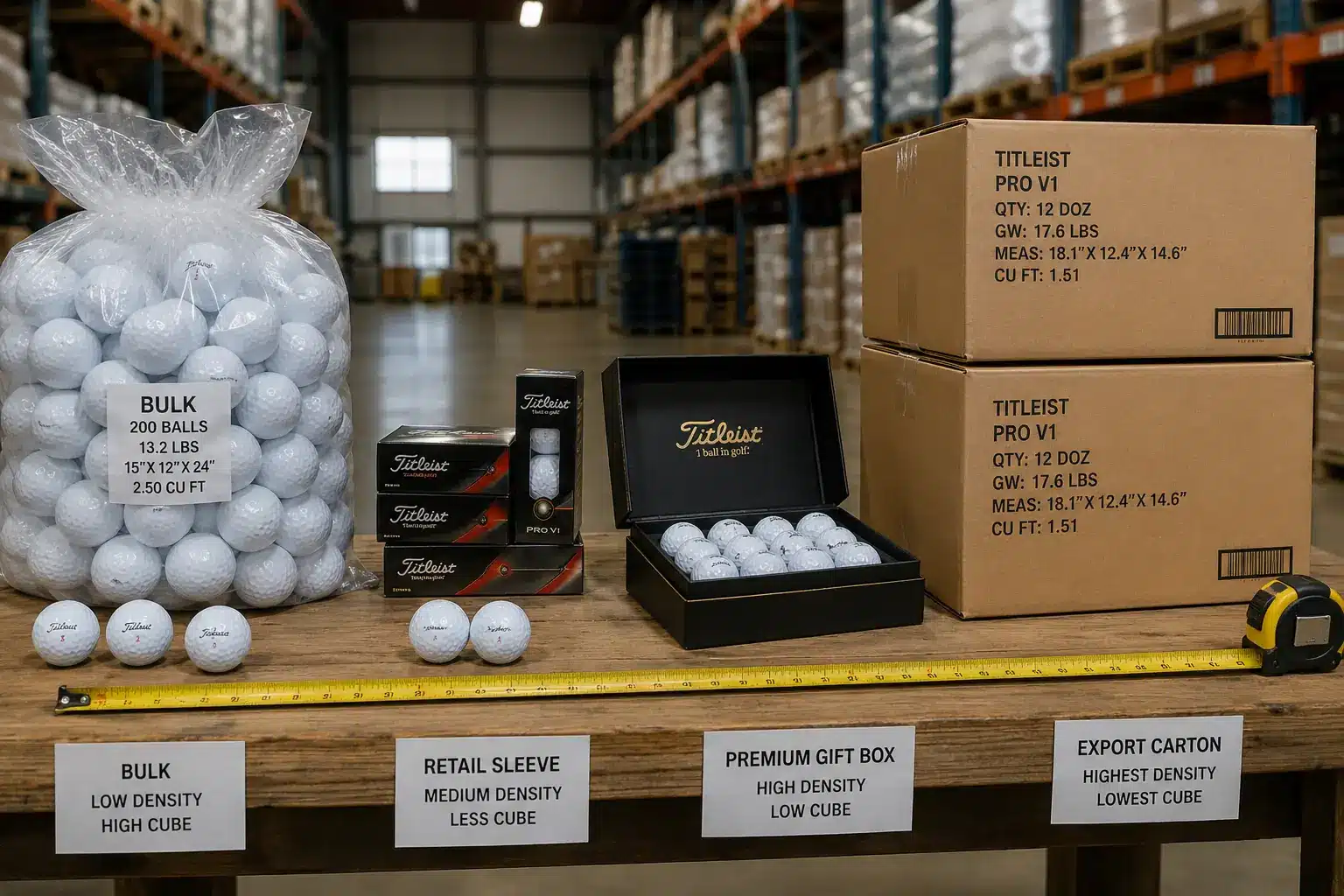
Golf ball packaging density can double freight per unit. If a 40HC costs $3,000 and carries 100,000 standard-pack balls, ocean freight adds $0.03 per ball. If oversized gift boxes reduce loading to 50,000 balls, the same container adds $0.06 per ball before customs and delivery.
| Packaging scenario | Freight assumption | Balls loaded | Freight per ball | Buyer action |
|---|---|---|---|---|
| Bulk / white box | $3,000/40HC | 100,000 | $0.030 | Use for test and replenishment |
| Retail sleeve | $3,000/40HC | 80,000 | $0.0375 | Use when shelf value supports it |
| Premium gift box | $3,000/40HC | 50,000 | $0.060 | Check margin before approval |
| Oversized gift set | $3,000/40HC | 35,000 | $0.0857 | Reserve for high-ticket gifting |
Packaging density is the cleanest table-snippet opportunity in this article because the math is simple and painful. Same container. Same freight bill. Different packaging. Different profit.
For planning, a realistic China-to-U.S. West Coast ocean benchmark can be modeled around roughly $2,700–$3,600 per FEU / 40ft / 40HC-equivalent container, with low-end base quotes and premium guaranteed-space sailings outside that range. But the rate itself is not the only issue. The denominator is the issue. How many sellable balls can your packaging fit into the container?
A white box or mesh bag may look plain, but it protects working capital during test runs and replenishment cycles. A premium gift box may help sell a corporate package or holiday SKU, but it can also reduce container density, increase carton count, raise storage space, and create more transit damage exposure. Packaging cost is paid twice: once at the factory and again through freight per ball.
For low-to-mid priced DTC and wholesale programs, start dense. Use bulk, mesh, or efficient white box packaging until demand and price point are proven. Upgrade to retail sleeves, PET boxes, or EVA gift boxes when your selling price can absorb both the packaging cost and the lost loading density.
Request a packaging-density calculation with carton dimensions, balls per carton, cartons per container, gross weight, CBM, and freight per ball. Ask your forwarder to verify whether the loading assumption is realistic for the booking type. Do not approve premium packaging until delivered cost per ball still supports your target margin.
What Does a Defect Really Cost?
You may assume a 5% defect rate can be solved by a FOB credit, but defective balls have already consumed freight, customs fees, storage, replacement handling, and customer-service cost.
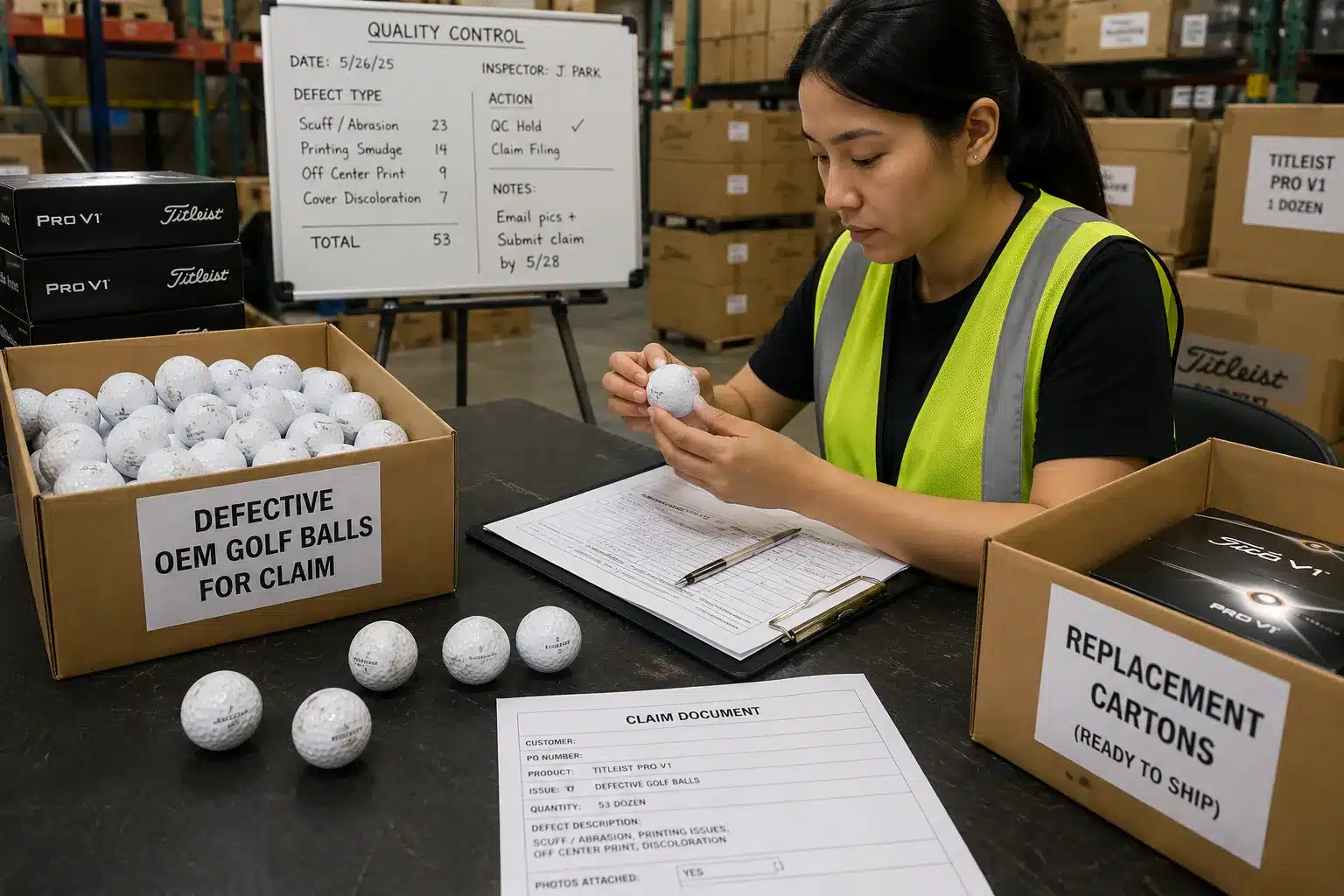
A defective golf ball costs more than its FOB value after it has crossed the ocean. Once freight, customs user fees, possible duties or tariffs, warehouse handling, and replacement logistics are paid, a FOB-only credit may leave you absorbing the real loss.
| Cost layer | FOB-only refund covers? | Why it matters | Contract action |
|---|---|---|---|
| FOB value | Yes | Visible product cost | Define credit amount |
| Freight share | No | Already paid per ball | Add proportional recovery |
| MPF/HMF/tariff exposure | No | Small but real | Add customs-fee basis |
| Warehouse handling | No | Sorting and storage cost | Define buyer evidence |
| Replacement logistics | No | Second shipment cost | Assign responsibility |
A 5% defect rate is not a 5% FOB problem. Imagine a $0.60 ball that has already absorbed $0.06 in freight, customs user fees, possible China-origin tariff exposure, warehouse receiving, carton opening, sorting labor, customer-service time, and replacement planning. If the supplier refunds only the $0.60 FOB value, your accounting team still owns the expensive part of the defect.
FOB-only defect credit is a failure signal. It sounds reasonable because the factory sold the ball at FOB, but your loss did not stop at FOB. Once the shipment is landed, rejected units create warehouse noise, customer complaints, stockouts, replacement freight, and sometimes markdowns. For private-label programs, the hidden cost can be larger than the original unit-price difference between suppliers.
Place this in your RFQ: “Please quote FOB, packaging cost, carton density, estimated freight per ball, HTS/HS classification, customs-fee assumptions, defect allowance, AQL limit, and compensation basis for any rejected quantity.”
Your PO can also state: If rejected quantity exceeds the agreed AQL or functional defect limit, supplier compensation shall include FOB value plus proportional freight, customs user fees, duties or tariff exposure where applicable, and replacement logistics cost.
Build a small operating buffer when the channel needs it. For long-distance shipments and cosmetic sorting, producing around 3% extra can protect a launch from shortages, especially when replacement by sea would miss the selling window. Define quarantine, rework, rejection, replacement timing, inspection evidence, and who pays replacement freight before the order leaves the factory.
✔ True — Defects have landed-cost consequences.
Once rejected balls arrive, you may already have paid freight, customs user fees, warehousing, sorting, and replacement logistics. The compensation basis should reflect that loss.
✘ False — “A FOB refund makes you whole.”
Use a landed-cost clawback when defects exceed agreed AQL or functional limits.
How Can Cash Flow Lower MOQ?
You may push only for a lower unit price, while the stronger financial lever is reducing factory risk through payment terms, existing molds, simpler packaging, and cleaner replenishment planning.
You can often negotiate lower MOQ by reducing factory risk instead of cutting FOB harder. Use existing molds, simple packaging, higher prepayment, a defined pilot lot, a 3% defect buffer, and a reorder calendar to improve inventory turnover while keeping the supplier’s cash-flow risk manageable.
| Negotiation lever | Factory risk reduced | Buyer benefit | Evidence to request |
|---|---|---|---|
| Existing mold | Tooling setup | Lower MOQ | Mold/platform list |
| Simple packaging | Pack-out complexity | Faster launch | Packaging ladder quote |
| Higher prepayment | Receivable risk | MOQ flexibility | Payment/MOQ option |
| 3% buffer | Replacement urgency | Fewer shortages | Buffer line in PO |
| Reorder forecast | Capacity uncertainty | Better slot access | Rolling forecast |
MOQ is not only a production rule. It is a risk price. The factory is protecting setup time, raw-material purchase, printing setup, packaging procurement, line changeover, receivable risk, and the chance that a small custom order blocks a better production slot.
China clusters often give more room to negotiate because standard molds, packaging vendors, printing vendors, cartons, and logistics support sit close together. Zhejiang suppliers may support low-thousand-piece OEM runs on suitable platforms, while other clusters and constructions may require higher quantities depending on ball type, process complexity, and packaging variants. Japan may fit boutique premium programs, but longer cycles and smaller production lanes can tie up more cash before sell-through is proven.
Low MOQ can be more valuable than a small unit-price discount. If your sell-through is uncertain, a smaller pilot can improve your inventory turnover rate OEM and reduce dead stock. If demand is proven, a rolling reorder schedule can help the supplier reserve capacity without forcing you to overbuy in one shipment.
Ask for two quote paths: lowest FOB at standard MOQ, and lower MOQ with higher prepayment or existing mold. In some cases, a higher prepayment or prepaid test order reduces receivable risk enough to unlock a lower MOQ. Keep packaging simple for the first run, then upgrade once the SKU proves demand.
Approve MOQ only when cash tied in inventory, defect buffer, and reorder timing fit your sales channel. A low MOQ that causes emergency air freight is not cheap. A high MOQ that sits for nine months is not efficient. The best MOQ is the one that protects launch timing, cash flow, and replenishment rhythm.
FAQ
How much does it cost to manufacture a golf ball in 2026?
A 2026 OEM planning range can start around $0.40–0.80 per ball for China 2-piece Surlyn, $0.60–1.00 for China 3-piece Surlyn, and $1.50–2.50+ for China 3-piece PU. Japan usually carries a higher premium because labor, energy, smaller batch size, and overhead are harder to amortize.
- Use FOB only as the baseline.
- Add packaging, freight, customs, and defect risk.
- Compare by landed cost per accepted ball.
The final cost depends on construction, cover process, annual quantity, logo printing, packaging, payment terms, QC scope, and delivery term. A buyer comparing China vs Japan golf ball OEM costs should not stop at the factory price board. Add freight per ball, customs user fees, possible tariff exposure, destination delivery, rejected-goods cost, and inventory carrying cost.
Are there import tariffs on golf balls from China?
For U.S. imports, golf balls are generally classified under HTSUS 9506.32.00.00 / 9506.32.0000 with a Free base duty rate. That does not make clearance free, and China-origin goods may still require Section 301 / Chapter 99 verification at entry.
- Add MPF and HMF where applicable.
- Ask a broker to confirm current treatment.
- Do not rely on base duty alone.
The phrase “Free duty” only answers one layer of the import file. U.S. buyers still need to model customs user fees, broker charges, destination fees, inland delivery, and any current China-origin trade-remedy exposure. A DDP or landed-cost quote can help smaller teams compare suppliers without managing every import variable internally.
Why are urethane golf balls expensive to produce?
Urethane golf balls are expensive because the process is overhead-heavy. More layers add handling, curing, coating, inspection, slower takt time, and yield risk. The material alone does not explain the price; labor, energy, scrap, and utilization often move the final cost more.
- PU programs need tighter process control.
- Energy and labor compound across steps.
- Yield loss can move cost more than resin price.
A 3-piece or 4-piece PU ball carries more cost because every added layer creates more chances for rework, cosmetic defects, and process delays. The best way to control cost is not only pushing resin price down. It is choosing the right construction, packaging density, QC scope, and supplier scale for the channel.
Is it cheaper to manufacture golf balls in China or Japan?
China is usually cheaper on FOB and often much cheaper on high-volume landed cost, especially when packaging is efficient. Japan can be financially justified when your premium channel can absorb the higher cost for origin story, boutique consistency, or “Made in Japan” positioning.
- China favors volume, customization, and MOQ flexibility.
- Japan favors premium story and smaller high-control programs.
- The final decision should use landed cost per accepted ball.
For low-to-mid priced private-label golf balls, China usually gives more room to manage MOQ, packaging, replenishment, and margin. Japan can still make sense for a flagship SKU where the sales channel monetizes origin and premium positioning. The wrong move is choosing either country by reputation without a landed-cost worksheet.
How do you calculate freight cost per golf ball?
Calculate freight cost per golf ball by dividing container freight by the number of balls loaded. A $3,000 container equals $0.03 per ball at 100,000 balls, but $0.06 per ball at 50,000 balls. Packaging density controls the denominator.
- Gift boxes can double freight per ball.
- Ask for carton dimensions and CBM.
- Verify loading assumptions before approval.
This is why packaging should not be approved only by the marketing team. A premium box may improve shelf value, but it can also increase carton count, reduce container loading, increase storage space, and raise damage risk. Run the freight-per-ball calculation before approving any packaging upgrade.
When is USGA/R&A conforming-list status worth the cost?
Current USGA/R&A conforming-list status is worth the cost when your channel requires competition eligibility or model-level conformance proof. It may not be worth forcing into practice, gifting, range, or low-volume DTC programs unless buyers specifically demand it.
- Amortize the USGA submission or resubmission fee by projected volume.
- Use QC reports when listing is not channel-critical.
- Define who pays submission and renewal costs.
Listing is not a bad expense; it is a channel-specific expense. If the program sells into competition-sensitive channels, listing can be necessary. If the program is for practice, promotion, corporate gifting, or casual retail, you may get higher ROI from lot-level QC reports, retained samples, packaging checks, and defect compensation terms.
How should a buyer handle defective OEM golf balls?
Defects should be handled by agreed AQL, quarantine, rework, replacement, and compensation terms. A FOB-only credit is often insufficient after the goods have absorbed freight, customs user fees, warehouse handling, sorting labor, and replacement logistics.
- Define defect categories before production.
- Use landed-cost clawback for serious failures.
- Keep inspection evidence tied to lot ID.
Before production, define what counts as cosmetic, functional, packaging, and critical defects. Then state what evidence is required, how rejected quantities are counted, whether rework is allowed, and who pays replacement freight. This keeps the dispute financial and evidence-based when defects appear.
Can higher prepayment reduce golf ball MOQ?
Sometimes yes. Higher prepayment can reduce factory receivable risk, especially when you use existing molds, standard formulas, and simple packaging. It should be paired with sample approval, lot inspection, shipment controls, and a realistic reorder plan.
- Ask for MOQ options by payment term.
- Use simple packaging for test runs.
- Plan reorder timing around inventory turnover.
Higher prepayment is not a magic discount button, but it can be a useful lever for smaller buyers. If you reduce tooling, packaging, receivable, and schedule risk, the factory may have more room to support a lower MOQ. Protect yourself by tying payment to samples, production records, inspection, and shipment release.
Conclusion
China vs Japan golf ball OEM costs should not be judged by FOB price alone. China usually gives buyers a stronger landed-cost path for volume, private label, DTC, gifting, range, and repeat replenishment, while Japan can still fit premium channels that can monetize origin, boutique control, and higher overhead.
Your best comparison is accepted landed cost: FOB, packaging density, freight per ball, HTS/HS treatment, MPF/HMF, possible tariff exposure, compliance amortization, defect risk, and inventory turnover. When those numbers are visible, the sourcing decision becomes clearer. You are no longer buying the cheapest quote. You are buying the margin that survives after the goods arrive.
You might also like — Japan vs China Golf Ball OEM: Which Manufacturing is Better? (2026)