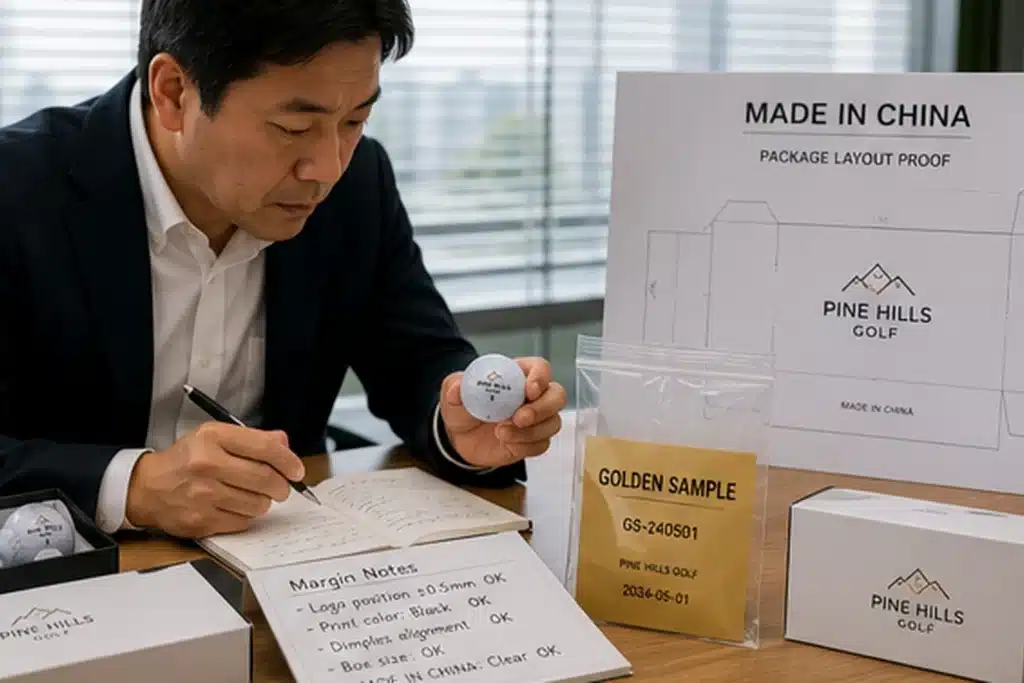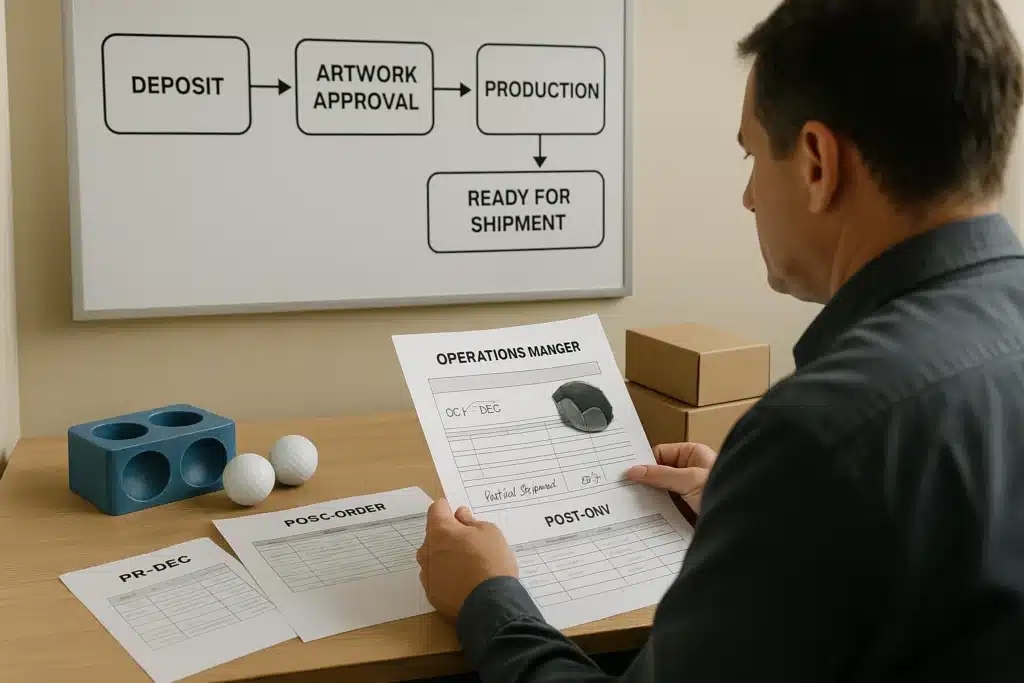
Golf ball OEM lead time is the factory-calendar window from a defined Day 0 to an agreed factory-release milestone. For China OEM orders, quoted days are comparable only when the production slot, critical path, approvals, inspection, and release condition are defined. A 12–18-day Fast Lane is possible only under qualified conditions.
A supplier can promise “20 days” and still miss your launch if Day 0 is vague, a required approval remains open, or another dependency becomes the critical path before release.
The shortest quote is not always the safest schedule. For a deadline-sensitive order, you need to know what starts the clock, what currently controls the release date, and what evidence confirms the factory clock has ended.
Physical manufacturing time is a separate clock. Here, the focus is your OEM order schedule from Trigger → Critical Path → Release.
What Does Golf Ball OEM Lead Time Include?
Your supplier says “20 days.” Your first question should not be whether 20 sounds fast. It should be: 20 days from what event to what event?
A golf ball OEM lead-time quote is only useful when you know what starts the clock and what ends it. Separate factory lead time from logistics transit and warehouse arrival, then define Day 0, included dependencies, and the factory-release milestone before comparing quoted days.
| Pain / decision | Scope question | Risk if undefined | Buyer action |
|---|---|---|---|
| Supplier quotes fewer days | What starts Day 0? | Clock starts later than assumed | Record the trigger |
| “Production complete” | What ends factory lead time? | Completion remains ambiguous | Define release condition |
| Packaging status unclear | Is packaging inside the quote? | Ball-ready ≠ order-ready | Track packaging milestone |
| Inspection unclear | Is inspection part of release? | Factory release moves later | Define inspection window |
| Arrival date discussed | Is transport included? | Factory and logistics clocks mix | Separate delivery planning |
What Defines Day 0?
Day 0 is the agreed event that activates the quoted factory schedule. It might be PO confirmation, deposit receipt, approved artwork, specification release, packaging approval, production-slot confirmation, or a combination of conditions. The important point is not choosing one universal trigger; it is making your trigger explicit.
That distinction matters because two suppliers can quote the same number while starting their clocks on different dates.
One might say 18 days from deposit. Another might say 18 days after final artwork and packaging approval. If those approvals take another week, the customer-facing calendars are not equivalent.
Professional cycle-time and lead-time definitions make the broader manufacturing distinction useful here: machine time, processing time, production lead time, and order lead time measure different things. Your golf ball production schedule needs the same discipline.
If you want the physical clock from core molding through finishing and QC release, use our golf ball manufacturing process time guide. Do not mix that process clock with the OEM order clock.
The endpoint also needs to be precise. Ball-ready, packed, inspection-passed, cargo-ready, and EXW-ready are not automatically interchangeable. The agreed commercial term matters; for example, the formal EXW delivery framework defines a specific seller-delivery boundary rather than a generic synonym for “finished.”
So your RFQ should normalize scope before comparing speed.
Ask for one written definition containing the Day 0 trigger, what the quoted days include, and what exact event closes the factory lead-time clock.
A “20 days” promise with no written Day 0 or end trigger is a failure signal.
✔ True — A useful lead-time quote defines both its start trigger and end condition
Once two suppliers quote the same clock, you can compare schedule performance rather than two numbers with different meanings.
✘ False — “A 15-day quote is automatically faster than a 20-day quote”
The 15-day clock may start after approvals that are already included in the other supplier’s schedule. Normalize scope first.
Can a 12–18-Day Fast Lane Be Realistic?
A customer event, distributor launch, promotional program, or inventory gap can make 12 days sound much better than 20. The danger is buying the headline before checking the dependencies.
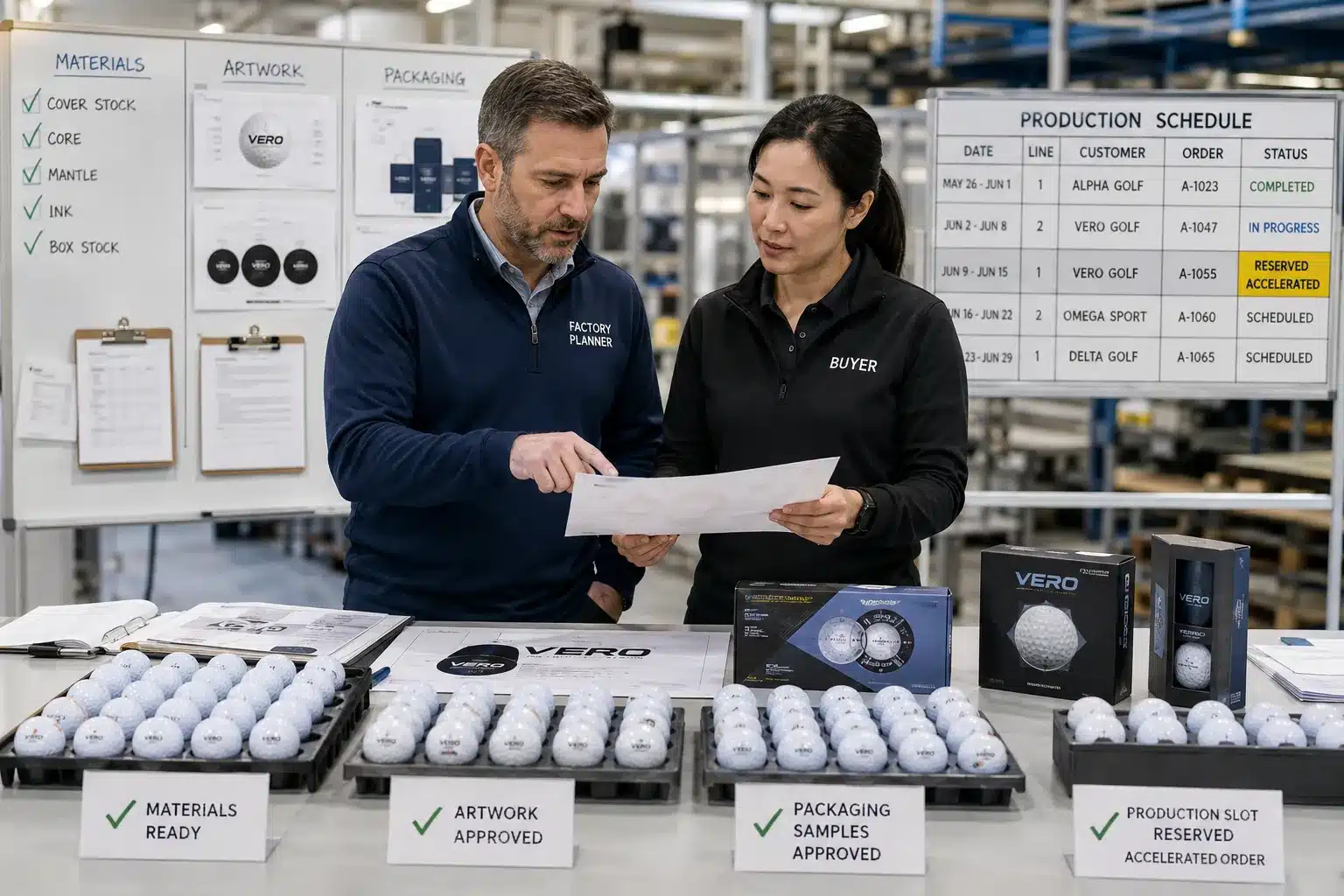
A 12–18-day schedule can be realistic for a qualified Golfara Fast-Lane order, but it is not a universal China OEM lead time. The order needs an approved route, ready materials, locked artwork, confirmed packaging, an available production slot, and no unresolved buyer approvals.
What Qualifies for the Fast Lane?
At Golfara, we treat the 12–18-day Fast Lane as a qualification scenario, not a standard promise attached to every golf ball order.
| Fast-Lane check | Qualified condition | Failure risk | Buyer evidence |
|---|---|---|---|
| Product route | Existing approved route | Development appears later | Approved spec reference |
| Materials / tooling | Ready for the order | Day 0 slips | Readiness confirmation |
| Artwork / printing | Version locked | Approval loop reopens | Approved artwork |
| Packaging | Route already defined | Pack controls release | Packaging-ready plan |
| Production / release | Slot and inspection path confirmed | Rush promise lacks capacity | Slot + milestones |
A fast custom golf ball production lead time becomes credible when the slow prerequisites have already been resolved.
That means the existing product route is suitable, required tooling is available, materials are ready or committed, your artwork is actually approved, the print route is known, packaging is not waiting for a design decision, the production slot exists, and the inspection or factory-release path has been defined.
If several of those items are still described as “should be ready soon,” the order does not yet qualify. It is a hopeful schedule with open dependencies.
Our normal production-planning references are generally wider than the Fast-Lane scenario. Depending on the approved route and order conditions, our current references include 15–25 days for 2-piece Surlyn / ionomer, 18–30 days for 3-piece Surlyn / ionomer, and 30–50+ days for 4-piece cast thermoset urethane.
These are Golfara planning references, not universal China factory standards or descriptions of continuous machine-processing time. They represent our normal customer-facing planning bands under the applicable order conditions. A Fast-Lane date should be treated separately and confirmed against the actual readiness of the specific order.
The Fast Lane is therefore about order readiness, not simply choosing the SKU with the shortest apparent lead time.
That leads to an important buyer rule: simplify non-core customization before changing the product you actually intend to sell.
If your intended product is a premium urethane SKU, replacing it with a fundamentally different ball construction just to shorten the schedule can change the product promise. Packaging complexity, artwork versions, decoration, and nonessential variants are usually cleaner places to look for simplification first.
If the accelerated order is also your first small OEM production run, use the golf ball OEM trial guide to check whether the batch still represents the product you intend to scale.
A Fast-Lane promise with no confirmed production slot, material status, artwork version, or packaging status is a failure signal.
Your acceptance test is simple: every dependency that the short schedule relies on should be confirmed now, not merely expected later.
What Actually Controls the Release Date?
“The balls are finished” sounds reassuring until you discover that packaging is not finished, inspection is unbooked, or a late artwork issue is still blocking release.
The factory release date is controlled by the longest unresolved dependency, not by adding every activity as if all work were sequential. Your critical path can move between production slot, ball production, printing, packaging, inspection, QC disposition, and handoff while independent activities run in parallel.
That is the core of a controlled golf ball production schedule: lead time is a critical-path problem, not a simple addition problem.
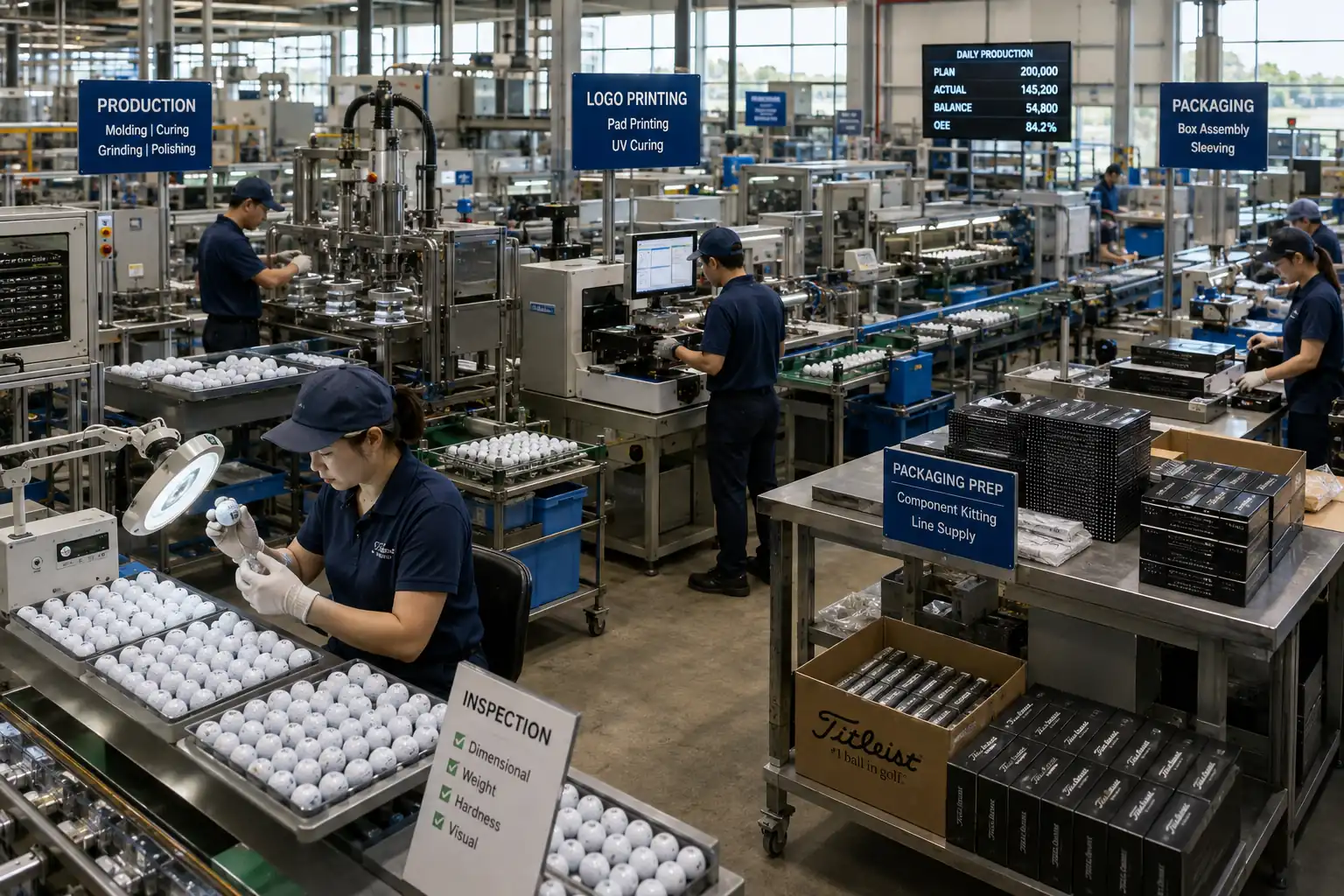
| Dependency | Parallel potential | Schedule risk | Buyer action |
|---|---|---|---|
| Production slot | Limited | Order waits before routing | Confirm slot |
| Artwork / print preparation | Often partial | Late revision reopens work | Freeze version |
| Packaging proof / production | Often partial | Balls finish before packs | Track separately |
| PSI booking | Often schedulable ahead | Inspector unavailable | Reserve window |
| QC hold / correction | Cannot be bypassed | Release remains open | Request hold status |
Which Steps Can Run in Parallel?
Formal schedule-model guidance treats a project schedule as connected activities and dependencies. That is a better model for OEM lead time than simply adding production days, printing days, packaging days, and inspection days into one long chain.
Imagine that ball production is underway while a packaging supplier already has the approved dimensions and artwork needed to start proofing. If those tasks do not depend on each other, running them in parallel can shorten the calendar without asking the physical manufacturing process to run unnaturally fast.
Inspection provides another example. If your PO requires third-party PSI, you may be able to reserve the intended inspection window before the final day of production. Waiting until everything is finished before looking for an inspector creates avoidable schedule risk.
Printing preparation can also begin before the balls reach the print station when artwork, print positions, and the approved route are sufficiently locked. But printing should never be reduced to “UV is faster” or “pad is faster.” Quantity, colors, gradients, fine text, sides, positions, artwork versions, equipment availability, curing, and approval all matter. Use the dedicated golf ball printing methods guide when the method itself becomes the decision.
Packaging works the same way. Track packaging-ready separately from ball-ready, and let suitable packaging work proceed in parallel when its inputs are controlled. If the packaging specification is still being designed, move that discussion to the OEM golf ball packaging guide.
For buyers with a fixed launch date, the market lens is straightforward: schedule confidence improves when dependencies have owners and milestones, not when every department is simply told to “rush.”
Ask your supplier one question in every schedule update:
What unresolved activity is controlling my factory release date today?
That answer is more useful than another email saying your order is “in production.”
✔ True — Lead-time reduction often comes from managing dependencies and parallel work
When independent activities overlap safely, you can protect the release date without forcing required manufacturing or inspection steps to disappear.
✘ False — “Production, printing, packaging, and inspection must always happen one after another”
Some activities are sequential; others can overlap. The critical path is the dependency chain that actually controls release.

Which Changes Can Move the Factory Schedule?
Your original golf ball OEM lead time may have been realistic when you approved it. A Day 5 artwork, Pantone, packaging, or specification change means the factory may no longer be scheduling the same order.
A buyer-requested change can move the factory schedule even when the original quote was valid. Every post-Day-0 change should be checked against the critical path, with its approval requirement, affected milestone, and revised release date documented before your team authorizes implementation.
The useful concept is a Change-Control Clock.
Not every revision needs to reset Day 0. Not every revision is harmless either.
A logo correction may require a new proof but leave ball production untouched. A Pantone change can reopen color matching and approval. Changing the print position may require different setup or registration work. A packaging revision can become the new critical path even while the balls remain on schedule.
A ball specification change is more serious because it may affect materials, tooling, product route, approvals, or the production slot itself.
| Requested change | Possible schedule effect | What to verify | Buyer action |
|---|---|---|---|
| Logo / artwork | New setup or proof | Critical-path impact | Freeze version |
| Pantone / color | New matching / approval | Approval requirement | Approve reference |
| Print position | Setup / registration change | Print-route impact | Confirm feasibility |
| Packaging | Proof / supplier work changes | Packaging-ready date | Revise milestone |
| Ball specification | Product route may change | Full schedule impact | Requote schedule |
Your team should therefore ask four questions before approving any post-Day-0 revision:
-
Does this change affect the critical path?
-
Does the original Day 0 still apply?
-
Which milestone moves?
-
What is the revised factory-release date?
Version control makes those answers auditable. Your approved artwork, print configuration, packaging version, product specification, and schedule revision should tell the same story.
This also separates buyer-caused schedule movement from supplier-controlled delay. If you change the specification and approve the added time, that is different from a supplier missing a milestone without a scope change.
Use the same product-protection logic here that applies to Fast Lane: if speed matters, remove non-core complexity before changing the product proposition.
The schedule-control clause can state:
The quoted factory lead time shall begin from the Day 0 trigger recorded in the approved schedule. The applicable product specification, artwork version, print configuration, and packaging version shall be identified at Day 0. Any requested change after Day 0 shall be logged with its critical-path impact and revised factory-release date before implementation.
That language does not stop your team from changing the order. It stops an approved change from quietly becoming an unexplained late delivery.
How Do CNY and Peak Season Change Capacity?
You can confirm that the factory has time to produce your order and still lose the required handoff window because another resource tightens before the goods move onward.
CNY and peak season are capacity events, not just factory-closure dates. Your schedule can fail after production if packaging vendors, inspectors, local trucking, warehouse receiving, or forwarder cut-offs tighten, so verify the complete release-and-handoff path rather than only asking whether the factory is open.
Seasonal capacity therefore has to be supplier-specific.
| Capacity node | What can tighten | Evidence to request | Buyer action |
|---|---|---|---|
| Factory | Production slot | Confirmed slot | Lock schedule |
| Packaging / print | Vendor capacity | Ready-date confirmation | Track separately |
| Inspection | Inspector availability | Booked window | Reserve early |
| Local trucking | Driver / vehicle capacity | Pickup confirmation | Secure handoff |
| Warehouse | Receiving cut-off | Written deadline | Back-plan release |
Broader Lunar New Year supply-chain guidance supports the same principle: production capacity, warehousing, transportation, and supporting operations can tighten before the holiday and may recover gradually afterward. For your actual PO, however, generic calendar advice is not enough.
You need the schedule of the factory and partners handling your order:
-
actual production cut-off;
-
confirmed production slot;
-
packaging and printing availability;
-
inspection availability;
-
immediate pickup capacity;
-
warehouse or forwarder receiving cut-off;
-
supplier-specific restart plan.
That is a more useful question than asking how many weeks “China” closes for CNY. Different factories, supporting vendors, cities, order types, and handoff plans can have different constraints.

Before the 2025 Chinese New Year, we accepted an urgent order about 25 days before our holiday closure because the production schedule itself was achievable. The goods were completed as planned, but we underestimated local trucking capacity into the designated ocean-freight warehouse as drivers left early for home.
Suitable vehicles became difficult to secure, so our team ultimately used six staff vehicles to meet the warehouse receiving cut-off. The manufacturing schedule had worked, but the critical path had moved from production capacity to local transport availability.
The lesson was not simply that we needed more vehicles. It was that confirming factory capacity alone did not protect the required handoff window. We now treat immediate pickup capacity and the relevant receiving cut-off as part of the pre-holiday schedule check.
That changes how we assess rush orders before seasonal shutdowns. Confirming the production slot alone is not enough; the immediate release-and-handoff path also needs to work.
This is where the article boundary matters. We stop at the immediate handoff. Ocean transit, freight rates, customs, duties, and warehouse arrival belong to the logistics clock.
An “order ready” status while inspection, packaging, local pickup, or handoff remains unresolved is a failure signal.
Your peak-season deliverable should therefore be a release-and-handoff plan, not merely a factory completion date.
✔ True — Holiday risk can move from production to a downstream handoff dependency
The balls may be completed while inspection, local trucking, packaging, or receiving capacity becomes the new schedule constraint.
✘ False — “If production finishes before the holiday, the shipment window is automatically protected”
Your pre-holiday schedule is only as strong as the dependencies needed to release and hand off the completed order before the required cut-off.
What Should a Controlled Lead-Time Quote Include?
Supplier A promises 12 days. Supplier B quotes 18. If Supplier A cannot show a slot, milestone schedule, inspection window, or release definition, the shorter number may carry more launch risk.
The shortest quoted lead time is not automatically the safest schedule. A controlled quote should show Day 0, scope, production slot, critical path, parallel work, approval deadlines, inspection window, factory-release condition, and change-control rules so your team can audit the date rather than rely on a sales promise.

| Schedule control | Weak quote | Controlled quote | Buyer evidence |
|---|---|---|---|
| Day 0 | “After confirmation” | Defined trigger | Written trigger |
| Production slot | Not shown | Confirmed | Slot record |
| Milestones | One final date | Key ready dates | Versioned schedule |
| Inspection | “Before shipment” | Defined window | Booking / status |
| Release | “Goods ready” | Defined condition | Release record |
| Changes | No rule | Impact logged | Revision history |
A credible custom golf ball production lead time should be auditable before the date slips. Your schedule should identify the scope, Day 0, confirmed production slot, current critical path, buyer approval deadlines, ball-ready, print-ready and packaging-ready milestones, inspection window, factory-release condition, and the rule used when the approved scope changes.
If artwork Rev. 3 replaces Rev. 2, the record should show whether the printing milestone moves. If packaging approval arrives late, it should show whether packaging becomes the critical path. If an agreed inspection finds a problem, the factory-release gate should remain open until the required corrective action or reinspection is completed.
If third-party PSI is contractually required, treat the inspection window and report status as schedule dependencies rather than assuming the inspector will automatically be available when production finishes. Professional pre-shipment inspection services use this stage to verify order requirements and identify issues before shipment, so an unresolved inspection or corrective-action requirement can legitimately keep the factory-release gate open.
Your PO can define the release gate this way:
Before production release, the supplier shall provide a milestone schedule identifying the production slot, ball-ready milestone, print-ready milestone, packaging-ready milestone, inspection window, and factory-release condition. The order shall not be treated as factory released while an agreed inspection, corrective-action, or release gate remains open.
Then make one schedule-verification request in your RFQ:
Provide a version-controlled OEM production schedule showing the agreed Day 0 trigger, confirmed production slot, ball-ready, print-ready and packaging-ready milestones, inspection window, current critical path, buyer approval deadlines, factory-release condition, latest ship date where applicable, and the method used to record schedule changes.
Consider two suppliers:
Supplier A offers 12 days, but the production slot is “to be arranged,” packaging is unconfirmed, and the end condition says only “goods ready.”
Supplier B offers 18 days, with a defined Day 0, confirmed slot, artwork deadline, packaging-ready date, inspection window, release condition, and change-control rule.
Supplier B may be the safer schedule.
That is the market lens procurement teams often miss: you are buying schedule confidence, not just a number of days.
Your PO should make a missed milestone visible while there is still time to recover it—not on the morning your launch inventory was supposed to leave the factory.
FAQ
Does split shipment shorten factory lead time?
Split shipment can make an agreed first quantity available earlier, but it does not automatically shorten the factory lead time required for the complete order. Whether it helps depends on whether partial release actually changes the critical path.
Define the first-drop quantity or percentage for your specific program rather than using a fixed rule.
Then ask what becomes available earlier and why. If the same packaging, inspection, or production dependency blocks both portions, splitting the shipment may improve inventory flow without reducing the underlying production schedule.
Use split release because it protects a real launch requirement—not because “partial shipment” sounds like a universal lead-time shortcut.
Can paying more guarantee a faster production slot?
No. A priority fee may help when usable capacity exists, but money cannot create an unavailable production slot, finish missing artwork, resolve an open packaging dependency, remove required physical process time, or close an unresolved QC hold.
Ask what the rush fee actually changes.
Does it reserve an available resource? Support approved overtime? Change sequencing? Secure another capacity input?
Then require that operational change in the revised schedule. A surcharge without a confirmed slot or milestone impact is not evidence of faster golf ball OEM lead time.
Should you change ball construction to save time?
Not automatically. If your intended commercial SKU is a premium urethane golf ball, switching to a fundamentally different construction purely to reduce lead time can change your product proposition rather than simply simplify the schedule.
Start with non-core complexity.
Reduce packaging variants, artwork versions, decoration complexity, or other optional first-wave requirements where commercially acceptable.
Change the golf ball construction only when your product strategy supports that decision. If the physical production route is the real constraint, use the manufacturing-process guide to understand it rather than disguising a product change as schedule optimization.
Can packaging run in parallel with production?
Yes, in some projects. Packaging proofing, preparation, or production can overlap with golf-ball production when the necessary artwork, dimensions, labeling, and specifications are sufficiently locked. Packaging-ready and ball-ready should therefore be tracked as separate milestones.
Ask which packaging inputs are still open.
If packaging cannot start, identify exactly what dependency is blocking it. If its inputs are approved, ask whether the work can proceed while ball production continues.
Parallel work reduces calendar time only when the tasks are genuinely independent; it does not make the packaging stage itself disappear.
Can third-party PSI delay factory release?
Yes, when third-party PSI is part of your agreed release process. An unavailable inspection slot, unresolved report, or corrective action can keep the factory-release gate open even after most physical production work has been completed.
Reserve the intended inspection window early where possible.
Define whether factory release requires a passing report and what happens if the inspection finds a problem. If reinspection is required, reflect it in the revised milestone schedule.
Do not label an order factory released while a contractually required inspection gate remains unresolved.
What if the supplier misses the agreed release date?
Start with schedule recovery rather than another vague promise. Ask which dependency now controls the critical path, which milestones moved, what quantity is affected, and what recovery action can realistically protect your program.
Record whether the cause was buyer-controlled, supplier-controlled, or external where that distinction can be established.
Then issue a revised release date and milestone schedule. An agreed partial release may help when it genuinely protects the launch, but it should not conceal an unresolved quality or schedule problem.
Commercial remedies should follow the PO or contract already agreed, not be improvised after the delay.
Conclusion
Quoted days are not a controlled schedule. If your launch matters, stop asking only, “How many days?”
Ask what starts Day 0. Ask which dependency controls the release date today. Ask what can safely run in parallel. Ask what happens if your team changes the approved scope. And ask what evidence proves the factory clock has actually ended.
The shortest promise is not always the safest schedule.
A dependable golf ball OEM lead-time plan follows Trigger → Critical Path → Release. It gives your team enough visibility to spot a schedule problem while there is still time to manage it.
You might also like — China Golf Ball Freight: The B2B Shipping & Landed Cost Guide