You upgraded the range experience. Now your best balls are leaving in members’ pockets.
To stop golfers from stealing range balls without sacrificing feel, make the ball visually unmistakable as range property. Theft rises when a practice ball feels premium and still looks usable on the course, so the smart fix is facility-only graphics—not a lower-performance ball.
The real decision is not theft prevention versus player experience. It is whether your visual system creates enough social friction to stop pocketing without changing the internal performance platform.
You upgrade the practice tee to improve member experience. Then the replenishment budget starts acting like somebody opened a side door in your P&L.
Your best range balls disappear first because they feel too close to a golfer’s on-course ball. When the ball delivers premium feedback without any visible social downside, shrinkage becomes the hidden tax on a better practice experience.
This is the premium penalty. The better the ball feels, the easier it is for a golfer to justify taking a few home. Not because members suddenly turn into organized thieves. Because the ball solves a temptation problem. It feels good enough to keep, and it looks normal enough to use later.
That combination is expensive.
A lot of clubs fall into the same trap. The GM wants a stronger practice product. The golf staff wants more credible carry windows and better feedback. Members complain when the range ball feels hard, launches oddly, or falls short of what they see on the course. So the facility upgrades. Maybe to a stronger two-piece platform. Maybe to a premium-feel build. Maybe even to a urethane-covered practice ball. The intention is smart. The visual identity often is not.
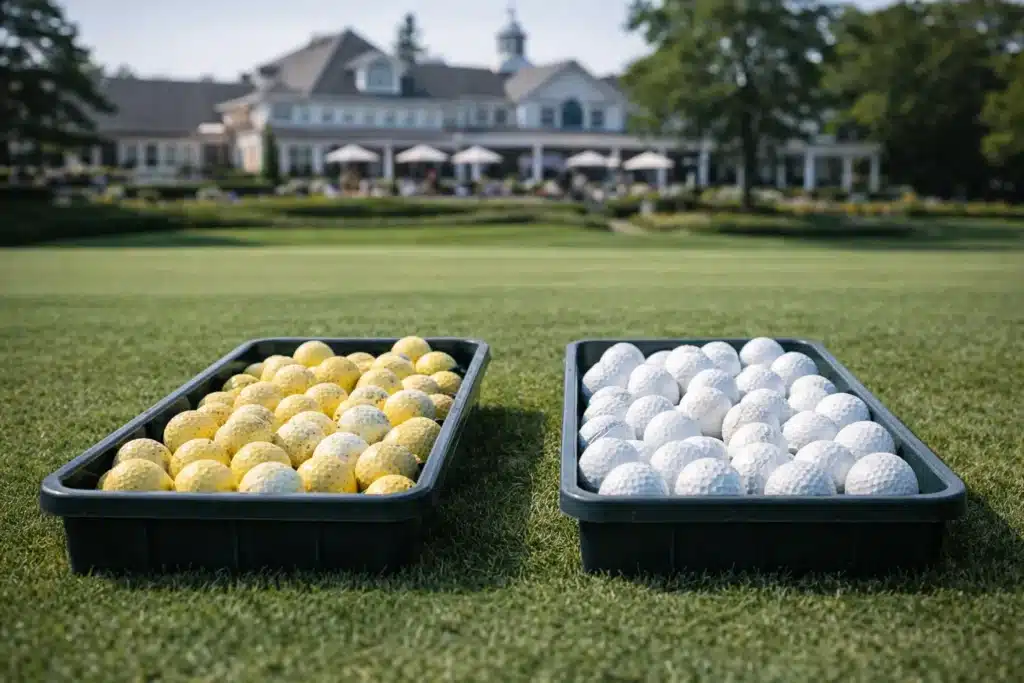
Once the ball feels like a “real ball,” a plain white cover or a tiny logo becomes an invitation. One slips into a pocket after a lesson. Two stay in a cart basket after warm-up. A few get tossed into a bag side pocket because they “look close enough” to a gamer ball anyway. That is what makes shrinkage so frustrating operationally. The loss is usually too small each day to trigger drama, but big enough over a season to distort reorder timing and quietly flatten margin.
For many facilities, the real product choice is not “cheap two-piece or premium urethane.” It may be a controlled three-piece Surlyn platform with unmistakably facility-only visuals. That middle route can preserve a more credible feel than a basic range rock while keeping durability and replacement economics more manageable than a full premium retail-style build.
Reported theft cases have reached the thousands of balls at individual facilities, which is enough to make shrinkage a replenishment issue, not just a nuisance. That matters because once loss reaches that scale, the decision is no longer about golfer behavior alone. It becomes a product-design and operating-margin issue.
| Practice ball condition | Buyer intention | Why pocketing risk rises | What to change next |
|---|---|---|---|
| Premium feel + plain white look | Improve experience | Low social friction, high take-home temptation | Change visual identity before changing core |
| Premium feel + tiny logo | Preserve branding | Still reads like a gamer ball | Enlarge facility-only cues |
| Premium feel + unmistakable facility look | Keep experience and reduce theft | First-tee embarrassment rises immediately | Test deterrent graphics on the same core |
The first buyer move is not calling security. It is reconciling loss properly. Compare monthly replenishment against visible breakage, picker loss, and seasonal usage. If reorder rhythm is materially worse than physical wear, build a 12-month shrinkage reconciliation sheet and make finance sign off on the assumptions. That gives you a clean rule for the rest of the project: use scenario labels until the facility’s own count data says otherwise.
✔ True — Better practice quality is not the mistake
A better ball can be the right move for a private club, public facility, or premium range. The mistake is pairing that upgrade with a cover that still looks pocketable and first-tee usable.
✘ False — “Staff enforcement should solve this”
Staff can only police behavior at the margins. Product design decides whether the ball feels awkward to pocket in the first place.
What Makes a Range Ball Impossible to Pocket?
The fastest way to reduce range-ball theft without sacrificing feel is to make the ball visually unmistakable as facility property. If a golfer can pull it out on the first tee without anyone noticing, the design is visible but not deterrent.
As of March 2026, visual deterrence only works when the ball looks unmistakably facility-only—not like a retail alignment aid.
That distinction matters because the retail market has trained golfers to accept stronger graphics on premium balls. A few neat lines on a white cover no longer communicate ownership. They can look premium, modern, even desirable. That is good for shelf appeal. It is terrible for shrinkage control.
When Visible Is Not Enough
Social stigma in golf ball design is not about making the ball ugly for fun. It is about making ownership obvious at social distance. The ball should look like something golfers enjoy hitting on the range and would feel mildly ridiculous explaining on the first tee.
That is where many buyers stop too early. They ask for a tasteful logo. A small PRACTICE mark. A cleaner stripe. The design becomes branded, but not protective. It still passes as a normal gamer ball when it matters most: in a bag, in a cart, or in a golfer’s hand around other players.
That is not anti-theft design. That is polite decoration.
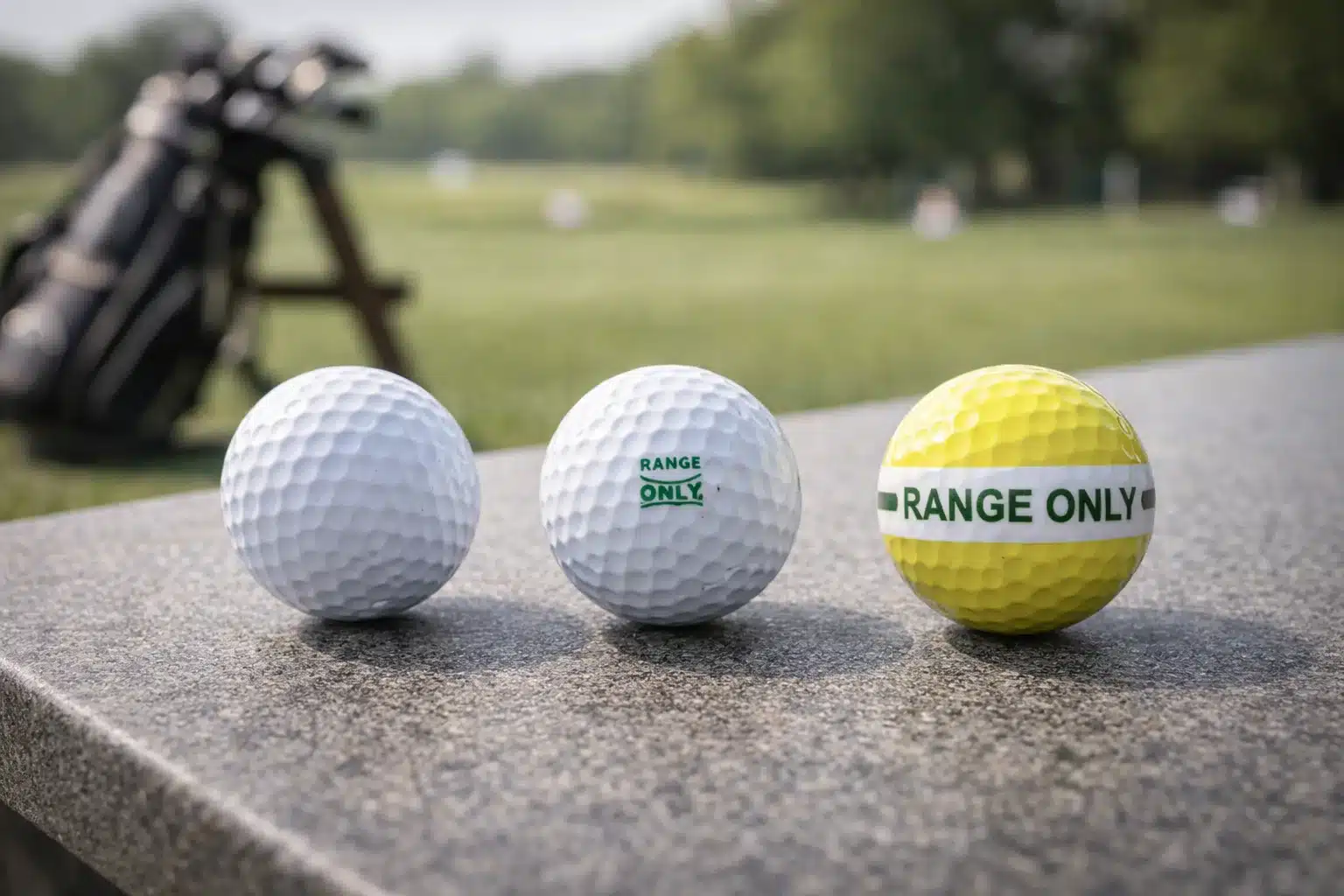
The anti-theft version is more intentional. A split two-tone cover works because the whole ball reads as facility equipment, not retail merchandise. A wraparound stripe works because the ball remains identifiable even when the text rotates away. An oversized PRACTICE mark works because it changes the social meaning of the ball from “nice ball” to “range property.” The golfer is no longer deciding whether the ball feels worth keeping. The golfer is deciding whether it is worth the social friction of being seen with it later.
The most common design mistake is choosing something that looks premium instead of something that looks owned. That is why one of your three artwork directions should be deliberately uncomfortable in a retail sense. If all three mockups look elegant enough to merchandise in the shop, the project has already drifted off brief.
A red flag is any concept that still reads like a retail alignment aid. Reject it early. Do not let it survive into sampling just because the logo is technically visible.
The practical verification step is simple. Request three artwork directions on the same internal platform: one retail-like line treatment, one wrap stripe, and one split two-tone direction with a clear facility code or oversized PRACTICE system. Review them from tee distance, bag distance, and cart distance. If the design can still hide in plain sight on the course, it failed the brief.
Write one approval line into the artwork process: any layout that can be mistaken for a retail alignment graphic at social distance will be rejected before pre-production proof. That saves time, sample cost, and false confidence.
✔ True — The goal is recognition, not ugliness
A good anti-theft visual system does not need to look bad up close. It needs to read as unmistakably range-only from the distances where social judgment happens.
✘ False — “Any custom logo will stop theft”
Small, tasteful marks often preserve the ball’s first-tee usability. If the ball still blends into retail visual language, it is still easy to pocket.
How Do You Add Theft Deterrence Without Killing Feel?
This is where buyers get nervous, and they should. A bad decoration process can turn a smart anti-theft concept into a technical and procurement mess.
A bold anti-theft graphic does not have to ruin feel. The real risk comes from weak process control, uneven coating, poor concentricity, or ad hoc repainting—not from the fact that the ball is striped, split-color, or clearly marked as practice property.
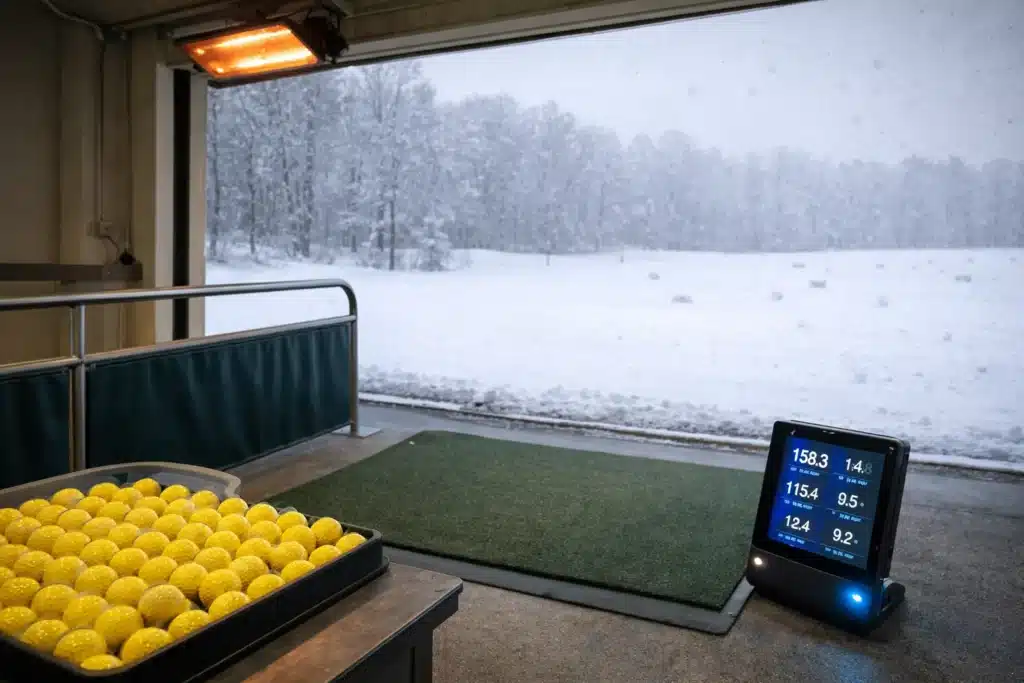
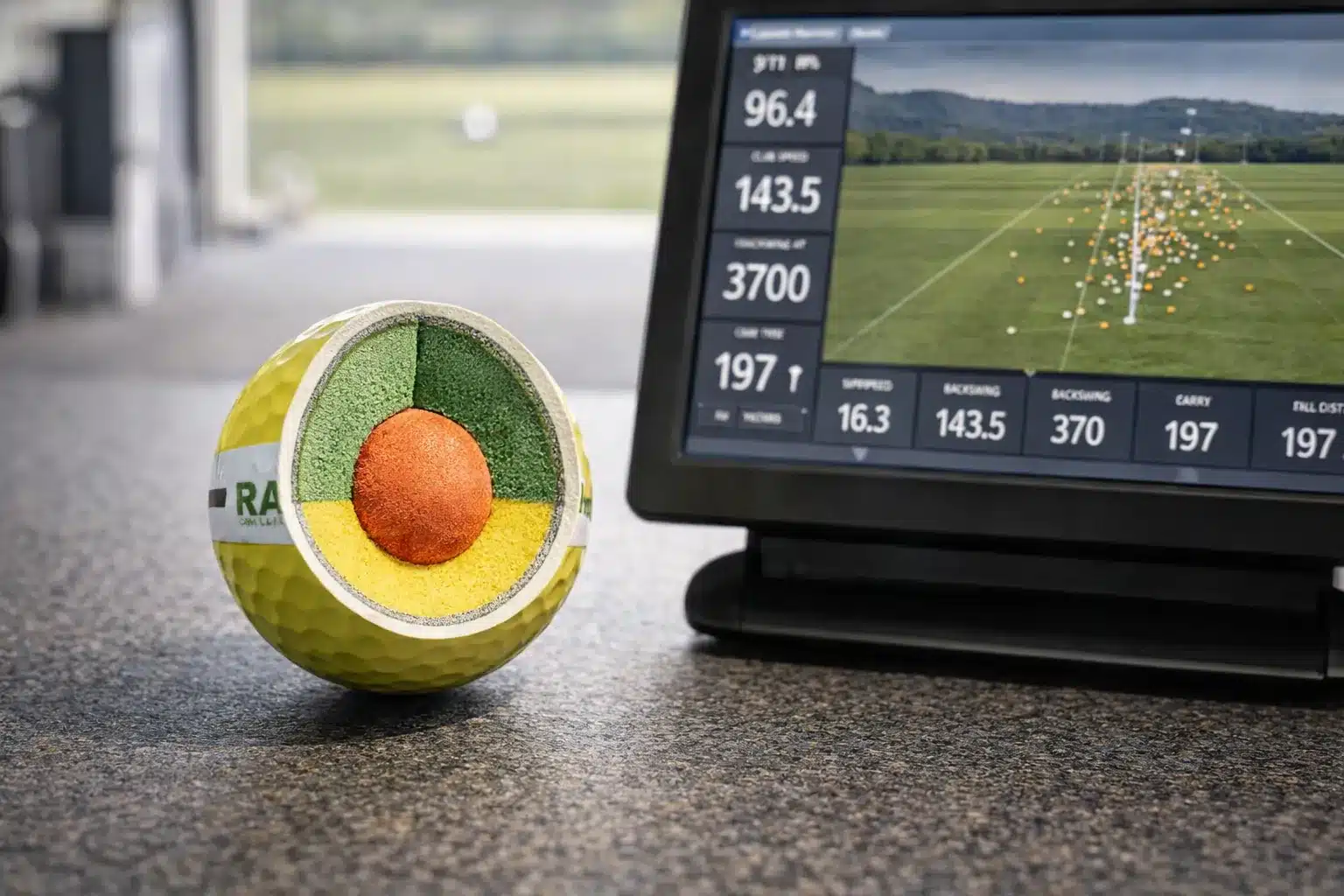
Premium practice facilities still care about radar credibility. Coaches, fitters, and better players pay attention to ball speed, launch, spin, and usable feedback. That is why the buyer should stop asking, “Will the stripe hurt performance?” and start asking, “Can the factory prove the final decorated SKU still behaves like the approved platform?”
Why Factory Pad Printing Beats Aftermarket Repaint
A factory-applied visual treatment belongs inside a controlled build, not on top of one.
The decorated ball is the product. Not the plain sister model. Not the “same core” sample. Not the concept rendering. The actual decorated batch sample.
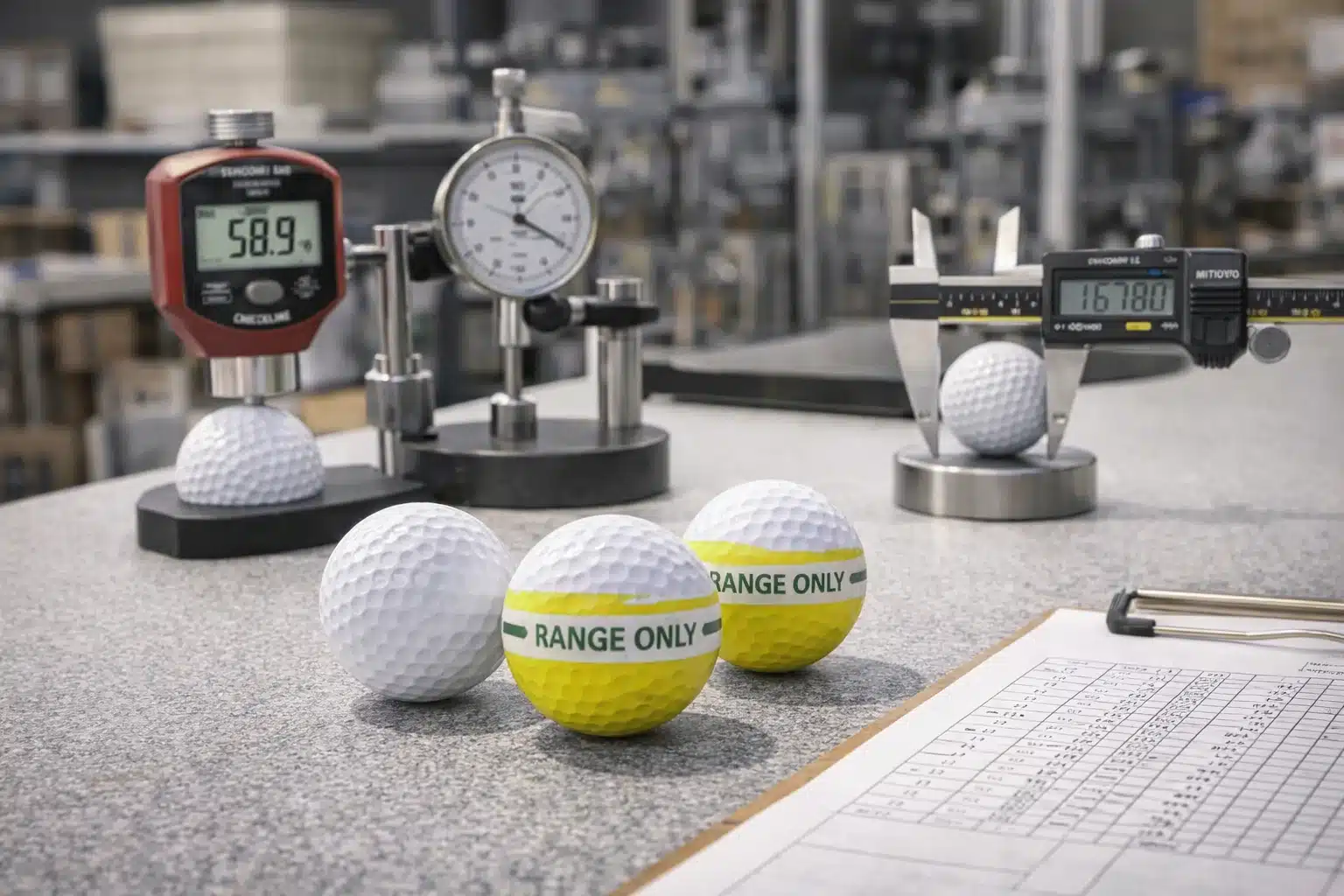
That is the key procurement discipline this category needs. Ask for raw values, sigma, range, device list, and calibration date from the decorated batch sample. Ask what the comparison object is: plain control sample, previous approved run, or sister construction. Ask how the factory verifies more than just a hero sample: weight, diameter, compression, hardness window, coating thickness, visual-defect rate, and whether concentricity or layer-thickness logic is checked rather than assumed. If the answer stops at one good-looking sample and a pass/fail summary, the proof system is weak.
If a supplier says “urethane,” the buyer should still ask what kind: cast thermoset urethane or injection-molded TPU urethane, because feel, yield, and cost discipline are not the same. That question does not need to turn the RFQ into a chemistry exam. It simply prevents the buyer from treating one broad cover term as if every version behaves like the same premium retail platform.
A telltale sign is when the decorated sample was tested for the presentation, but the bulk sample shown for approval is plain. Another is when the factory says the print is “durable enough” but cannot explain the coating stack, protective layer, or washer and abrasion verification method. Commercial range operations are too harsh for that kind of vagueness. Weak print systems get exposed fast.
| Decision point | Safe claim | What proof to request | Next step |
|---|---|---|---|
| Premium feel claim | The same internal platform can remain premium | Decorated-ball launch data + cutaway | Compare plain and decorated candidates |
| Durability claim | Controlled print + protective coating beat ad hoc repainting | Coating-stack note + abrasion or washer method | Reject vague durability wording |
| Radar-ready claim | Launch data matters more than appearance | Screenshot set from the final decorated SKU | Lock the test protocol before PO |
| Consistency claim | Batch variation is the real risk | 12-ball QC report with sigma, range, device list, and calibration | Put the acceptance window into the order |
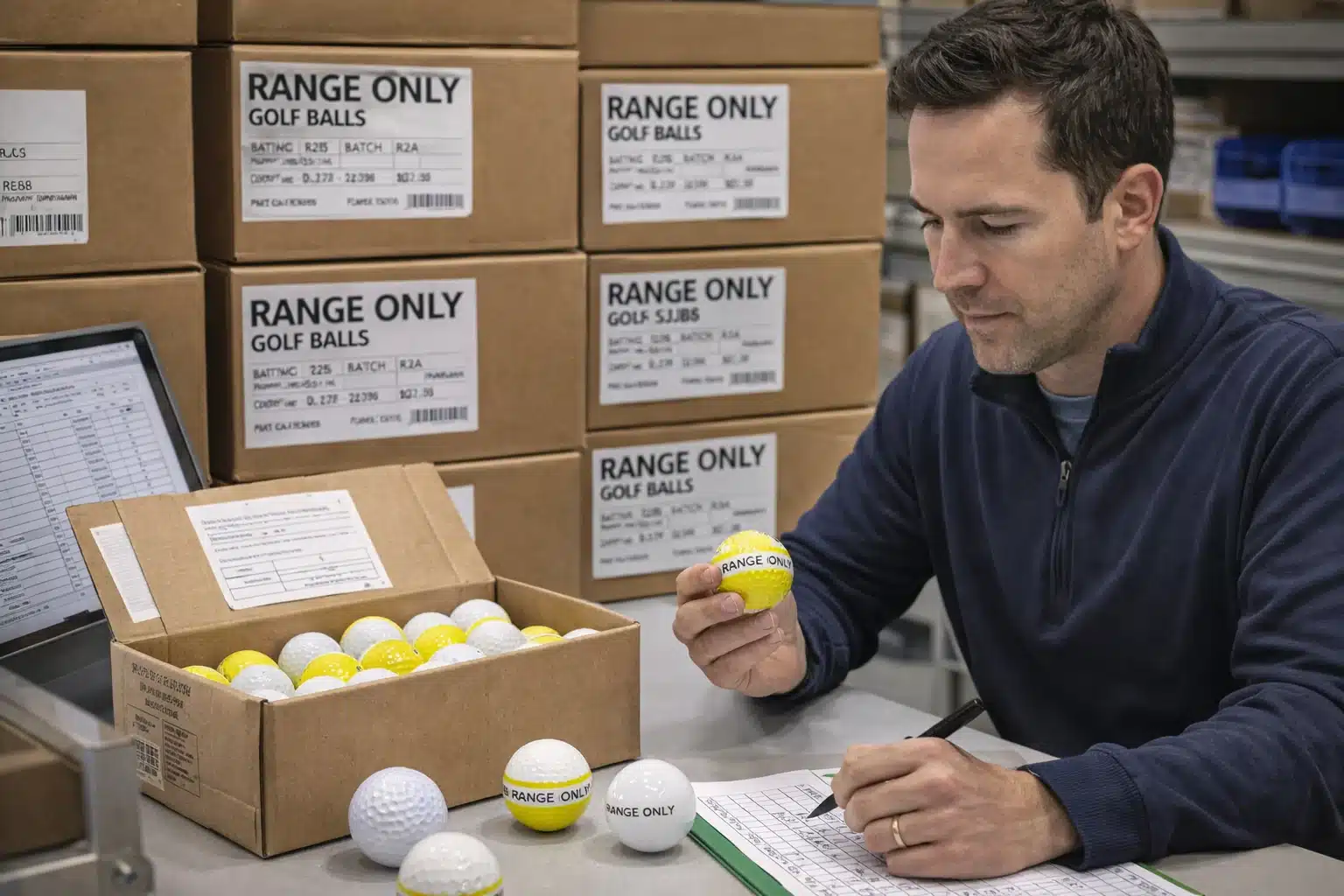
The receiving logic should be just as clear as the testing logic. Final approved production ball shall match the approved visual layout and internal construction on the pre-production sample, with buyer acceptance based on artwork position, color placement, logo legibility, batch QC results, and visual-defect rate from the decorated production version. That line belongs in the PO, not buried in a friendly email.
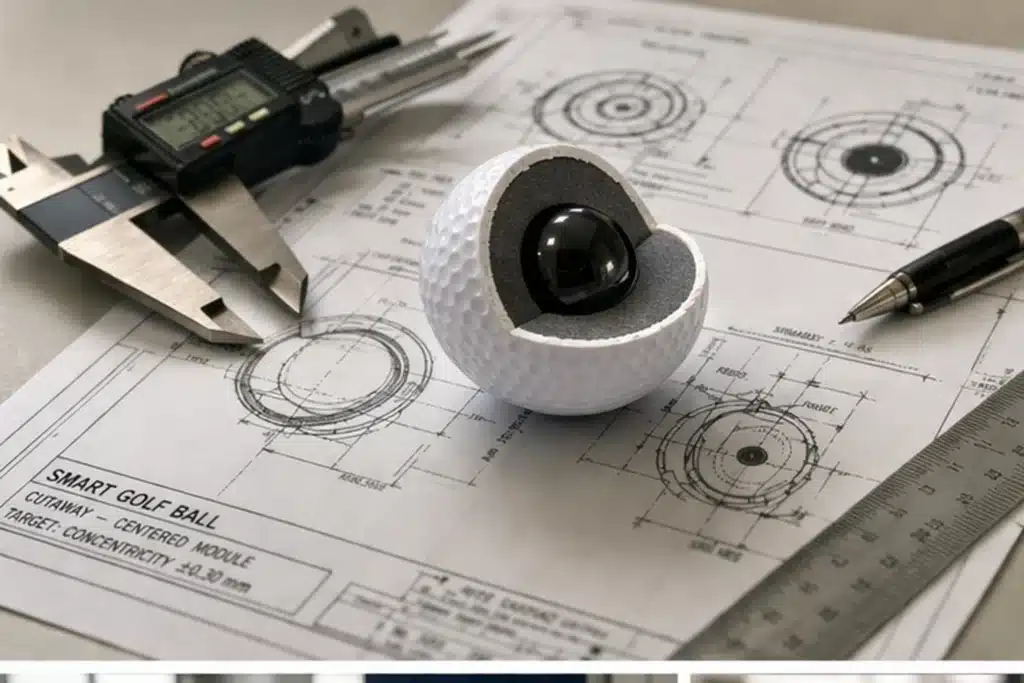
The safest proof stack is not complicated. It is disciplined: decorated-ball launch screenshots, cutaway image of the final candidate SKU, 12-ball QC report with raw values and statistical spread, device list, calibration reference, coating and print-process summary, and before/after washer or abrasion evidence. That is how you validate premium outside claims with premium inside proof.
What Does Shrinkage Cost a 10,000-Ball Fleet?
A 10,000-ball fleet becomes a finance issue as soon as monthly shrinkage is large enough to trigger avoidable replenishment. The payback question is simple: how much theft reduction is needed for the visual treatment to recover its upfront premium?
That is the part GMs and procurement managers can actually use. Not “does it look better.” Not “do golfers like it.” How fast does the redesign pay back?
Because there is no universal published golf-industry benchmark proving one specific visual treatment cuts theft by one fixed percentage everywhere, the clean way to handle this is scenario modeling. That is not a weakness. It is the honest version of CFO language.
Here is the most practical format for internal review.
| Scenario | Plain-white monthly shrinkage | Facility-only visual monthly shrinkage | Annual replenishment exposure | What this means operationally |
|---|---|---|---|---|
| Conservative | 3.0% | 1.5% | About half the annual exposure | Enough improvement to justify visual redesign if loss is steady |
| Base case | 5.0% | 1.0% | Sharp reduction in replacement spend | Often turns the project into a short-payback margin fix |
| Aggressive | 8.0% | 2.0% | Major cut in replenishment pressure | Shrinkage control becomes more important than cosmetic cost |
Illustrative operator benchmark for a 10,000-ball fleet using a replacement value of roughly $0.50 to $0.667 per ball:
-
Conservative: annual exposure falls from about $1,800–$2,400 to about $900–$1,200
-
Base case: annual exposure falls from about $3,000–$4,000 to about $600–$800
-
Aggressive: annual exposure falls from about $4,800–$6,400 to about $1,200–$1,600
The formula behind it is straightforward: annual shrinkage cost = fleet size × unit replacement value × monthly shrinkage rate × 12.
That is why anti-theft visuals should be discussed as a margin-protection project, not a decoration project. If the visual treatment adds only a few cents per ball upfront, the payback threshold is not dramatic. You do not need shrinkage to vanish. You only need it to improve enough that avoided replenishment outpaces the customization premium.
This is also where buyers should keep discipline. Every hard percentage in this section should be tagged as a scenario unless it comes from the facility’s own reconciliation records. That keeps the business case credible and prevents a good article from slipping into invented-average territory.
The best next step is operational. Build one editable model using your own fleet size, replacement value, current monthly loss, and target shrinkage reduction. Replace assumptions with real monthly counts as soon as you have them. That turns shrinkage from a complaint into an approval-ready business case.
✔ True — Scenario modeling is the right language here
You do not need a fake industry average to make a strong business case. You need a transparent model, clear labels, and the discipline to replace assumptions with facility data.
✘ False — “If the exact theft percentage is unproven, the ROI story is weak”
Facilities approve many operating decisions through scenario logic. What matters is whether the assumptions are labeled honestly and tied back to real replacement exposure.
What Proof Should a Factory Show Before You Buy?
Once the strategy is clear, the real procurement risk is no longer concept risk. It is drift.
Do not buy anti-theft range balls on artwork alone. The factory should prove the decorated ball with data, show how the print is protected, and document the controls that keep feel, dimensions, and finish stable after approval.
The strongest factories do not just answer quickly. They answer logically. They can explain what was tested, how it was measured, what the pass window was, what the comparison sample was, and how the approved sample is locked to mass production.
That distinction matters more than many buyers admit. If the approved sample and the bulk lot are not controlled as the same product, the buyer is not buying a golf ball program. The buyer is buying drift.
That is why low price by itself is a weak signal in this category. A cheap sample can hide a more expensive problem later: formula drift, inconsistent compression, visual inconsistency, poor print survival, or a batch that looks close enough until your receiving team opens the cartons. In performance products, you should not sign bulk on the promise that production will be improved later. If the sample is not right, the program is not ready.
| Proof item | Why it matters | Minimum buyer ask | Next step |
|---|---|---|---|
| Decorated-ball launch data | Proves the graphic did not change usable performance | Screenshot set from the final decorated candidate | Compare against control sample |
| 12-ball QC report | Exposes consistency, not just one hero sample | Raw values + sigma + range + device list + calibration | Attach to approval file |
| Coating / print method note | Separates controlled process from cosmetic afterthought | Print process + protective layer summary | Reject vague durability promises |
| Pre-production proof version | Locks artwork and batch identity | Signed artwork proof with revision code | Reference revision on PO |
| Receiving acceptance checklist | Prevents disputes later | Spot-check items for the first bulk batch | Train warehouse and receiving before arrival |
Use the RFQ to force comparability instead of conversation. Quote one fixed core spec across three visual-deterrence treatments—split two-tone, wraparound stripe, and oversized PRACTICE mark—and include pre-production artwork proof, 12-ball QC report, coating-stack description, and washer / abrasion verification method.
Then lock version control in writing: supplier shall issue one locked pre-production proof version before mass production and reference that version on batch records, QC report, and packing list; any change to artwork scale, color zone, print position, coating process, or internal construction requires written buyer approval before shipment.
A final red flag is a supplier with no raw QC data, only pass/fail claims. Another is a factory that moves fast on price but slowly on technical questions. In golf-ball sourcing, that usually means the response system is weaker than the sales system.
The buyer move here is straightforward. Review the decorated sample first, then compare the first bulk batch against that same revision, not against memory. If the proof version, QC report, and shipment lot cannot be tied together cleanly, hold the approval.
FAQ
Do striped range balls still deter theft if retail balls now use bold lines too?
Yes, but only when the design reads as facility-only rather than retail-styled. If the visual system still looks like a premium alignment feature, it remains socially usable on the course and therefore easier to pocket.
That is why buyers should push beyond “visible” and toward “unmistakably non-retail.” Split-color zones, wraparound stripes, facility codes, and oversized PRACTICE language do more deterrence work than neat linework. Review the design from tee distance, cart distance, and bag distance, not just on a clean artwork proof.
Will aggressive graphics change launch monitor numbers?
They do not have to, as long as the decorated production ball keeps the same internal platform and controlled coating process. The risk is not bold visuals by themselves. The risk is proof taken from the wrong sample or weak process control in decoration and finishing.
That is why the buyer should request launch data from the final decorated SKU, then compare ball speed, launch, spin, and smash against the plain control sample. Pair that with a cutaway and a 12-ball QC report so the judgment is based on batch logic, not one hero ball.
Do you need conforming anti-theft range balls for a private club?
Only when the club’s actual use case justifies the cost, requirements, and renewal burden. Conformity should be treated as a fit-for-purpose decision, not a universal shortcut for quality.
The right filter is practical: member expectation, event preparation, fitting use, and whether conformity materially improves the practice environment you are trying to create. For many clubs, stable construction, credible feel, and strong supplier proof matter more day to day than a conformity discussion that does not match the range’s actual job.
How large should PRACTICE markings be?
Large enough to be understood instantly at social distance. The correct sizing rule is recognition, not elegance.
If the mark disappears in a tray, a side pocket, or a golfer’s hand on the first tee, it is too subtle. Use contrast and placement that survive rotation and quick handling, then pair the word mark with a clearly non-retail color system so the ball still reads as facility property when the text is not facing outward.
Can pad printing survive commercial washer use?
It can, but the safe claim is process-based unless the supplier shows owned QA on the actual SKU. Buyers should ask for the washer or abrasion verification method, before/after evidence, and a coating-stack summary rather than relying on pretty durability claims.
The real question is not whether the ball ever sees harsh handling. It does. The question is whether the graphic lives inside a controlled print-and-protection system built for repeated washing, collection, storage, and impact. If the supplier cannot explain the method, the durability promise is too thin.
What should be in a first sample kit?
Not just balls in a box, but one proof stack built around the same platform. The sample kit should let the buyer compare deterrence, feel, and manufacturing proof on the same candidate, not across unrelated samples.
A useful first kit includes three visual versions on one fixed core spec, a cutaway of the final candidate, decorated-ball launch screenshots, a 12-ball QC report with raw values and calibration reference, the artwork proof sheet, and the coating or print-method summary. That makes approval cleaner and prevents the classic mistake of validating performance on one sample family and buying another.
Conclusion
Shrinkage is not a decoration issue. It is a margin leak hiding inside a member-experience upgrade.
The best anti-theft range ball is not the one golfers hate to hit. It is the one they enjoy hitting on the range and would never want to pull out on the first tee.
For procurement, the standard is simple: make the ball unmistakably facility-only, keep the internal platform credible, and approve only what the final decorated SKU can actually prove.
You might also like — How Long to Ship Golf Balls from China? (2026 Guide)