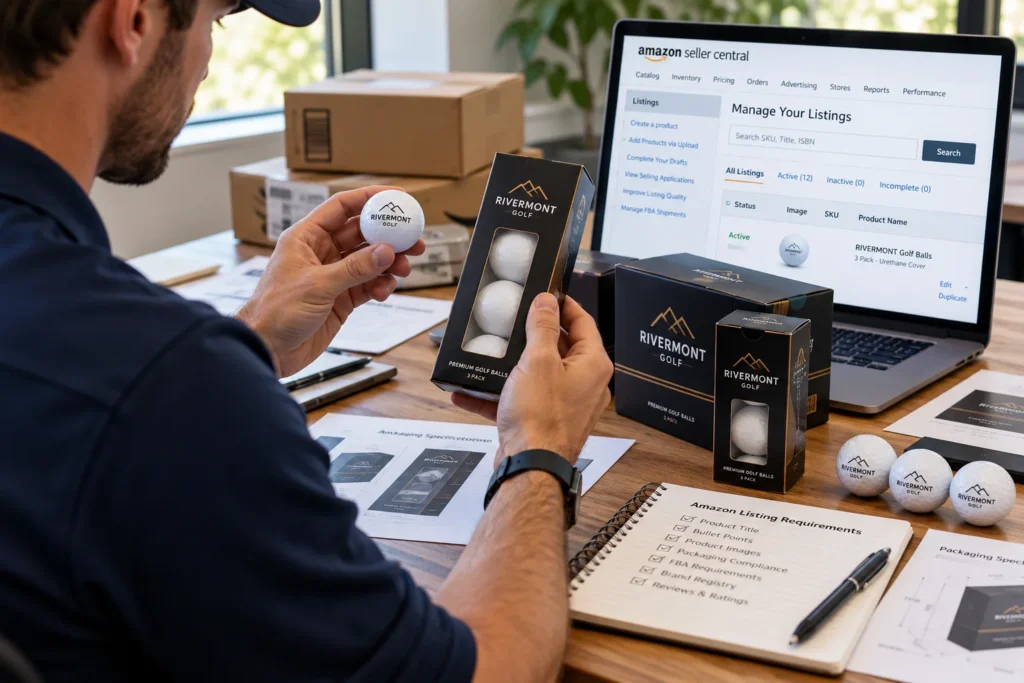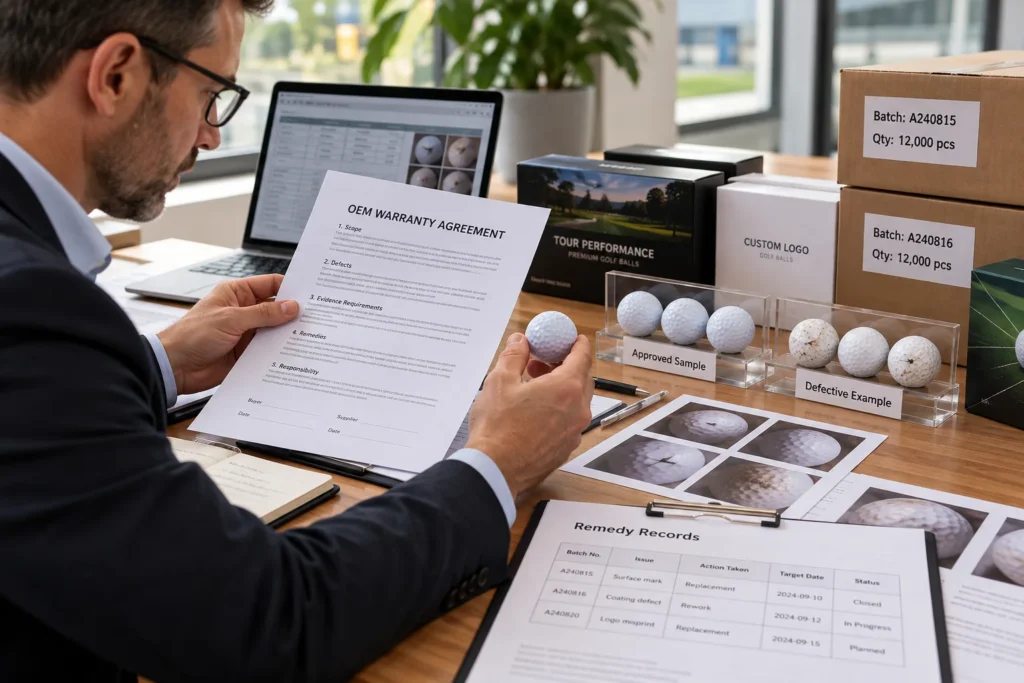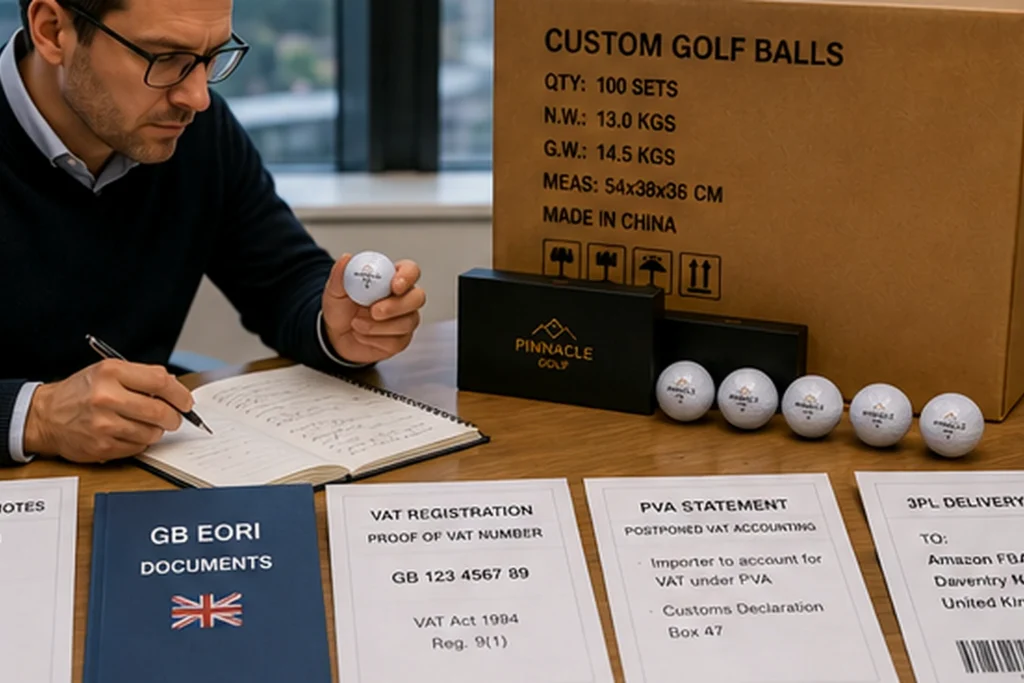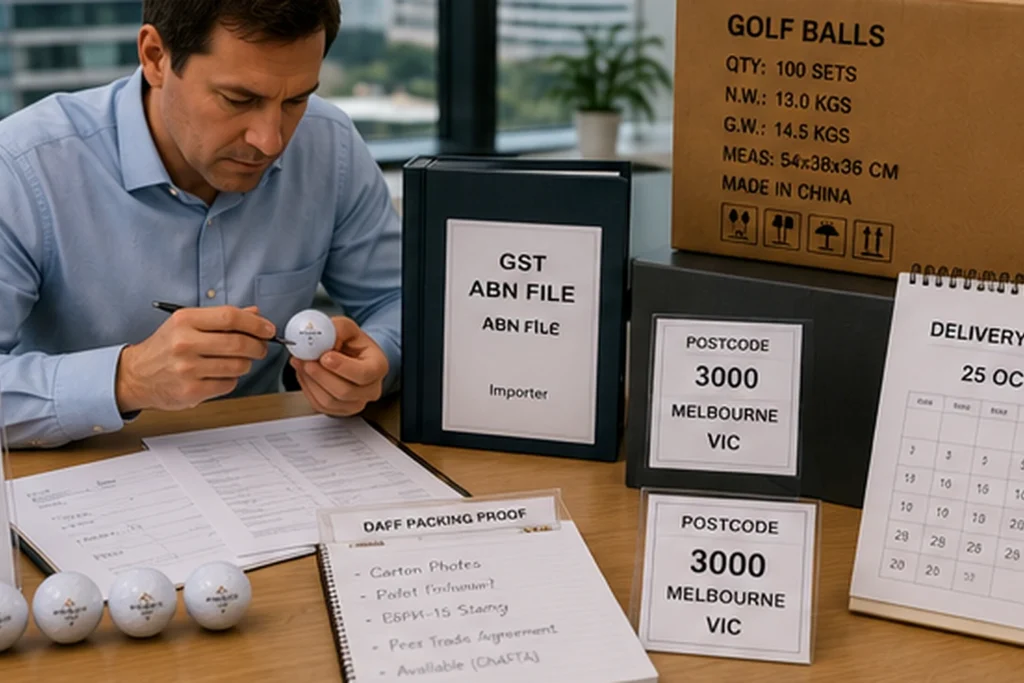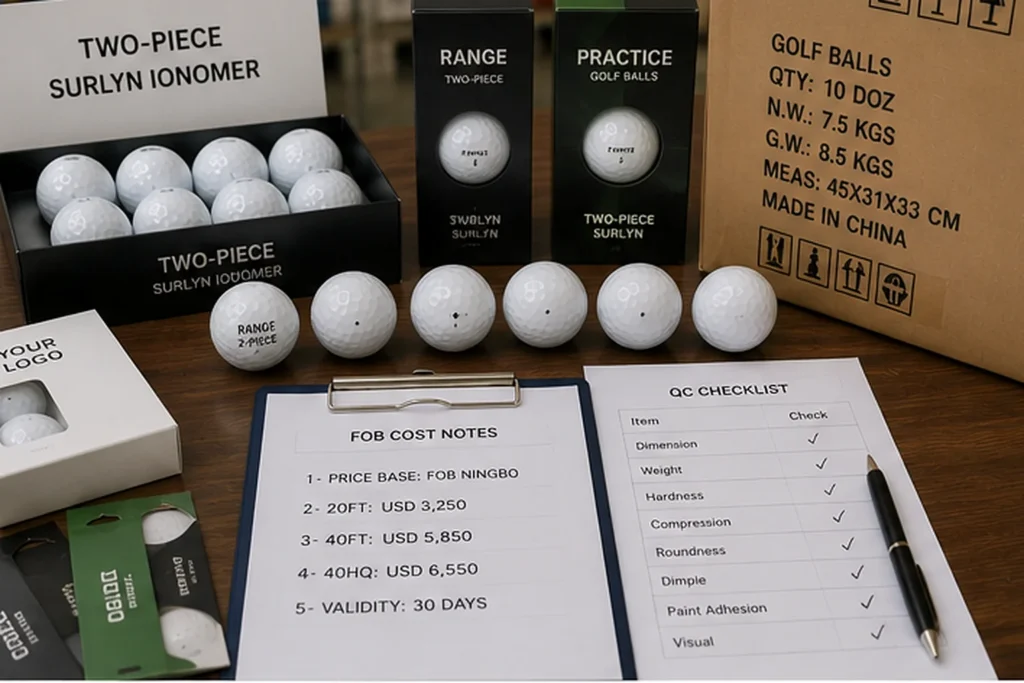
A cheap 2-piece ball can become expensive if the spec, packaging, freight, or batch QC is wrong.
Top 2-piece Surlyn golf ball manufacturers in China include Ningbo Golfara, Shenzhen Xinjintian, Hangzhou Grasbird, and Xiamen MLG. For high-volume OEM buyers, the best supplier is not simply the lowest FOB quote; it is the factory that can match your practice or play spec, control CBM, hit the delivery window, and prove lot-level consistency.
For 2026 budgeting, 2-piece Surlyn practice balls often quote around $0.32–0.45/ball FOB, while play or conforming-oriented 2-piece balls often quote around $0.39–0.60/ball FOB before print, packaging, and freight.
To compare wholesale 2-piece golf ball suppliers in China, check five items before mass production:
-
Manufacturer fit: Ningbo, Shenzhen, Hangzhou, or Xiamen supply path.
-
Practice vs play spec: 90+ compression durability or tighter retail-play tolerance.
-
Packaging CBM: bulk white box or fold-flat sleeves before tubes and blisters.
-
QC red lines: weight ≤45.93 g, diameter ≥42.67 mm, plus lot-level spread data.
-
Lead-time control: existing 332/342/352 dimple tools, standard colors, and locked artwork.
This page keeps the supplier shortlist buyers came for, then shows how to avoid four expensive mistakes: buying the wrong 2-piece Surlyn spec, accepting loose QC, choosing bulky packaging, and waiting too long to lock tooling.
Which 2-piece Surlyn makers lead China?
You need a clean factory shortlist, but you also need to know what each supplier is best suited for before asking for price.
China’s 2-piece Surlyn OEM shortlist should start with manufacturer, city, MOQ, lead time, dimple family, and buyer fit. Ningbo suits flexible pilot runs, Shenzhen and Xiamen suit packaging-heavy promo or retail work, and spec-driven suppliers need tighter QC confirmation.
China-based OEMs making 2-piece Surlyn or ionomer golf balls include Ningbo Golfara, Shenzhen Xinjintian, Hangzhou Grasbird, and Xiamen MLG. All four can be relevant for private-label, practice, promotional, wholesale, or play-ball programs, but the safest buyer move is to treat this as a shortlist, not final qualification.
| Factory | City | 2-piece Surlyn fit | Typical MOQ | Lead-time logic | Buyer move |
|---|---|---|---|---|---|
| Ningbo Golfara | Ningbo | Pilot runs, private label, low-MOQ testing | ~1,000 pcs | Sampling 7–15 days with existing tools/colors | Verify pilot QC and packaging path |
| Shenzhen Xinjintian | Shenzhen | Practice SKUs, promo/gift supply | 2,000–5,000 pcs | Bulk practice builds fastest | Verify packaging and print schedule |
| Hangzhou Grasbird | Hangzhou | Spec-driven 2-piece Surlyn builds | ~5,000 pcs | Spec-tight builds trend longer | Verify tolerance and batch data |
| Xiamen MLG | Xiamen | Retail packs and USGA-conforming 2-piece offers | ~2,000 pcs | Gift boxes add time | Verify play-ball red lines |
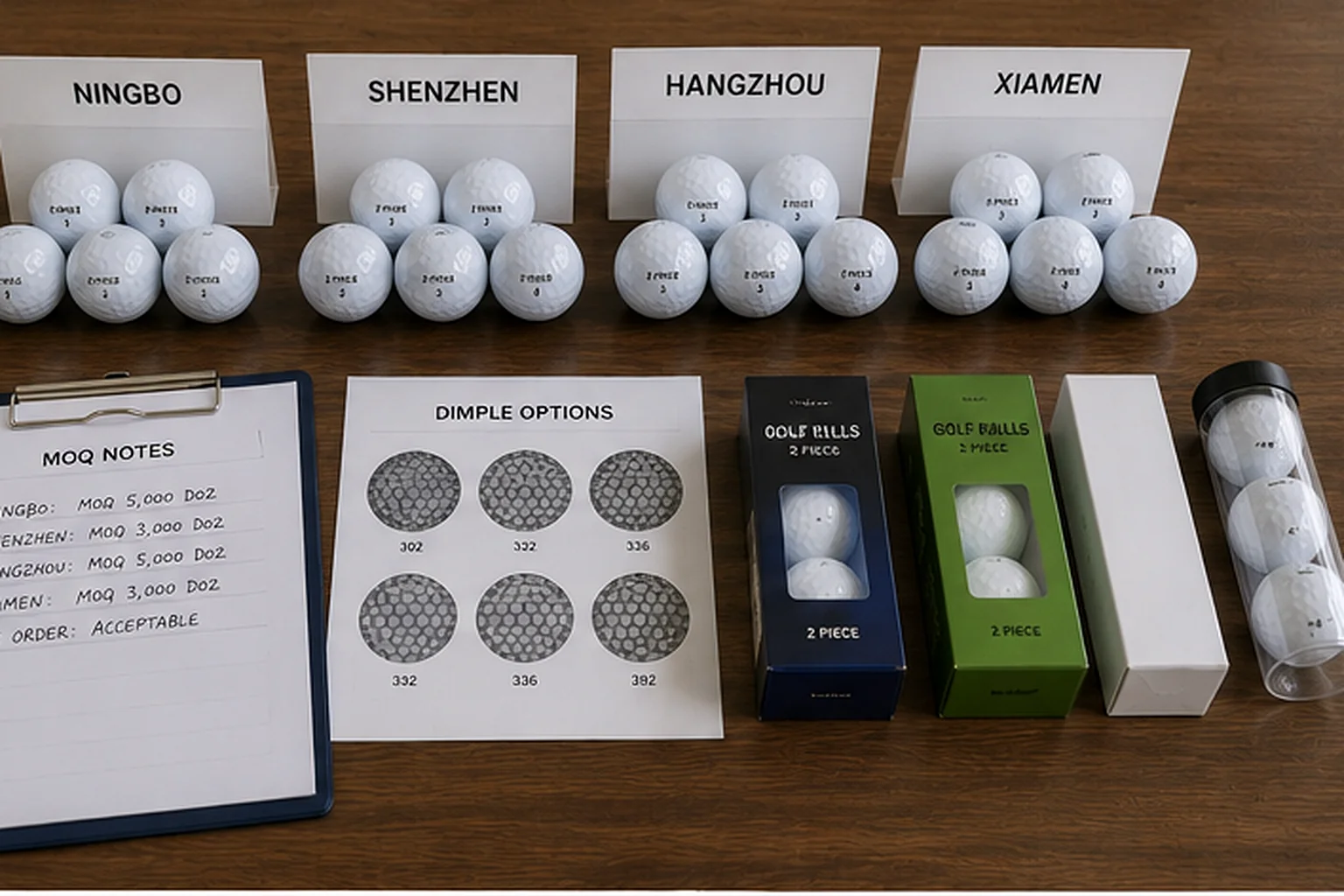
The useful question is not “Who is cheapest?” It is “Which supplier’s MOQ, packaging path, tooling, and QC rhythm fit this order?” Ningbo and the Yangtze River Delta often fit flexible pilot logic. Shenzhen and the Pearl River Delta are useful when promotional speed and packaging coordination matter. Xiamen and the Minnan supply base fit retail packs and giftable sets. Hangzhou can fit spec-driven builds when the buyer is ready to verify tighter tolerances.
All four should confirm current dimple-tool IDs before quotation. Common 2-piece families include 332, 342, and 352 patterns, but the tool ID matters more than the catalog number. Ask each supplier for current MOQ, lead time, dimple-tool ID, FOB price band, packaging route, and one sample QC file. For budgeting, keep the original FOB bands visible: practice builds often sit around $0.32–0.45/ball, while play or conforming-oriented 2-piece builds often sit around $0.39–0.60/ball before print, packaging, and freight.
✔ True — The Top 4 table is a shortlist, not final approval.
Manufacturer name, city, MOQ, and lead time help you screen faster. Final approval still depends on sample quality, packaging CBM, lot-level QC, and batch traceability.
✘ False — “The lowest MOQ is always the best supplier.”
Low MOQ only helps if the supplier can still protect QC, packaging, production slots, and repeat orders.
Which Surlyn spec fits practice or play?
You may buy a soft retail-style 2-piece ball for a driving range, or a low-tolerance practice ball for retail play. Both mistakes create complaints.
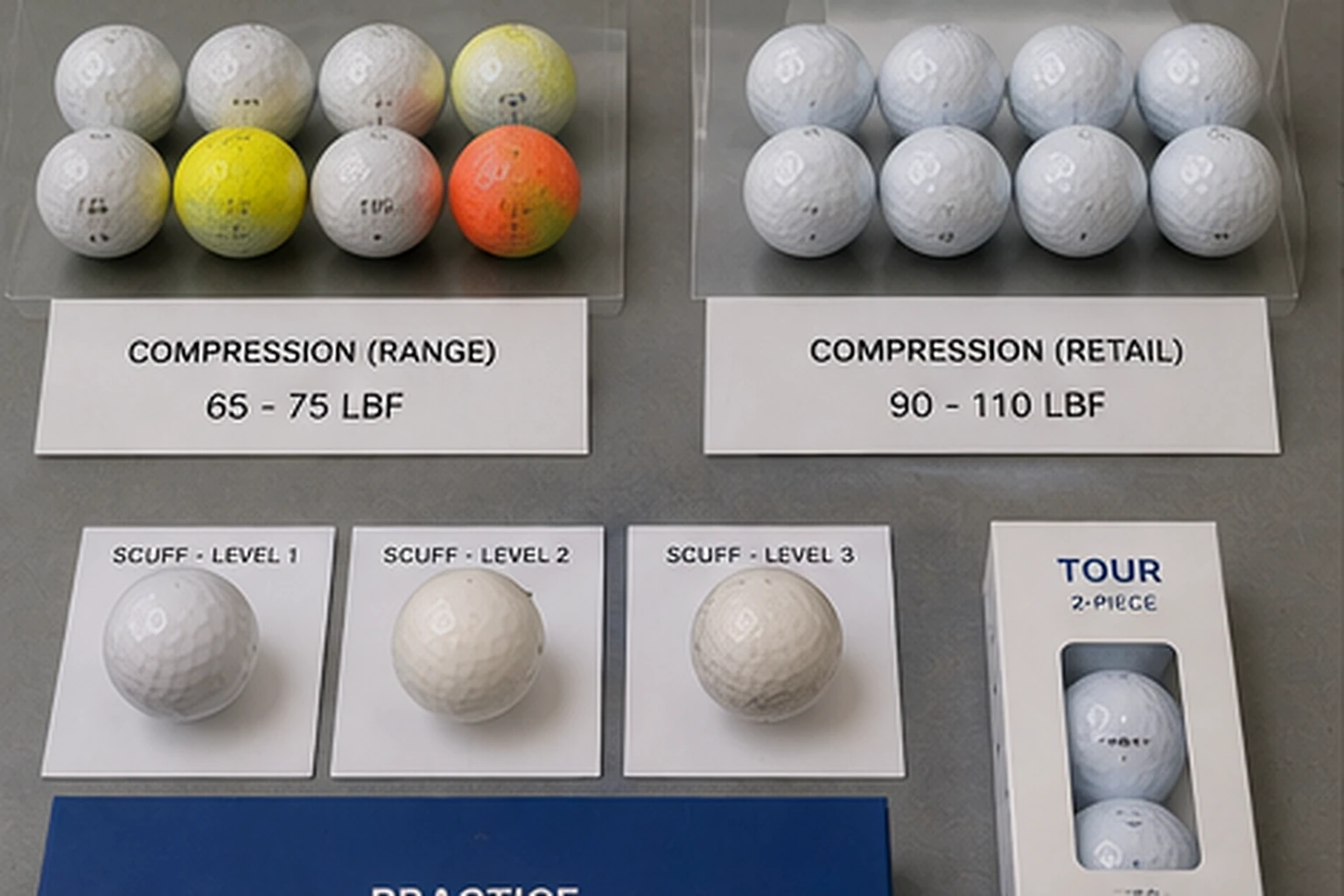
Practice and play 2-piece Surlyn balls share a two-layer structure, but they should not share the same PO. Practice balls prioritize 90+ compression, thick ionomer cover, and scuff resistance; play balls need tighter dispersion and rule-ready tolerances.
Surlyn® is a well-known ionomer brand, while ionomer is the broader material family. In B2B RFQs, “ionomer cover, such as Surlyn®” is often safer than locking yourself to one branded resin unless the channel requires it. The material is popular in 2-piece golf balls because it supports durability, resilience, firm feel, efficient processing, and excellent cut and scuff resistance.
For a driving range, that durability is not a small detail. Range balls face repeated machine washing, wet baskets, concrete trays, ball pickers, and golfers practicing like they are trying to settle a personal dispute with the driver. Softer retail feel is not the priority. Long service life is.
| Decision | Practice ball | Play ball | Buyer move |
|---|---|---|---|
| Primary job | Survive range use | Support retail/play performance | Define channel first |
| Compression | Usually 90+ | Usually 70–90 | Write target in PO |
| Cover priority | Thicker ionomer durability | Balance feel and control | Specify cover intent |
| QC focus | Scuff/paint durability | Weight/diameter/flight consistency | Use different gates |
| Packaging | Bulk white box, mesh, OPP | Sleeves/dozen/gift box | Match packaging to channel |
Where do compression and durability split?
Practice balls should be tuned for abuse; play balls should be tuned for consistency. This is where many low-price RFQs go wrong.
A practice ball quoted with soft retail compression is a clear warning sign. It may feel nicer in a sample sleeve, but it may not survive range use. For range programs, ask for 90+ compression, thicker ionomer-cover intent, strong paint adhesion, scuff resistance, and simple packaging. For play balls, ask for a defined compression target, tighter weight and diameter spread, stable roundness, and retail-ready appearance.
Write the PO so practice and play cannot blur: supplier shall identify approved sample ID, dimple-tool ID, production date, batch number, compression target, paint/coating system, packaging format, and retained-sample period before mass production.
Do not approve one generic 2-piece spec for both driving range and retail play channels. Quote practice and play versions separately, then compare the real cost of durability versus the real cost of tighter tolerance.
What is the real cost of a 2-piece ball?
You may see a low FOB price and miss the bigger cost driver: packaging volume, carton loading, and freight efficiency.
For wholesale 2-piece golf balls, the real cost is FOB price plus packaging CBM. Practice balls may quote $0.32–0.45 FOB and play balls $0.39–0.60 FOB, but tubes and blisters can erase margin through freight volume.
Volume buyers usually care about two numbers: FOB per ball and landed cost per dozen. The second number is the one that gets people in trouble. A 2-piece Surlyn ball is small and dense. Packaging is not. Transparent tubes, blisters, EVA trays, and display formats may look stronger on a retail shelf, but they can reduce carton efficiency and increase dimensional freight.
A standard 20ft container has about 33.2 CBM of internal volume, but practical carton loading depends on carton shape, handling space, and loading efficiency. For landed-cost planning, model usable carton loading below theoretical container volume because carton shape and loading efficiency reduce practical capacity.
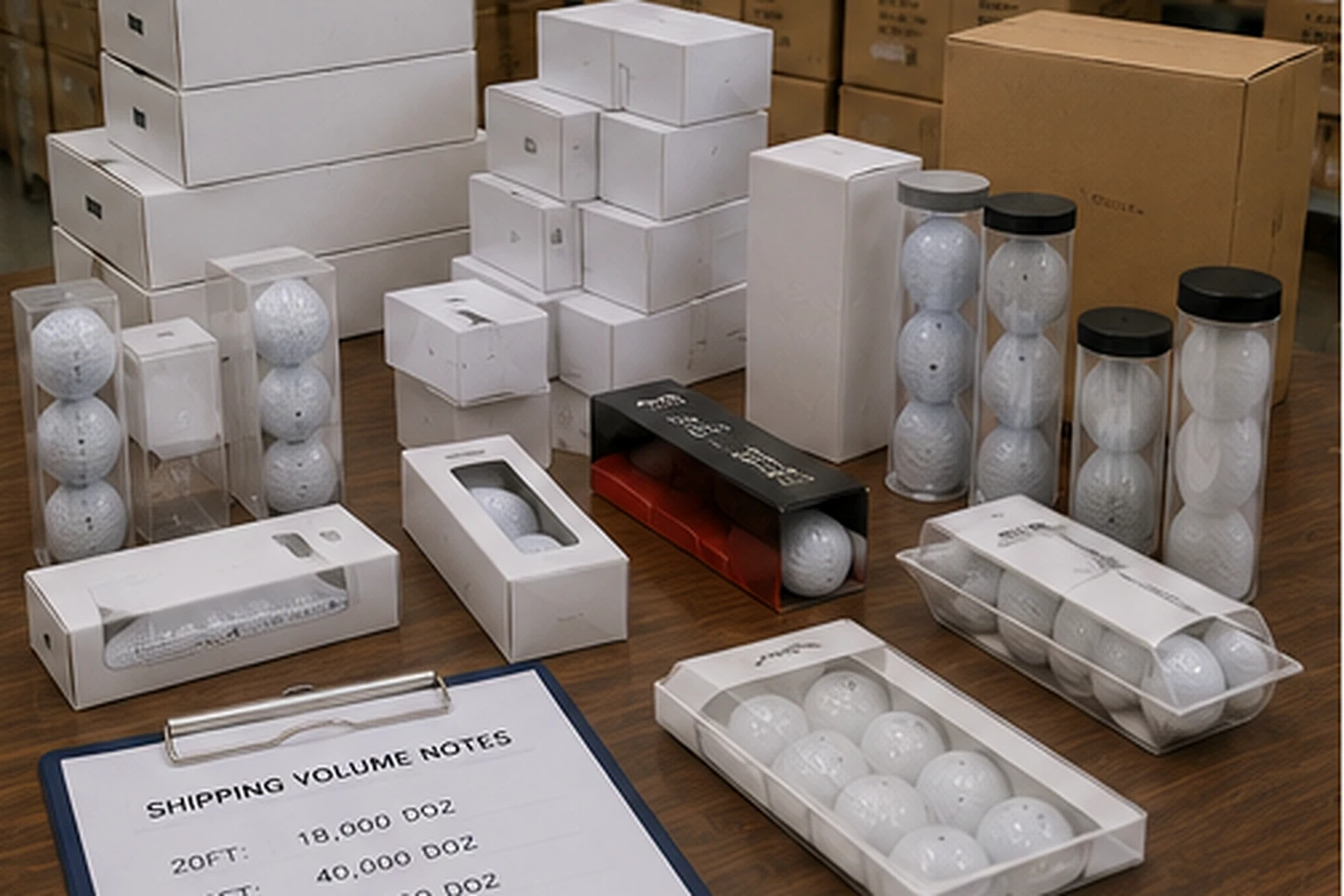
| Packaging format | CBM/dozen | 20ft loading logic | Best use | Buyer move |
|---|---|---|---|---|
| Bulk white box | 0.011–0.013 | Highest loading efficiency | Range, wholesale, first order | Use for cost control |
| 3-ball sleeves + dozen box | 0.012–0.014 | Good retail / freight balance | Retail pilot | Fold-flat before assembly if possible |
| Tube 3×4 | 0.014–0.017 | Round voids waste volume | Display retail / gifts | Use after demand is proven |
| Blister 2/3 | 0.015–0.018 | Highest dimensional pressure | Warehouse clubs / anti-tamper | Avoid for first order unless required |
How does packaging CBM eat margin?
Packaging CBM eats margin when the box ships more air than product value. That sounds dramatic until the freight bill arrives and everyone suddenly becomes a packaging engineer.
Using the original CBM ranges, bulk white box at 0.011–0.013 CBM/dozen can load far more dozens than tube or blister formats. Tubes and blisters may be valid for retail display, warehouse-club presentation, or anti-tamper needs, but they are rarely the safest first-order format for wholesale 2-piece golf balls.
Choosing tubes or blisters before freight and CBM simulation is a classic warning sign. Request FOB ball price, print cost, packaging cost, carton dimensions, dozens per carton, gross weight, and CBM/dozen. Then compare landed cost per dozen, not FOB per ball. First-order packaging should meet channel needs while staying close to the lowest practical CBM range. Save tubes, blisters, foil, EVA, and premium presentation packs for proven reorders.
✔ True — Carton CBM can decide landed cost.
For volume golf balls, packaging volume can matter as much as small differences in FOB unit price. A beautiful package that wastes space can quietly destroy margin.
✘ False — “Lowest EXW or FOB unit price always wins.”
A lower ball price can lose if the packaging format reduces container loading or increases dimensional freight.
Which QC gates protect bulk orders?
You may buy a low-cost 2-piece play ball that looks fine, but weak weight, diameter, compression, or paint control can create complaints.
USGA limits define legality; batch QC defines repeatability. For 2-piece Surlyn play balls, write weight ≤45.93 g, diameter ≥42.67 mm, plus tighter lot gates such as weight spread, diameter spread, compression tolerance, roundness, and paint adhesion.
USGA/R&A limits set the floor for a conforming play ball: maximum weight 45.93 g and minimum diameter 42.67 mm. Those numbers are necessary, but they do not prove a shipment is consistent. A low-cost ionomer ball can be legal on paper and still feel inconsistent if weight, diameter, roundness, or compression drifts across the lot.
For play-ball shipments, Golfara recommends tighter buyer-side gates: lot weight spread ≤±0.3 g, diameter spread ≤±0.15 mm, and compression target ±3. These are internal shipment controls, not official rule limits. For practice balls, the priority shifts toward 90+ compression, thicker ionomer cover, paint adhesion, scuff resistance, washing survival, and machine-strike durability.
| QC item | Practice priority | Play priority | Proof to request | Acceptance move |
|---|---|---|---|---|
| Weight | Stable enough for bulk use | ≤45.93 g + tight spread | Raw values and range | Hold if drift exceeds PO |
| Diameter | No major size drift | ≥42.67 mm + diameter spread | Gauge/ring record | Reject undersize risk |
| Compression | 90+ durability target | Target ±3 | Same-gauge readings | Separate practice/play specs |
| Paint/coating | Scuff and washing resistance | Retail appearance consistency | Cross-hatch/rub/abrasion report | Approve before mass print |
| Traceability | Batch and carton ID | Batch and retained sample | Dimple-tool ID + production date | Link QC to shipment |
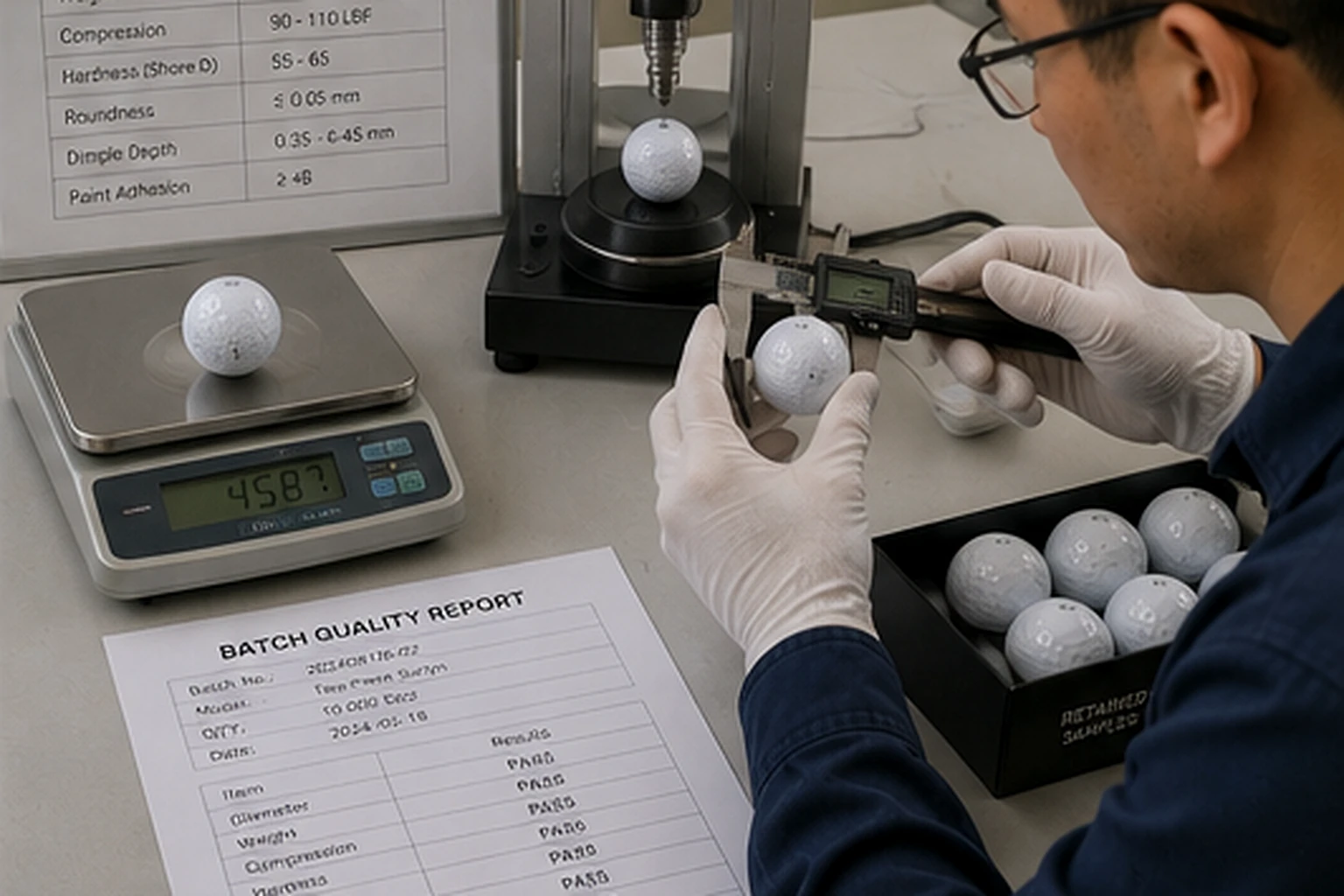
Supplier gives USGA red lines but no lot-level spread data is another warning sign. The rules tell you whether the ball can be eligible; the batch report tells you whether your shipment is stable.
Request a lot-level QC report for 2-piece Surlyn play balls showing weight spread, diameter spread, compression tolerance, roundness, paint adhesion, sample quantity, raw values, equipment ID, calibration date, batch number, and retained-sample plan.
For practice balls, add scuff and washing checks so a cheap range ball does not become expensive through early replacement. For play balls, require raw values instead of pass/fail screenshots. High-volume low-cost orders need tighter repeatability because every small drift multiplies across thousands of balls.
How do you keep lead time under control?
You may need promo or range balls fast, but new tools, custom colors, and packaging proofs can turn a simple 2-piece order into a delayed shipment.
The fastest 2-piece Surlyn order is usually the least custom one. Use existing 332/342/352 dimple tools, standard color cards, one-position print, and simple packaging to keep sampling near 7–15 days and mass production more predictable.
The original timing benchmark still works when conditions are clear: sampling 7–15 days with existing tools and colors, and mass production 20–35 days after artwork lock. Treat those as bounded references, not magic calendar promises. New dimple tooling, custom color matching, matte/neon paint, extra logo colors, premium gift boxes, and special carton marks can all add time.
For event buyers, the fastest route is not heroic overtime. It is fewer moving parts. Reuse an existing 332, 342, or 352 dimple family when it fits the product. Choose a standard white or approved color card. Keep logo printing simple for the first order. Use bulk white box or fold-flat sleeves before moving into tubes, blisters, foil, or EVA.
The PO should define approved artwork date, packaging lock date, dimple-tool ID, production date, retained sample rule, and ship-ready date. Lead time should start after artwork, packaging, tool, and color are locked, not simply after deposit. Ask for the dimple-tool ID, standard color card, artwork approval date, packaging format, and production slot before you commit to an event deadline.
✔ True — Fast orders usually reuse proven inputs.
Existing dimple tools, standard color cards, simple artwork, and low-CBM packaging reduce approval loops and make timing easier to protect.
✘ False — “Once the deposit is paid, production starts immediately.”
Artwork, tool selection, color, print method, packaging, and line slot must be locked before the production clock is meaningful.
FAQ
Is Surlyn the same as ionomer in golf balls?
Yes. Ionomer is the generic material family, while Surlyn® is a well-known ionomer brand. In B2B RFQs, write “ionomer cover, such as Surlyn®” if you want both material clarity and sourcing flexibility.
Surlyn® may be required when a brand spec or customer brief names it directly. Otherwise, ionomer gives the supplier more material flexibility while keeping the same durable 2-piece concept. Ask for cover hardness, durability target, paint system, and scuff-resistance test method so the quote does not become a vague material promise.
How much does a 2-piece golf ball cost in China?
For budgeting, FOB practice builds can be framed around $0.32–0.45 per ball, while play or conforming-oriented 2-piece builds can sit around $0.39–0.60 per ball before print, packaging, and freight.
Use these as illustrative FOB bands, not guaranteed quotes for every color, finish, logo, or packaging format. Quote print and packaging separately. A low FOB number can still lose if the carton CBM is high, the print setup is complex, or the play-ball QC gate requires tighter inspection.
Are 2-piece Surlyn balls good for driving ranges?
Yes. A well-built 2-piece Surlyn or ionomer ball is often the best choice for driving ranges because durability, scuff resistance, washing survival, and low replacement cost matter more than soft short-game feel.
For range use, write a 90+ compression target, thicker ionomer-cover intent, paint adhesion requirements, and simple packaging into the PO. Do not buy a soft retail-style 2-piece spec for heavy range use unless you have tested machine washing, scuff resistance, and repeated-impact durability.
Can 2-piece Surlyn balls be tournament legal?
Yes, if the exact model meets the rules and appears on the required conforming list for the event. Layer count and ionomer cover do not automatically make a golf ball illegal.
A 2-piece play ball still needs the proper weight, diameter, symmetry, and performance behavior for formal use. Check the exact model string when regulated play requires it. Do not confuse a practice marking, range stripe, or bulk package with the construction itself.
How can I reduce shipping cost for wholesale balls?
Start with packaging CBM. Bulk white boxes and fold-flat sleeves usually load more efficiently than tubes or blisters, which can increase dimensional freight and reduce container loading.
Ask for carton dimensions, dozens per carton, gross weight, and CBM/dozen before approving packaging. Standard packaging is usually safer for first orders. Upgrade to tubes, blisters, EVA, foil, or display packs after sell-through data proves demand and the margin can absorb the freight.
What compression should a practice range ball use?
Many range-focused 2-piece Surlyn balls use higher compression, often 90+, because the goal is durability, machine-washing survival, and repeated impact resistance rather than a soft premium feel.
Compression should be written into the PO, not discussed casually after samples. Pair the compression target with paint durability, cover scuff resistance, and retained samples. A softer ball may feel better in the hand, but heavy range use punishes weak covers and poor paint systems quickly.
What QC data should I request before shipment?
Ask for lot-level data for weight, diameter, compression, roundness, paint adhesion, visual defects, batch ID, production date, dimple-tool ID, equipment ID, and retained samples.
Request raw values, not only pass/fail screenshots. Separate practice and play QC gates because the risks are different. Practice orders need durability proof; play orders need tighter weight, diameter, compression, and appearance control. Link every QC report to carton and batch IDs.
Which packaging is best for first orders?
For first orders, use bulk white box or fold-flat sleeves plus dozen box unless the channel requires display packaging. Tubes, blisters, EVA, foil, and premium packs should usually wait for reorders.
First orders should validate demand, logo quality, ball spec, and delivery rhythm. Keeping CBM low protects cash flow and makes freight more predictable. Once the product proves repeat sales, upgraded packaging becomes a margin decision instead of a launch risk.
Conclusion
A 2-piece Surlyn golf ball is not a low-end afterthought. For volume buyers, it is often the most practical cost-control product when compression, durability, USGA red lines, packaging CBM, and QC gates are defined before production.
Start with the separate practice specs from play specs. Keep the original FOB bands in view, but do not stop there. Compare packaging CBM, carton loading, print method, dimple-tool ID, and lot-level QC before you approve a mass order.
You might also like — How to Source OEM Golf Balls from China: The 2026 PO Negotiation Guide