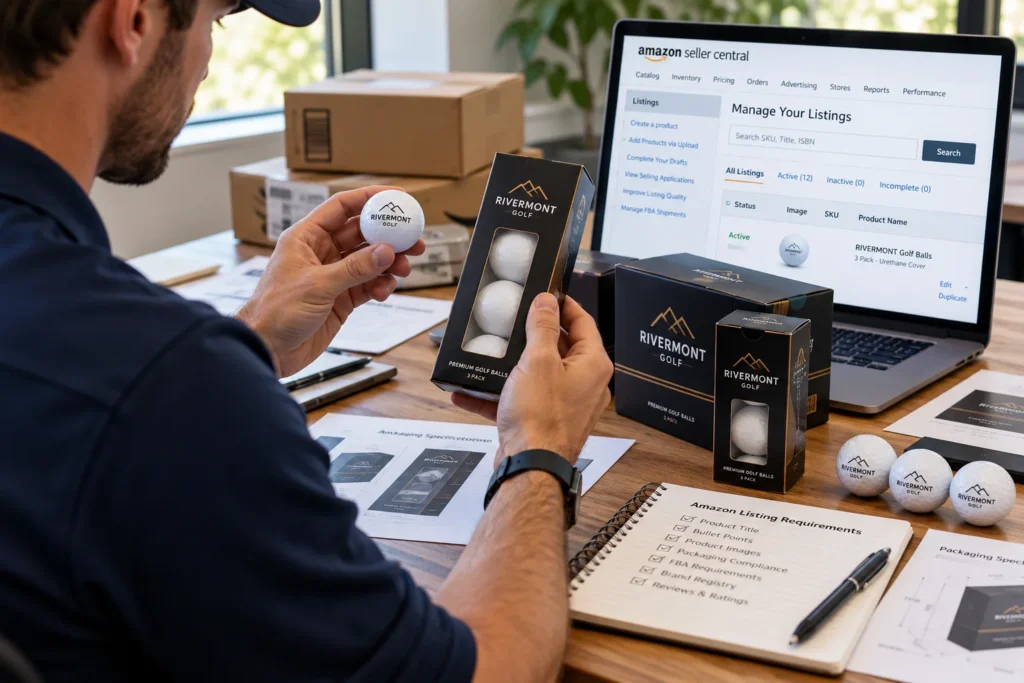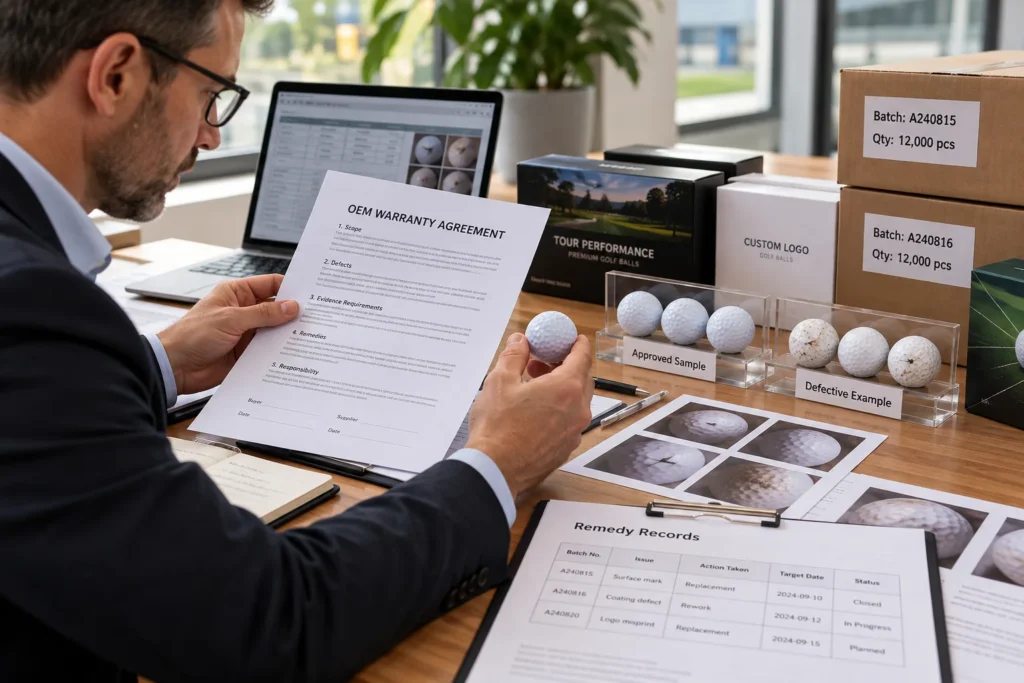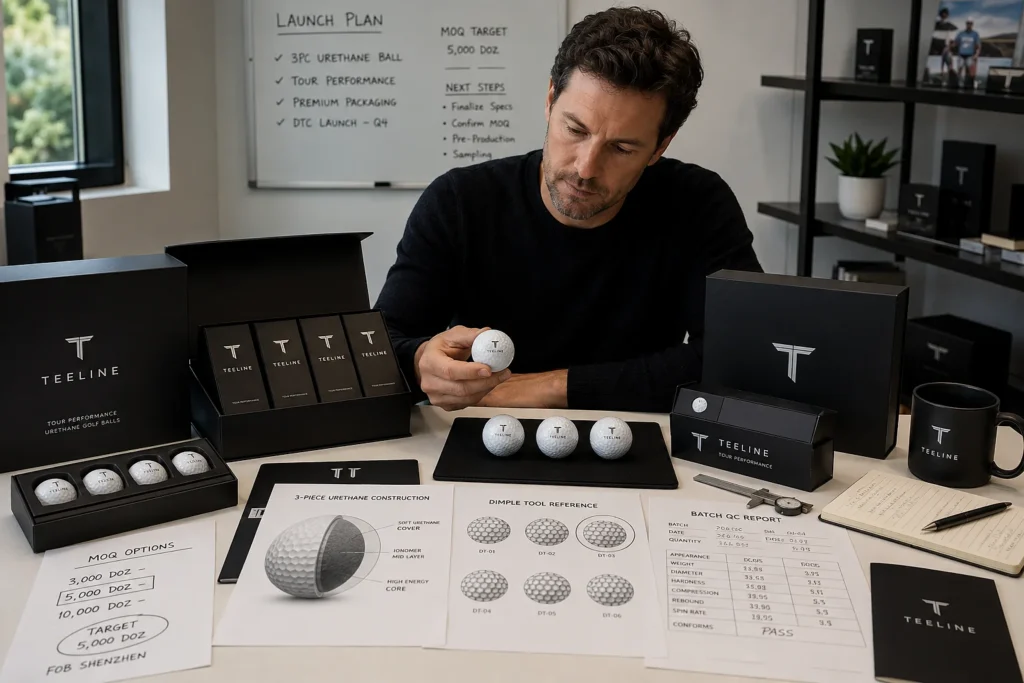
A premium DTC golf ball can fail before launch if the urethane route, MOQ, or batch QC is wrong.
Top China OEM options for 3-piece urethane golf balls include Xiamen JTS, Xiamen MLG, Ningbo Golfara, and qualified Hangzhou/Shenzhen makers. For DTC founders, the best supplier is not the one that sends the softest sample; it is the one that can prove cast vs TPU route, dimple-tool control, pilot MOQ, and batch consistency.
For a low-risk private-label tour golf ball launch, expect practical pilot MOQs around 1,000–3,000 balls when you reuse existing 332/342/352 dimple tools, standard colors, mature formulas, and controlled premium packaging. Sampling can move fastest when the cover route, artwork, and packaging scope are locked before development starts.
Before choosing a 3-piece urethane golf ball manufacturer in China, check five items:
-
Supplier fit: Xiamen JTS, Xiamen MLG, Ningbo Golfara, or qualified Hangzhou/Shenzhen OEMs.
-
Cover route: TPU injection, TPU compression, or cast thermoset urethane.
-
Launch economics: 1,000–3,000 ball pilot before private tooling or multi-SKU complexity.
-
Feel engineering: dimple family, mantle hardness, compression target, coating stack, and wedge response.
-
Batch proof: compression sigma, weight and diameter distribution, X-ray/CT or cut-ball concentricity, Cpk/SPC where available, and retained samples.
This guide keeps the manufacturer shortlist buyers searched for, then helps you avoid the three DTC launch killers: vague urethane wording, oversized MOQ risk, and batch-two performance drift.
Which China OEMs fit 3-piece urethane?
You need a real shortlist, but you also need to know which supplier fits a DTC launch, mature repeat order, or premium retail program.
Start with the shortlist, but qualify the route before you quote. Xiamen JTS and Xiamen MLG fit mature 3-piece urethane programs; Ningbo Golfara fits lower-MOQ DTC pilots; Hangzhou/Shenzhen OEMs need cover-route and QC proof before approval.
A 3-piece urethane golf ball is not a commodity logo ball with a softer cover. It is a brand promise: better short-game control, softer acoustics, retail-ready feel, and enough consistency to survive reviewers, fitters, and early customers. That means the factory should identify the cover route, dimple-tool family, compression target, batch-control method, and packaging path before you place the pilot order.
| Factory | Typical spec | Common MOQ | Lead time | DTC buyer move |
|---|---|---|---|---|
| Xiamen JTS | 3-piece urethane tournament-style builds | 2,000–3,000 | 20–30 days after approval | Verify cast/TPU route and 24-ball data |
| Xiamen MLG | 2/3/4-piece including urethane | 2,000–3,000 | 20–30 days after approval | Verify retail packaging and repeatability |
| Ningbo Golfara | 3-piece urethane pilot and private label | 1,000–3,000 | 10–20 days with existing tools/colors | Use for low-MOQ launch path |
| Qualified Hangzhou/Shenzhen OEMs | 3-/4-piece urethane | 1,000+ | 20–35 days after approval | Audit cover route and batch QC first |
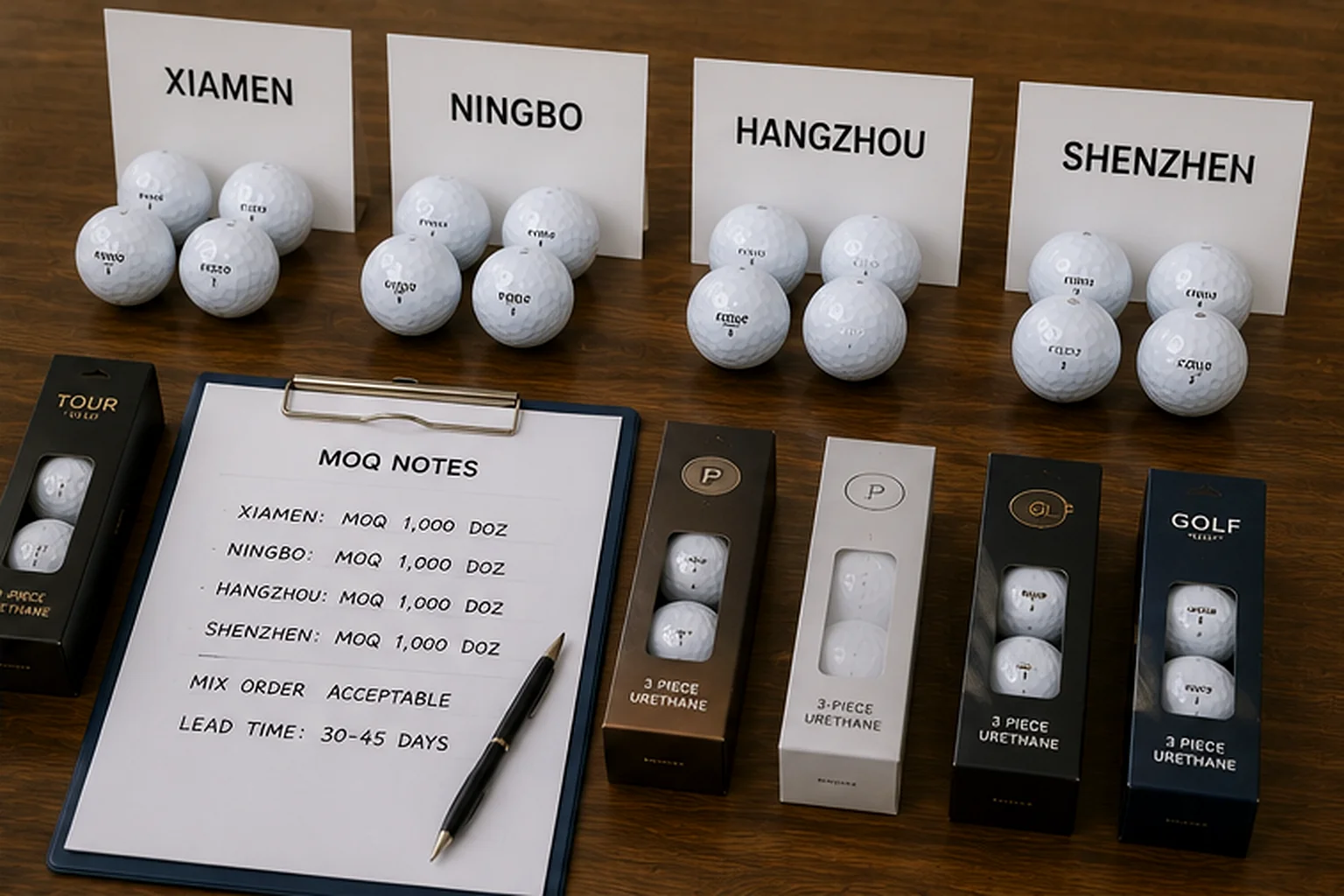
The regional fit matters. Xiamen and the Minnan supply base can make sense for mature 3-piece repeat runs, retail kitting, and larger replenishment logic. Ningbo and the Yangtze River Delta fit agile DTC pilot work when you need lower MOQ, faster feedback, and practical packaging control. Hangzhou and Shenzhen options can work, but only after the buyer verifies whether urethane is routine production, special production, or merely a catalog promise.
Ask each supplier for current MOQ, sample lead time, cover route, dimple-tool IDs, and one anonymized QC pack. Common 3-piece dimple families such as 332, 342, and 352 can reduce tooling cost and shorten sampling when they fit your performance target. Do not shortlist a supplier on the word “urethane” alone.
✔ True — A 3-piece urethane shortlist starts with route proof.
Factory name, MOQ, and lead time help you screen fast. Final approval still depends on cast/TPU route, dimple-tool evidence, compression control, and batch data.
✘ False — “Any urethane supplier can make your flagship.”
A value TPU program, a cast urethane flagship, and a catalog-only claim are very different supply risks.
Should your flagship use cast or TPU?
You may want a premium DTC ball, but generic urethane wording can hide a completely different process, cost, feel, and spin story.
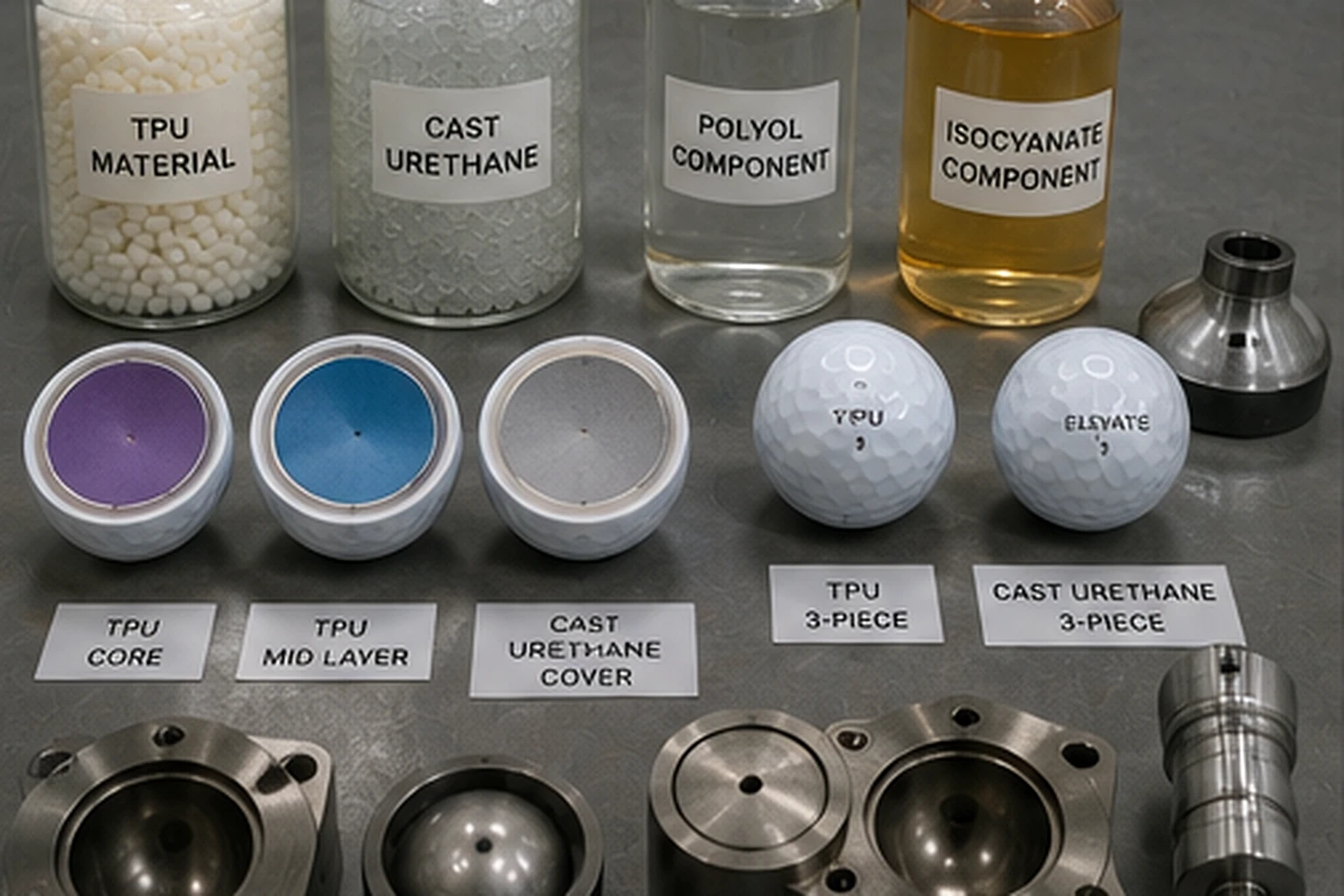
Do not let a supplier quote only “urethane.” Your PO should say TPU injection, TPU compression, or cast thermoset urethane. Cast is the flagship soft-feel route; TPU is the faster value-premium route. Both can work, but they sell different brand promises.
Here is the founder-friendly version: TPU is like a crayon; cast urethane is like baking a cake. TPU is thermoplastic. It starts as pelletized urethane, then it can be heated, molded, cooled, and processed efficiently. Cast thermoset urethane is different. Liquid components react inside the dimple mold and chemically crosslink into a cover that cannot simply be re-melted after curing.
For a DTC brand, this changes the story you can tell, the cost you should expect, the sample timing, the QC risk, and the review outcome. Cast thermoset urethane is usually the preferred route for flagship soft-feel, premium acoustics, and high-spin positioning. TPU is often the smarter value-premium route when speed-to-market, margin, and replenishment stability matter.
| Decision | Cast thermoset urethane | TPU urethane | Buyer move |
|---|---|---|---|
| Brand role | Flagship soft-feel / high-spin story | Value-premium DTC SKU | Choose before packaging copy |
| Process | Liquid components cure/crosslink in mold | Pelletized urethane molded by injection/compression | Write route in PO |
| Cost/speed | Higher cost, slower takt | Faster, more economical | Match launch budget |
| Feel/spin story | Preferred for soft acoustics and wedge spin | Firmer, practical, scalable | Pilot both if budget allows |
| QC focus | Cure, thickness, concentricity | Gate/knit line, weight reserve, adhesion | Audit route-specific risks |
How should the PO name the cover route?
The PO should name the cover route exactly, not poetically. “Premium urethane” sounds nice in a pitch deck, but it is not a manufacturing instruction.
Supplier says urethane but cannot define TPU or cast thermoset is a failure signal. A safer PO names the route, approved sample ID, cover thickness or hardness window, coating stack, and no-change rule. If the supplier changes cover route after sample approval, the ball can still look the same while the sound, wedge response, and review feedback move in the wrong direction.
Supplier shall confirm approved sample ID, cover route, dimple-tool ID, compression target, mantle hardness option, coating/paint stack, artwork version, production batch number, and retained-sample location before pilot or mass production. No material, tooling, dimple, cover route, paint, coating, logo, or subcontracting change is allowed without written buyer approval.
Do not approve packaging or marketing claims until the cover route is written into the PO. Your box copy should not promise a cast-urethane feel if the quote is actually a TPU build.
What specs create tour-style feel?
You may chase a Pro V1-equivalent idea, but your factory needs measurable targets, not a famous-ball comparison.
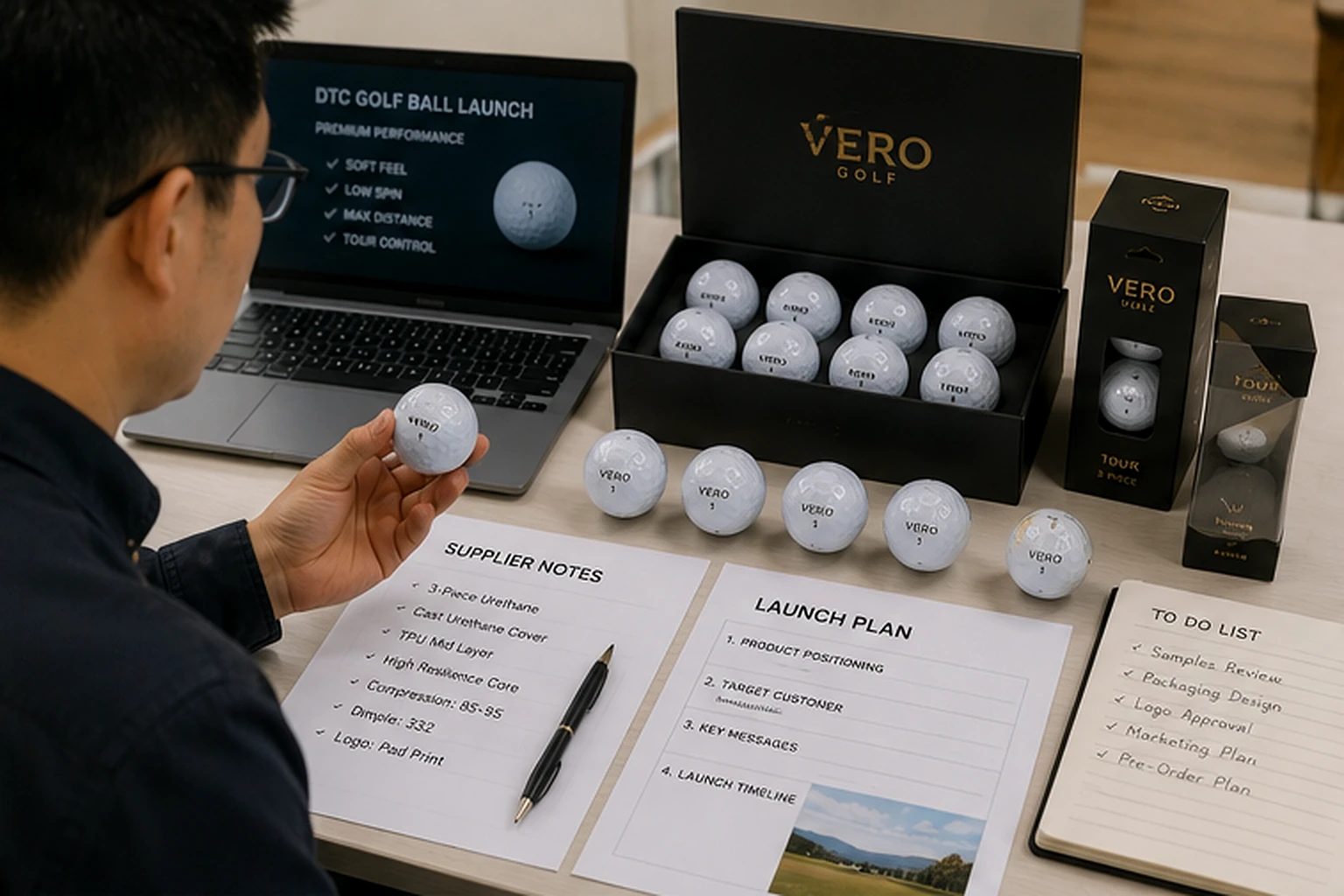
Tour-style feel is engineered through choices you can write down: dimple tool, mantle hardness, compression target, cover route, coating stack, and pilot feedback. Do not ask for a famous-ball clone; ask for measurable windows that fit your DTC brand.
The phrase “Pro V1 equivalent” may attract search traffic, but it does not protect you in production. It can also create the wrong conversation. You are not asking a factory to copy a famous ball; you are asking it to build a flagship feel for your channel, swing-speed audience, climate, retail price, and review risk.
Start with one dimple family. Existing 332, 342, or 352 dimple tools can reduce cost and sampling time when they fit the performance target. If you test TPU against cast, keep the same dimple family so you are comparing cover route and feel, not changing aerodynamics at the same time.
How do dimples and mantles tune feel?
Dimples influence flight stability, while mantle hardness helps tune launch, driver spin, and compression. Cover softness then changes wedge response, sound, and perceived quality.
For a DTC pilot, choose one primary compression target first. Many brands test around 72, 80, and 88 during development, but the first sellable pilot should avoid too many options. Mixed compression SKUs create noisy feedback and expensive inventory. A single target lets reviewers, fitters, and early customers react to one clear product.
Your flagship spec sheet should include dimple family, mantle hardness option, compression target, cover route, coating stack, logo method, wedge-response feedback method, and packaging direction. Compare pilot samples by carry, dispersion, wedge response, sound, and compression data. Approve one primary compression and one dimple family before ordering multi-SKU packaging. That keeps your first DTC launch from becoming a science fair with invoices.
✔ True — “Tour-style” must become measurable.
A premium feel target needs dimple family, mantle hardness, compression, cover route, coating stack, and pilot feedback. The factory cannot mass-produce a mood.
✘ False — “Pro V1-equivalent is a complete spec.”
It is a positioning idea. Your PO still needs construction, cover route, compression, dimple tool, and QC windows.
Can you launch with 1,000 balls?
You want a premium DTC launch, but full private tooling, multiple colors, USGA listing, and luxury packaging can burn cash before market proof.
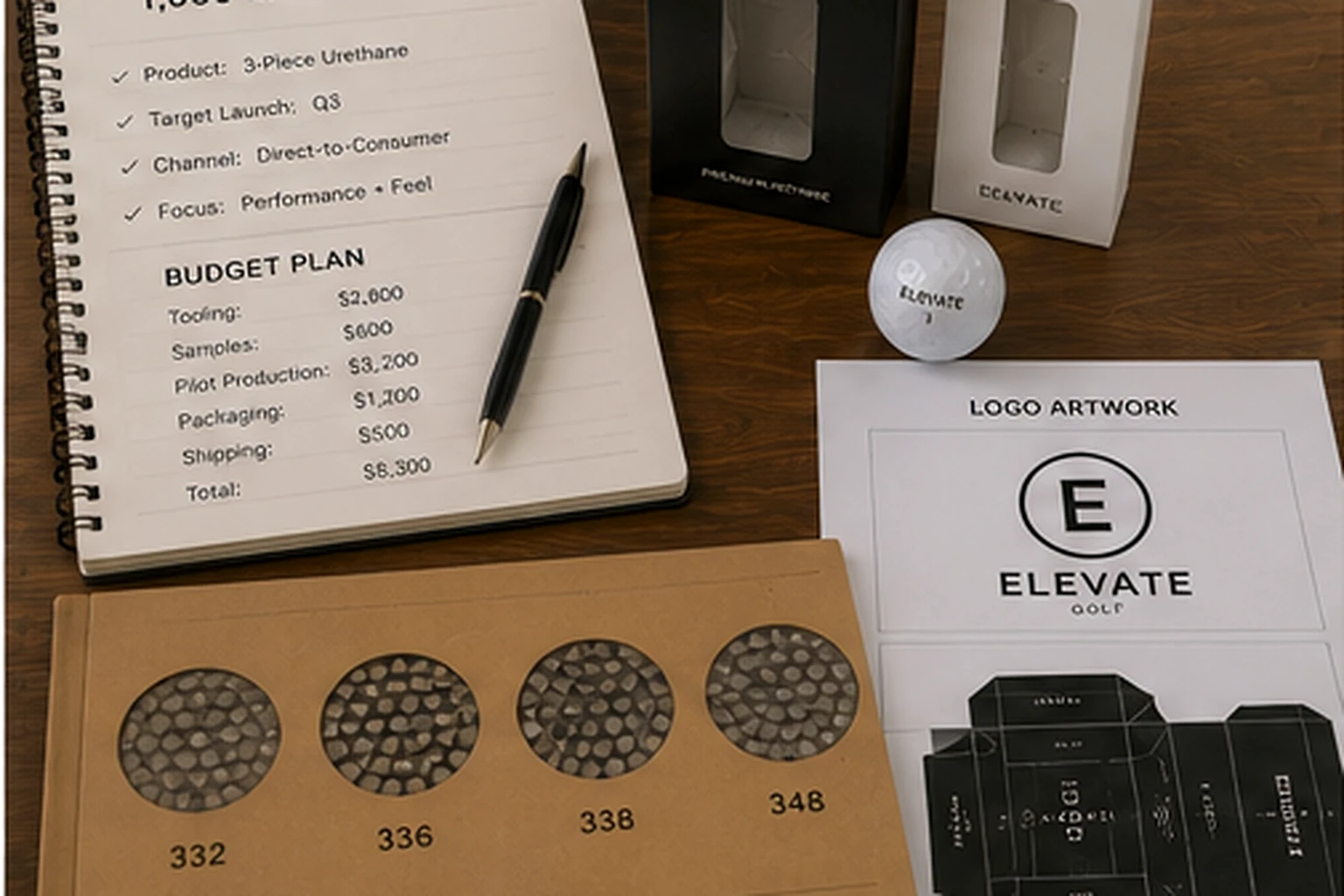
A 1,000–3,000 ball DTC pilot is possible when you reuse proven tools and control complexity. Use an existing 332/342/352 dimple family, one compression target, one cover route, simple artwork, and premium-but-standard packaging before spending on private tooling or listing.
New founders often try to buy “perfect” too early. They want a private dimple tool, two cover routes, three compression targets, four colors, influencer packaging, launch boxes, and tournament eligibility before anyone has proven repeat demand. That is a cash-flow trap wearing a very nice box sleeve.
A better first run buys market evidence. Use an existing dimple tool. Choose one cover route. Choose one compression target. Use standard premium packaging that still feels credible on camera. Keep logo markings controlled. Collect player feedback, launch-monitor data, wedge-response notes, packaging reactions, and reorder intent before you commit to private tooling.
| Launch decision | Low-risk pilot choice | Avoid at first run | Launch reason | Buyer move |
|---|---|---|---|---|
| Dimple tool | Existing 332/342/352 | Private tool immediately | Cuts tooling cost/time | Ask tool ID |
| SKU scope | One flagship compression | Three feels at once | Keeps feedback clean | Pick one target |
| Cover route | Cast or TPU, not vague urethane | Vague urethane | Protects brand promise | Write route in PO |
| Packaging | Premium standard sleeve/dozen | Overbuilt gift system | Protects cash flow | Upgrade on reorder |
| Compliance claim | Pilot without claim if channel allows | Premature USGA spend | Protects launch budget | Decide by channel |
When should USGA listing wait?
Listing should follow channel risk, not founder pride. If the first run is for founder testing, influencer seeding, fittings, or limited feedback, you may not need a public conforming claim yet.
That does not mean you should ignore rules or make loose claims. It means you should avoid spending before the market validates the product. A pilot without a conforming claim may be reasonable unless the ball will immediately enter tournaments, serious retail, or channels requiring current listing.
For launch planning, budget submission and annual resubmission separately. In the current fee structure, new submission and annual resubmission each sit at $1,200 per ball type for 24 sample balls, with late premium charges listed at $1,500 per ball type. That is before courier cost, sample preparation, internal QC, admin time, and calendar risk.
Supplier pushing public listing before market validation without channel need is a failure signal. Do not pay for private tooling, multi-color SKU spread, or public listing until your channel needs it. Ask for a pilot plan with MOQ, existing-tool ID, sample timing, packaging scope, cover route, and listing-timing recommendation.
Your first batch may feel good, but batch two can ruin your DTC reviews if compression, mantle alignment, cover thickness, or coating drifts.
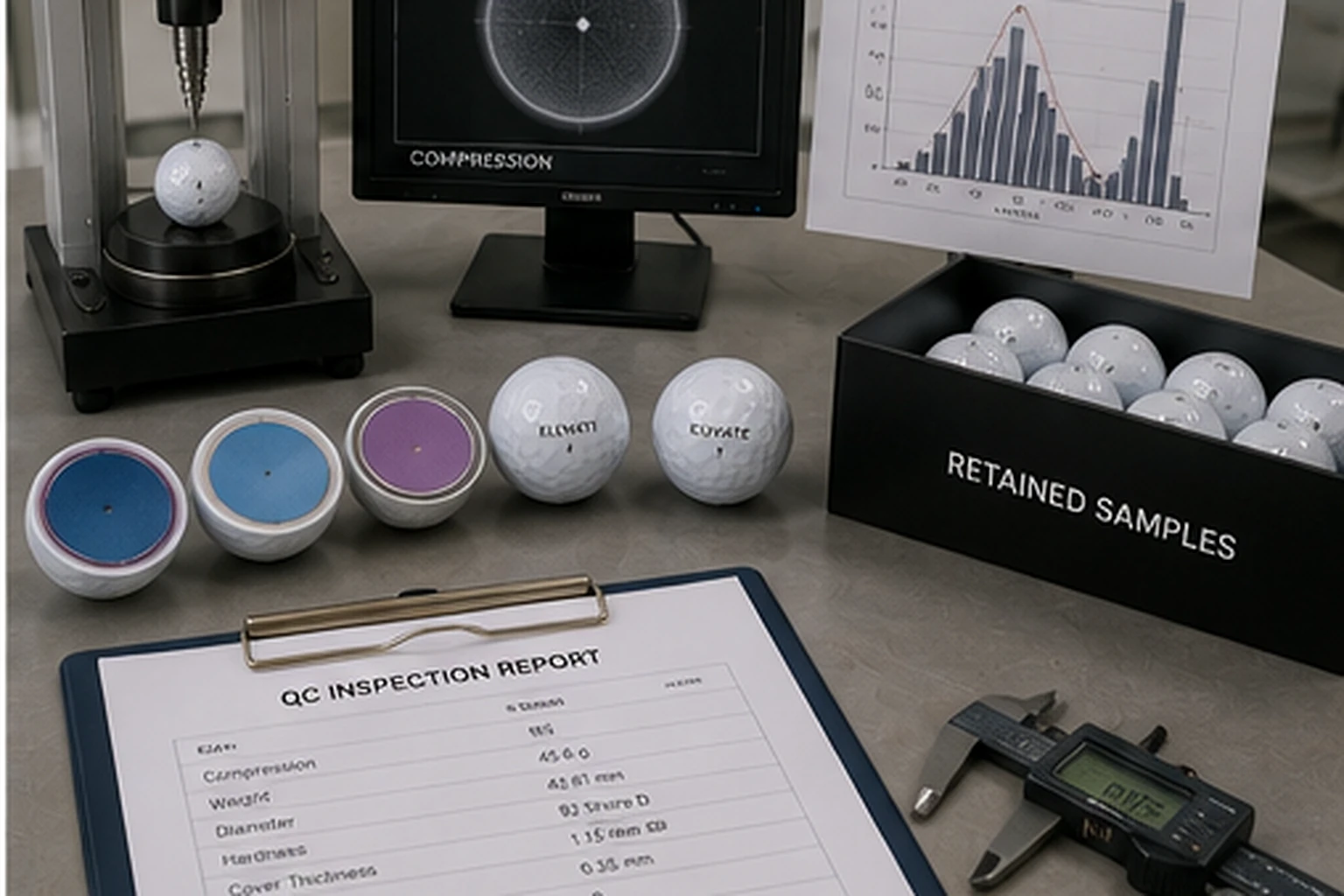
Your DTC ball will be judged by consistency, not your product page. Before shipment, ask for random-ball compression, weight, diameter, roundness, X-ray/CT or cut-ball evidence, Cpk/SPC where available, and retained samples linked to the batch.
Premium buyers are moving toward review-proof consistency. Serious ball-lab-style testing does not stop at launch-monitor numbers. It looks at compression, weight, diameter, roundness, visual defects, cut-open construction, and bad-ball rate. For a new DTC brand, that means your OEM quality system should start before the first PO, not after the first public review.
| Review risk | QC evidence | Internal gate | Buyer move |
|---|---|---|---|
| Feel drift | Compression raw data | σ≤2 on same gauge | Hold shipment if spread opens |
| Distance/flight drift | Weight + diameter distribution | Range + mean tracked | Compare to approved sample |
| Off-center layers | X-ray/CT or cut-ball proof | No visible major offset | Request batch-linked images |
| Cover inconsistency | Cover thickness / hardness | Defined window | Compare pilot vs mass |
| Reorder mismatch | Cpk/SPC + retained samples | Cpk≥1.33 where available | Approve reorder only after match |
In 2024, David, a Florida DTC founder, sourced what a B2B platform supplier called “Tour-Quality Cast Urethane” at an unbelievable **$1.15 FOB**. Weeks after launch, a gearhead YouTuber cut his flagship ball in half on camera. The verdict was brutal: cheap TPU injection disguised as urethane, with wildly off-center mantles. His sales flatlined almost instantly.
Burned and skeptical, David found Golfara on Google and assumed we were another trading company. Instead of pitching, we sent raw footage of our low-temp casting lines and joined an engineering video call to explain cast thermoset urethane, TPU injection, mantle alignment, and X-ray QC. That proof earned enough trust to build a recovery plan.
We locked **true Cast Thermoset Urethane** in the PO, reused our proven **332-dimple public mold** to keep the rescue pilot at **3,000 balls**, and supplied **X-ray concentricity scans** plus **Cpk charts** for his homepage. David relaunched his V2 ball with engineering transparency, and the **3,000-ball pilot sold out in 16 days**, helping save the brand and recover his losses.
What would a reviewer test first?
A reviewer will look for consistency before believing the story. Compression drift, uneven layers, off-center cores, roundness failure, and cover defects can turn a premium launch into a very public headache.
Supplier claims tour-level without X-ray/CT or compression distribution is the final failure signal. One soft-feeling sample sleeve does not prove the bulk lot. It only proves the supplier can make a few good samples.
Request a pre-shipment 3-piece urethane QC pack with cover route, approved sample ID, dimple-tool ID, 12 or 24 random-ball raw data, compression sigma, weight and diameter distribution, X-ray/CT or cut-ball concentricity proof, Cpk/SPC where available, equipment ID, calibration date, and retained-sample plan.
Pre-shipment acceptance should include random-ball raw data for weight, diameter, compression, hardness, cover thickness, and concentricity, with method, equipment ID, calibration date, sample ID, batch link, mean, range, and sigma. Do not approve shipment or reorder until batch data matches the approved sample within the agreed window.
✔ True — Batch-linked QC protects your brand.
A premium sample sleeve can impress your team, but batch data protects you from review damage, reorder drift, and customer complaints.
✘ False — “A premium sample sleeve protects your brand.”
Samples start the conversation. Random-ball data, X-ray/CT or cut-ball proof, compression sigma, and retained samples protect the launch.
FAQ
Can Chinese factories make tour-grade cast urethane balls?
Yes, selected China OEM factories can support tour or near-tour cast urethane builds, but the claim must be verified. Ask for cast thermoset wording, X-ray/CT or cut-ball proof, compression distribution, Cpk/SPC where available, and pilot-lot data.
Do not accept generic urethane wording. Ask whether cast is routine production, special production, or only quoted on request. Scale only after the supplier provides batch-linked QC proof that connects the approved sample, dimple tool, cover route, compression target, and retained samples.
What is the MOQ for custom 3-piece urethane balls?
A practical DTC pilot can often sit around 1,000–3,000 balls when you reuse existing dimple tools, standard colors, mature formulas, and controlled packaging. Full private tooling or complex builds usually push MOQ higher.
Ask for 1k, 3k, and private-tool quotes under the same cover route and QC gate. Use 332/342/352 tool families where appropriate. Avoid multiple compressions, colors, logo variants, and gift systems in the first run unless the launch budget can absorb slower validation.
What is the difference between TPU and cast urethane?
TPU is thermoplastic and can be injection- or compression-molded from pelletized urethane. Cast thermoset urethane forms through chemical reaction in the mold and cannot simply be remelted after curing.
TPU is faster and more economical, making it useful for value-premium DTC programs. Cast is usually preferred for flagship soft-feel and high-spin positioning. Write the exact route in the RFQ and PO so the supplier cannot hide behind generic urethane wording.
How much does a 3-piece urethane golf ball cost?
Use price bands as quote references, not guarantees. TPU and cast routes, paint stack, print, packaging, tolerance, QC data, and MOQ all change FOB cost. Ask for line-item quotes before comparing suppliers.
Separate ball build, paint, print, packaging, and QC cost. Do not compare a TPU quote against a cast quote and call the lower number better. Verify current pricing with the same construction, cover route, compression target, packaging scope, and batch-proof requirement.
Should a DTC launch pay for USGA listing first?
Only if the first launch will enter tournaments, serious retail, or channels requiring current listing. Many DTC pilots should validate feel, demand, and batch stability first without making a conforming claim.
Budget submission and annual resubmission separately. Do not call a model conforming before listing. Use listing timing as a channel decision, not vanity spend. A stronger first move is to lock the model, markings, cover route, and batch consistency before funding public eligibility.
What QC data should I request for a premium urethane ball?
Request random-ball raw data for compression, weight, diameter, roundness, cover thickness, hardness, and concentricity, plus X-ray/CT or cut-ball proof and retained samples.
Ask for mean, range, and sigma, not only pass/fail wording. Link every report to sample ID and batch ID. Use the same calibrated compression gauge across pilot, shipment, and reorder so batch-two feel can be compared against the approved sample.
Can I use existing dimple tools for a premium DTC ball?
Yes, existing 332/342/352 dimple families can reduce tooling cost and speed up sampling when they fit your performance goal. The trade-off is less aerodynamic exclusivity.
Ask for dimple-tool ID and maintenance status. Keep one dimple family during cover-route testing so you can isolate TPU vs cast differences. Move to private tooling only after demand is proven and your brand can afford development risk.
How do I stop the second batch from feeling different?
Freeze the approved sample, cover route, dimple tool, compression target, coating system, and QC window. Then require batch-linked raw data and retained samples for every production run.
No material, tooling, cover-route, coating, or logo change should happen without written approval. Compare reorder data to pilot data before shipment. Hold the reorder if compression, concentricity, cover thickness, or visual quality drifts outside the agreed window.
Conclusion
The right China OEM is not just the one that can make a urethane-covered ball. It is the one that helps you choose a cover route, launch at a sane MOQ, avoid premature listing spend, and prove batch consistency before reviewers or customers judge the ball.
Start with the shortlist, then force clarity: cast or TPU, which dimple family, which compression target, which launch quantity, which listing path, and which QC pack. That is how a DTC founder turns a premium idea into a shipment that can survive real players, real reviews, and real reorders.
You might also like — Top 2-Piece Surlyn Golf Ball Manufacturers in China: The 2026 Volume OEM Guide