Top China OEM sources for 4-piece urethane golf balls include Xiamen MLG, Ningbo Golfara, Ningbo Yihong, and Xiamen Yopral. For 2026 tour-grade sourcing, typical MOQs range from 1,000–3,000+ pcs, samples can run 7–12 days, and mass production usually falls around 15–35 days when tooling, artwork, cover route, and QC gates are locked.
A 4-piece urethane ball fails when the layers exist on paper but not in performance. The safer manufacturer is the supplier that can prove dual-mantle speed/spin separation, cast urethane control, X-ray/CT concentricity, Shore D hardness by layer, and sample-to-mass repeatability before you approve bulk production.
Before choosing a 4-piece urethane golf ball manufacturer in China, check five items:
-
Supplier fit: Xiamen MLG, Ningbo Golfara, Ningbo Yihong, or Xiamen Yopral.
-
MOQ and timing: 1,000–3,000+ pcs, 7–12 day samples, and 15–35 day mass production when scoped.
-
Performance logic: dual mantles should decouple driver speed from wedge spin.
-
Internal audit proof: X-ray/CT, Shore D by layer, compression data, and cover-thickness maps.
-
Trial path: low MOQ works only with proven dimple tools, controlled customization, and stricter QC.
Use the factory shortlist as the starting point, then audit what separates a real 4-piece tour-style build from an extra-layer brochure claim.
Which China OEMs make 4-piece urethane?
You need the known China shortlist, but you also need to know which supplier fits tour-style trials, mature retail programs, or small-MOQ premium testing.
Start with the Top 4 shortlist, but approve only after engineering proof. Xiamen MLG, Ningbo Golfara, Ningbo Yihong, and Xiamen Yopral can fit different 4-piece urethane programs, but MOQ and lead time are useful only after cover route and QC proof are verified.
The China 4-piece urethane supply base is concentrated around Xiamen and Ningbo for practical reasons. Xiamen and the Fujian coast are strong in mature multilayer urethane production, repeat retail logic, and packaging coordination. Ningbo and Zhejiang are useful when a premium buyer needs agile sampling, lower trial MOQ, and faster engineering communication before committing to a larger run.
| Manufacturer | Region | Typical MOQ | Timing | Best fit | Buyer move |
|---|---|---|---|---|---|
| Xiamen MLG | Xiamen / Fujian | ~2,000 | 20–35 days mass | Mid-volume tour-style programs | Verify dual-mantle and cast route |
| Ningbo Golfara | Ningbo / Zhejiang | 1,000–2,000 | 7–12 day sample / 15–20 day mass when scoped | Small-MOQ premium trials | Use existing tool + X-ray gate |
| Ningbo Yihong | Ningbo / Zhejiang | 3,000+ | 15–30 days | Price-tiered premium lines | Verify route by SKU |
| Xiamen Yopral | Xiamen / Fujian | 1,000–3,000 | 15–25 days | Event balls / white-label premium | Verify batch consistency |
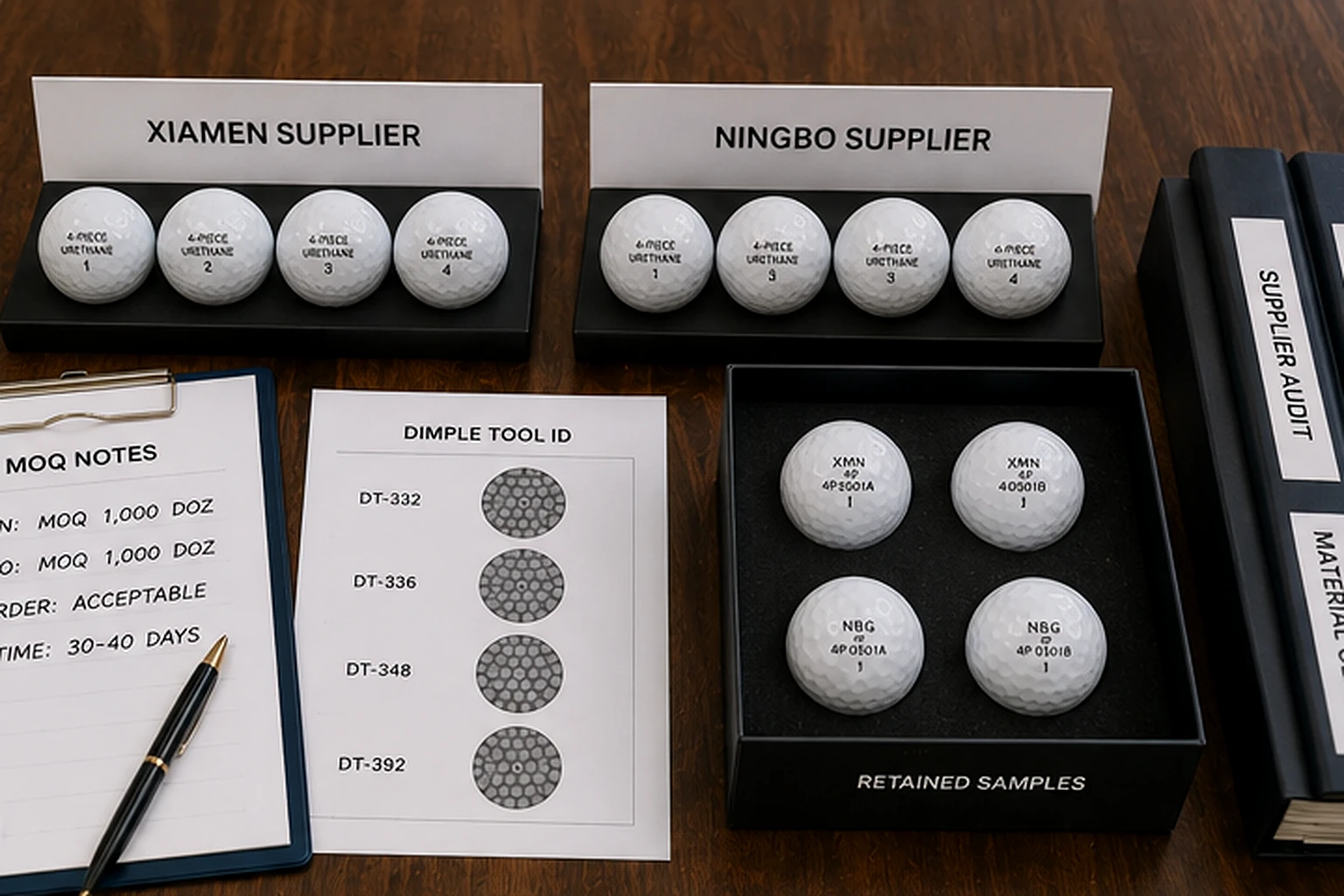
Treat this table as shortlist evidence, not final supplier approval. Ask each supplier for current MOQ, sample timing, dimple-tool ID, cover route, mantle hardness data, and a recent QC pack. Confirm whether 4-piece cast urethane is routine production, special production, or only a catalog claim.
The first thing you should consider: can the supplier explain the PB core, inner mantle, outer mantle, and urethane cover as a working system? If not, the MOQ number is just decoration. Low MOQ only helps when tooling, formula, X-ray/CT audit scope, and retained samples are controlled.
✔ True — The Top 4 table is a shortlist, not approval.
Names, MOQs, and lead times help you screen quickly. A premium 4-piece program still needs cover-route proof, dual-mantle logic, X-ray/CT evidence, and batch-linked QC.
✘ False — “The smallest MOQ is automatically the best 4-piece factory.”
A small trial is only safe when the supplier controls the formula, tooling, inspection plan, and repeat order path.
How does 4-piece decouple speed and spin?
You may pay for a fourth layer but fail to get real driver-spin and wedge-spin separation if the mantle stack has no measurable hardness gradient.
A real 4-piece ball uses dual mantles to separate driver behavior from wedge behavior. The inner mantle helps speed and long-game launch; the outer mantle and cast urethane cover help spin control, stopping power, and wind-stable premium flight.
A 4-piece tour ball is not designed to break the distance rule. It is designed to live right under the allowed performance envelope while improving launch, spin separation, and control. Under the Overall Distance Standard, the distance ceiling is 317 yards plus a 3-yard tolerance under controlled test conditions. For full compliance context, review the USGA/R&A conforming golf ball requirements before making tournament or regulated retail claims.
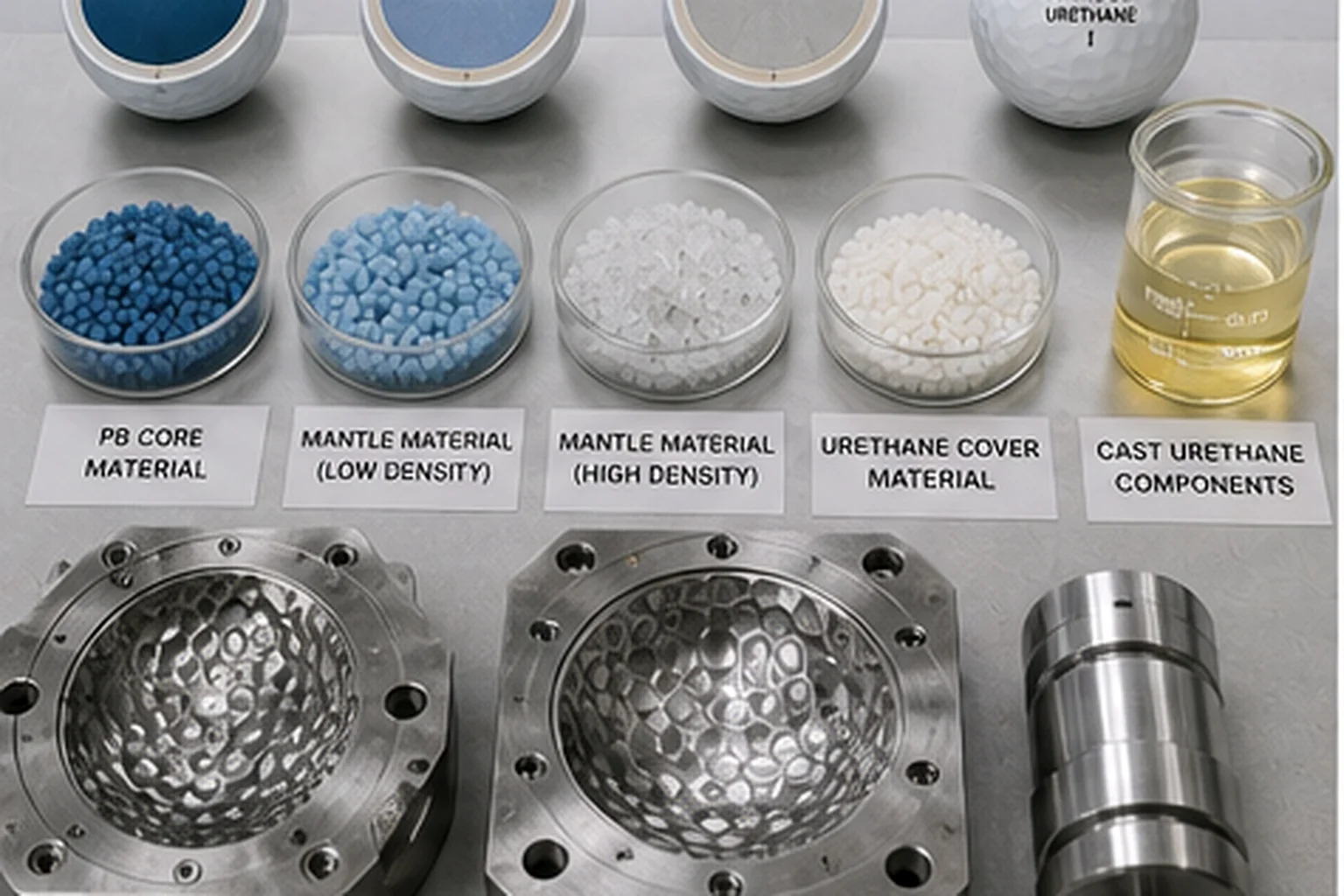
The fourth layer matters only if it does useful work. The PB core supplies energy. The inner mantle supports ball speed and long-game response. The outer mantle helps tune spin, trajectory, and cover interaction. The cast urethane cover adds wedge friction, soft feel, and stopping power.
| Layer | Engineering role | Buyer risk | Proof to request | Acceptance gate |
|---|---|---|---|---|
| PB core | Primary energy source | Wrong compression base | Core spec + compression data | Lock target window |
| Inner mantle | Velocity and driver response | No speed separation | Shore D + rebound logic | Compare to sample |
| Outer mantle | Spin/trajectory control | Fake fourth layer | Shore D gradient | Require layer data |
| Cast urethane cover | Wedge friction and feel | Generic TPU substitution | Cover route + thickness map | Write route in PO |
| Coating/finish | Appearance and durability | Paint hides tolerance issues | Post-paint weight/QC | Verify after coating |
Which mantle does what?
The inner mantle supports speed; the outer mantle helps manage spin and cover interaction. A supplier should be able to describe both layers without turning the answer into fog.
A real 4-piece ball is not “one extra layer for the brochure.” The mantle stack should create a measurable hardness and resilience strategy. Ask for Shore D data by layer: inner mantle, outer mantle, and cover. If the supplier claims 4-piece but cannot provide layer Shore D data, that is a failure signal.
Thin cast urethane adds another factory challenge. Patent-style engineering references for multilayer balls often discuss thin thermoset cover targets in the 0.020–0.040 inch range, with about 0.030 inch / 0.76 mm as an engineering benchmark, not a universal public spec. At that scale, cover uniformity, liquid metering, mold temperature, degassing, and post-cure control become part of the audit.
For cleaner version control, ask the supplier to identify the approved sample ID, dimple mold/tool ID, core formulation, inner mantle material, outer mantle material, cast urethane chemistry, coating stack, curing window, production batch number, and retained-sample location before mass production. No material, tooling, dimple, mantle, cover chemistry, coating, curing, or line change should happen without written buyer approval and re-validation.
When is 4-piece better than 3-piece?
You may choose 4-piece because it sounds premium, but your target players may get better feel, cost, and launch from a 3-piece urethane ball.
A 4-piece urethane ball is not better for every golfer. It fits buyers targeting faster players, wind stability, lower long-game spin, and high short-game control. For broader amateur audiences, a 3-piece urethane may feel easier and cost less.
The market lens is practical: R&D buyers prefer proof over layer-count claims. A 4-piece ball should be chosen because the target player can benefit from extra mantle tuning, not because the product page looks more premium with a bigger number.
A Pro V1x-style intent class is usually firmer, higher flying, lower in long-game spin, and stronger in short-game spin than softer broad-fit alternatives. That does not mean your brand should clone a famous ball. It means your team should define the player profile before choosing the construction.
| Buyer decision | Choose 3-piece urethane | Choose 4-piece urethane | Buyer move |
|---|---|---|---|
| Target player | Moderate speed / broader fit | High speed / high control | Define audience first |
| Feel target | Softer, easier activation | Firmer, tour-style response | Pilot by compression |
| Spin goal | Balanced short-game control | Driver/wedge spin separation | Use launch monitor + wedge test |
| Budget | Lower unit and scrap risk | Higher precision and audit cost | Price engineering proof |
| Brand position | Premium all-rounder | Tournament / tour-style SKU | Match claim to proof |
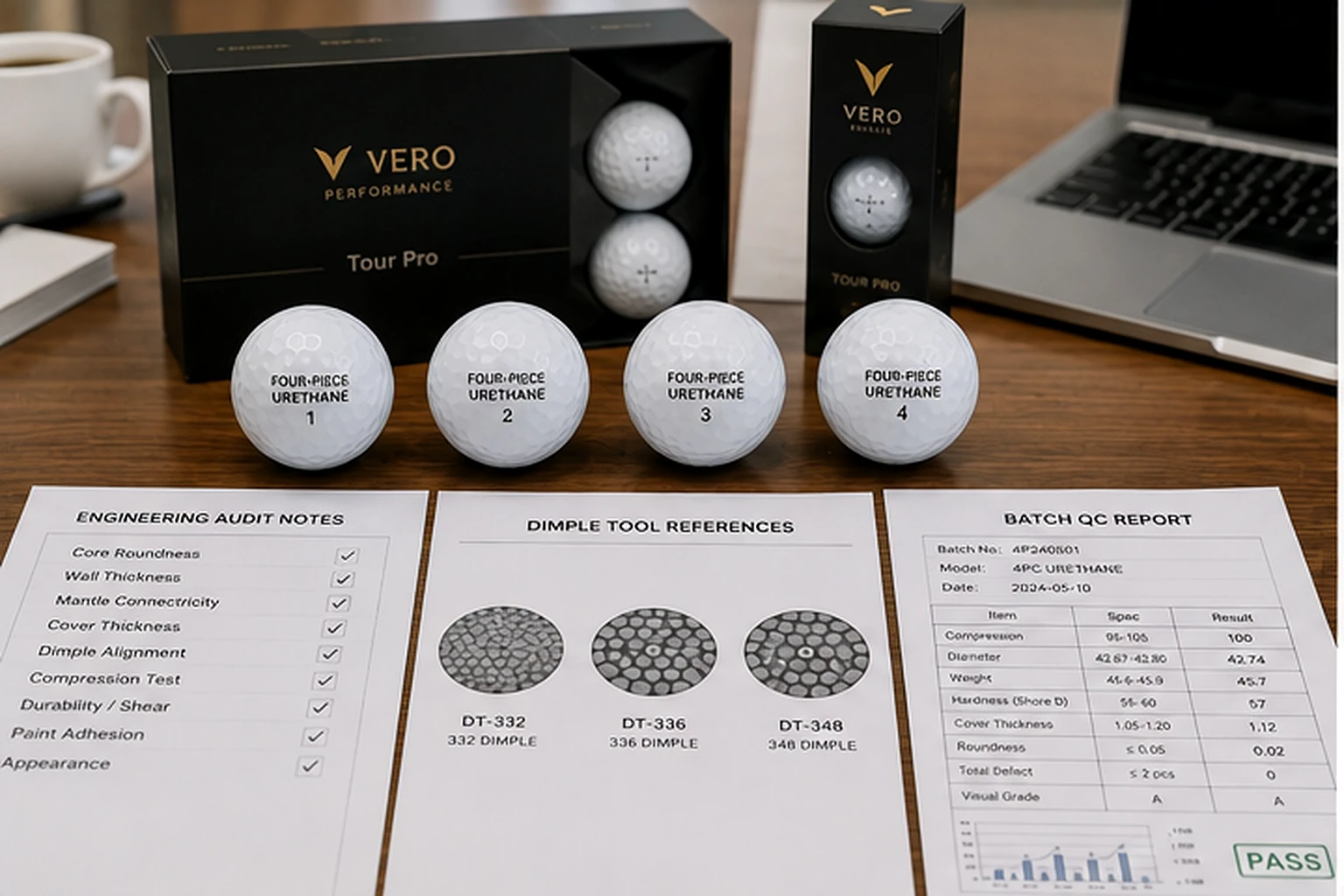
Who should not choose 4-piece?
Average-speed audiences may not need a 4-piece ball. Many players get easier launch, softer feel, and better value from a well-built 3-piece urethane model.
Do not write “4-piece” into the brief just because it sounds elite. High-compression, tour-style balls often fit faster players who can load the ball hard enough to benefit from extra mantle tuning. Still, swing speed is not the only variable. Launch, spin, landing angle, feel preference, weather, and retail position all matter.
Request 3-piece and 4-piece pilot options with the same cover route and comparable compression targets. Compare launch, driver spin, wedge spin, feel, dispersion, and player feedback. Choose 4-piece only if the target player and channel can benefit from extra mantle tuning. If your customer base is mostly moderate-speed recreational golfers, a 3-piece urethane may convert better and create fewer returns.
✔ True — 4-piece should match the player profile.
The extra mantle is useful when your target player needs speed/spin separation, firmer response, wind stability, and premium short-game control.
✘ False — “Premium buyers should always choose 4-piece.”
A 3-piece urethane ball may be a smarter choice for broader amateur fit, softer feel, lower cost, and easier launch.
How do you audit 4-layer concentricity?
You cannot see whether a 4-piece ball is off-center from the outside, but layer misalignment can damage flight, feel, and premium consistency.
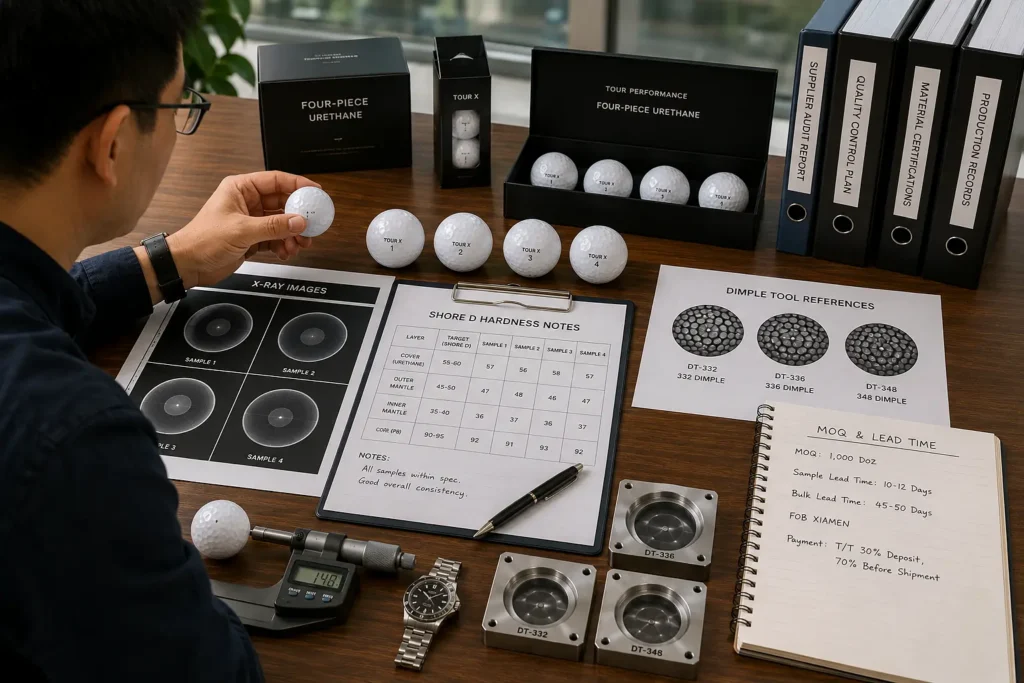
The highest-risk defect in a 4-piece urethane ball is invisible: off-center layers. Before shipment, require X-ray/CT or cut-ball proof, Shore D by layer, cover-thickness map, compression distribution, and batch-linked retained samples.
A 4-piece structure has multiple internal interfaces. The surface can look perfect while the core or mantle stack is slightly off-center. That drift can affect balance, compression behavior, launch consistency, and premium feel. A buyer cannot inspect that risk with a sleeve photo.
This is where a tour-grade OEM audit becomes serious. The supplier should show random production samples, not only golden samples. It should connect each QC file to the batch ID, dimple-tool ID, approved sample, equipment ID, and retained sample location.
| Audit risk | Proof to request | Strong buyer gate | Why it matters | Buyer move |
|---|---|---|---|---|
| Core/mantle offset | X-ray/CT or cut-ball images | Batch-linked images | Prevents biased flight | Hold if offset appears |
| Fake mantle gradient | Shore D by layer | Defined layer window | Proves fourth layer function | Require data before PO |
| Cover inconsistency | Cover-thickness map | Target + tolerance | Protects spin/feel | Compare pilot and bulk |
| Feel drift | Compression raw values | σ≤2 internal gate | Protects batch feel | Use same gauge |
| Process drift | Cpk/SPC where available | Cpk≥1.33 target | Shows repeatability | Review before reorder |
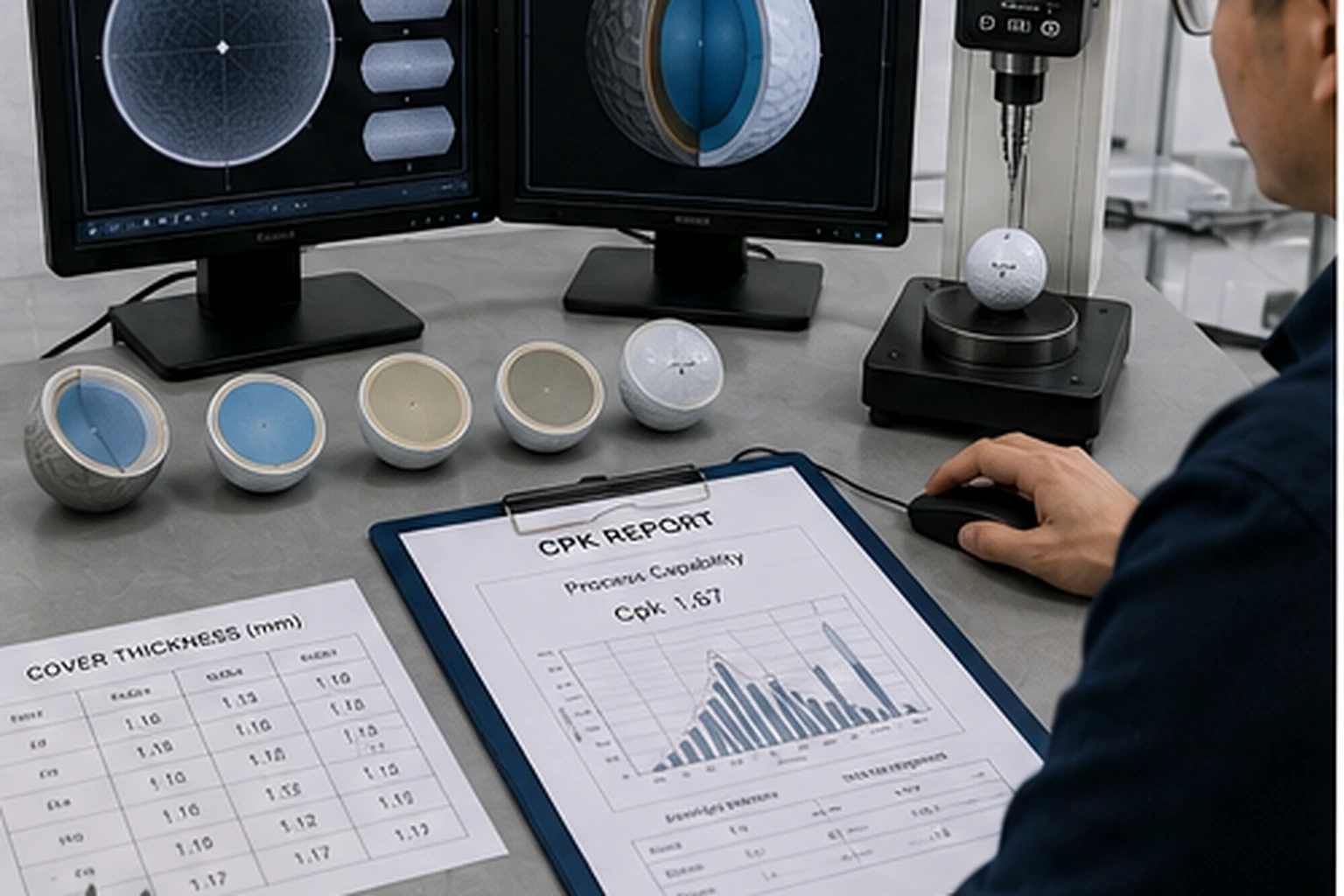
Which QC pack proves tour-grade?
A tour-grade QC pack proves the inside, not just the paint. It should include layer data, concentricity evidence, compression distribution, and retained samples tied to the same production batch.
Supplier refuses X-ray/CT or cut-ball concentricity proof is a failure signal. For a premium 4-piece program, that evidence is not a lab luxury; it is the only practical way to verify hidden layer alignment before the market judges the ball.
Request pre-shipment data for random production samples, including X-ray/CT concentricity images, layer-by-layer Shore D hardness data, cover-thickness map, compression distribution, weight, diameter, roundness, CT/COR, equipment ID, calibration date, batch ID, and retained samples.
Pre-shipment acceptance should include X-ray/CT concentricity images, Shore D hardness by layer, cover-thickness map, compression distribution, weight, diameter, roundness, CT/COR, and retained samples by lot ID, with method, equipment ID, calibration date, sample ID, batch link, mean, range, and sigma. Do not approve shipment if internal-layer evidence is missing for a premium 4-piece program.
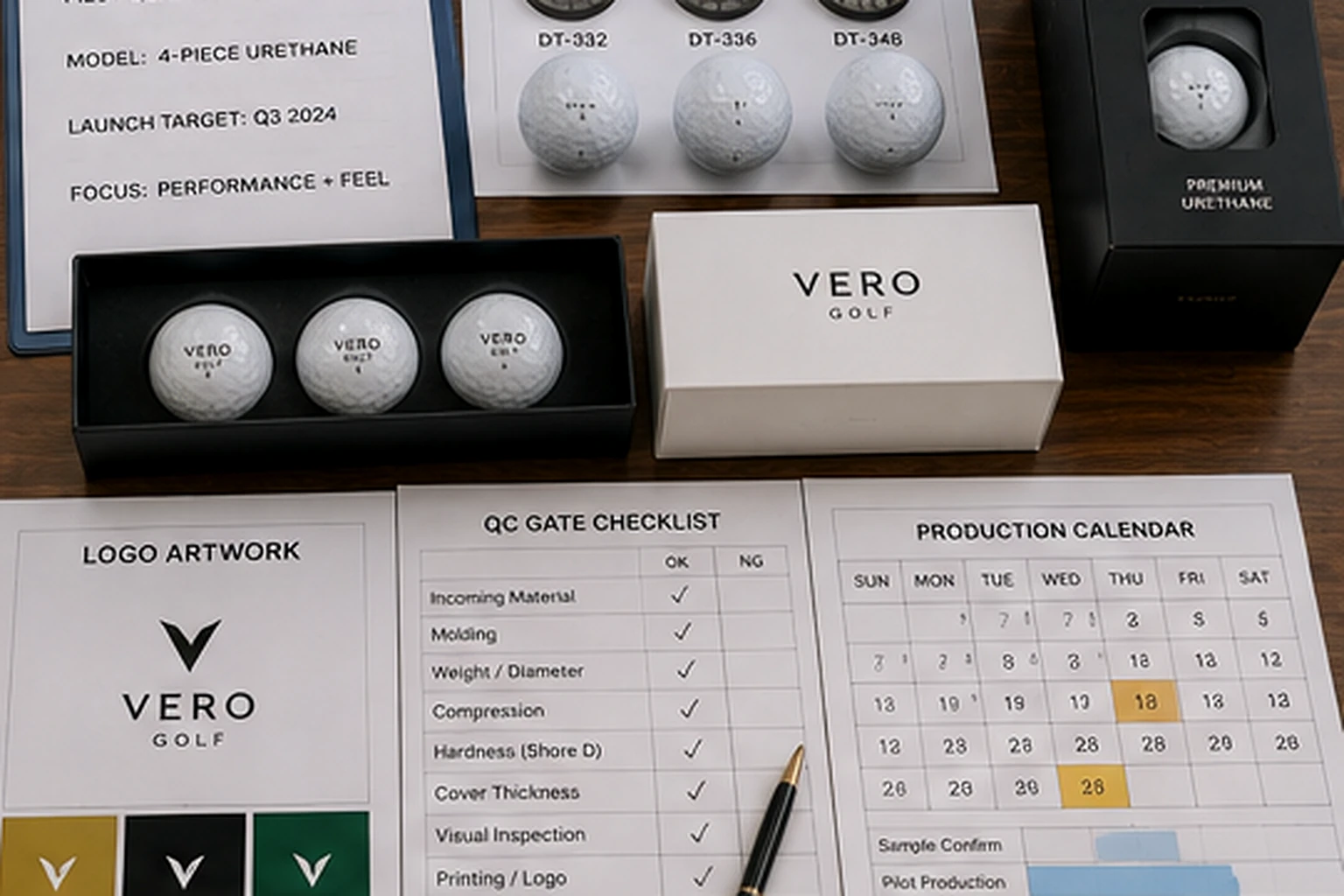
File name: branded-golf-balls-oem-quality-control.webp
Keywords: branded, OEM, quality control
Can 4-piece trials start at 1,000 pcs?
You may need a tournament-grade or premium test run, but private tooling and high scrap risk can push many factories toward high MOQs.
A 1,000–2,000 pcs 4-piece urethane trial is realistic only when the project reuses proven inputs. Use an existing dimple tool, mature formula, standard color, one compression target, and X-ray/CT audit gate before private tooling or complex finishes.
https://golfara.com/wp-content/uploads/2026/05/branded-golf-balls-oem-quality-control.webp
Golfara’s Ningbo path is best understood as agile engineering, not magic. A low-MOQ 4-piece trial works when the buyer accepts the trade-off: proven 332/342/352 dimple tooling, existing high-speed formula, standard white or yellow finish, controlled logo scope, and a clear QC gate. That is how a premium test can stay disciplined instead of becoming an over-customized prototype.
Private molds, custom color shells, complex coating stacks, many logo colors, and gift-box systems change the math. They add validation time, finishing risk, and minimum production pressure. Supplier offers 1,000 pcs with private tooling, many colors, and no audit trade-off is the third failure signal.
For a small-MOQ 4-piece trial, request a plan that confirms:
-
Existing dimple-tool ID and maintenance status.
-
Formula status and whether it has been run before.
-
One compression target and one cover route.
-
Standard color or limited finish scope.
-
Sample timing tied to approved artwork and tool selection.
-
X-ray/CT, Shore D, compression, and retained-sample gate.
-
Mass timing after sample, artwork, and QC criteria are approved.
Samples can move in 7–12 days and mass production can fall within 15–35 days only when scope is controlled. Tournament and premium buyers often prefer small verified trials before private-tool investment. Approve a low-MOQ trial only when customization scope and engineering inspection are locked.
✔ True — Low MOQ can be safe when the inputs are proven.
Existing tools, mature formulas, limited finishes, and stronger inspection can support a disciplined premium trial without pretending every custom idea fits 1,000 pcs.
✘ False — “Low MOQ means the factory is cutting corners.”
Low MOQ becomes risky only when it is paired with private tooling, too many custom variables, and weak QC evidence.
FAQ
What is the advantage of a 4-piece urethane ball?
The main advantage is decoupling: dual mantles let the ball manage driver speed and long-game spin separately from wedge interaction and stopping power. That gives R&D teams more tuning freedom than a simpler 3-piece construction.
Use 4-piece when speed/spin separation matters for the target player and channel. Ask for inner and outer mantle hardness data, compression distribution, dimple-tool ID, and cover-route proof. Do not buy layer count without performance evidence, because an extra layer with no real function is just a more expensive label.
Should average golfers use a 4-piece golf ball?
Not always. Many average-speed golfers may get easier launch, softer feel, and better value from a 3-piece urethane ball. A 4-piece model usually makes more sense for faster players and tour-style control needs.
Choose 4-piece when the player profile needs firmer response, wind stability, long-game spin control, and strong wedge stopping power. Choose 3-piece for broader amateur fit. Test by launch, spin, feel, landing behavior, and customer feedback instead of assuming more layers automatically fit more golfers.
Why is a 4-piece golf ball hard to manufacture?
The difficulty is internal alignment. A 4-piece structure adds multiple internal interfaces, so mantle offset, cover thickness drift, and compression spread can damage consistency even when the surface looks perfect.
Request X-ray/CT or cut-ball proof from random production samples. Ask for Shore D hardness by layer, cover-thickness maps, compression distribution, weight, diameter, roundness, and retained samples. Compare pilot and bulk data before shipment, because the defect that hurts flight may be invisible from the outside.
What is dual mantle golf ball technology?
Dual mantle golf ball technology uses inner and outer mantle layers to tune different parts of performance. The inner mantle supports speed and launch; the outer mantle helps manage spin, trajectory, and cover interaction.
Ask what each mantle is designed to do. A serious factory should explain hardness, rebound, compression target, and cover interaction without hiding behind “tour-grade” language. Request Shore D and resilience data where available. Avoid suppliers that cannot explain the layer function or provide any proof of hardness strategy.
What is the difference between X-Out and Practice balls?
In premium 4-piece urethane, X-Out or Practice usually means cosmetic grading, not a cheap range-ball construction. The internal 4-layer structure should match the retail model unless the supplier states otherwise in writing.
Blemishes may include paint marks, print mis-registration, dust nibs, or minor surface appearance issues. These balls can be useful for personal practice or value play. They are not the same as range-bucket balls, which are usually 1–2 piece Surlyn builds designed for abuse and low replacement cost.
Is cast urethane better than TPU for 4-piece balls?
Cast urethane is usually the preferred route for flagship 4-piece tour-style feel and wedge control, while TPU can reduce cycle time and cost for some programs. The right choice depends on SKU intent and proof.
Ask the supplier to declare cast thermoset urethane or TPU before quoting. If schedule and cost matter, run controlled A/B testing while keeping core, mantle, dimple family, and compression target comparable. Write the cover route into the PO so the final shipment cannot drift away from the approved sample.
What MOQ should I expect for custom 4-piece balls?
MOQ depends on tooling, formula, color, cover route, finishing, and inspection scope. In this shortlist, Golfara is positioned around 1,000–2,000 pcs when mature tools and controlled customization are used.
Private tooling usually increases MOQ and development time. Existing 332/342/352 tools can lower trial risk when they fit the performance target. Ask for a low-MOQ trial plan that explains dimple tool, formula status, sample timing, customization limits, and engineering audit gates.
What QC data should a 4-piece OEM provide?
A premium 4-piece OEM should provide batch-linked data for X-ray/CT concentricity, Shore D by layer, cover thickness, compression, weight, diameter, roundness, CT/COR, and retained samples.
Request raw values, mean, range, and sigma, not only pass/fail wording. Link every report to sample ID, batch ID, tool ID, and retained samples. Use the QC file before shipment and again before reorder approval, because batch-two drift can damage a premium product faster than a slow sample response.
Conclusion
The right 4-piece China OEM is not merely the factory offering four layers. It is the supplier that can prove dual-mantle function, cast urethane route, layer concentricity, cover thickness, compression control, and small-MOQ trial discipline before mass production.
Start with the Top 4 shortlist, then force the engineering proof. Ask what each layer does, how the supplier verifies it, and whether the trial scope supports the MOQ being quoted.
You might also like — Top 3-Piece Urethane Golf Ball Manufacturers in China: The 2026 DTC Guide