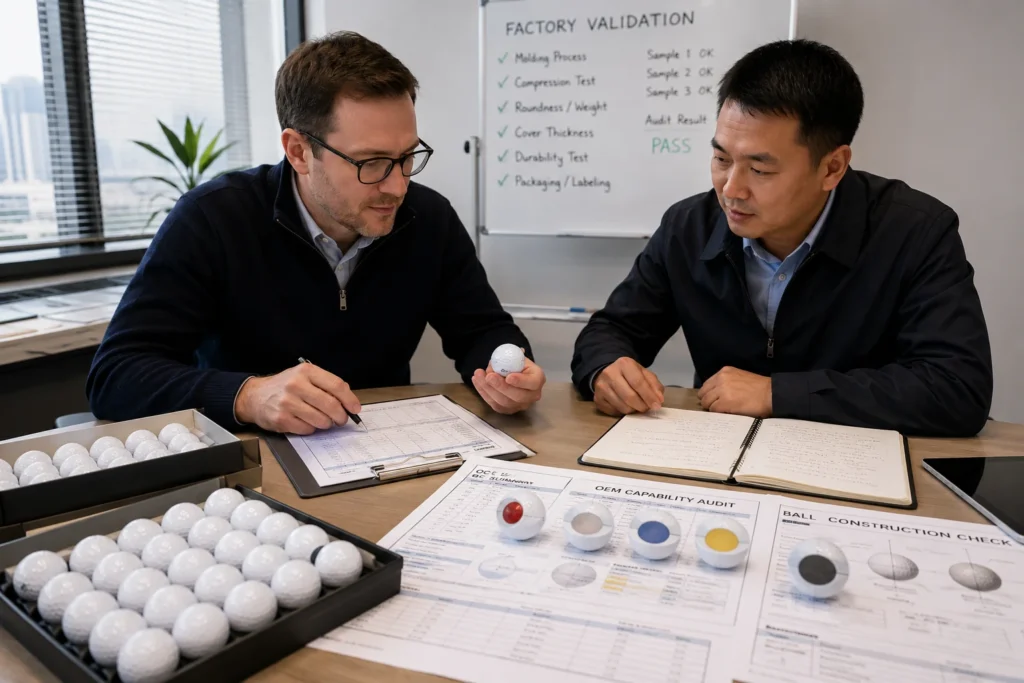
Can Chinese factories make tour-level golf balls? Yes, some advanced Chinese OEMs can build credible tour-style alternatives, but tour-level claims require proof: cover process, core control, spin data, concentricity, aerodynamic tooling, USGA logic, and batch repeatability. A soft feel, clean finish, or one certificate is not enough to prove premium performance at scale.
Your real risk is not that China can only make low-end golf balls. Your risk is approving a premium-looking sample that loses wedge spin, cover durability, wind stability, or compression consistency once the factory moves into bulk production.
This article does not promise a Pro V1 or Pro V1x clone. It gives you an audit framework for deciding when China is a smart tour-style OEM route, what still limits full parity, and what evidence belongs in your RFQ before a factory prints the first logo.
Can China Make Tour-Style Golf Balls?
A premium sample can fool a buyer fast. It may look clean, feel soft, and still fail when tested for wedge spin, core centering, or batch consistency.
China can manufacture credible tour-style golf balls, but buyers should not treat appearance as parity. Your decision should depend on whether the factory can prove core chemistry, cover process, concentricity, spin separation, and batch repeatability under production conditions.
Tour-Style Capability, Not Clone Parity
The right question is not whether a China OEM can “copy Pro V1.” That wording creates IP risk and encourages shallow layer-count thinking. Your better sourcing question is whether a specific factory can build a legal, repeatable, data-backed performance window for your target buyer.
China’s premium OEM capability is no longer limited to cosmetic look-alikes. Strong factories can produce clean 2-piece, 3-piece, and developing urethane programs for value-premium players. The real gap is repeatability: gradient-style core chemistry, thin cast urethane yield, layer concentricity, aerodynamic tooling, and batch-to-batch QC.
The USGA/R&A distance framework also changes the conversation. The goal is not illegal distance. The USGA/R&A distance-limit update confirms the Overall Distance Standard remains 317 yards with a 3-yard tolerance, while 2028 test conditions move to 125 mph clubhead speed, 11° launch, and 2200 rpm spin. That means a premium ball wins through legal optimization: low driver spin, useful iron spin, reliable wedge control, and stable dispersion.
If you need a deeper benchmark comparison of the two Titleist models, read our Pro V1 vs Pro V1x comparison. For this audit, keep the decision practical: can this supplier prove a production window, or only a nice sample?
| Buyer question | Weak answer | Audit-grade answer | Evidence to request |
|---|---|---|---|
| Can China make premium balls? | Yes, same as Pro V1 | Some factories can make tour-style alternatives | Request a validation pack. |
| Can China copy Pro V1? | Yes, we can clone it | Copying is unsafe and not the goal | Request an original spec path. |
| Is soft feel enough? | Soft means premium | Feel must match spin, durability, and repeatability | Request cover, spin, and batch data. |
| Is distance enough? | Longer is better | ODS limits distance; spin separation matters | Request club-by-club data. |
| Is certification enough? | Listed means good | Current-list status is only one signal | Request batch-linked evidence. |
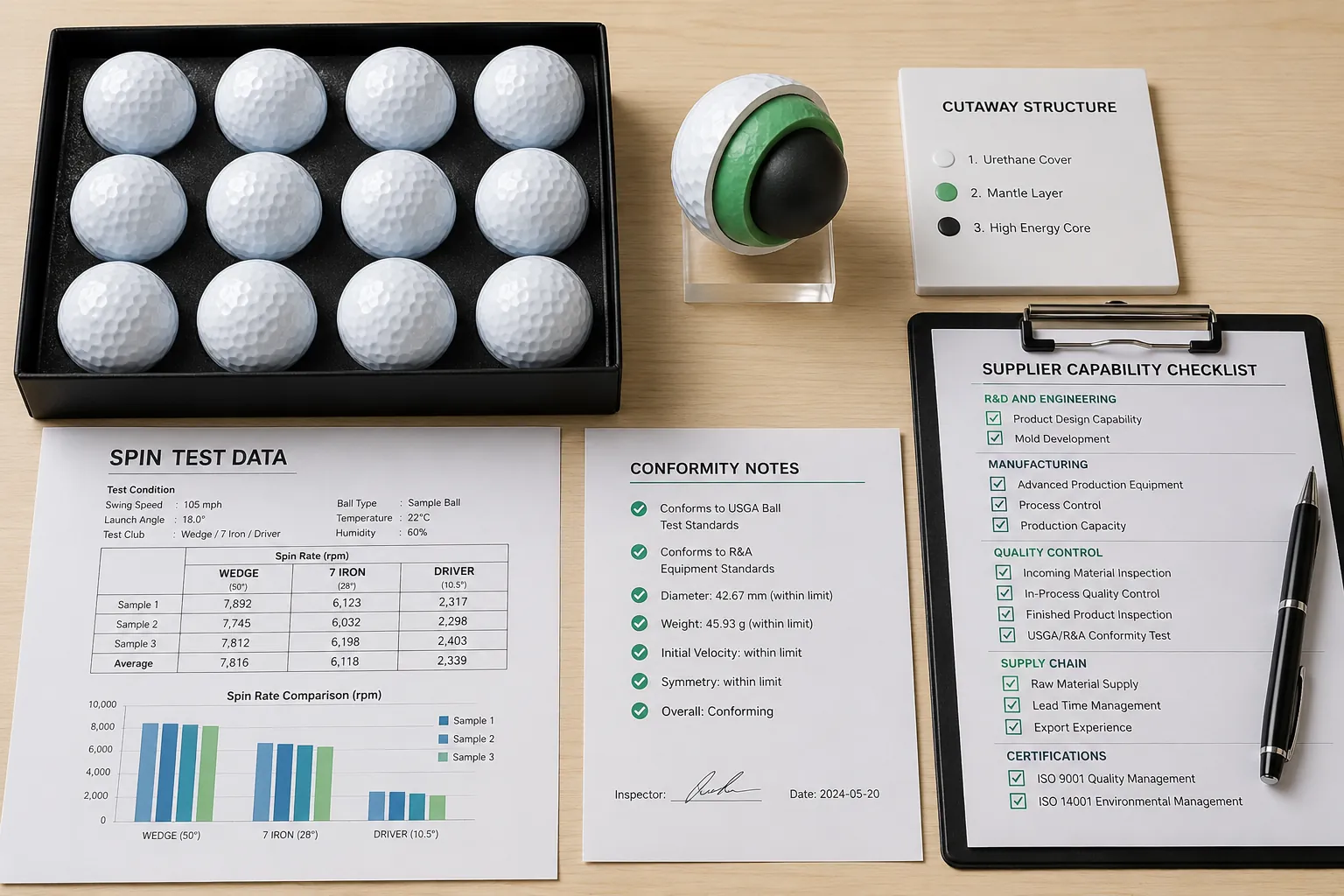
Ask for a capability deck that separates visual finish, material system, physical structure, spin data, conformity status, and batch repeatability. Verify whether the supplier’s claim is based on one sample, one lab result, or repeated pilot-batch data. Do not approve tour-level wording unless the claim is narrowed to a specific evidence-backed performance window.
✔ True — China can be a credible value-premium OEM route.
Advanced Chinese factories can build strong tour-style alternatives when material choice, process control, and batch testing are verified. That is different from claiming a direct Pro V1 clone.
✘ False — “Visually similar balls prove Pro V1 parity.”
A glossy cover, clean logo, or similar feel cannot prove wedge spin, wind stability, core centering, or repeat production quality.
Can China control the core chemistry?
Many buyers still picture China-made golf balls as hard, low-end “stone balls.” That assumption is outdated, but the core still needs audit-grade proof.
Core quality is the hidden floor under every premium golf ball claim. Your supplier should prove material choice, curing control, compression distribution, and rebound consistency before you judge feel, distance, or cover performance.
High-Cis Core and Compression Curing
The core is the engine you cannot see. A soft cover can flatter a sample, but a poorly controlled core will still create inconsistent feel, ball speed, launch, and spin response.
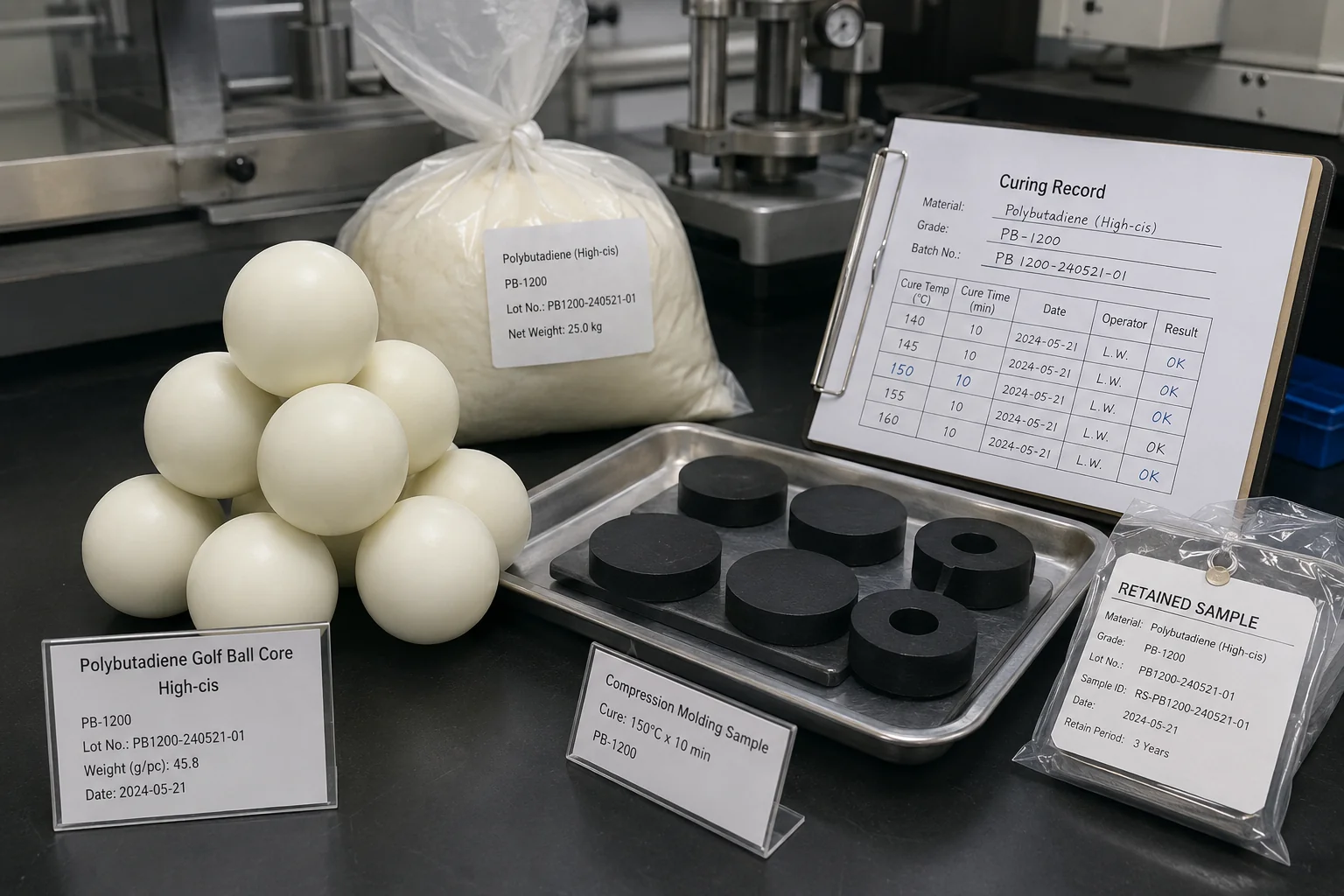
Premium cores commonly rely on polybutadiene rubber systems, with curing control and compression molding doing much of the quiet work. In stronger Chinese OEM programs, the discussion has moved beyond “hard ball” versus “soft ball.” You should ask about raw material category, curing window, compression target, compression distribution, rebound evidence, and retained sample policy.
Some R&D-driven Chinese factories can target thinner cover construction and larger energy-core designs than many buyers assume. If a supplier claims improved rebound, longer hitting durability, or special compression molding advantages, do not reject the idea automatically. But do not publish the claim without a test method, sample ID, batch ID, and comparison basis.
The buyer-side evidence action is simple: ask for raw material category, curing process controls, compression target, compression distribution, and retained samples from the same pilot batch. Verify the core through compression mapping and batch data, not hand feel. Write acceptance around compression distribution and batch stability rather than vague phrases like “lively core” or “high rebound.”
A practical PO line can read: Supplier shall identify the approved production version by sample ID, batch ID, cover material, forming method, dimple family, compression target, markings, coating, and packaging version; any change to material, construction, finish, or coating requires written buyer approval.
To move your audit from qualitative claims to manufacturing reality, your RFQ should cross-reference benchmark geometry against the supplier’s own production capability. A premium-looking sample is not enough; the layer allocation has to be measurable.
| Ball Model | Core Diameter (in) | Mantle Outer Diameter (in) | Ball Outer Diameter (in) | Mantle Thickness | Cover Thickness |
|---|---|---|---|---|---|
| Titleist Pro V1 benchmark sample | 1.530 ± 0.006 | 1.600 ± 0.006 | 1.680 ± 0.004 | 0.035 in / 0.89 mm | 0.040 in / 1.02 mm |
| Golfara OEM sample reference | 1.555 ± 0.006 | 1.620 ± 0.006 | 1.684 ± 0.004 | 0.0325 in / 0.83 mm | 0.0320 in / 0.81 mm |
These benchmark values should be treated as sample-based engineering references, not Titleist-published official production specifications.
A thinner cover profile can create more room for the internal energy core, but it should never be accepted as a performance claim by itself. Ask the supplier to connect cover thickness, core size, compression distribution, rebound evidence, and retained batch samples before you approve any premium-performance wording.
Where a supplier claims a 5%–10% elasticity improvement or roughly 30% longer hitting durability versus legacy setups, require the test method, sample ID, batch ID, and comparison baseline before using that claim in public marketing.
Is the urethane cover truly cast?
The most expensive mistake is approving a “urethane” ball that feels soft in sampling but loses short-game spin in the real product.
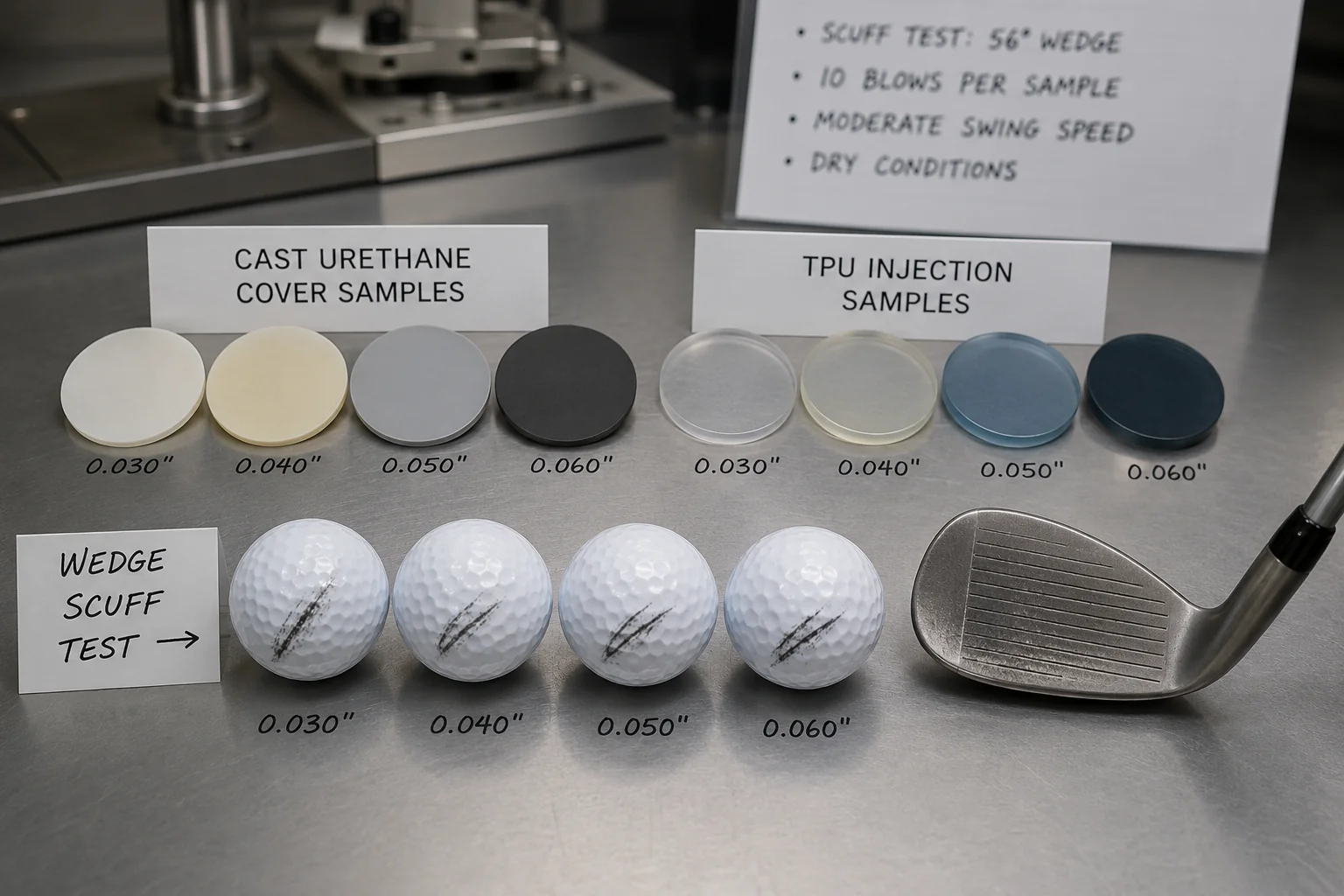
The word urethane is not enough for a premium OEM decision. Your PO should lock the cover system, forming method, cover thickness, and wedge-shear evidence so the supplier cannot sell a TPU injection cover as cast thermoset performance.
Liquid Casting vs TPU Injection
This is the fake-urethane trap. Many export-facing suppliers use “urethane” loosely because both TPU and cast urethane sit under the broader polyurethane family. For sourcing, that loose language is dangerous.
TPU injection is thermoplastic. Pellets are heated, injected, cooled, and shaped efficiently. It can be cost-friendly, scalable, and practical for the right value-premium SKU. It may feel crisp or springy, but it should not be positioned as the same performance route as cast thermoset urethane when your brand promise depends on wedge grab.
Cast thermoset urethane follows a different path. Liquid systems cure through chemical crosslinking, and the process can support a softer premium cover with stronger groove interaction and better cut or wear resistance when processed correctly. That is why buyers associate cast urethane with tour-style greenside control.
A failure signal appears when the supplier says cast urethane but only explains TPU injection. Ask for cover material confirmation, forming method, cover thickness map, cure or molding method, and wedge-shear or scuff evidence. Verify the cover process before logo approval and before any tour-grade claim. For any premium claim, the cover process should be documented before the printed sample is approved.
| Cover decision | TPU injection risk | Cast urethane requirement | Buyer evidence |
|---|---|---|---|
| Material claim | Urethane used loosely | Specify cast thermoset if required | Request process record. |
| Short-game spin | Soft feel but weak groove bite | Validate wedge interaction | Request wedge-spin test. |
| Durability | Scuff profile may differ | Check wear and cut resistance | Request shear/scuff evidence. |
| Bulk consistency | One sample can mislead | Verify batch cover thickness | Request thickness map. |
PO should state that changing cover system, cover thickness, coating, or forming process requires written buyer approval. If a supplier offers TPU for cost reasons, that can be a valid SKU decision. It just should not be sold as cast-urethane performance.
✔ True — TPU can be practical for the right SKU.
TPU injection can work for cost-controlled premium-feel products, promotional lines, or mid-tier balls. It becomes risky when sold as the same performance route as cast thermoset urethane.
✘ False — “TPU injection and cast thermoset urethane are the same OEM decision.”
The buyer decision changes when the SKU promise depends on high wedge spin, soft cover interaction, and premium greenside control.
Can tolerance stay tight at scale?
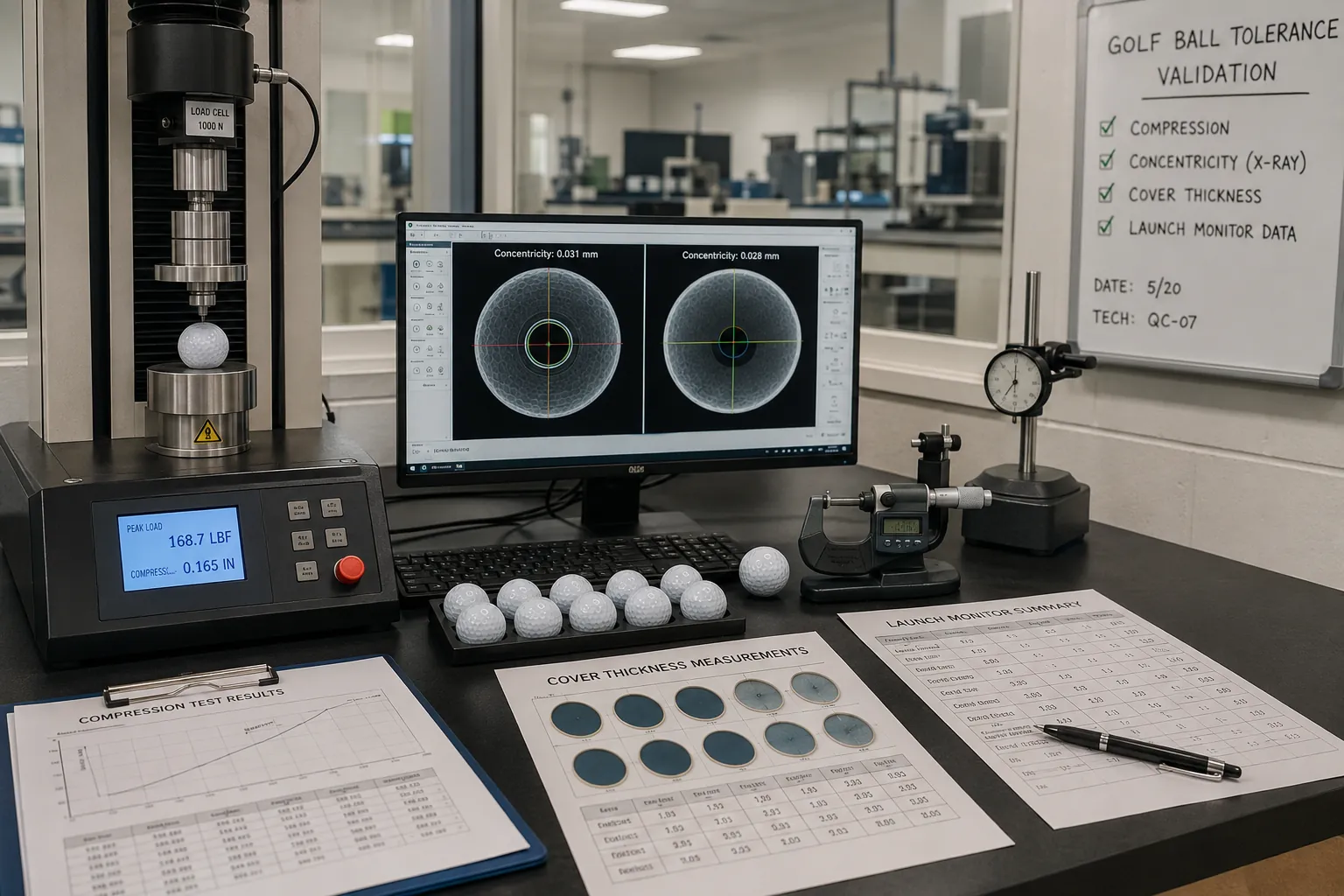
One strong lab sample proves possibility. It does not prove thousands of balls will hold the same compression, center balance, or spin window.
Tour-style performance fails when tolerances drift from sample to batch. Your supplier should prove compression distribution, layer concentricity, cover thickness, weight, diameter, and club-by-club spin data before you treat one good prototype as a scalable product.
Concentricity, Compression, and Spin
Repeatability is the real premium test. Multilayer golf balls are sensitive because each interface affects momentum balance, compression response, and spin. A small core or mantle offset may not show in photos, but it can show up as dispersion, ballooning, or a ball that feels different from dozen to dozen.
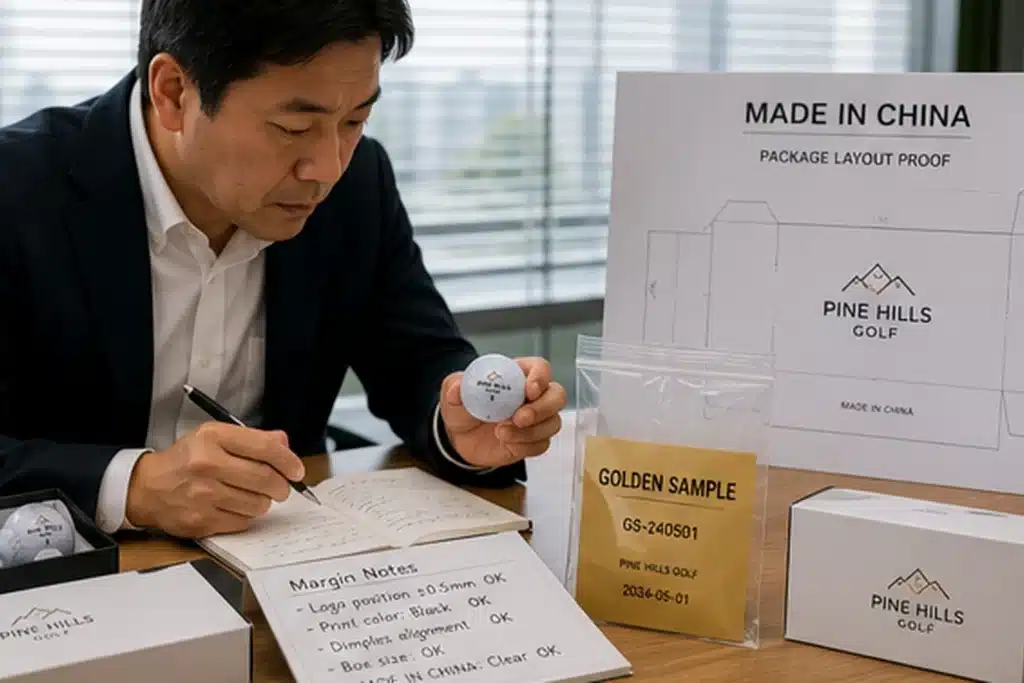
For 3-piece urethane, you need stable core, mantle, and cover alignment. For 4-piece construction, the burden increases again. This is why ATTI or equivalent compression data, X-ray or CT-style concentricity evidence, weight and diameter records, and cover thickness maps should sit inside your pilot gate.
Spin data should be separated by club. Driver spin may look acceptable while 7-iron or wedge spin misses the premium promise. As audit targets, request driver, 7-iron, and wedge data with sample ID, batch ID, equipment, test method, and conditions. If a China OEM shares internal benchmark ranges, treat them as valuable discussion points only when they are tied to the actual production formula and test protocol.
True tour-style validation cannot rely on a generic “soft feel” narrative. The factory has to show whether the ball holds the intended spin window across driver, iron, and wedge testing.
| Ball Model | Driver Spin (rpm) | 7 Iron Spin (rpm) | PW / Wedge Spin (rpm) |
|---|---|---|---|
| Titleist Pro V1 benchmark sample | 2,300–2,600 | 5,000–5,400 | 8,000–8,600 |
| Golfara custom sample reference | 2,400–2,750 | 5,050–5,500 | 7,800–8,400 |
Spin windows vary by test setup, swing condition, equipment, temperature, and ball condition, so every supplier claim should be tied to the actual test protocol.
This table should not be treated as a universal production guarantee. Use it as an RFQ benchmark: the supplier must identify the test equipment, swing condition, sample ID, batch ID, production formula, and testing environment behind every spin claim.
To sustain that window at scale, the quality lab should use ATTI, OK Automation 55-M, or equivalent compression gauges. For a premium DTC lot, a strong internal gate is to keep compression standard deviation around σ≤2–3 across production batches, with raw readings retained by batch.
A failure signal appears when a supplier claims Pro V1 level but cannot show batch-linked spin data. Request a batch-linked validation pack with cover material and forming method, compression distribution, weight and diameter records, cover thickness map, X-ray/CT or cut-ball concentricity evidence, driver / 7-iron / wedge spin data, wedge-shear durability, and USGA submission status by ball type.
For a deeper technical checklist, see Golf Ball QC in China: The 4 Must-Have Testing Processes. Release mass production only after physical data, spin data, and batch equivalence meet written limits across pilot and first bulk production.
✔ True — One sample can prove possibility.
A strong prototype shows the factory can reach a performance target under controlled conditions. It does not prove the same result will hold across thousands of balls.
✘ False — “One good sample proves production repeatability.”
Repeatability needs batch-linked compression, concentricity, dimensional, spin, and retained-sample evidence.
Does dimple tooling limit parity?
Matching 388 or 348 dimples sounds simple. Real aerodynamic parity depends on protected development systems, not visible count alone.
Dimple count is not an aerodynamic recipe. Your OEM should never be asked to copy proprietary geometry; it should propose a legal tooling family, target flight window, mold-cavity control method, and flight evidence that your team can audit.
Public Tooling vs Proprietary Aerodynamics
Aerodynamic IP is one of the hardest gaps to close. A dimple pattern is not just a number. It is a flight system built from depth, radius, edge shape, distribution, coating, cover thickness, and repeated validation.
Titleist’s official 2025 Pro V1 / Pro V1x release describes Pro V1 with a 388 spherically tiled tetrahedral dimple design and Pro V1x with a 348 dimple design. It also states that Titleist has designed, manufactured, and tested more than 2,500 dimple patterns since the original Pro V1. That is the lesson for buyers: the count is visible, but the development system is the real moat.
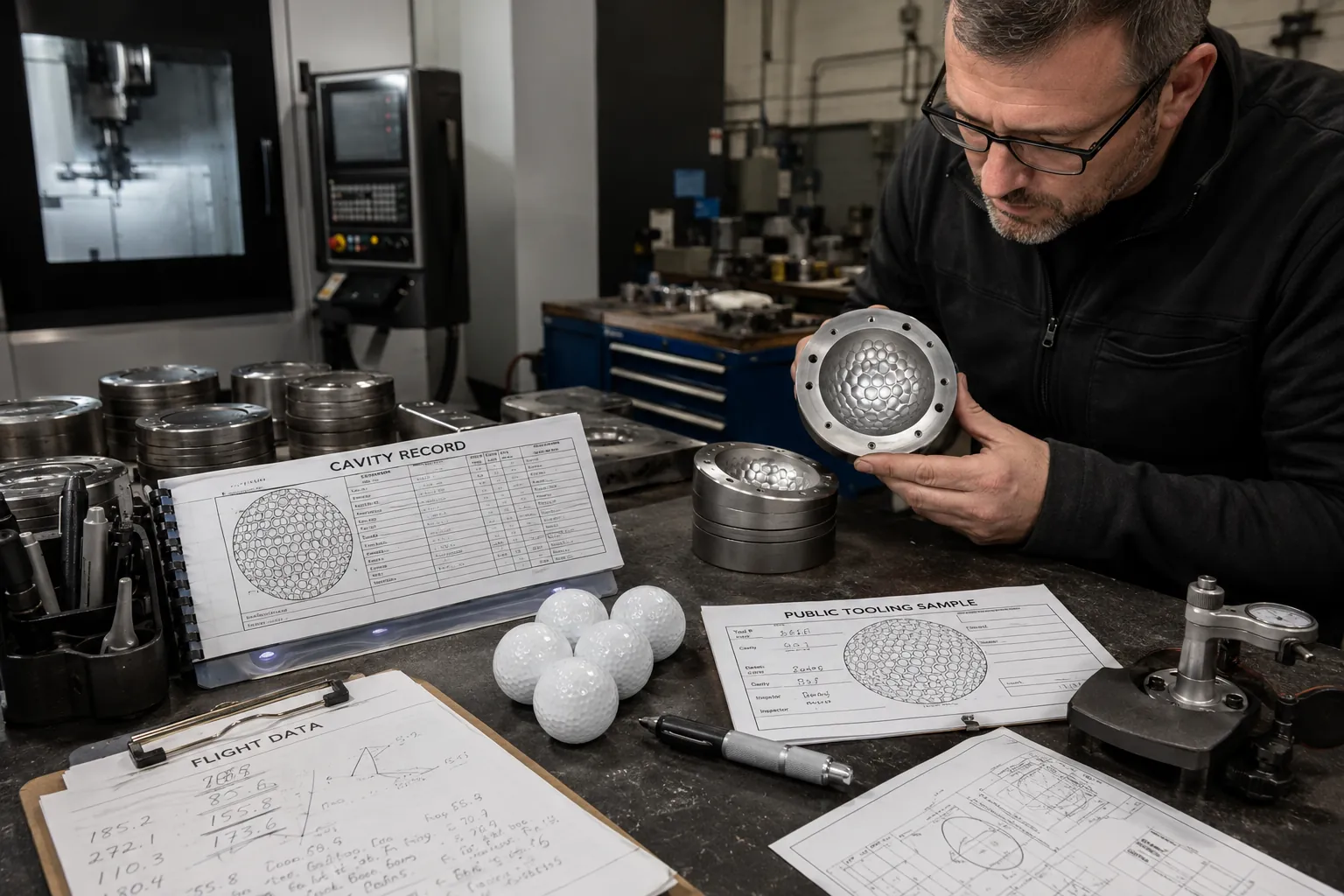
For early China OEM development, public tooling families can be a legal and practical starting point. A validated 332, 342, or 352-style public mold family may support a premium alternative if it has flight data, mold-cavity control, and repeatable production history. Private dimple tooling should wait until you have volume proof and a clear target flight window.
| Aero decision | Buyer mistake | Safer route | Evidence to request |
|---|---|---|---|
| Dimple count | Copy 388 or 348 | Use as reference only | Request flight window. |
| Public tooling | Assume low quality | Audit mold history | Request cavity records. |
| Private tooling | Pay NRE too early | Wait for volume proof | Request pilot demand. |
| IP risk | Ask for clone geometry | Avoid proprietary copying | Request original tooling path. |
Ask for dimple count, tooling family, mold-cavity record, target flight window, and aerodynamic validation evidence. Verify tooling with launch, descent, and dispersion data before approving marketing claims. PO should prohibit copying third-party patented or proprietary dimple geometry.
The safer sourcing path is not “copy 388” or “copy 348.” It is to build a legal aerodynamic alternative that your factory can mold consistently and your brand can defend honestly.
✔ True — Public tooling can support a premium alternative when validated.
A mature public mold can reduce early NRE exposure and still support a controlled flight window when backed by launch and dispersion evidence.
✘ False — “Copying a dimple count copies Pro V1 flight.”
Aerodynamics depend on geometry, tooling accuracy, coating, cover thickness, and validation data, not count alone.
When does USGA listing matter?
A model missing from the current list is not automatically low quality. A model on the list is not automatically the right production batch.
USGA listing is important, but it is not a complete factory-quality score. You should verify current list status when competition use matters, while also auditing lab capability, production data, and batch equivalence before judging a factory’s real technical base.
Certification Status vs Factory Capability
Current listing matters when your SKU needs competition legality. It may matter less when the target channel is range, promo, casual amateur, internal testing, or early DTC validation.
USGA conformance is a model-level, submission-based process. The 2026 USGA Golf Ball Conformance Submission Guidelines list new submission and annual resubmission fees by ball type and 24 sample balls, plus a late-submission premium. For a factory maintaining several models, annual renewal becomes real SKU overhead.
This is why non-renewal should be audited, not blindly punished. In a thin-margin OEM environment, a capable factory may choose not to renew every model every year unless the buyer, brand, or competition channel requires it. That decision does not automatically prove weak manufacturing. It proves you need better evidence.
A failure signal appears when a supplier uses USGA logo language without current model-level list proof. Ask the supplier to state current list status, last submission year, ball type, markings, and whether current production matches the submitted sample. If competition use matters, verify the listing. If the product is for range, promo, or amateur value-premium channels, also evaluate ATTI data, X-ray/CT evidence, spin data, retained samples, and batch records.
Only submit production-representative balls after BOM, markings, cover, dimple pattern, finish, and launch SKU are locked. If your site has a deeper USGA-specific guide, this is the natural section to support that internal link. The decision is simple: use list status when it matters, but do not confuse non-renewal with proof that a factory cannot make a high-quality ball.
FAQ
Can Chinese factories truly match Pro V1 specs?
A few advanced factories can approach tour-style performance windows, but true Pro V1 parity requires repeatable proof across core chemistry, cover process, layer precision, aerodynamics, and batch QC.
Treat “Pro V1 specs” carefully. If a supplier means appearance, soft feel, or a multilayer cutaway, that is not enough. Your audit should ask for sample ID, batch ID, cover process, compression distribution, X-ray/CT or cut-ball evidence, driver / 7-iron / wedge spin, and retained samples. Use “tour-style alternative” unless every parity claim is supported by production evidence.
What separates TPU from cast urethane?
TPU injection is thermoplastic and production-friendly, while cast thermoset urethane uses chemical crosslinking and is normally associated with premium short-game control when processed correctly.
TPU can be practical for a cost-controlled premium-feel SKU, but it should not be marketed as the same route as cast urethane. Ask for cover material, forming method, cover thickness map, wedge-shear results, and scuff evidence. Match the material choice to the SKU’s true market role instead of forcing every product into tour language.
Why do capable factories skip USGA renewal?
Non-renewal can be a commercial decision, especially when the factory serves range, promo, amateur, or value-premium markets where annual list status is not always required.
If your SKU is intended for competition use, verify current model-level listing and confirm that the listed ball matches current production. If the model is not currently renewed, do not stop the audit there. Ask for lab equipment, batch evidence, compression data, concentricity checks, spin records, and retained samples. Listing status is one signal, not the whole capability review.
What evidence proves batch consistency?
A serious factory should provide compression distribution, weight and diameter records, cover thickness, X-ray/CT or cut-ball evidence, spin data, and retained sample control.
The evidence should include method, sample ID, batch ID, equipment, raw readings, and acceptance limits. A spin table is useful only when the supplier also provides test method, equipment, sample ID, batch ID, swing condition, and production formula. Compare pilot data with first bulk data rather than relying on one pre-production sample.
Can public dimple molds make premium balls?
Yes, public tooling can support premium alternatives when validated, but it cannot be treated as a copy of Titleist aerodynamics simply because the dimple count looks similar.
Ask for tooling family, cavity-control method, mold history, target flight window, and launch or dispersion data. Public tooling can reduce early NRE exposure and help you validate the channel. Private tooling should come after demand and volume justify the investment. Avoid any supplier that suggests copying protected dimple geometry.
How should I position a China-made tour-style ball?
Position it as a data-backed value-premium or tour-style alternative for the right player segment, not as a Pro V1 clone unless every claim is supported by production evidence.
Use performance-window language. For example, speak about softer feel, controlled launch, verified wedge spin, or stable batch data when evidence supports it. Avoid broad parity claims. Strong positioning for amateur, retail, range, or DTC channels is often more commercially useful than chasing a full tour-equivalence promise that your evidence cannot defend.
Conclusion
Chinese factories can manufacture credible tour-style golf balls for value-premium players, DTC brands, retail programs, and amateur channels when the claim is backed by real production evidence.
The smarter question is not whether China can clone Pro V1 or Pro V1x. It is whether a specific factory can prove cover process, core control, layer precision, aerodynamic tooling, conformity status, and batch repeatability under production conditions.
Use performance-window language until the supplier can prove more. A China-made premium ball can be commercially strong without pretending to be a direct clone of a protected benchmark product.
You might also like — China Golf Ball OEM Supplier Verification Checklist