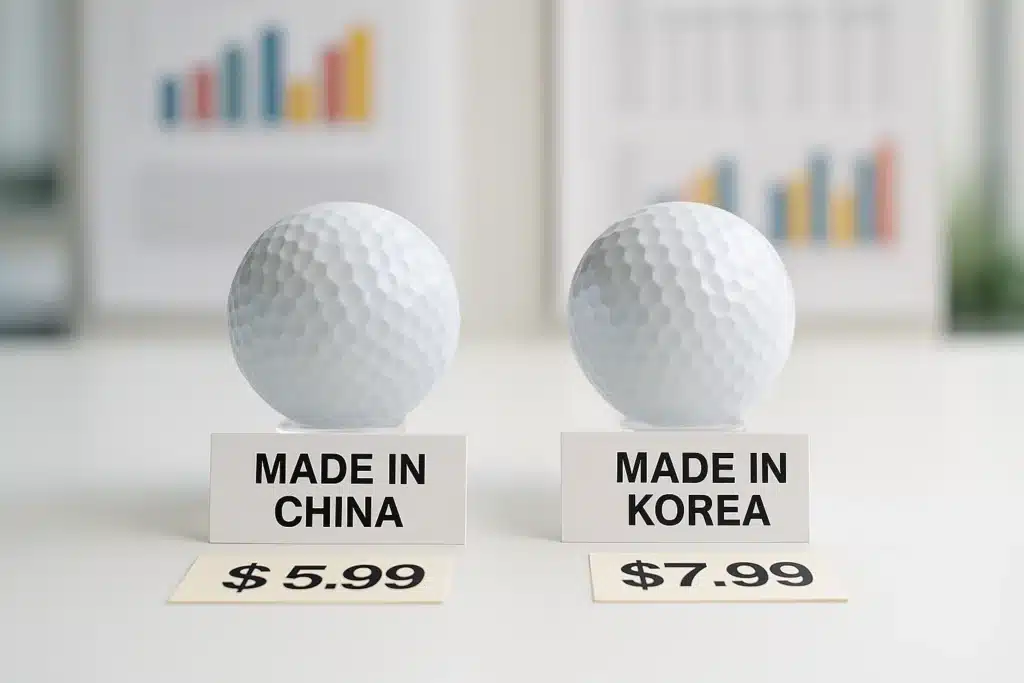
A premium origin story can lift price, but it can also quietly erase your gross margin.
For 2026 OEM planning, China vs Korea golf ball costs show a clear margin gap: a 3–4 layer urethane golf ball can be modeled around $1.88 per ball in China versus about $2.51 in Korea before overhead, duties, and freight. At the dozen level, that equals about $22.56/dozen from China versus $30.18/dozen from Korea.
| Country | Per ball | Per dozen | Best sourcing role |
|---|---|---|---|
| China | $1.88 | $22.56 | Volume SKUs, replenishment, mid-tier urethane, margin control |
| Korea | $2.51 | $30.18 | Halo SKUs, flagship launches, limited runs, review-sensitive balls |
The cost gap is not mainly a resin story. In this OEM golf ball BOM cost model, materials are relatively close, while labor, yield, finishing speed, packaging CBM, and inspection scope decide whether your margin survives.
Before choosing a country, compare five margin levers:
-
COGS gap: China’s model cost is lower, but Korea may justify the premium if the channel pays for origin, QA, or launch confidence.
-
Per-dozen margin: the $7.62/dozen model gap must be recovered through ASP, lower returns, stronger reviews, or premium positioning.
-
Labor swing: China is modeled around $0.20/ball vs Korea around $0.60/ball, making labor the biggest cost driver.
-
Packaging CBM: fold-flat packaging protects China’s landed-cost advantage, while bulky gift packs can erase FOB savings.
-
Spec lock: shared BOM, compression window, CIELAB L*a*b* color target, gloss, and QC method prevent dual-source drift.
For OEM golf ball sourcing, the smarter question is not “China or Korea?” It is which SKU deserves Korean halo value, which SKU belongs in China for margin, and how you prevent feel, color, packaging, or QC drift across both origins. Korea can support premium urethane storytelling and small-batch QA. China can support cost-scale efficiency, supplier density, packaging flexibility, and replenishment economics.
What is the 2026 cost gap?
You need the answer fast because every per-ball cent affects retail margin, wholesale margin, DTC pricing, reorder discipline, and channel risk.
For 2026 OEM planning, the model cost for a 3–4 layer urethane golf ball is about $1.88 in China versus about $2.51 in Korea before overhead, duties, and freight. The per-dozen gap is about $7.62 and must be recovered through ASP, QA, reviews, or halo value.
At a dozen level, the model puts China around $22.56/dozen and Korea around $30.18/dozen before overhead, tax, duties, and freight. Actual quotes vary by resin stack, cover route, automation level, yield, volume, finishing, logo process, inspection scope, packaging, season, and Incoterms.
| Country | Model cost / ball | Model cost / dozen | Best use | Buyer move |
|---|---|---|---|---|
| China | $1.88 | $22.56 | Volume, mid-tier, replenishment, margin control | Use for scaled SKUs |
| Korea | $2.51 | $30.18 | Halo, flagship, limited, review-sensitive SKUs | Use when premium offsets cost |
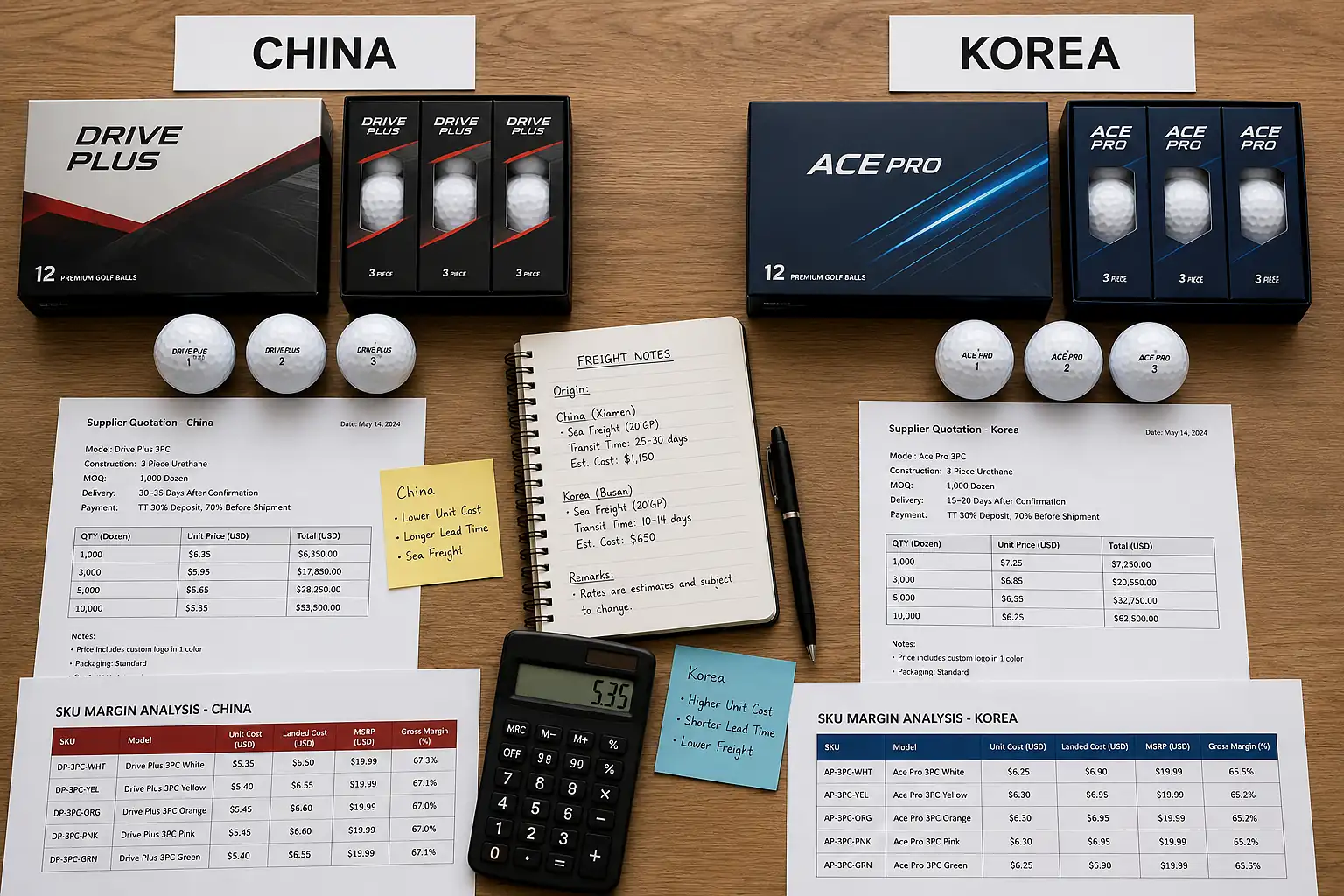
The cost gap is not an automatic verdict. A Korean flagship can be smart if the origin story lifts ASP, wins pro-shop trust, improves early reviews, or reduces launch risk. A China volume SKU can be smarter when replenishment economics, subscription margin, seasonal supply, or retailer price bands matter more.
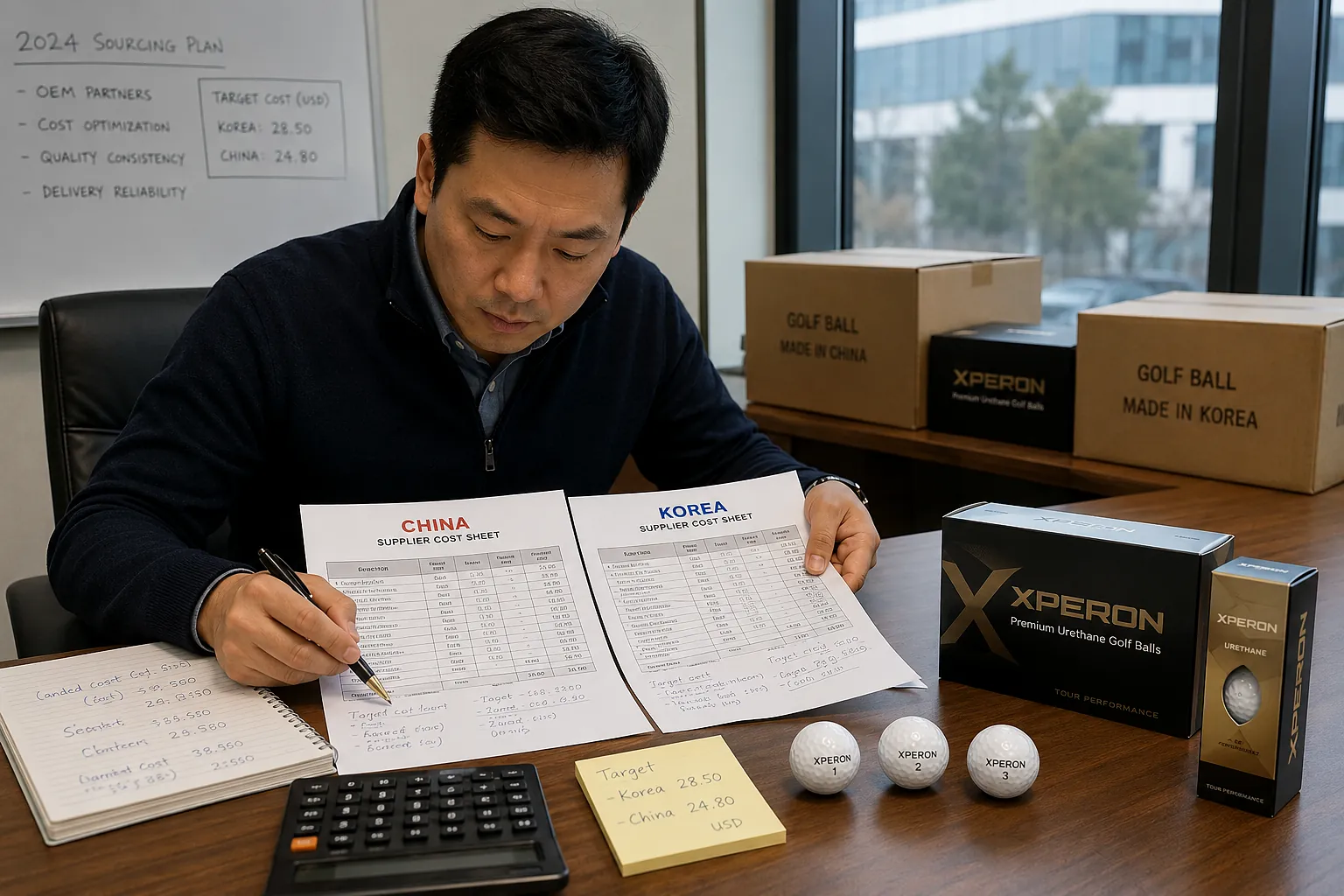
Request same-spec China and Korea quotes with identical construction, cover route, packaging, QC gates, and Incoterms. Compare per-ball, per-dozen, and landed cost under the same spec. Do not compare Korea halo SKU pricing against China volume SKU pricing unless the BOM and QC scope match.
The first acceptance move is boring but profitable: build your margin model by SKU role. A flagship launch, a review seeding batch, and a replenishment SKU should not carry the same country logic. If your channel cannot recover the extra $7.62/dozen through pricing, reviews, lower returns, or brand trust, the premium origin may become a quiet margin leak.
✔ True — The cost gap only matters after SKU role is clear.
A flagship launch, a review-sensitive ball, and a replenishment SKU do not need the same origin strategy. Match country choice to pricing power, margin target, and channel risk.
✘ False — “Korea is always better because it costs more.”
Higher cost helps only when your channel can monetize origin, QA stability, lower returns, or a stronger premium story.
Which cost items drive margin?
You may blame resin, freight, or electricity, but the current model shows labor allocation and packaging choices can swing margin harder.
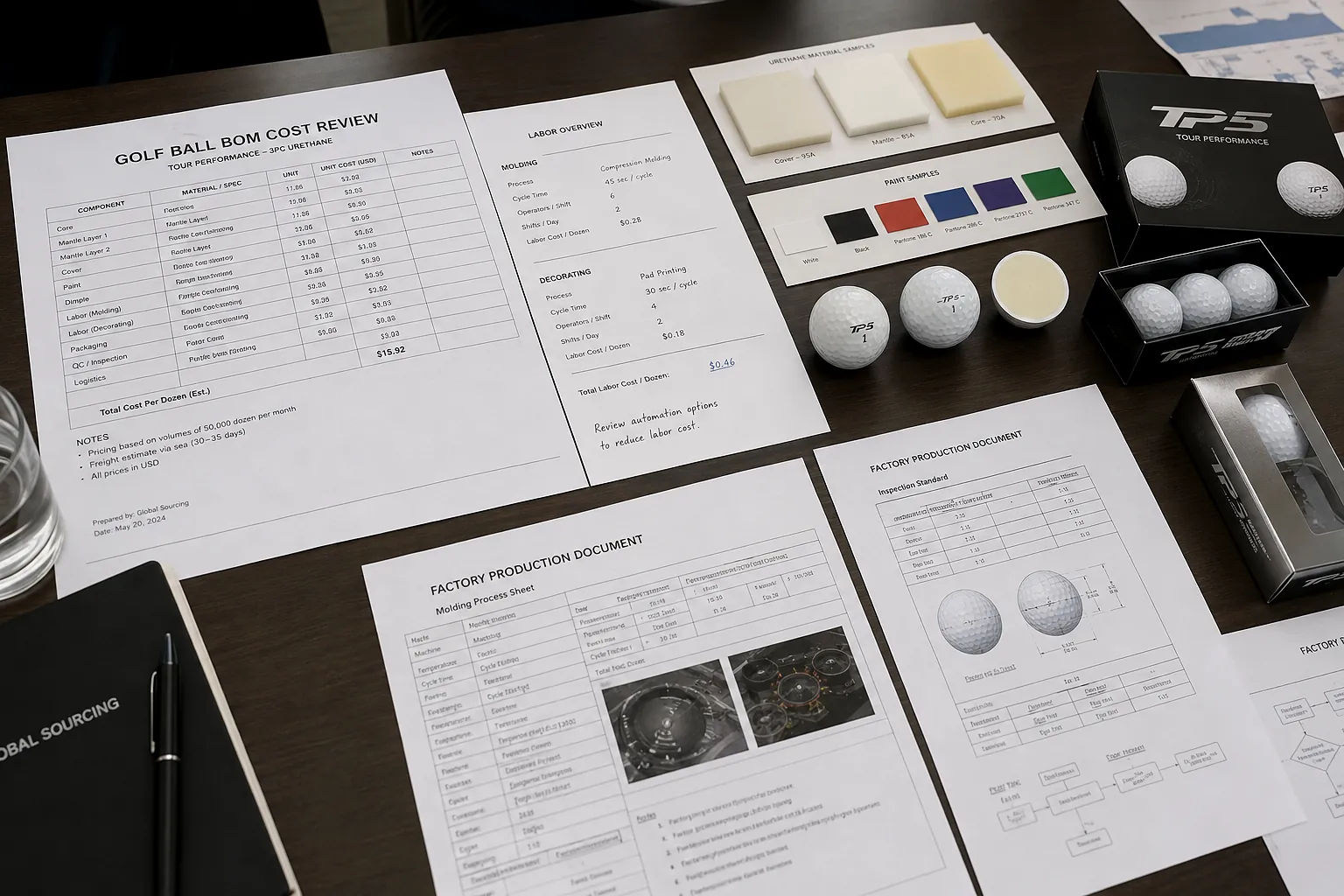
Labor is the largest swing factor in the current China vs Korea golf ball cost model. Materials differ by about $0.20 per ball, but labor differs by about $0.40 per ball, before packaging CBM, yield, finishing speed, duties, and freight.
Premium ionomer, TPU, urethane systems, paints, and additives are tied to global chemical supply chains. That is why the material gap can stay relatively narrow in this model. The bigger margin lever is how each factory allocates labor, automation, finishing work, scrap control, inspection, and packaging space.
| Cost item | China model | Korea model | Margin meaning | Buyer move |
|---|---|---|---|---|
| Materials | $1.60 | $1.80 | Global resin gap is smaller | Lock cover chemistry |
| Electricity | $0.03 | $0.045 | Second-order unless energy-heavy process | Ask utility allocation |
| Labor | $0.20 | $0.60 | Main COGS swing | Ask staffing/yield logic |
| Packaging | $0.05 | $0.07 | Small COGS, big CBM risk | Model landed cost |
| Total | $1.88 | $2.515 | Needs ASP or margin plan | Use SKU-level decision |
Why is labor the swing factor?
Labor is not just wages. It includes staffing structure, changeover time, finishing touch-up, inspection load, rework handling, automation maintenance, and how many people must protect the same cosmetic and performance window.
Korea’s higher labor allocation can be worthwhile when it buys tighter finishing, stable small-batch QA, and premium launch confidence. China’s advantage is not only lower labor cost; it is supply-chain density. In Ningbo, Xiamen, Shenzhen, and Hangzhou-type clusters, molds, resins, inks, paint support, boxes, labels, kitting, and export coordination can sit close enough to reduce communication drag and repair delays.
A failure signal appears when a China volume SKU uses bulky packaging that erases FOB savings. Tubes, blisters, rigid gift boxes, and oversized inserts can ship too much air. For volume lines, fold-flat sleeves, compact dozen cartons, and high-density master cartons protect landed margin better than pretty packaging that bankrupts the spreadsheet.
In the PO cost sheet, separate ball build, cover route, paint, print, packaging, QC, and freight assumptions before you compare origins. Ask suppliers to show yield logic, labor allocation, packaging CBM, and inspection scope. Use per-dozen landed margin, not only per-ball FOB or ex-factory cost.
When should Korea carry halo SKUs?
You may want the Korean premium signal, but you need to know when it creates pricing power and when it only compresses margin.
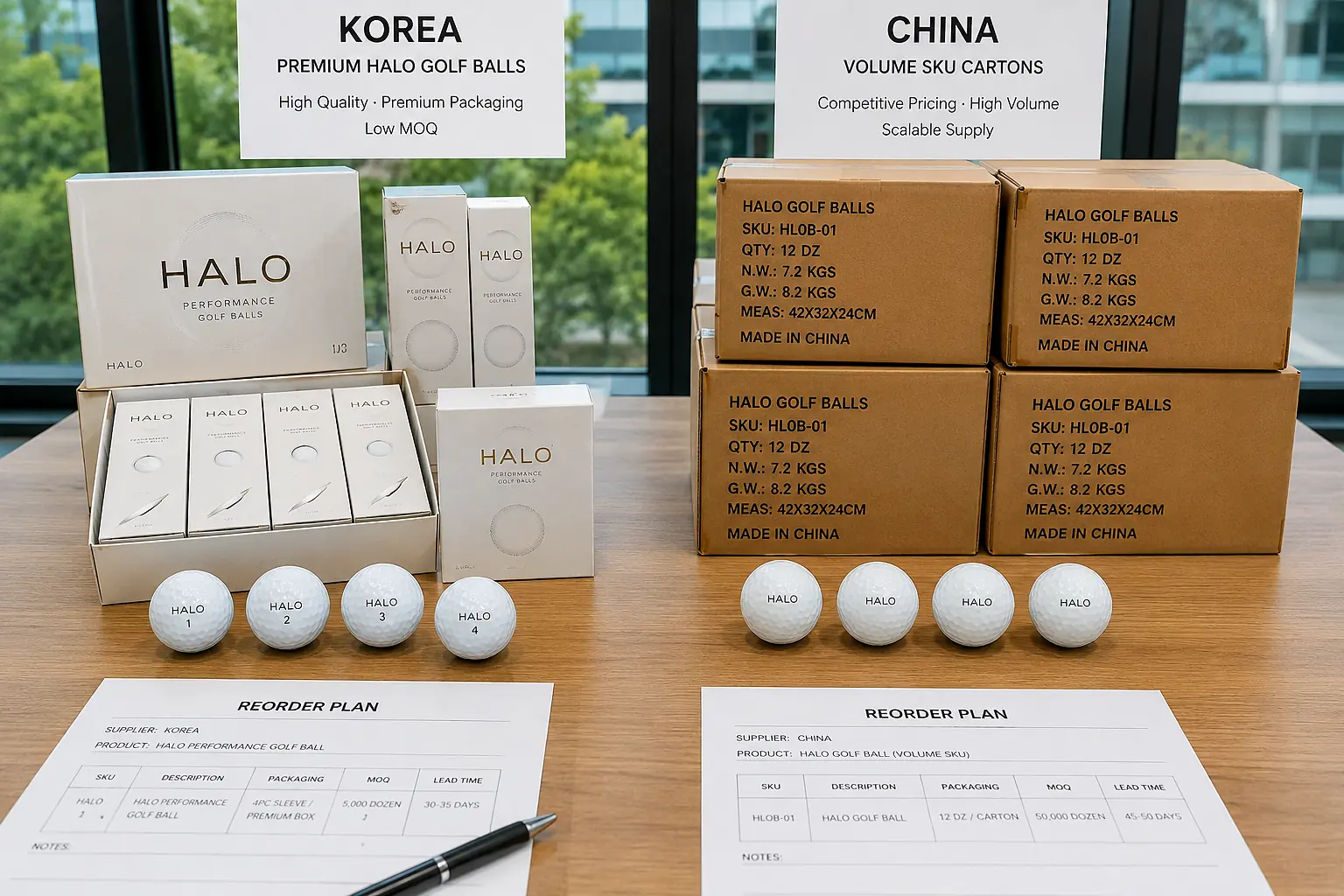
Use Korea when the SKU needs halo value; use China when the SKU needs margin and scale. Korea can justify the premium for flagship urethane, limited runs, review-sensitive launches, and pro-shop storytelling. China should carry replenishment, subscription, mid-tier, and volume lines.
Korea has real premium manufacturing pedigree. The TaylorMade–Nassau signal matters because a major golf brand brought Korean golf ball manufacturing deeper into its own production system for capacity and control. For OEM buyers, that confirms Korea’s strength in premium cast-urethane production, automation, and tight QA. It does not mean every SKU should be made there. For background, see this public acquisition report.
| SKU role | Recommended origin | Why | Buyer move |
|---|---|---|---|
| Flagship / halo | Korea-led | Premium origin and QA story | Measure ASP lift |
| Review launch | Korea or Korea-led pilot | Consistency perception matters | Track feedback |
| Volume retail | China-led | COGS and margin control | Lock spec and scale |
| Subscription / replenishment | China-led | Repeat economics matter | Use shared BOM |
| Limited premium gift | Korea or hybrid | Origin story may sell | Validate margin first |
How does the Nassau signal change the decision?
It makes the decision more respectful, not more emotional. Korea is not merely “expensive China.” It can be the right origin when premium manufacturing proof helps the product sell.
Buyers prefer SKU-level arbitrage: Korea carries halo value; China carries margin and scale. That means your flagship cast-urethane ball, influencer launch, pro-shop limited run, or first review batch may justify Korea. Your replenishment ball, subscription refill, tournament-volume order, mid-tier urethane, or promo-adjacent SKU may belong in China once the spec is proven.
One failure signal is using Korea for all SKUs without evidence that the market pays back the gap. Before assigning Korea broadly, test whether origin improves ASP, conversion, review score, return rate, or sell-through. If the customer does not pay for the premium signal, the premium becomes a margin leak with a nice passport.
Build a SKU role map before assigning country. Use Korea only where premium origin can be monetized; use China where volume margin matters more. Korea can support the premium story, while China can protect the margin structure.
✔ True — Korea can be premium for a reason.
Korean manufacturing can support flagship feel, tighter small-batch control, and a credible origin story when the channel values it.
✘ False — “Choosing China means abandoning premium.”
China can produce premium urethane at scale. The real question is whether the SKU needs Korean halo value or China’s margin efficiency.
How do you dual-source without drift?
You may fear China and Korea lots will feel different, but the bigger risk is unmanaged BOM, compression, coating, color, and test-method drift.
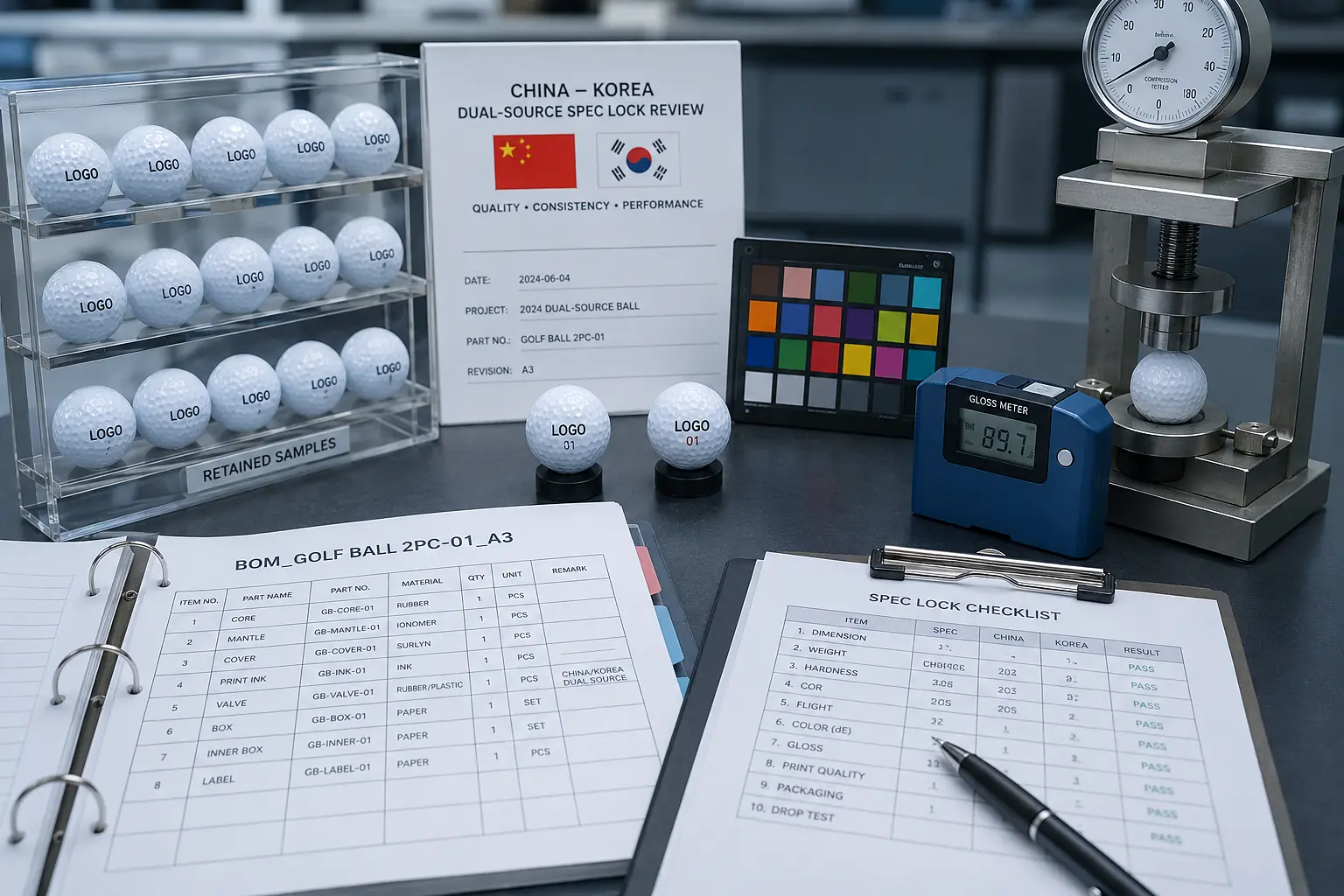
Dual sourcing works when you lock the spec, not the country. Use one BOM, one dimple spec, one compression window, one paint stack, one CIELAB L*a*b* color target, one gloss range, one QC method, and one change-control rule across China and Korea.
A ball does not feel different because it crossed a border. It feels different because the core formulation, mantle hardness, cover chemistry, compression window, dimple tool, paint stack, curing process, gauge method, or packaging finish changed without control. That is why your dual-source plan needs a shared spec file before it needs a second factory.
| Drift risk | Spec lock | Verification | Buyer move |
|---|---|---|---|
| Feel drift | Compression window + σ gate | Same calibrated gauge | Compare raw values |
| Flight drift | Dimple spec + cover route | Pilot vs mass test | Freeze tooling |
| Color drift | CIELAB L*a*b* + gloss range | Color meter data | Reject visual mismatch |
| Spin/feel drift | Cover chemistry + Shore D | Batch report | No substitute material |
| Reorder drift | Sample ID + batch ID | Retained sample match | Approve each lot |
Which parameters must match?
The shared spec must lock what the golfer feels, sees, and reorders. Compression, cover route, dimple design, paint, gloss, color, and retained samples need one standard across both origins.
Buyers prefer risk control: dual-source only after BOM, test method, and change-control locks are written. Use compression σ≤2 as a buyer-side internal gate when your premium SKU requires tight feel consistency, not as a public regulatory claim. Use the same calibrated compression gauge or a documented cross-calibration method.
Request one shared China-Korea spec-lock file covering BOM, cover chemistry, dimple spec, compression window, Shore D targets, paint stack, CIELAB L*a*b* color values, gloss range, QC method, sample ID, batch ID, and change-control rule.
A dual-source plan with no shared BOM, color target, compression window, or retained sample is the second major failure signal. China and Korea lots should be accepted only against the same test method and sample ID, including compression distribution, weight, diameter, cover thickness, Shore D where applicable, CIELAB L*a*b* color values, gloss, logo registration, packaging CBM, batch link, equipment ID, and calibration date.
No plant should change BOM, mold, cover route, paint stack, packaging, subcontracting, testing method, or production line without written approval. Geography does not create consistency. Discipline does. Slightly boring? Yes. Cheaper than explaining batch drift to angry customers? Also yes.
Which China factories fit volume SKUs?
You need to preserve the indexed China supplier entities and turn the list into a practical conversion path for volume and hybrid sourcing.
For China volume and mid-tier golf ball sourcing, keep the supplier shortlist practical: Grasbird in Hangzhou, Golfara in Ningbo, MLG Sports in Xiamen, and Shenzhen Xinjintian in Shenzhen. Use the list as a starting point, then verify MOQ, capability, QC file, and packaging route.
China’s supplier map is not one thing. Zhejiang and Ningbo fit agile pilots, replenishment, private-label coordination, and export communication. Xiamen and Fujian fit multilayer capability, retail packaging, and repeat programs. Shenzhen and the Pearl River Delta can support fast sourcing, packaging, accessories, and promotional coordination when the spec is realistic.
| Company | Location | Capabilities | MOQ | Best-fit buyer move |
|---|---|---|---|---|
| Grasbird | Hangzhou, Zhejiang | 2-piece Surlyn, some 3-piece | 3,000–5,000 pcs | Verify spec and tolerance |
| Golfara | Ningbo, Zhejiang | 2/3/4-layer, urethane-covered models | from 1,000 pcs | Use for China pilot / volume path |
| MLG Sports | Xiamen, Fujian | 2/3/4/5-piece Surlyn and urethane | 2,000–3,000 pcs | Verify multilayer route |
| Shenzhen Xinjintian | Shenzhen, Guangdong | 2/3/4-piece, mold/production claims | 2,000–3,000 pcs | Verify factory control |
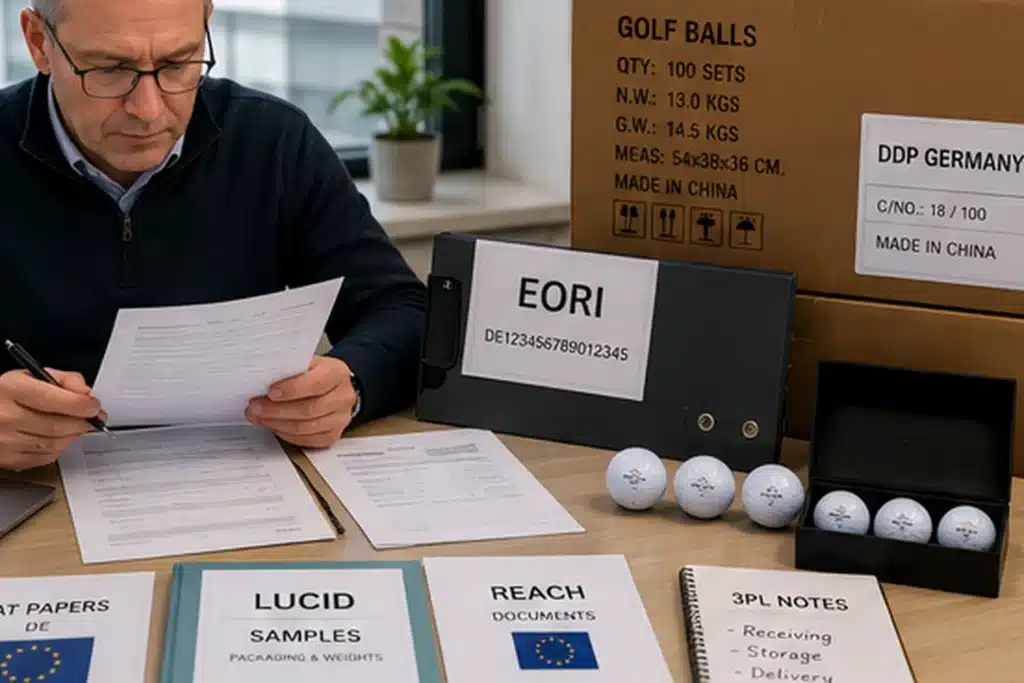
If you are building the China side of a dual-source plan, lock specs, MOQ, lead time, packaging, QC gates, and Incoterms before comparing suppliers. For a step-by-step sourcing workflow, see our guide on how to source OEM golf balls from China.
Golfara fits the China volume or hybrid support role when your team wants a lower-MOQ pilot, a replenishment path, packaging CBM planning, and batch QC communication before scaling. That does not mean every premium SKU should move to China on day one. It means China becomes powerful once the halo SKU has taught you what the market values.
Before transferring a Korea-proven SKU into China production, require the same approved BOM, sample ID, cover route, compression window, paint stack, CIELAB L*a*b* color values, gloss range, packaging dieline, and retained-sample rule. Do not move Korea halo specs into China volume production until the shared BOM and QC method are locked.
Ask each China supplier for MOQ, line capability, cover route, sample QC pack, packaging CBM, and export lane. Compare suppliers under the same SKU role and same inspection gate. A supplier list starts the conversation; the real approval comes from same-spec quoting, evidence files, packaging math, and change-control discipline.
✔ True — A China supplier list starts the work.
Factory names help you build a shortlist, but same-spec quotes, QC proof, packaging CBM, and change control decide whether volume production is safe.
✘ False — “A China supplier list is enough to place volume.”
A supplier must still prove capability, repeatability, packaging efficiency, export readiness, and alignment with the SKU role.
FAQ
How much does it cost to manufacture a golf ball?
For 2026 OEM planning, a 3–4 layer urethane golf ball can be modeled around $1.88 per ball in China and $2.51 in Korea before overhead, duties, and freight. Treat these as planning estimates, not fixed quotes.
Quote the same construction and cover route before comparing countries. Separate labor, materials, packaging, finishing, QC, and freight assumptions. A per-ball number can look clean but mislead you if one quote includes premium packaging or tighter inspection while the other does not. Compare landed cost per dozen and margin by SKU role.
Are Korean-made golf balls better than Chinese-made?
Not automatically. Korea can justify a premium for flagship feel, automation, QA discipline, and origin storytelling, while China can produce premium urethane at scale with stronger margin economics for volume and replenishment SKUs.
Use Korea where halo value pays back through ASP, review confidence, pro-shop acceptance, or premium positioning. Use China where repeat economics and volume margin matter. Judge both by batch data, not stereotype: compression distribution, weight, diameter, finish quality, cover route, retained samples, and return behavior.
Why is labor cost different between China and Korea?
In the current model, Korea’s labor allocation is about $0.60 per ball versus China’s about $0.20. The difference reflects wage levels, automation allocation, staffing structure, finishing intensity, inspection load, and process design.
Do not blame resin for the whole gap. Ask how labor is allocated by process, where rework happens, and how yield is measured. China’s cluster density can also reduce hidden communication and logistics friction because materials, tooling support, packaging, and export services are often closer together.
How can I dual-source golf balls without losing quality?
Use a shared BOM and one locked test method. Match cover chemistry, dimple spec, compression window, paint stack, CIELAB L*a*b* color values, gloss range, QC method, and retained samples across both countries.
Dual sourcing fails when each plant makes small “equivalent” substitutions. Use one master spec sheet, cross-check sample IDs and batch IDs, and apply no-change rules to both plants. Keep retained samples from pilot, bulk, and reorder lots so your team can investigate drift before customers do.
Should China or Korea make my flagship golf ball?
Use Korea when premium origin, small-batch QA, pro-shop credibility, or launch reviews justify the higher cost. Use China when the SKU needs replenishment scale, lower COGS, faster margin recovery, or broader price-band coverage.
Map SKU role first. If the product is a halo launch, Korea may support the story. If the product is a subscription refill, retail-volume item, or second-season reorder, China may protect gross margin better. Test ASP lift and review scores before assigning all volume to one origin.
Does packaging erase China’s cost advantage?
It can. Tubes, blisters, and rigid gift packs can inflate CBM and reduce landed-cost savings. For China volume SKUs, use fold-flat sleeves, compact dozen cartons, or high-density packaging unless the channel requires premium display.
Request CBM per dozen, carton dimensions, pallet plan, and packaging dieline before approving artwork. Compare landed cost, not FOB only. Reserve premium packaging for halo launches, limited gifts, or proven reorders. For volume China SKUs, do not let unused packaging space absorb the FOB advantage.
What should a shared OEM spec file include?
A shared spec file should include BOM, cover route, dimple spec, compression target, Shore D targets where applicable, paint stack, CIELAB L*a*b* color values, gloss, packaging dieline, QC method, sample ID, and no-change rule.
Use the same equipment or a cross-calibration method for critical measurements. Attach retained sample references and batch IDs. Require written approval for changes to materials, molds, cover chemistry, paint, packaging, subcontracting, or test method. This file becomes the bridge between China and Korea.
Which Chinese OEM factories fit volume golf balls?
For China volume or mid-tier sourcing, keep a shortlist that includes Grasbird, Golfara, MLG Sports, and Shenzhen Xinjintian, then verify capability, MOQ, QC data, packaging CBM, and export route before production.
Use supplier lists as screening tools, not final proof. Verify route and batch evidence under the same SKU role. Match the supplier to your program: entry and mid-tier builds, urethane-covered models, multilayer programs, packaging-heavy orders, or replenishment volume after a Korean halo launch.
Conclusion
The best 2026 answer is not China or Korea. It is SKU-level arbitrage: Korea for halo value when the channel pays for it, China for volume and margin when the spec is locked, and one shared QA system to prevent drift.
Use Korea when premium origin, review sensitivity, or small-batch QA creates measurable value. Use China when replenishment, subscription, retail scale, packaging efficiency, and gross margin matter more.
You might also like — Top 3-Piece Urethane Golf Ball Manufacturers in China: The 2026 DTC Guide