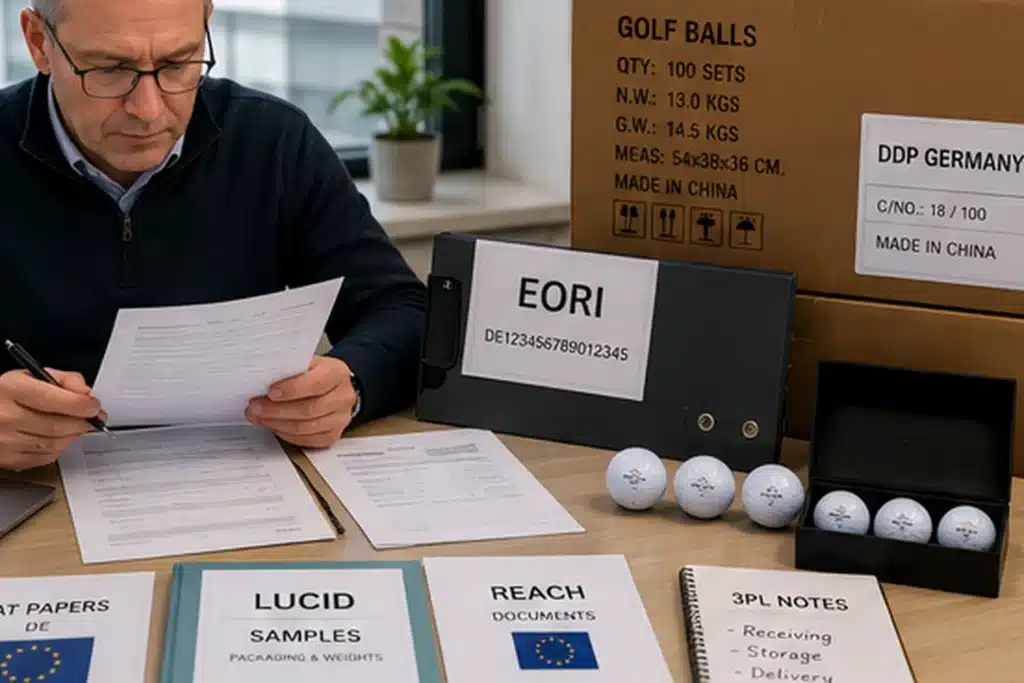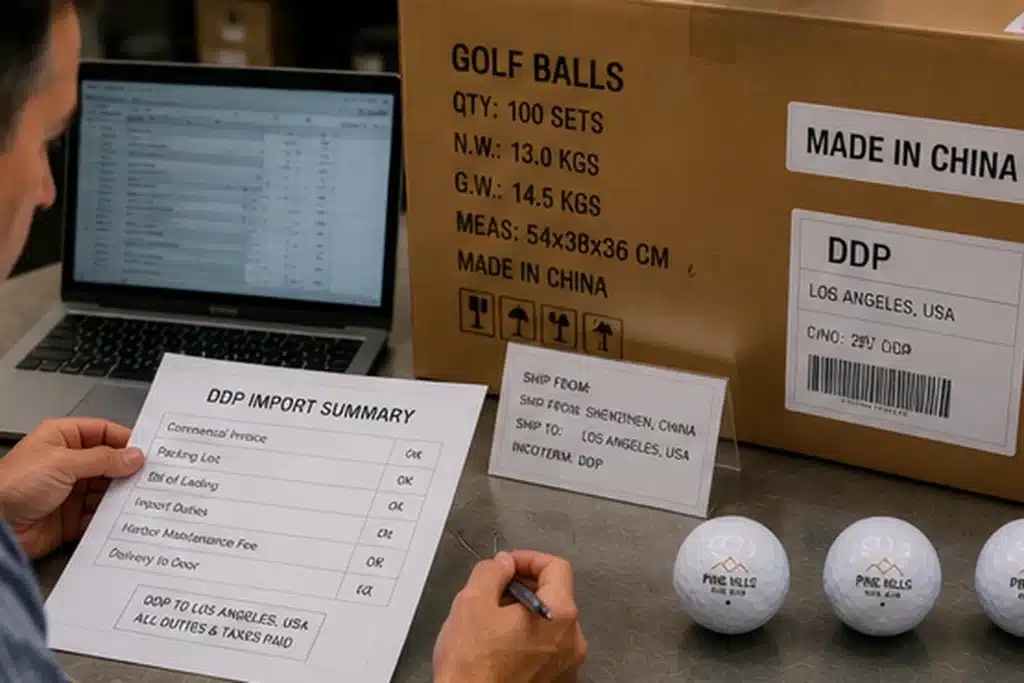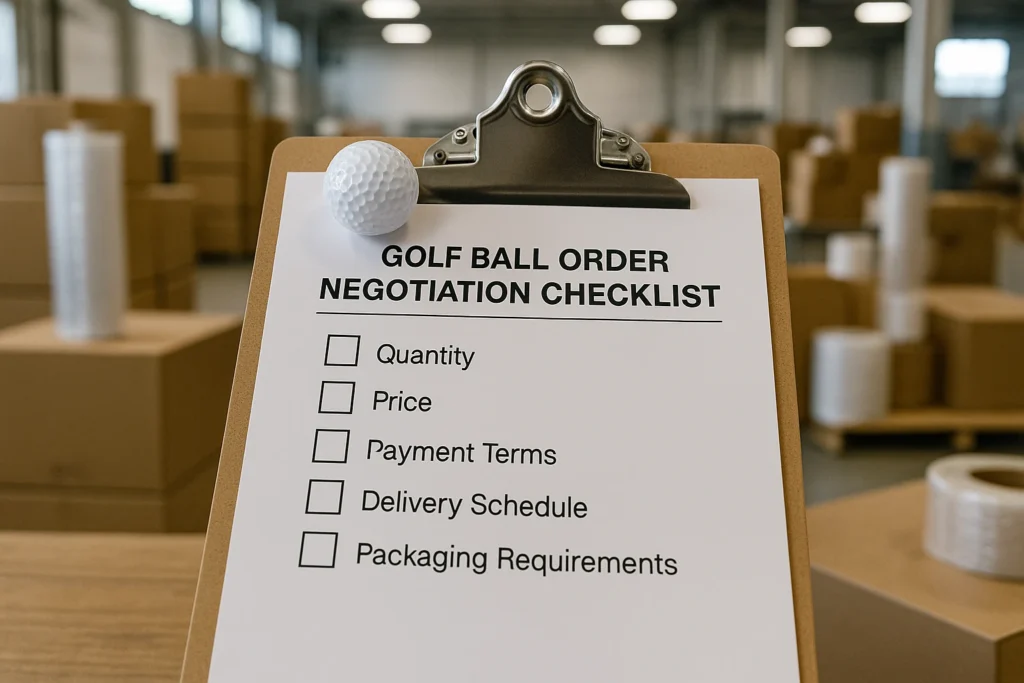
To negotiate China golf ball OEM pricing without losing quality, lock the tech pack first, then trade safer levers for price: payment terms, tiered volume, split shipments, simpler printing, and evidence-based raw-material pass-through. The unit price can move, but the approved ball structure, CTQs, inspection gates, and shipment records should not.
A lower golf ball quote can become expensive fast. If the factory protects margin by changing materials, shortening process time, weakening inspection, or downgrading print execution, your “saving” turns into returns, complaints, missed launches, and a very uncomfortable warehouse conversation.
Use this guide to decide which price levers are safe, which discounts create quality-fade risk, and what evidence your team should request before approving a lower unit price.
Why can a lower price ruin your golf balls?
You may think the goal is to push the factory as low as possible. The real goal is lower cost without letting the factory quietly change the ball you approved.
A lower quote is only a win if the golf ball specification stays locked. If your price cut comes from weaker materials, looser compression control, rushed curing, reduced inspection, or cheaper printing, your EXW or FOB price may fall while your return risk, brand damage, and replacement cost rise.
The “China price” paradox is simple: a factory can often reduce the number on the quote, but the buyer must know where the saving comes from. A healthy discount comes from payment certainty, volume visibility, simplified printing, standard packaging, or real material-price evidence. A dangerous discount comes from vague “same quality, cheaper” language with no CTQs, no golden sample control, and no inspection release gate.
Quality fade is not always dramatic on day one. It can appear in bulk production as shorter distance, cracked covers, wider feel variation, logo rub-off, inconsistent coating, or a second shipment that no longer matches the first. Factory accepts a large price cut but refuses to lock CTQs is a failure signal.
Your savings only count if your shipment still matches the approved ball. Ask what changes and what does not change at the lower price, then verify it through the tech pack, first-article report, and pre-shipment inspection.
| Pain/decision | Bad discount source | Buyer risk | Safer negotiation lever |
|---|---|---|---|
| 15% price cut looks attractive | Hidden material substitution | Distance or durability complaints | Lock CTQs before price |
| Factory says “same quality, cheaper” | No evidence pack | Sample and bulk mismatch | Require first-article report |
| Buyer pushes below margin floor | Process shortcut | Inconsistent compression | Use payment or volume lever |
| Price drops but specs stay vague | Backdoor downgrade | Hard-to-prove claims | Attach tech pack to PO |
| No inspection gate | Payment without leverage | Defect dispute | Link balance to TPI pass |
✔ True — Price cuts must preserve CTQs
A real saving keeps the same ball structure, cover family, compression window, logo method, packaging specification, and inspection method. If the lower price changes those controls, you are not comparing the same product.
✘ False — “The lowest quote is automatically the best sourcing result”
The lowest quote can become the most expensive option if it increases rejects, returns, rework, late launches, or customer complaints.
What must your tech pack lock before price?
If you negotiate before locking the tech pack, the factory can protect margin by changing details you did not define clearly enough. “Same as sample” is not enough.
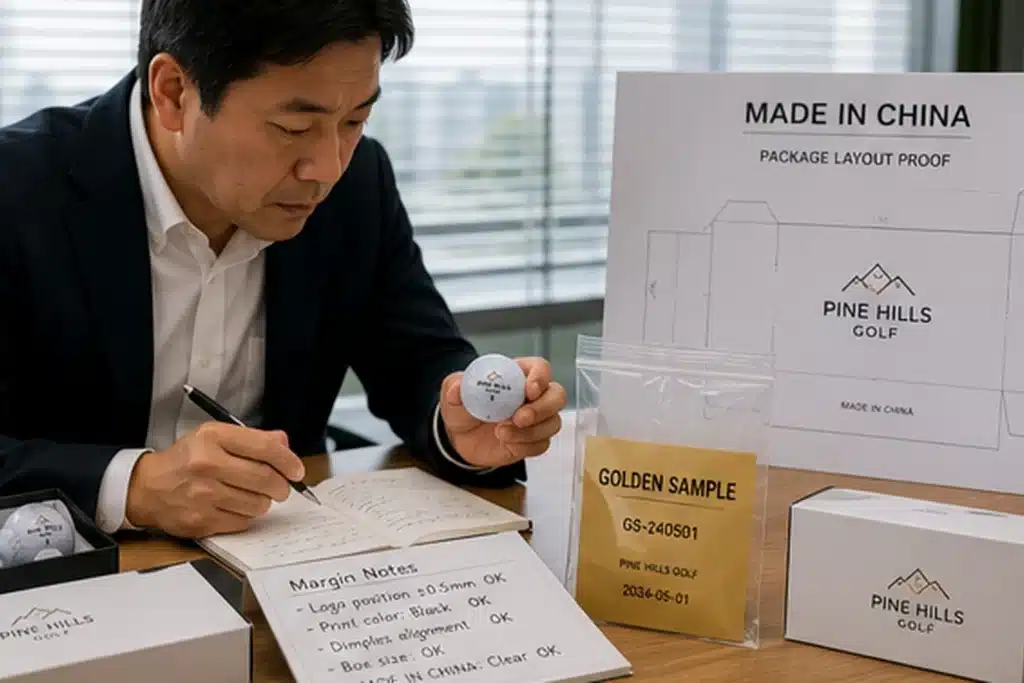
Do not negotiate China golf ball OEM pricing against a vague product. Lock cover family, cover thickness where applicable, compression distribution, weight, diameter, logo method, packaging, golden sample, and inspection method first; then ask the factory where it can save cost without changing the ball.
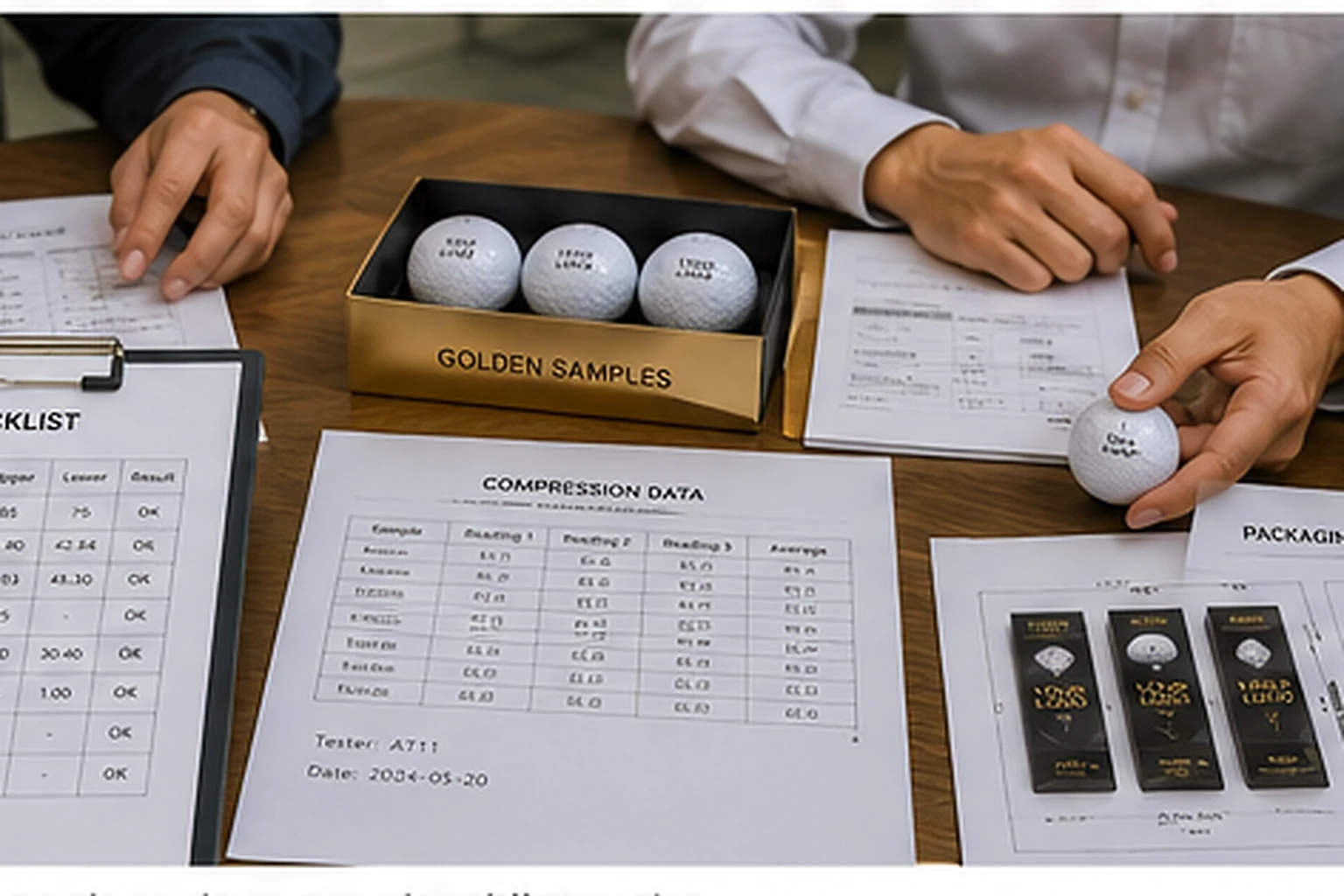
Your first price question should be: what must not change? For a controlled negotiation, the purchase order should freeze the approved structure, cover family, cover thickness target where applicable, compression window, logo method, packaging, golden sample, and inspection plan.
For premium or multi-layer programs, cover control matters. A verified Golfara 3-piece urethane design may use 0.81 mm / 0.0320 in cover thickness as a program benchmark, but this number must be tied to the specific sample, structure, and test method. It is not a universal target for every 3-piece ball.
Compression should be reported as a distribution, not a single number. Ask for ATTI or equivalent compression data with 12-ball average, SD, range, equipment model, method notes, and batch ID. A σ≤2–3 window can be used as a good-to-excellent control target when agreed for the product type.
For a deeper production-control framework, see our guide to golf ball manufacturing CTQs.
| Decision | CTQ to lock | Verification | Acceptance / action |
|---|---|---|---|
| Prevent cover downgrade | Cover family + thickness | Cutaway / thickness map | Require re-approval for changes |
| Prevent feel drift | ATTI/equivalent compression | 12-ball average + SD + range | Set SD window in PO |
| Prevent nonconforming goods | Weight / diameter | Digital scale / gauge | Stop-ship if out of limit |
| Prevent logo disputes | Print method + color count | Signed artwork proof | Approve physical sample |
| Prevent sample-bulk mismatch | Golden sample | Counter-signed retained set | Compare before payment |
Which CTQs stop quality fade?
The CTQs that stop quality fade are the controls a supplier cannot change quietly without being caught: cover system, compression distribution, weight, diameter, print method, coating, packaging, and first-article comparison.
A strong negotiation does not sound like, “Can you make it cheaper?” It sounds like, “These CTQs are locked; where can we reduce cost without changing them?” That moves the conversation from blind price pressure to controlled value engineering.
Supplier shall maintain the approved ball structure, cover family, cover thickness target, compression window, print method, packaging specification, and QC method used for the approved sample. Any deviation requires written buyer approval before mass production.
✔ True — The tech pack is your price-protection tool
A locked tech pack tells the factory what cannot change when price changes. It also gives your inspection team measurable criteria before shipment release.
✘ False — “‘Same as sample’ is enough without measurable controls”
Samples help, but they do not replace cover evidence, compression data, artwork proof, packaging approval, and batch-linked inspection records.
Can payment terms lower unit price safely?
You may still have leverage when the factory refuses another price cut. Payment terms affect supplier cash flow, receivable risk, FX exposure, and collection effort.
Better payment terms can lower golf ball OEM price because they reduce factory risk, not because interest alone equals the discount. A 100% pre-shipment T/T offer can support a 3–5% concession only when payment is released after TPI pass, sealed-sample match, and evidence review.
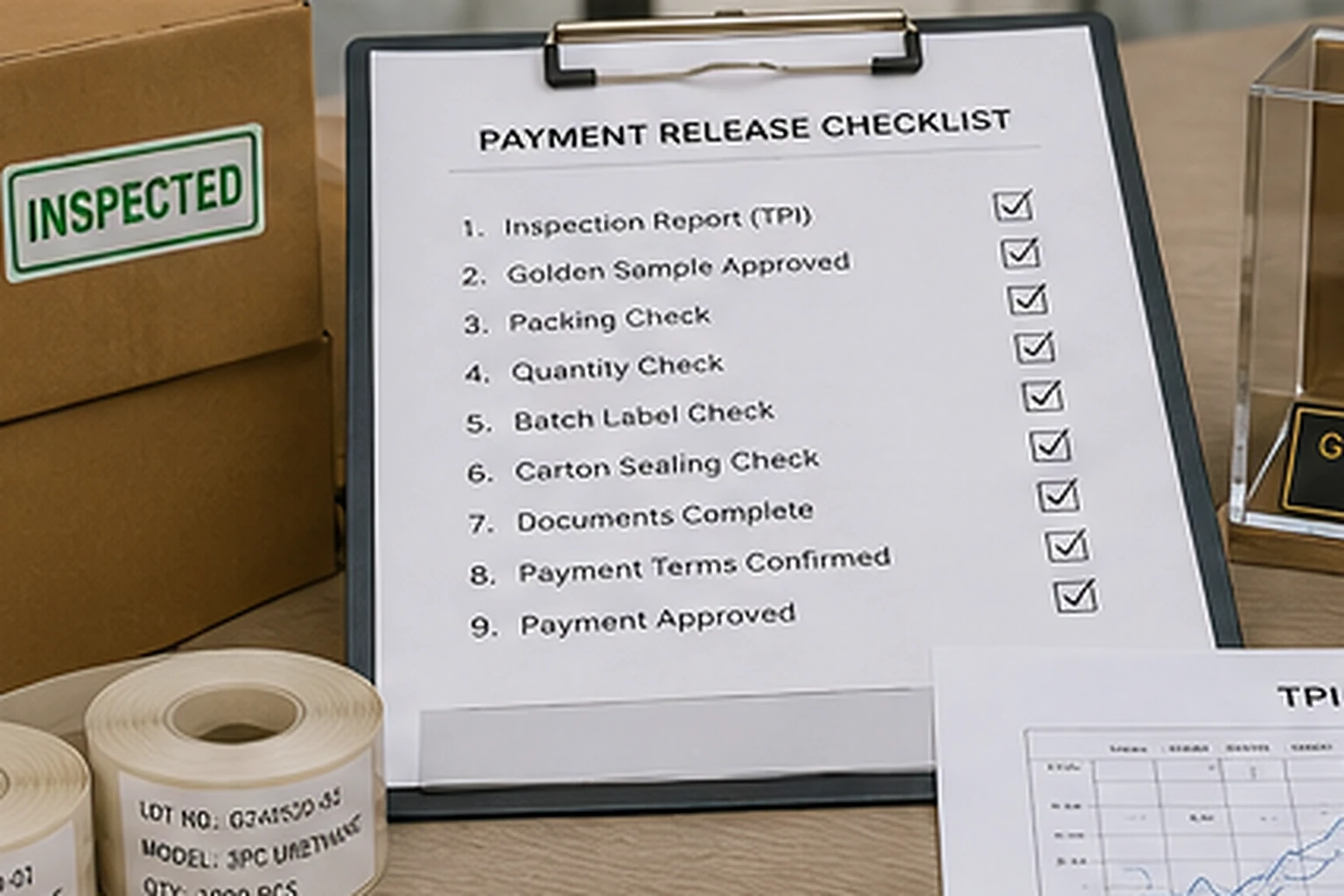
Your cash is a negotiation tool, not a blank check. Export production creates a time gap between materials, manufacturing, shipment preparation, and final payment. Trade finance exists to bridge the time gap between production, purchase, and final payment, so payment timing has real value for the supplier. A stronger payment term can reduce working-capital pressure, receivable risk, collection work, and FX uncertainty.
That does not mean the discount is pure interest saving. In May 2026, China’s one-year LPR was 3.00%, according to the official LPR publication, so 30–90 days of interest alone would not explain a full 3–5% unit-price concession. The concession is better understood as total risk relief: cash-flow certainty, lower non-payment exposure, simpler collection, and less currency uncertainty.
The safer offer is 100% pre-shipment T/T after third-party inspection, not 100% before production. Supplier offers a 100% payment discount without TPI or golden sample is a failure signal. Require TPI pass, sealed golden sample match, dated photo/video evidence, carton ID confirmation, packing list reconciliation, and batch-linked QC records before payment release.
| Payment option | Price effect | Buyer risk | Required control |
|---|---|---|---|
| 30/70 standard | Baseline | Moderate | Normal QC gates |
| 50/50 pre-ship | Small concession | Medium | Inspection tied to balance |
| 100% pre-shipment after TPI | 3–5% possible | Higher | TPI + sealed sample + media proof |
| 100% before production | Risky | High | Avoid unless relationship proven |
| Escrow / documentary method | Lower risk | More admin | Use for new suppliers |
When does 100% pre-shipment T/T work?
100% pre-shipment T/T works when the goods are already made, inspected, documented, and matched to the approved sample before money moves.
Request payment-term quote versions with and without TPI-linked pre-shipment payment. Then compare the discount with the control package. Your release checklist should include inspection report, photo/video pack, carton IDs, packing list, golden sample comparison, and corrective-action path.
Payment release is conditional on third-party inspection pass, sealed golden sample match, dated photo/video evidence, carton ID confirmation, packing list reconciliation, and batch-linked QC records. Any mismatch requires buyer approval before payment.
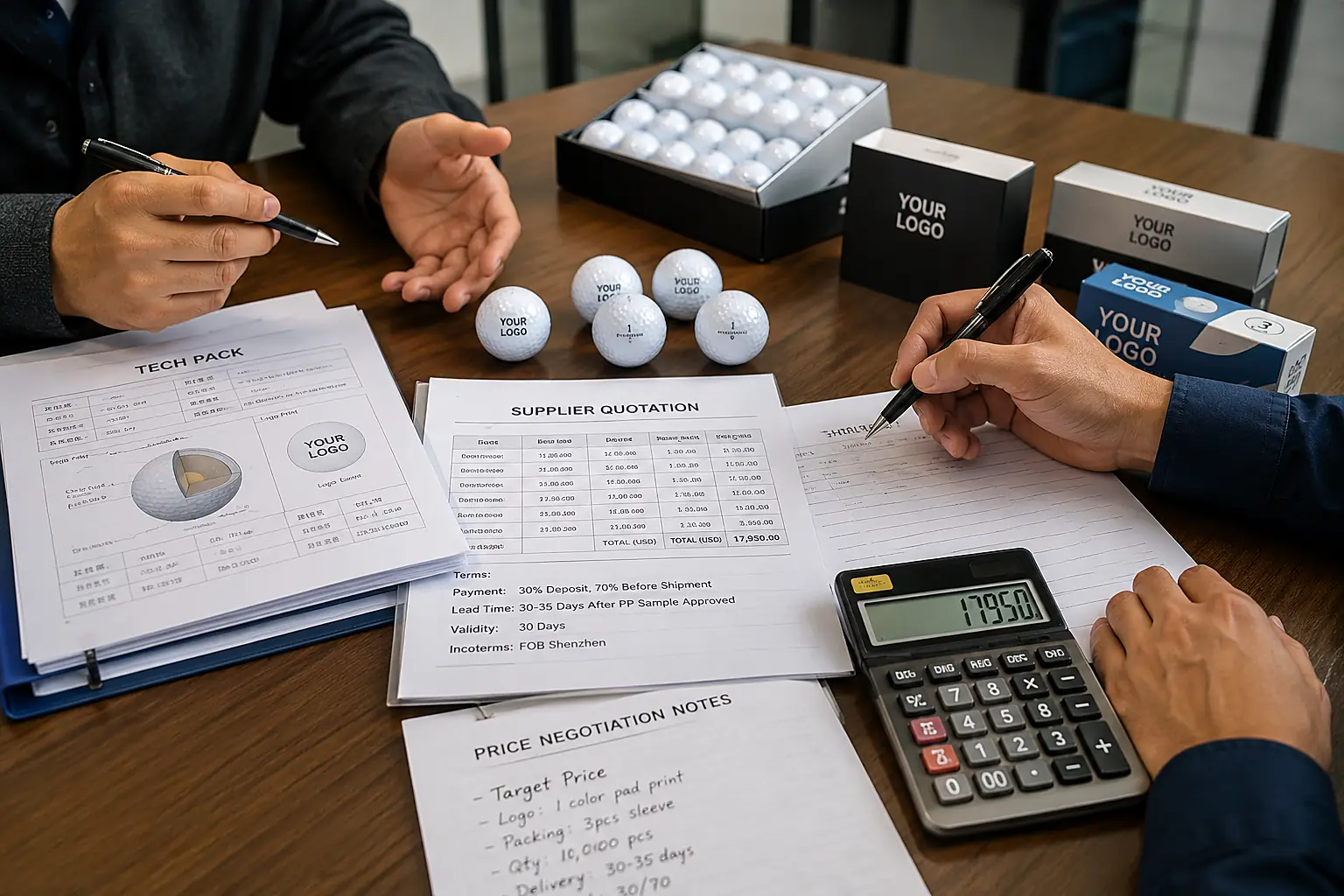
How do split shipments secure tier pricing?
You may want the lower unit cost of a large order but cannot absorb all inventory, cash demand, or warehouse pressure at once. That is where framework contracts can help.
Framework orders let you trade volume visibility for better pricing without taking all goods at once. The structure works only when the contract fixes total quantity, wave schedule, storage cap, batch QC, title/risk, and payment milestones.
A one-time small PO gives the factory limited visibility. A larger annual or framework order gives better planning confidence, stronger material planning, and improved line utilization. In exchange, you can request a lower tier price while pulling goods in shipment waves.
This is not the same as asking for unlimited free storage. Use an agreed storage window with clear liability terms. The practical structure is simple: fix the annual or framework quantity, secure the price tier, produce or allocate in a planned way, and release goods in defined waves. Typical discussions may cover 90–120 days of storage, but the final terms depend on factory capacity, product type, packaging, and season.
Each shipment wave should have quantity, date, QC deliverable, payment trigger, and remedy. If those details are missing, your “big order discount” can become a future dispute about storage fees, delayed release, batch drift, or repricing.
| Decision | Framework clause | Risk if missing | Acceptance / action |
|---|---|---|---|
| Lock lower price | Total quantity + unit price | Supplier reprices later | Fix price across waves |
| Protect cash flow | Split payment by wave | Large cash burden | Tie payment to batch release |
| Avoid storage disputes | Storage cap | Open-ended fees | Define days and liability |
| Protect consistency | Same spec across waves | Batch drift | Require QC per wave |
| Manage delay | Pull windows | Missed sales window | Add dated schedule |
How should framework orders be written?
A framework order should read like a calendar, not a handshake. It needs total volume, unit price, shipment waves, storage responsibility, QC records, payment milestones, and remedies.
A clean clause fixes total contract quantity, unit price across waves, shipment wave quantities, planned release dates, QC per wave, storage cap, title/risk while stored, and late-release or late-ship remedy. The goal is price stability without losing operational control.
You are not asking the factory to discount blindly. You are giving volume visibility in exchange for price stability. That exchange only works when both sides know exactly when goods move, when payment happens, and what evidence is required per wave.
Which specs should you simplify for savings?
You may be trying to cut cost in the wrong place. Cutting core or cover quality creates performance risk; simplifying printing and packaging can reduce cost with less functional damage.
If you need savings, simplify print and packaging before touching core materials. A simple 1–4 color pad-printed logo on standard blank stock can reduce setup and unit cost, while keeping the ball structure, compression control, cover system, and durability checks intact.
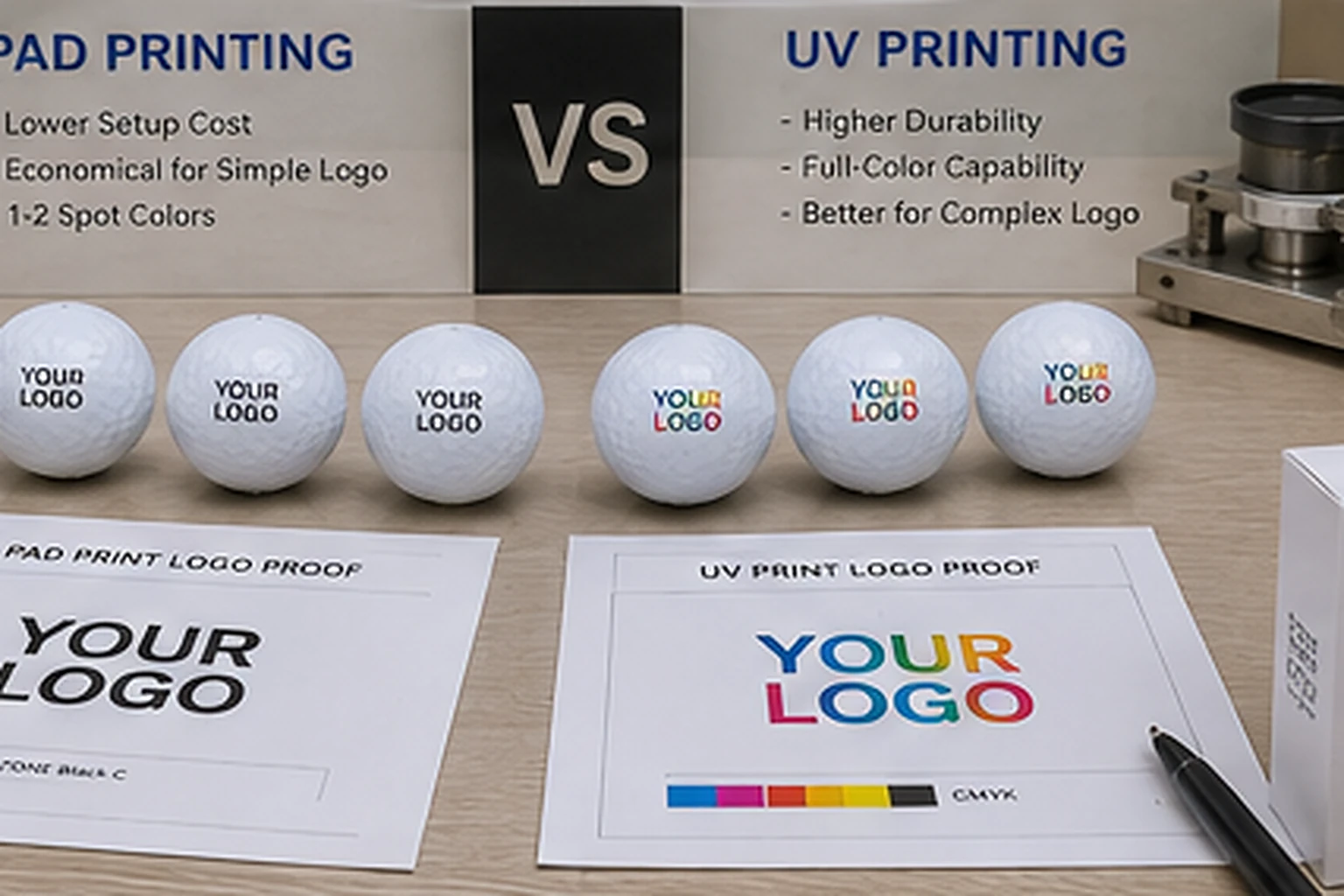
Do not cut the core if your complaint risk is distance, feel, or durability. Look first at cosmetic and presentation costs. A complex logo, special colorway, premium box, insert, and high-detail packaging set can push price up even when the ball itself is unchanged.
Pad printing is often the practical saving lever for simple B2B logos. It uses a silicone pad to transfer ink from a plate onto the ball surface and suits repeated 1–4 color logos, standard positions, and clean edges. UV printing is valuable for gradients, photo-style artwork, personalization, and complex multi-color designs, but it can add setup friction when the artwork does not need that complexity.
Your savings should not remove verification. Request print method declaration, signed artwork proof, cured print sample, rub/abrasion evidence, and packaging proof. If the logo method changes, the approved physical sample should change too.
For more detail, read our guide to golf ball logo printing methods.
| Cost lever | Safer saving | What not to cut | Evidence to request |
|---|---|---|---|
| Logo method | Pad print simple logos | Core material | Print proof + rub test |
| Color count | Reduce to 1–4 colors | Cover grade | Artwork approval |
| Packaging | Use standard box first | Compression QC | Packaging proof |
| Ball shell | Use blank stock | Approved CTQs | Structure declaration |
| Finish | Standard gloss / clear | Durability checks | Coating/adhesion evidence |
✔ True — Cosmetic simplification can create real savings
Simpler artwork, fewer colors, standard positions, and standard packaging can reduce setup and unit cost without touching the ball’s performance-critical structure.
✘ False — “The fastest cost cut should come from weaker core or cover materials”
Cutting the core, cover, or compression control can damage distance, feel, durability, and customer trust. Save first where performance risk is lower.
Where should pad printing replace UV?
Pad printing should replace UV when the artwork is simple, repeatable, and limited to a few solid colors. UV should stay when the design truly needs gradients, photographic detail, or personalization.
Request two quotes: full-custom UV/packaging and simplified pad-print/standard-pack option. Compare print method, setup fee, unit price, lead time, and durability evidence. The lower-cost route should still pass logo clarity, adhesion, rub resistance, and artwork approval.
This is controlled value engineering. You are protecting performance while removing unnecessary cosmetic cost.
How do you verify supplier price claims?
Suppliers may use “resin went up,” “rubber went up,” or “PU is expensive now” to defend a price increase. Vague material claims do not prove the finished-ball increase is fair.
Do not accept “materials went up” as a complete price explanation. Ask for grade, supplier notice, invoice month, index reference, and pass-through logic; a raw-material index increase only affects the portion of EXW cost tied to that material.
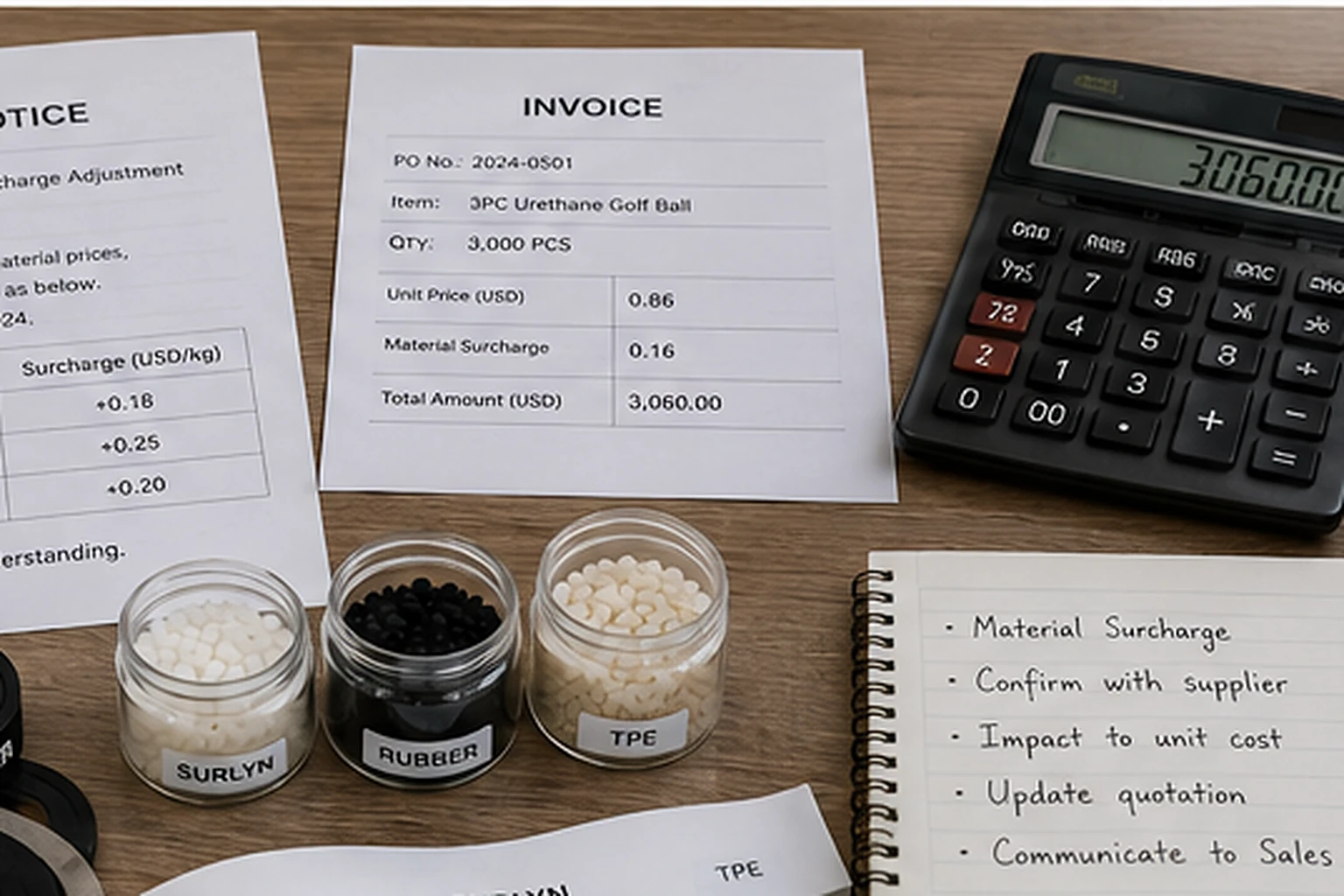
Your goal is not to deny real cost increases. Your goal is to reject unsupported pass-through. For ionomer or Surlyn-type cover discussions, public thermoplastic resin indexes can be used as proxy checks. In April 2026, one public thermoplastic resin PPI series showed a sharp month-on-month increase. That can support a resin-cost discussion, but it does not automatically justify a double-digit finished-ball price increase.
Use a simple first-pass formula: fair material pass-through ≈ material share of EXW cost × raw-material index change. If a cover resin represents 30% of EXW cost and a relevant resin proxy rises 5%, the first-pass cost pressure is about 1.5%, before FX, inventory timing, grade substitution, and supplier purchase price are considered.
For rubber-core discussions, public rubber references such as World Bank commodity price data can help check whether a claim matches market direction. For PU or TPU systems, use PU, MDI, or polyol proxy data carefully, not as a one-to-one finished-ball price. Resin surcharge is claimed without grade, month, invoice, or index reference is a failure signal.
Please quote the same approved specification at MOQ / +20% / +50% / ×2, with payment-term options, TPI requirements, sample approval process, shipment-wave options, storage terms, and any raw-material surcharge evidence. Keep structure, cover family, logo method, packaging, and acceptance criteria unchanged across all tiers.
| Supplier claim | Evidence to ask | Cross-check | Buyer action |
|---|---|---|---|
| Resin went up | Grade + invoice month | Thermoplastic resin PPI proxy | Calculate pass-through |
| PU went up | MDI/polyol evidence | PU/MDI proxy | Check material share |
| Rubber went up | Rubber type + supplier notice | Rubber index proxy | Compare timing |
| FX changed | Currency assumption | FX rate at quote date | Define validity window |
| Labor/overhead rose | Cost-driver detail | Ask for scope change | Avoid vague surcharge |
What evidence should suppliers provide?
Suppliers should provide material grade, invoice or supplier notice, purchase month, index reference, FX assumption, and pass-through calculation. Without those, the price claim is not ready for approval.
You can accept real material increases and still reject vague math. Ask whether the supplier is using old inventory or new purchases. Ask whether the surcharge is temporary or permanent. Ask how long the quote remains valid and what index movement would trigger a revision.
Do not accept raw-material surcharges without evidence and a time-limited price-validity clause. If you are still screening potential factories before price negotiation, this China OEM supplier audit guide can help your team narrow the shortlist.
FAQ
How do I negotiate price with a Chinese manufacturer without losing quality?
To negotiate price without losing quality, lock the golf ball tech pack before discussing discounts. The structure, cover family, cover thickness, compression distribution, logo method, packaging, golden sample, and inspection method should stay fixed while you negotiate payment, volume, timing, or simplified cosmetics.
The safe method is to move cost through business terms, not hidden substitutions. Ask for the same specification across all quote tiers and link payment release to inspection evidence. Reject discounts that depend on vague “same quality” promises, lighter QC, unknown material changes, or unclear production shortcuts.
Can better payment terms reduce OEM golf ball price?
Yes. Better payment terms can reduce OEM golf ball price when they lower supplier cash-flow risk, receivable exposure, FX uncertainty, and collection effort. A 100% pre-shipment T/T offer can support a concession only when tied to TPI pass, sealed sample match, and evidence review.
Do not confuse payment leverage with blind prepayment. Use TPI before payment release, require carton IDs and packing evidence, and keep remedies in the PO. Avoid full prepayment before production for new suppliers unless the relationship, legal controls, and inspection process are already proven.
What is quality fade in manufacturing?
Quality fade means a supplier gradually reduces material, process, inspection, or execution quality after the buyer approves the sample or squeezes price too far. In golf balls, it can appear as wider compression spread, weaker cover durability, poor logo adhesion, inconsistent flight, or bulk goods that no longer match samples.
The prevention method is written control. Compare sample and first article, track compression SD and range, keep retained samples, and require written approval for material, process, logo, packaging, or inspection changes. The more aggressive the price cut, the more important the evidence pack becomes.
How do split shipments lower golf ball OEM cost?
Split shipments lower golf ball OEM cost by letting you give the factory a larger total order while receiving goods in waves. This can unlock tier pricing and production efficiency while reducing warehouse pressure, cash-flow strain, and the risk of taking all inventory at once.
Fix total volume and unit price first. Then define shipment waves, storage cap, liability, title/risk transfer, payment milestone, and QC per wave. A framework order can create savings only when the calendar and responsibilities are written clearly.
Why are custom printed golf balls expensive?
Custom printed golf balls are expensive because printing adds artwork setup, plate or UV setup, color count, curing, surface treatment, inspection, and packaging coordination. For simple logos, 1–4 color pad printing can be more cost-efficient than complex UV printing.
Reduce color count, use a standard logo position, approve a physical print proof, and keep UV for complex artwork that truly needs it. Do not reduce the ball’s core or cover quality just to solve a logo-cost problem.
How should buyers verify raw material surcharges?
Buyers should verify raw-material surcharges by asking for resin or rubber grade, supplier notice, invoice month, index reference, FX assumption, and material-share pass-through. A raw-material index increase should not automatically become the same percentage increase on the finished golf ball.
Check public proxy indexes, but use them carefully. The fair question is not only whether resin, PU, or rubber increased. It is how much of the EXW price is affected, when the supplier bought material, what grade was used, and whether the surcharge has an expiry date.
Conclusion
The best golf ball OEM price negotiation is not a fight over pennies. It is a structured exchange: you lock CTQs, protect quality, offer better payment or volume visibility, simplify non-critical specs, challenge vague raw-material claims, and convert every discount into written acceptance criteria.
Price can move, but the approved ball should not. Use your cash, order visibility, artwork flexibility, and evidence discipline as negotiation tools. That is how you reduce cost without inviting quality fade.
You might also like — How Much Does It Cost to Manufacture Golf Balls? (EXW & BOM Audit)