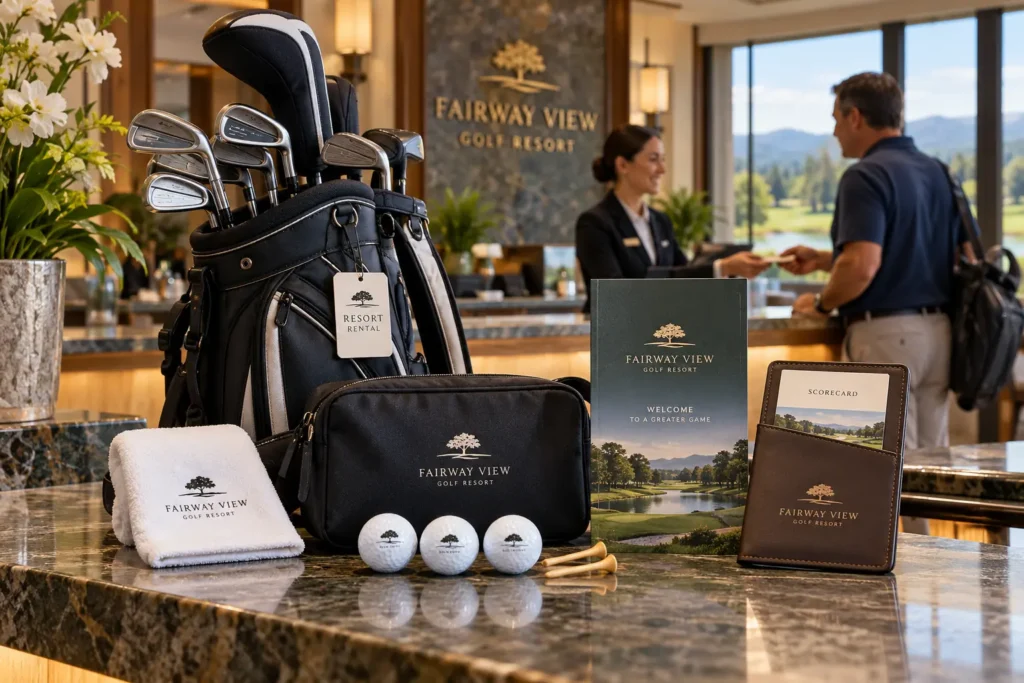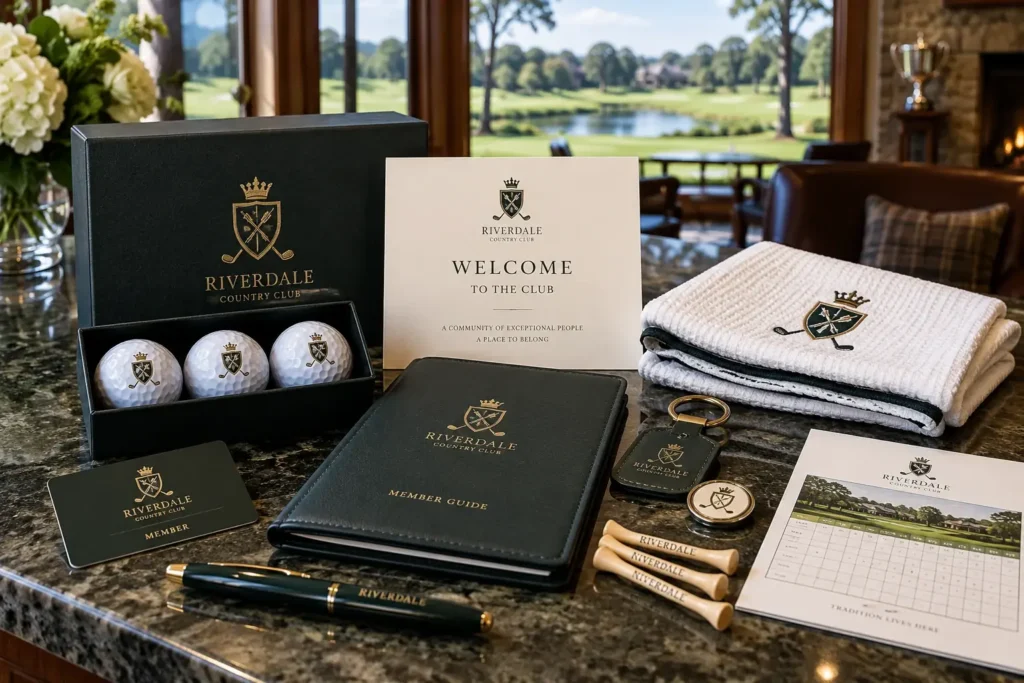
A premium country club welcome kit can still feel generic when members with very different club experiences all receive the same logo-ball package.
Yes—but only when the golf balls support a defined onboarding role and fit the recipient’s actual membership experience. Country clubs should decide eligibility first, then set the allocation, ball tier, club-crest approval, and replenishment standard for the program.
The real question is not whether logo golf balls are a good gift. It is whether they are the right welcome item for this member and this onboarding program.
Start with the member. Then decide what the ball should do, how many belong in the program, and which approved version your club should keep reordering.
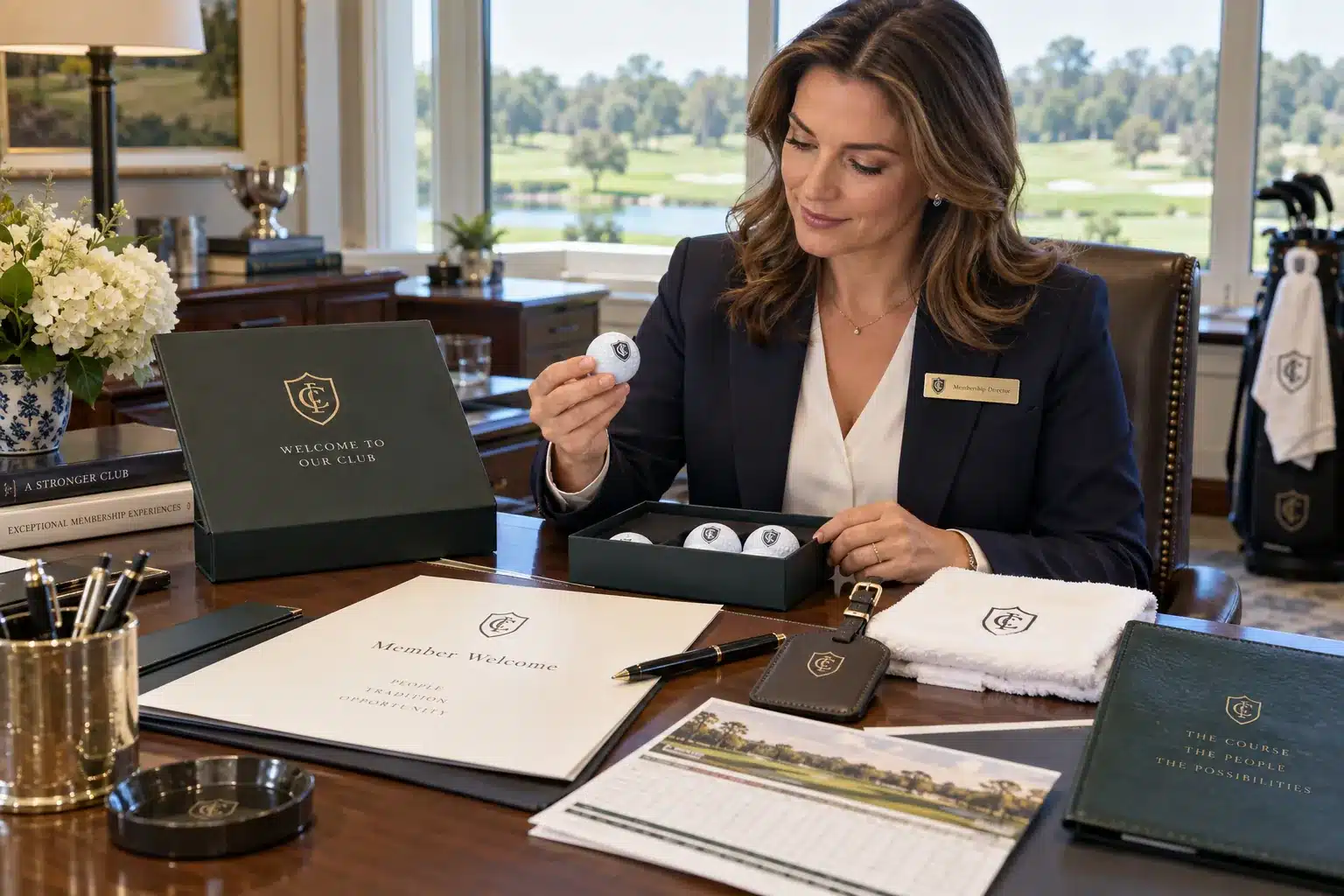
What role should logo balls play in onboarding?
It is easy to begin with, “What should we put in the welcome box?” That can leave your team choosing attractive products before anyone defines what those products should accomplish.
A logo golf ball earns its place in a new-member kit only when it supports the onboarding experience. Decide whether it should help your member play immediately, reinforce club identity, mark the start of golf membership, or remain a useful branded item before choosing the model, quantity, or presentation.
Private-club onboarding is much larger than a gift handoff. The National Club Association’s private-club onboarding resource describes onboarding as a structured process extending from pre-membership expectations through the first year, including education, engagement, family integration, events, and check-ins.
A logo-ball gift can support that process. It cannot replace it.
Create a New-Member Ball Program Brief before choosing a SKU. Record the Member Type, Onboarding Role, Ball Role, Club Branding Role, and Distribution Moment. That forces your Membership Director, golf operation, and purchasing team to agree on why the ball belongs in the program.
Treat the ball as part of member onboarding, not generic promotional inventory.
Presentation comes later. If the next question becomes sleeve, box, or gift presentation, move to the guide on OEM golf-ball packaging options.
✔ True — The ball should have a defined onboarding job
A playable first-round item, club-identity touchpoint, golf-membership signal, or useful keepsake can all make sense when the role is deliberate and relevant.
✘ False — “Every premium country-club welcome kit automatically needs golf balls”
Club prestige sets the brand context. It does not prove that the same golf item creates value for every new member.
Which new members should receive golf balls?
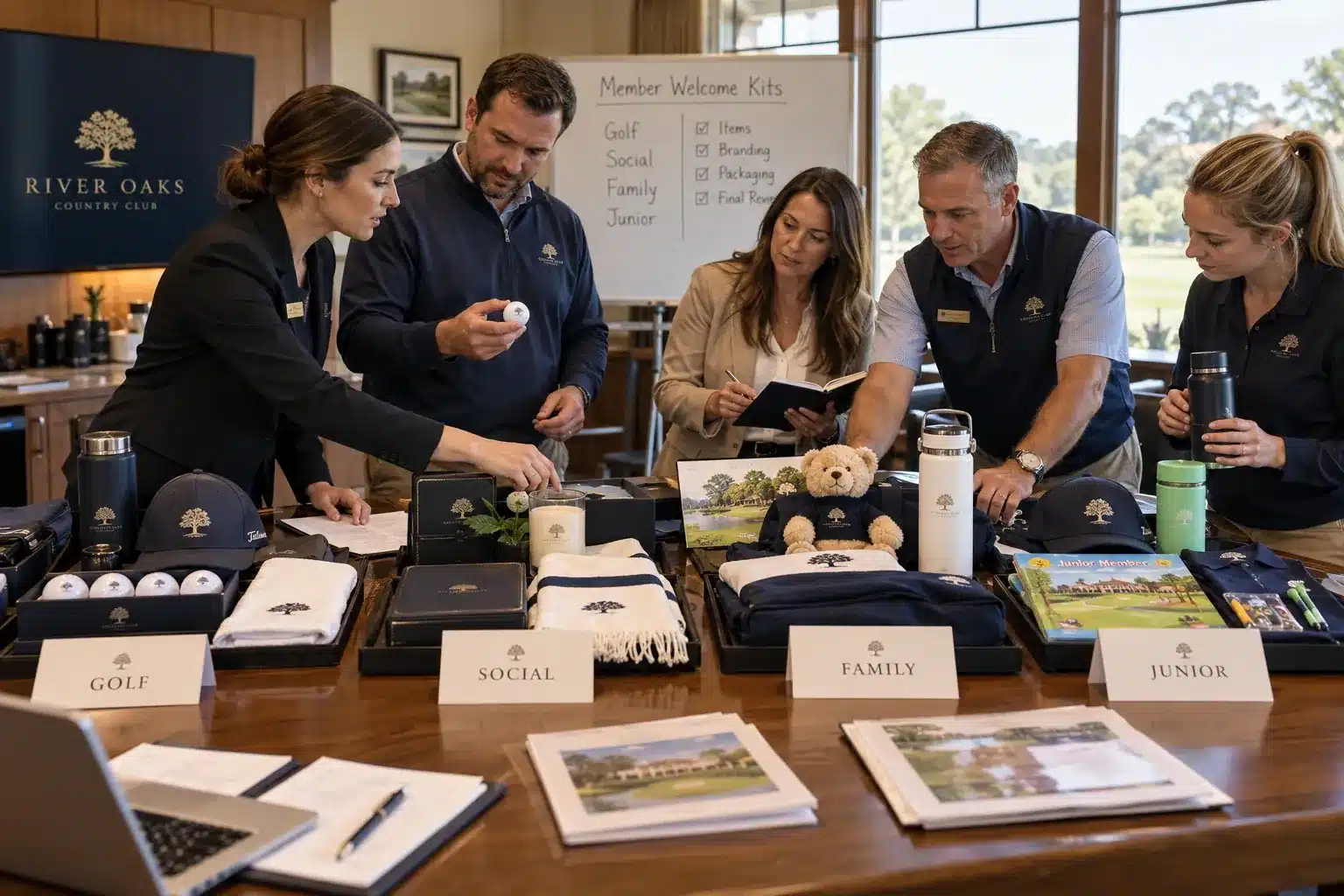
Giving every new member the same club-logo balls looks consistent on a spreadsheet. It can feel surprisingly impersonal once Golf, Social, Family, Junior, and Non-Resident members begin using the club differently.
Do not give golf balls to every new member simply because your club has a golf course. Match the allocation to the member’s actual club experience: a golf-focused member may immediately value a playable club-logo ball, while another membership category may receive more value from an item tied to the activities they actually use.
Membership type should trigger a relevance review—not become an automatic gift rule.
Published private-club practice supports that distinction. A Yellowstone Country Club onboarding case study discusses tailoring welcome items by membership type, including golf balls for resident members while considering activity-related products for court-sports or pool members. The example supports personalization by membership context, not a rule that any membership label automatically determines the gift.
We learned this from an earlier club project where logo golf balls were included in the same member gift package for everyone, but member feedback fell short of expectations. The club later found that Golf, Social, Family and Junior memberships had different needs. We applied that lesson when another club approached us for logo-ball member gifts. Instead of recommending one package for every member, we suggested segmenting the program. The club ultimately used different products for different membership groups rather than ordering logo golf balls for everyone.
The lesson was not that logo golf balls were a poor welcome gift. They were simply more relevant to some membership groups than others. Eligibility should come before quantity, ball tier, or presentation.
| Member Decision | Onboarding Relevance | Risk | Buyer Action |
|---|---|---|---|
| Golf membership | Usually direct | Wrong tier | Define ball role |
| Full / resident | Depends on golf use | Generic kit | Confirm relevance |
| Social | May be limited | Unused item | Verify golf use |
| Family | Mixed | Over-allocation | Define household rule |
| Junior | Program-specific | Adult assumptions | Match junior program |
| Non-resident | Usage varies | Wrong allocation | Check expected use |
Build a Member Eligibility Matrix using golf access, expected participation, household structure, junior-program relevance, and seasonal or non-resident use.
A Social Member may still golf. A Family Membership may contain one active golfer rather than four. Your categories should prompt questions, not replace them.
Every membership type receiving the same golf-ball kit by default is a failure signal.
How many logo balls should each member receive?
Once eligibility is clear, the next temptation is to copy a visible quantity from another club: three balls, six balls, or a dozen.
There is no universal number of logo golf balls that belongs in every new-member welcome kit. Set your allocation from membership type, household structure, intended use, annual member intake, and onboarding budget, then lock that quantity into the approved program instead of copying another club’s sleeve or dozen.
Mayville Golf Course’s First Time Member Package currently includes one dozen logo balls for an individual and two dozen for a couple.
That demonstrates that allocation can change with membership configuration. It does not make one dozen a country-club standard.
| Quantity Decision | Variable | Bad Assumption | Buyer Action |
|---|---|---|---|
| Individual | Program role | Copy another club | Set baseline |
| Couple | Household policy | Automatically double | Define rule |
| Family | Golf participation | One box per person | Set allocation |
| First-round use | Playing intent | Gift quantity = use quantity | Define purpose |
| Annual program | Eligible intake | Order from memory | Forecast demand |
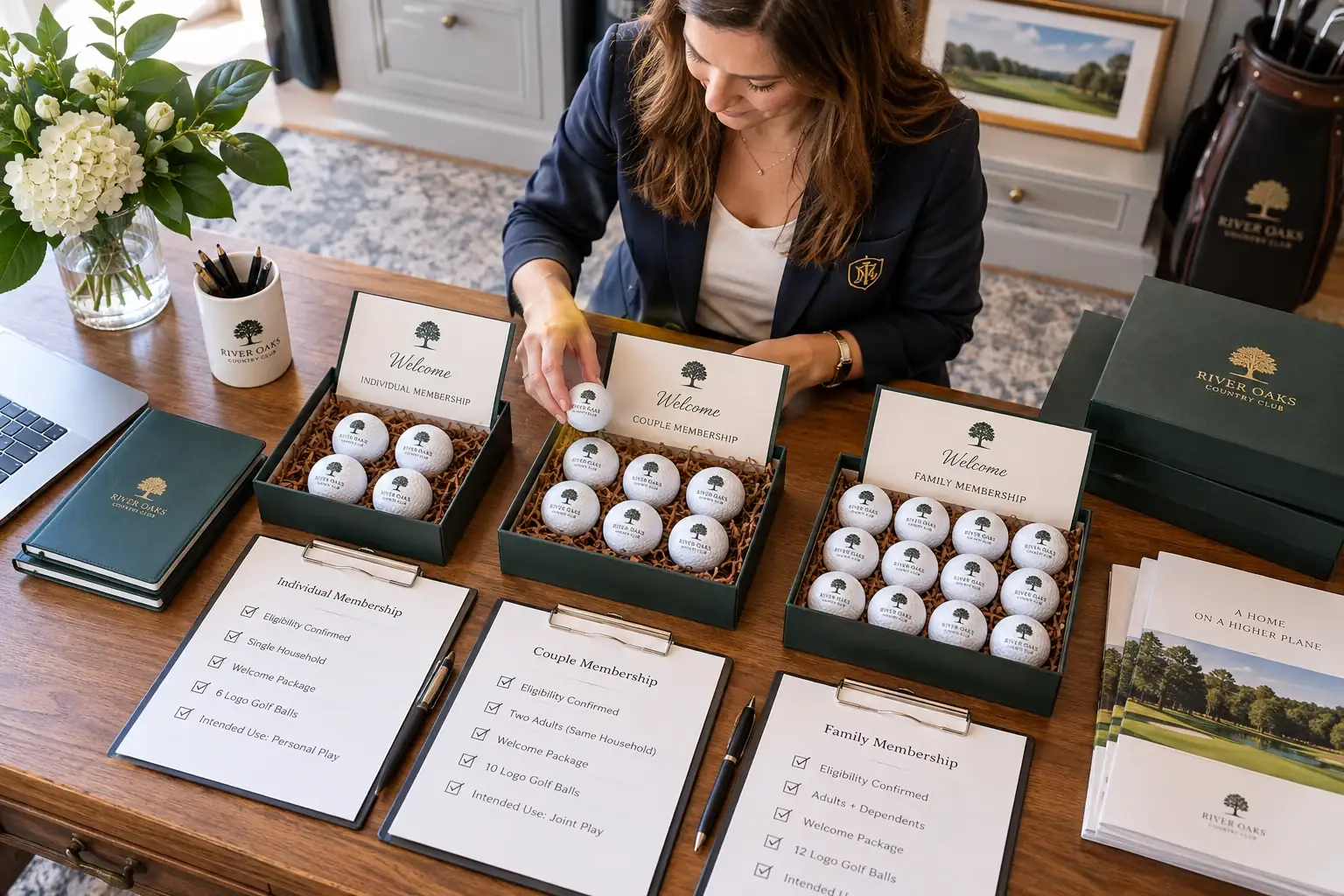
Your team should define whether the allocation is per eligible member, per golfer, per household, or per membership before requesting an annual quantity.
Then compare actual distribution with eligible new-member intake before reordering. That gives you a club-specific planning signal rather than an invented industry average.
✔ True — Different welcome programs can legitimately use different quantities
Allocation should reflect who is eligible, what the ball is for, and whether your unit is a golfer, member, household, or membership.
✘ False — “One dozen logo balls is the normal country-club standard”
A published club package is an operating example, not a quantity benchmark your membership team should copy automatically.
Which ball tier fits your member promise?
A prestigious club can overspecify the gift by buying the most expensive ball available. It can also weaken the experience by deciding that “it’s only a welcome gift” and choosing on price alone.
Do not choose the ball tier from your club’s prestige alone. Match the ball to the member experience you want to create—whether that is practical first-round use, a polished club-branded welcome, or a more performance-sensitive golf experience. Product construction should follow that promise rather than define it.
Your club’s prestige sets the brand context. It does not tell you which ball every new member will value.
| Program Need | Tier Direction | Main Risk | Buyer Action |
|---|---|---|---|
| Functional welcome | Value / performance | Feels too promotional | Validate experience |
| Golf-focused member | Performance-oriented | Over-specifying | Define expectation |
| Premium experience | Possible premium tier | Prestige-only upgrade | Justify value |
| Multiple segments | One or segmented tier | SKU complexity | Keep useful variants |
Create a New-Member Ball Tier Brief and require one written reason for every recurring tier:
What difference in member experience justifies this ball tier?
If two versions solve essentially the same onboarding need, another SKU may add more complexity than value.
“Premium club” automatically becoming “most expensive golf ball” is a failure signal.
If your team moves from onboarding tier to the technical question of whether the program needs a 2-piece or 3-piece construction, use the dedicated 2-piece vs 3-piece golf-ball sourcing guide instead of turning the welcome-kit program into a ball-engineering discussion.
How should your club crest be approved?
Your marketing team can approve a polished crest PDF and still receive a finished ball whose color, scale, position, or fine detail does not look the way anyone expected.
A club-approved logo file is not the same as an approved logo golf ball. Lock the crest revision, color reference, logo size, and position, then approve the mark on the actual ball and finish that will enter your welcome program. Preserve that physical sample as the visual reference for repeat orders.
Digital proof is a normal part of commercial custom-logo approval. Titleist’s custom-logo process asks buyers to review and approve a digital proof before production and requests PMS color information where available.
For a recurring country-club program, we recommend adding a physical on-ball sample as a stricter buyer-side control. The purpose is not to dismiss digital proof; it is to preserve how the approved crest actually appears on the selected ball and finish.
| Approval Decision | What to Lock | Weak Proof | Buyer Action |
|---|---|---|---|
| Crest | Artwork revision | Email attachment | Name final version |
| Color | Approved reference | Screen color | Confirm reference |
| Size | Actual dimensions | Enlarged render | Inspect on ball |
| Position | Exact location | Generic mockup | Approve placement |
| Appearance | Physical sample | Photo only | Sign sample |
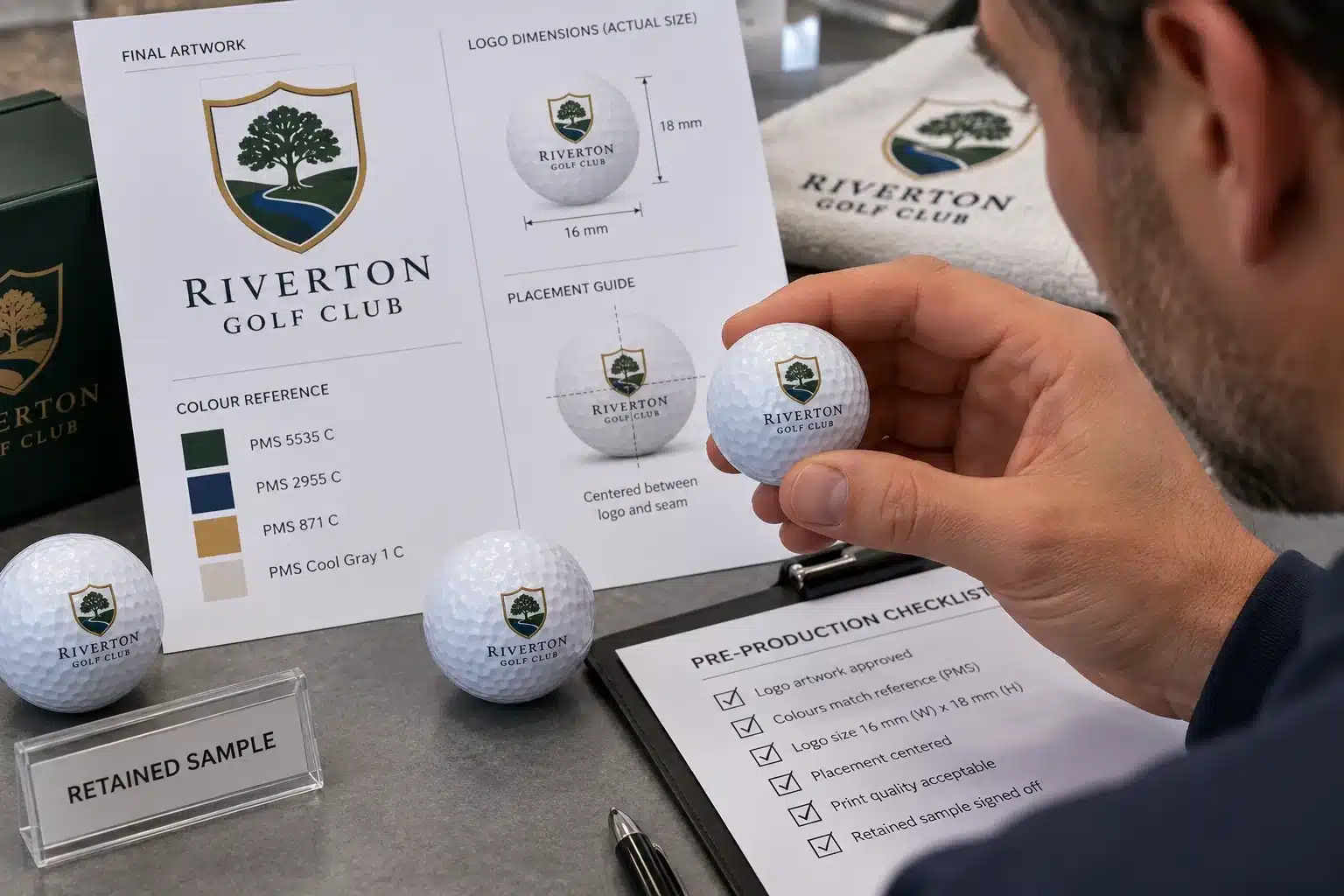
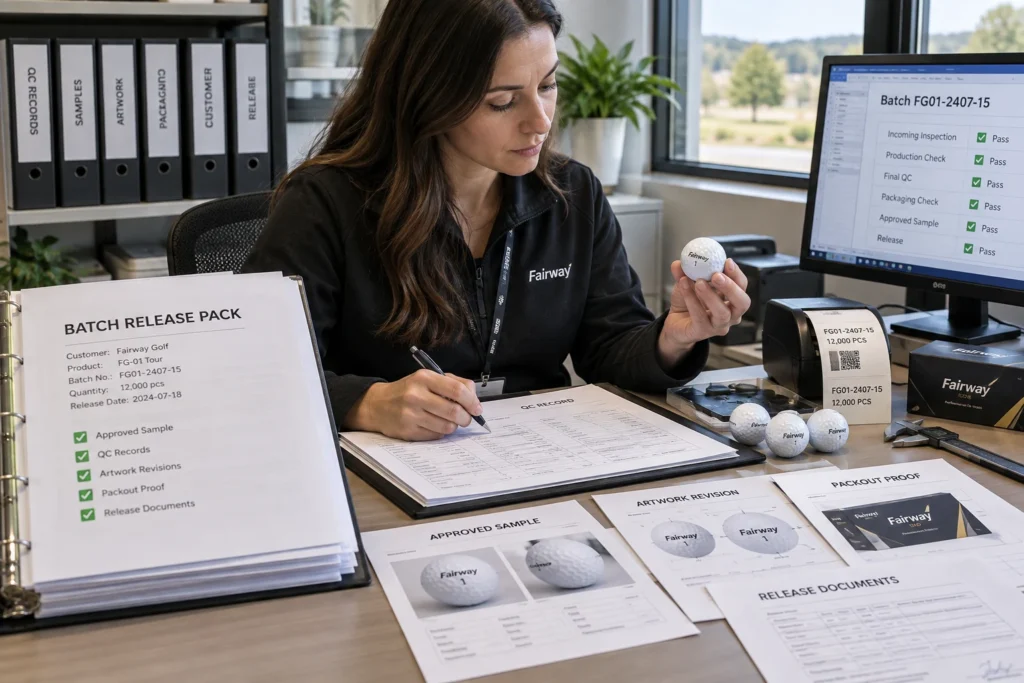
Create a Club Crest Ball Approval Record containing Ball SKU, Crest Revision, Approved Color Reference, Logo Size, Logo Position, Sample ID, Approval Date, and Approver.
Please provide one physical new-member logo-ball approval sample using the quoted ball SKU and final club crest revision, showing the approved color reference, logo size and position, final ball finish, sample ID, and repeat-order reference that will be used for the membership program.
Bulk new-member logo balls shall match the buyer-approved physical sample for ball SKU, club crest appearance, logo position, approved color reference, and agreed welcome-program configuration. Any substitution affecting the ball model, artwork, finish, or approved presentation requires buyer approval before production release.
The club approving only a digital crest mockup is a failure signal.
If the question changes from what your club should approve to how the crest should actually be produced, move to custom golf-ball logo printing. Questions about repeated-play wear belong in the golf-ball logo durability guide.
✔ True — A physical ball sample gives your club a stronger repeat-order reference
Digital proof controls artwork intent. The physical sample records how the approved crest appears on the selected ball and finish.
✘ False — “A digital crest mockup guarantees the appearance of the finished golf ball”
A screen cannot fully represent physical logo scale, placement, fine detail, or appearance on a curved and dimpled finished product.
How should you plan welcome-kit replenishment?
Your first order can be carefully approved and still create trouble later if the next member intake arrives and nobody can reconstruct exactly what the club bought.
Treat new-member logo balls as recurring membership inventory, not an annual promotional scramble. Forecast demand from actual member intake, preserve your approved ball and crest references, and set a reorder trigger so the next onboarding cycle does not depend on someone remembering which SKU, artwork, allocation, or presentation the club used last time.
Preserve one program identity:
Ball SKU + Physical Sample + Crest Revision + Eligibility Rule + Allocation Rule + Presentation Version + Reorder Reference
| Planning Input | Record | Risk | Buyer Action |
|---|---|---|---|
| New-member intake | Members per period | Underforecast | Track intake |
| Eligibility | Approved member types | Wrong distribution | Maintain matrix |
| Allocation | Per member / household | Staff inconsistency | Lock rule |
| Approved version | Ball + crest sample | Version drift | Preserve reference |
| Inventory | Usable stock | Emergency reorder | Set trigger |
| Incoming order | Batch / reorder reference | Silent substitution | Verify version |
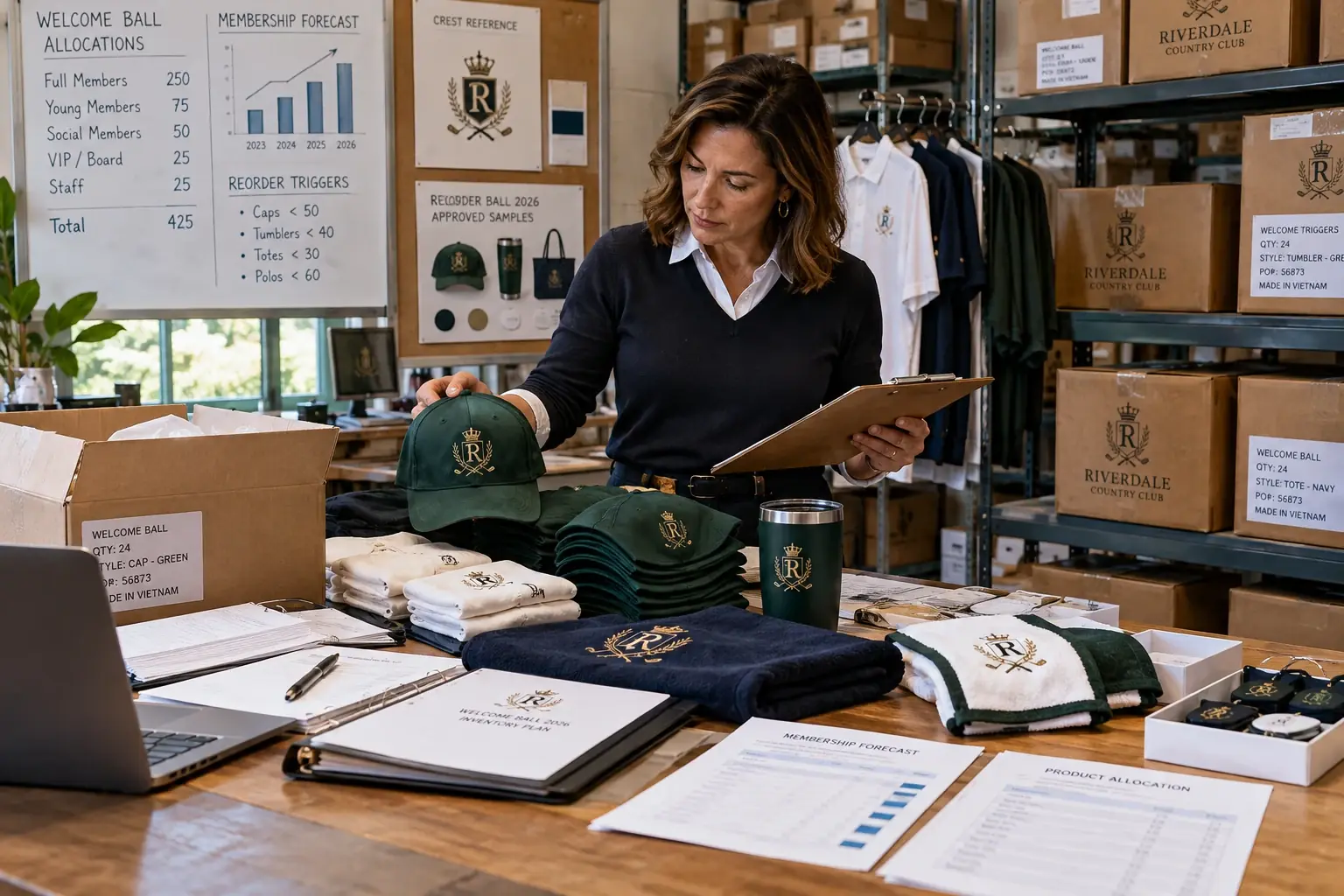
A simple planning relationship is:
Eligible Upcoming Members × Approved Allocation − Usable Existing Inventory → Planned Replenishment Requirement
Apply it using your actual allocation unit rather than a universal safety-stock percentage.
Maintain the inputs in a New-Member Ball Replenishment Sheet. Your reorder should begin with an approved program record, not “send us the same balls as last year.”
Supplier shall identify the approved new-member ball program by ball SKU, club crest/artwork revision, physical approval sample reference, included quantity per approved member package, applicable presentation version, production batch ID, and repeat-order reference.
A repeatable base program does not require identical gifts across every membership category. Add another welcome-ball version only when it solves a genuine member or onboarding need.
If the question becomes whether a new manufacturing batch technically matches the approved ball, move to golf-ball reorder consistency.
FAQ
Can couples or family memberships share one ball allocation?
Yes, when one household allocation fits your club’s program. Define whether the approved quantity applies per membership, per golfer, per eligible member, or per household rather than automatically multiplying an individual allocation.
-
Confirm applicable golf privileges.
-
Review likely golfers in the household.
-
Write the household rule into the program record.
-
Forecast purchasing from that approved rule.
Should social members receive logo golf balls?
They can when golf is relevant to that member’s actual club experience. Treat Social Membership as a reason to review relevance—not as an automatic yes or no.
-
Check the member’s golf access.
-
Consider likely participation.
-
Avoid assuming
Social = no golf balls. -
Use another item when it better fits the onboarding experience.
Should welcome-kit balls be playable or commemorative?
Either can work. Define the onboarding role first: a playable ball should support real use, while a primarily commemorative ball may place more emphasis on crest presentation and keepsake value.
-
Record intended use.
-
Select the tier afterward.
-
Avoid over-specifying symbolic inventory.
-
Avoid under-specifying balls expected to be played.
Can a sponsor logo appear with the club crest?
Yes, if your club approves the co-branded program. A sponsor adds another stakeholder, artwork version, scope, and approval path, so it should not be treated as a casual logo edit.
-
Confirm club approval authority.
-
Define sponsor scope.
-
Lock the co-branded artwork version.
-
Use a dedicated sponsorship-governance process if sponsorship becomes the main commercial decision.
Should pro-shop balls match the welcome-kit ball?
Not necessarily. One SKU may simplify inventory, but your welcome program and retail program perform different jobs. They should match only when the onboarding role and retail proposition genuinely align. If the question becomes whether the same club-logo ball deserves permanent shelf space, use the country club pro-shop logo-ball stocking guide as a separate retail decision.
-
Compare onboarding and retail objectives.
-
Avoid forcing one SKU across both channels.
-
Compare actual retail demand with onboarding requirements.
-
Keep the two programs separate when their jobs differ.
Should the club redesign the welcome ball every year?
No. A new calendar year alone is not a good reason to create another version. Change the program when the crest, member segment, onboarding role, ball requirement, or another meaningful variable changes.
-
Preserve the approved SKU.
-
Preserve the Crest Revision and Physical Sample.
-
Record the current Program Version.
-
Retire the old version deliberately when a real change is approved.
Conclusion
A logo golf ball belongs in a new-member welcome kit when it helps the member enter the club experience—not simply because it carries the club crest. Decide who should receive it and what job it should perform, then lock the allocation, ball tier, physical crest approval, and replenishment reference so the next member intake does not become another sourcing project.
Member Role → Allocation → Ball Tier → Crest Approval → Replenishment
You might also like — Which Golf Ball Packaging Fits Your OEM Program?