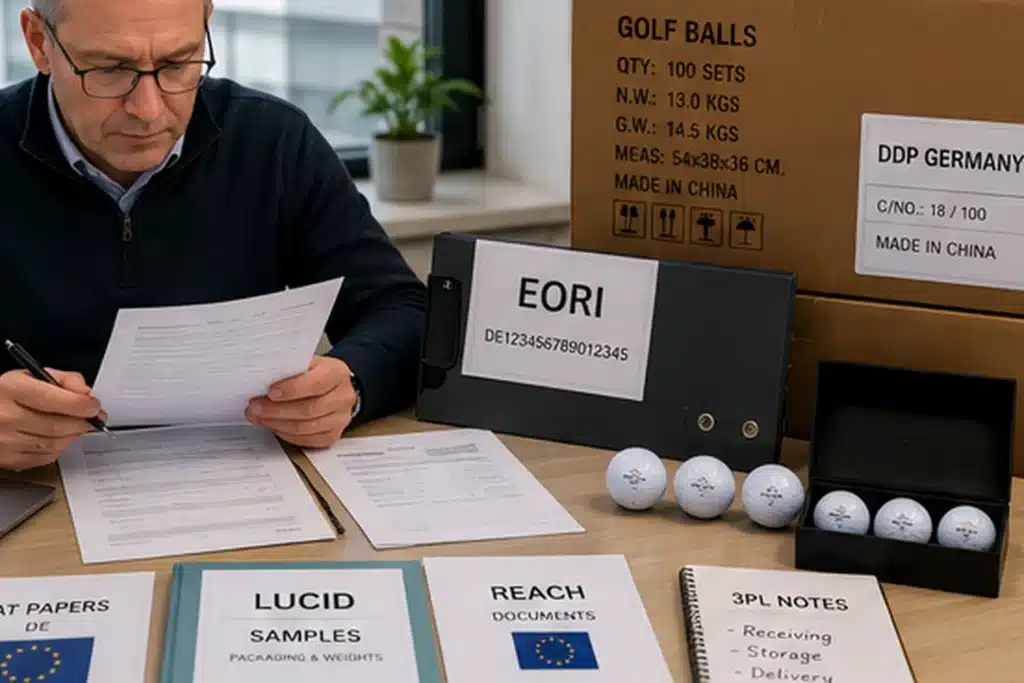
A supplier can send you a real business license, factory video, ISO certificate, approved sample, and QC report—and those records can still point to different entities, sites, SKUs, or production batches.
To verify a China golf ball OEM supplier, connect five controls: legal entity, production site, exact-SKU process ownership, current batch evidence, and reorder control. Each record should prove the specific entity, site, SKU, or batch it claims to support; a genuine document by itself does not verify the whole supply system.
Your verification should deepen as your financial commitment increases. Confirm identity and the declared production site before paying for samples, verify process ownership and the approved sample before deposit or PO release, and confirm batch-linked QC and shipment evidence before final payment.
The practical verification chain is:
Entity → Site → Process → Batch → Reorder
A Supplier Verification Pack is useful only when those records connect. The goal is not to collect more certificates or PDFs, but to prove that the supplier you approved, the site producing your golf balls, the SKU you sampled, the batch you are paying for, and the next reorder belong to the same controlled production system.
How Do You Verify a China Golf Ball Supplier?
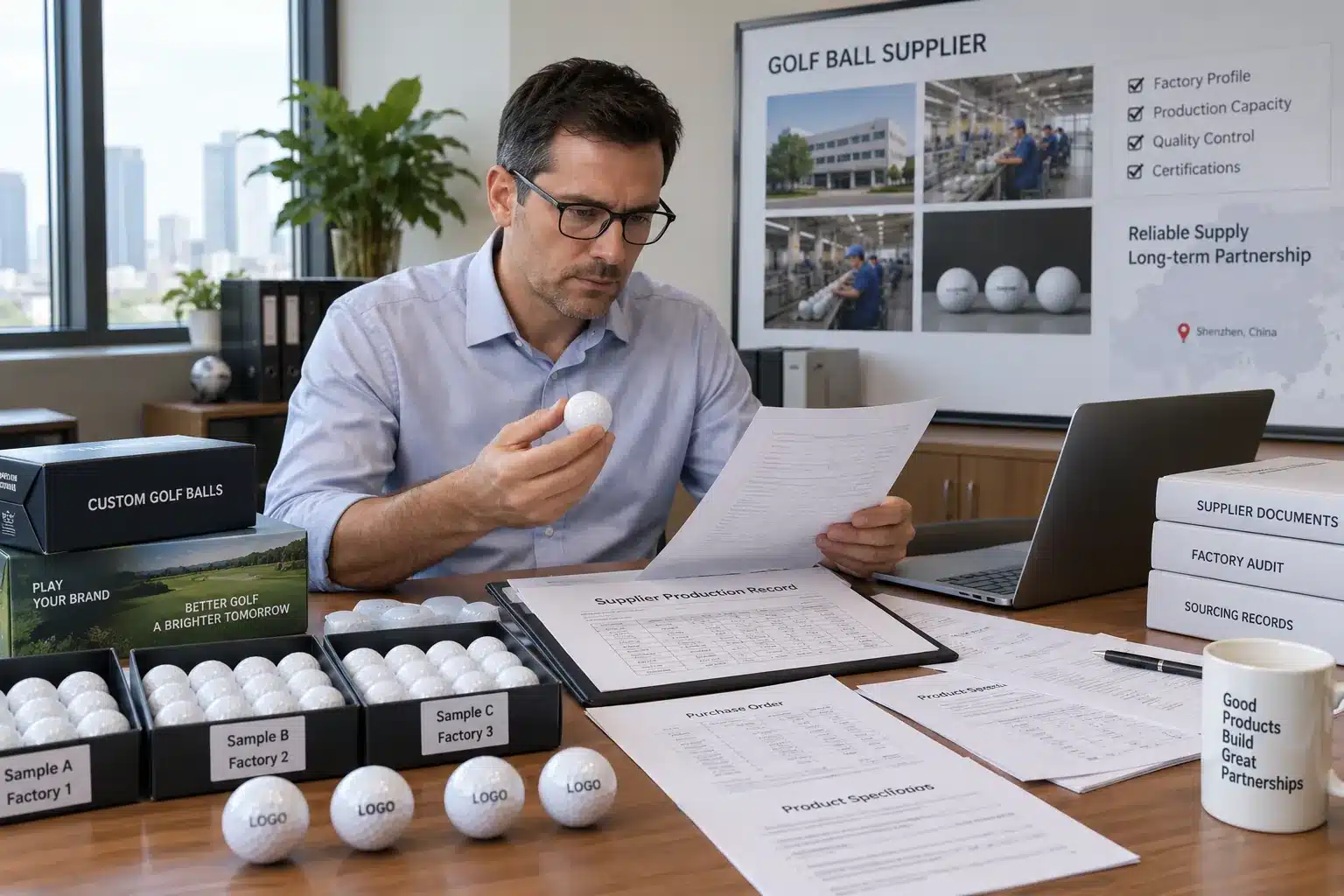
A polished website can give you a quote, certificates, and factory footage while leaving one expensive question unanswered: do those records describe the same supply system?
Verify a China golf ball supplier by linking Entity → Site → Process → Batch → Reorder, then deepen the evidence before each payment or release gate. Counting documents is weaker than proving which entity, site, SKU, and batch each document actually supports.
| Commitment Gate | Minimum Verification | Evidence to Request | Buyer Action |
|---|---|---|---|
| Before sample spend | Entity, role, site, SKU capability | Identity and site evidence | Decide whether to fund sampling |
| Before deposit / PO | SKU, process ownership, sample reference | Production-control evidence | Approve or hold production |
| Before final payment | Batch, QC, retained sample, shipment link | Current batch evidence | Release or hold shipment |
What Changes Before Sample Fee vs Deposit?
Before sample spend, confirm the legal entity, supplier role, declared site, and basic SKU capability. Before deposit or PO release, add process ownership, outsourced stages, approved sample reference, relevant claims, and PI/payee relationship. Before final payment, require batch identity, linked QC evidence, a retained reference, shipment-lot linkage, and disclosed process changes.
Your Supplier Verification Stage-Gate Checklist should show what has been proved before the next financial commitment. If you still need candidates, use the Top 10 Golf Ball Manufacturers in China for OEM to build the shortlist first.
✔ True — Genuine documents can still belong to an unverified supply chain
A real record becomes useful when you can identify which entity, site, SKU, or batch it supports.
✘ False — “If every document is authentic, verification is complete”
Authenticity proves the document. Linkage proves whether it applies to the order you are funding.
Does the Legal Entity Match Your Documents?
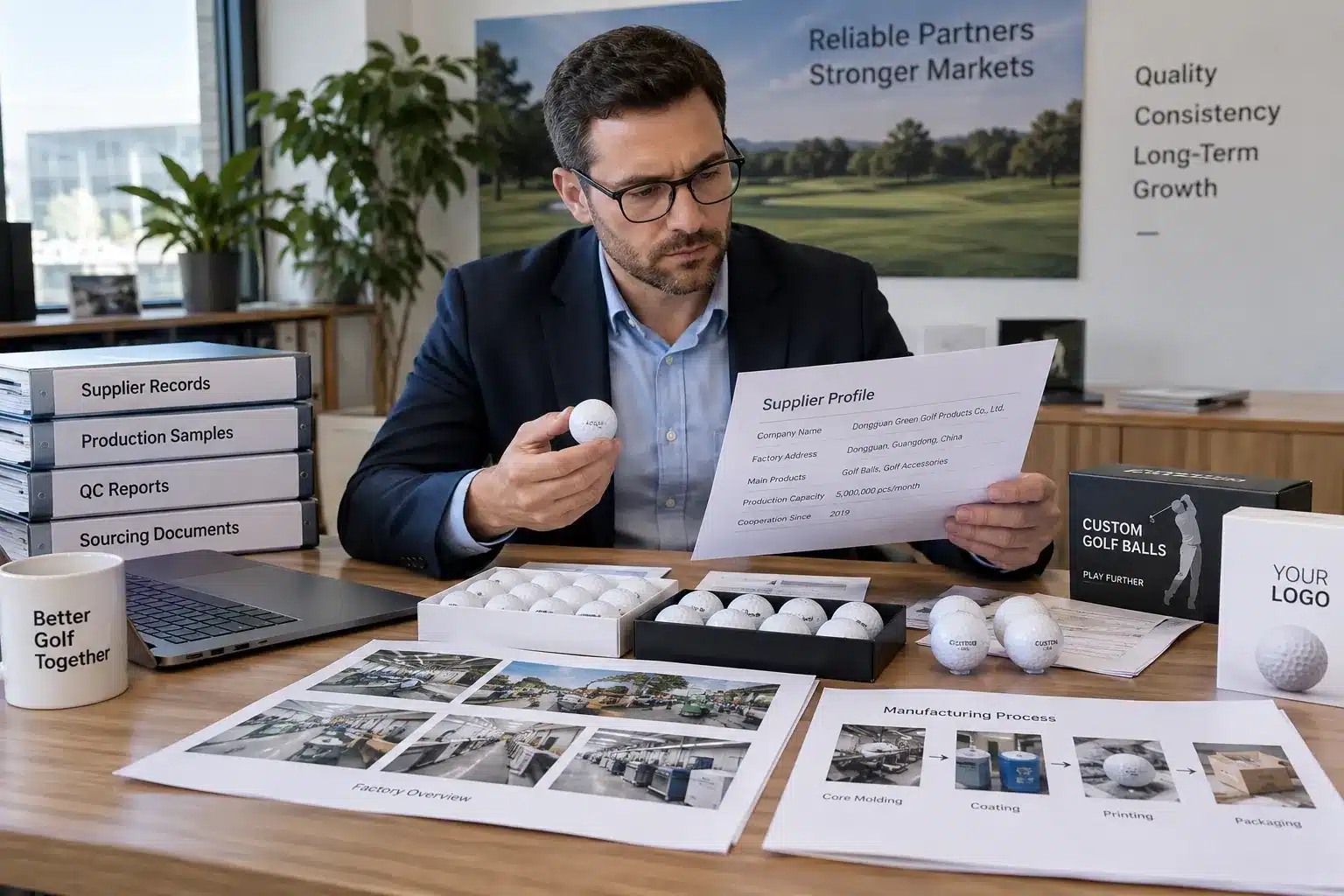
Your early risk may not be a fake company. It may be several legitimate names appearing across the quote, PI, contract, payment details, production address, certificates, and shipment records.
Cross-check the Chinese legal name, Unified Social Credit Code, PI or contract party, bank beneficiary, production address, certificate holder, QC-record identity, and shipment records. Different names are not automatically a problem; unexplained differences are.
Use China’s official National Enterprise Credit Information Publicity System to cross-check the supplier’s registered legal entity and Unified Social Credit Code. The registry is in Chinese, so use the supplier’s Chinese legal name or Unified Social Credit Code for the search; browser translation can help with navigation.
The registry verifies the registered entity. It does not, by itself, prove that the company controls the production site making your exact golf-ball SKU.
| Record | What You Compare | Acceptable Condition | Buyer Action |
|---|---|---|---|
| Company registration | Legal entity and identifier | Current and explainable | Record verified entity |
| PI / contract | Contracting party | Match or disclosed relationship | Resolve before signature |
| Bank beneficiary | Payment recipient | Match or authorized relationship | Approve before payment |
| Production address | Manufacturing site | Relationship disclosed | Continue to site verification |
| Certificate / QC record | Holder or site | Scope and relationship clear | Verify evidence layer |
A manufacturer, export entity, group company, or authorized collection entity can be legitimate. Mismatch is not automatically fraud. An undisclosed mismatch is a verification risk. Resolve any unexplained PI/payee, site, or certificate-holder relationship before payment. Registration proves identity, not exact-SKU production control.
Does the Site Control Your Exact Golf Ball SKU?
A live factory walkthrough can prove access to a real site without proving where your sample, bulk order, QC, or reorder will actually run.
Ask for a Production Control Map for your quoted SKU. It should show where each critical stage occurs, whether it is in-house or outsourced, and who owns QC and final release. Site access is evidence; exact-SKU production control is the qualification decision.
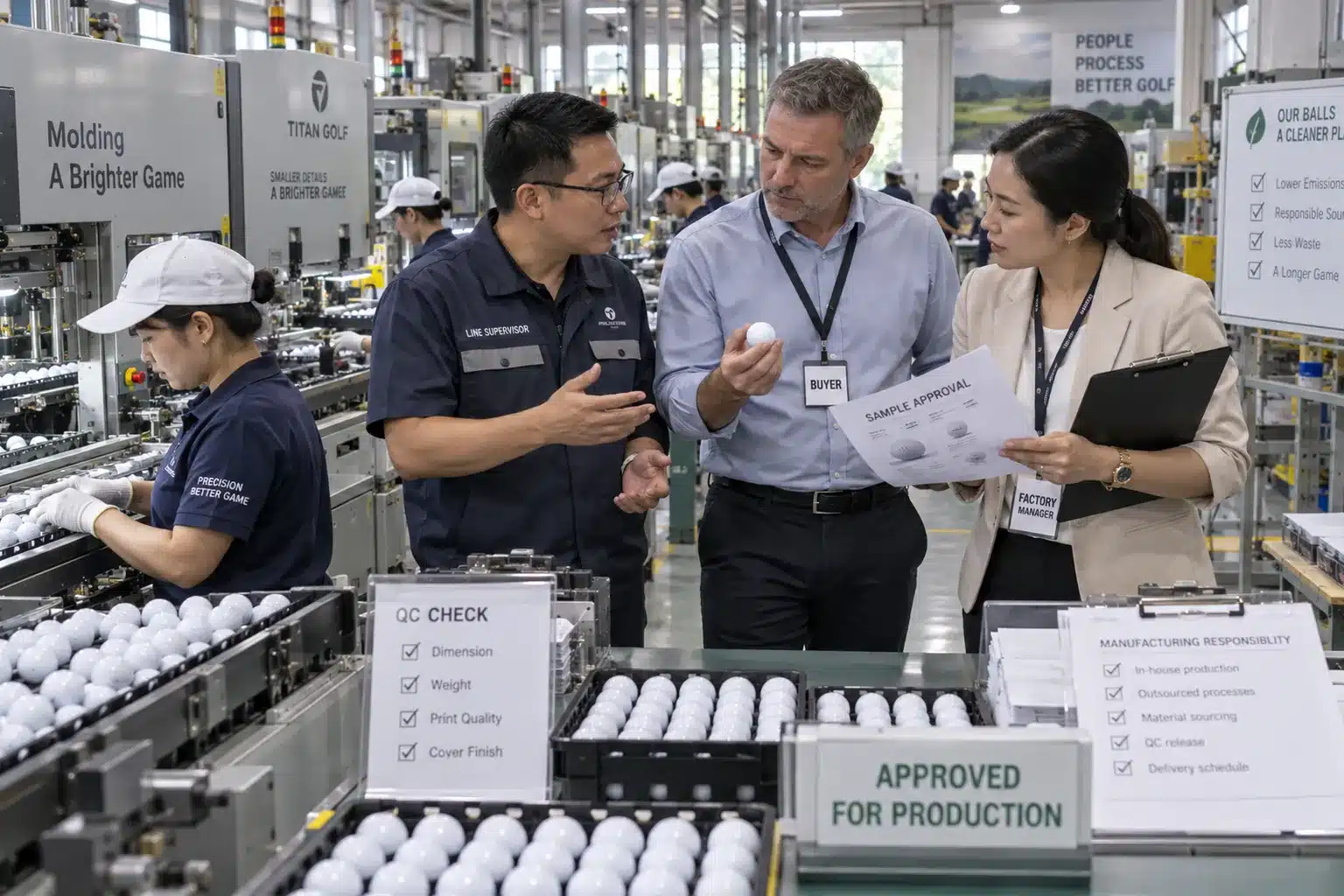
Which Processes Are In-House or Outsourced?
Map the stages relevant to your construction.
| Production Stage | Site | Control Model | Release Owner | Buyer Action |
|---|---|---|---|---|
| Core | Declared site | In-house / outsourced | Named function | Verify route |
| Mantle if applicable | Declared site | In-house / outsourced | Named function | Verify route |
| Cover | Declared site | In-house / outsourced | Named function | Confirm actual process |
| Coating | Declared site | In-house / outsourced | Named function | Link approved SKU |
| Printing | Declared site | In-house / outsourced | Named function | Lock approved version |
| Packaging | Declared site | In-house / outsourced | Named function | Confirm pack reference |
| Final QC | Declared site | In-house / outsourced | Named function | Confirm release |
If the specification says only “urethane,” request the actual production-route declaration rather than assuming one method. For logo programs, link the artwork version and decoration route to the approved SKU.
Disclosed outsourcing can be manageable; undisclosed production control is the risk. Factory media is weak evidence if the supplier still cannot identify which site and process will produce your exact SKU.
For manufacturer, trader, agent, or hybrid analysis, use China Golf Ball Manufacturer vs Trading Company. For deeper manufacturing-system evidence, use the deep golf ball factory audit to test whether one comparable production lot can be traced through its declared route, linked records, exception handling, final release, and change control.
✔ True — A live walkthrough is useful site evidence
It becomes SKU evidence when the supplier connects that site to your actual stages, QC ownership, and release path.
✘ False — “Seeing a real factory proves it controls my exact SKU”
Factory media should lead to a SKU-specific Production Control Map, not end the verification process.
Can You Link the Sample to the Production Batch?
The dangerous sample is often a good one that wins approval without a traceable link to the bulk lot, QC record, retained sample, and cartons.
A good sample proves one approved reference exists.
Before bulk approval, require Approved Sample → Production Batch → QC Record → Retained Sample → Shipment Lot. The question is not “Do you have a QC report?” but “Does this QC evidence belong to my goods?”
What Should a Batch Record Link?
Your Batch Linkage Record should identify the approved sample or PPS, exact SKU/version, production batch ID, QC reference, retained sample ID, shipment lot, and any approved process change.
Use one principle: Method + Equipment + Sample + Batch Link.
A genuine QC record can still belong to another SKU or lot. Detailed limits, calibration, AQL, and instrument methodology belong in the technical QC article; here, prove the record belongs to your goods.
“Same as the approved sample” is a failure signal when sample, batch, QC, retained reference, and shipment cannot be linked.
Supplier shall disclose the legal entity, production site, and in-house or outsourced owner of each critical production stage used for the quoted SKU, and shall link the approved sample, production batch ID, QC record, retained sample, shipment lot, and any approved process change under one traceable production record before shipment release.
For PPS, Golden Sample, FAI, and sample methodology, use the China Golf Ball OEM Sample Evaluation Guide. For calibration and batch-testing methodology, use Golf Ball QC in China.
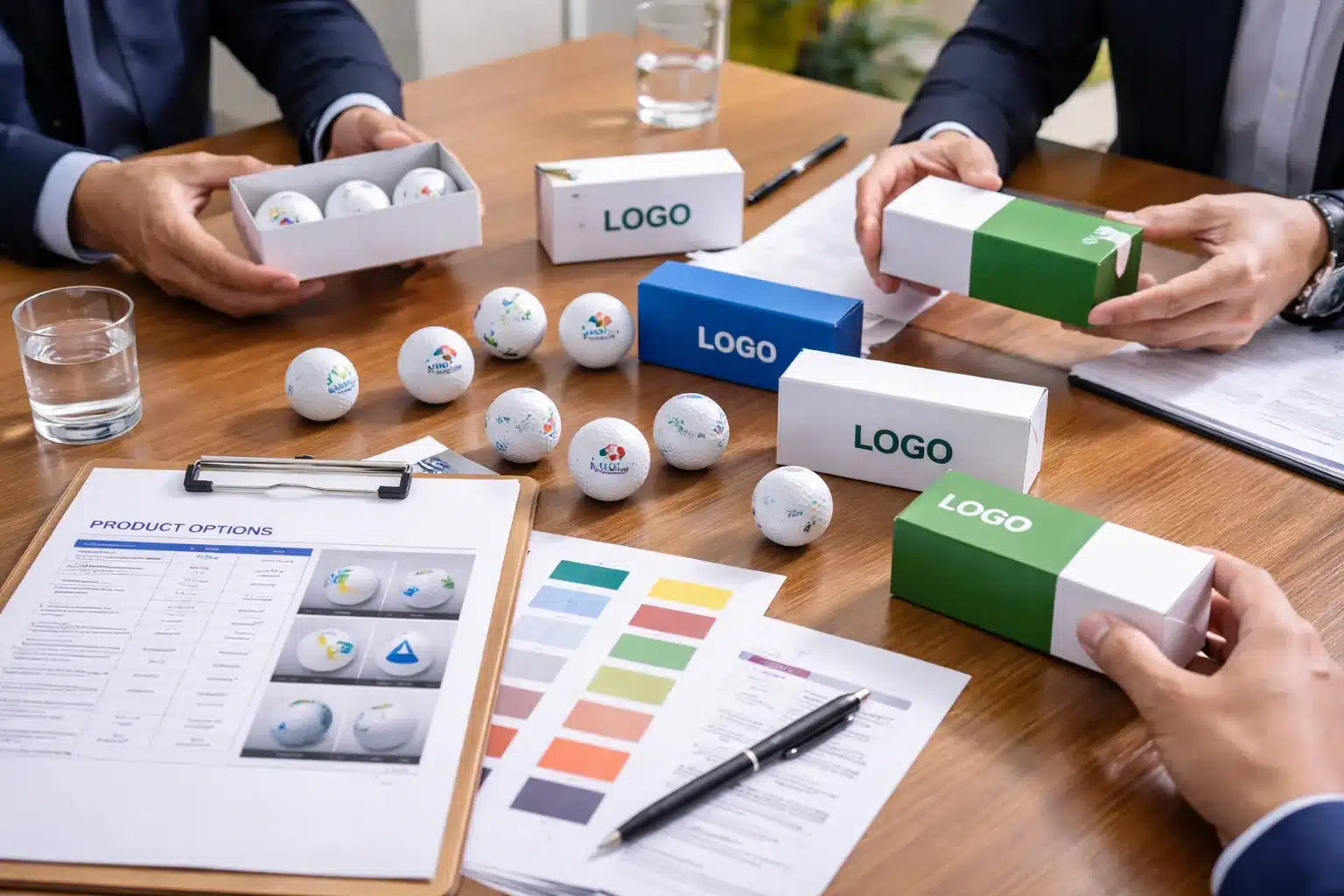
Which Supplier Claims Need Independent Proof?
A business license, ISO certificate, conforming-ball record, and QC report can all be genuine while proving different things.
Classify supplier claims as legal-entity, management-system, product/model-conformance, or production-batch evidence. Verify the holder, scope, exact model or batch, and current status before relying on a claim; one evidence layer should never substitute for another.
Certificate, Model, or Batch Evidence?
| Supplier Claim | Evidence Layer | What It Can Prove | What It Cannot Prove | Buyer Action |
|---|---|---|---|---|
| “We are registered” | Entity | Company identity | Exact-SKU control | Verify site/process |
| “We have ISO 9001” | Management system | Certified scope when valid | Your batch meets PO | Verify holder/status |
| “Our ball conforms” | Product/model | Exact verified model | Every OEM SKU conforms | Check identity/markings |
| “Our QC passed” | Batch | Linked result for a batch | Future batches will match | Confirm linkage |
For an ISO 9001 claim, verify the holder, number, scope, relevant site, certification body, and current status. ISO’s certification guidance explains that ISO develops standards but does not certify companies or issue ISO certificates. For accredited certification, verify the certificate through the issuing certification body and, where available, cross-check the record in IAF CertSearch.
For Rules-of-Golf claims, verify the exact ball identity and markings against the current USGA List of Conforming Golf Balls when relevant. One conforming model does not make every OEM SKU conforming. See China-Made Golf Balls and USGA/R&A Standards for the full mechanism.
✔ True — Different evidence layers answer different questions
Registration, management-system certification, exact-model conformance, and batch QC should each be checked against the claim they support.
✘ False — “ISO certification or one conforming model verifies my current OEM batch”
Neither replaces evidence linked to the exact SKU and production batch you are buying.
How Do You Protect the Next Reorder?
Supplier due diligence can be solid on the first PO and stale on the second when a site, process, decoration route, QC reference, or outsourced stage changes quietly.
Supplier verification should survive the reorder. Before repeating an approved SKU, confirm that the entity/site, production route, declared construction, approved sample, QC reference, outsourced process ownership, and change-control status still match the system your team approved.
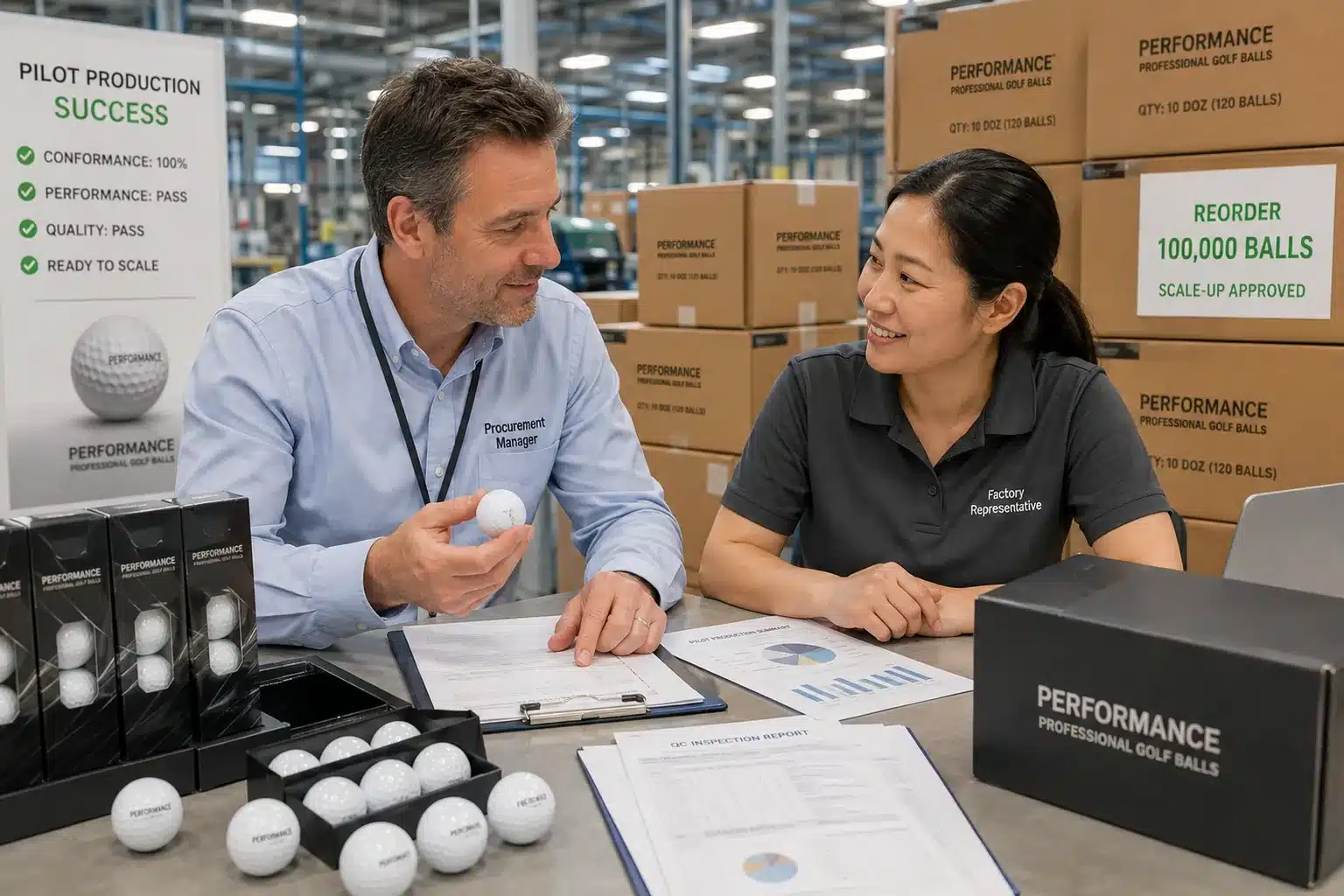
What Changes Require Reapproval?
Define the controlled variables for your SKU instead of using a universal “minor versus major” list. Recheck entity/site, process route, material declaration, artwork, approved sample, QC reference, retained sample, outsourced owner, and batch-identification logic.
When today’s decision depends on it, current, relevant evidence should carry more weight than generic historical evidence. Check date together with entity, site, SKU, batch, version, and validity.
The Supplier Verification Pack should let another person on your team trace these records together:
| Verification Record | Must Link To | Buyer Use |
|---|---|---|
| Legal entity record | PI, contract, payee | Payment approval |
| Production Control Map | Site and exact SKU | PO release |
| Approved sample reference | SKU version and batch | Bulk approval |
| QC record | Sample, method, batch | Quality release |
| Retained sample | Batch and approved version | Dispute / reorder reference |
| Shipment lot | Batch and carton records | Final release |
| Reorder change record | Previous approved system | Repeat-order approval |
That creates one auditable chain:
Legal Entity → Production Site → Process Control → Approved Sample → Batch Evidence → Shipment Lot → Reorder Change Control
The final test is: Can your team verify the same controlled system again?
FAQ
What if the payee differs from the factory entity?
A different payee can be legitimate, but you should not send payment until the relationship is disclosed, documented, and approved against the PI or contract party and your internal payment-control process.
Ask the supplier to explain the relationship, provide authorization, and confirm beneficiary details before funds move. Keep that approval with the sourcing record. The important distinction is not “same name or fraud.” International supply structures may involve manufacturing, export, group, or collection entities. The risk begins when the relationship is unclear, undisclosed, or changes after approval.
Can a third-party inspection replace supplier verification?
No. A third-party inspection can verify defined conditions at a specific stage or shipment, but it does not automatically prove the legal entity, production-control model, approved sample linkage, or future reorder continuity.
Use inspection as one evidence layer inside your verification system. Define what the inspector should verify, which SKU or batch it applies to, and how the inspection result links to your PO and shipment.
Does a business license prove factory status?
No. A business-registration record verifies the legal entity; it does not prove that the company controls the site producing your exact golf-ball SKU.
Use registration as the identity gate, then verify the production site and Production Control Map separately. If the question becomes manufacturer versus trader or agent, move to the dedicated supplier-role guide.
What if printing or packaging is outsourced?
Outsourcing can be acceptable if the supplier discloses the outsourced stage and remains accountable for approval, QC release, traceability, and change notification.
Before PO release, confirm which site performs the work, which artwork or packaging version is approved, and who releases the finished goods. The risk is not outsourcing itself; it is an undisclosed process change that breaks your approved SKU.
How do I verify an ISO 9001 certificate?
Check the certificate holder, certificate number, scope, relevant site, certification body, and current status rather than relying on a PDF or logo supplied by sales.
-
Confirm that the holder matches or is clearly linked to the supplier or production site you are evaluating.
-
Check that the scope is relevant to the operation being claimed.
-
Verify the record through the issuing certification body or, where available, IAF CertSearch.
-
Treat ISO 9001 as management-system evidence, not proof that your current golf-ball batch meets the PO.
How do I verify a golf ball conformity claim?
Verify the exact ball or model being claimed, not a supplier-level statement that the factory makes conforming golf balls.
-
Check the exact model identity and identification markings against the relevant current conforming-ball record when your program requires it.
-
Confirm that the evidence applies to the same construction and product identity as the OEM SKU you plan to buy.
-
Do not transfer conformity evidence from one model to another private-label SKU automatically.
-
If markings, current-list status, or private-label identity become part of the purchasing decision, use the dedicated USGA/R&A conformity guide.
Conclusion
You have not fully verified a supplier because it sent more documents. You have verified the supply system when your team can connect the entity, production site, process ownership, approved sample, current batch evidence, shipment, and reorder controls into one auditable record.
Verify identity before sample commitment, production control before deposit or PO release, the batch before final release, and controlled changes before reorder.
Proof matters, but linkage makes the proof usable.
You might also like — Top 10 Golf Ball Manufacturers in China for OEM Buyers