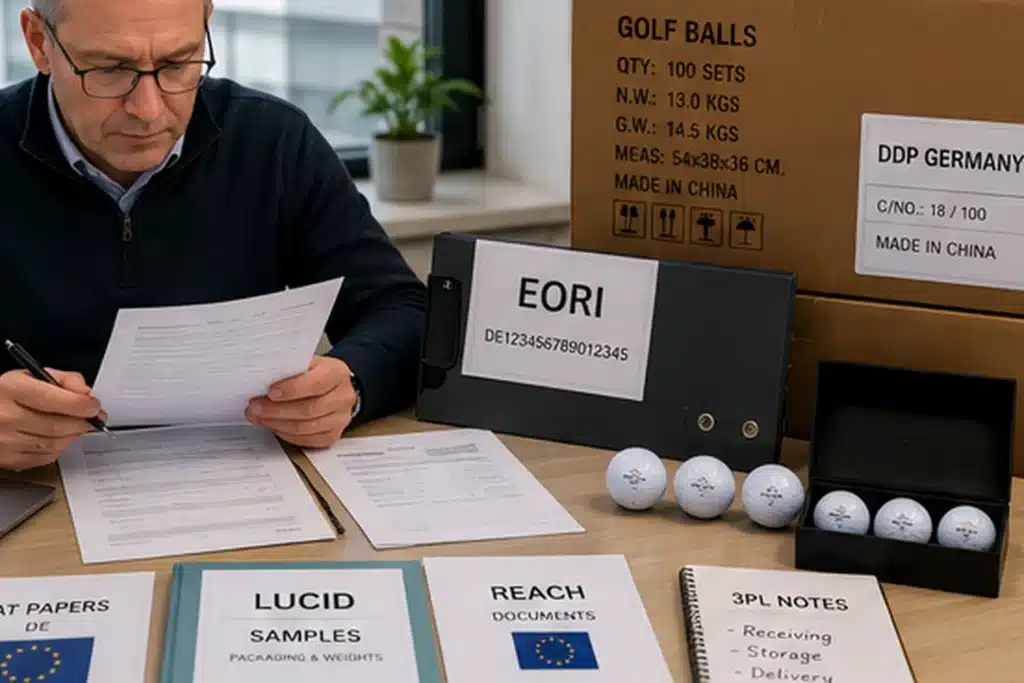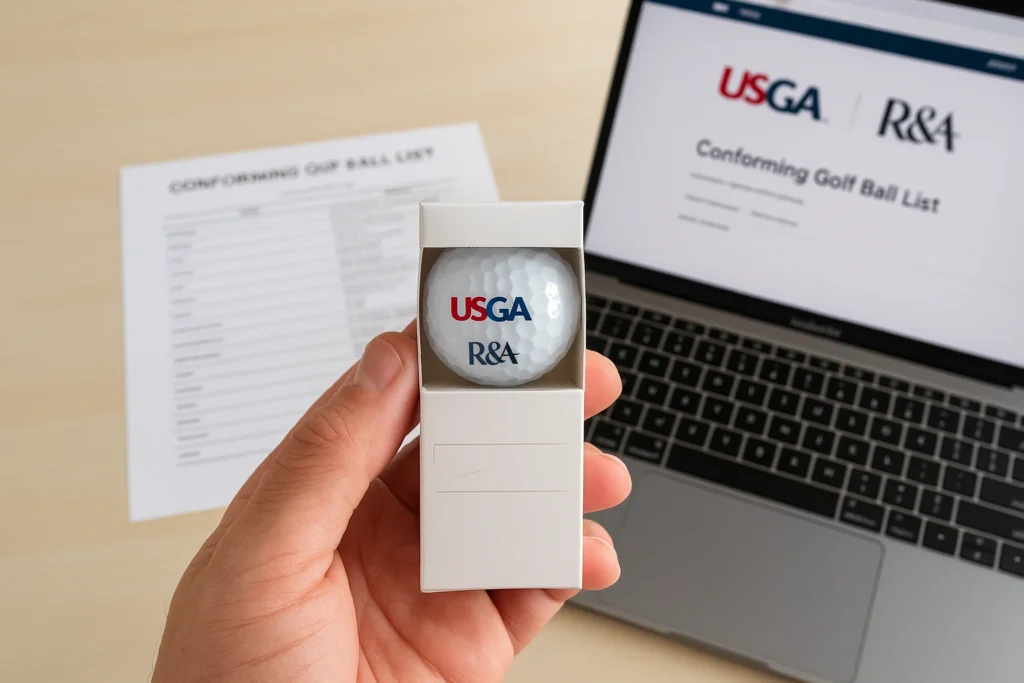
To submit a private-label golf ball for USGA/R&A conformity, freeze the exact ball type first, confirm whether your logo, markings, color, finish, or construction changes its identity, then submit 24 representative balls from the intended production version.
A submission can fail before testing starts. Your team may submit the wrong version, use non-representative samples, introduce unreviewed changes, or release conformity claims before the required status exists.
The key distinction is:
You are not submitting a logo or a brand concept. You are submitting one controlled ball type.
Use one execution sequence:
Freeze → Identify → Submit → Publish → Release → Maintain
If your SKU still needs a current List-status decision, first verify whether your OEM golf ball needs current conformity status. Once that decision is yes, start with the exact version you intend to sell—not with the form.

What Must You Freeze Before Submission?
You may think submission starts when someone completes a form. The larger risk begins earlier, while your construction, cover, color, finish, dimple version, markings, or production route is still changing.
Freeze the submission version before you freeze the submission form. Your file should identify the exact construction, cover, dimple pattern or tool, color, finish, Pole/Seam markings, alignment treatment, artwork revision, and production route that define the ball you intend to submit.
The operating principle is simple:
You do not submit a brand idea. You submit a defined ball type.
Official ball-type identity includes characteristics such as external appearance, markings, construction, dimple pattern, and material composition. Your manufacturing-control file can go one level deeper by connecting those characteristics to the version your supplier must actually reproduce.
That may include the cover material or route, dimple/tool reference, coating or finish, artwork revision, intended production route, sample-lot reference, and retained comparator.
These additional fields are buyer-side manufacturing controls, not extra USGA-mandated submission fields.
They matter because a commercial model name can stay unchanged while the physical product changes underneath it.
A label such as “3-piece urethane,” “Tour X,” or “Model 88” does not tell you which material revision, dimple tool, finish, or marking version entered the submission.
Same construction name ≠ same controlled manufacturing version.
Before samples leave the factory, assign ownership as well. Your program should know who owns submission correspondence, fees, evidence storage, and approval of later changes. “The factory handles USGA” is not enough if nobody owns the deadline or final version decision.
| Version Decision | What to Freeze | Evidence | Buyer Action |
|---|---|---|---|
| Construction | Layer/build revision | Approved spec version | Freeze revision |
| Cover | Material/route | Material reference | Lock source/version |
| Dimples | Pattern/tool | Tool or pattern reference | Freeze identity |
| Appearance | Color + finish | Master sample | Approve exact variant |
| Markings | Pole/Seam/alignment | Artwork + physical ball | Freeze physical identity |
| Production | Intended route + lot | Lot/version record | Link submitted samples |

What Belongs in the Submission Version Pack?
Your Submission Version Pack should make the exact submitted ball reconstructable without relying on memory, a product nickname, or artwork alone. The finished ball, controlled version sheet, physical marking proof, sample-lot reference, and retained comparator should all point to one approved version.
For private label, physical marking approval is especially important.
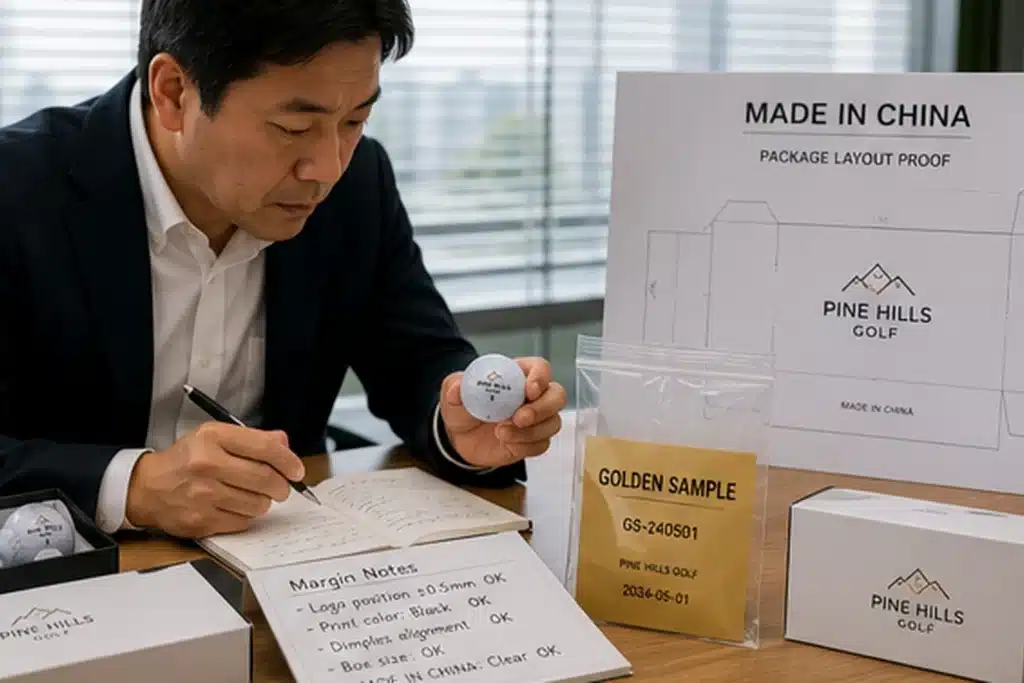
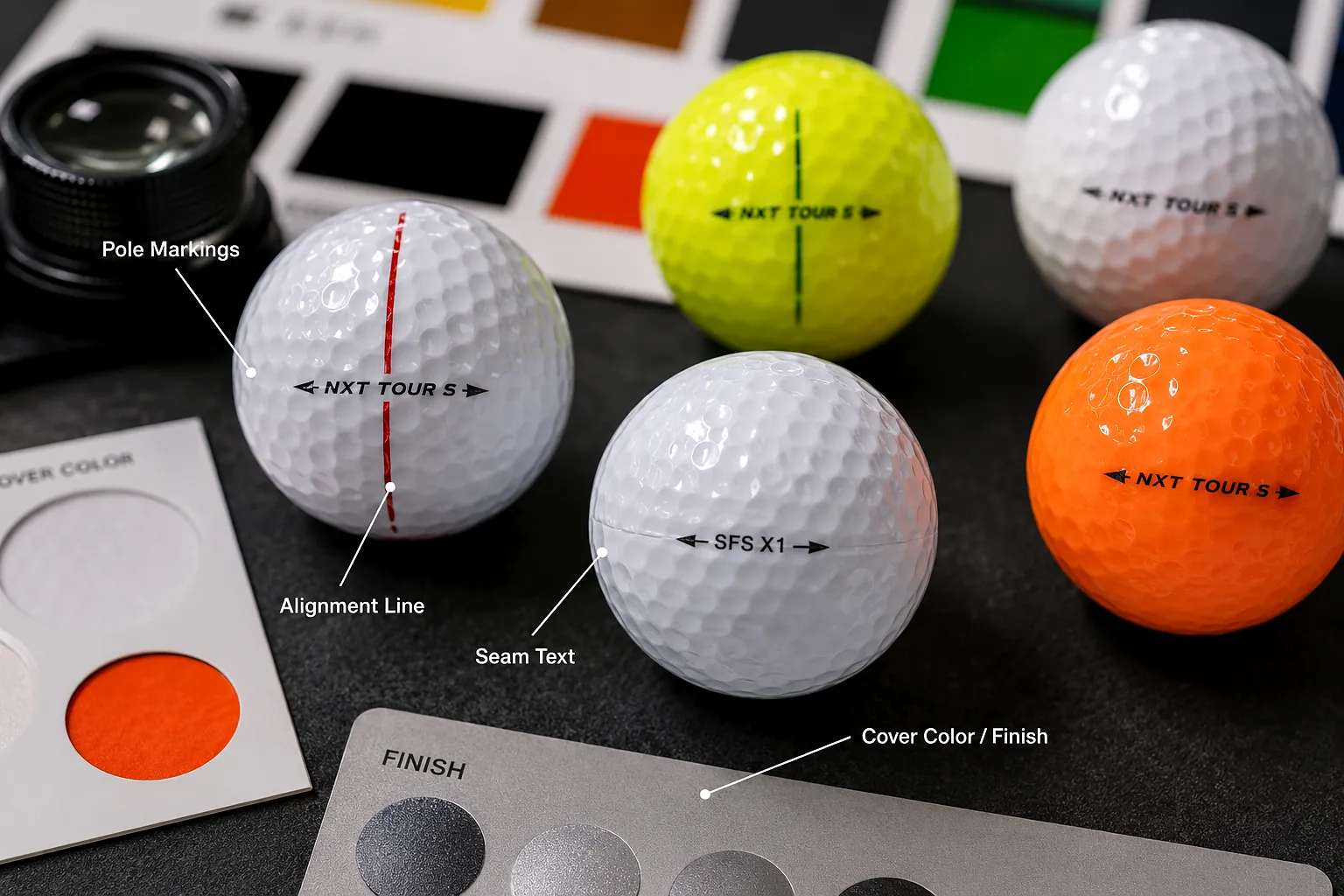
A PDF can be correct while the finished ball uses a different logo size, location, alignment treatment, cover color, or finish. The version you approve should therefore include a real finished-ball sample showing the Pole, Seam, alignment treatment, logo, color, and finish that will actually be submitted.
If logo adhesion, print repeatability, or finished-ball printing quality becomes the next decision, use the separate guide to verify custom golf ball printing and physical logo proof.
Supplier shall freeze the submitted ball type before conformity submission, including construction, cover material, dimple/tool version, cover color, finish, Pole/Seam identification markings, alignment treatment and artwork revision. The submitted sample lot and retained comparison samples shall be linked to the approved version.
Please identify the exact ball type and submission version, including construction, cover material/color, finish, dimple/tool reference, Pole/Seam markings, alignment treatment, artwork revision, representative sample-lot ID and retained-sample reference. Flag any variable that may require separate conformity review before production release.
The evidence deliverable here is a Submission Version Pack. Do not release conformity samples while construction, appearance, markings, or sample-lot references are still undefined.
Does Your Customization Change Ball Identity?
Private-label teams make two opposite mistakes. One supplier says every new logo requires another submission. Another says the construction is unchanged, so every customized version automatically inherits the same identity.
A custom logo does not automatically create a new ball type, and unchanged construction does not automatically preserve the same ball type. First identify what actually changed—decoration, identification, color, finish, construction, materials, or dimples—then determine the conformity impact before production.
The current 2026 USGA Golf Ball Conformance Submission Guidelines make customization more nuanced than a simple “logo changed / logo did not change” rule.
Custom logos, symbols, player names, initials, and certain personalized markings can be permitted when they do not encroach on Pole or Seam markings and cannot be mistaken for identification markings.
Custom Logo ≠ Automatically New Ball Type
But the opposite shortcut is equally risky.
Alignment arrows or lines can function as identification markings. When an alignment treatment includes words, phrases, brand names, or model names, its role in the ball’s identity can become more significant.
Cover variants matter too. Different cover colors receive separate submission treatment. Different hues should not automatically be collapsed into one compliance identity merely because a designer sees them as shades of the same marketing color.
And even with identical construction, a matte version and a gloss version can be treated as separate ball types requiring distinguishing identification.
So the second rule is:
Same Construction ≠ Automatically Same Ball Type
| What Changed? | Identity Impact | What to Verify | Buyer Action |
|---|---|---|---|
| Small custom logo away from Pole/Seam | Not automatically a new type | Location + identification effect | Review before print |
| Pole/Seam identification | Direct identity impact | Exact marking convention | Review version |
| Alignment + text/brand/model | May affect model identity | Text/color/placement | Review before submission |
| Cover color | Separate submission treatment | Exact color/hue | Add to Variant Map |
| Matte ↔ gloss | Separate ball-type treatment | Finish + identifying marking | Treat separately |
| Construction/material/dimple | Substantive identity change | Exact changed variable | Conformity impact review |
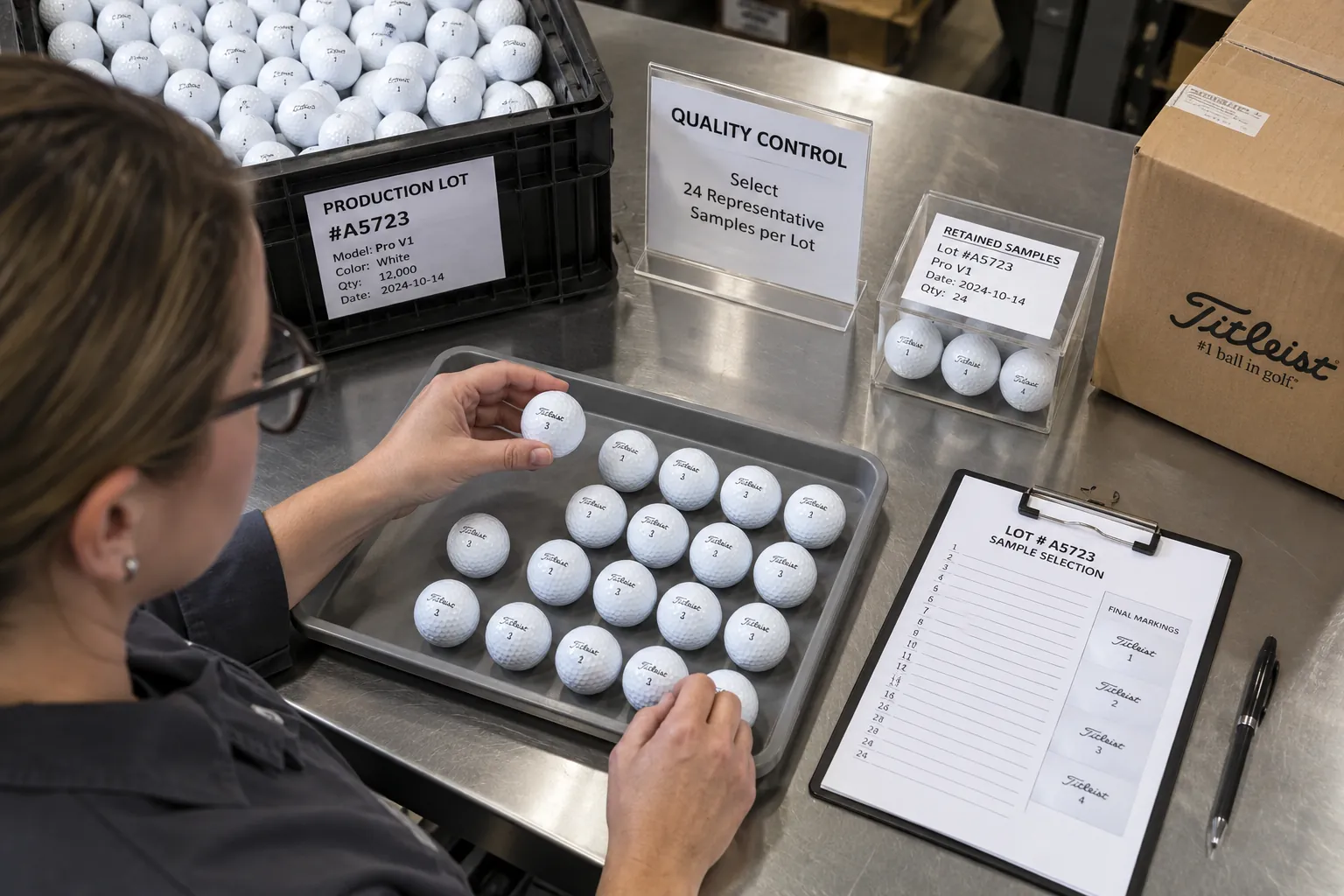
Is the Change Decoration or Identification?
Run an Identity Impact Review before final artwork or variant count is approved.
Start with the physical surface.
Is the custom logo completely outside the existing Pole/Seam identity?
Could it be mistaken for an identification marking?
Did the alignment line or wording change?
Did brand or model text change?
Then move beyond artwork:
-
Did the cover color or hue change?
-
Did gloss become matte, or vice versa?
-
Did construction change?
-
Did material composition change?
-
Did the dimple pattern or tool change?
This is where private-label flexibility turns into version-control work.
Marketing may see white gloss, yellow gloss, and white matte as one construction with three cosmetic options. Your conformity plan may see several separately treated identities, separate fees, separate samples, and separate maintenance obligations.
A failure signal is a supplier saying:
“Same construction, so any logo is covered.”
Construction is only one part of the identity analysis.
Your deliverable is an Identity Impact Review + Variant Map showing construction, color/hue, finish, Pole/Seam version, alignment treatment, and expected submission treatment before artwork and samples are released.
✔ True — Customization becomes a conformity issue when it changes how the ball is identified or changes another ball-type characteristic
A decorative logo may not create a new ball type, while color, finish, markings, alignment treatment, construction, materials, or dimples can change the identity analysis.
✘ False — “Every logo change needs a new submission” or “same construction automatically keeps the existing identity”
Both shortcuts skip the real question: exactly what changed on the physical ball, and does that change affect the submitted identity?

How Should You Submit the 24 Sample Balls?
Sending 24 balls is not enough if nobody can show where they came from, whether someone cherry-picked them, or which physical marking and manufacturing version they represent.
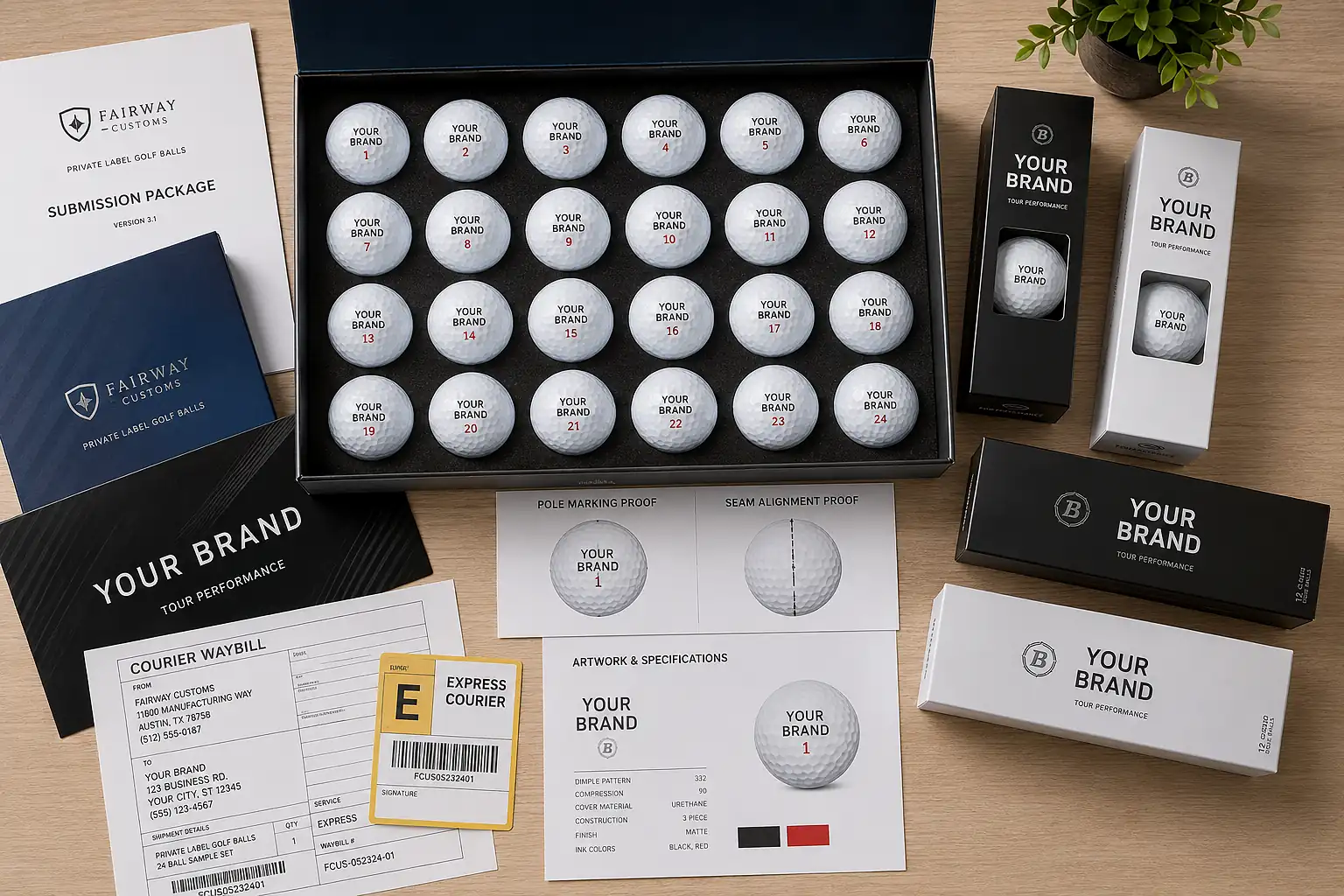
Do not treat the 24-ball requirement as a shipping quantity. Your submitted balls should represent the intended production version, come from the relevant recent production lot, avoid cherry-picking, and remain traceable to the lot, markings, version, and retained comparison samples your team will use later.
The official USGA golf-ball submission page is the appropriate starting point for current forms and submission instructions within USGA jurisdiction.
If The R&A is the correct route, use its dedicated Golf Ball Submissions page rather than copying a U.S. address, form, deadline, or payment process.
Current guidance calls for two dozen / 24 balls of each ball type for new or repeat submission.
The more important requirement is representativeness. The samples should not be pre-selected, should represent the product intended for the marketplace or tournament use, and should come from the most recent production lot.
That changes your internal question from:
“Did we send 24 balls?”
to:
“Which 24 balls did we send?”
| Traceability Field | What to Record | Risk Closed | Buyer Action |
|---|---|---|---|
| Ball type/version | Approved version ID | Wrong configuration | Match submission |
| Production lot | Lot ID + production date | Unknown sample origin | Record source |
| Selection | Date + non-preselected record | Cherry-picking | Document pull |
| Markings | Final physical revision | Identity drift | Match submitted ball |
| Retained set | Comparator sample ID | No later reference | Seal/store samples |
| Submission | Courier/form reference | Broken file chain | Archive record |
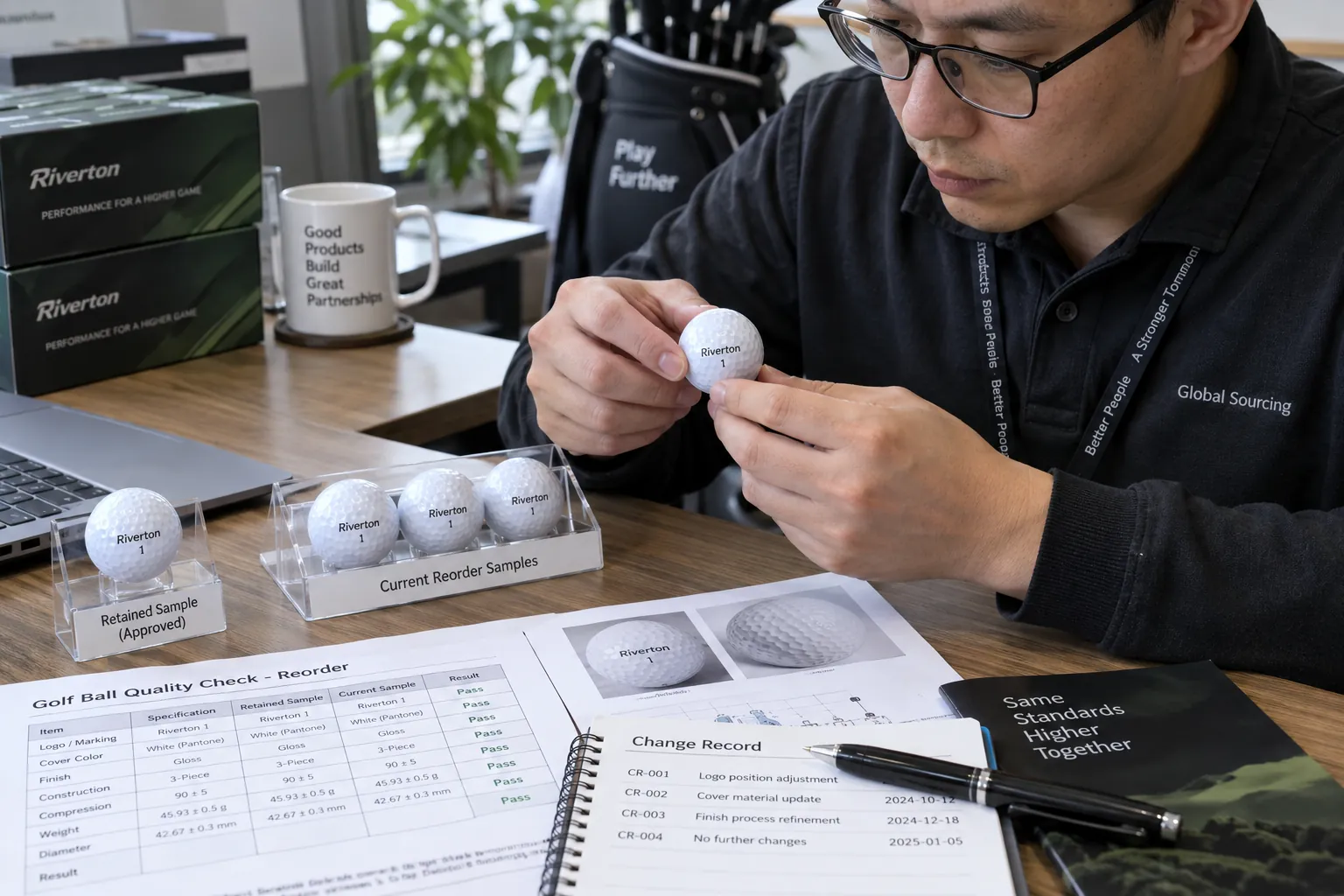
How Do You Trace the Submitted Sample Lot?
Upgrade Representative Samples into Traceable Samples.
Your 24-Ball Traceability Record can link:
Submission Version → Production Lot → Sample Selection → Submitted Set → Retained Comparator
Useful buyer-side fields include the lot ID, production or selection date, approved version ID, final marking revision, sample photographs, retained-sample reference, and courier/submission record.
These fields support manufacturing traceability. They should not be presented as additional mandatory USGA form fields unless the official form requires them.
A clear failure signal is:
The 24 samples have no production-lot or version reference.
Even if those samples later achieve the required status, you have created a weak bridge between the tested product and bulk manufacturing.
The evidence deliverable is a 24-Ball Traceability Record. Block submission when sample origin, identity version, or retained-comparator reference is missing.
When Does Submission Become List Evidence?
Samples shipped can feel like a launch milestone. They are not the same event as the published status your packaging, retailers, or tournament-facing marketing may require.
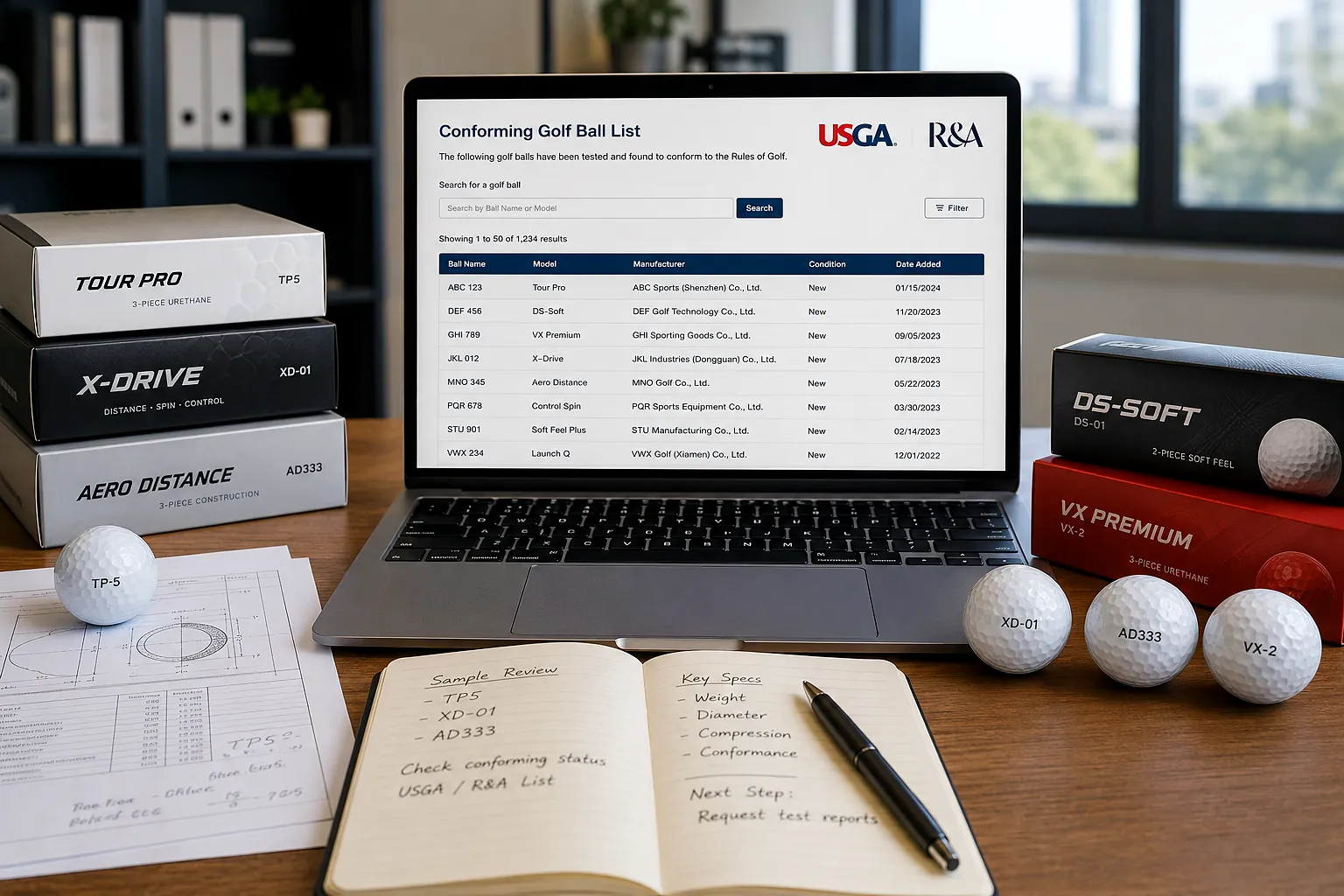
Samples shipped is not your launch gate. Build your conformity calendar from the current submission deadline, expected publication window, and required evidence, then calculate how many separately treated color, finish, or identity variants your program is actually willing to fund and maintain.
Do not rely on an evergreen “4–8 weeks” estimate.
The current 2026 USGA Golf Ball Conformance Submission Guidelines use specific submission deadlines and subsequent List-publication dates.
As of September 17, 2026, the current schedule shows an October 7, 2026 submission deadline corresponding to a December 2, 2026 subsequent List publication. The following normal deadline is November 4, 2026, corresponding to January 6, 2027 publication.
Those dates are current-cycle inputs, not permanent turnaround promises.
The same 2026 guidance lists US$1,200 per ball type / 24 balls for a new submission and annual resubmission. A limited late submission is listed at US$1,500 per ball type / 24 balls when the USGA confirms that the applicable cycle can accommodate it.
The commercial lesson is more useful than the fee alone.
If your launch contains several separately treated cover colors, finishes, or identities, your conformity work can multiply.
A useful planning framework is:
Current Fee × Confirmed Number of Separately Treated Ball Types
Do not assume every theoretical color/finish combination will always be treated identically. Confirm the treatment of the variants you actually intend to commercialize.
| Launch Variable | What to Confirm | Commercial Risk | Buyer Action |
|---|---|---|---|
| Submission deadline | Current official cycle | Missed publication window | Verify current date |
| Publication window | Expected List release | Premature claims | Hold release gate |
| Ball-type count | Color/finish/identity variants | Unexpected fees | Build Variant Map |
| Fee ownership | Brand/factory/shared | Payment delay | Assign owner |
| Maintenance | Current-cycle requirement | Future lapse | Budget renewal |
How Should You Build the Publication Calendar?
Build backward from required evidence instead of forcing the conformity process into a marketing date that was chosen first.
Variant Freeze → Sample Lot → Submission Deadline → Expected Publication → Status Check → Claim Release
If you miss a normal deadline, do not treat a late-submission fee as guaranteed access to that cycle. Confirm that the governing body can accept the late submission before rebuilding the launch around it.
Your deliverable is a Submission Calendar + Variant Map + Fee Ownership Record.
✔ True — Submission timing should follow the current official cycle
Submission deadlines, publication windows, fees, and any late route are dated launch inputs that should be rechecked before you commit packaging or retailer dates.
✘ False — “USGA golf-ball submission always takes a fixed four to eight weeks”
A fixed buffer can miss the actual deadline-to-publication cycle. Build your calendar from the current schedule instead.
When Can You Release Packaging Claims?
Your packaging team can be ready before the conformity evidence is ready. Printing first can turn one unresolved submission into sleeves, dozen boxes, Amazon copy, sell sheets, and retailer material that all require correction.
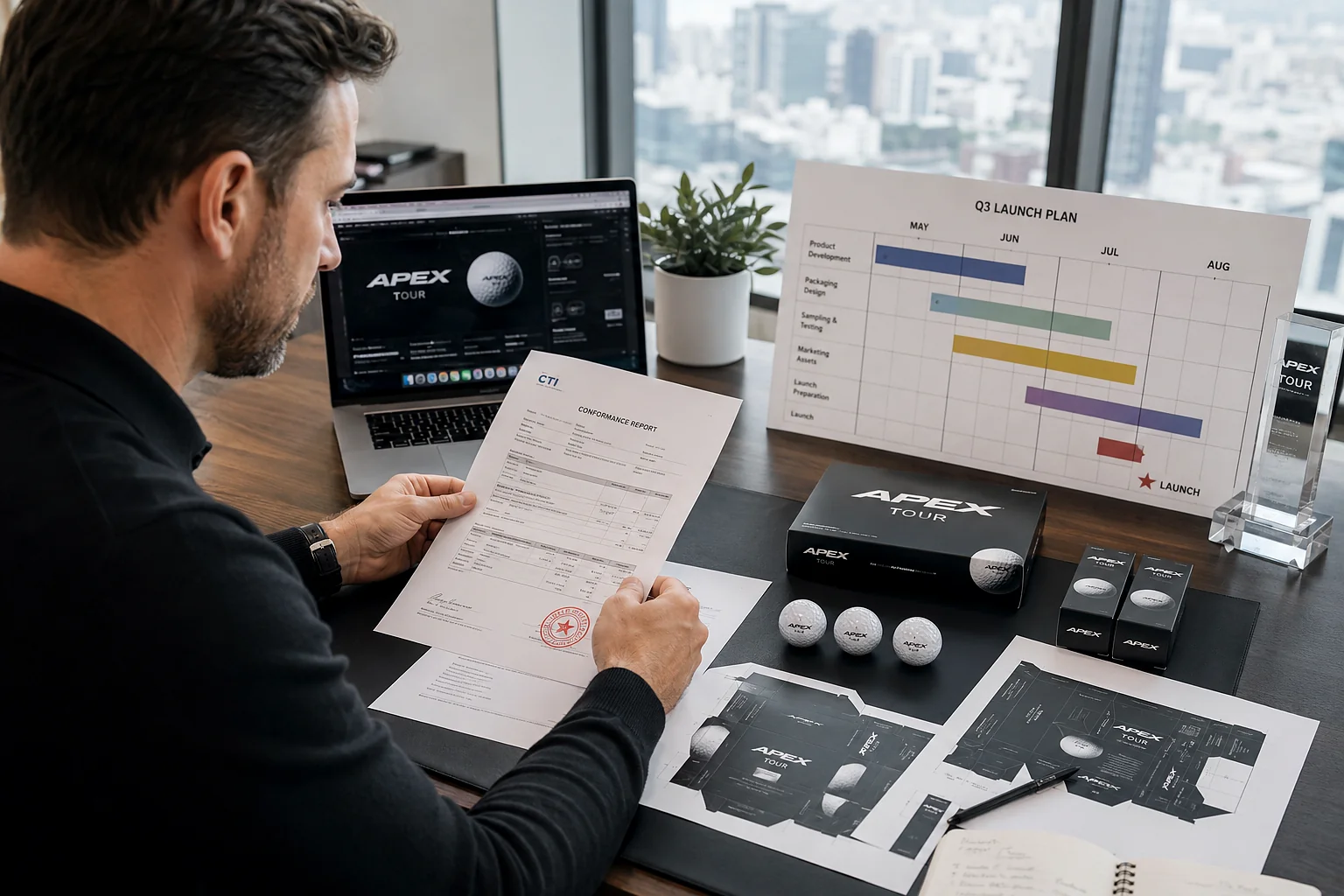
Release conformity-dependent packaging only after the required status, exact ball identity, and approved claim wording are confirmed. The same release decision should control your sleeve, dozen box, website, Amazon listing, retailer sell sheet, and tournament-facing material so one unresolved submission does not create six different claims.
Use one controlled sequence:
Ball Spec Freeze → Marking Freeze → Submission → Required Status/Evidence → Claim Approval → Packaging Release
What Is the Compliance Claim Release Gate?
A submission receipt proves that samples entered the process.
It does not prove the status required for your finished-market claim.
The 2026 USGA Golf Ball Conformance Submission Guidelines state that after a ball appears on the List, the wording “Conforms with the Rules of Golf” may be used. The same guidance prohibits claims such as “USGA Approved” and “USGA Tested,” publication of test results, and use of the USGA seal or logo.
That is why claim approval should happen after evidence—not merely after submission.
Your Claim Release Record should identify:
-
exact ball/version;
-
evidence date;
-
approved claim wording;
-
sleeve or box version;
-
website/marketplace version;
-
release approver.
That record should control the same message across physical and digital assets.
A failure signal is:
Conformity-dependent packaging is printed before the required status or evidence is available.
This does not merely create a compliance problem. It can create scrap, relabeling, delayed retailer assets, revised marketplace copy, and awkward explanations to downstream customers.
The evidence deliverable is a Claim Release Record linked to the same product/version ID used in the submission file.
When your next decision becomes sleeve structure, board grade, gift-box design, barcode placement, or packout, move that work to choose OEM golf ball packaging options.
What Must Stay Locked After Listing?
Your first submission can be controlled carefully while a later production run quietly changes material, dimple tooling, cover color, finish, markings, or another identity variable under the same SKU name.
Listing is not permanent permission to change the product under the same SKU name. Before each reorder, compare the current construction, materials, dimples, markings, color, finish, and controlled manufacturing version with the submitted version; document no change or trigger a conformity-impact review before release.
Conformity maintenance is recurring version control.
A reorder should therefore inherit the controlled evidence chain—not simply last year’s SKU name.
| Version Variable | Submitted Version | Reorder Version | Buyer Action |
|---|---|---|---|
| Construction/material | Approved revision | Current revision | Compare / review |
| Dimple pattern/tool | Approved reference | Current reference | Compare / review |
| Pole/Seam markings | Artwork version | Current artwork | Compare / review |
| Alignment | Approved version | Current version | Compare / review |
| Cover color/finish | Approved variant | Current variant | Compare / review |
| Production lot | Prior lot | New lot | Link evidence |
What Triggers a Conformity Impact Review?
Replace “same SKU” with a variable-by-variable comparison.
-
construction;
-
material composition;
-
dimple pattern or tool;
-
Pole/Seam identification;
-
alignment treatment;
-
cover color;
-
finish;
-
relevant appearance/version changes.
Your manufacturing controls may also compare the material reference, coating version, approved sample, retained sample, and current production-lot ID.
If nothing changed, document no change.
If something changed, trigger a conformity-impact review before the new version is released.
No construction, material, dimple, cover-color, finish or identification-marking change shall be introduced after submission without written buyer approval and a conformity-impact review. Production release and reorder approval shall use the same approved version or a documented replacement version.
Retained samples become especially useful here. They give your team a physical comparator when a supplier says the reorder is “same as last time.”
The rules environment also needs version control. The current June 17, 2026 joint statement on the ODS testing approach confirms that the ODS testing approach will not change before January 2030 while alternative approaches are evaluated.
The sourcing implication is narrow but important:
Submission assumptions are version-controlled launch inputs.
Do not preserve an old roadmap or compliance spreadsheet as permanent truth.
If detailed compression, weight, diameter, hardness, concentricity, equipment, calibration, or raw batch data becomes the next question, use the separate guide to verify production golf ball quality.
The evidence deliverable is a Reorder Change Review containing either a documented no-change declaration or an approved replacement version.
✔ True — A reorder should confirm the product version before it repeats the claim
The previous submission is useful only when your team can compare the reorder with the same controlled construction, markings, color, finish, and retained reference.
✘ False — “Same SKU” or “same as last time” proves the ball is still the same controlled identity
A commercial SKU name can remain unchanged while the manufacturing or identification version changes underneath it.
FAQ
Who Should Own the USGA Submission?
Assign ownership before final samples are released. Your factory may coordinate the process, but your program should identify who owns submission correspondence, fees, evidence storage, and future change approval rather than allowing responsibility to sit between two companies.
Name a Submission Owner, Fee Owner, Evidence Owner, and Change-Approval Owner. One person may hold several roles, but each responsibility should have a named owner. This prevents the factory from waiting for forms or payment while the brand assumes the supplier is managing the entire calendar.
Can One Budget Cover Several Color Variants?
Do not assume one construction means one submission budget. Cover color and finish can change submission scope, so map the commercial variants first and calculate cost from the confirmed number of separately treated ball types.
Freeze each commercial color/hue, finish, and marking version before committing samples or packaging. Budget ongoing maintenance as well as the first submission, especially when a marketing team wants several cosmetic-looking variants of the same construction.
What If Artwork Changes After Submission?
Treat an artwork revision as an identity question before production. A decorative logo change may not have the same impact as changing Pole/Seam identification, alignment treatment, brand/model wording, or another identifying element.
Compare the old and new revisions and inspect the finished ball. Determine whether the change is decoration or identification, update the physical marking record, and hold conformity-dependent release if the revised ball no longer clearly matches the submitted identity.
What If You Miss the Submission Deadline?
Do not promise a fixed recovery period. Rebuild your launch calendar from the current official schedule and use any late-submission route only when the governing body confirms that the applicable cycle can accept it.
Check the next normal deadline and its publication window first. If the launch timing changes, update packaging, retailer commitments, and the Claim Release Gate rather than treating a premium late fee as guaranteed capacity.
Can You Print Neutral Packaging Before Listing?
Potentially, if the packaging carries no conformity-dependent claim and the commercial risk is acceptable. Keep the claim area version-controlled so final evidence and approved wording can be released without scrapping the entire package.
Separate structural design and ordinary brand copy from the conformity claim. Do not imply that a pending submission already has current status, and release the final claim through the same gate used for your website and retailer materials.
What Should You Archive for Annual Maintenance?
Keep enough evidence to reconstruct exactly what was submitted and what changed afterward. Your archive should connect the submitted version, sample lot, physical markings, retained comparator, current-status evidence, and change history—not merely a screenshot of the List.
Retain the Submission Version Pack, 24-Ball Traceability Record, physical marking proof, submission correspondence, retained-sample reference, current-status evidence, and change log. On a reorder, refresh the current version rather than copying last year’s submission folder unchanged.
Conclusion
A private-label conformity program is not a form-filling exercise. Freeze one exact ball type, review customization for identity impact, submit a traceable representative lot, wait for the required evidence, release claims through one controlled gate, and compare every reorder with the submitted version.
Freeze → Identify → Submit → Publish → Release → Maintain
Once conformity becomes one controlled milestone rather than a loose certificate task, the next question is how it fits into tooling, samples, packaging, QC, inventory, and commercialization.
You might also like — How to Launch a Golf Ball Brand with a China OEM